belt TOYOTA VERSO S 2014 Owner's Manual
[x] Cancel search | Manufacturer: TOYOTA, Model Year: 2014, Model line: VERSO S, Model: TOYOTA VERSO S 2014Pages: 560, PDF Size: 16.94 MB
Page 125 of 560
125 1-7. Safety information
1
Before driving
VERSO-S_EE
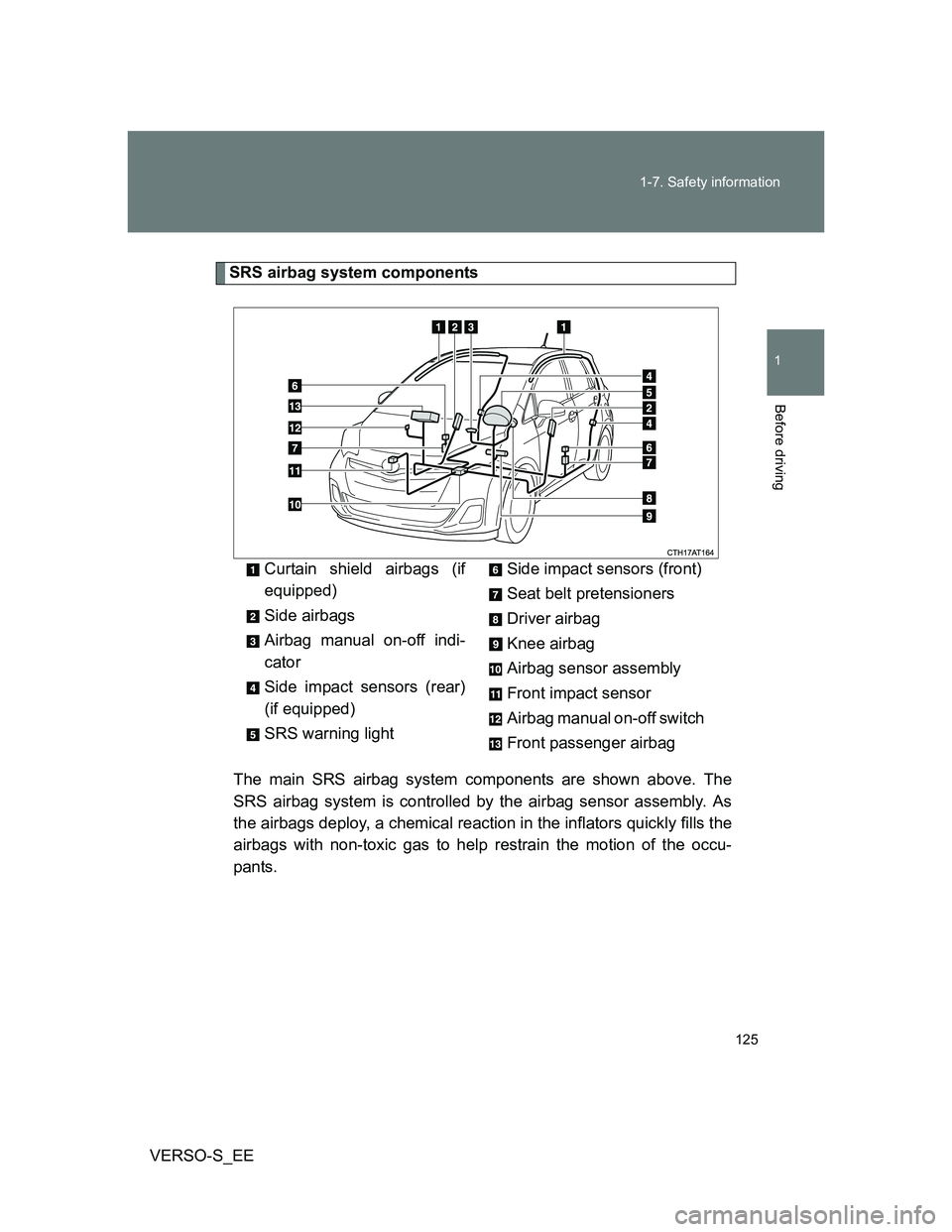
SRS airbag system components
The main SRS airbag system components are shown above. The
SRS airbag system is controlled by the airbag sensor assembly. As
the airbags deploy, a chemical reaction in the inflators quickly fills the
airbags with non-toxic gas to help restrain the motion of the occu-
pants.Curtain shield airbags (if
equipped)
Side airbags
Airbag manual on-off indi-
cator
Side impact sensors (rear)
(if equipped)
SRS warning lightSide impact sensors (front)
Seat belt pretensioners
Driver airbag
Knee airbag
Airbag sensor assembly
Front impact sensor
Airbag manual on-off switch
Front passenger airbag
Page 126 of 560
126 1-7. Safety information
VERSO-S_EE
If the SRS airbags deploy (inflate)
Bruising and slight abrasions may result from contact with a deploying
(inflating) SRS airbag.
A loud noise and white powder will be emitted.
Parts of the airbag module (steering wheel hub, airbag cover and inflator)
as well as the front seats, parts of the front and rear pillars, and roof side
rails, may be hot for several minutes. The airbag itself may also be hot.
The windshield may crack.
SRS airbag deployment conditions (SRS front airbags)
The SRS front airbags will deploy in the event of an impact that exceeds
the set threshold level (the level of force corresponding to an approxi-
mately 20 - 30 km/h [12 - 18 mph] frontal collision with a fixed wall that
does not move or deform).
However, this threshold velocity will be considerably higher if the vehicle
strikes an object, such as a parked vehicle and sign pole, which can move
or deform on impact, or if the vehicle is involved in an underride collision
(e.g. a collision in which the front of the vehicle “underrides”, or goes
under, the bed of a truck etc.).
Depending on the type of collision, it is possible that only the seat belt
pretensioners will activate.
SRS airbag deployment conditions (SRS side and curtain shield air-
bags [if equipped])
The SRS side and curtain shield airbags will deploy in the event of an impact
that exceeds the set threshold level (the level of force corresponding to the
impact force produced by an approximately 1500 kg [3300 lb.] vehicle collid-
ing with the vehicle cabin from a direction perpendicular to the vehicle orien-
tation at an approximate speed of 20 - 30 km/h [12 - 18 mph]).
Page 130 of 560
130 1-7. Safety information
VERSO-S_EE
CAUTION
SRS airbag precautions
Observe the following precautions regarding the SRS airbags.
Failure to do so may cause death or serious injury.
The driver and all passengers in the vehicle must wear their seat belts
properly.
The SRS airbags are supplemental devices to be used with the seat belts.
The SRS driver airbag deploys with considerable force, and can cause
death or serious injury especially if the driver is very close to the airbag.
Since the risk zone for the driver’s airbag is the first 50 - 75 mm (2 - 3 in.)
of inflation, placing yourself 250 mm (10 in.) from your driver airbag pro-
vides you with a clear margin of safety. This distance is measured from the
center of the steering wheel to your breastbone. If you sit less than 250
mm (10 in.) away now, you can change your driving position in several
ways:
• Move your seat to the rear as far as you can while still reaching the
pedals comfortably.
• Slightly recline the back of the seat. Although vehicle designs vary,
many drivers can achieve the 250 mm (10 in.) distance, even with the
driver seat all the way forward, simply by reclining the back of the seat
somewhat. If reclining the back of your seat makes it hard to see the
road, raise yourself by using a firm, non-slippery cushion, or raise the
seat if your vehicle has that feature.
• If your steering wheel is adjustable, tilt it downward. This points the air-
bag toward your chest instead of your head and neck.
The seat should be adjusted as recommended above, while still maintain-
ing control of the foot pedals, steering wheel, and your view of the instru-
ment panel controls.
Page 131 of 560
131 1-7. Safety information
1
Before driving
VERSO-S_EE
CAUTION
SRS airbag precautions
The SRS front passenger airbag also deploys with considerable force, and
can cause death or serious injury especially if the front passenger is very
close to the airbag. The front passenger seat should be as far from the air-
bag as possible with the seatback adjusted, so the front passenger sits
upright.
Improperly seated and/or restrained infants and children can be killed or
seriously injured by a deploying airbag. An infant or child who is too small
to use a seat belt should be properly secured using a child restraint sys-
tem. Toyota strongly recommends that all infants and children be placed in
the rear seats of the vehicle and properly restrained. The rear seats are
safer for infants and children than the front passenger seat. (P. 138)
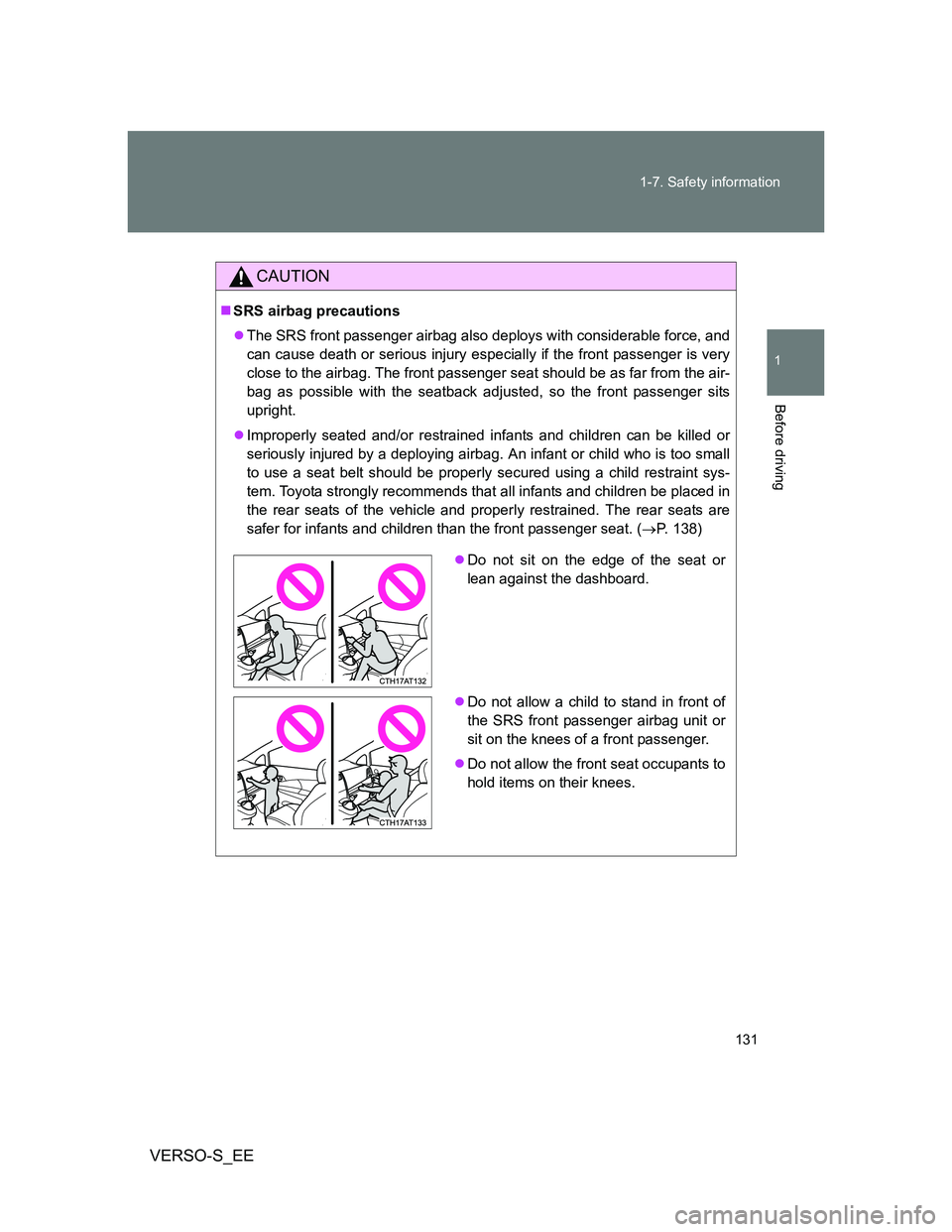
Do not sit on the edge of the seat or
lean against the dashboard.
Do not allow a child to stand in front of
the SRS front passenger airbag unit or
sit on the knees of a front passenger.
Do not allow the front seat occupants to
hold items on their knees.
Page 138 of 560
138
1-7. Safety information
VERSO-S_EE
Child restraint systems
Points to remember
Studies have shown that installing a child restraint on a rear seat is
much safer than installing one on the front passenger seat.
Choose a child restraint system that suits your vehicle and is
appropriate to the age and size of the child.
For installation details, follow the instructions provided with the
child restraint system.
General installation instructions are provided in this manual.
(P. 147)
If child restraint system regulations exist in the country where you
reside, please contact your Toyota dealer for the child restraint sys-
tem installation.
Toyota recommends that you use a child restraint system which
conforms to the regulation ECE No.44.
Types of child restraints
Child restraint systems are classified into the following 5 groups
according to the regulation ECE No.44:
Group 0: Up to 10 kg (22 lb.) (0 - 9 months)
Group 0
+: Up to 13 kg (28 lb.) (0 - 2 years)
Group I: 9 to 18 kg (20 to 39 lb.) (9 months - 4 years)
Group II: 15 to 25 kg (34 to 55 lb.) (4 years - 7 years)
Group III: 22 to 36 kg (49 to 79 lb.) (6 years - 12 years)
In this owner's manual, the following 3 types of popular child restraint
systems that can be secured with the seat belts are explained:
Toyota strongly urges the use of child restraint systems.
Page 141 of 560
141 1-7. Safety information
1
Before driving
VERSO-S_EEKey of letters inserted in the above table:
U: Suitable for “universal” category child restraint system approved
for the use in this mass group.
UF: Suitable for forward-facing “universal” category child restraint
system approved for the use in this mass group.
L1: Suitable for “TOYOTA G 0+, BABYSAFE PLUS with SEAT BELT
FIXATION, BASE PLATFORM” (0 to 13 kg[0 to 28 lb.]) approved
for the use in this mass group.
L2: Suitable for “TOYOTA DUO+” (without ISOFIX, 9 to 18 kg [20 to
39 lb.]) approved for the use in this mass group.
L3: Suitable for “TOYOTA KID” (15 to 36 kg [34 to 79 lb.]) approved
for the use in this mass group.
L4: Suitable for “TOYOTA G 0/1” (without ISOFIX, 9 to 18 kg [20 to
39 lb.]) approved for the use in this mass group.
L5: Suitable for “TOYOTA KIDFIX” (15 to 36 kg [34 to 79 lb.])
approved for the use in this mass group.
X: Not suitable seat position for children in this mass group.
*
1: When you use a child restraint system in this position, remove
the head restraint.
*
2: Adjust the rear seat back to 1st lock position from the most
upright position.
*
3: Adjust the front seat back to upright position.
The child restraint systems mentioned in the table may not be avail-
able outside of the EU area.
Other child restraint systems different from the systems mentioned in
the table can be used, but the suitability of the systems must be care-
fully checked with the child restraint system manufacturer and
retailer.
Page 144 of 560
144 1-7. Safety information
VERSO-S_EE
Selecting an appropriate child restraint system
Use a child restraint system appropriate for the child until the child
becomes large enough to properly wear the vehicle’s seat belt.
If the child is too large for a child restraint system, sit the child on a rear
seat and use the vehicle's seat belt. (P. 87)
CAUTION
Using a child restraint system
The use of a child restraint system not suitable for the vehicle may not prop-
erly secure the infant or child. It may result in death or serious injury (in the
event of sudden braking or an accident).
Child restraint precautions
For effective protection in automobile accidents and sudden stops, a child
must be properly restrained, using a seat belt or child restraint system
depending on the age and size of the child. Holding a child in your arms is
not a substitute for a child restraint system. In an accident, the child can be
crushed against the windshield, or between you and the vehicle's interior.
Toyota strongly urges the use of a proper child restraint system that con-
forms to the size of the child, installed on the rear seat. According to acci-
dent statistics, the child is safer when properly restrained in the rear seat
than in the front seat.
Page 146 of 560
146 1-7. Safety information
VERSO-S_EE
CAUTION
When children are in the vehicle
Do not allow children to play with the seat belt. If the seat belt becomes
twisted around a child’s neck, choking or other serious injuries may result in
death.
If this occurs and the buckle cannot be unfastened, scissors should be used
to cut the belt.
When the child restraint system is not in use
Keep the child restraint system properly secured on the seat even if it is
not in use. Do not store the child restraint system unsecured in the pas-
senger compartment.
If it is necessary to detach the child restraint system, remove it from the
vehicle or store it securely in the luggage compartment. This will prevent it
from injuring passengers in the event of a sudden stop, sudden swerve or
accident.
Page 147 of 560
147
1
1-7. Safety information
Before driving
VERSO-S_EE
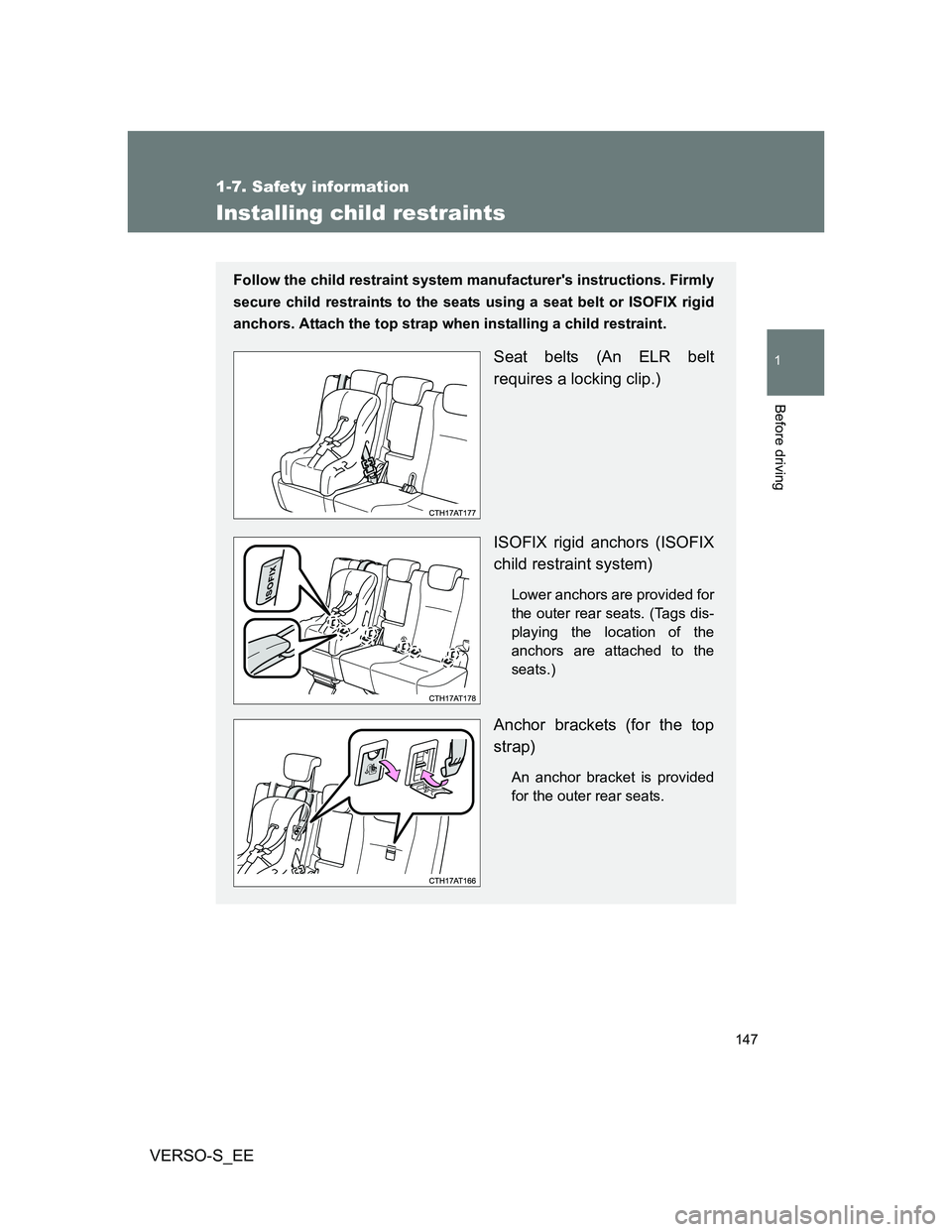
Installing child restraints
Follow the child restraint system manufacturer's instructions. Firmly
secure child restraints to the seats using a seat belt or ISOFIX rigid
anchors. Attach the top strap when installing a child restraint.
Seat belts (An ELR belt
requires a locking clip.)
ISOFIX rigid anchors (ISOFIX
child restraint system)
Lower anchors are provided for
the outer rear seats. (Tags dis-
playing the location of the
anchors are attached to the
seats.)
Anchor brackets (for the top
strap)
An anchor bracket is provided
for the outer rear seats.
Page 148 of 560
148 1-7. Safety information
VERSO-S_EE
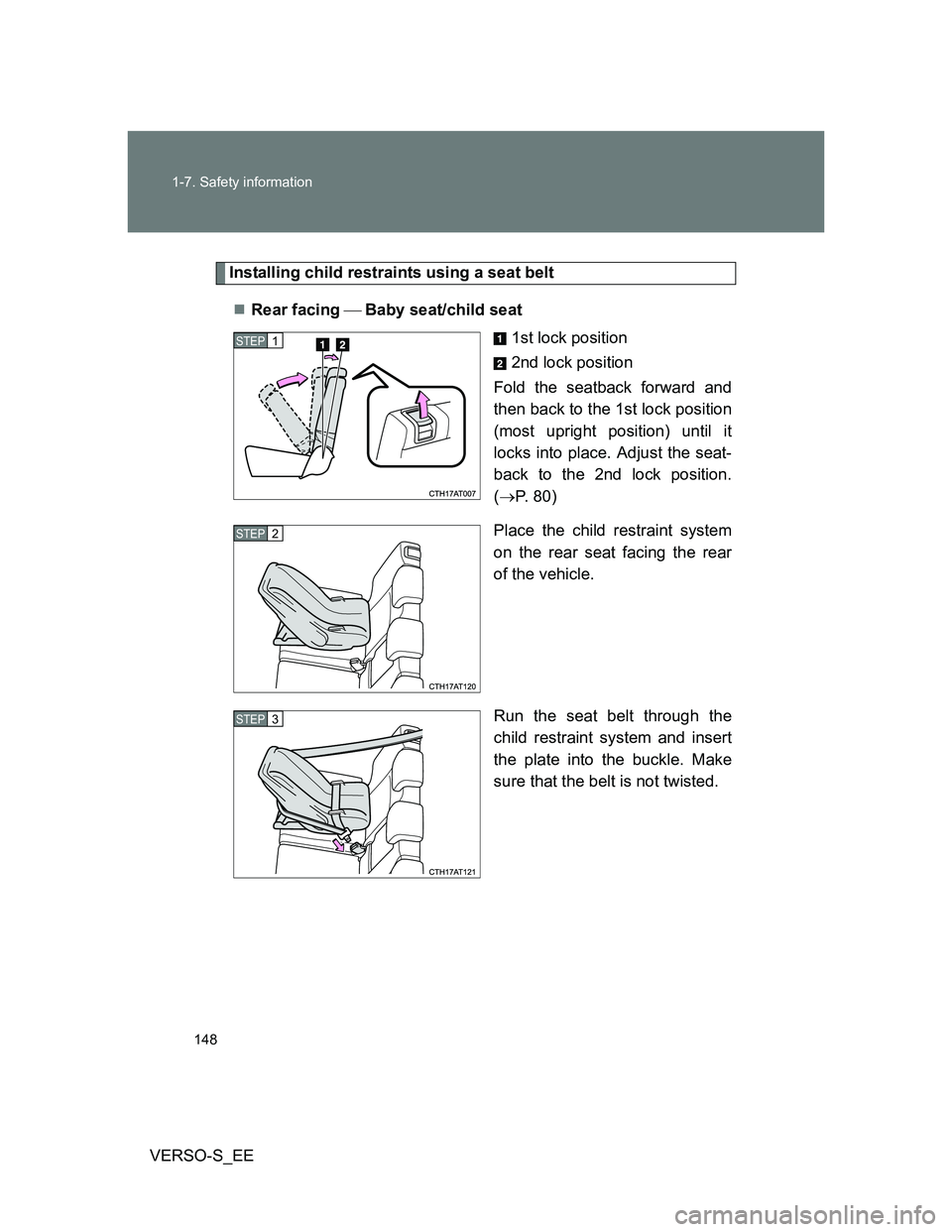
Installing child restraints using a seat belt
Rear facing Baby seat/child seat
1st lock position
2nd lock position
Fold the seatback forward and
then back to the 1st lock position
(most upright position) until it
locks into place. Adjust the seat-
back to the 2nd lock position.
(P. 8 0 )
Place the child restraint system
on the rear seat facing the rear
of the vehicle.
Run the seat belt through the
child restraint system and insert
the plate into the buckle. Make
sure that the belt is not twisted.
STEP1
STEP2
STEP3