run flat TOYOTA xB 2011 Owners Manual (in English)
[x] Cancel search | Manufacturer: TOYOTA, Model Year: 2011, Model line: xB, Model: TOYOTA xB 2011Pages: 372, PDF Size: 9.58 MB
Page 207 of 372

207
4-2. Maintenance
4
Maintenance and care
Vehicle exterior
ItemsCheck points
Doors • Do the doors operate smoothly?
Engine hood • Does the engine hood lock sys-
tem work properly?
Fluid leaks • There should not be any signs of
fluid leakage after the vehicle has
been parked.
Tires • Is the tire inflation pressure cor-
rect?
• The tires should not be dam- aged or excessively worn.
• Have the tires been rotated according to the maintenance
schedule?
• The wheel nuts should not be loose.
CAUTION
■ If the engine is running
Turn the engine off and ensure that there is adequate ventilation before per-
forming maintenance checks.
Page 271 of 372

5
When trouble arises
271
5-1. Essential information
If your vehicle needs to be towed
Before towingThe following may indicate a problem with your transmission. Contact
your Scion dealer before towing.
● The engine is running but the vehicle will not move.
● The vehicle makes an abnormal sound.
If towing is necessary, we recommend having your vehicle towed by
your Scion dealer or a commercial towing service, using a lift-type
truck or flatbed truck.
Use a safety chain system for all to wing, and abide by all state/pro-
vincial and local laws.
Page 276 of 372

276 5-1. Essential information
Using a flatbed truckIf you use chains or cables to tie
down your vehicle, the angles
shaded in black must be 45.
Do not overly tighten the tie
downs or the vehicle may be
damaged.
■ Before emergency towing
Release the parking brake.
Shift the shift lever to N.
Turn the engine switch to the “ACC” (engine off) or “ON” (engine
running) position.
■ Emergency towing eyelet location
P. 294
CAUTION
■ Caution while towing
●Use extreme caution when towing the vehicle.
Avoid sudden starts or erratic driving maneuvers which place excessive
stress on the emergency towing eyelets and the cables or chains. Always
use caution for the surroundings and other vehicles while towing.
● If the engine is not running, the power assist for the brakes and steering
will not function, making steering and braking more difficult.
■ Installing towing eyelets to the vehicle
Make sure that towing eyelets are installed securely.
If not securely installed, towing eyelets may come loose during towing. This
may lead to accidents that cause serious injury or even death.
STEP 1
STEP 2
STEP 3
Page 278 of 372

278
5-1. Essential information
If you think something is wrong
If you notice any of the following symptoms, your vehicle probably
needs adjustment or repair. Cont act your Scion dealer as soon as
possible.
■ Visible symptoms
●Fluid leaks under the vehicle
(Water dripping from the air cond itioning after use is normal.)
● Flat-looking tires or uneven tire wear
● High engine coolant temperatur e warning light flashes or
comes on
● Low engine coolant temperature indicator comes on or does
not come on continuously
■ Audible symptoms
●Changes in exhaust sound
● Excessive tire squeal when cornering
● Strange noises related to the suspension system
● Pinging or other noises related to the engine
■ Operational symptoms
●Engine missing, stumbling or running roughly
● Appreciable loss of power
● Vehicle pulls heavily to one side when braking
● Vehicle pulls heavily to one side when driving on a level road
● Loss of brake effectiveness, s pongy feeling, pedal almost
touches the floor
Page 305 of 372

5
When trouble arises
305
5-2. Steps to take in an emergency
CAUTION
■Using the tire jack
Improper use of the tire jack may cause the vehicle to suddenly fall off
the jack, leading to death or serious injury.
●Do not use the tire jack for any pu
rpose other than replacing tires or
installing and removing tire chains.
●Only use the tire jack that comes wi th this vehicle for replacing a flat
tire.
Do not use it on other vehicles, and do not use other tire jacks for
replacing tires on this vehicle.
●Always check that the tire jack is securely set to the jack point.
●Do not put any part of your body under the vehicle while it is supported
by the jack.
●Do not start or run the engine while your vehicle is supported by the
jack.
●Do not raise the vehicle while someone is inside.
●When raising the vehicle, do not put an object on or under the jack.
●Do not raise the vehicle to a hei ght greater than that required to
replace the tire.
●Use a jack stand if it is necessary to get under the vehicle.
Take particular care when lowering the vehicle to ensure that no one
working on or near the vehicle may be injured.
Page 332 of 372
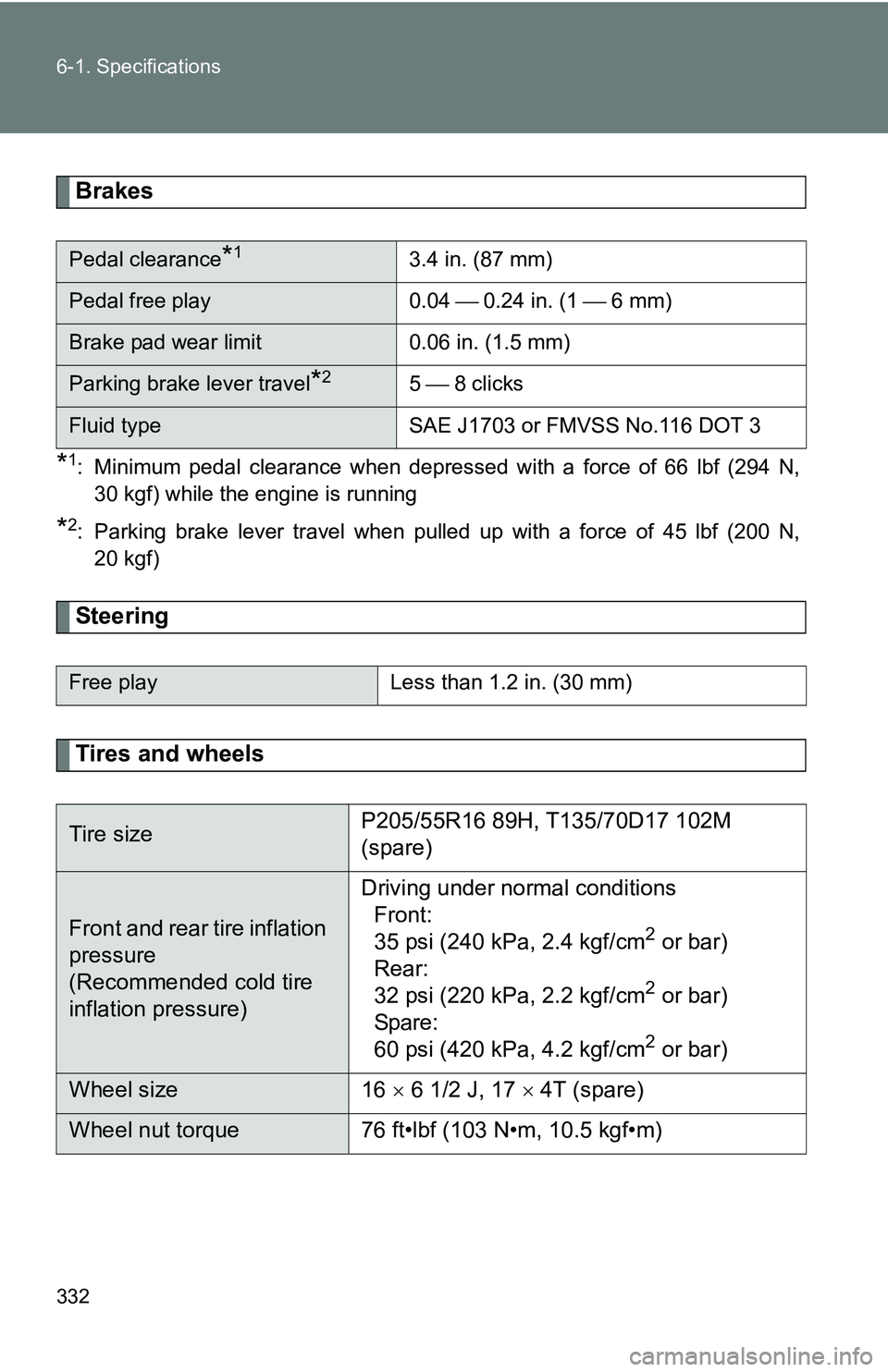
332 6-1. Specifications
Brakes
*1: Minimum pedal clearance when depressed with a force of 66 lbf (294 N,30 kgf) while the engine is running
*2: Parking brake lever travel when pulled up with a force of 45 lbf (200 N,20 kgf)
Steering
Tires and wheels
Pedal clearance*13.4 in. (87 mm)
Pedal free play 0.04 0.24 in. (1 6 mm)
Brake pad wear limit 0.06 in. (1.5 mm)
Parking brake lever travel*25 8 clicks
Fluid type SAE J1703 or FMVSS No.116 DOT 3
Free playLess than 1.2 in. (30 mm)
Tire sizeP205/55R16 89H, T135/70D17 102M
(spare)
Front and rear tire inflation
pressure
(Recommended cold tire
inflation pressure)Driving under normal conditions
Front:
35 psi (240 kPa, 2.4 kgf/cm2 or bar)
Rear:
32 psi (220 kPa, 2.2 kgf/cm
2 or bar)
Spare:
60 psi (420 kPa, 4.2 kgf/cm
2 or bar)
Wheel size 16 6 1/2 J, 17 4T (spare)
Wheel nut torque 76 ft•lbf (103 N•m, 10.5 kgf•m)
Page 348 of 372

348 6-1. Specifications
Tire related termMeaning
Radial ply tire A pneumatic tire in which the ply cords that
extend to the beads are laid at substantially 90
degrees to the centerline of the tread
Reinforced tire A tire designed to operate at higher loads and
at higher inflation pressures than the corre-
sponding standard tire
Section width The linear distance between the exteriors of
the sidewalls of an inflated tire, excluding ele-
vations due to labeling, decoration, or protec-
tive bands
Sidewall That portion of a tire between the tread and
bead
Sidewall separation The parting of the rubber compound from the
cord material in the sidewall
Snow tire A tire that attains a traction index equal to or
greater than 110, compared to the ASTM
E-1136 Standard Reference Test Tire, when
using the snow traction test as described in
ASTM F-1805-00, Standard Test Method for
Single Wheel Driving Traction in a Straight Line
on Snow-and Ice-Covered Surfaces, and which
is marked with an Alpine Symbol ( ) on at
least one sidewall
Te s t r i m The rim on which a tire is fitted for testing, and
may be any rim listed as appropriate for use
with that tire
Tread That portion of a tire that comes into contact
with the road
Tread rib A tread section running circumferentially
around a tire
Tread separation Pulling away of the tread from the tire carcass
Page 368 of 372

368
What to do if...
What to do if...
A tire puncturesP. 294If you have a flat tire
The engine does not start
P. 308If the engine will not start
P. 6 3Engine immobilizer system
P. 3 1 1If the battery is discharged
The shift lever cannot be
moved outP. 309If the shift lever cannot be shifted
from P
The high engine coolant temperature
warning light flashes or comes on
Steam can be seen coming
from under the hood
P. 315If your vehicle overheats
The key is lostP. 310If you lose your keys
The battery runs outP. 3 1 1If the battery is discharged
The doors cannot be locked
P. 2 9Side doors
P. 3 5Back door
The vehicle is stuck in
mud or sandP. 318If the vehicle becomes stuck
A warning light or indicator light
comes onP. 282If a warning light turns on