power steering TOYOTA xB 2011 Owners Manual (in English)
[x] Cancel search | Manufacturer: TOYOTA, Model Year: 2011, Model line: xB, Model: TOYOTA xB 2011Pages: 388, PDF Size: 11.79 MB
Page 2 of 388

TABLE OF CONTENTSIndex
2
1-1. Key informationKeys ..................................... 22
1-2. Opening, closing and locking the doors
Wireless remote control ....... 24
Side doors ............................ 29
Back door ............................. 35
1-3. Adjustable components (seats, mirrors, steering
wheel)
Front seats ........................... 41
Rear seats ............................ 42
Head restraints ..................... 44
Seat belts ............................. 46
Steering wheel ..................... 53
Anti-glare inside rear view mirror .................................. 54
Outside rear view mirrors ..... 55
1-4. Opening and closing the windows and moon roof
Power windows .................... 57
Moon roof ............................. 59 1-5. Refueling
Opening the fuel tank cap..... 63
1-6. Theft deterrent system Engine immobilizer system ................................ 67
Theft prevention labels (for U.S.A.) ......................... 69
1-7. Safety information Correct driving posture ......... 70
SRS airbags ......................... 72
Front passenger occupant classification system ........... 84
Child restraint systems ......... 90
Installing child restraints ....... 95
2-1. Driving procedures Driving the vehicle .............. 108
Engine (ignition) switch....... 121
Automatic transmission ...... 125
Manual transmission........... 129
Turn signal lever ................. 130
Parking brake ..................... 131
Horn .................................... 132
1Before driving
2When driving
Page 3 of 388
1
2
3
4
5
6
7
3
2-2. Instrument clusterGauges and meters ............ 133
Indicators and warning lights ................................. 136
Multi-information display ..... 139
2-3. Operating the lights and Windshield wipers
Headlight switch .................. 142
Windshield wipers and washer .............................. 144
Rear window wiper and washer .............................. 146
2-4. Using other driving systems Cruise control ...................... 147
Driving assist systems ........ 151
2-5. Driving information Cargo and luggage ............. 156
Vehicle load limits ............... 161
Winter driving tips ............... 162
Trailer towing ...................... 167
Dinghy towing (automatic transmission) .................... 168
Dinghy towing (manual transmission) .................... 169 3-1. Using the air conditioning
system and defogger
Air conditioning system ...... 172
Rear window and outside rear view mirror defoggers....... 178
3-2. Using the audio system Using the AUX port/USB port........................... 179
Using the steering wheel audio switches.................. 180
3-3. Using the interior lights Interior lights list ................. 181
• Interior light ...................... 182
• Personal lights.................. 182
3-4. Using the storage features List of storage features ....... 184
• Glove box ......................... 185
• Console box ..................... 186
• Cup holders ...................... 187
• Auxiliary box ..................... 189
• Bottle holder ..................... 190
3-5. Other interior features Sun visors........................... 191
Vanity mirrors ..................... 192
Clock .................................. 193
Outside temperature display .............................. 194
Power outlet ....................... 195
Floor mat ............................ 196
Luggage compartment features ............................ 198
3Interior features
Page 12 of 388
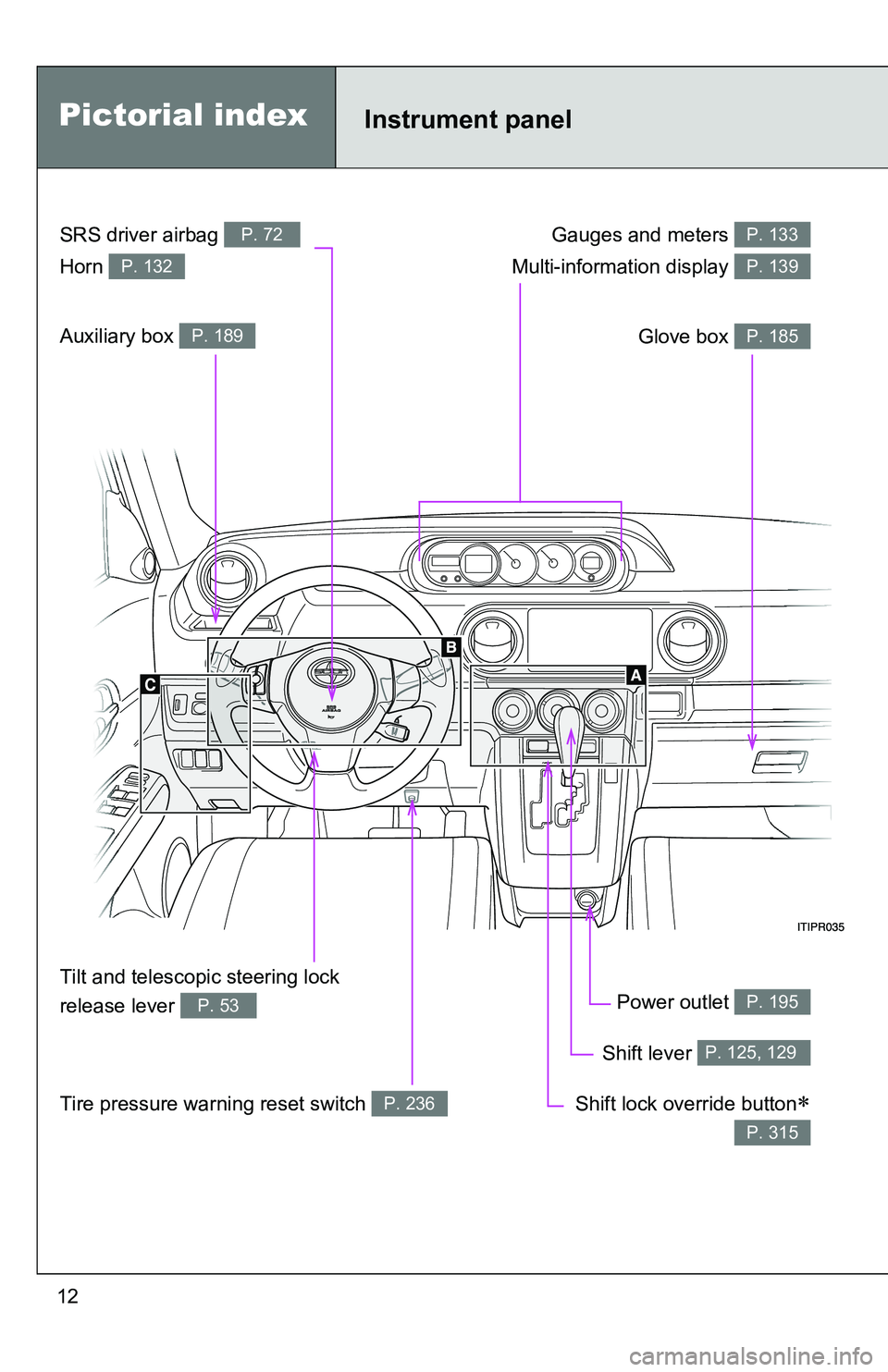
12
Gauges and meters P. 133
Glove box P. 185
Power outlet P. 195
Shift lever P. 125, 129
Shift lock override button
P. 315
SRS driver airbag P. 72
Horn P. 132
Tilt and telescopic steering lock
release lever
P. 53
Tire pressure warning reset switch P. 236
Auxiliary box P. 189
Multi-information display P. 139
Instrument panelPictorial index
Page 21 of 388

Before driving1
21
1-1. Key informationKeys ................................... 22
1-2. Opening, closing and locking the doors
Wireless remote control ..... 24
Side doors .......................... 29
Back door ........................... 35
1-3. Adjustable components (seats, mirrors,
steering wheel)
Front seats ......................... 41
Rear seats.......................... 42
Head restraints................... 44
Seat belts ........................... 46
Steering wheel ................... 53
Anti-glare inside rear view mirror ............................... 54
Outside rear view mirrors.............................. 55 1-4. Opening and closing
the windows and moon roof
Power windows .................. 57
Moon roof ........................... 59
1-5. Refueling Opening the fuel tank cap ................................... 63
1-6. Theft deterrent system Engine immobilizer system ............................. 67
Theft prevention labels (for U.S.A.) ....................... 69
1-7. Safety information Correct driving posture....... 70
SRS airbags ....................... 72
Front passenger occupant classification system ........ 84
Child restraint systems....... 90
Installing child restraints..... 95
Page 113 of 388

113
2-1. Driving procedures
2
When driving
CAUTION
●
On vehicles with an automatic transmission, do not under any circum-
stances shift the shift lever to P while the vehicle is moving.
Doing so can cause significant damage to the driveline and may result in a
loss of vehicle control.
● Do not under any circumstances shift the shift lever to R while the vehicle
is moving forward.
Doing so can cause significant damage to the driveline and may result in a
loss of vehicle control.
● Do not shift the shift lever to N while the vehicle is moving.
Doing so may cause insufficient engine braking, resulting in an accident.
● Do not turn the engine off while driving.
The power steering and brake booster will not operate properly if the
engine is not running.
● Use engine braking (downshift) to maintain a safe speed when driving
down a steep hill.
Using the brakes continuously may cause the brakes to overheat and lose
effectiveness. ( P. 126)
● Do not adjust the position of the steering wheel, the seat, or the inside or
outside rear view mirrors while driving.
Doing so may result in a loss of vehicle control that can cause accidents,
resulting in death or serious injury.
● Always check that all passengers’ arms, heads or other parts of their body
are not outside the vehicle, as this may result in death or serious injury.
● Do not drive in excess of the speed limit. Even if the legal speed limit per-
mits it, do not drive over 85 mph (140 km/h) unless your vehicle has high-
speed capability tires. Driving over 85 mph (140 km/h) may result in tire
failure, loss of control and possible injury. Be sure to consult a tire dealer
to determine whether the tires on your vehicle are high-speed capability
tires or not before driving at such speeds.
Page 120 of 388

120 2-1. Driving procedures
NOTICE
■Avoiding damage to vehicle parts
●Do not turn the steering wheel fully in either direction and hold it there for
an extended period of time.
Doing so may damage the power steering motor.
● When driving over bumps in the road, drive as slowly as possible to avoid
damaging the wheels, underside of the vehicle, etc.
■ If you get a flat tire while driving
A flat or damaged tire may cause the following situations. Hold the steering
wheel firmly and gradually depress the br ake pedal to slow down the vehicle.
● It may be difficult to control your vehicle.
● The vehicle will make abnormal sounds or vibrations.
● The vehicle will lean abnormally.
Information on what to do in case of a flat tire. ( P. 304)
■ When encountering flooded roads
Do not drive on a road that has flooded after heavy rain etc. Doing so may
cause the following serious damage to the vehicle:
●Engine stalling
● Short in electrical components
● Engine damage caused by water immersion
In the event that you drive on a flooded road and the vehicle is flooded, be
sure to have your Scion dealer check the following:
● Brake function
● Changes in quantity and quality of engine oil, and transaxle fluid etc.
● Lubricant condition for the bearings and suspension joints (where possi-
ble), and the function of all joints, bearings, etc.
Page 122 of 388

122 2-1. Driving procedures
■Turning the key from “ACC” to “LOCK”
Shift the shift lever to P (automatic transmission) or N (manual
transmission). ( P. 125, 129)
■ If the engine does not start
The engine immobilizer system may not have been deactivated. ( P. 67)
■Changing engine switch position
“LOCK”
The steering wheel is locked
and the key can be removed.
(Vehicles with an automatic
transmission: The key can be
removed only when the shift
lever is in P.)
“ACC”
Some electrical components
such as the power outlet can
be used.
“ON”
All electrical components can
be used.
“START”
For starting the engine.
STEP 1
Push in the key and turn it to the “LOCK”
position.STEP 2
Page 151 of 388

151
2-4. Using other driving systems
2
When driving
Driving assist systems
When the VSC/TRAC systems are operating
If the vehicle is in danger of slip-
ping or if any of the drive wheels
spins, the slip indicator light
flashes to indicate that the VSC/
TRAC systems are operating.
To help enhance driving safety and performance, the following sys-
tems operate automatically in res ponse to various driving situations.
Be aware, however, that these systems are supplementary and
should not be relied upon too heavi ly when operating the vehicle.
■ABS (Anti-lock Brake System)
Helps to prevent wheel lock when the brakes are applied suddenly, or if
the brakes are applied while driving on a slippery road surface
■Brake assist
Generates an increased level of braking force after the brake pedal is
depressed when the system detects a panic stop situation
■VSC (Vehicle Stability Control)
Helps the driver to control skidding when swerving suddenly or turning
on slippery road surfaces
■TRAC (Traction Control)
Helps to maintain drive power and prevent the drive wheels from spin-
ning when starting the vehicle or accelerating on slippery roads
■EPS (Electric Power Steering)
Employs an electric motor to reduce the amount of effort needed to turn
the steering wheel
Page 171 of 388
Interior features3
171
3-1. Using the air conditioning system and defogger
Air conditioning system .... 172
Rear window and outside rear view mirror
defoggers ....................... 178
3-2. Using the audio system Using the AUX port/USB port ........................ 179
Using the steering wheel audio switches ............... 180 3-3. Using the interior lights
Interior lights list ............... 181
• Interior light .................... 182
• Personal lights ............... 182
3-4. Using the storage features List of storage features .... 184
• Glove box....................... 185
• Console box ................... 186
• Cup holders ................... 187
• Auxiliary box .................. 189
• Bottle holder................... 190
3-5. Other interior features Sun visors ........................ 191
Vanity mirrors ................... 192
Clock ................................ 193
Outside temperature display............................ 194
Power outlet ..................... 195
Floor mat .......................... 196
Luggage compartment features .......................... 198
Page 257 of 388

257
4-3. Do-it-yourself maintenance
4
Maintenance and care
Fuse layout and amperage ratings
■ Engine compartment
FuseAmpereCircuit
1 CDS FAN 30 A Electric cooling fan
2 RAD FAN 40 A Electric cooling fan
3 ABS NO.3 30 A Anti-lock brake system, vehicle sta-
bility control system
4 ABS NO.1 50 A Anti-lock brake system, vehicle sta-
bility control system
5 HTR 50 A Air conditioning system
6 ALT 120 A RDI FAN, CDS FAN, ABS NO.1,
ABS NO.3, HTR, AM1, DOOR,
STOP, FR DOOR, POWER, RR
DOOR, RL DOOR, OBD, ACC-B,
DEF, TAIL, PANEL
7 EPS 60 A Electric power steering system
8 P/I 50 A EFI MAIN, HORN, IG2
9 H-LP MAIN 50 A H-LP LH LO, H-LP RH LO, H-LP
LH HI, H-LP RH HI
10 ECU-B2 10 A Air conditioning system