ECU TOYOTA YARIS 2008 2.G Owners Manual
[x] Cancel search | Manufacturer: TOYOTA, Model Year: 2008, Model line: YARIS, Model: TOYOTA YARIS 2008 2.GPages: 388, PDF Size: 7.34 MB
Page 10 of 388
10
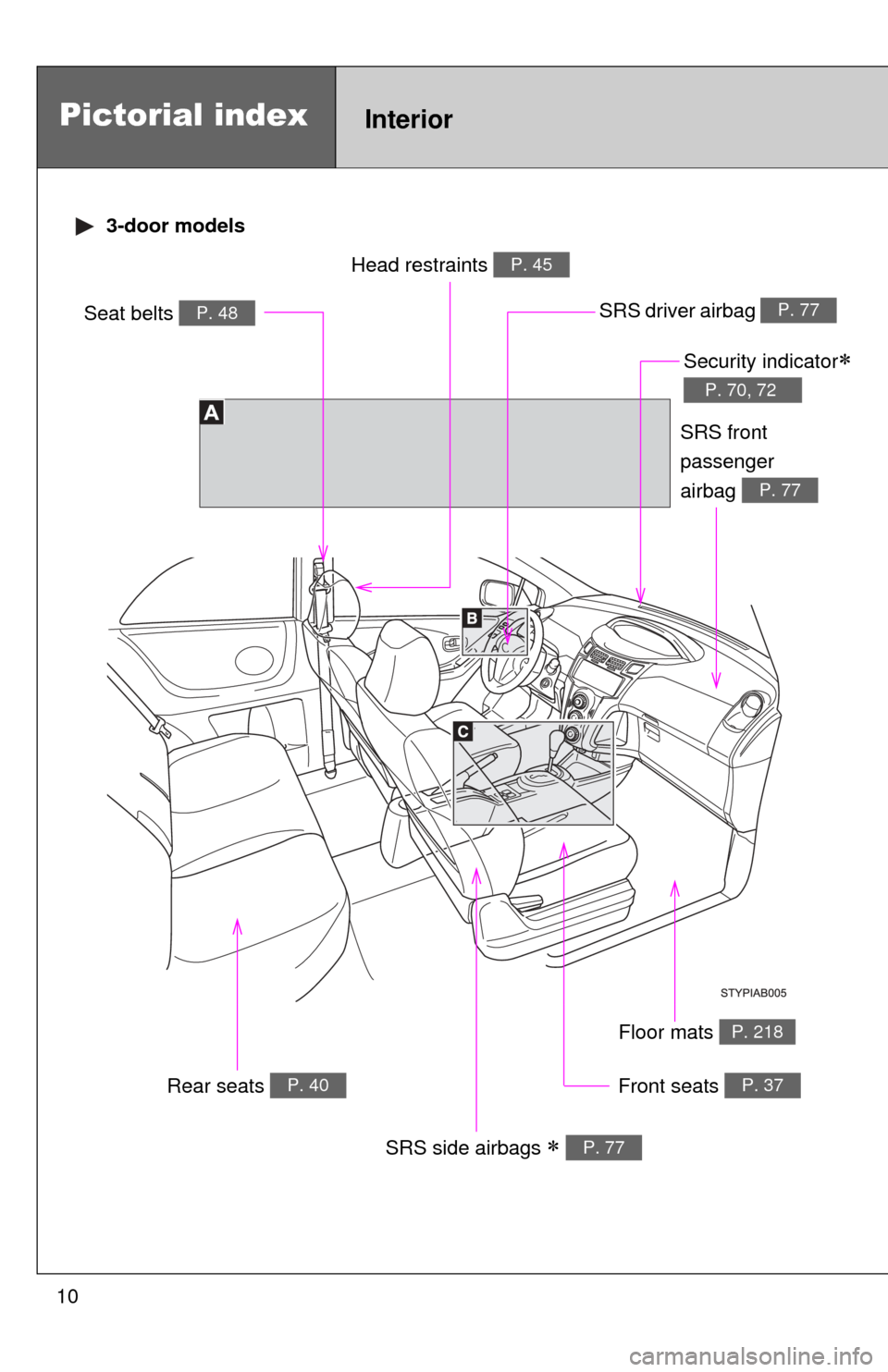
Pictorial indexInterior
Seat belts P. 48SRS driver airbag P. 77
Head restraints P. 45
Front seats P. 37
SRS side airbags P. 77
Floor mats P. 218
SRS front
passenger
airbag
P. 77
Security indicator
P. 70, 72
3-door models
Rear seats P. 40
Page 11 of 388
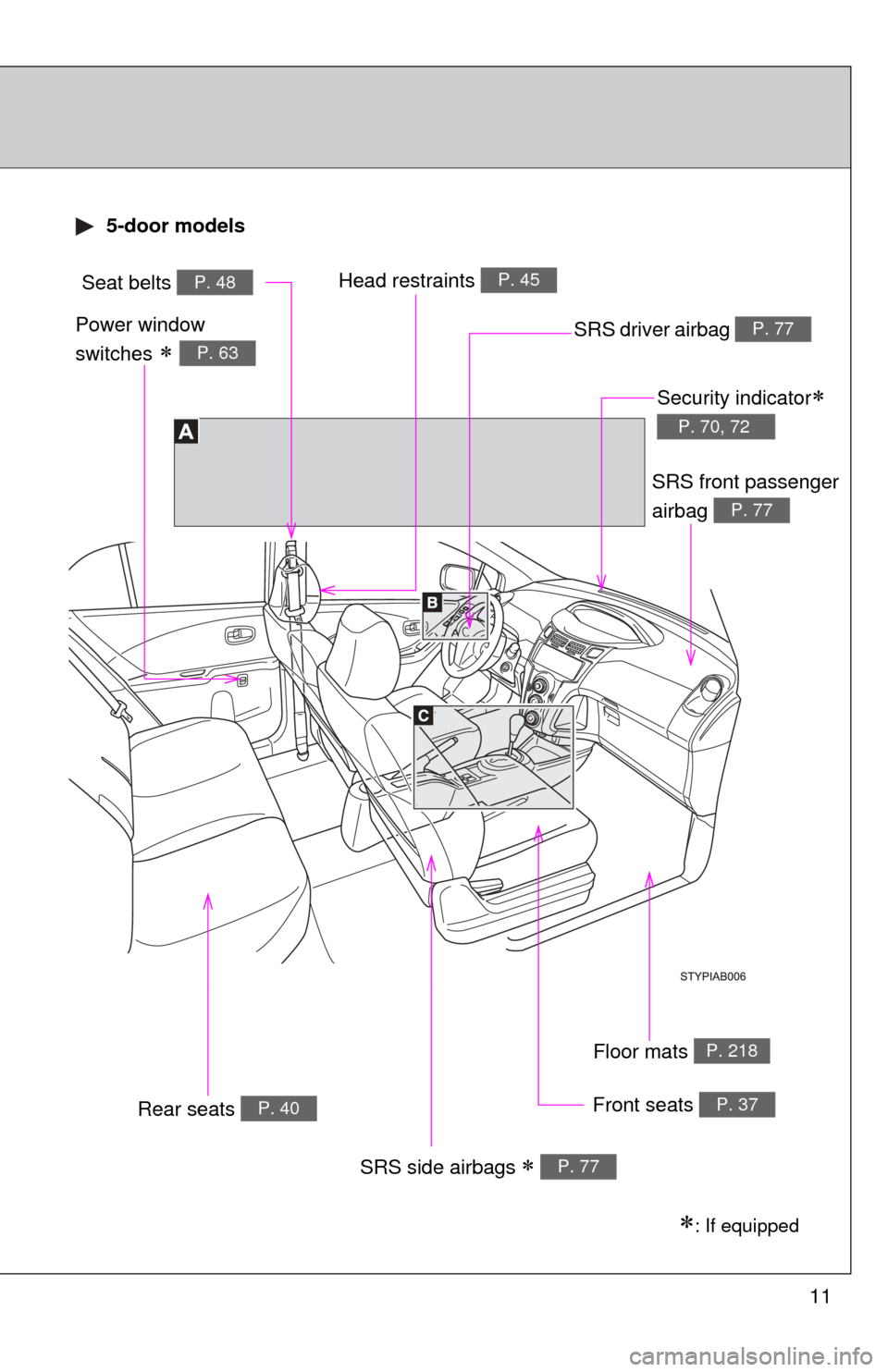
11
Seat belts P. 48
SRS driver airbag P. 77
Head restraints P. 45
Front seats P. 37
SRS side airbags P. 77
Floor mats P. 218
SRS front passenger
airbag
P. 77
Security indicator
P. 70, 72
Power window
switches
P. 63
5-door models
Rear seats P. 40
: If equipped
Page 29 of 388
29
1-2. Opening, closing and locking the doors
1
Before driving
■
Key battery depletion
The standard battery life is 1 to 2 years. (The battery becomes depleted
even if the key is not used.) If the wireless remote control function does not
operate, the battery may be depleted. Replace the battery when necessary.
(P. 267)
■ Security feature
If a door is not opened within approximately 30 seconds after the vehicle is
unlocked, the security feature automatically locks the vehicle again.
■ Conditions affecting operation
The wireless remote control function may not operate normally in the follow-
ing situations.
●Near a TV tower, radio station, electr ic power plant, airport or other facil-
ity that generates strong radio waves
● When carrying a portable radio, cell ular phone or other wireless commu-
nication device
● When multiple wireless keys are in the vicinity
● When the wireless key has come into contact with, or is covered by a
metallic object
■Conditions affecting operation
●When a wireless key (that emits radio waves) is being used nearby
● When the wireless key has been left near an electrical appliance such as
a personal computer
■ Customization that can be co nfigured at Toyota dealer
● Settings (e.g. wireless remote control system) can be changed.
(Customizable features P. 363)
Page 39 of 388
39
1-3. Adjustable components (s
eats, mirrors, steering wheel)
1
Before driving
CAUTION
■Seat adjustment
●Do not recline the seat more than necessary when the vehicle is in motion
to reduce the risk of sliding under the lap belt.
If the seat is too reclined, the lap belt may slide past the hips and apply
restraint forces directly to the abdomen or your neck may contact the
shoulder belt, increasing the risk of death or serious injury in the event of
an accident.
● After adjusting the seat, make sure that the seat is locked in position.
■ After returning the seatback
Push and pull the seatback to confirm that it is securely locked.
■ Caution while driving
Never operate the seatback lock release lever.
Page 44 of 388
44 1-3. Adjustable components (seats, mirrors, steering wheel)
CAUTION
■Seat adjustment
●Do not recline the seat more than necessary when the vehicle is in motion
to reduce the risk of sliding under the lap belt. If the seat is too reclined,
the lap belt may slide past the hips and apply restraint forces directly to the
abdomen or your neck may contact the shoulder belt, increasing the risk of
death or serious injury in the event of an accident.
● After adjusting the seat, make sure that the seat is locked in position.
■ After returning the seatback to the upright position
Observe the following precautions. Failure to do so may result in death or
serious injury.
● Make sure that the seatback is securely locked in position by lightly rock-
ing it back and forth.
● Check that the seat belts and buckles are not twisted or caught under the
seat.
● Arrange the seat belts in the proper positions for ready use.
NOTICE
■Stowing the seat belts
The seat belts and the buckles must be stowed before you fold down the
rear seat backs.
■ When returning the seatback to the upright position
Do not pull the pocket that stores the seat belt comfort guide.
Page 49 of 388
49
1-3. Adjustable components (s
eats, mirrors, steering wheel)
1
Before driving
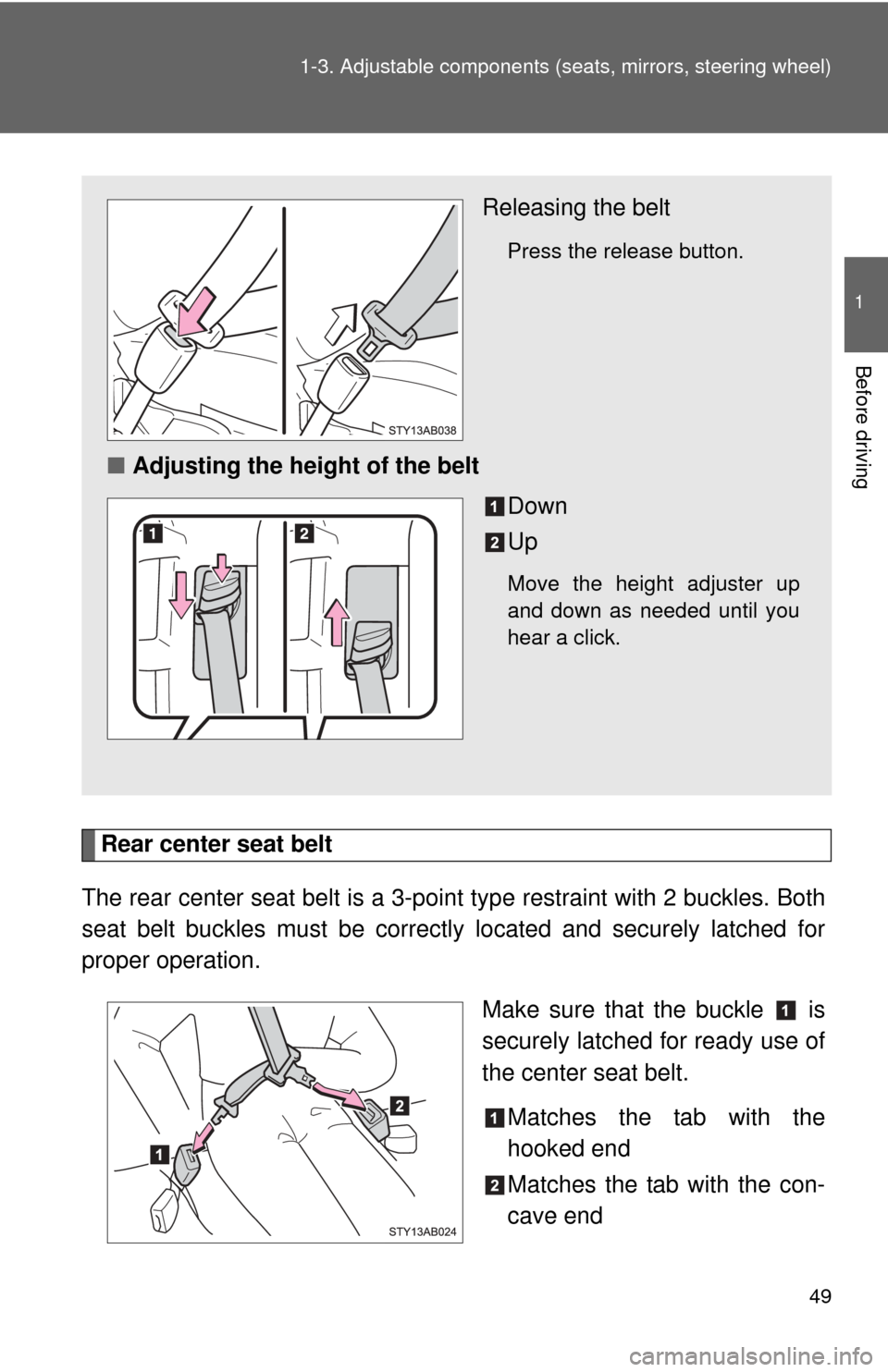
Rear center seat belt
The rear center seat belt is a 3-po int type restraint with 2 buckles. Both
seat belt buckles must be correctly located and securely latched for
proper operation.
Make sure that the buckle is
securely latched for ready use of
the center seat belt.Matches the tab with the
hooked end
Matches the tab with the con-
cave end
Releasing the belt
Press the release button.
■Adjusting the height of the belt
Down
Up
Move the height adjuster up
and down as needed until you
hear a click.
Page 55 of 388
55
1-3. Adjustable components (s
eats, mirrors, steering wheel)
1
Before driving
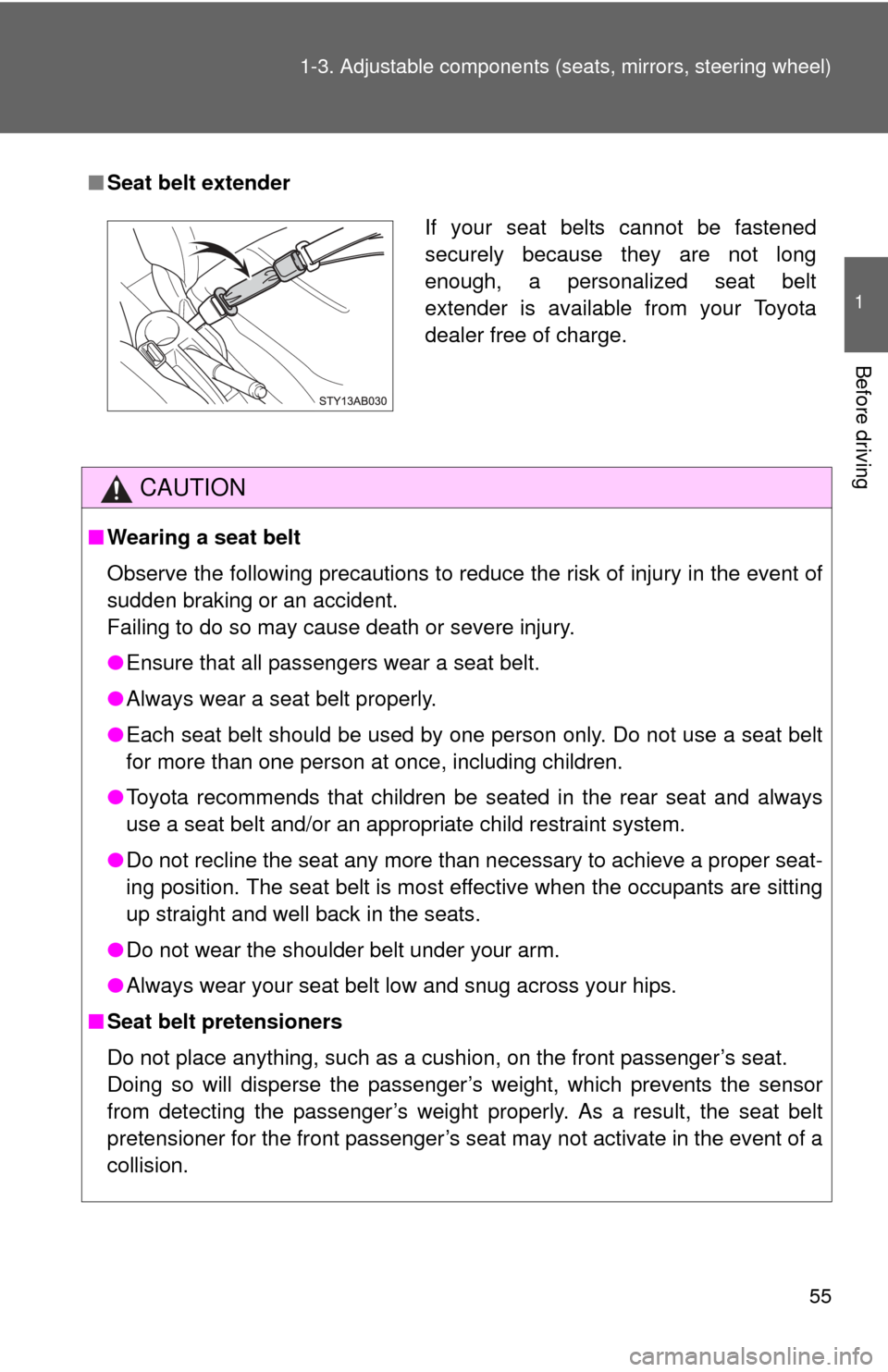
■Seat belt extender
CAUTION
■Wearing a seat belt
Observe the following precautions to reduce the risk of injury in the event of
sudden braking or an accident.
Failing to do so may cause death or severe injury.
●Ensure that all passengers wear a seat belt.
● Always wear a seat belt properly.
● Each seat belt should be used by one person only. Do not use a seat belt
for more than one person at once, including children.
● Toyota recommends that children be seated in the rear seat and always
use a seat belt and/or an appropriate child restraint system.
● Do not recline the seat any more than necessary to achieve a proper seat-
ing position. The seat belt is most effective when the occupants are sitting
up straight and well back in the seats.
● Do not wear the shoulder belt under your arm.
● Always wear your seat belt low and snug across your hips.
■ Seat belt pretensioners
Do not place anything, such as a cushion, on the front passenger’s seat.
Doing so will disperse the passenger’s weight, which prevents the sensor
from detecting the passenger’s weight properly. As a result, the seat belt
pretensioner for the front passenger’s seat may not activate in the event of a
collision.
If your seat belts cannot be fastened
securely because they are not long
enough, a personalized seat belt
extender is available from your Toyota
dealer free of charge.
Page 57 of 388
57
1-3. Adjustable components (s
eats, mirrors, steering wheel)
1
Before driving
CAUTION
■Using a seat belt comfort guide
●Always make sure the shoulder belt is positioned across the center of the
shoulder. The belt should be kept away from the neck, and should not fall
off the shoulder.
Failure to observe these precautions could reduce the effectiveness of the
seat belt in an accident, causing death or serious injury.
■ Using a seat belt extender
●Do not wear the seat belt extender, if you can fasten the seat belt without
the extender.
● Do not use the seat belt extender when installing a child restraint system,
because the belt will not securely hold the child restraint system, increas-
ing the risk of death or serious injury in the event of a collision.
● The personalized extender may not be safe on another vehicle, when
used by another person, or at a different seating position other than the
one originally intended.
NOTICE
■When using a seat belt extender
When releasing the seat belt, press on the buckle release button on the
extender, not on the seat belt.
This helps prevent damage to the vehicle interior and the extender itself.
Page 58 of 388
58
1-3. Adjustable components (seats, mirrors, steering wheel)
Steering wheel
CAUTION
■Caution while driving
Do not adjust the steering wheel while driving.
Doing so may cause the driver to mishandle the vehicle and an accident
may occur resulting in death or serious injury.
■ After adjusting the steering wheel
Make sure that the steering wheel is securely locked.
Otherwise, the steering wheel may move suddenly, possibly causing an
accident and resulting in death or serious injury.
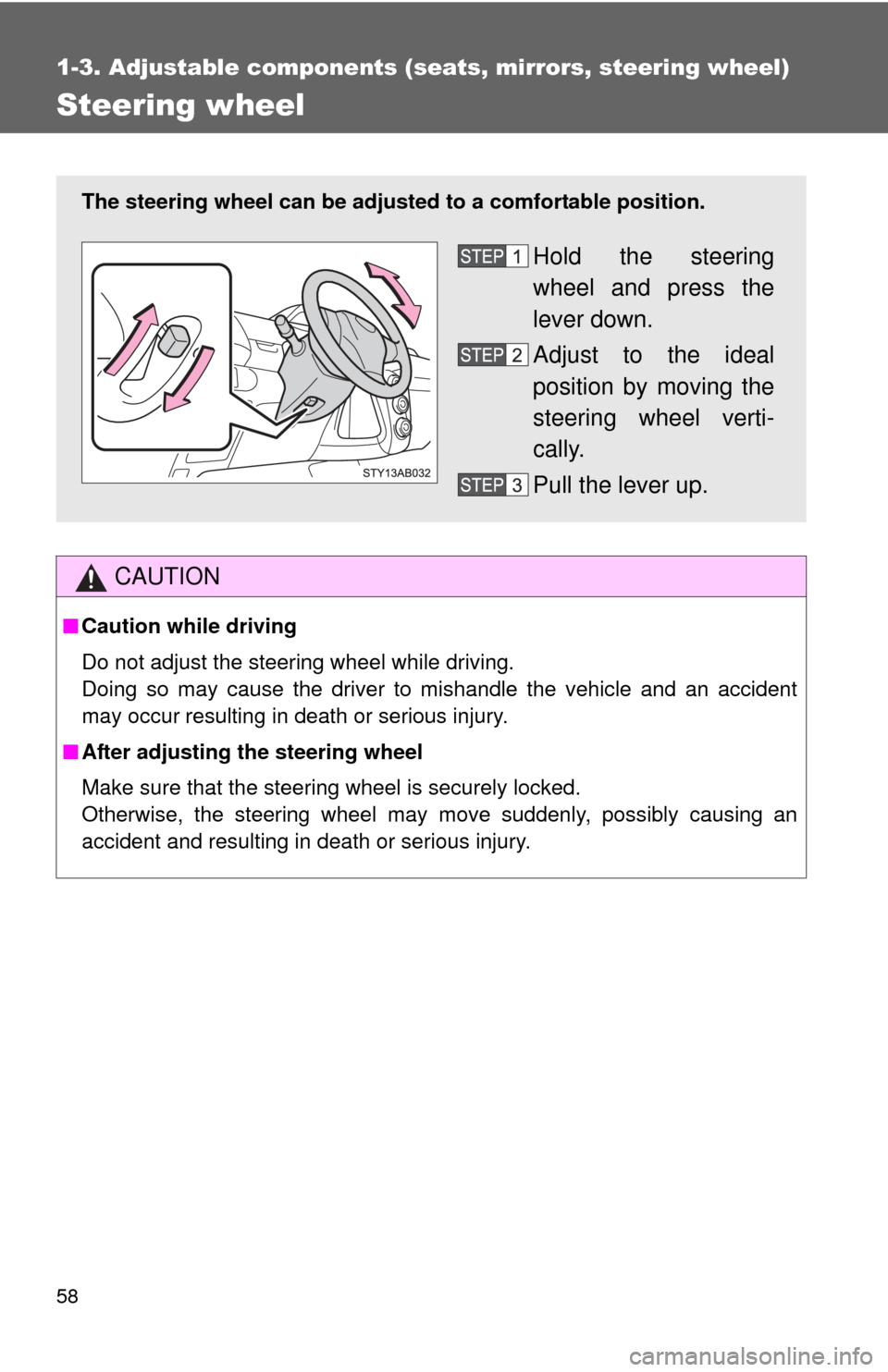
The steering wheel can be adjust ed to a comfortable position.
Hold the steering
wheel and press the
lever down.
Adjust to the ideal
position by moving the
steering wheel verti-
cally.
Pull the lever up.
Page 70 of 388
70
1-6. Theft deterrent system
Engine immobilizer system (if equipped)
■System maintenance
The vehicle has a maintenance-free type of engine immobilizer system.
■ Conditions that may cause the system to malfunction
●If the key is in contact with a metallic object
● If the key is in close proximity to or touching a key to the security system
(key with a built-in transponder chip) of another vehicle
■ Certifications for the engine immobilizer system
For vehicles sold in U.S.A.
FCC ID: MOZRI-20BTY
This device complies with Part 15 of the FCC Rules. Operation is subject to
the following two conditions: (1) This device may not cause harmful interfer-
ence, and (2) this device must accept any interference received, including
interference that may cause undesired operation.
FCC WARNING:
Changes or modifications not expressly approved by the party responsible
for compliance could void the user’s authority to operate the equipment.
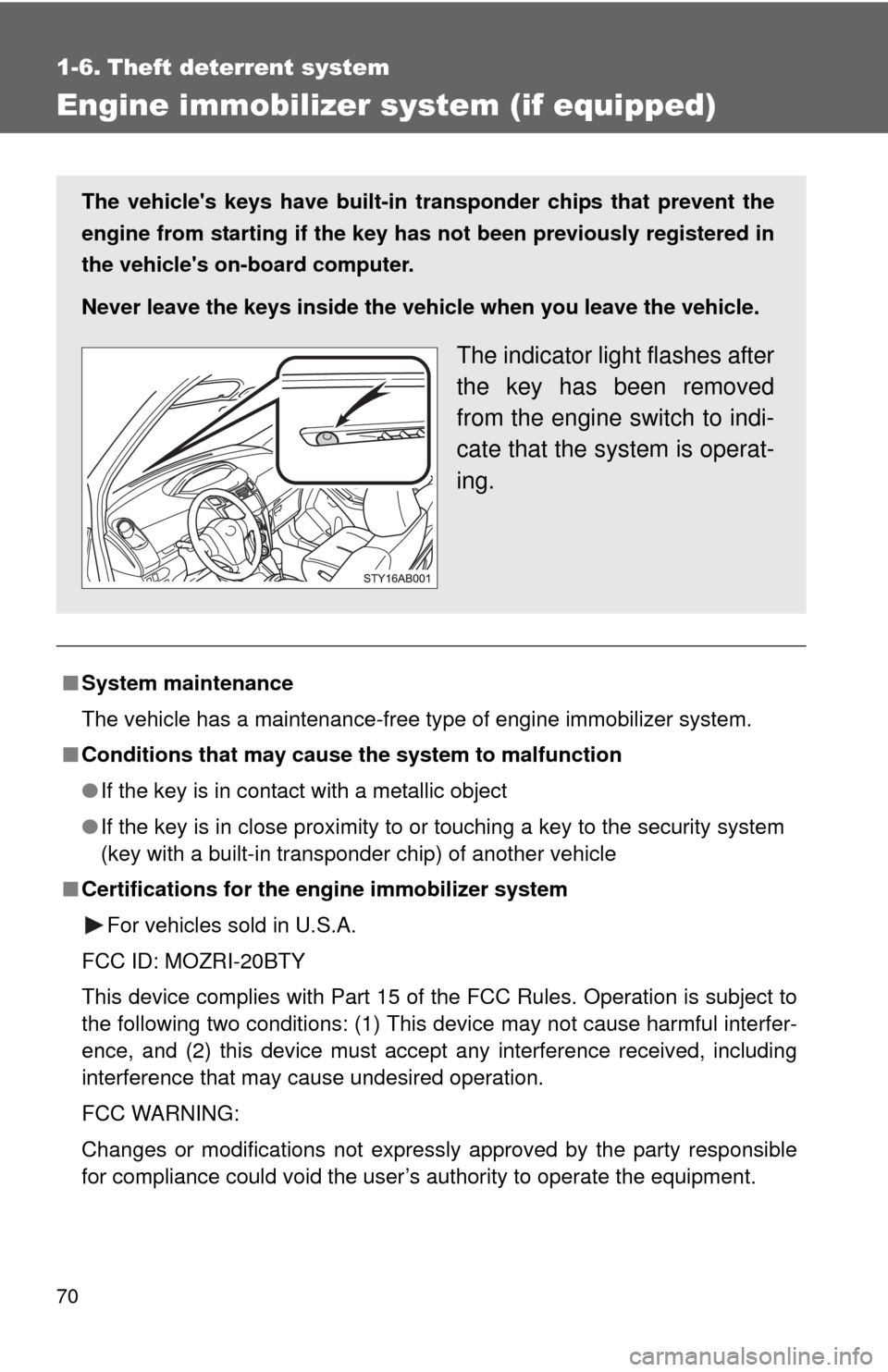
The vehicle's keys have built-in tran sponder chips that prevent the
engine from starting if the key has not been previously registered in
the vehicle's on-board computer.
Never leave the keys inside the vehicle when you leave the vehicle.
The indicator light flashes after
the key has been removed
from the engine switch to indi-
cate that the system is operat-
ing.