inflation pressure TOYOTA YARIS 2008 2.G Owners Manual
[x] Cancel search | Manufacturer: TOYOTA, Model Year: 2008, Model line: YARIS, Model: TOYOTA YARIS 2008 2.GPages: 388, PDF Size: 7.34 MB
Page 4 of 388

TABLE OF CONTENTSIndex
4
4-3. Do-it-yourself maintenance ................... 233
Do-it-yourself service precautions ...................... 233
Hood................................... 236
Positioning a floor jack ....... 237
Engine compartment .......... 239
Tires ................................... 252
Tire inflation pressure......... 258
Wheels ............................... 262
Air conditioning filter ........... 264
Key battery ......................... 267
Checking and replacing fuses ................................ 269
Light bulbs .......................... 280
5-1. Essential information....... 290 If your vehicle needs to be towed ............................... 290
If you think something is wrong ............................... 296
Fuel pump shut off system .............................. 297
Event data recorder............ 298
5-2. Steps to take in an emergency ...................... 300
If a warning light turns on or a warning buzzer
sounds... .......................... 300
If you have a flat tire ........... 310
If the engine will not start ... 323
If the shift lever cannot be shifted from P ................... 325
If you lose your keys .......... 326 If the vehicle battery is
discharged ........................ 327
If your vehicle overheats..... 332
If the vehicle becomes stuck ................................. 335
6-1. Specifications ................... 338 Maintenance data (fuel, oil level, etc.) ........... 338
Fuel information .................. 347
Tire information................... 350
6-2. Customization ................... 363 Customizable features ........ 363
Items to initialize ................. 365
Reporting safety defects for U.S. owners ...................... 368
Seat belt instructions for Canadian owners
(in French) ......................... 369
Abbreviation list ........................ 374
Alphabetical index .................... 375
What to do if... ........................... 383
5When trouble arises
6Vehicle specifications
7For owners
Index
Page 7 of 388
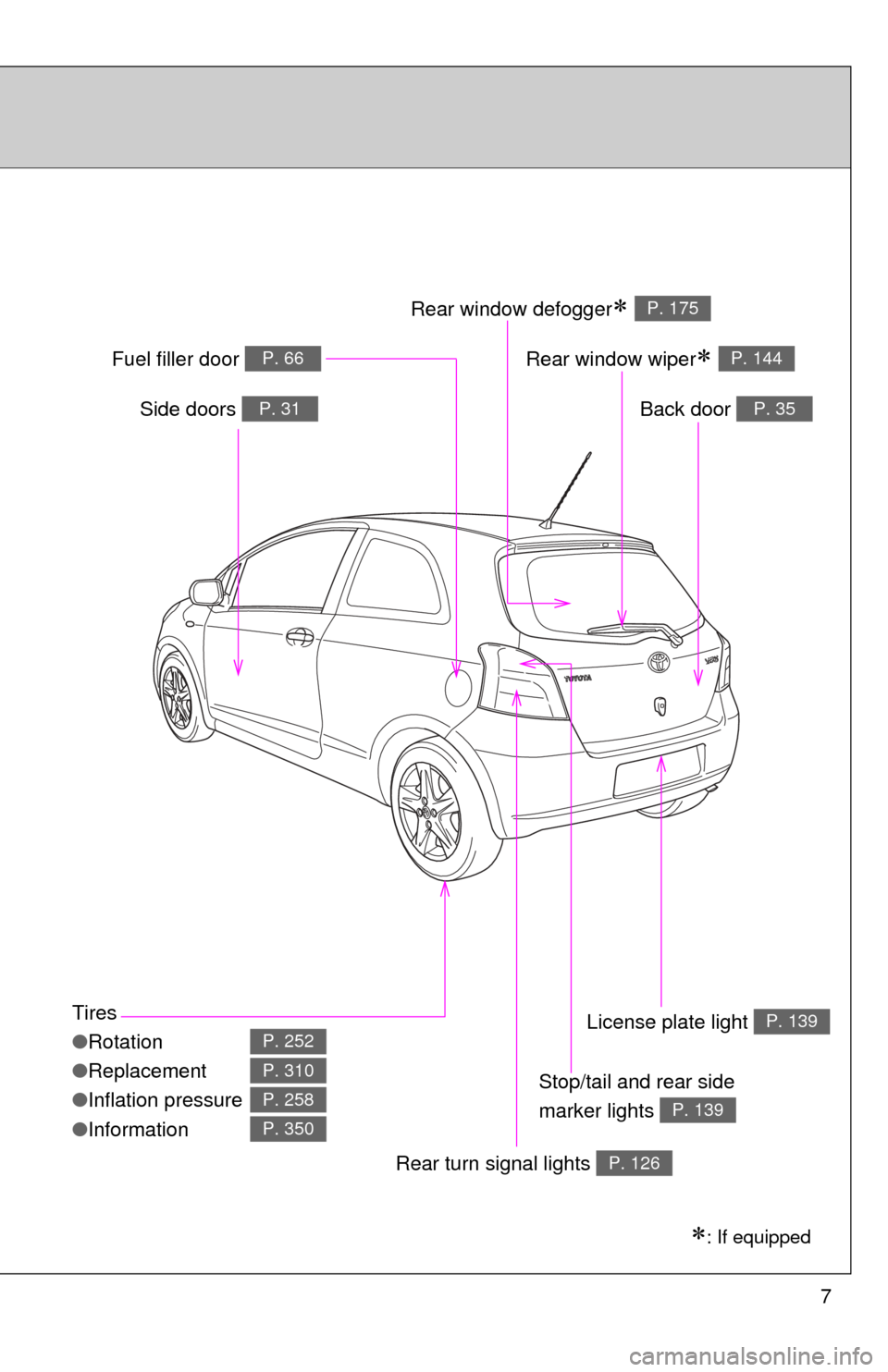
7
Tires
●Rotation
● Replacement
● Inflation pressure
● Information
P. 252
P. 310
P. 258
P. 350
: If equipped
Back door P. 35Side doors P. 31
Fuel filler door P. 66
Rear turn signal lights P. 126
Rear window defoggerP. 175
License plate light P. 139
Stop/tail and rear side
marker lights
P. 139
Rear window wiperP. 144
Page 9 of 388
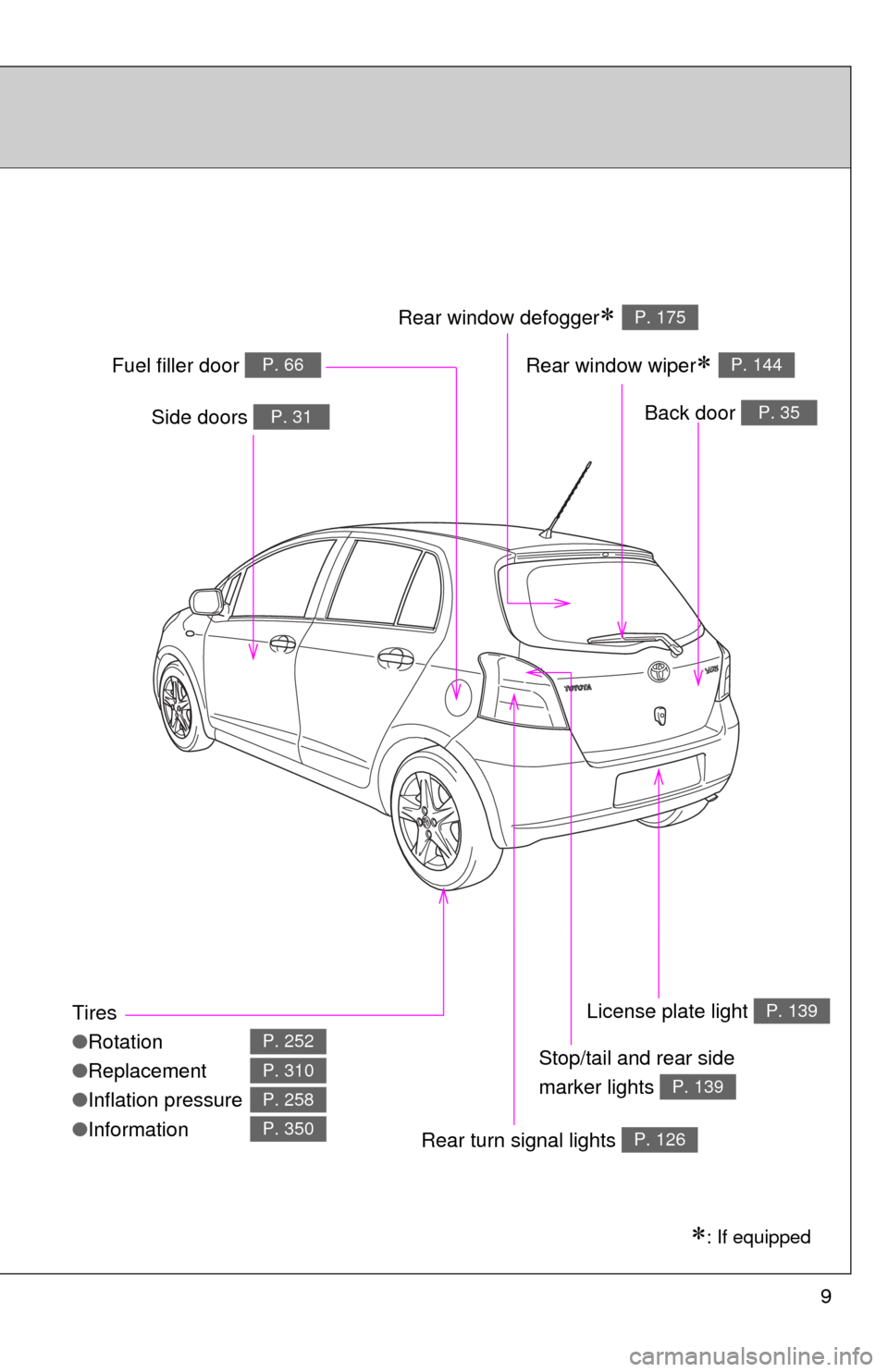
9
Tires
●Rotation
● Replacement
● Inflation pressure
● Information
P. 252
P. 310
P. 258
P. 350
: If equipped
Back door P. 35Side doors P. 31
Fuel filler door P. 66
Rear turn signal lights P. 126
Rear window defoggerP. 175
License plate light P. 139
Stop/tail and rear side
marker lights
P. 139
Rear window wiperP. 144
Page 221 of 388
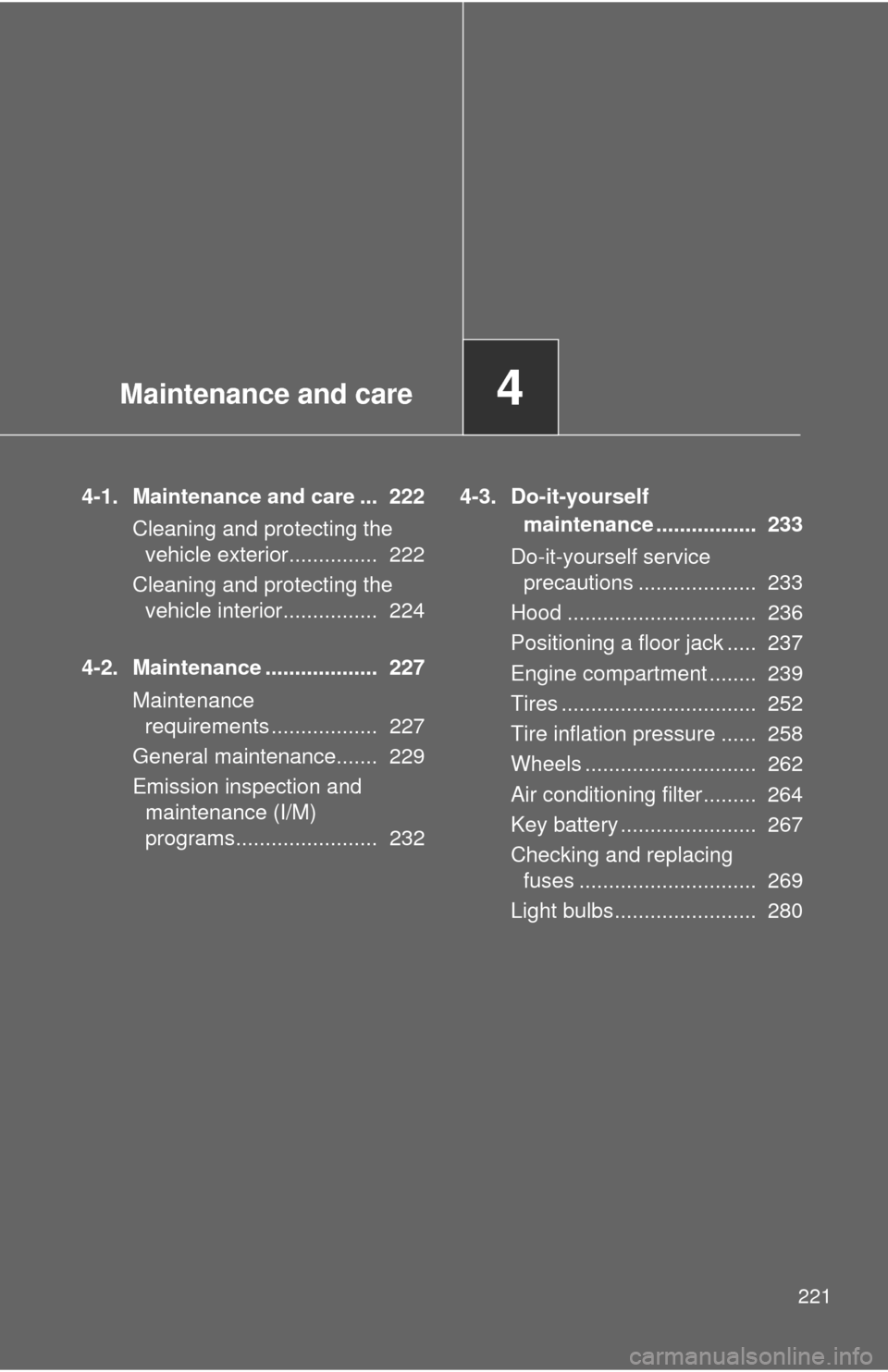
Maintenance and care4
221
4-1. Maintenance and care ... 222Cleaning and protecting the vehicle exterior............... 222
Cleaning and protecting the vehicle interior................ 224
4-2. Maintenance ................... 227 Maintenance requirements .................. 227
General maintenance....... 229
Emission inspection and maintenance (I/M)
programs........................ 232 4-3. Do-it-yourself
maintenance ................. 233
Do-it-yourself service precautions .................... 233
Hood ................................ 236
Positioning a floor jack ..... 237
Engine compartment ........ 239
Tires ................................. 252
Tire inflation pressure ...... 258
Wheels ............................. 262
Air conditioning filter......... 264
Key battery ....................... 267
Checking and replacing fuses .............................. 269
Light bulbs........................ 280
Page 231 of 388
231
4-2. Maintenance
4
Maintenance and care
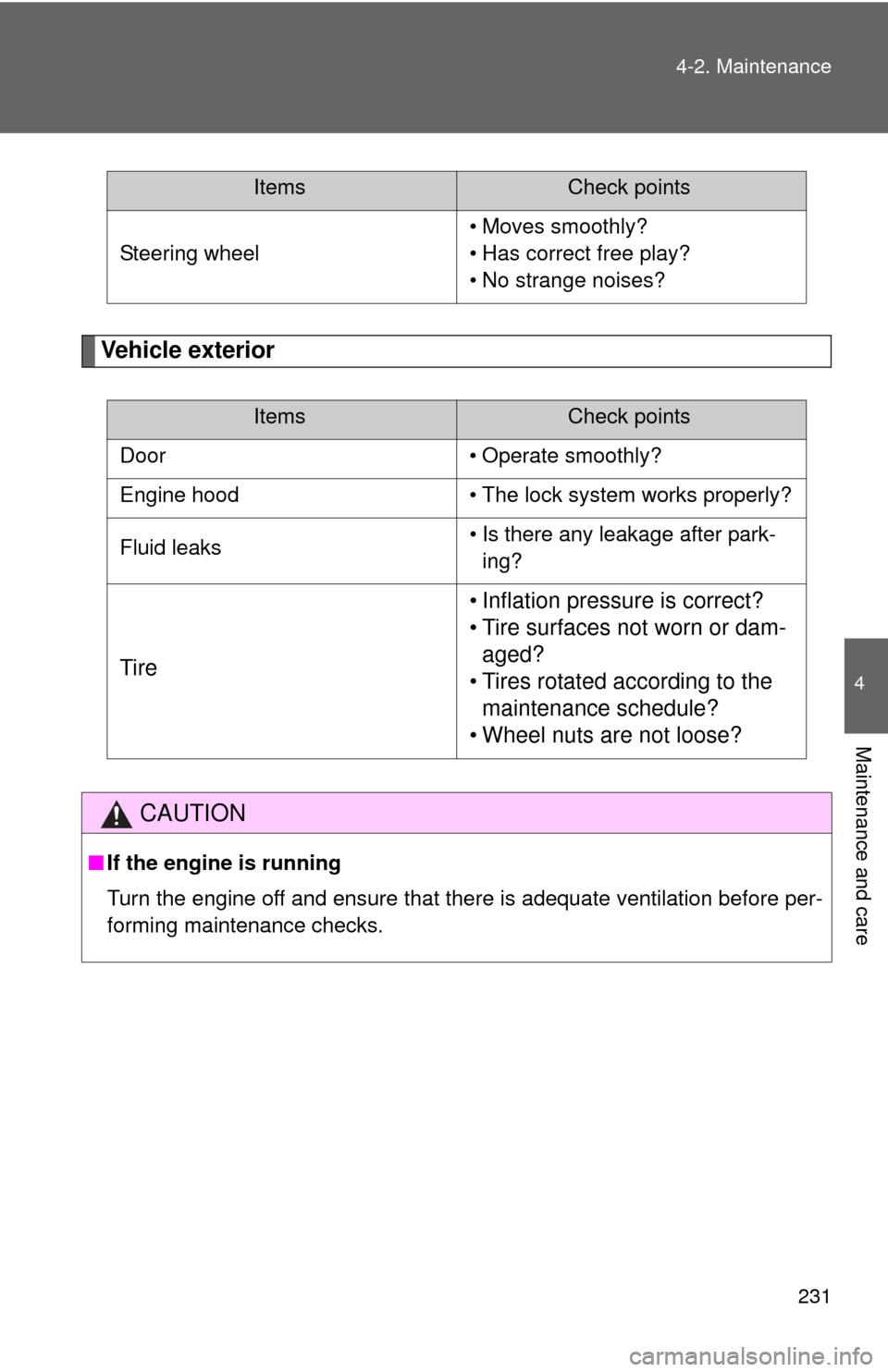
Vehicle exterior
Steering wheel
• Moves smoothly?
• Has correct free play?
• No strange noises?
ItemsCheck points
Door • Operate smoothly?
Engine hood • The lock system works properly?
Fluid leaks • Is there any leakage after park-
ing?
Tire • Inflation pressure is correct?
• Tire surfaces not worn or dam-
aged?
• Tires rotated according to the maintenance schedule?
• Wheel nuts are not loose?
CAUTION
■ If the engine is running
Turn the engine off and ensure that there is adequate ventilation before per-
forming maintenance checks.
ItemsCheck points
Page 234 of 388
234 4-3. Do-it-yourself maintenance
CAUTION
The engine compartment contains many mechanisms and fluids that may
move suddenly, become hot, or become electrically energized. To avoid death
or serious injury observe the following precautions.
■When working on the engine compartment
●Keep hands, clothing, and tools away from the moving fan and engine
drive belt.
● Be careful not to touch the engine, radiator, exhaust manifold, etc. right
after driving as they may be hot. Oil and other fluids may also be hot.
● Do not leave anything that may burn easily, such as paper or rags, in the
engine compartment.
● Do not smoke, cause sparks or expose an open flame to fuel or the bat-
tery. Fuel and battery fumes are flammable.
● Be extremely cautious when working on the battery. It contains poisonous
and corrosive sulfuric acid.
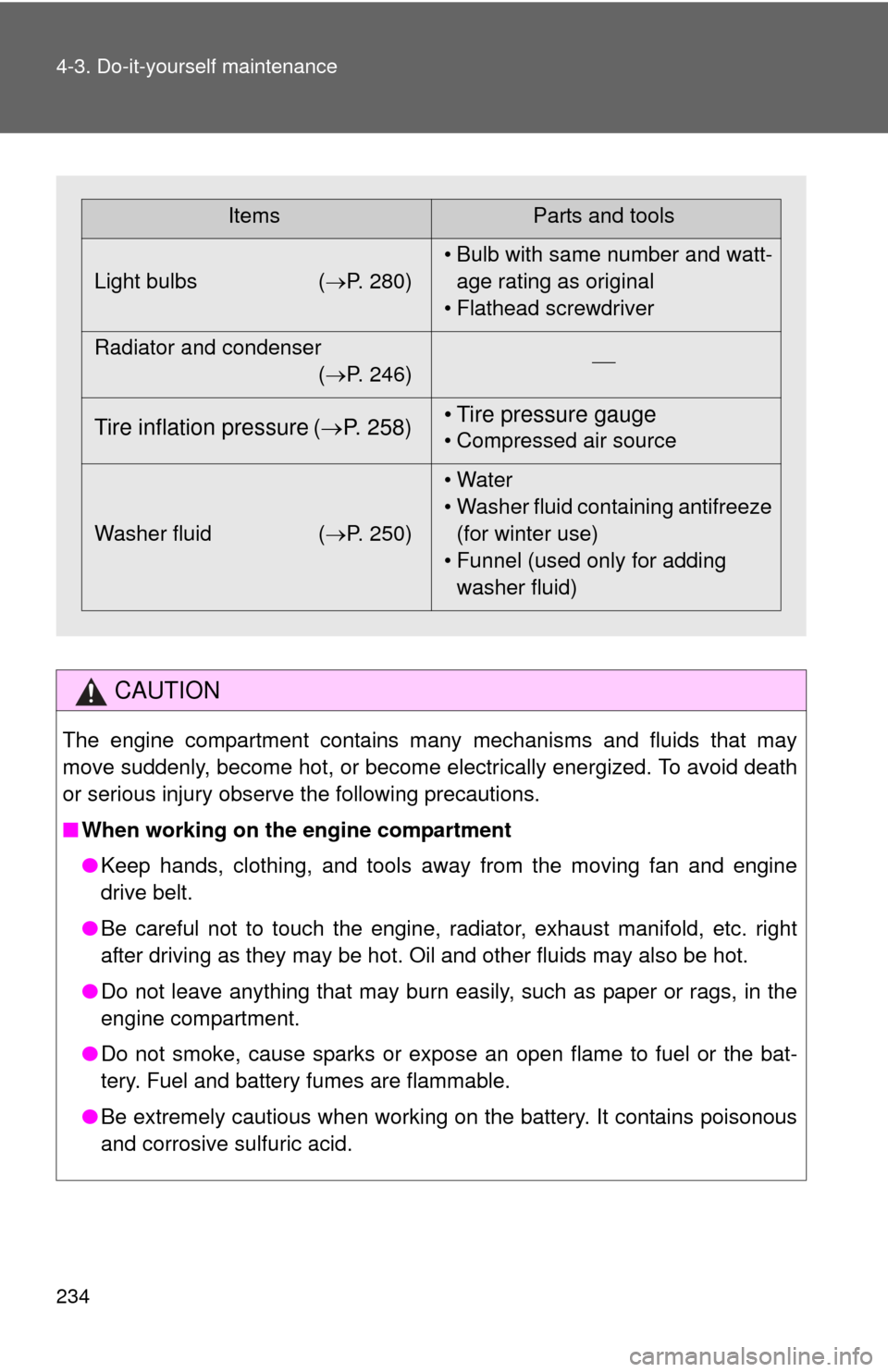
ItemsParts and tools
Light bulbs ( P. 280)• Bulb with same number and watt-
age rating as original
• Flathead screwdriver
Radiator and condenser (P. 246)
Tire inflation pressure (
P. 258) • Tire pressure gauge• Compressed air source
Washer fluid ( P. 250)• Water
• Washer fluid containing antifreeze
(for winter use)
• Funnel (used only for adding washer fluid)
Page 252 of 388
252
4-3. Do-it-yourself maintenance
Tires
Replace or rotate tires in accordance with maintenance sched-
ules and treadwear.
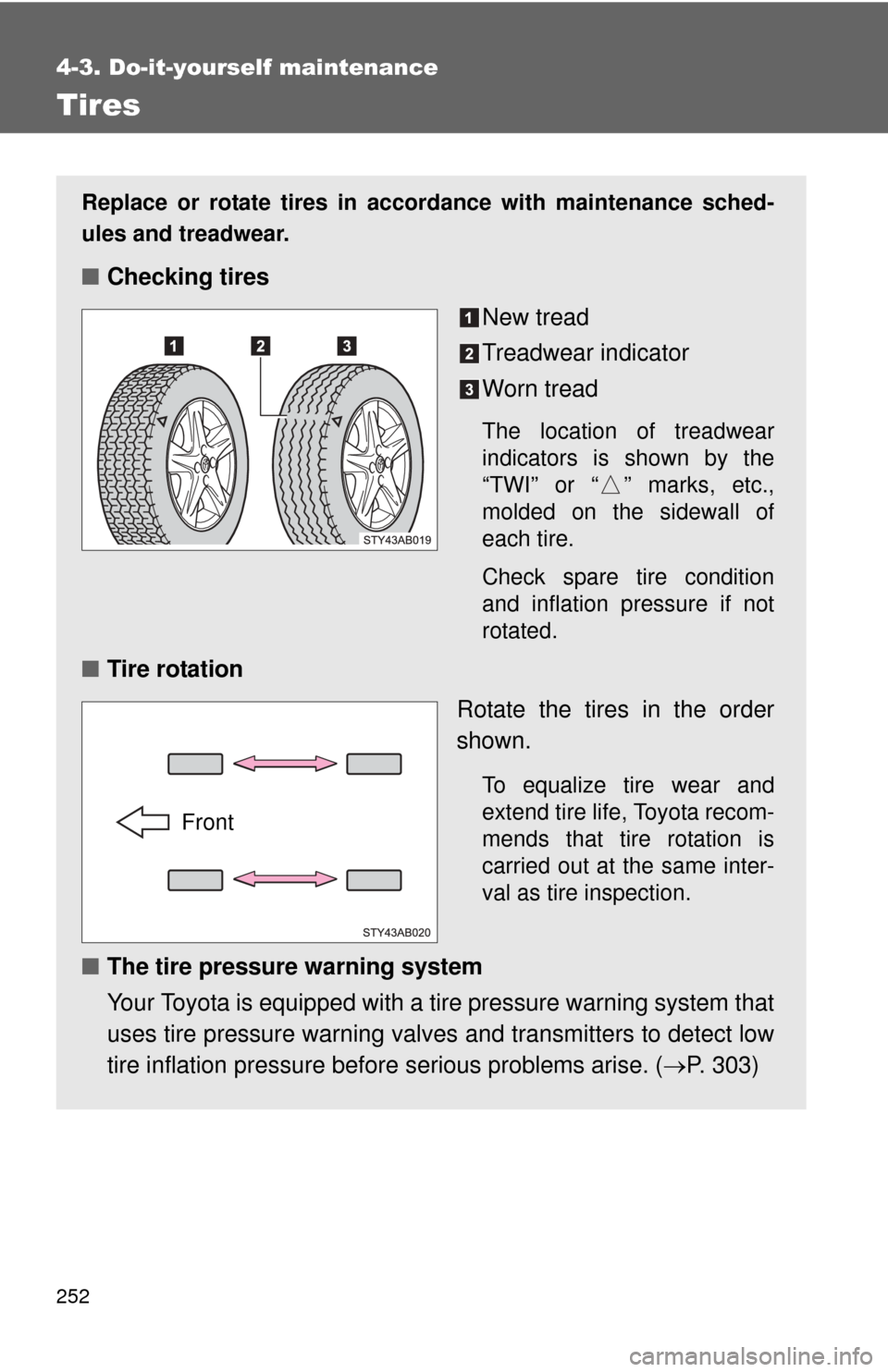
■Checking tires
New tread
Treadwear indicator
Worn tread
The location of treadwear
indicators is shown by the
“TWI” or “ ” marks, etc.,
molded on the sidewall of
each tire.
Check spare tire condition
and inflation pressure if not
rotated.
■Tire rotation
Rotate the tires in the order
shown.
To equalize tire wear and
extend tire life, Toyota recom-
mends that tire rotation is
carried out at the same inter-
val as tire inspection.
■The tire pressure warning system
Your Toyota is equipped with a tire pressure warning system that
uses tire pressure warning valves and transmitters to detect low
tire inflation pressure before serious problems arise. (P. 303)
Front
Page 254 of 388

254 4-3. Do-it-yourself maintenance
■Routine tire inflation pressure checks
The tire pressure warning system does not replace routine tire inflation
pressure checks. Make sure to check tire inflation pressure as part of
your routine of daily vehicle checks.
■Maximum load of tire
Check that the maximum load of the re placed tire is greater than 1/2 of
the Gross Axle Weight Ratings (GAWR) of either the front axle or the
rear axle, whichever is greater.
As for the maximum load of the tire, see the load limit at maximum cold
tire inflation pressure mentioned on the sidewall of the tire, and as for the
Gross Axle Weight Ratings (GAWR) , see the Certification Label. (P.
258, 350).
■Tire types
1 Summer tires
Summer tires are high-speed performance tires best suited to highway
driving under dry conditions. Sinc e summer tires do not have the same
traction performance as snow tire s, summer tires are inadequate for
driving on snow-covered or icy roads. For driving on snow-covered
roads or icy roads, the use of snow tires is recommended. When
installing snow tires, be sure to replace all four tires.
2 All season tires
All season tires are designed to provide better traction in snow and to
be adequate for driving in most winter conditions, as well as for use
year round. All season tires, however, do not have adequate traction
performance compared with snow tires in heavy or loose snow. Also,
all season tires fall short in acceleration and handling performance
compared with summer tires in highway driving.
3Snow tires For driving on snow-covered roads or icy roads, we recommend using
snow tires. If you need snow tires, select tires of the same size, con-
struction and load capacity as the or iginally installed tires. Since your
vehicle has radial tires as original equipment, make sure your snow
tires also have radial construction. Do not install studded tires without
first checking local regulations for possible restriction. Snow tires
should be installed on all wheels. ( P. 151)
Page 257 of 388

257
4-3. Do-it-yourself maintenance
4
Maintenance and care
NOTICE
■Repairing or replacing tires, wheels and tire pressure warning
valves and transmitters
When removing or fitting the wheels, tires or the tire pressure warning
valve and transmitter, contact your
Toyota dealer as the tire pressure
warning valve and transmitter may be damaged if not handled correctly.
■To avoid damaging the tire pressure warning valves and transmit-
ters
Do not use liquid sealants on flat tires.
■Driving on rough roads
Take particular care when driving on roads with loose surfaces or pot-
holes.
These conditions may cause losses in tire inflation pressure, reducing
the cushioning ability of the tires. In addition driving on rough roads may
cause damage to the tires themselves, as well as the vehicle's wheels
and body.
■If tire inflation pressures become low while driving
Do not continue driving, or your tires and/or wheels may be ruined.
Page 258 of 388
258
4-3. Do-it-yourself maintenance
Tire inflation pressure
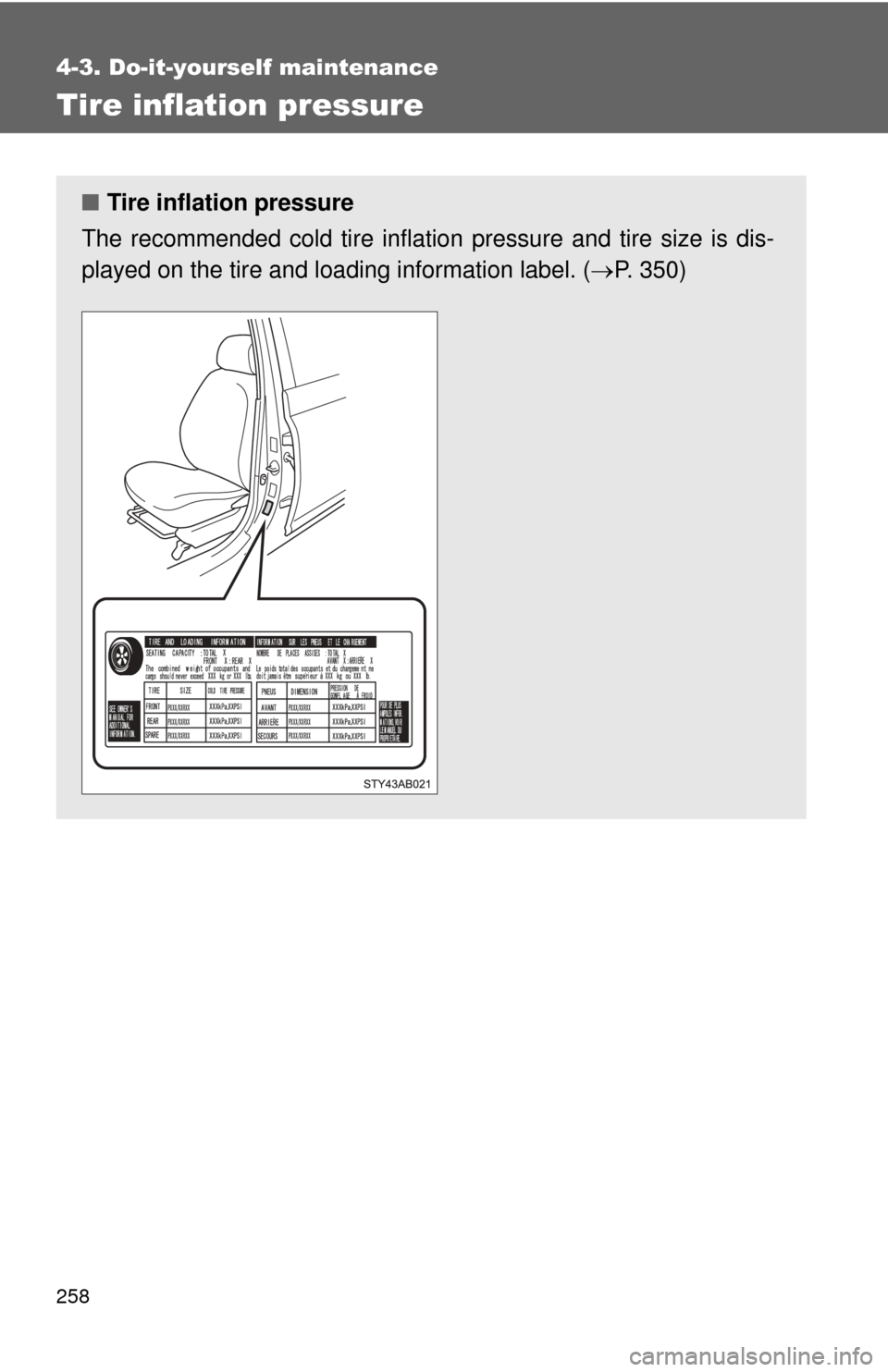
■Tire inflation pressure
The recommended cold tire inflation pressure and tire size is dis-
played on the tire and loadi ng information label. (P. 350)