Eco TOYOTA YARIS 2009 2.G User Guide
[x] Cancel search | Manufacturer: TOYOTA, Model Year: 2009, Model line: YARIS, Model: TOYOTA YARIS 2009 2.GPages: 392, PDF Size: 8.52 MB
Page 91 of 392
91
1-7. Safety information
1
Before driving
CAUTION
■
SRS airbag precautions
●Vehicles with side airbags: Do not use seat accessories which cover the
parts where the SRS side airbags inflate as they may interfere with infla-
tion of the airbags.
● Do not strike or apply significant levels of force to the area of the SRS air-
bag components shown on P. 82.
Doing so can cause the SRS airbags to malfunction.
● Do not touch any of the component parts immediately after the SRS air-
bags have deployed (inflated) as they may be hot.
● If breathing becomes difficult after the SRS airbag has deployed, open a
door or window to allow fresh air in, or leave the vehicle if it is safe to do
so. Wash off any residue as soon as possible to prevent skin irritation.
● Vehicles with curtain shield airbags: If the areas where the SRS airbags
are stored, such as the steering w heel pad and front and rear pillar gar-
nishes, are damaged or cracked, have them replaced by your Toyota
dealer.
● Vehicles without curtain shield airbags: If the areas where the SRS airbags
are stored, such as the steering wheel pad are damaged or cracked, have
them replaced by your Toyota dealer.
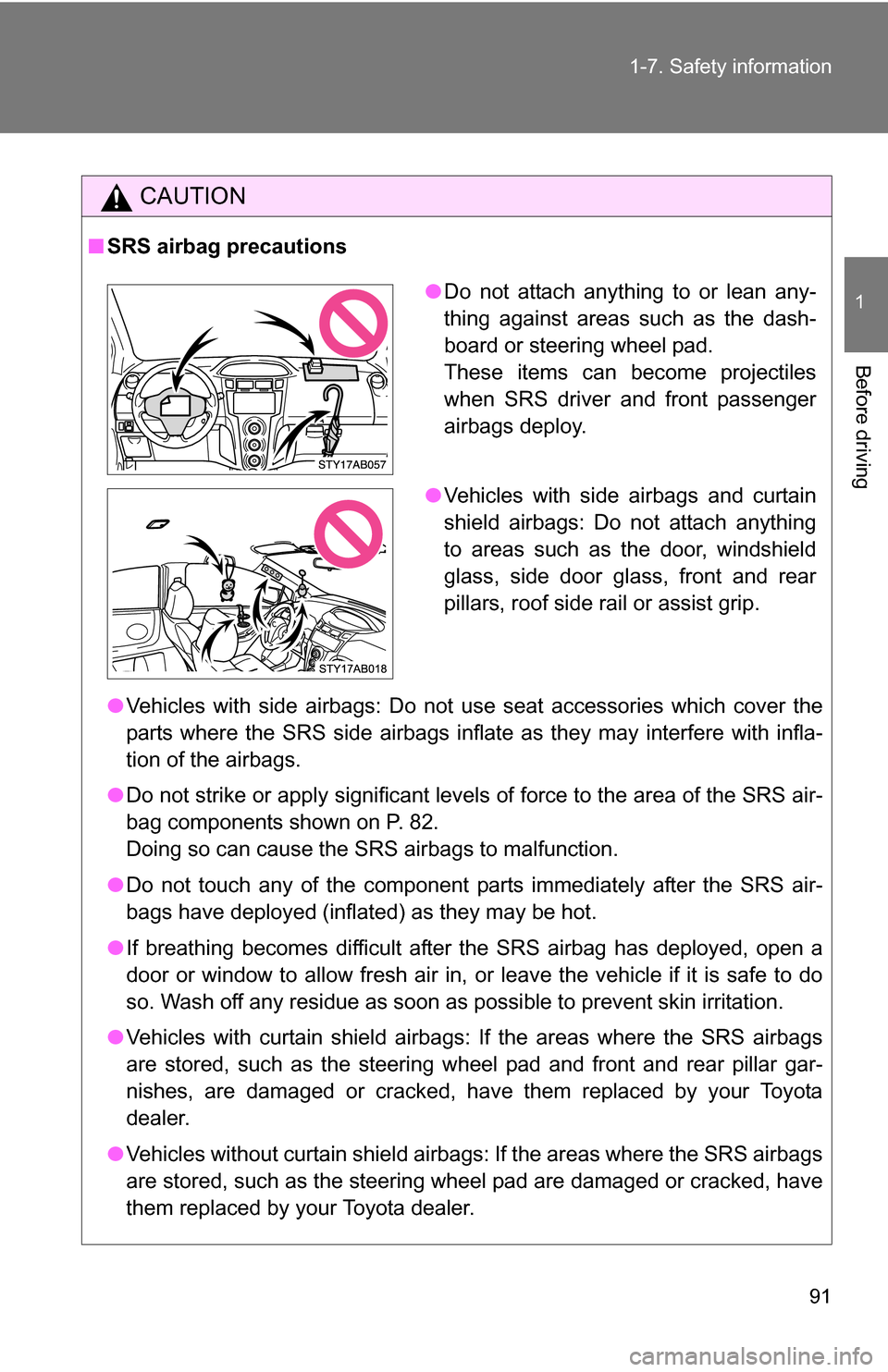
●Do not attach anything to or lean any-
thing against areas such as the dash-
board or steering wheel pad.
These items can become projectiles
when SRS driver and front passenger
airbags deploy.
● Vehicles with side airbags and curtain
shield airbags: Do not attach anything
to areas such as the door, windshield
glass, side door glass, front and rear
pillars, roof side rail or assist grip.
Page 95 of 392
95
1-7. Safety information
1
Before driving
■
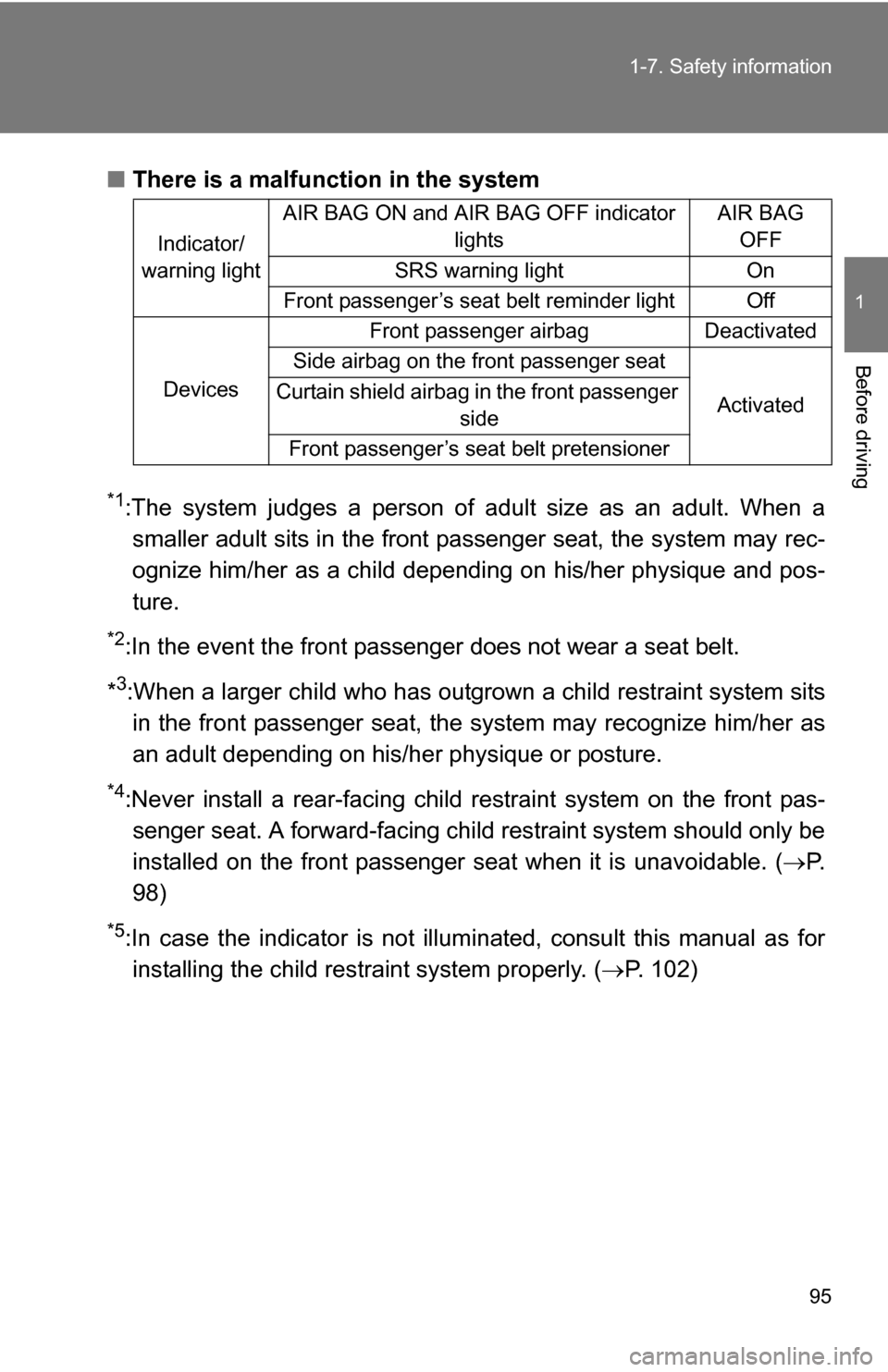
There is a malfunction in the system
*1:The system judges a person of adult size as an adult. When a
smaller adult sits in the front pa ssenger seat, the system may rec-
ognize him/her as a child dependi ng on his/her physique and pos-
ture.
*2:In the event the front passenge r does not wear a seat belt.
*
3:When a larger child who has outgrow n a child restraint system sits
in the front passenger seat, the system may recognize him/her as
an adult depending on his/her physique or posture.
*4:Never install a rear-facing child restraint system on the front pas-
senger seat. A forward-facing child restraint system should only be
installed on the front passenger seat when it is unavoidable. ( P.
98)
*5:In case the indicator is not illum inated, consult this manual as for
installing the child restraint system properly. ( P. 102)
Indicator/
warning light AIR BAG ON and AIR BAG OFF indicator
lights AIR BAG
OFF
SRS warning light On
Front passenger’s seat belt reminder light Off
Devices Front passenger airbag
Deactivated
Side airbag on the front passenger seat
Activated
Curtain shield airbag in the front passenger
side
Front passenger’s seat belt pretensioner
Page 96 of 392
96 1-7. Safety information
CAUTION
■Front passenger occupant cl assification system precautions
Observe the following precautions regarding front passenger occupant clas-
sification system.
Failure to do so may cause death or serious injury.
● Wear the seat belt properly.
● Make sure the front passenger’s seat belt tab has not been left inserted
into the buckle before someone sits in the front passenger seat.
● Make sure the AIR BAG OFF indicator light is not illuminated when using
the seat belt extender for the front passenger seat. If the AIR BAG OFF
indicator light is illuminated, disconnect the extender tongue from the seat
belt buckle, then reconnect the seat belt. Reconnect the seat belt extender
after making sure the AIR BAG ON indicator light is illuminated. If you use
the seat belt extender while the AIR BAG OFF indicator light is illuminated,
the front passenger airbag and side airbag on the front passenger side
may not activate correctly, which could cause death or serious injury in the
event of collision.
● Do not apply a heavy load to the front passenger seat or equipment.
● Do not put weight on the front passenger seat by putting your hands or
feet on the front passenger seat seatback from the rear passenger seat.
● Do not let a rear passenger lift the front passenger seat with their feet or
press on the seatback with their legs.
● Do not put objects under the front passenger seat.
● Do not recline the front passenger seatback so far that it touches a rear
seat. This may cause the AIR BAG OFF indicator light to be illuminated,
which indicates that the passenger’s airbags will not deploy in the event of
a severe accident. If the seatback touches the rear seat, return the seat-
back to a position where it does not touch the rear seat. Keep the front\
passenger seatback as upright as possible when the vehicle is moving.
Reclining the seatback excessively may lessen the effectiveness of the
seat belt system.
Page 99 of 392
99
1-7. Safety information
1
Before driving
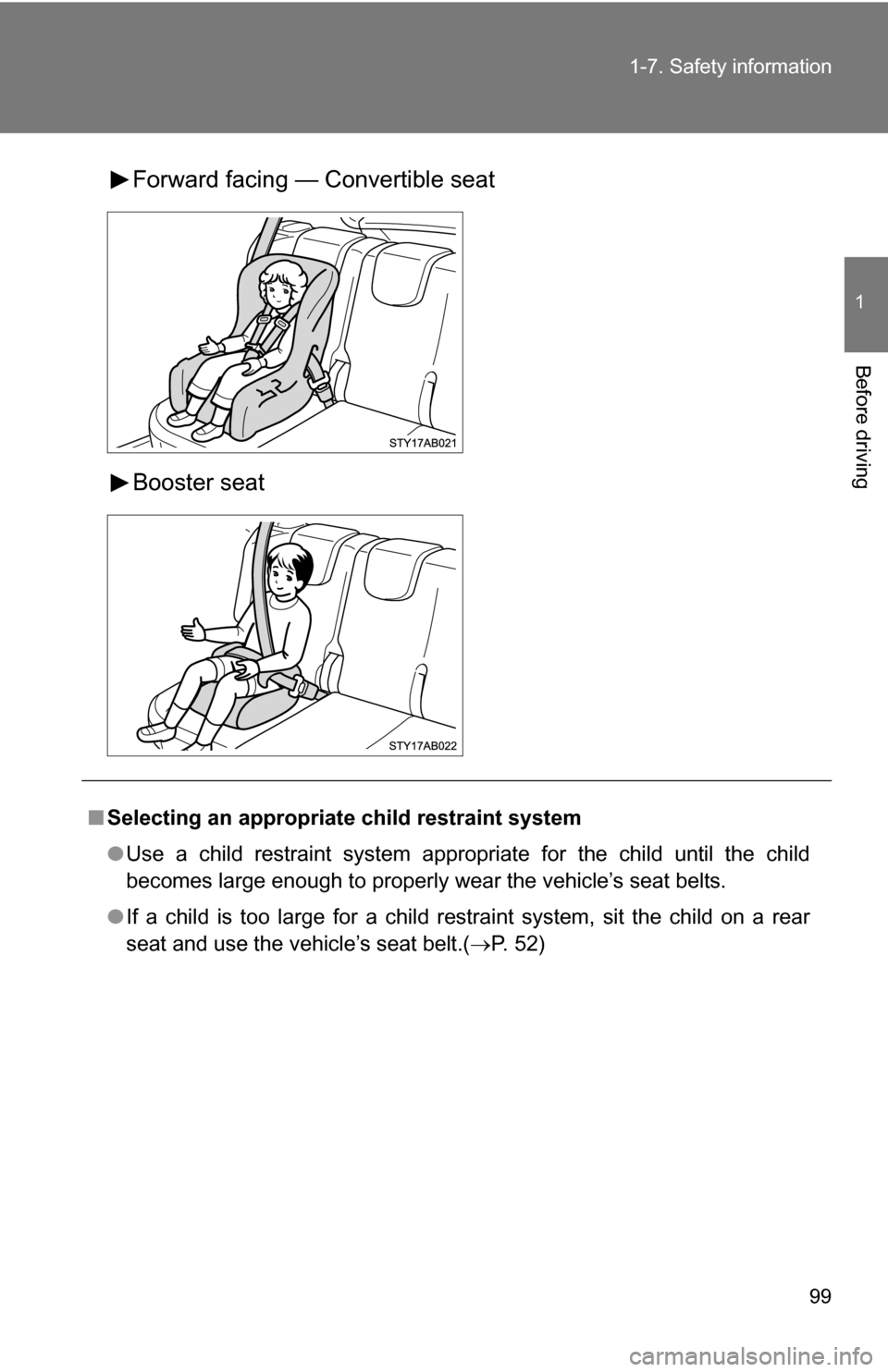
Forward facing — Convertible seat
Booster seat
■
Selecting an appropriat e child restraint system
● Use a child restraint system appropriate for the child until the child
becomes large enough to properly wear the vehicle’s seat belts.
● If a child is too large for a child restraint system, sit the child on a rear
seat and use the vehicle’s seat belt.( P. 52)
Page 101 of 392
101
1-7. Safety information
1
Before driving
CAUTION
■
Child restraint precautions
●Make sure you have complied with all installation instructions provided by
the child restraint manufacturer and that the system is properly secured. If
it is not secured properly, it may cause death or serious injury to the child
in the event of a sudden stop or accident.
■ Child restraint lock function belt precaution
Do not allow children to play with the child restraint lock function belt. If the
belt becomes twisted around a child’s neck, it will not be possible to pull the
belt out leading to choking or other serious injuries that could result in death.
If this occurs and the buckle cannot be unfastened, scissors should be used
to cut the belt.
■ When the child restrain t system is not in use
● Keep the child restraint system properly secured on the seat even if it is
not in use. Do not store the restraint unsecured in the passenger compart-
ment.
● If it is necessary to detach the child restraint system, remove it from the
vehicle or store it securely in the luggage compartment. This will prevent it
from injuring passengers in the event of a sudden stop or accident.
Page 118 of 392
118 2-1. Driving procedures
Manual transmissionWith the parking brake firmly set and the clutch pedal fully
depressed, shift the shift lever to 1.
Lightly depress the accelerator pedal at the same time as
gradually releasing the clutch pedal.
Release the parking brake.
■Driving in the rain
●Drive carefully when it is raining, because visibility will be reduced, the
windows may become fogged-up, and the road will be slippery.
● Drive carefully when it starts to rain, because the road surface will be
especially slippery.
● Refrain from high speeds when driving on an expressway in the rain,
because there may be a layer of water between the tires and the road
surface, preventing the steering and brakes from operating properly.
■ Breaking in your new Toyota
To extend the life of the vehicle, the following precautions are recommended
to observe:
●For the first 200 miles (300 km):
Avoid sudden stops.
● For the first 500 miles (800 km):
Do not tow a trailer.
● For the first 1000 miles (1600 km):
• Do not drive at extremely high speeds.
• Avoid sudden acceleration.
• Do not drive continuously in the low gears.
• Do not drive at a constant speed for extended periods.
■ Operating your vehicle in a foreign country
Comply with the relevant vehicle registration laws and confirm the availability
of the correct fuel. ( P. 346)
■ Normal characteristics afte r turning off the engine
Approximately five hours after the engine is turned off, you may hear sound
coming from under the vehicle for several minutes. This is the sound of a
fuel evaporation leakage check and, it does not indicate a malfunction.
Page 123 of 392
123
2-1. Driving procedures
2
When driving
CAUTION
■
When braking the vehicle
●If the power brake assist function does not operate, do not follow other
vehicles closely and avoid downhills or sharp turns that require braking.
In this case, braking is still possible, but it will require more force on the
pedal than usual. Braking distance may also increase.
● Do not pump the brake pedal if the engine stalls.
Each push on the brake pedal uses up the reserve for the power-assisted
brakes.
● The brake system consists of 2 individual hydraulic systems: If one of the
systems fails, the other will still operate. In this case, the brake pedal
should be depressed more firmly than usual and braking distance
becomes longer.
Do not drive your vehicle with only a single brake system. Have your
brakes fixed immediately.
NOTICE
■When driving the vehicle
Vehicles with a manual transmission
● Do not rest your foot on the clutch pedal while driving.
Doing so may cause clutch trouble.
● Do not use any gears other than the first gear when starting off and mov-
ing forward.
Doing so may damage the clutch.
● Do not use the clutch to hold the vehicle when stopping on an uphill grade.
Doing so may damage the clutch.
Vehicles with an automatic transmission
● Do not use the accelerator pedal or depress accelerator and brake pedals
together to hold the vehicle on a hill.
■ When parking the vehicle
Vehicles with an automatic transmission: Always put the shift lever in P.
Failure to do so may cause the vehicle to move or the vehicle may acceler-
ate suddenly if the accelerator pedal is accidentally depressed.
Page 125 of 392
125
2-1. Driving procedures
2
When driving
Engine (ignition) switch
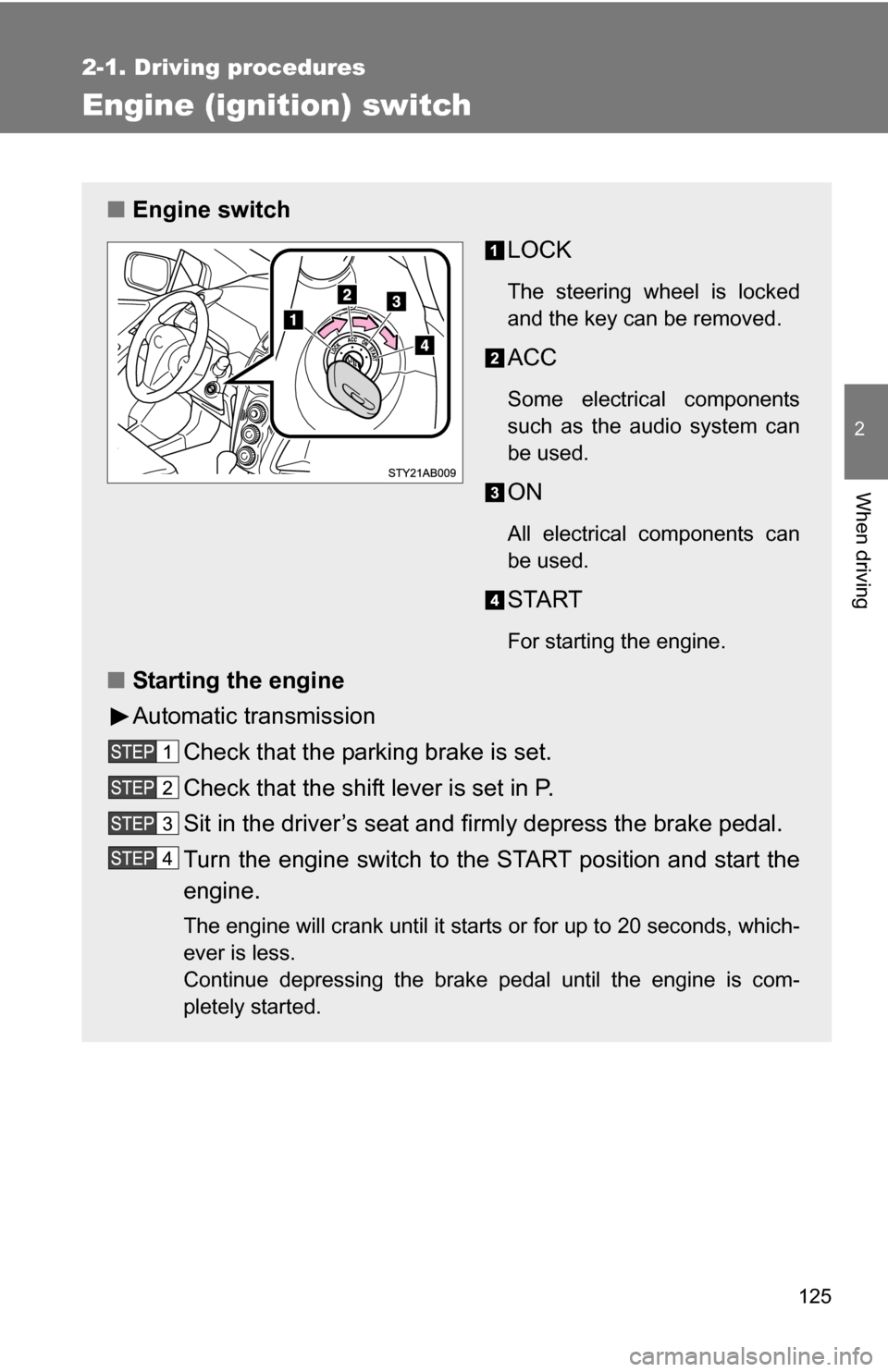
■Engine switch
LOCK
The steering wheel is locked
and the key can be removed.
ACC
Some electrical components
such as the audio system can
be used.
ON
All electrical components can
be used.
START
For starting the engine.
■Starting the engine
Automatic transmission
Check that the parking brake is set.
Check that the shift lever is set in P.
Sit in the driver’s seat and firmly depress the brake pedal.
Turn the engine switch to the START position and start the
engine.
The engine will crank until it starts or for up to 20 seconds, which-
ever is less.
Continue depressing the brake pedal until the engine is com-
pletely started.
Page 126 of 392
126 2-1. Driving procedures
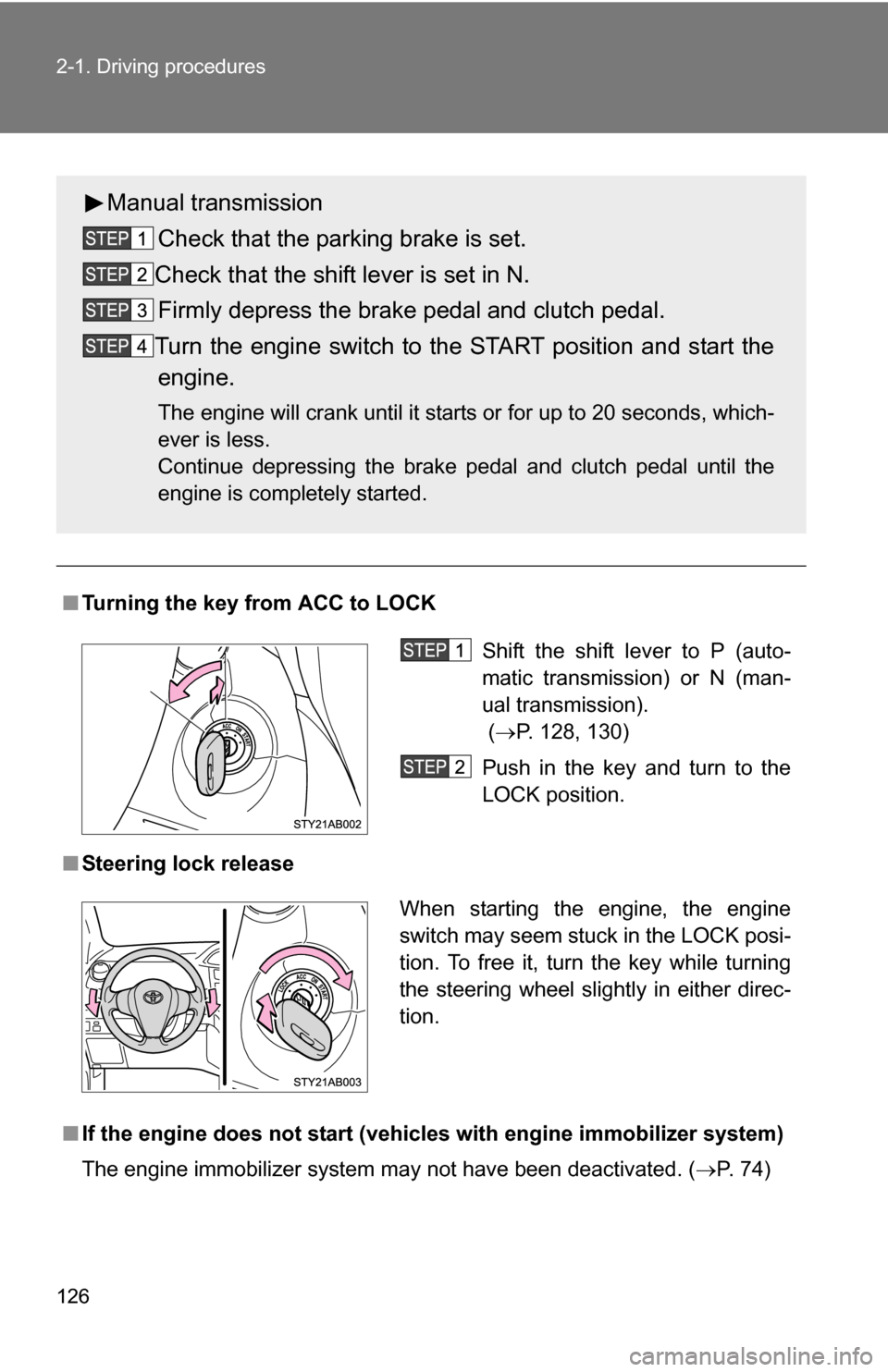
■Turning the key from ACC to LOCK
■ Steering lock release
■ If the engine does not start (vehic les with engine immobilizer system)
The engine immobilizer system may not have been deactivated. ( P. 74)
Manual transmission
Check that the parking brake is set.
Check that the shift lever is set in N. Firmly depress the brake pedal and clutch pedal.
Turn the engine switch to the START position and start the engine.
The engine will crank until it starts or for up to 20 seconds, which-
ever is less.
Continue depressing the brake pedal and clutch pedal until the
engine is completely started.
Shift the shift lever to P (auto-
matic transmission) or N (man-
ual transmission).
( P. 128, 130)
Push in the key and turn to the
LOCK position.
When starting the engine, the engine
switch may seem stuck in the LOCK posi-
tion. To free it, turn the key while turning
the steering wheel slightly in either direc-
tion.
Page 127 of 392
127
2-1. Driving procedures
2
When driving
■
Key reminder function
A buzzer sounds if the driver’s door is opened, while the engine switch is in
the ACC or LOCK position to remind you to remove the key.
CAUTION
■When starting the engine
Always start the engine while sitting in the driver's seat. Do not depress the
accelerator while starting the engine under any circumstances.
Doing so may cause an accident resulting in death or serious injury.
■ Caution while driving
Do not turn the engine switch to the LOCK position.
If in an emergency, you must turn the engine off while the vehicle is moving,
turn the key only to the ACC position.
NOTICE
■To prevent battery discharge
Do not leave the key in the ACC or ON position for long periods if the engine
is not running.
■ When starting the engine
●Do not crank for more than 30 seconds at a time. This may overheat the
starter and wiring systems.
● Do not race a cold engine.
● If the engine becomes difficult to start or stalls frequently, have the engine
checked immediately.