Service TOYOTA YARIS 2009 2.G User Guide
[x] Cancel search | Manufacturer: TOYOTA, Model Year: 2009, Model line: YARIS, Model: TOYOTA YARIS 2009 2.GPages: 392, PDF Size: 8.52 MB
Page 249 of 392

249
4-3. Do-it-yourself maintenance
4
Maintenance and care
■
Engine oil consumption
●If you consume more than 1.1 qt. (1.0 L, 0.9 lmp.qt.) every 600 miles
(1000 km), contact your Toyota dealer.
■ After changing the engine oil (except Canada)
The oil change system should be reset. Perform the following procedures:
Turn the engine switch off with the Trip A reading shown.( P. 135)
Turn the engine switch to the ON position while holding down the
trip meter reset button.
Continue to press and hold the button until the trip meter displays
000000.
If the system fails to reset, the light will continue flashing.
CAUTION
■ Used engine oil
●Used engine oil contains potentially harmful contaminants which may
cause skin disorders such as inflammation or skin cancer, so care should
be taken to avoid prolonged and repeated contact. To remove used engine
oil from your skin, wash thoroughly with soap and water.
● Dispose of used oil and filters only in a safe and acceptable manner. Do
not dispose of used oil and filters in household trash, in sewers or onto the
ground. Call your Toyota dealer, service station or auto parts store for
information concerning recycling or disposal.
● Do not leave used engine oil within the reach of children.
Page 269 of 392
269
4-3. Do-it-yourself maintenance
4
Maintenance and care
CAUTION
■When replacing wheels
●Do not use wheels that are a different size from those recommended in
the Owner’s Manual, as this may re
sult in loss of handling control.
●Never use an inner tube in a leaking wheel which is designed for a
tubeless tire. Doing so may result in an accident, causing death or seri-
ous injury.
NOTICE
■Replacing tire pressure warning valves and transmitters
●Because tire repair or replacement may affect the tire pressure warn-
ing valves and transmitters, make su re to have tires serviced by your
Toyota dealer or other qualified service shop. In addition, make sure to
purchase your tire pressure warning valves and transmitters at your
Toyota dealer.
●Ensure that only genuine Toyota wheels are used on your vehicle.
Tire pressure warning valves and transmitters may not work properly
with non-genuine wheels.
Page 297 of 392
5
When trouble arises
297
5-1. Essential information
If your vehicle needs to be towed
Before towingThe following may indicate a problem with your transmission. Contact
your Toyota dealer before towing.
● The engine is running, but the vehicle will not move.
● The vehicle makes an abnormal sound.
Emergency towing
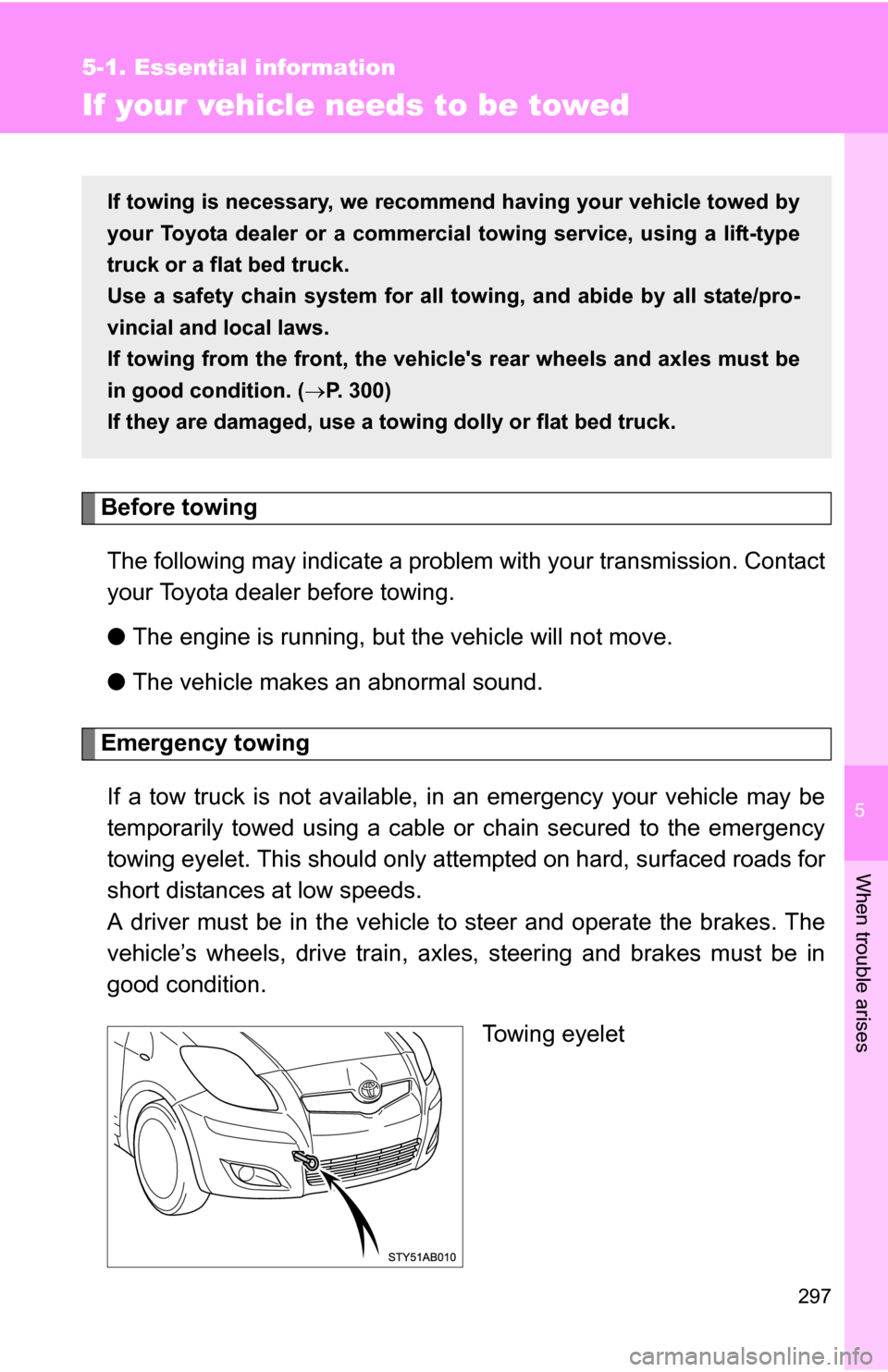
If a tow truck is not available, in an emergency your vehicle may be
temporarily towed using a cable or chain secured to the emergency
towing eyelet. This should only attempted on hard, surfaced roads for
short distances at low speeds.
A driver must be in the vehicle to steer and operate the brakes. The
vehicle’s wheels, drive train, axles, steering and brakes must be in
good condition.
Towing eyelet
If towing is necessary, we recommend having your vehicle towed by
your Toyota dealer or a commerci al towing service, using a lift-type
truck or a flat bed truck.
Use a safety chain system for all to wing, and abide by all state/pro-
vincial and local laws.
If towing from the front, the vehic le's rear wheels and axles must be
in good condition. (P. 300)
If they are damaged, use a towing dolly or flat bed truck.
Page 354 of 392
354 6-1. Specifications
■Toyota recommends the use of gaso line containing detergent additives
● Toyota recommends the use of gasoline that contains detergent additives
to avoid build-up of engine deposits.
● All gasoline sold in the US contains detergent additives to clean and/or
keep clean intake systems.
■ Toyota recommends the use of cleaner burning gasoline
Cleaner burning gasoline, including reformulated gasoline that contains oxy-
genates such as ethanol or MTBE (Methyl Tertiary Butyl Ether) is available in
many areas.
Toyota recommends the use of cleaner burning gasoline and appropriately
blended reformulated gasoline. These types of gasoline provide excellent
vehicle performance, reduce vehicle emissions and improve air quality.
■ Toyota does not recomm end blended gasoline
● Toyota allows the use of oxygenate blended gasoline where the oxygen-
ate content is up to 10 % ethanol or 15 % MTBE.
● If you use gasohol in your Toyota, be sure that it has an octane rating no
lower than 87.
● Toyota does not recommend the use of gasoline containing methanol.
■ Toyota does not recommen d gasoline containing MMT
Some gasoline contains octane enhancing additive called MMT (Methylcy-
clopentadienyl Manganese Tricarbonyl).
Toyota does not recommend the use of gasoline that contains MMT. If fuel
containing MMT is used, your emission control system may be adversely
affected.
The malfunction indicator lamp on the instrument cluster may come on. If
this happens, contact your Toyota dealer for service.
Page 362 of 392
362 6-1. Specifications
■Treadwear
The treadwear grade is a comparative rating based on the wear
rate of the tire when tested under controlled conditions on a speci-
fied government test course.
For example, a tire graded 150 would wear one and a half (1 - 1/2)
times as well on the government course as a tire graded 100.
The relative performance of tires depends upon the actual conditions
of their use, however, and may depart significantly from the norm due
to variations in driving habits, service practices and differences in road
characteristics and climate.
■Traction AA, A, B, C
The traction grades, from highest to lowest, are AA, A, B and C,
and they represent the tire’s ab ility to stop on wet pavement as
measured under controlled cond itions on specified government
test surfaces of asphalt and concrete.
A tire marked C may have poor traction performance.
Warning: The traction grade assigned to this tire is based on braking
(straight ahead) traction tests and does not include cornering (turning)
traction.
■ Temperature A, B, C
The temperature grades are A (the highest), B, and C, represent-
ing the tire’s resistance to the generation of heat and its ability to
dissipate heat when tested under controlled conditions on a speci-
fied indoor laboratory test wheel.
Sustained high temperature can cause the material of the tire to
degenerate and reduce tire life, a nd excessive temperature can lead
to sudden tire failure.
The grade C corresponds to a level of performance which all passen-
ger car tires must meet under the Federal Motor Vehicle Safety Stan-
dard No. 109.
Grades B and A represent higher levels of performance on the labora-
tory test wheel than the minimum required by law.
Page 386 of 392
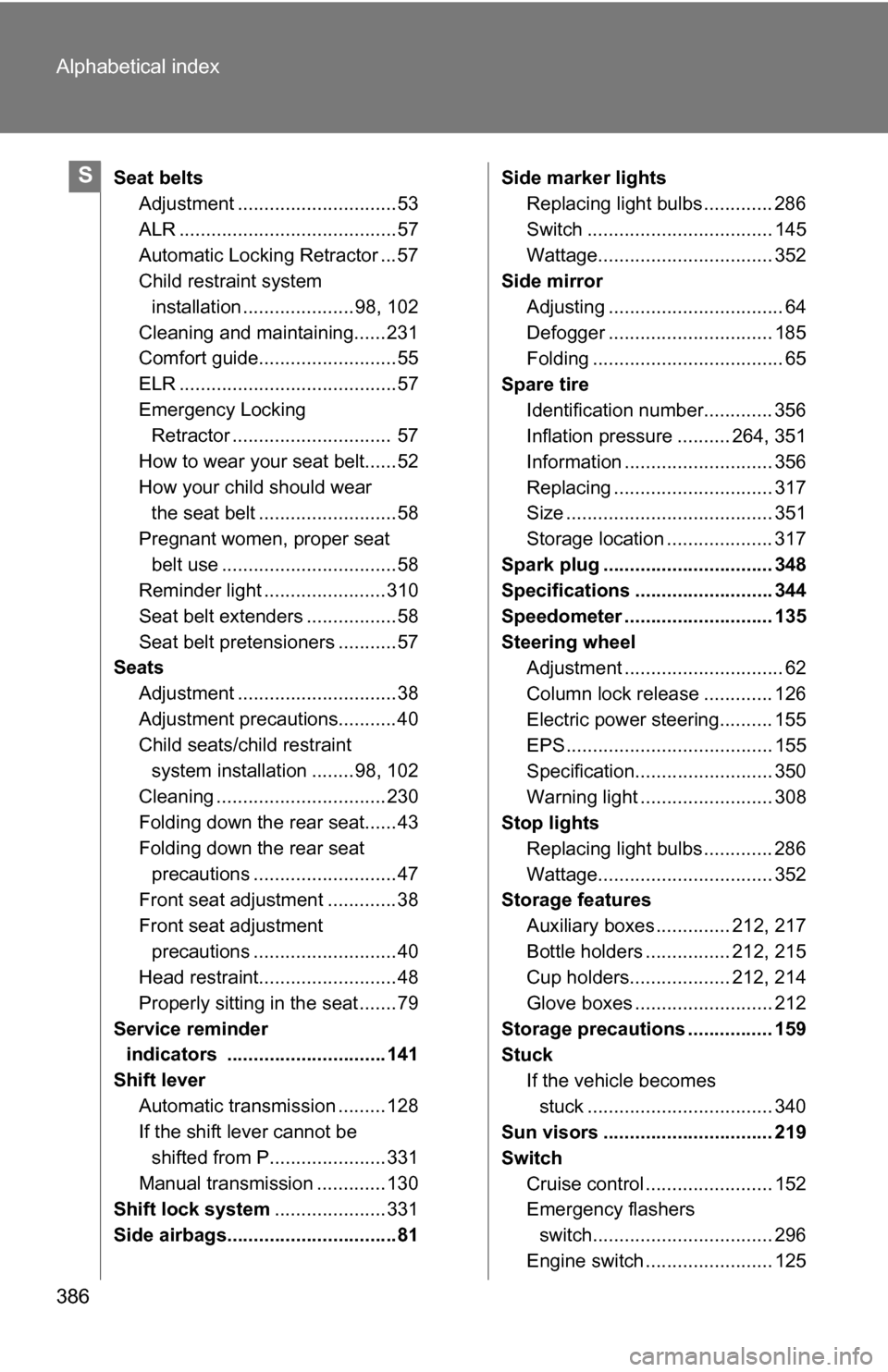
386 Alphabetical index
Seat beltsAdjustment ..............................53
ALR .........................................57
Automatic Locking Retractor ...57
Child restraint system
installation .....................98, 102
Cleaning and maintaining...... 231
Comfort guide..........................55
ELR .........................................57
Emergency Locking Retractor .............................. 57
How to wear your seat belt......52
How your child should wear the seat belt ..........................58
Pregnant women, proper seat belt use .................................58
Reminder light ....................... 310
Seat belt extenders .................58
Seat belt pretensioners ...........57
Seats
Adjustment ..............................38
Adjustment precautions........... 40
Child seats/child restraint system installation ........98, 102
Cleaning ................................ 230
Folding down the rear seat......43
Folding down the rear seat precautions ...........................47
Front seat adjustment .............38
Front seat adjustment
precautions ...........................40
Head restraint..........................48
Properly sitting in the seat .......79
Service reminder indicators .............................. 141
Shift lever Automatic transmission ......... 128
If the shift lever cannot be shifted from P...................... 331
Manual transmission ............. 130
Shift lock system ..................... 331
Side airbags................................81 Side marker lights
Replacing light bulbs ............. 286
Switch ................................... 145
Wattage................................. 352
Side mirror
Adjusting ................................. 64
Defogger ............................... 185
Folding .................................... 65
Spare tire Identification number............. 356
Inflation pressure .......... 264, 351
Information ............................ 356
Replacing .............................. 317
Size ....................................... 351
Storage location .................... 317
Spark plug ................................ 348
Specifications .......................... 344
Speedometer ............................ 135
Steering wheel Adjustment .............................. 62
Column lock release ............. 126
Electric power steering.......... 155
EPS ....................................... 155
Specification.......................... 350
Warning light ......................... 308
Stop lights
Replacing light bulbs ............. 286
Wattage................................. 352
Storage features
Auxiliary boxes .............. 212, 217
Bottle holders ................ 212, 215
Cup holders................... 212, 214
Glove boxes .......................... 212
Storage precautions ................ 159
Stuck If the vehicle becomes stuck ................................... 340
Sun visors ................................ 219
Switch
Cruise control ........................ 152
Emergency flashers switch.................................. 296
Engine switch ........................ 125S