Fuel TOYOTA YARIS 2009 2.G Owner's Manual
[x] Cancel search | Manufacturer: TOYOTA, Model Year: 2009, Model line: YARIS, Model: TOYOTA YARIS 2009 2.GPages: 392, PDF Size: 8.52 MB
Page 240 of 392
240 4-3. Do-it-yourself maintenance
CAUTION
The engine compartment contains many mechanisms and fluids that may
move suddenly, become hot, or become electrically energized. To avoid death
or serious injury observe the following precautions.
■When working on the engine compartment
●Keep hands, clothing, and tools away from the moving fan and engine
drive belt.
● Be careful not to touch the engine, radiator, exhaust manifold, etc. right
after driving as they may be hot. Oil and other fluids may also be hot.
● Do not leave anything that may burn easily, such as paper or rags, in the
engine compartment.
● Do not smoke, cause sparks or expose an open flame to fuel or the bat-
tery. Fuel and battery fumes are flammable.
● Be extremely cautious when working on the battery. It contains poisonous
and corrosive sulfuric acid.
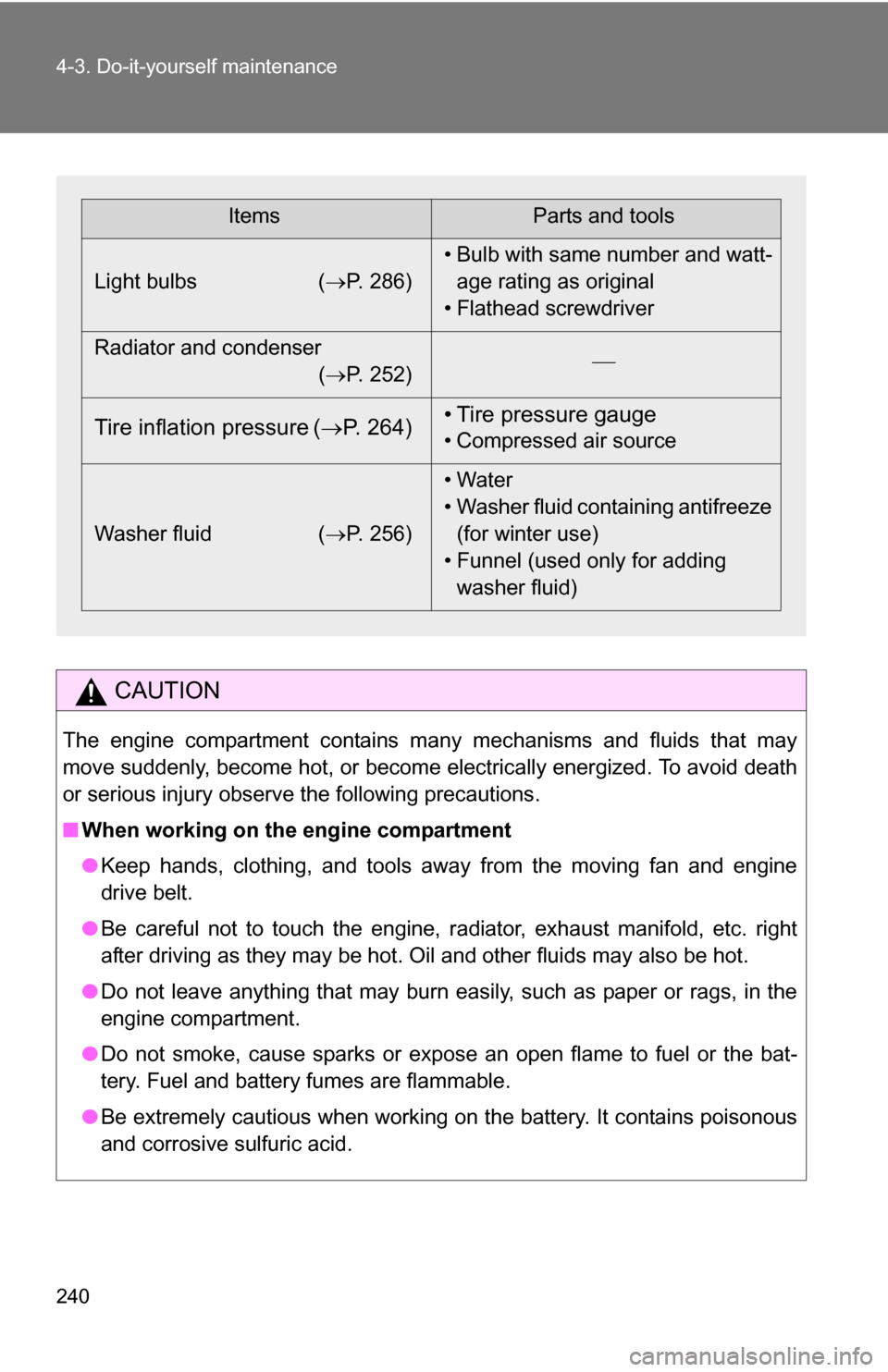
ItemsParts and tools
Light bulbs ( P. 286)• Bulb with same number and watt-
age rating as original
• Flathead screwdriver
Radiator and condenser (P. 252)
Tire inflation pressure (
P. 264) • Tire pressure gauge• Compressed air source
Washer fluid ( P. 256)• Water
• Washer fluid containing antifreeze
(for winter use)
• Funnel (used only for adding washer fluid)
Page 248 of 392
248 4-3. Do-it-yourself maintenance
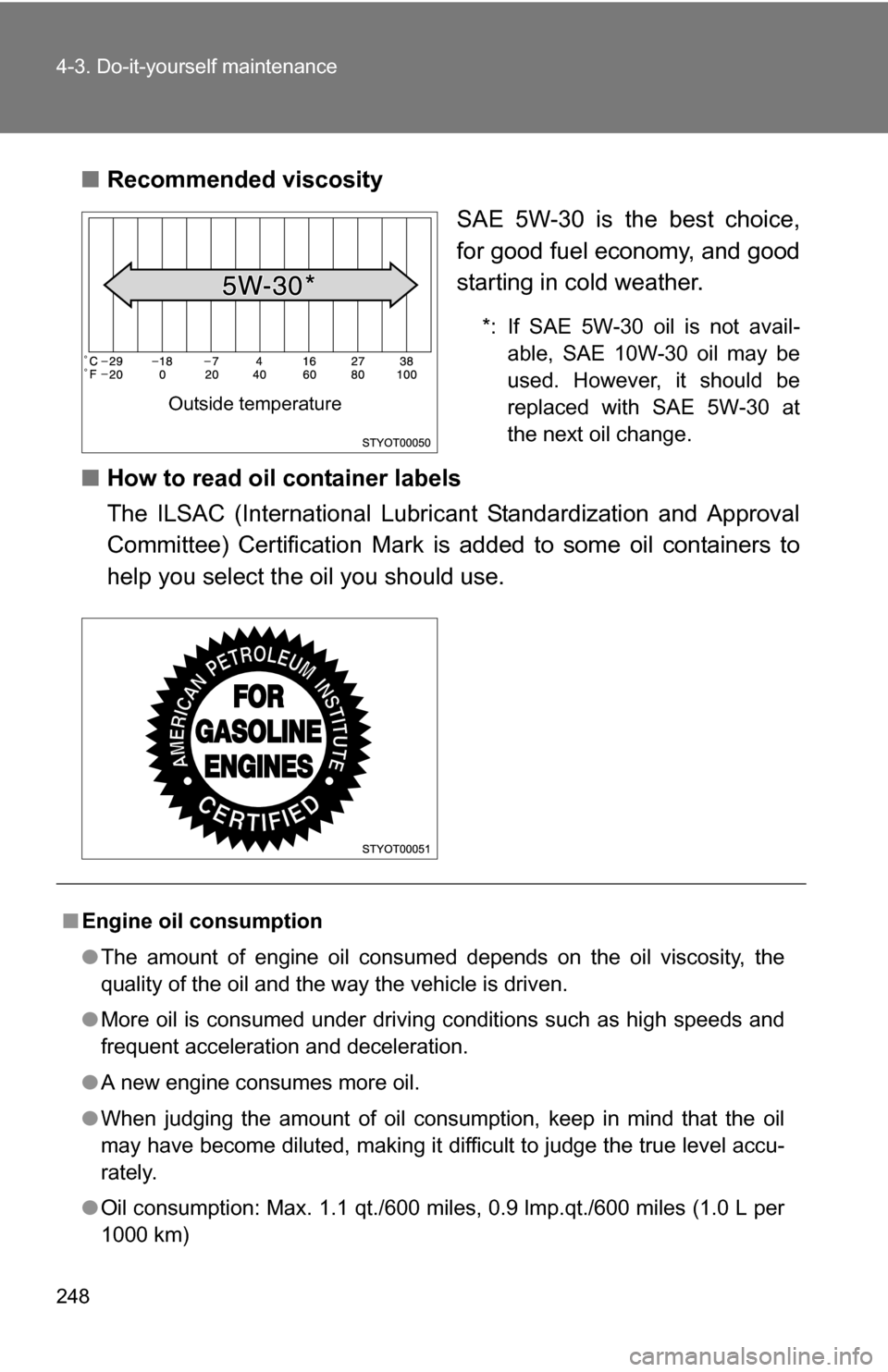
■Recommended viscosity
SAE 5W-30 is the best choice,
for good fuel economy, and good
starting in cold weather.
*: If SAE 5W-30 oil is not avail-able, SAE 10W-30 oil may be
used. However, it should be
replaced with SAE 5W-30 at
the next oil change.
■How to read oil container labels
The ILSAC (International Lubricant Standardization and Approval
Committee) Certification Mark is added to some oil containers to
help you select th e oil you should use.
Outside temperature
■Engine oil consumption
●The amount of engine oil consumed depends on the oil viscosity, the
quality of the oil and the way the vehicle is driven.
● More oil is consumed under driving conditions such as high speeds and
frequent acceleration and deceleration.
● A new engine consumes more oil.
● When judging the amount of oil consumption, keep in mind that the oil
may have become diluted, making it difficult to judge the true level accu-
rately.
● Oil consumption: Max. 1.1 qt./600 miles, 0.9 lmp.qt./600 miles (1.0 L per
1000 km)
Page 266 of 392
266 4-3. Do-it-yourself maintenance
■Tire inflation pressure check interval
You should check tire pressure every two weeks, or at least once a
month.
Do not forget to check the spare tire.
■Effects of incorrect tire inflation pressure
Driving with incorrect tire inflation pressure ma y result in the following:
●Reduced fuel efficiency
●Reduced driving comfort and tire life
●Reduced safety
●Damage to the drive train
If a tire needs frequent refilling, have it checked by your Toyota dealer.
■
Instructions for checking tire inflation pressure
When checking tire inflation pressure, observe the following:
●Check only when the tires are cold.
If your vehicle has been parked for at least 3 hours and has not been
driven for more than 1 mile or 1.5 km, you will get an accurate cold
tire inflation pressure reading.
●Always use a tire pressure gauge.
The appearance of the tire can be mi sleading. In addition, tire infla-
tion pressures that are even just a few pounds off can degrade ride
and handling.
●Do not bleed or reduce tire inflation pressure after driving. It is normal
for the tire inflation pressure to be higher after driving.
●Never exceed the vehicle capacity weight.
Passengers and luggage weight should be placed so that the vehicle
is balanced.
Page 280 of 392
280 4-3. Do-it-yourself maintenance
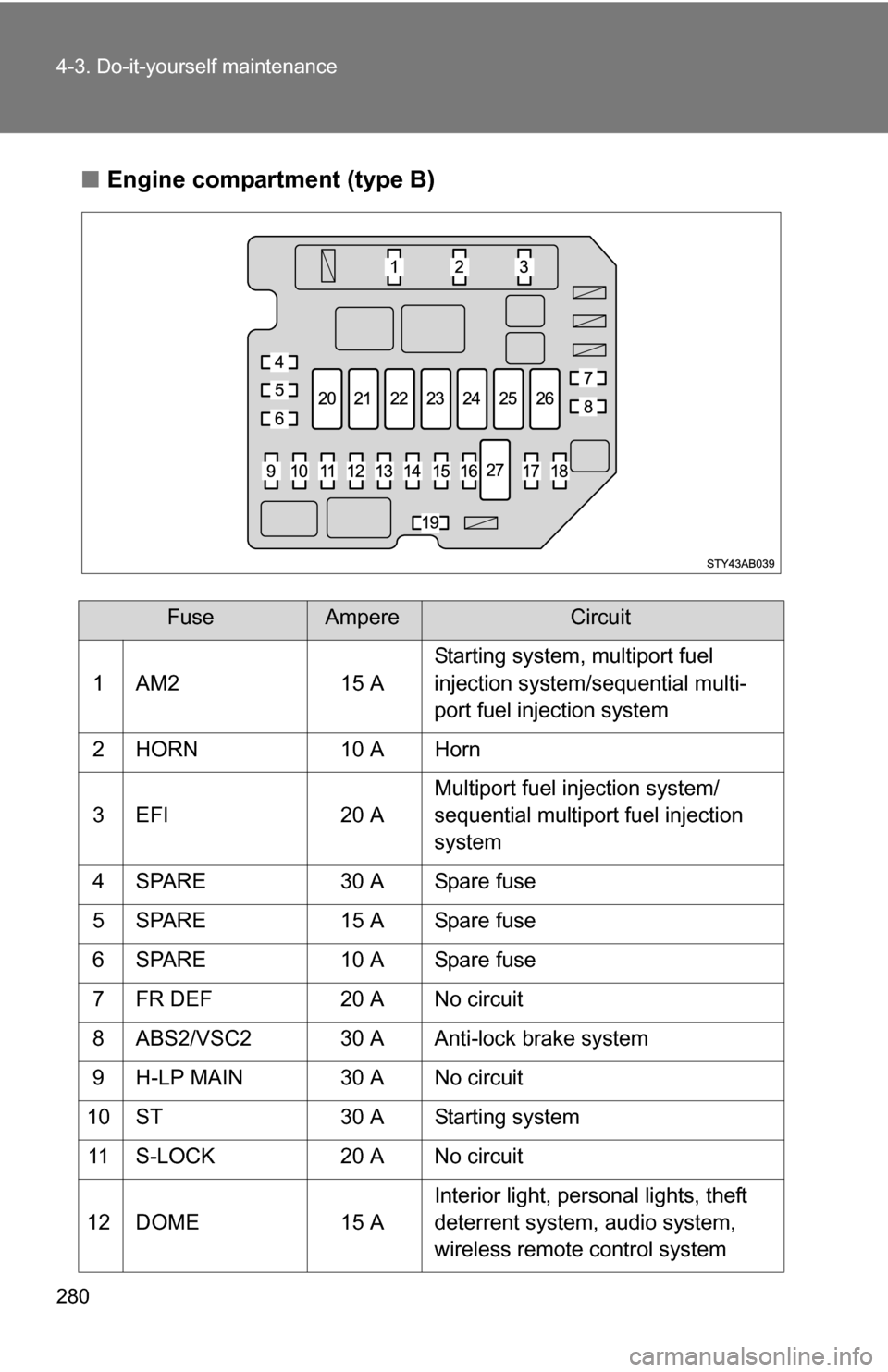
■Engine compartment (type B)
FuseAmpereCircuit
1 AM2 15 A Starting system, multiport fuel
injection system/sequential multi-
port fuel injection system
2 HORN 10 A Horn
3 EFI 20 A Multiport fuel injection system/
sequential multiport fuel injection
system
4 SPARE 30 A Spare fuse
5 SPARE 15 A Spare fuse
6 SPARE 10 A Spare fuse
7 FR DEF 20 A No circuit
8 ABS2/VSC2 30 A Anti-lock brake system
9 H-LP MAIN 30 A No circuit
10 ST 30 A Starting system 11 S-LOCK 20 A No circuit
12 DOME 15 A Interior light, personal lights, theft
deterrent system, audio system,
wireless remote control system
Page 281 of 392
281
4-3. Do-it-yourself maintenance
4
Maintenance and care
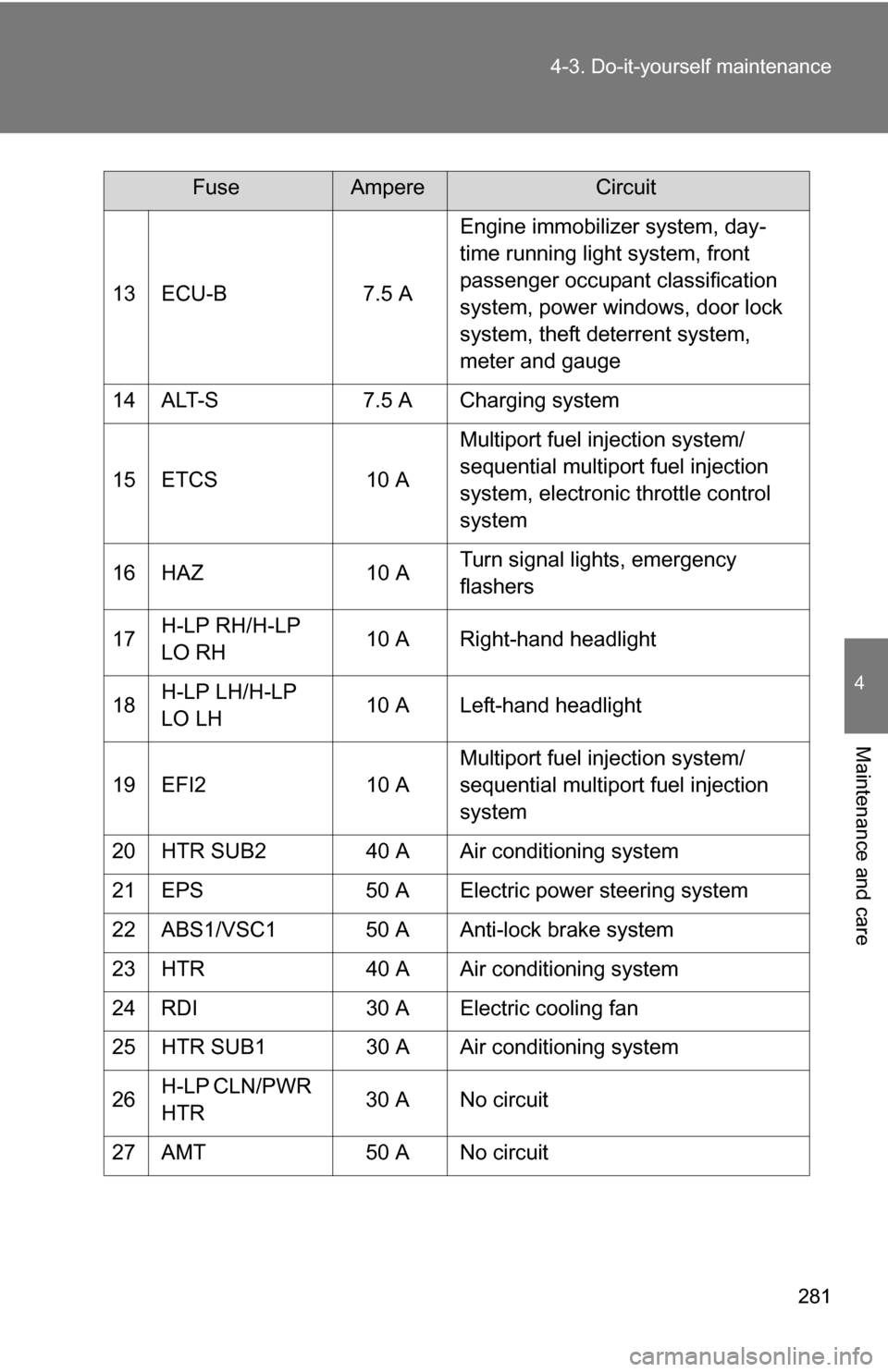
13 ECU-B
7.5 AEngine immobilizer system, day-
time running light system, front
passenger occupant classification
system, power windows, door lock
system, theft deterrent system,
meter and gauge
14 ALT-S 7.5 A Charging system
15 ETCS 10 AMultiport fuel injection system/
sequential multiport fuel injection
system, electronic throttle control
system
16 HAZ 10 ATurn signal lights, emergency
flashers
17 H-LP RH/H-LP
LO RH 10 A Right-hand headlight
18 H-LP LH/H-LP
LO LH 10 A Left-hand headlight
19 EFI2 10 AMultiport fuel injection system/
sequential multiport fuel injection
system
20 HTR SUB2 40 A Air conditioning system
21 EPS 50 A Electric power steering system
22 ABS1/VSC1 50 A Anti-lock brake system
23 HTR 40 A Air conditioning system
24 RDI 30 A Electric cooling fan
25 HTR SUB1 30 A Air conditioning system
26 H-LP CLN/PWR
HTR 30 A No circuit
27 AMT 50 A No circuit
FuseAmpereCircuit
Page 283 of 392
283
4-3. Do-it-yourself maintenance
4
Maintenance and care
■
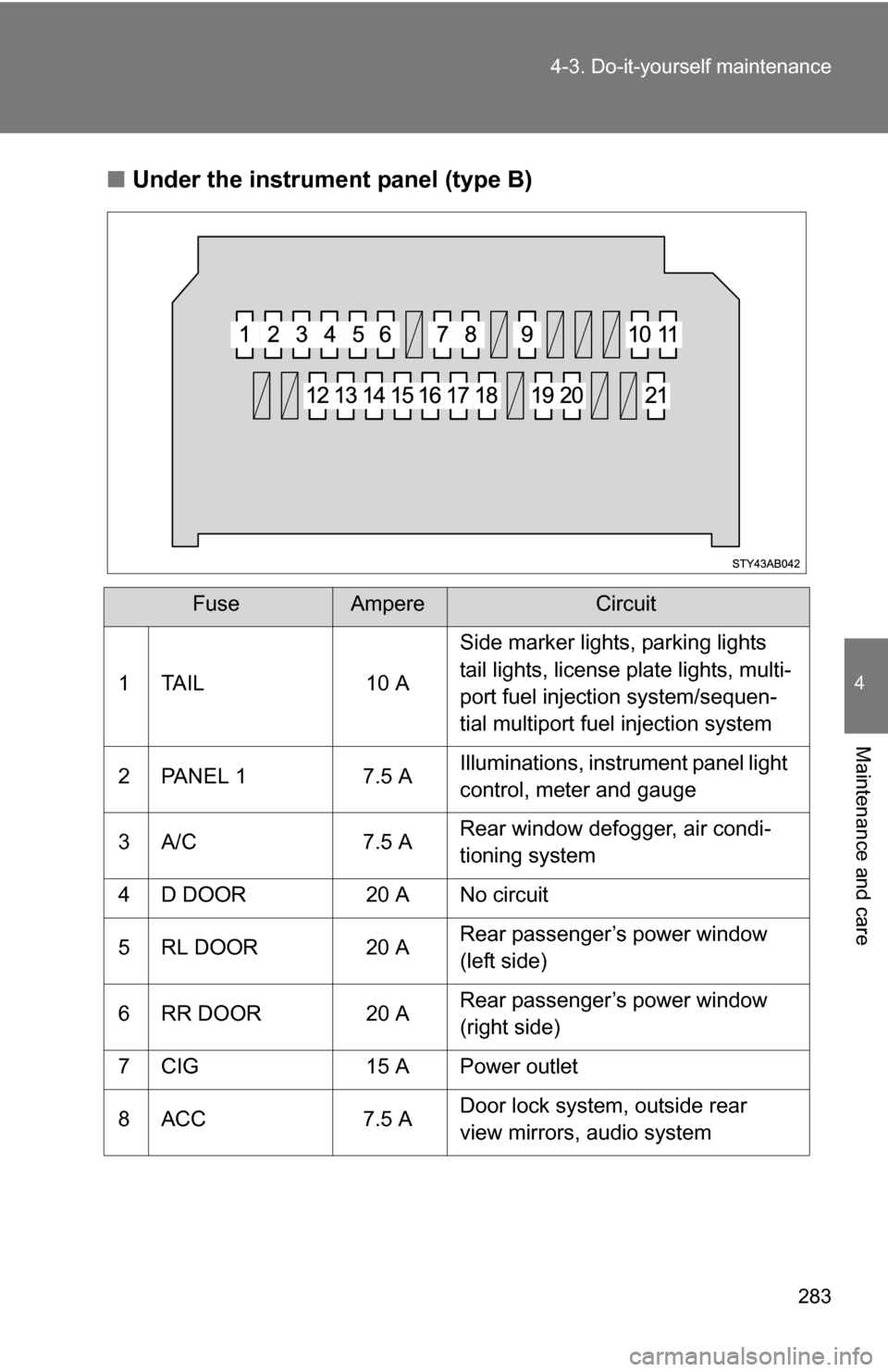
Under the instrument panel (type B)
FuseAmpereCircuit
1 TAIL 10 A Side marker lights, parking lights
tail lights, license plate lights, multi-
port fuel injection system/sequen-
tial multiport fuel injection system
2 PANEL 1 7.5 A Illuminations, instrument panel light
control, meter and gauge
3 A/C 7.5 A Rear window defogger, air condi-
tioning system
4 D DOOR 20 A No circuit
5 RL DOOR 20 A Rear passenger’s power window
(left side)
6 RR DOOR 20 A Rear passenger’s power window
(right side)
7 CIG 15 A Power outlet
8 ACC 7.5 A Door lock system, outside rear
view mirrors, audio system
Page 284 of 392
284 4-3. Do-it-yourself maintenance
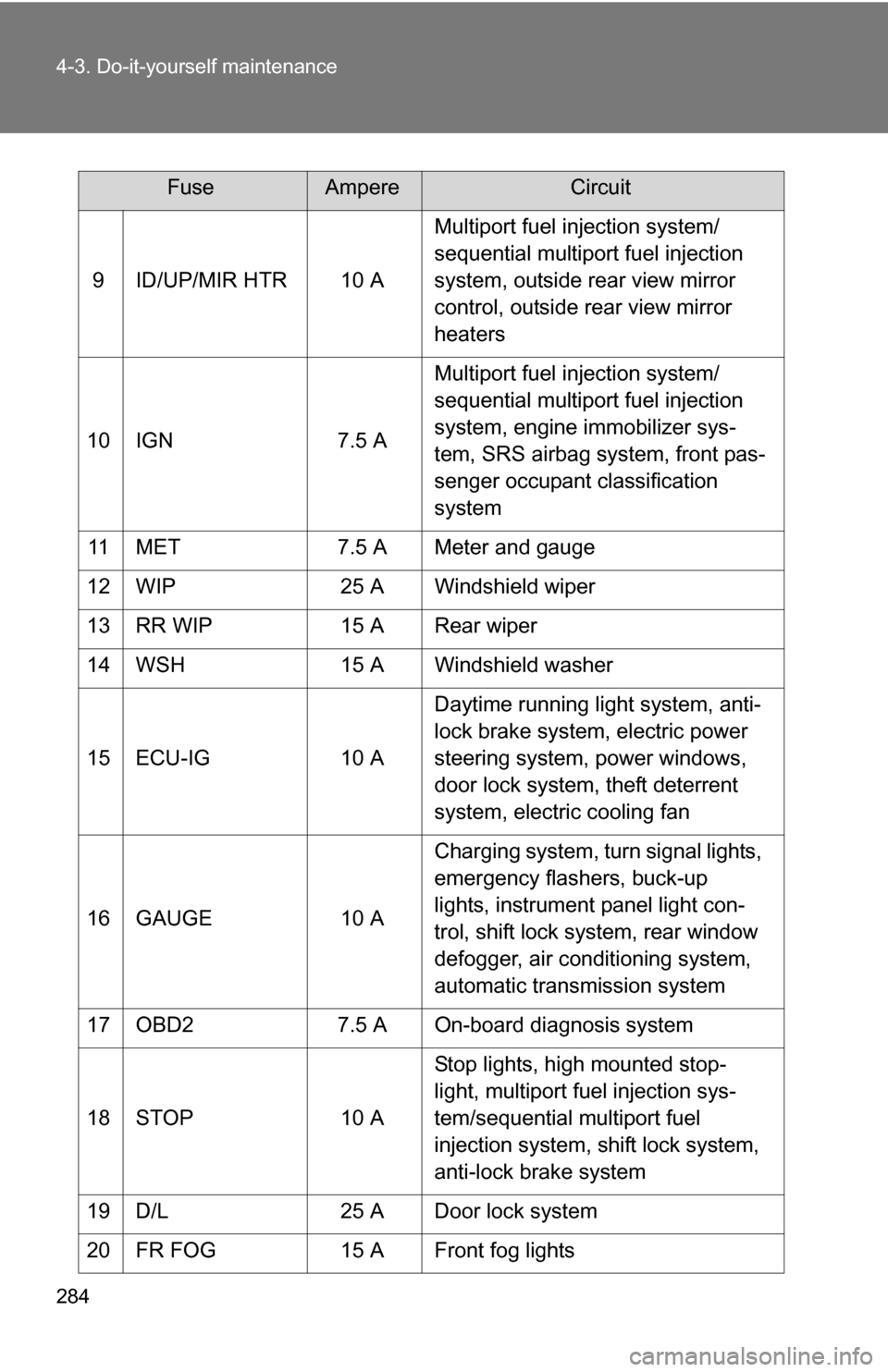
9 ID/UP/MIR HTR 10 AMultiport fuel injection system/
sequential multiport fuel injection
system, outside rear view mirror
control, outside rear view mirror
heaters
10 IGN 7.5 A Multiport fuel injection system/
sequential multiport fuel injection
system, engine immobilizer sys-
tem, SRS airbag system, front pas-
senger occupant classification
system
11 MET 7.5 A Meter and gauge
12 WIP 25 A Windshield wiper
13 RR WIP 15 A Rear wiper
14 WSH 15 A Windshield washer
15 ECU-IG 10 A Daytime running light system, anti-
lock brake system, electric power
steering system, power windows,
door lock system, theft deterrent
system, electric cooling fan
16 GAUGE 10 A Charging system, turn signal lights,
emergency flashers, buck-up
lights, instrument panel light con-
trol, shift lock system, rear window
defogger, air conditioning system,
automatic transmission system
17 OBD2 7.5 A On-board diagnosis system
18 STOP 10 A Stop lights, high mounted stop-
light, multiport fuel injection sys-
tem/sequential multiport fuel
injection system, shift lock system,
anti-lock brake system
19 D/L 25 A Door lock system
20 FR FOG 15 A Front fog lights
FuseAmpereCircuit
Page 285 of 392
285
4-3. Do-it-yourself maintenance
4
Maintenance and care
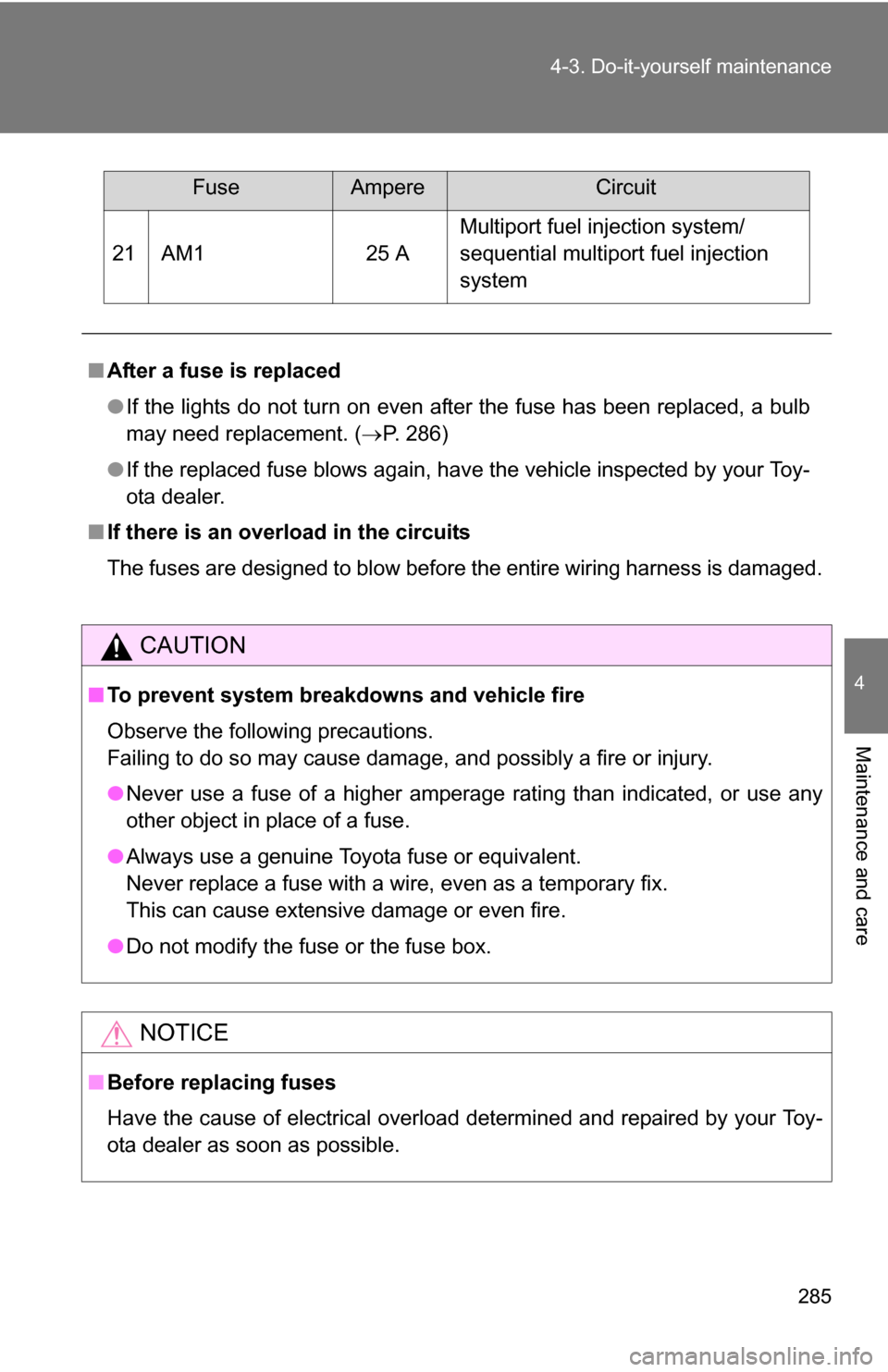
21 AM1
25 AMultiport fuel injection system/
sequential multiport fuel injection
system
■ After a fuse is replaced
●If the lights do not turn on even after the fuse has been replaced, a bulb
may need replacement. ( P. 286)
● If the replaced fuse blows again, have the vehicle inspected by your Toy-
ota dealer.
■ If there is an overload in the circuits
The fuses are designed to blow before the entire wiring harness is damaged.
CAUTION
■To prevent system breakdowns and vehicle fire
Observe the following precautions.
Failing to do so may cause damage, and possibly a fire or injury.
●Never use a fuse of a higher amperage rating than indicated, or use any
other object in place of a fuse.
● Always use a genuine Toyota fuse or equivalent.
Never replace a fuse with a wire, even as a temporary fix.
This can cause extensive damage or even fire.
● Do not modify the fuse or the fuse box.
NOTICE
■Before replacing fuses
Have the cause of electrical overload determined and repaired by your Toy-
ota dealer as soon as possible.
FuseAmpereCircuit
Page 295 of 392
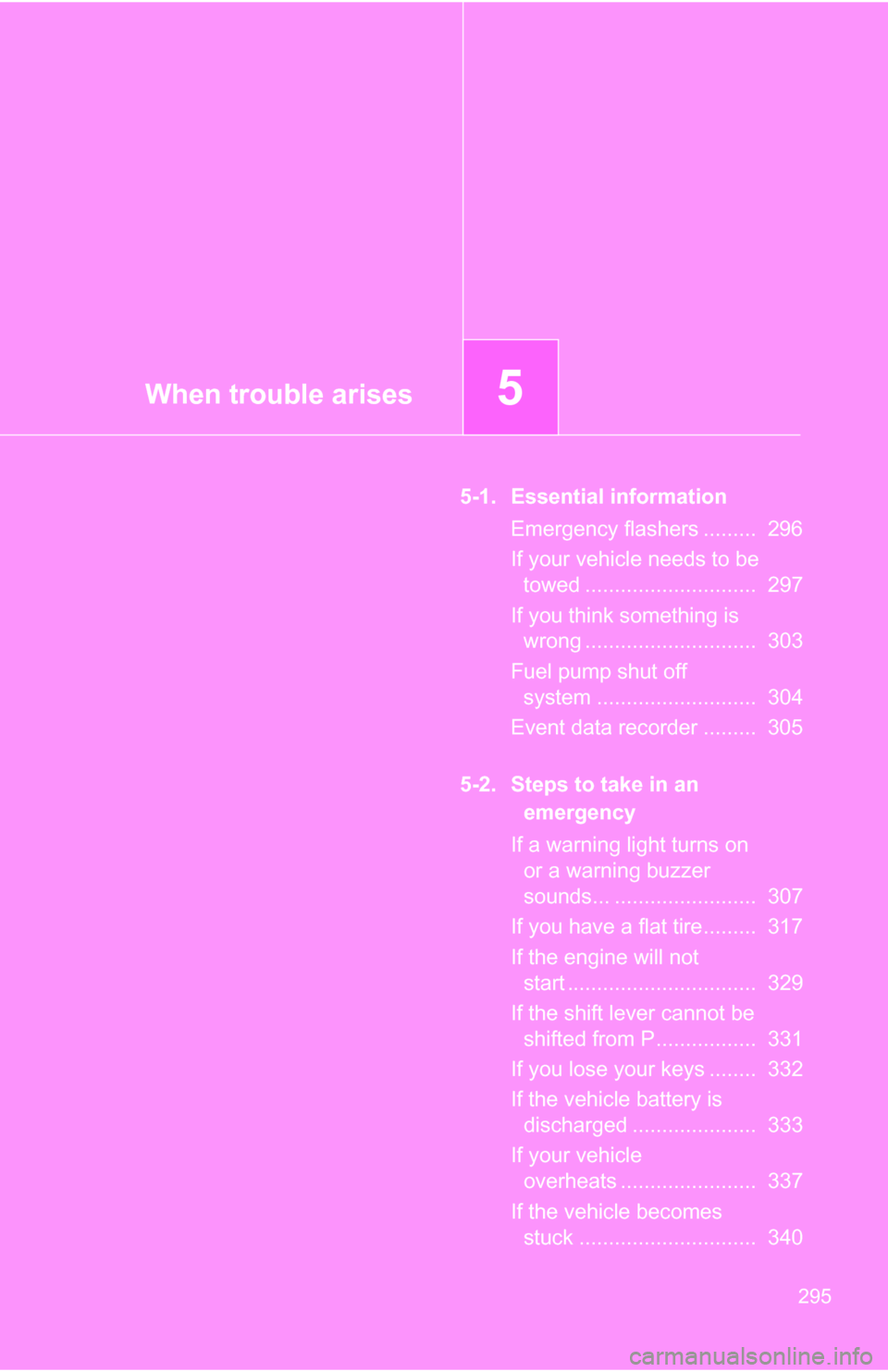
When trouble arises5
295
5-1. Essential informationEmergency flashers ......... 296
If your vehicle needs to be towed ............................. 297
If you think something is wrong ............................. 303
Fuel pump shut off system ........................... 304
Event data recorder ......... 305
5-2. Steps to take in an emergency
If a warning light turns on or a warning buzzer
sounds... ........................ 307
If you have a flat tire......... 317
If the engine will not start ................................ 329
If the shift lever cannot be shifted from P................. 331
If you lose your keys ........ 332
If the vehicle battery is discharged ..................... 333
If your vehicle overheats ....................... 337
If the vehicle becomes stuck .............................. 340
Page 304 of 392
304
5-1. Essential information
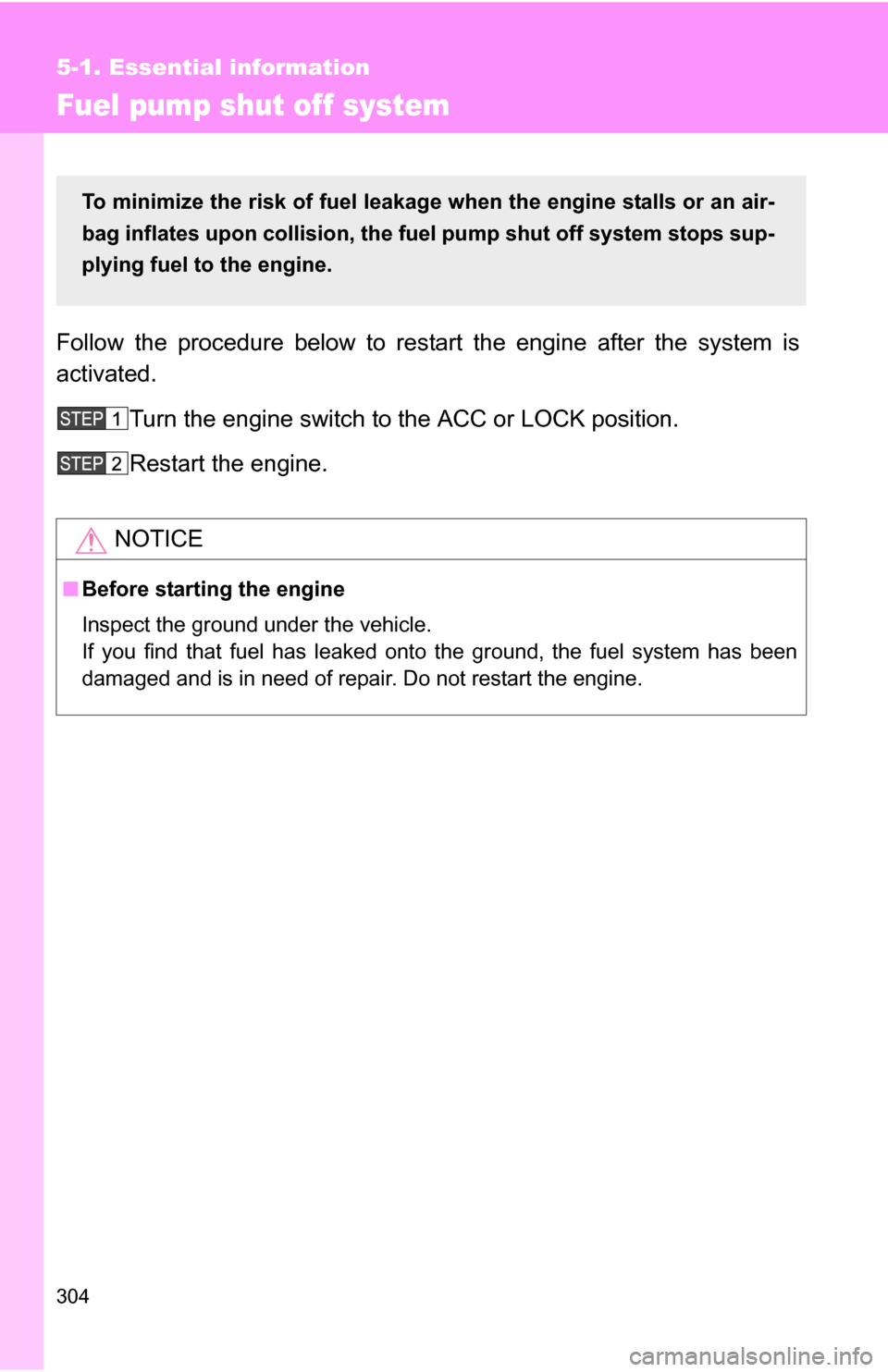
Fuel pump shut off system
Follow the procedure below to restart the engine after the system is
activated.Turn the engine switch to the ACC or LOCK position.
Restart the engine.
NOTICE
■Before starting the engine
Inspect the ground under the vehicle.
If you find that fuel has leaked onto the ground, the fuel system has been
damaged and is in need of repair. Do not restart the engine.
To minimize the risk of fuel leakage when the engine stalls or an air-
bag inflates upon collision, the fuel pump shut off system stops sup-
plying fuel to the engine.