window TOYOTA YARIS 2010 3.G User Guide
[x] Cancel search | Manufacturer: TOYOTA, Model Year: 2010, Model line: YARIS, Model: TOYOTA YARIS 2010 3.GPages: 400, PDF Size: 11.4 MB
Page 71 of 400

71
1
Before driving
1-4. Opening and closing the windows
Power windows
: If equipped
The power windows can be opened/closed using the following
switches.
Driver’s power window switches (3-door models)
Closing
Opening
One-touch opening (driver’s
window only)
*
*:Pressing the switch in the
opposite direction will stop win-
dow travel partway.
Driver’s power window switches (5-door models)
Closing
Opening
One-touch opening (driver’s
window only)
*
*: Pressing the switch in the
opposite direction will stop win-
dow travel partway.
Front passenger’s power window switch
Closing
Opening
Page 72 of 400
72 1-4. Opening and closing the windows
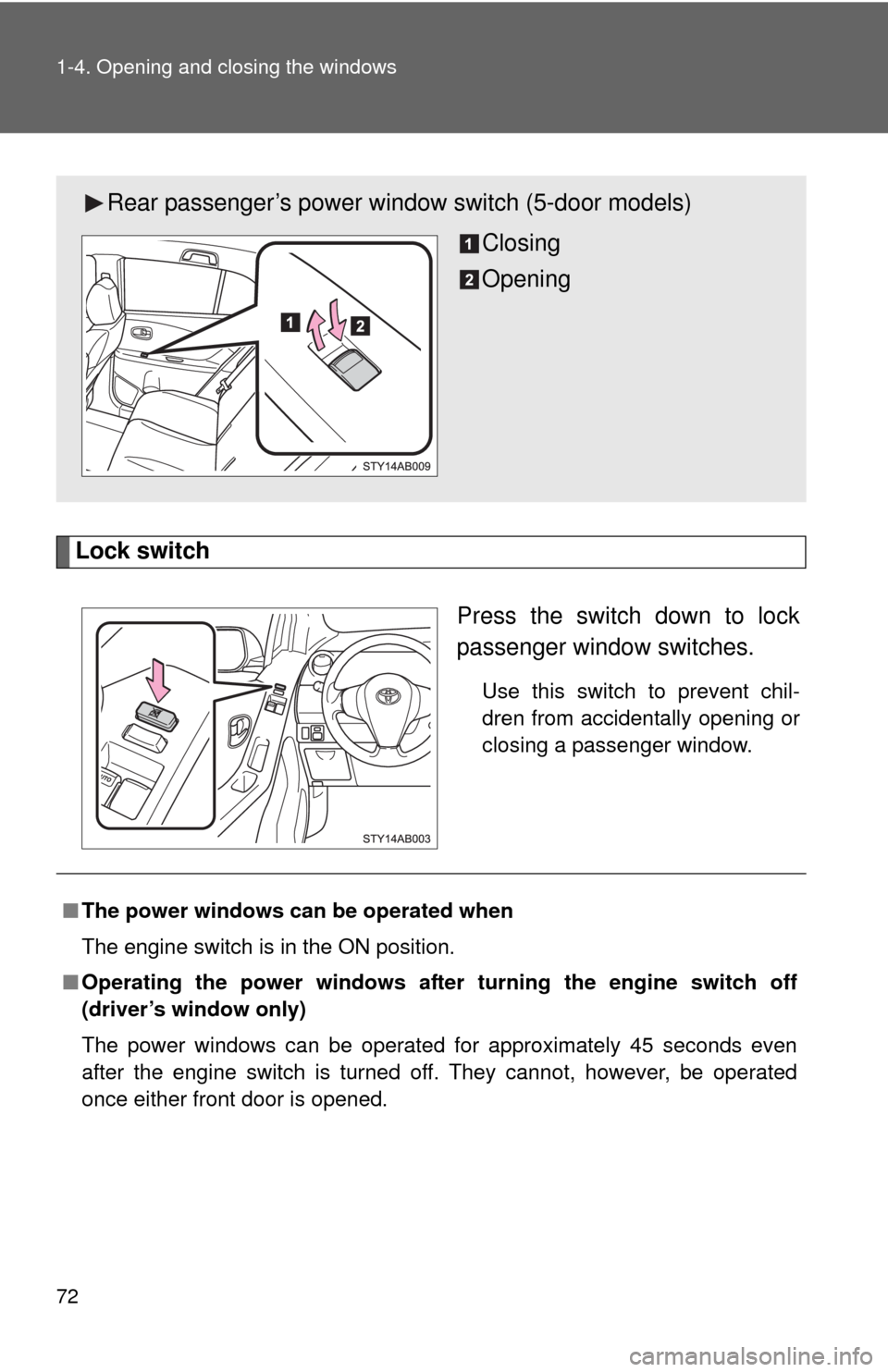
Lock switch
Press the switch down to lock
passenger window switches.
Use this switch to prevent chil-
dren from accidentally opening or
closing a passenger window.
Rear passenger’s power window switch (5-door models)
Closing
Opening
■The power windows can be operated when
The engine switch is in the ON position.
■Operating the power windows after turning the engine switch off
(driver’s window only)
The power windows can be operated for approximately 45 seconds even
after the engine switch is turned off. They cannot, however, be operated
once either front door is opened.
Page 73 of 400

73 1-4. Opening and closing the windows
1
Before driving
CAUTION
■Closing the windows
Observe the following precautions.
Failing to do so may result in death or serious injury.
●Check to make sure that all passengers do not have any part of their body
in a position where it could be caught when a window is being operated.
●Do not allow children to operate the power windows.
Closing a power window on someone can cause serious injury, and in
some instances, even death.
Page 81 of 400

81 1-6. Theft deterrent system
1
Before driving
■System maintenance
The vehicle has a maintenance-free type alarm system.
■Items to check before locking the vehicle
To prevent unexpected triggering of the alarm and vehicle theft, make sure
of the following.
●Nobody is in the vehicle.
●The windows are closed before the alarm is set.
●No valuables or other personal items are left in the vehicle.
■Triggering of the alarm
The alarm may be triggered in the following situations.
(Stopping the alarm deactivates the system.)
●A person inside the vehicle opens a door or hood.
●The battery is recharged or replaced when the vehicle is locked.
■When the battery is disconnected
Be sure to cancel the alarm system.
If the battery is disconnected before canceling the alarm, the system may be
triggered when the battery is reconnected.
■Alarm-operated door lock
●When the alarm is operating, the doors are locked automatically to pre-
vent intruders.
●Do not leave the key inside the vehicle when the alarm is operating, and
make sure the key is not inside the vehicle when recharging or replacing
the battery.
NOTICE
■To ensure the system operates correctly
Do not modify or remove the system. If modified or removed, the proper
operation of the system cannot be guaranteed.
Page 95 of 400

95 1-7. Safety information
1
Before driving
CAUTION
■SRS airbag precautions
●Vehicles with side airbags: Do not use seat accessories which cover the
parts where the SRS side airbags inflate as they may interfere with infla-
tion of the airbags.
●Do not strike or apply significant levels of force to the area of the SRS air-
bag components shown on P. 86.
Doing so can cause the SRS airbags to malfunction.
●Do not touch any of the component parts immediately after the SRS air-
bags have deployed (inflated) as they may be hot.
●If breathing becomes difficult after the SRS airbag has deployed, open a
door or window to allow fresh air in, or leave the vehicle if it is safe to do
so. Wash off any residue as soon as possible to prevent skin irritation.
●Vehicles with curtain shield airbags: If the areas where the SRS airbags
are stored, such as the steering wheel pad and front and rear pillar gar-
nishes, are damaged or cracked, have them replaced by your Toyota
dealer.
●Vehicles without curtain shield airbags: If the areas where the SRS airbags
are stored, such as the steering wheel pad are damaged or cracked, have
them replaced by your Toyota dealer.
●Do not attach anything to or lean any-
thing against areas such as the dash-
board or steering wheel pad.
These items can become projectiles
when SRS driver and front passenger
airbags deploy.
●Vehicles with side airbags and curtain
shield airbags: Do not attach anything
to areas such as the door, windshield
glass, side door glass, front and rear
pillars, roof side rail or assist grip.
Page 119 of 400
When driving2
119
2-1. Driving procedures
Driving the vehicle............ 120
Engine (ignition) switch .... 129
Automatic
Transmission.... 132
Manual Transmission ....... 134
Turn signal lever .............. 135
Parking brake ................... 136
Horn ................................. 138
2-2. Instrument cluster
Gauges and meters ......... 139
Indicators and warning
lights .............................. 145
2-3. Operating the lights and
wipers
Headlight switch ............... 149
Fog light switch ................ 151
Windshield wipers and
washer ........................... 152
Rear window wiper and
washer ........................... 155
2-4. Using other driving systems
Cruise control ................... 156
Driving assist systems ..... 1602-5. Driving information
Cargo and luggage .......... 165
Vehicle load limits ............ 168
Winter driving tips ............ 169
Trailer towing
(except Canada) ............ 172
Trailer towing (Canada) ... 173
Dinghy towing (vehicles
with an automatic
transmission) ................. 181
Dinghy towing (vehicles
with a manual
transmission) ................. 182
Page 122 of 400

122 2-1. Driving procedures
Manual transmission
With the parking brake firmly set and the clutch pedal fully
depressed, shift the shift lever to 1.
Lightly depress the accelerator pedal at the same time as
gradually releasing the clutch pedal.
Release the parking brake.
■Driving in the rain
●Drive carefully when it is raining, because visibility will be reduced, the
windows may become fogged-up, and the road will be slippery.
●Drive carefully when it starts to rain, because the road surface will be
especially slippery.
●Refrain from high speeds when driving on an expressway in the rain,
because there may be a layer of water between the tires and the road
surface, preventing the steering and brakes from operating properly.
■Breaking in your new Toyota
To extend the life of the vehicle, the following precautions are recommended
to observe:
●For the first 200 miles (300 km):
Avoid sudden stops.
●For the first 500 miles (800 km):
Do not tow a trailer.
●For the first 1000 miles (1600 km):
• Do not drive at extremely high speeds.
• Avoid sudden acceleration.
• Do not drive continuously in the low gears.
• Do not drive at a constant speed for extended periods.
■Operating your vehicle in a foreign country
Comply with the relevant vehicle registration laws and confirm the availability
of the correct fuel. (P. 354)
Page 123 of 400
123 2-1. Driving procedures
2
When driving
CAUTION
■When starting the vehicle
Vehicles with an automatic transmission, always keep your foot on the brake
pedal while stopped with the engine running. This prevents the vehicle from
creeping.
■When driving the vehicle
●Do not drive if you are unfamiliar with the location of the clutch, brake and
accelerator pedals to avoid depressing the wrong pedal.
• Accidentally depressing the accelerator pedal instead of the brake
pedal will result in sudden acceleration that may lead to an accident
that could result in death or serious injury.
• When backing up, you may twist your body around, leading to a diffi-
culty in operating the pedals. Make sure to operate the pedals properly.
• Make sure to keep a correct driving posture even when moving the
vehicle only slightly, allowing you to depress the brake and accelerator
pedals properly.
• Depress the brake pedal using your right foot. Depressing the brake
pedal using your left foot may delay response in an emergency, result-
ing in an accident.
●Do not drive the vehicle over or stop the vehicle near flammable materials.
The exhaust system and exhaust gases can be extremely hot. This may
cause a fire if there is any flammable material nearby.
●Vehicles with an automatic transmission, do not let the vehicle roll back-
wards while the shift lever is in a driving position, or roll forward while the
shift lever is in R.
Doing so may cause the engine to stall or lead to poor brake and steering
performance, resulting in an accident or damage to the vehicle.
●If the smell of exhaust is noticed inside the vehicle, open the windows and
check that the back door is closed. Large amounts of exhaust in the vehi-
cle can cause driver drowsiness and an accident, resulting in death or a
serious health hazard. Have the vehicle inspected by your Toyota dealer
immediately.
●Do not under any circumstances shift the shift lever to P, R or N (automatic
transmission) or R (manual transmission) while the vehicle is moving.
Doing so can cause significant damage to the transmission system and
may result in a loss of vehicle control.
Page 155 of 400
155
2-3. Operating the lights and wipers
2
When driving
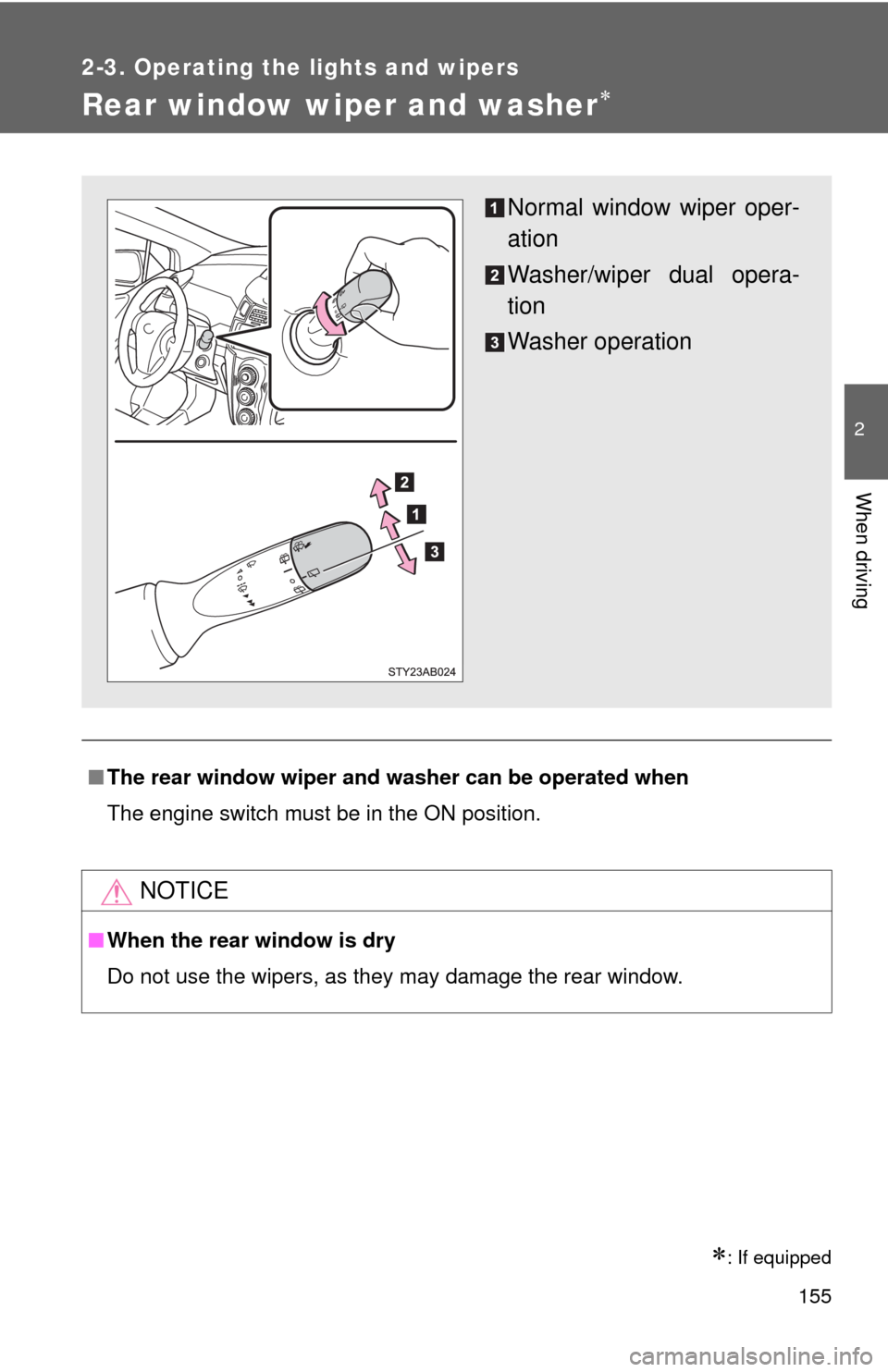
Rear window wiper and washer
: If equipped
■The rear window wiper and washer can be operated when
The engine switch must be in the ON position.
NOTICE
■When the rear window is dry
Do not use the wipers, as they may damage the rear window.
Normal window wiper oper-
ation
Washer/wiper dual opera-
tion
Washer operation
Page 169 of 400

169
2-5. Driving information
2
When driving
Winter driving tips
Carry out the necessary preparations and inspections before driving
the vehicle in winter. Always drive the vehicle in a manner appropri-
ate to the prevailing weather conditions.
■Pre-winter preparations
●Use fluids that are appropriate to the prevailing outside tem-
peratures.
• Engine oil
• Engine coolant
• Washer fluid
●Have a service technician inspect the level and specific grav-
ity of battery electrolyte.
●Have the vehicle fitted with four snow tires or purchase a set
of tire chains for the front tires.
Ensure that all tires are the same size and brand, and that chains
match the size of the tires.
■Before driving the vehicle
Perform the following according to the driving conditions.
●Do not try to forcibly open a window, scrape an outside rear
view mirror surface or move a wiper or outside rear view mir-
ror that is frozen. Pour warm water over the frozen area to
melt the ice. Wipe away the water immediately to prevent it
from freezing.
●To ensure proper operation of the climate control system fan,
remove any snow that has accumulated on the air inlet vents
in front of the windshield.
●Remove any ice that has accumulated on the vehicle chassis.
●Periodically check for and remove any excess ice or snow
that may have accumulated in the wheel well or on the
brakes.