Fuel TOYOTA YARIS 2010 3.G Owners Manual
[x] Cancel search | Manufacturer: TOYOTA, Model Year: 2010, Model line: YARIS, Model: TOYOTA YARIS 2010 3.GPages: 400, PDF Size: 11.4 MB
Page 2 of 400

TABLE OF CONTENTSIndex
2
1-1. Key information
Keys ..................................... 26
1-2. Opening, closing and locking
the doors
Wireless remote control ....... 28
Side doors ............................ 31
Back door ............................. 36
1-3. Adjustable components
(seats, mirrors, steering
wheel)
Front seats ........................... 40
Rear seats ............................ 43
Head restraints ..................... 50
Seat belts ............................. 56
Steering wheel ..................... 66
Anti-glare inside rear view
mirror .................................. 67
Outside rear view mirrors ..... 68
1-4. Opening and closing the
windows
Power windows .................... 71
1-5. Refueling
Opening the fuel tank cap .... 74
1-6. Theft deterrent system
Engine immobilizer
system ................................ 78
Alarm (Puerto Rico).............. 80
Theft prevention labels
(except Canada) ................ 821-7. Safety information
Correct driving posture ......... 83
SRS airbags ......................... 85
Front passenger occupant
classification system ........... 97
Child restraint systems ....... 102
Installing child restraints ..... 106
2-1. Driving procedures
Driving the vehicle .............. 120
Engine (ignition) switch....... 129
Automatic
Transmission...... 132
Manual Transmission ......... 134
Turn signal lever ................. 135
Parking brake ..................... 136
Horn .................................... 138
2-2. Instrument cluster
Gauges and meters ............ 139
Indicators and warning
lights ................................. 145
2-3. Operating the lights and
wipers
Headlight switch ................. 149
Fog light switch ................... 151
Windshield wipers and
washer .............................. 152
Rear window wiper and
washer .............................. 155
2-4. Using other driving systems
Cruise control ..................... 156
Driving assist systems ........ 160
1Before driving
2When driving
Page 4 of 400

TABLE OF CONTENTSIndex
4
4-3. Do-it-yourself maintenance
Do-it-yourself service
precautions ...................... 247
Hood................................... 250
Positioning a floor jack ....... 251
Engine compartment .......... 253
Tires ................................... 266
Tire inflation pressure......... 272
Wheels ............................... 276
Air conditioning filter ........... 278
Key battery ......................... 281
Checking and replacing
fuses ................................ 283
Light bulbs .......................... 294
5-1. Essential information
Emergency flashers ........... 304
If your vehicle needs to be
towed ............................... 305
If you think something is
wrong ............................... 311
Fuel pump shut off
system .............................. 312
Event data recorder............ 3135-2. Steps to take in an emergency
If a warning light turns on
or a warning buzzer
sounds... ........................... 315
If you have a flat tire ........... 325
If the engine will not start .... 337
If the shift lever cannot be
shifted from P ................... 339
If you lose your keys ........... 340
If the vehicle battery is
discharged ........................ 341
If your vehicle overheats..... 345
If the vehicle becomes
stuck ................................. 348
If your vehicle has to be
stopped in an
emergency........................ 350
6-1. Specifications
Maintenance data
(fuel, oil level, etc.) ........... 352
Fuel information .................. 361
Tire information................... 364
6-2. Customization
Customizable features ........ 377
Items to initialize ................. 379
5When trouble arises
6Vehicle specifications
Page 7 of 400
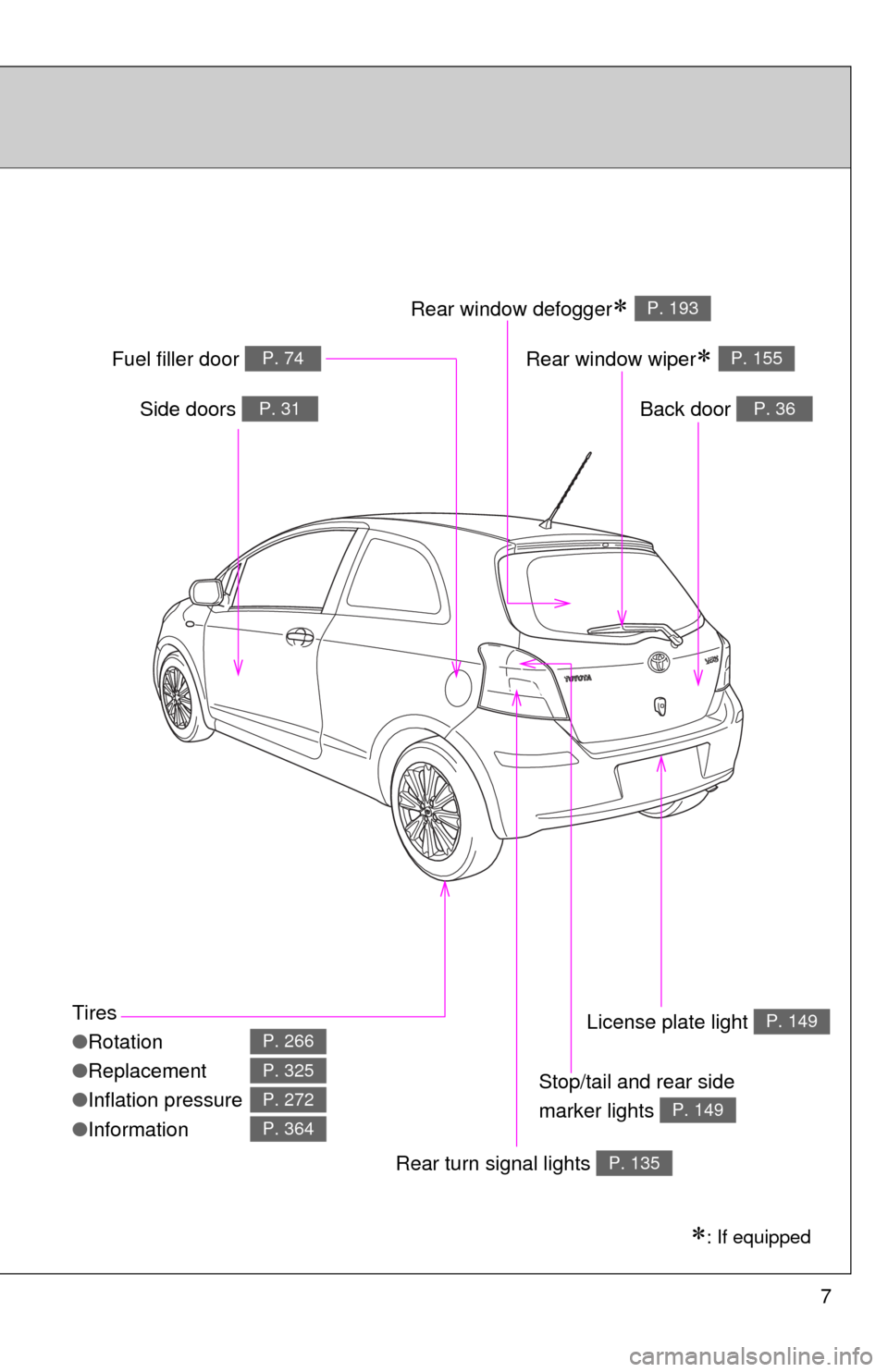
7
Tires
●Rotation
●Replacement
●Inflation pressure
●Information
P. 266
P. 325
P. 272
P. 364
: If equipped
Back door P. 36Side doors P. 31
Fuel filler door P. 74
Rear turn signal lights P. 135
Rear window defoggerP. 193
License plate light P. 149
Stop/tail and rear side
marker lights
P. 149
Rear window wiperP. 155
Page 9 of 400
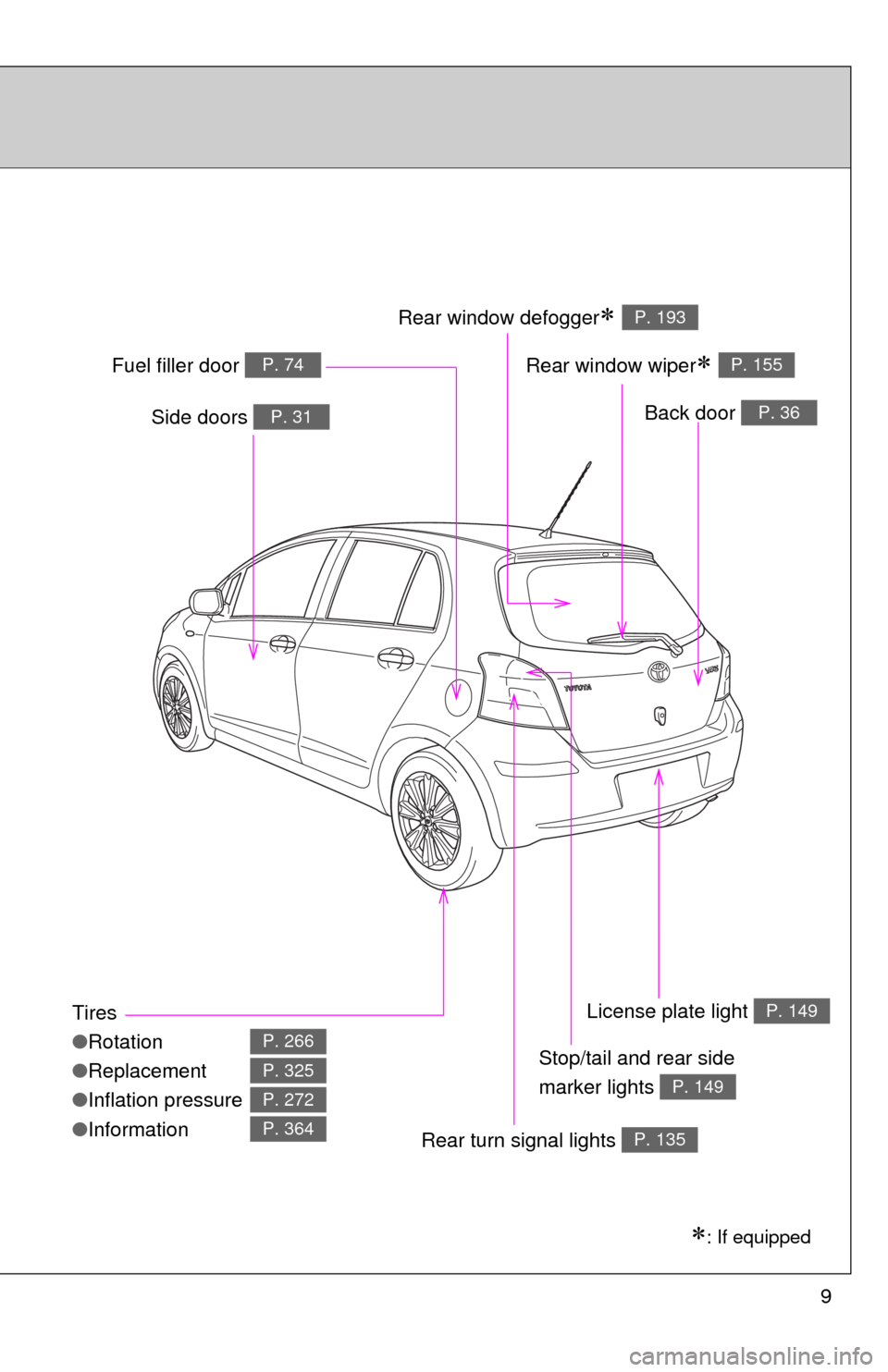
9
Tires
●Rotation
●Replacement
●Inflation pressure
●Information
P. 266
P. 325
P. 272
P. 364
: If equipped
Back door P. 36Side doors P. 31
Fuel filler door P. 74
Rear turn signal lights P. 135
Rear window defoggerP. 193
License plate light P. 149
Stop/tail and rear side
marker lights
P. 149
Rear window wiperP. 155
Page 15 of 400
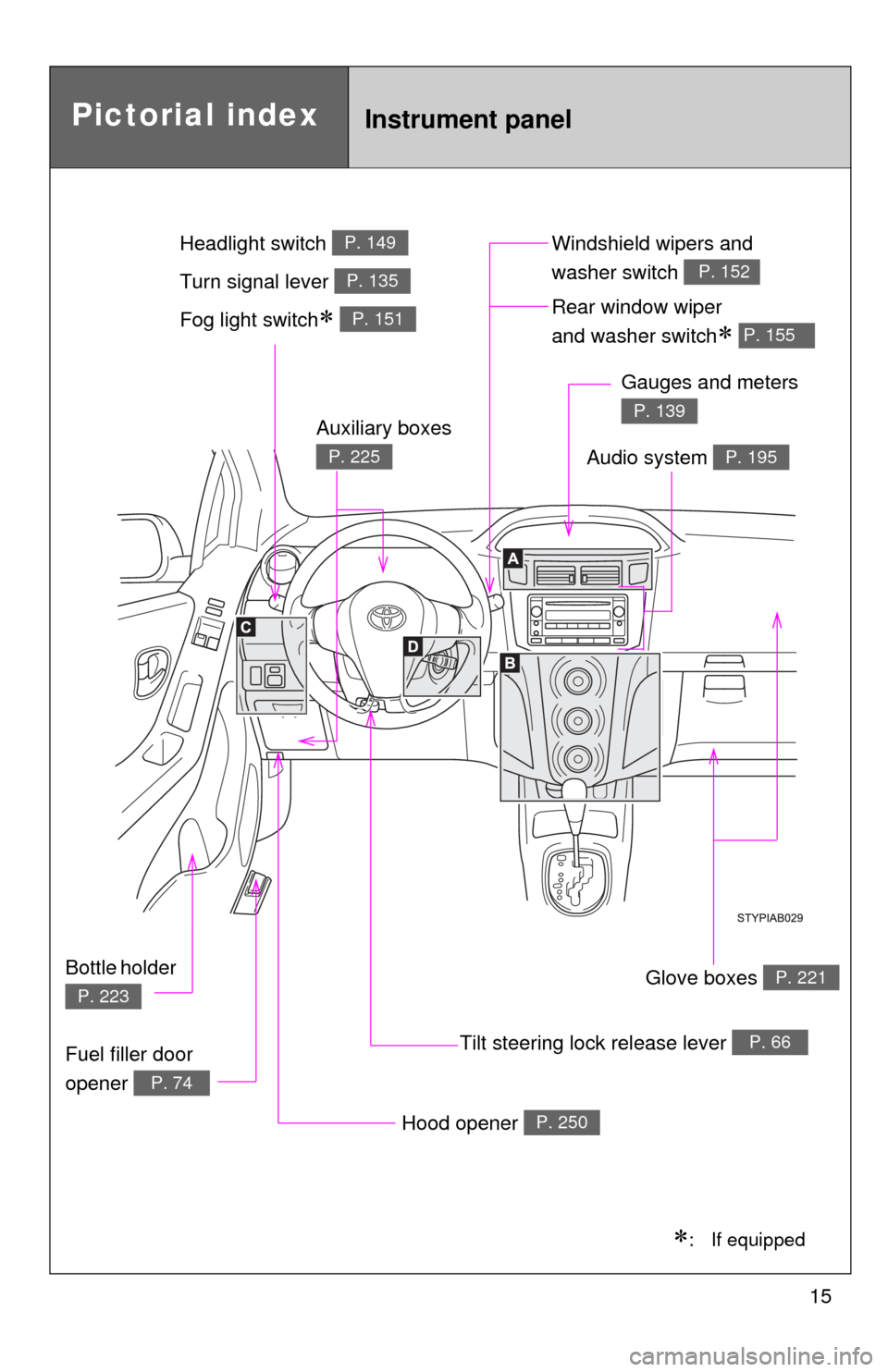
15
Pictorial indexInstrument panel
Fog light switch P. 151Rear window wiper
and washer switch
P. 155
Tilt steering lock release lever P. 66
Hood opener P. 250
Gauges and meters
P. 139
Audio system P. 195
Glove boxes P. 221
Fuel filler door
opener
P. 74
Auxiliary boxes
P. 225
Bottle holder
P. 223
Windshield wipers and
washer switch
P. 152Turn signal lever P. 135
Headlight switch P. 149
: If equipped
Page 20 of 400

20
For your information
Main Owners Manual
Please note that this manual applies to all models explains and all equip-
ment, including options. Therefore, you may find some explanations for
equipment not installed on your vehicle.
All specifications provided in this manual are current at the time of printing.
However, because of the Toyota policy of continual product improvement, we
reserve the right to make changes at any time without notice.
Depending on specifications, the vehicle shown in the illustrations may differ
from your vehicle in terms of equipment.
Noise from under vehicle after turning off the engine
Approximately five hours after the engine is turned off, you may hear sound
coming from under the vehicle for several minutes. This is the sound of a fuel
evaporation leakage check and, it does not indicate a malfunction.
Accessories, spare parts and modification of your Toyota
A wide variety of non-genuine spare parts and accessories for Toyota
vehicles are currently available in the market. You should know that Toyota
does not warrant these products and is not responsible for their
performance, repair, or replacement, or for any damage they may cause to,
or adverse effect they may have on, your Toyota vehicle.
This vehicle should not be modified with non-genuine Toyota products.
Modification with non-genuine Toyota products could affect its performance,
safety or durability, and may even violate governmental regulations. In
addition, damage or performance problems resulting from the modification
may not be covered under warranty.
Page 21 of 400

21
Installation of a mobile two-way radio system
As the installation of a mobile two-way radio system in your vehicle could
affect electronic systems such as the multiport fuel injection system/sequen-
tial multiport fuel injection system, anti-lock brake system, SRS airbag sys-
tem and seat belt pretensioner system, be sure to check with your Toyota
dealer for precautionary measures or special instructions regarding installa-
tion.
Scrapping your Toyota
The SRS airbag and seat belt pretensioner devices in your Toyota contain
explosive chemicals. If the vehicle is scrapped with the airbags and seat belt
pretensioners left as they are, this may cause an accident such as fire. Be
sure to have the systems of the SRS airbag and seat belt pretensioner
removed and disposed of by a qualified service shop or by your Toyota
dealer before you scrap your vehicle.
Perchlorate Material
Special handling may apply,
See www.dtsc.ca.gov/hazardouswaste/perchlorate.
Your vehicle has components that may contain perchlorate. These compo-
nents may include airbag, seat belt pretensioners, and wireless remote con-
trol batteries.
Page 25 of 400
Before driving1
25
1-1. Key information
Keys ................................... 26
1-2. Opening, closing and locking
the doors
Wireless remote control ..... 28
Side doors .......................... 31
Back door ........................... 36
1-3. Adjustable components
(seats, mirrors, steering
wheel)
Front seats ......................... 40
Rear seats.......................... 43
Head restraints................... 50
Seat belts ........................... 56
Steering wheel ................... 66
Anti-glare inside rear view
mirror ............................... 67
Outside rear view mirrors ... 68
1-4. Opening and closing the
windows
Power windows .................. 71
1-5. Refueling
Opening the fuel tank
cap ................................... 741-6. Theft deterrent system
Engine immobilizer
system ............................. 78
Alarm (Puerto Rico) ........... 80
Theft prevention labels
(except Canada) .............. 82
1-7. Safety information
Correct driving posture....... 83
SRS airbags ....................... 85
Front passenger occupant
classification system ........ 97
Child restraint systems..... 102
Installing child
restraints ........................ 106
Page 74 of 400
74
1-5. Refueling
Opening the fuel tank cap
Perform the following steps to open the fuel tank cap.
■Before refueling the vehicle
Turn the engine switch off and ensure that all the doors and win-
dows are closed.
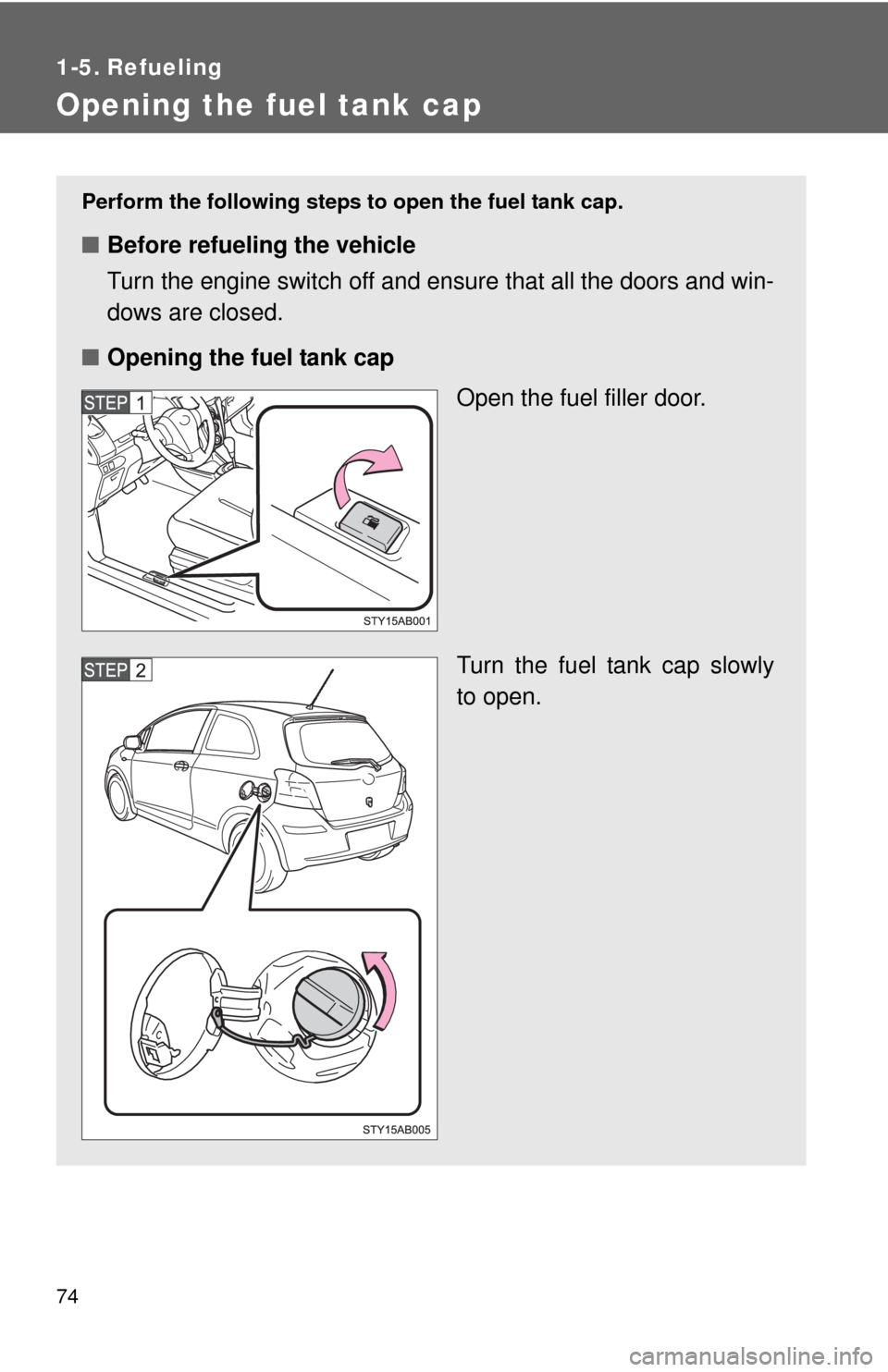
■Opening the fuel tank cap
Open the fuel filler door.
Turn the fuel tank cap slowly
to open.
Page 75 of 400
75 1-5. Refueling
1
Before driving
Closing the fuel tank cap
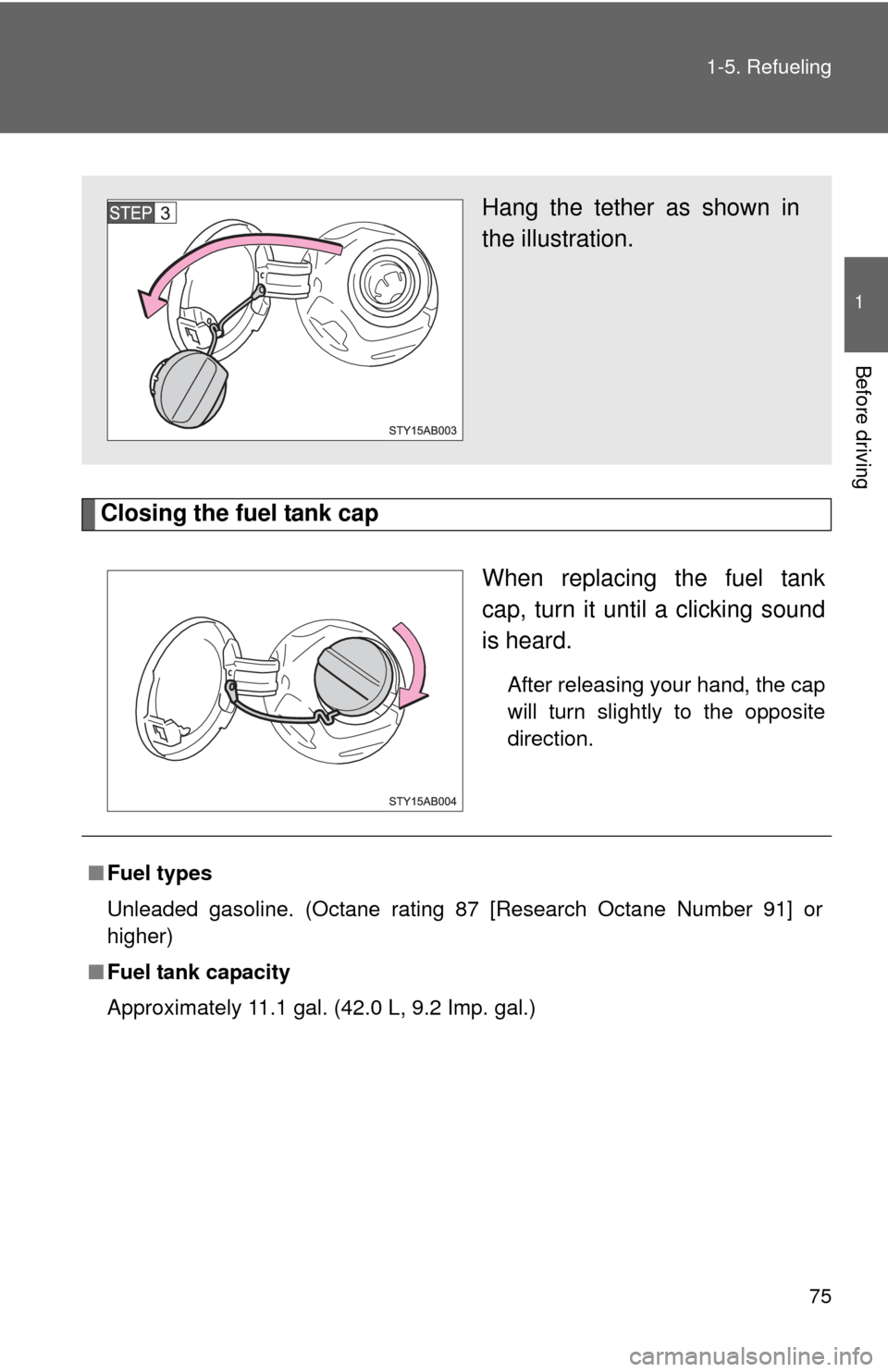
When replacing the fuel tank
cap, turn it until a clicking sound
is heard.
After releasing your hand, the cap
will turn slightly to the opposite
direction.
Hang the tether as shown in
the illustration.
■Fuel types
Unleaded gasoline. (Octane rating 87 [Research Octane Number 91] or
higher)
■Fuel tank capacity
Approximately 11.1 gal. (42.0 L, 9.2 Imp. gal.)