height TOYOTA YARIS 2010 3.G Owners Manual
[x] Cancel search | Manufacturer: TOYOTA, Model Year: 2010, Model line: YARIS, Model: TOYOTA YARIS 2010 3.GPages: 400, PDF Size: 11.4 MB
Page 54 of 400
54 1-3. Adjustable components (seats, mirrors, steering wheel)
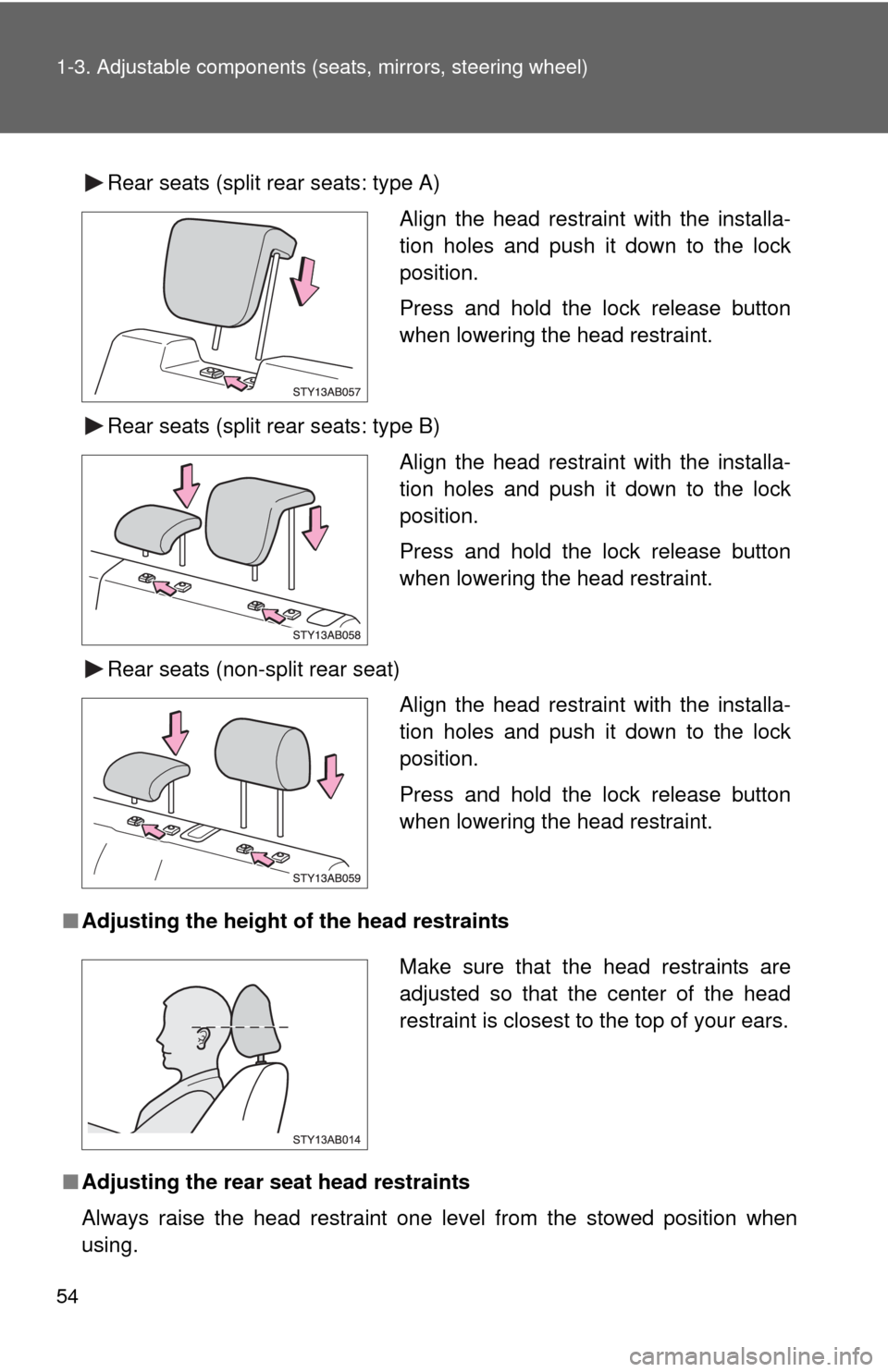
Rear seats (split rear seats: type A)
Rear seats (split rear seats: type B)
Rear seats (non-split rear seat)
■Adjusting the height of the head restraints
■Adjusting the rear seat head restraints
Always raise the head restraint one level from the stowed position when
using.
Align the head restraint with the installa-
tion holes and push it down to the lock
position.
Press and hold the lock release button
when lowering the head restraint.
Align the head restraint with the installa-
tion holes and push it down to the lock
position.
Press and hold the lock release button
when lowering the head restraint.
Align the head restraint with the installa-
tion holes and push it down to the lock
position.
Press and hold the lock release button
when lowering the head restraint.
Make sure that the head restraints are
adjusted so that the center of the head
restraint is closest to the top of your ears.
Page 57 of 400
57 1-3. Adjustable components (seats, mirrors, steering wheel)
1
Before driving
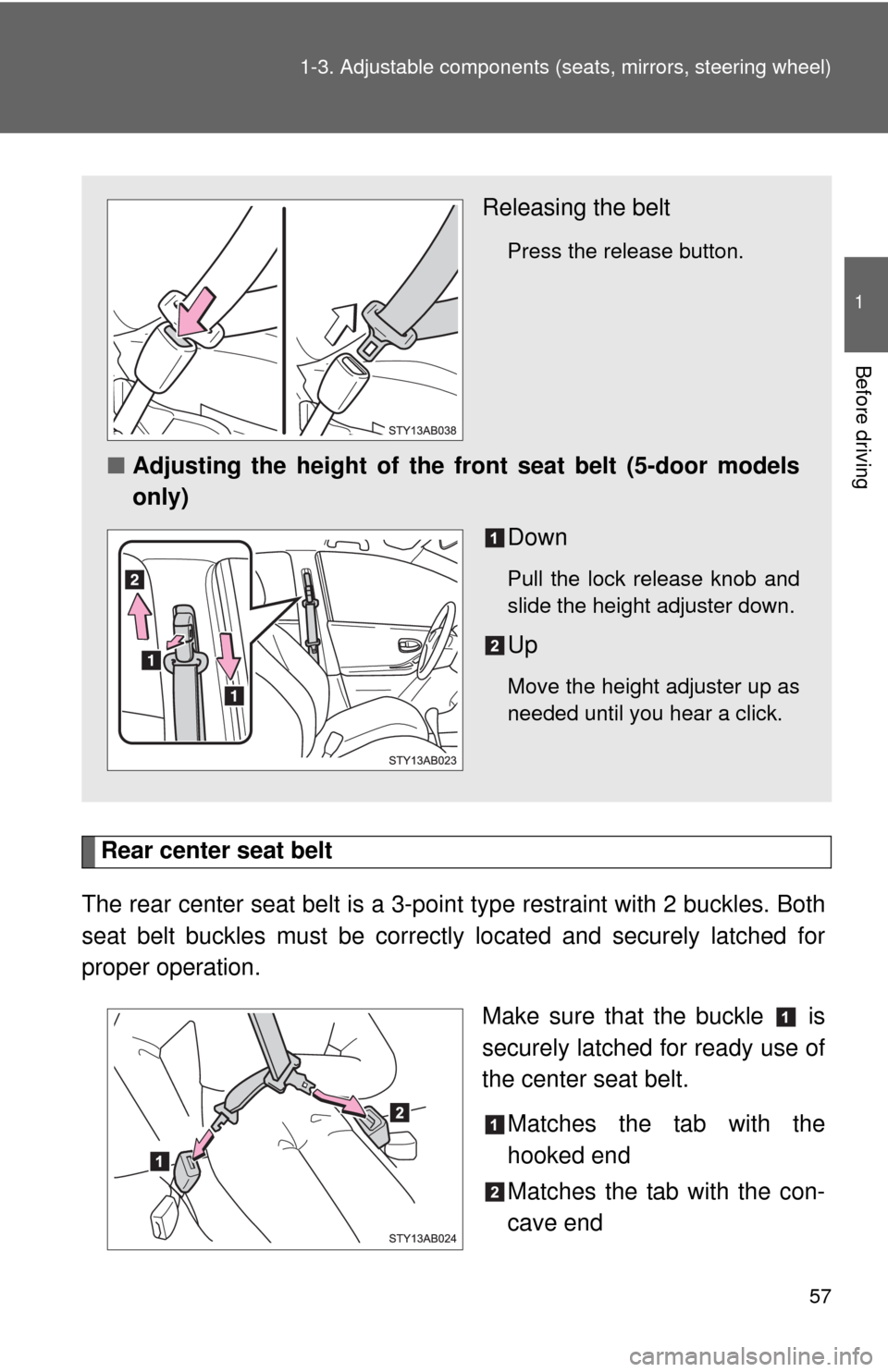
Rear center seat belt
The rear center seat belt is a 3-point type restraint with 2 buckles. Both
seat belt buckles must be correctly located and securely latched for
proper operation.
Make sure that the buckle is
securely latched for ready use of
the center seat belt.
Matches the tab with the
hooked end
Matches the tab with the con-
cave end
Releasing the belt
Press the release button.
■Adjusting the height of the front seat belt (5-door models
only)
Down
Pull the lock release knob and
slide the height adjuster down.
Up
Move the height adjuster up as
needed until you hear a click.
Page 334 of 400
334 5-2. Steps to take in an emergency
■After completing the tire change
The tire pressure warning system must be reset (P. 320)
CAUTION
■Using the jack
Improper use of the jack may lead to death or serious injuries due to the
vehicle suddenly falling off the jack.
●Do not use the jack for any purpose other than replacing tires or install-
ing and removing tire chains.
●Only use the jack that comes with this vehicle for replacing a flat tire.
Do not use it on other vehicles, and do not use other jacks for replac-
ing tires on this vehicle.
●Always check that the jack is securely set to the jack point.
●Do not put any part of your body under the vehicle supported by a jack.
●Do not start or run the engine while your vehicle is supported by the
jack.
●Do not raise the vehicle while someone is in it.
●When raising the vehicle, do not put an object on or under the jack.
●Do not raise the vehicle to a height greater than that required to
replace the tire.
●Use a jack stand if it is necessary to get under the vehicle.
Take particular care when lowering the vehicle to ensure that no one
working on or near the vehicle will be injured.
■Replacing a flat tire
Observe the following precautions to reduce the risk of death or serious
injury.
●Never use oil or grease on the wheel bolts or wheel nuts.
Oil and grease may cause the wheel nuts to be excessively tightened,
leading to bolt or disc wheel damage. In addition, the oil or grease can
cause the wheel nuts to loosen and the wheel may fall off, causing a
serious accident. Remove any oil grease from the wheel bolts or wheel
nuts.
Page 352 of 400
352
6-1. Specifications
Maintenance data (fuel, oil level, etc.)
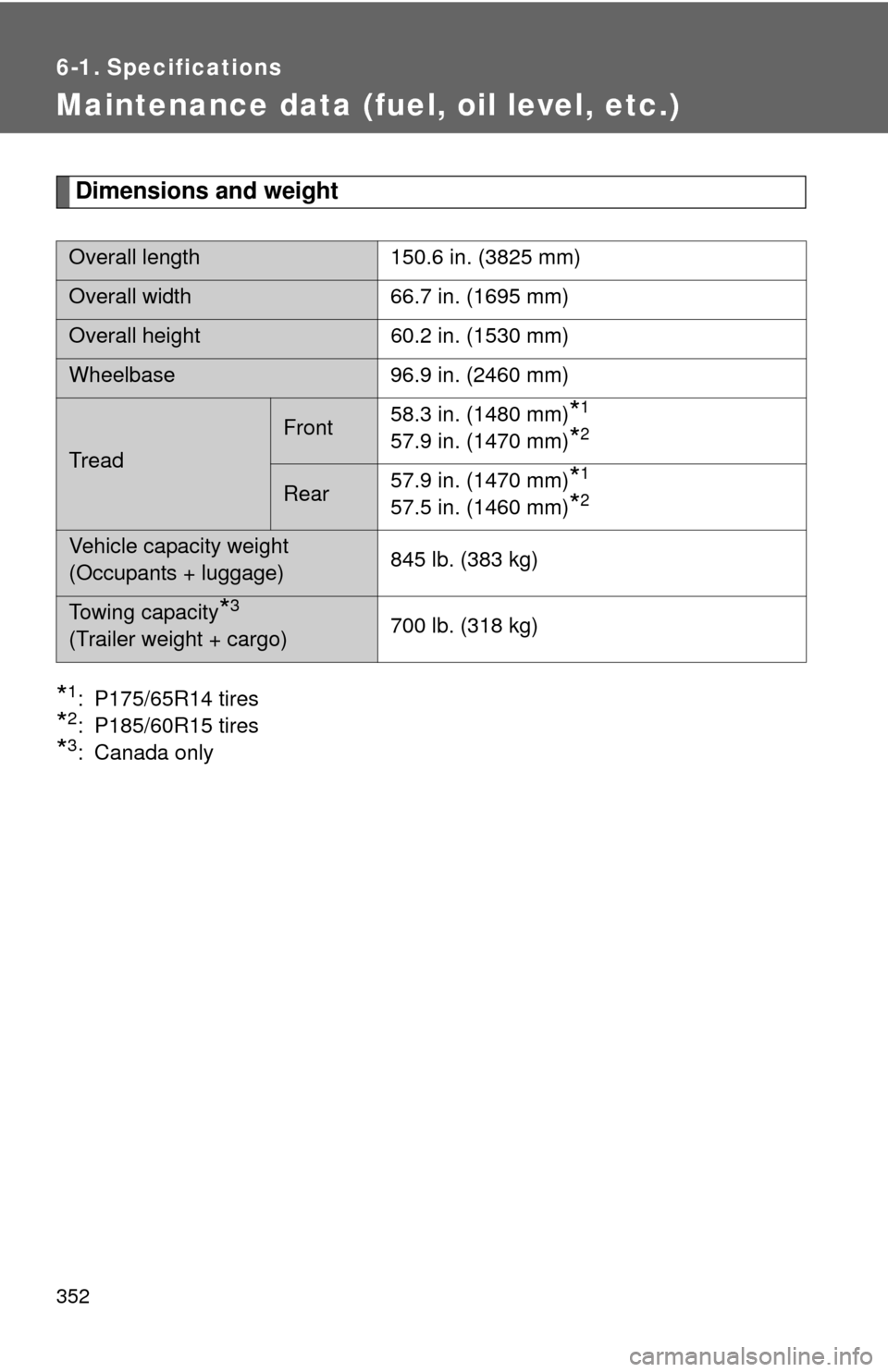
Dimensions and weight
*1: P175/65R14 tires
*2: P185/60R15 tires
*3: Canada only
Overall length 150.6 in. (3825 mm)
Overall width 66.7 in. (1695 mm)
Overall height 60.2 in. (1530 mm)
Wheelbase 96.9 in. (2460 mm)
Tread
Front58.3 in. (1480 mm)*1
57.9 in. (1470 mm)*2
Rear57.9 in. (1470 mm)*1
57.5 in. (1460 mm)*2
Vehicle capacity weight
(Occupants + luggage)845 lb. (383 kg)
Towing capacity*3
(Trailer weight + cargo)700 lb. (318 kg)
Page 368 of 400
368 6-1. Specifications
Tire size
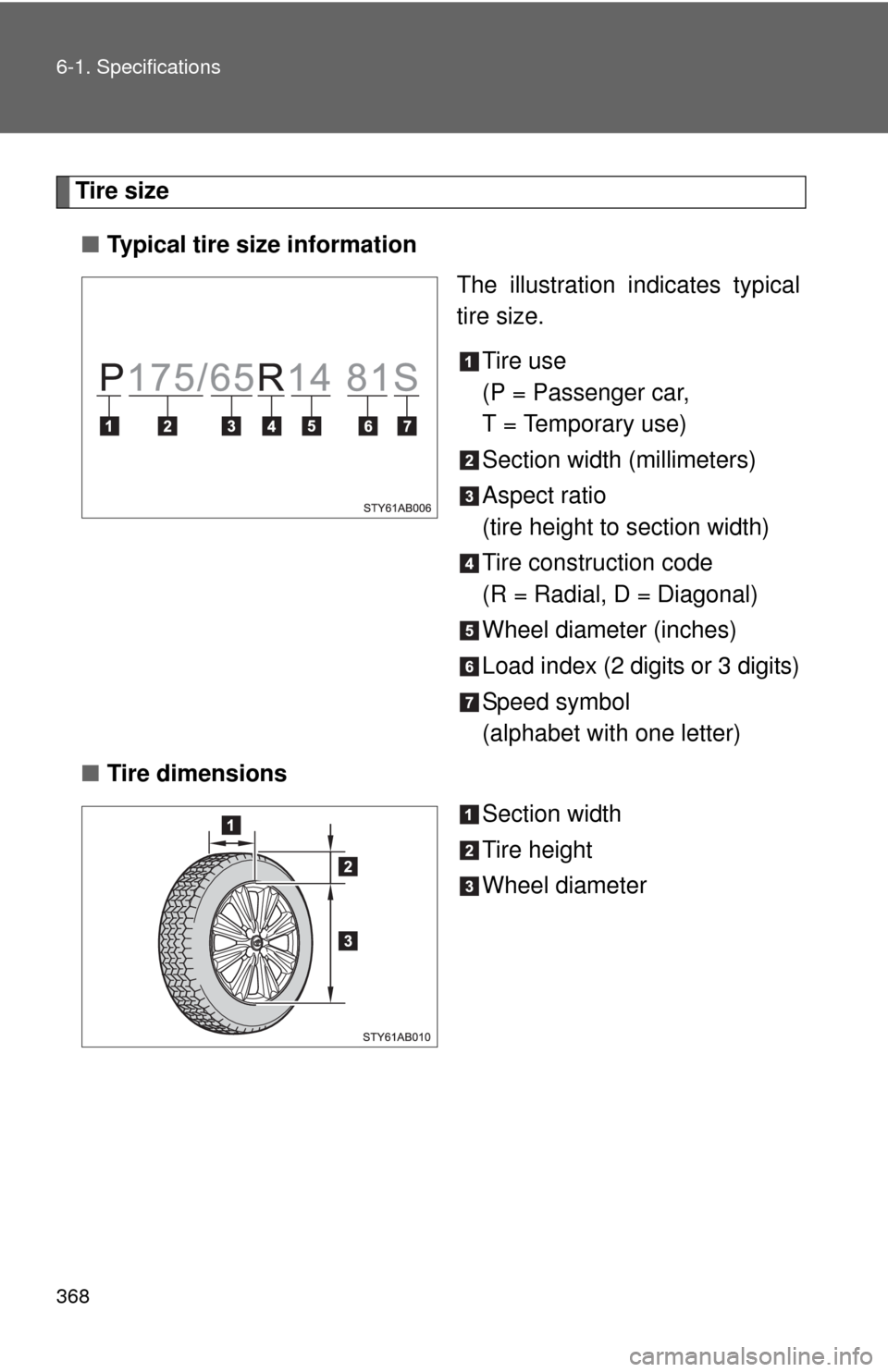
■Typical tire size information
The illustration indicates typical
tire size.
Tire use
(P = Passenger car,
T = Temporary use)
Section width (millimeters)
Aspect ratio
(tire height to section width)
Tire construction code
(R = Radial, D = Diagonal)
Wheel diameter (inches)
Load index (2 digits or 3 digits)
Speed symbol
(alphabet with one letter)
■Tire dimensions
Section width
Tire height
Wheel diameter