belt TOYOTA YARIS 2011 3.G Service Manual
[x] Cancel search | Manufacturer: TOYOTA, Model Year: 2011, Model line: YARIS, Model: TOYOTA YARIS 2011 3.GPages: 416, PDF Size: 10.18 MB
Page 110 of 416

110 1-7. Safety information
Type BWiden the gap between
the seat cushion and
seatback slightly.
Latch the buckles onto
the LATCH anchors.
If the child restraint has a
top tether strap, the top
tether strap should be
latched onto the top
tether strap anchor.
( P. 11 4 )
For owners in Canada:
The symbol on a child restraint
system indicates the presence of
a lower connector system.
Installing child restraints using a seat belt (child restraint lock function belt)
■ Rear facing Infant seat/convertible seat
Place the child seat on the rear
seat facing the rear of the vehi-
cle.
Canada
only
Page 111 of 416
111
1-7. Safety information
1
Before driving
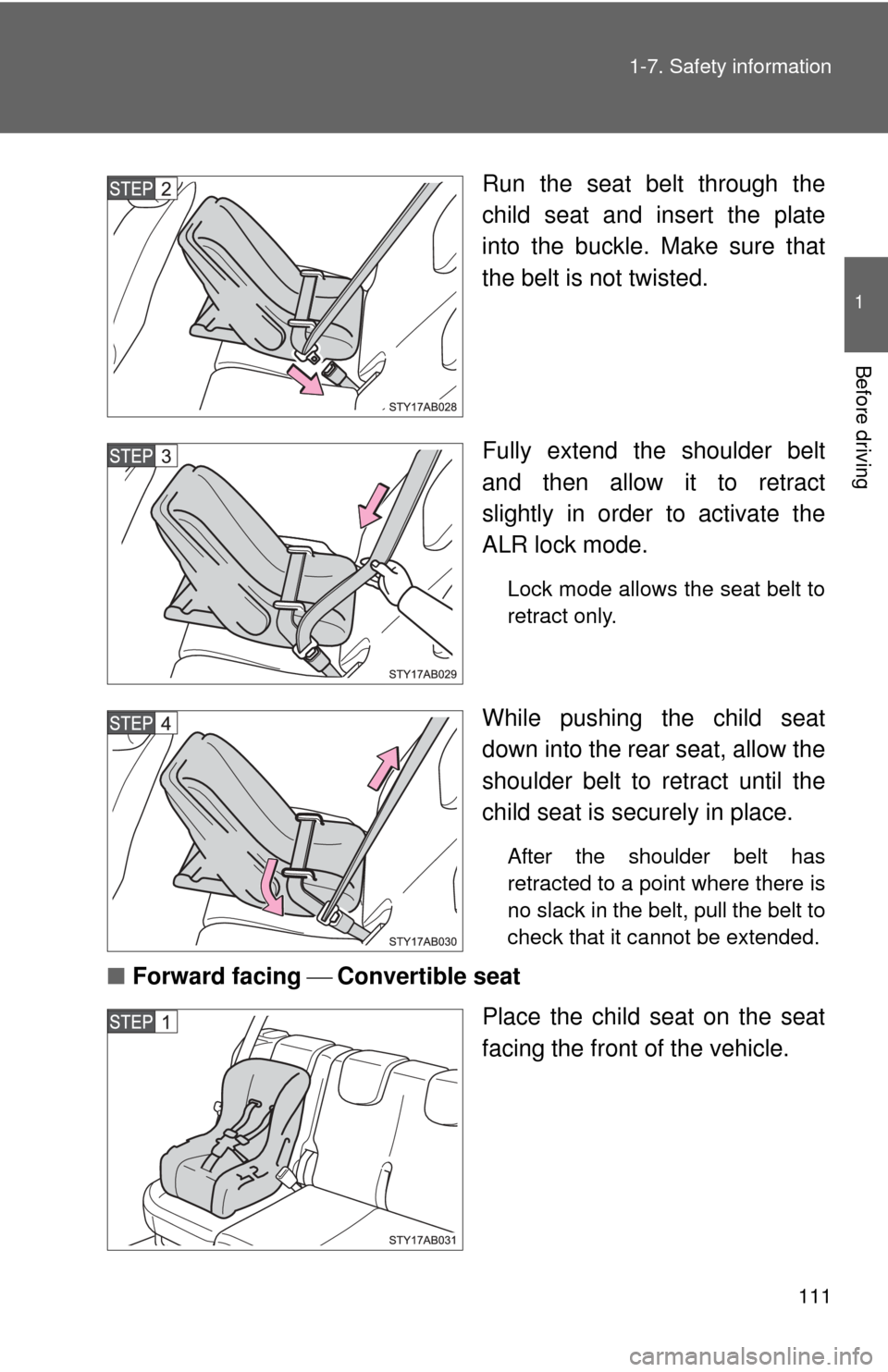
Run the seat belt through the
child seat and insert the plate
into the buckle. Make sure that
the belt is not twisted.
Fully extend the shoulder belt
and then allow it to retract
slightly in order to activate the
ALR lock mode.
Lock mode allows the seat belt to
retract only.
While pushing the child seat
down into the rear seat, allow the
shoulder belt to retract until the
child seat is securely in place.
After the shoulder belt has
retracted to a point where there is
no slack in the belt, pull the belt to
check that it cannot be extended.
■
Forward facing Convertible seat
Place the child seat on the seat
facing the front of the vehicle.
Page 112 of 416
112 1-7. Safety information
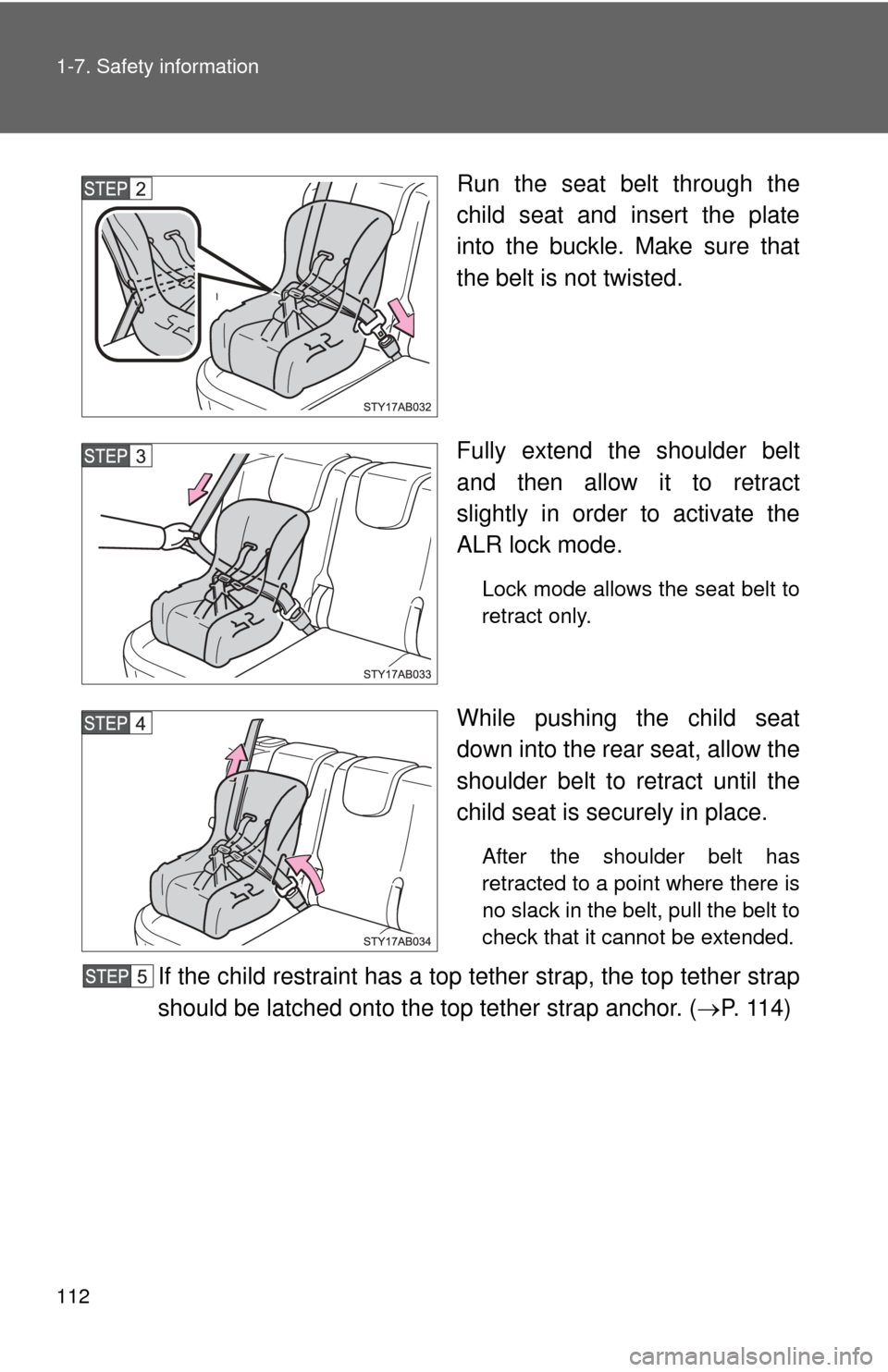
Run the seat belt through the
child seat and insert the plate
into the buckle. Make sure that
the belt is not twisted.
Fully extend the shoulder belt
and then allow it to retract
slightly in order to activate the
ALR lock mode.
Lock mode allows the seat belt to
retract only.
While pushing the child seat
down into the rear seat, allow the
shoulder belt to retract until the
child seat is securely in place.
After the shoulder belt has
retracted to a point where there is
no slack in the belt, pull the belt to
check that it cannot be extended.
If the child restraint has a top tether strap, the top tether strap
should be latched onto the top tether strap anchor. ( P. 114)
Page 113 of 416
113
1-7. Safety information
1
Before driving
■
Booster seat
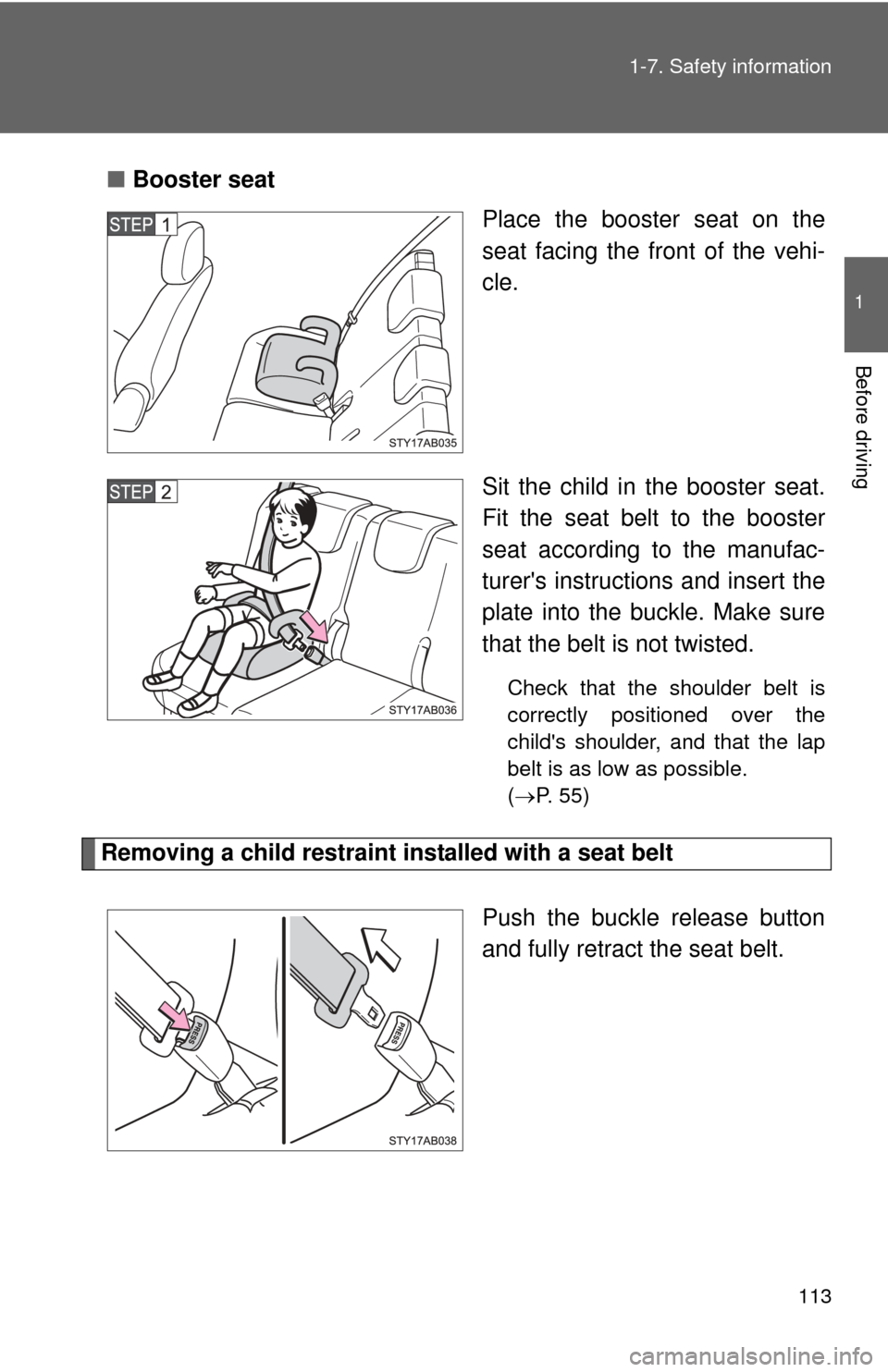
Place the booster seat on the
seat facing the front of the vehi-
cle.
Sit the child in the booster seat.
Fit the seat belt to the booster
seat according to the manufac-
turer's instructions and insert the
plate into the buckle. Make sure
that the belt is not twisted.
Check that the shoulder belt is
correctly positioned over the
child's shoulder, and that the lap
belt is as low as possible.
(P. 55)
Removing a child restraint installed with a seat belt
Push the buckle release button
and fully retract the seat belt.
Page 116 of 416
116 1-7. Safety information
CAUTION
■When installing a booster seat
Do not fully extend the shoulder belt to prevent the belt from going to ALR
lock mode. ( P. 60)
In ALR lock mode the belt is locked in that position and cannot be extended,
which could cause injury or discomfort to the child seated in the booster
seat.
■ When installing a child restraint system
Follow the directions given in the child restraint system installation manual
and fix the child restraint system securely in place.
If the child restraint system is not correctly fixed in place, the child or other
passengers may be seriously injured or even killed in the event of emer-
gency braking, sudden swerving or an accident.
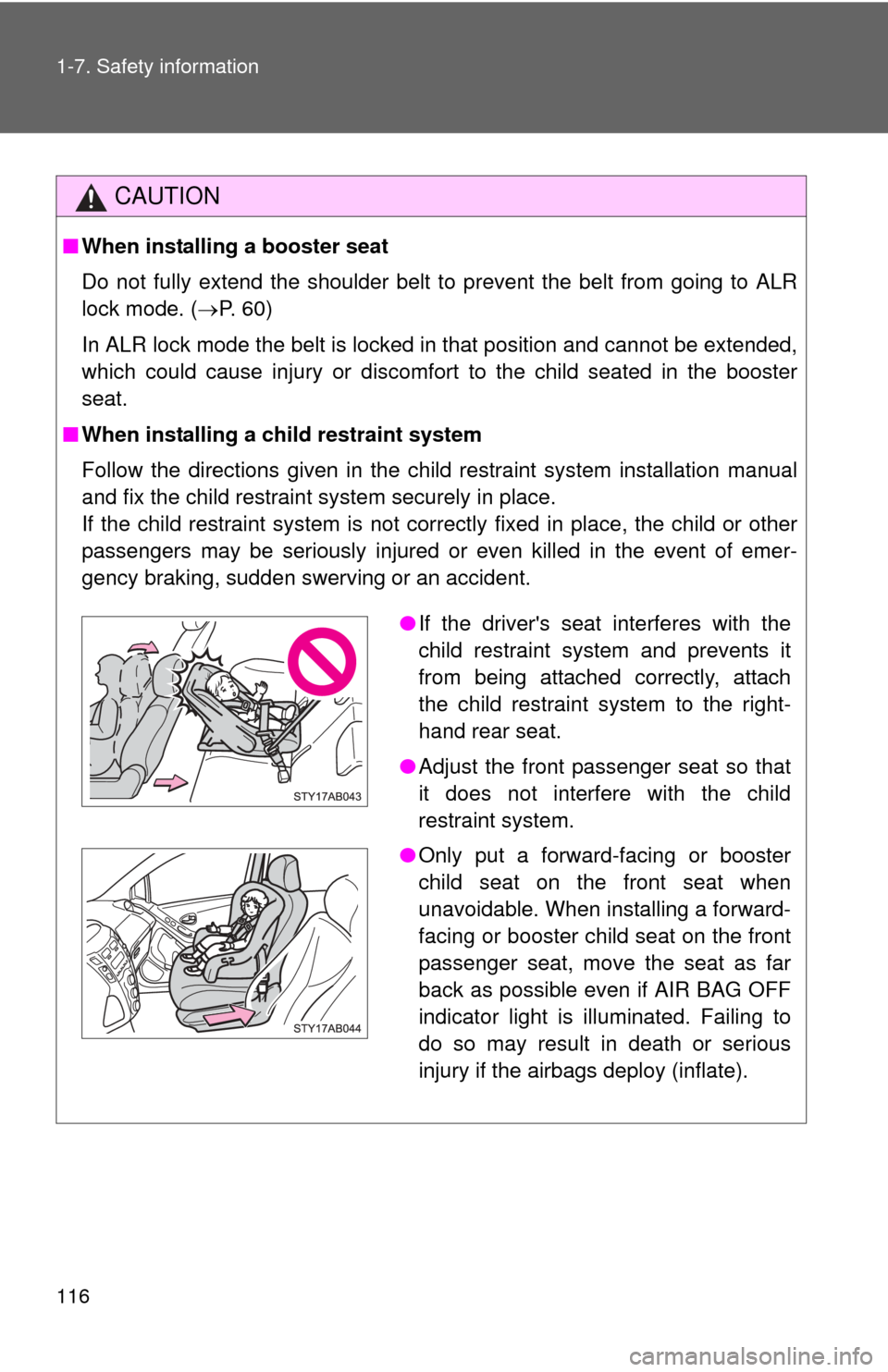
●If the driver's seat interferes with the
child restraint system and prevents it
from being attached correctly, attach
the child restraint system to the right-
hand rear seat.
● Adjust the front passenger seat so that
it does not interfere with the child
restraint system.
● Only put a forward-facing or booster
child seat on the front seat when
unavoidable. When installing a forward-
facing or booster child seat on the front
passenger seat, move the seat as far
back as possible even if AIR BAG OFF
indicator light is illuminated. Failing to
do so may result in death or serious
injury if the airbags deploy (inflate).
Page 117 of 416
117
1-7. Safety information
1
Before driving
CAUTION
■
When installing a child restraint system
●Split rear seats: When installing a child restraint system in the rear center
seat, adjust both seat cushions to the same position and align seatbacks
at the same angle. The seatbacks must be adjusted to the same angle.
Otherwise, the child restraint system cannot be securely restrained and
this may cause death or serious injuries in the event of emergency brak-
ing, sudden swerving or an accident.
● Split rear seats: When using the LATCH anchors for a child restraint sys-
tem, move the seat as far back as possible and adjust the seatback as
upright as possible.
● When a booster seat is installed, always ensure that the shoulder belt is
positioned across the center of the child's shoulder. The belt should be
kept away from the child's neck, but not so that it could fall off the child's
shoulder. Failing to do so may result in death or serious injury in the event
of emergency braking, sudden swerving or an accident.
● Ensure that the belt and tab are securely locked and the seat belt is not
twisted.
● Push and pull the child restraint system from side to side and forward to be
sure it is secure.
● After securing a child restraint system, never adjust the seat.
● Follow all installation instructions provided by the child restraint system
manufacturer.
● Split rear seats: When a child restraint system with a top tether strap is
installed, do not install the head restraint. The head restraint may interfere
with the top tether strap preventing secure installation of the child restraint
system.
● Split rear seats: Make sure to properly store the removed head restraint in
a secure place when you use the child restraint system on the rear seats.
Page 118 of 416
118 1-7. Safety information
CAUTION
■Do not use a seat belt extender
If a seat belt extender is used when installing a child restraint system, the
seat belt will not securely hold the child restraint system, which could cause
death or serious injury to the child or other passengers in the event of emer-
gency braking, sudden swerving or an accident.
■ To correctly attach a child r estraint system to the anchors
When using the LATCH anchors, be sure that there are no foreign objects
around the anchors and that the seat belt is not caught behind the child
restraint. Make sure the child restraint system is securely attached, or it may
cause death or serious injury to the child or other passengers in the event of
emergency braking, sudden swerving or an accident.
Page 167 of 416
167
2-5. Driving information
2
When driving
CAUTION
■Things that must not be carried in the luggage compartment
The following things may cause a fire if loaded in the luggage compart-
ment.
●Receptacles containing gasoline
●Aerosol cans
■Storage precautions
Observe the following precautions.
Failing to do so may result in death or serious injury.
●Do not place cargo or luggage in or on the following locations as the
item may get under the clutch, brake or accelerator pedal and prevent
the pedals from being depressed properly, block the driver’s vision, or
hit the driver or passengers, causing an accident.
• Driver’s feet
• Front passenger or rear seats (when stacking items)
• Luggage cover
• Instrument panel
• Dashboard
• Auxiliary box or tray that has no lid
●
Secure all items in the occupant compartment, as they may shift and
injure someone during emergency braking, sudden swerving or an
accident.
●Never allow anyone to ride in the luggage compartment. It is not
designed for passengers. They should ride in their seats with their seat
belts properly fastened. Otherwise, they are much more likely to suffer
serious bodily injury, in the event of emergency braking, sudden
swerving or an accident.
■Capacity and distribution
●Do not exceed the maximum axle weight rating or the total vehicle
weight rating.
●Even if the total load of occupant’s weight and the cargo load is less
than the total load capacity, do no t apply the load unevenly. Improper
loading may cause deterioration of st eering or braking control which
may cause death or serious injury.
Page 242 of 416
242 4-1. Maintenance and care
■Caring for leather areas
Toyota recommends cleaning the interior of the vehicle at least twice a year
to maintain the quality of the vehicle's interior.
■ Shampooing the carpets
There are several commercial foaming-type cleaners available. Use a
sponge or brush to apply the foam. Rub in overlapping circles. Do not apply
water. The excellent results are obtained when keeping the carpet as dry as
possible.
■ Seat belts
Clean with mild soap and lukewarm water using a cloth or sponge. Also
check the belts periodically for excessive wear, fraying or cuts.
CAUTION
■Water in the vehicle
●Do not splash or spill liquid in the vehicle. Doing so may cause the electri-
cal components etc. to malfunction or catch fire.
● Do not get any of the SRS components or wiring in the vehicle interior wet.
( P. 8 7 )
Electrical malfunction may cause the airbags to deploy or not function
properly, resulting in death or severe injury.
■ Cleaning the interior (esp ecially instrument panel)
Do not use polish wax or polish cleaner. The instrument panel may reflect off
the windshield, obstructing the driver’s view and leading to an accident,
resulting in death or serious injury.
Page 247 of 416
247
4-2. Maintenance
4
Maintenance and care
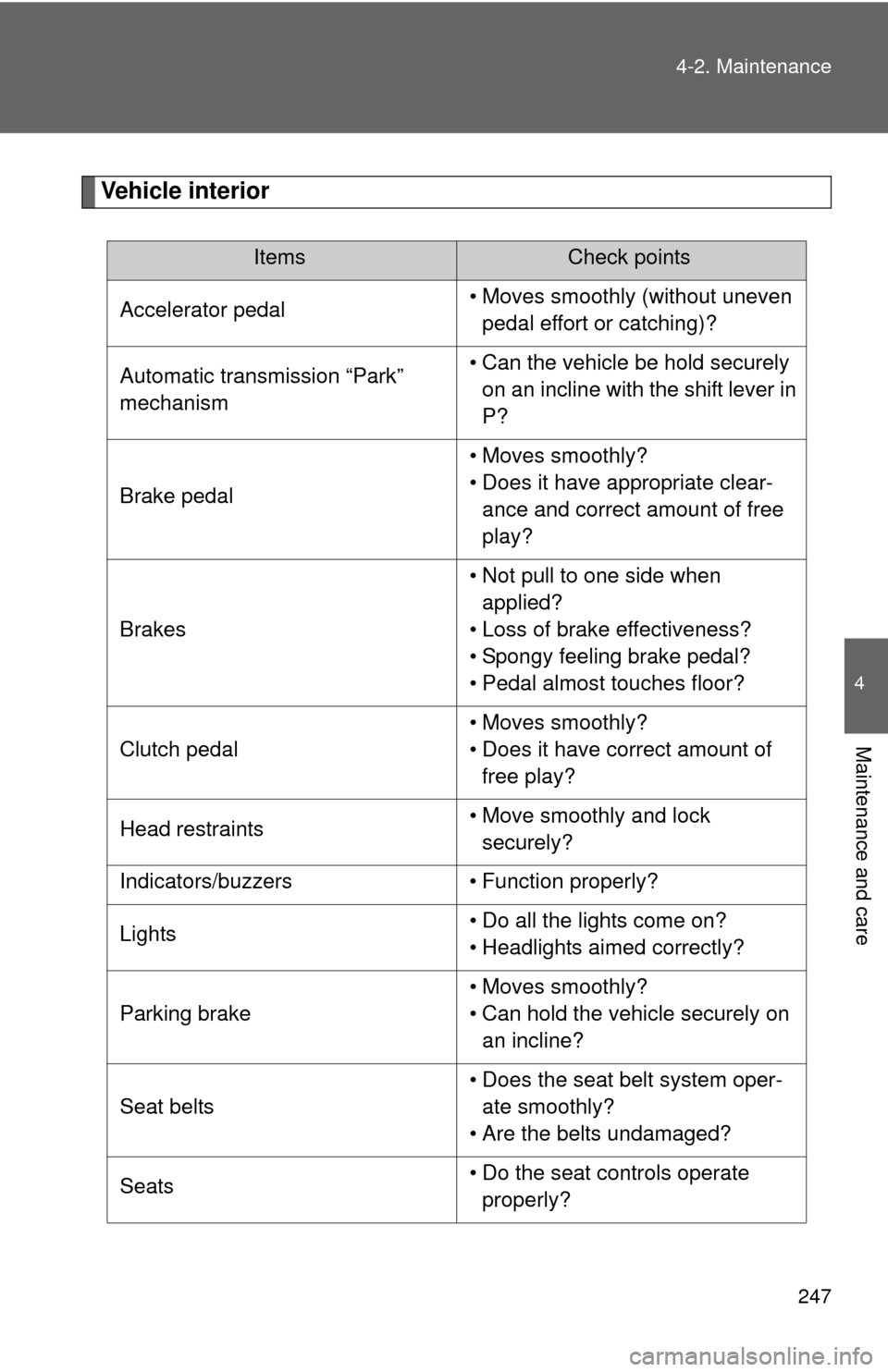
Vehicle interior
ItemsCheck points
Accelerator pedal • Moves smoothly (without uneven
pedal effort or catching)?
Automatic transmission “Park”
mechanism • Can the vehicle be hold securely
on an incline with the shift lever in
P?
Brake pedal • Moves smoothly?
• Does it have appropriate clear-
ance and correct amount of free
play?
Brakes • Not pull to one side when
applied?
• Loss of brake effectiveness?
• Spongy feeling brake pedal?
• Pedal almost touches floor?
Clutch pedal • Moves smoothly?
• Does it have correct amount of
free play?
Head restraints • Move smoothly and lock
securely?
Indicators/buzzers • Function properly?
Lights • Do all the lights come on?
• Headlights aimed correctly?
Parking brake • Moves smoothly?
• Can hold the vehicle securely on
an incline?
Seat belts • Does the seat belt system oper-
ate smoothly?
• Are the belts undamaged?
Seats • Do the seat controls operate
properly?