air TOYOTA YARIS 2012 3.G Service Manual
[x] Cancel search | Manufacturer: TOYOTA, Model Year: 2012, Model line: YARIS, Model: TOYOTA YARIS 2012 3.GPages: 400, PDF Size: 9.68 MB
Page 110 of 400
110 1-7. Safety information
CAUTION
■When installing a child restraint system
●Push and pull the child restraint system from side to side and forward to be
sure it is secure.
● After securing a child restraint system, never adjust the seat.
● Follow all installation instructions provided by the child restraint system
manufacturer.
● When a child restraint system with a top tether strap is installed, do not
install the head restraint. The head restraint may interfere with the top
tether strap preventing secure installation of the child restraint system.
● Make sure to properly store the removed head restraint in a secure place
when you use the child restraint system on the rear seat.
■ Do not use a seat belt extender
If a seat belt extender is used when installing a child restraint system, the
seat belt will not securely hold the child restraint system, which could cause
death or serious injury to the child or other passengers in the event of sud-
den braking, sudden swerving or an accident.
■ To correctly attach a child r estraint system to the anchors
When using the LATCH anchors, be sure that there are no foreign objects
around the anchors and that the seat belt is not caught behind the child
restraint. Make sure the child restraint system is securely attached, or it may
cause death or serious injury to the child or other passengers in the event of
sudden braking, sudden swerving or an accident.
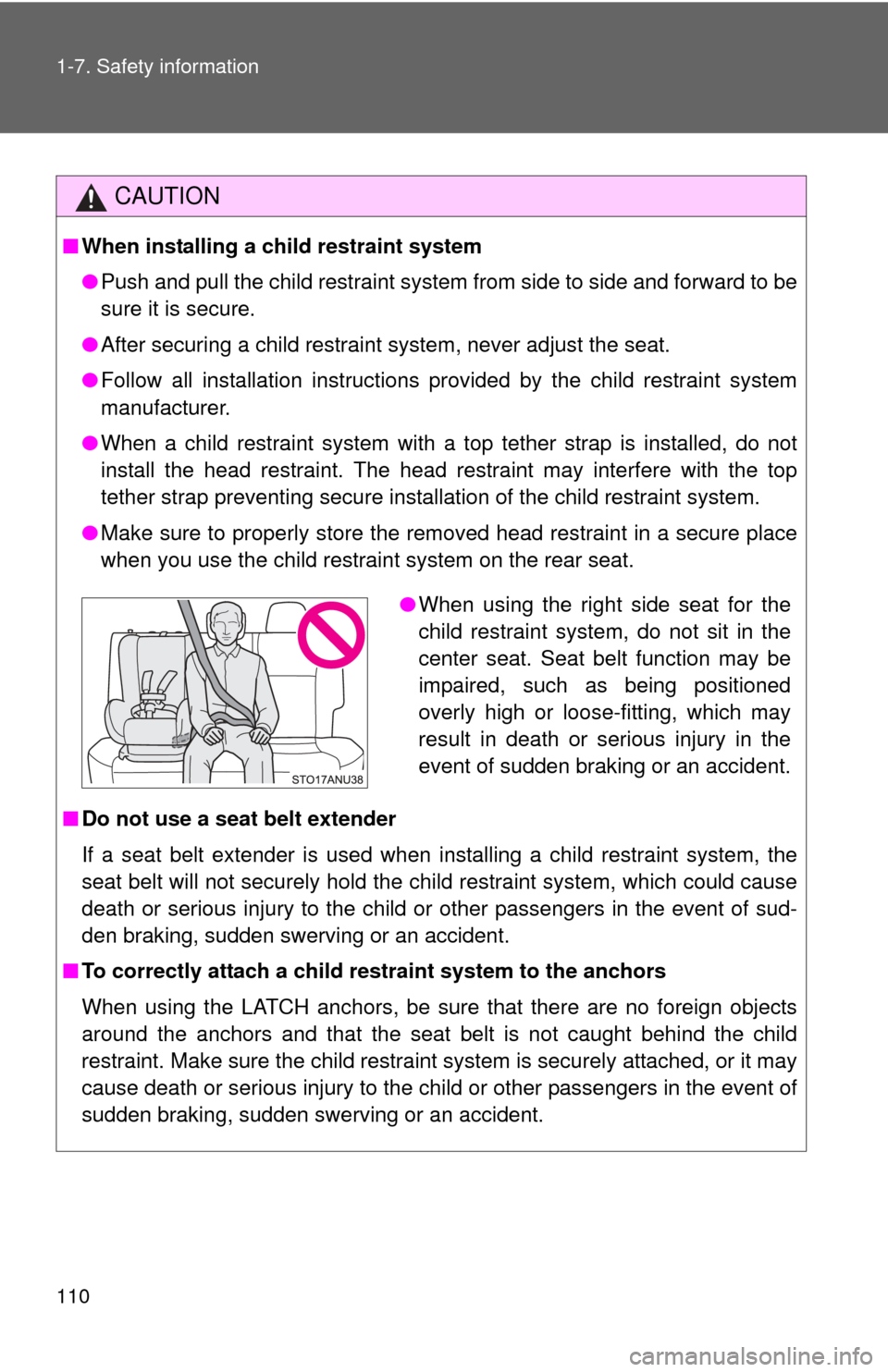
● When using the right side seat for the
child restraint system, do not sit in the
center seat. Seat belt function may be
impaired, such as being positioned
overly high or loose-fitting, which may
result in death or serious injury in the
event of sudden braking or an accident.
Page 120 of 400

120 2-1. Driving procedures
CAUTION
●Do not attach adhesive discs to the windshield or windows. Do not place
containers such as air fresheners on the instrument panel or dashboard.
Adhesive discs or containers may act as lenses, causing a fire in the vehi-
cle.
● Do not leave a door or window open if the curved glass is coated with a
metallized film such as a silver-colored one. Reflected sunlight may cause
the glass to act as a lens, causing a fire.
● Always apply the parking brake, shift the shift lever to P (vehicles with an
automatic transmission only), stop the engine and lock the vehicle.
Do not leave the vehicle unattended while the engine is running.
● Do not touch the exhaust pipes while the engine is running or immediately
after turning the engine off.
Doing so may cause burns.
● Do not leave the engine running in an area with snow build-up, or where it
is snowing. If snowbanks build up around the vehicle while the engine is
running, exhaust gases may collect and enter the vehicle. This may lead
to death or a serious health hazard.
■ Exhaust gases
Exhaust gases include harmful carbon monoxide (CO), which is colorless
and odorless. Inhaling exhaust gases may lead to death or a serious health
hazard.
●If the vehicle is in a poorly ventilated area, stop the engine. In a closed
area, such as a garage, exhaust gases may collect and enter the vehicle.
This may lead to death or a serious health hazard.
● The exhaust system should be checked occasionally. If there is a hole or
crack caused by corrosion, damage to a joint or abnormal exhaust noise,
be sure to have the vehicle inspected and repaired by your Toyota dealer.
Failure to do so may allow exhaust gases to enter the vehicle, resulting in
death or a serious health hazard.
Page 138 of 400
138 2-2. Instrument cluster
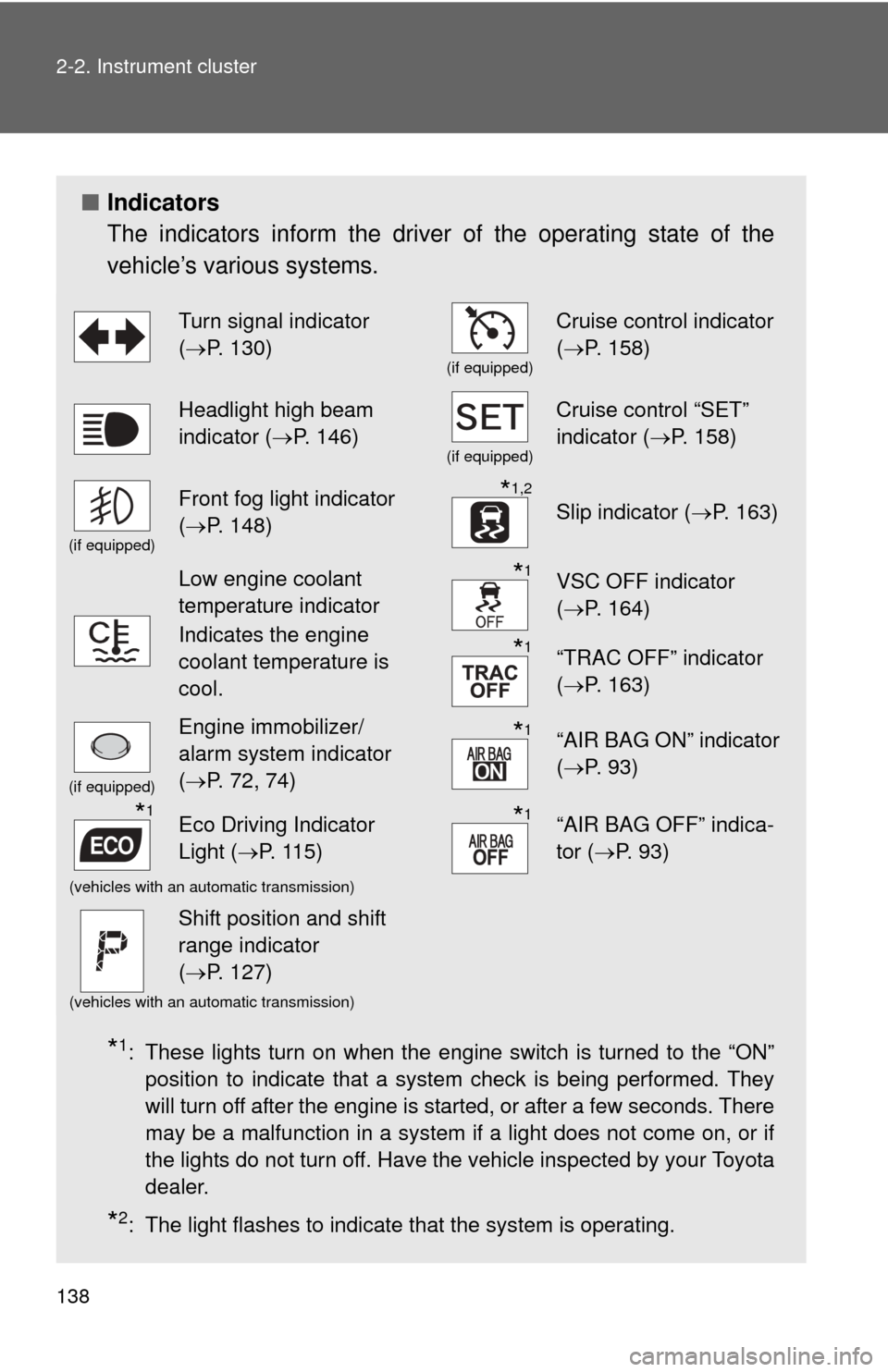
■Indicators
The indicators inform the driver of the operating state of the
vehicle’s various systems.
*1: These lights turn on when the engine switch is turned to the “ON”
position to indicate that a system check is being performed. They
will turn off after the engine is started, or after a few seconds. There
may be a malfunction in a system if a light does not come on, or if
the lights do not turn off. Have the vehicle inspected by your Toyota
dealer.
*2: The light flashes to indicate that the system is operating.
Turn signal indicator
(P. 130)
(if equipped)
Cruise control indicator
( P. 158)
Headlight high beam
indicator ( P. 146)
(if equipped)
Cruise control “SET”
indicator ( P. 158)
(if equipped)
Front fog light indicator
(P. 148)*1,2
Slip indicator ( P. 163)
Low engine coolant
temperature indicator
Indicates the engine
coolant temperature is
cool.*1VSC OFF indicator
(P. 164)
*1“TRAC OFF” indicator
(P. 163)
(if equipped)
Engine immobilizer/
alarm system indicator
(P. 72, 74)*1“AIR BAG ON” indicator
( P. 93)
*1Eco Driving Indicator
Light ( P. 115)*1“AIR BAG OFF” indica-
tor (P. 93)
(vehicles with an automatic transmission)
Shift position and shift
range indicator
(P. 127)
(vehicles with an automatic transmission)
Page 172 of 400
172
2-5. Driving information
Winter driving tips
Carry out the necessary preparations and inspections before driving
the vehicle in winter. Always drive the vehicle in a manner appropri-
ate to the prevailing weather conditions.
■ Pre-winter preparations
●Use fluids that are appropriate to the prevailing outside tem-
peratures.
• Engine oil
• Engine coolant
• Washer fluid
● Have a service technician inspect the level and specific grav-
ity of battery electrolyte.
● Have the vehicle fitted with four snow tires or purchase a set
of tire chains for the front tires.
Ensure that all tires are the same size and brand and that their wear
level is not noticeably different with each other. Also make sure that
chains match the size of the tires.
■Before driving the vehicle
Perform the following according to the driving conditions:
●Do not try to forcibly open a window or move a wiper that is
frozen. Pour warm water over the frozen area to melt the ice.
Wipe away the water immediately to prevent it from freezing.
● To ensure proper operation of th e climate control system fan,
remove any snow that has accumulated on the air inlet vents
in front of the windshield.
● Remove any ice that has accumu lated on the vehicle chassis.
● Periodically check for and remove any excess ice or snow
that may have accumulated in the wheel well or on the
brakes.
Page 174 of 400
174 2-5. Driving information
■Tire chain installation
Observe the following precautions when installing and removing chains:
●Install and remove tire chains in a safe location.
● Install tire chains on the front tires only. Do not install tire chains on the
rear tires.
● Install tire chains on front tires as tightly as possible. Retighten chains
after driving 1/4 - 1/2 mile (0.5 - 1.0 km).
● Install tire chains following the instructions provided with the tire chains.
● If wheel ornaments are used, they will be scratched by the chain band,
so remove the ornaments before putting on the chains. ( P. 317)
CAUTION
■Driving with snow tires
Observe the following precautions to reduce the risk of accidents.
Failure to do so may result in a loss of vehicle control and cause death or
serious injury.
●Use tires of the size specified.
● Maintain the recommended level of air pressure.
● Do not drive in excess of 75 mph (120 km/h), regardless of the type of
snow tires being used.
● Use snow tires on all, not just some wheels.
● Do not use tires of noticeably different wear level.
Page 175 of 400

175
2-5. Driving information
2
When driving
CAUTION
■
Driving with tire chains
Observe the following precautions to reduce the risk of accidents.
Failure to do so may result in the vehicle being unable to be driven safely,
and may cause death or serious injury.
●Do not drive in excess of the speed limit specified for the tire chains being
used, or 30 mph (50 km/h), whichever is lower.
● Avoid driving on bumpy road surfaces or over potholes.
● Avoid sudden turns and braking, as use of chains may adversely affect
vehicle handling.
● Slow down sufficiently before entering a curve to ensure that vehicle con-
trol is maintained.
NOTICE
■Repairing or replacing snow tires (vehicles with a tire pressure warn-
ing system)
Request repairs or replacement of snow tires from Toyota dealers or legiti-
mate tire retailers.
This is because the removal and attachment of snow tires affects the opera-
tion of the tire pressure warning valves and transmitters.
■ Fitting tire chains (vehicles wi th a tire pressure warning system)
The tire pressure warning valves and transmitters may not function correctly
when tire chains are fitted.
Page 176 of 400
176
2-5. Driving information
Trailer towing (except 3-door models for Canada)
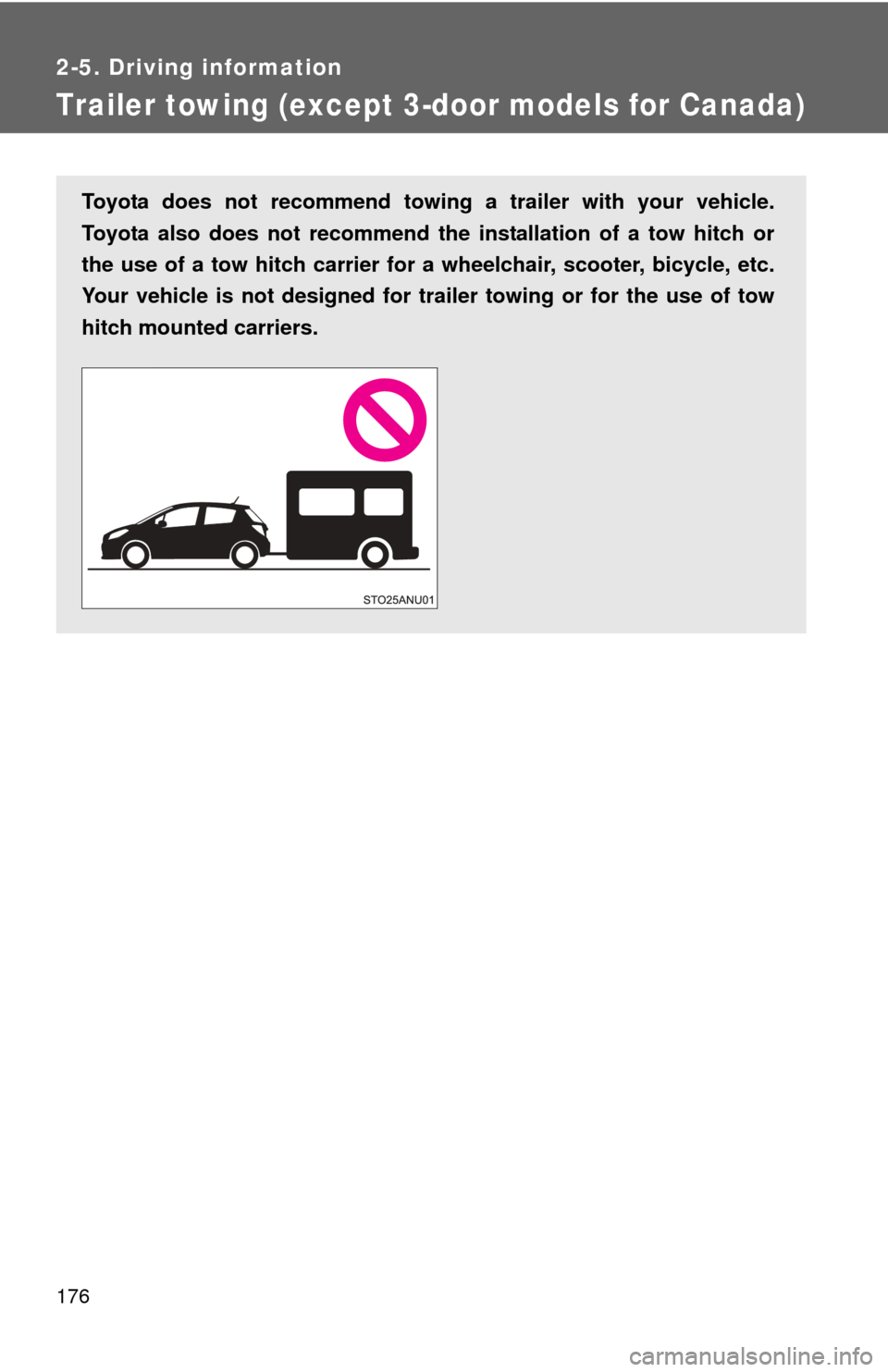
Toyota does not recommend towing a trailer with your vehicle.
Toyota also does not recommend the installation of a tow hitch or
the use of a tow hitch carrier for a wheelchair, scooter, bicycle, etc.
Your vehicle is not designed for trai ler towing or for the use of tow
hitch mounted carriers.
Page 181 of 400

181
2-5. Driving information
2
When driving
●
Crosswinds and rough roads will adversely affect handling of your
vehicle and trailer, causing sway . Periodically check the rear to
prepare for being passed by large trucks or buses, which may
cause your vehicle and trailer to sway. If swaying occurs, firmly grip
the steering wheel, reduce speed immediately but gradually, and
steer straight ahead. Never increase speed. If you make no
extreme correction with the stee ring or brakes, your vehicle and
trailer will stabilize.
● Take care when passing other vehicles. Passing requires consider-
able distance. After passing a vehicle, do not forget the length of
your trailer, and be sure you hav e plenty of room before changing
lanes.
● To maintain engine braking efficiency and charging system perfor-
mance when using engine braking, do not use the transmission in
D (vehicles with an automatic transmission) or 5 (vehicles with a
manual transmission).
● Due to the added load of the trailer, your vehicle’s engine may
overheat on hot days (at temperatures over 85°F [30°C]) when
driving up a long or steep grade. If the high engine coolant temper-
ature warning light flashes or co mes on overheating, immediately
turn off the air conditioning (if in use), pull your vehicle off the road
and stop in a safe place. ( P. 334)
Page 191 of 400
Interior features3
191
3-1. Using the air conditioning system and defogger
Air conditioning system .... 192
Rear window and outside rear view mirror
defoggers ....................... 199
3-2. Using the audio system Using the AUX port/USB port ........................ 200
Using the steering wheel audio switches ............... 201
3-3. Using the interior lights Interior lights list ............... 202
• Personal lights ................ 203
• Interior light .................... 203
3-4. Using the storage features List of storage features .... 204
• Glove box....................... 205
• Cup holders ................... 205
• Bottle holders ................. 207 3-5. Other interior features
Sun visors ........................ 208
Vanity mirrors ................... 209
Clock ................................ 210
Outside temperature display............................ 211
Power outlet ..................... 213
Floor mat .......................... 214
Luggage compartment features .......................... 216
Page 192 of 400
192
3-1. Using the air conditioning system and defogger
Air conditioning system
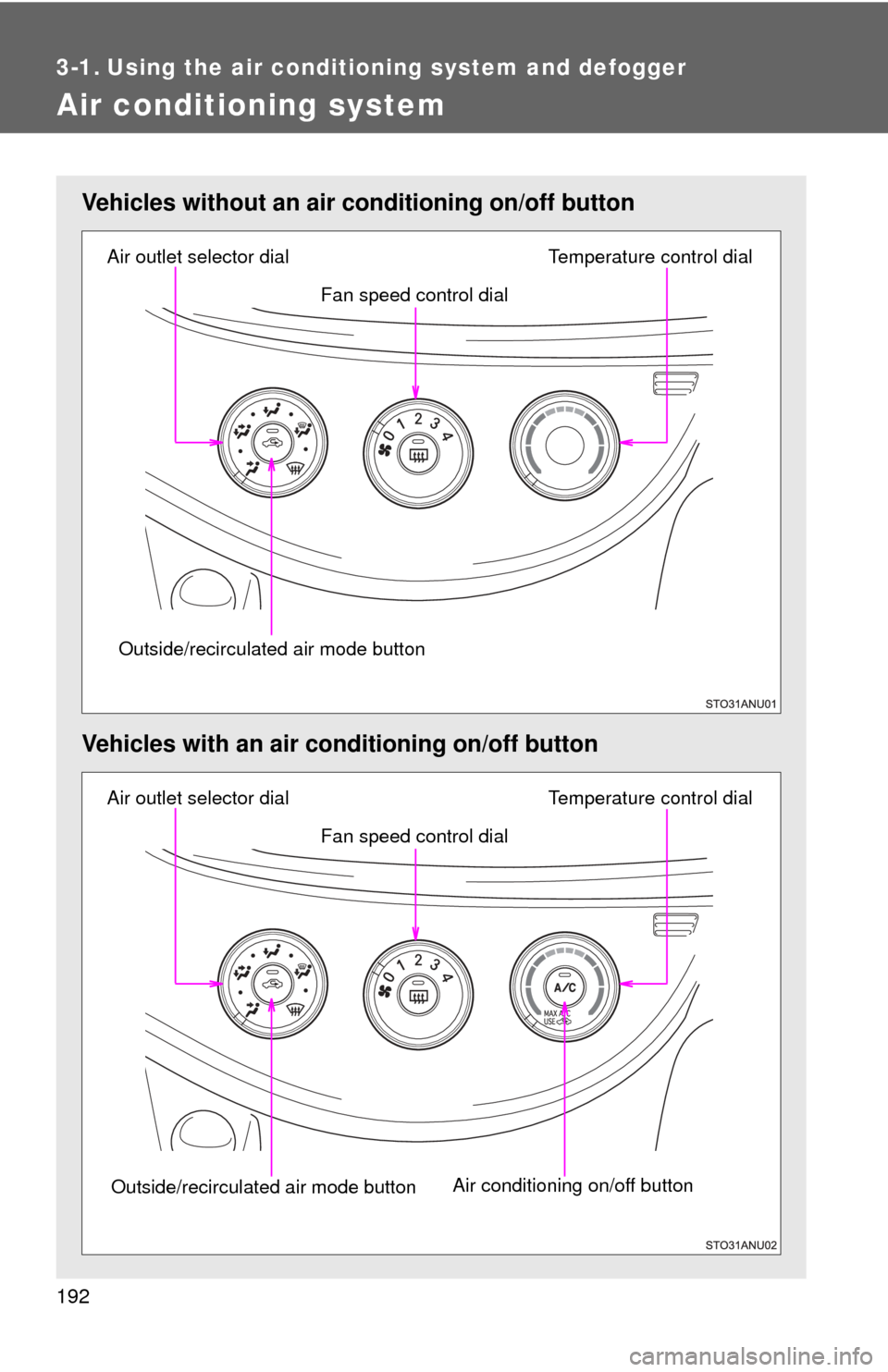
Vehicles without an air conditioning on/off button
Vehicles with an air conditioning on/off button
Fan speed control dial
Air outlet selector dial Temperature control dial
Outside/recirculated air mode button
Fan speed control dial
Air outlet selector dial Temperature control dial
Outside/recirculated air mode button
Air conditioning on/off button