Interior light TOYOTA YARIS 2012 3.G Owners Manual
[x] Cancel search | Manufacturer: TOYOTA, Model Year: 2012, Model line: YARIS, Model: TOYOTA YARIS 2012 3.GPages: 400, PDF Size: 9.68 MB
Page 3 of 400

1
2
3
4
5
6
7
3
2-4. Using other driving systemsCruise control ...................... 158
Driving assist systems ........ 162
2-5. Driving information Cargo and luggage ............. 167
Vehicle load limits ............... 171
Winter driving tips ............... 172
Trailer towing (except 3-door models
for Canada) ....................... 176
Trailer towing (3-door models
for Canada) ....................... 177
Dinghy towing (vehicles with an automatic
transmission) .................... 187
Dinghy towing (vehicles with a manual
transmission) .................... 188
3-1. Using the air conditioning system and defogger
Air conditioning system ....... 192
Rear window and outside rear view mirror
defoggers .......................... 199
3-2. Using the audio system Using the AUX port/USB port ........................... 200
Using the steering wheel audio switches .................. 201 3-3. Using the interior lights
Interior lights list ................. 202
• Personal lights................... 203
• Interior light ...................... 203
3-4. Using the storage features List of storage features ....... 204
• Glove box ......................... 205
• Cup holders ...................... 205
• Bottle holders ................... 207
3-5. Other interior features Sun visors........................... 208
Vanity mirrors ..................... 209
Clock .................................. 210
Outside temperature display .............................. 211
Power outlet ....................... 213
Floor mat ............................ 214
Luggage compartment features ............................ 216
4-1. Maintenance and care Cleaning and protecting the vehicle exterior ........... 220
Cleaning and protecting the vehicle interior ............ 223
4-2. Maintenance Maintenance requirements .................... 226
General maintenance ......... 228
Emission inspection and maintenance (I/M)
programs .......................... 232
3Interior features
4Maintenance and care
Page 12 of 400
12
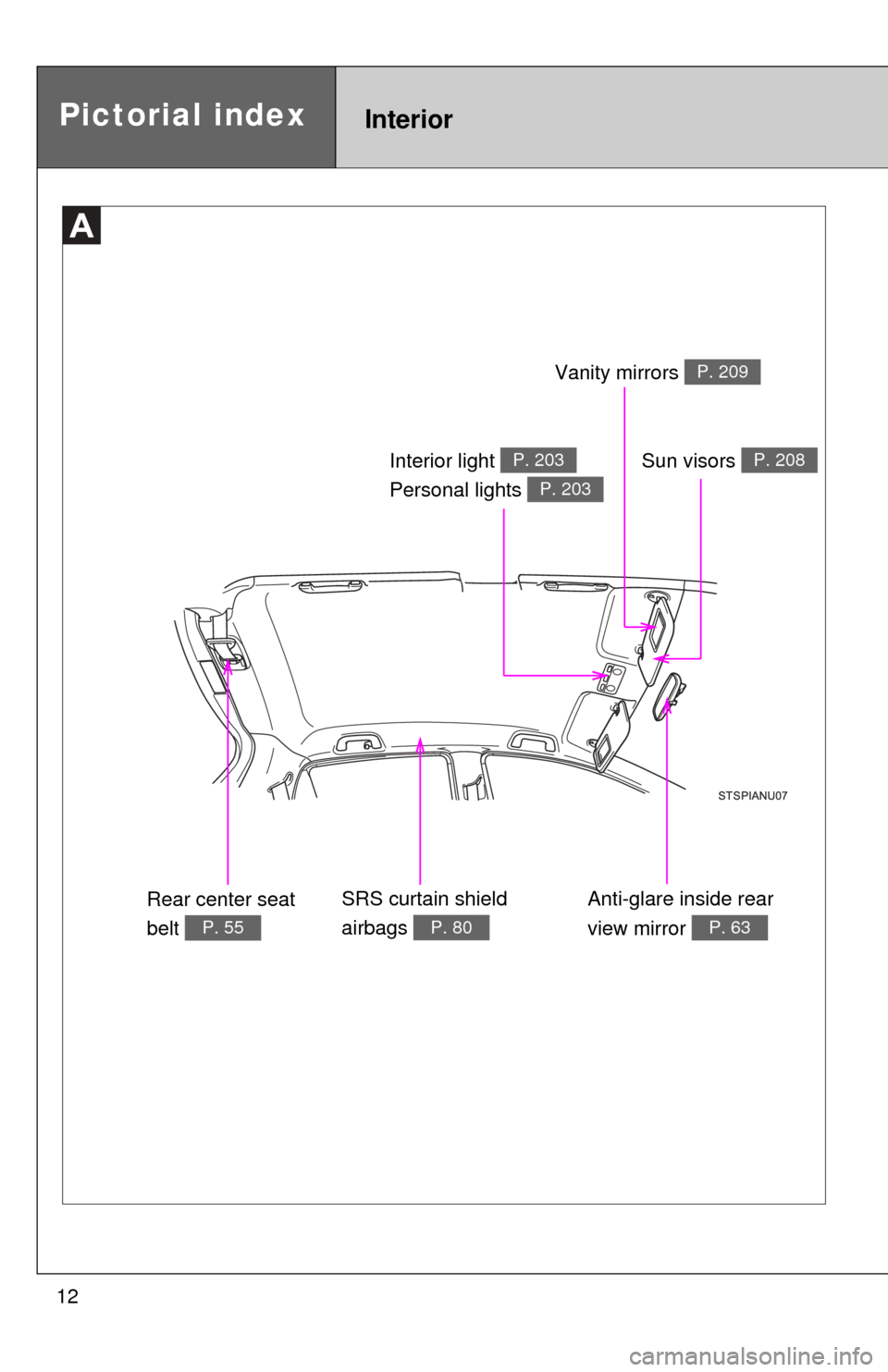
Pictorial indexInterior
Anti-glare inside rear
view mirror
P. 63
Vanity mirrors P. 209
Interior light
Personal lights P. 203
P. 203
Sun visors P. 208
SRS curtain shield
airbags
P. 80
Rear center seat
belt
P. 55
Page 100 of 400

100 1-7. Safety information
CAUTION
■Child restraint precautions
●For effective protection in automobile accidents and sudden stops, a child
must be properly restrained, using a seat belt or child restraint system
depending on the age and size of the child. Holding a child in your arms is
not a substitute for a child restraint system. In an accident, the child can be
crushed against the windshield, or between you and the vehicle’s interior.
● Toyota strongly urges the use of a proper child restraint system that con-
forms to the size of the child, installed on the rear seat. According to acci-
dent statistics, the child is safer when properly restrained in the rear seat
than in the front seat.
● Never install a rear-facing child restraint system on the front passenger
seat even if the “AIR BAG OFF” indicator light is illuminated. In the event
of an accident, the force of the rapid inflation of the front passenger airbag
can cause death or serious injury to the child if the rear-facing child
restraint system is installed on the front passenger seat.
● A forward-facing child restraint system may be installed on the front pas-
senger seat only when it is unavoidable. A child restraint system that
requires a top tether strap should not be used in the front passenger seat
since there is no top tether strap anchor for the front passenger seat.
Adjust the seatback as upright as possible and always move the seat as
far back as possible even if the “AIR BAG OFF” indicator light is illumi-
nated, because the front passenger airbag could inflate with considerable
speed and force. Otherwise, the child may be killed or seriously injured.
● Do not use the seat belt extender when installing a child restraint system
on the front or rear passenger seat. If installing a child restraint system
with the seat belt extender connected to the seat belt, the seat belt will not
securely hold the child restraint system, which could cause death or seri-
ous injury to the child or other passengers in the event of sudden braking,
sudden swerving or an accident.
● Do not allow the child to lean his/her head or any part of his/her body
against the door or the area of the sea t, front and rear pillars or roof side
rails from which the SRS side airbags or SRS curtain shield airbags deploy
even if the child is seated in the child restraint system. It is dangerous if
the SRS side airbags and curtain shield airbags inflate, and the impact
could cause death or serious injury to the child.
Page 119 of 400

119
2-1. Driving procedures
2
When driving
CAUTION
■
When the vehicle is stopped
●Do not race the engine.
If the vehicle is in any gear other than P (vehicles with an automatic trans-
mission only) or N, the vehicle may accelerate suddenly and unexpectedly,
causing an accident.
● Do not leave the vehicle with the engine running for a long time.
If such a situation cannot be avoided, park the vehicle in an open space
and check that exhaust fumes do not enter the vehicle interior.
● On vehicles with an automatic transmission, in order to prevent accidents
due to the vehicle rolling away, always keep depressing the brake pedal
while the engine is running, and apply the parking brake as necessary.
● If the vehicle is stopped on an incline, in order to prevent accidents caused
by the vehicle rolling forward or backward, always depress the brake pedal
and securely apply the parking brake as needed.
● Avoid revving or racing the engine.
Running the engine at high speed while the vehicle is stopped may cause
the exhaust system to overheat, which could result in a fire if combustible
material is nearby.
■ When the vehicle is parked
●Do not leave glasses, cigarette lighters, spray cans, or soft drink cans in
the vehicle when it is in the sun.
Doing so may result in the following:
• Gas may leak from a cigarette lighter or spray can, and may lead to a
fire.
• The temperature inside the vehicle may cause the plastic lenses and plastic material of glasses to deform or crack.
• Soft drink cans may fracture, causing the contents to spray over the interior of the vehicle, and may also cause a short circuit in the vehi-
cle’s electrical components.
● Do not leave cigarette lighters in the vehicle. If a cigarette lighter is in a
place such as the glove box or on the floor, it may be lit accidentally when
luggage is loaded or the seat is adjusted, causing a fire.
Page 191 of 400
Interior features3
191
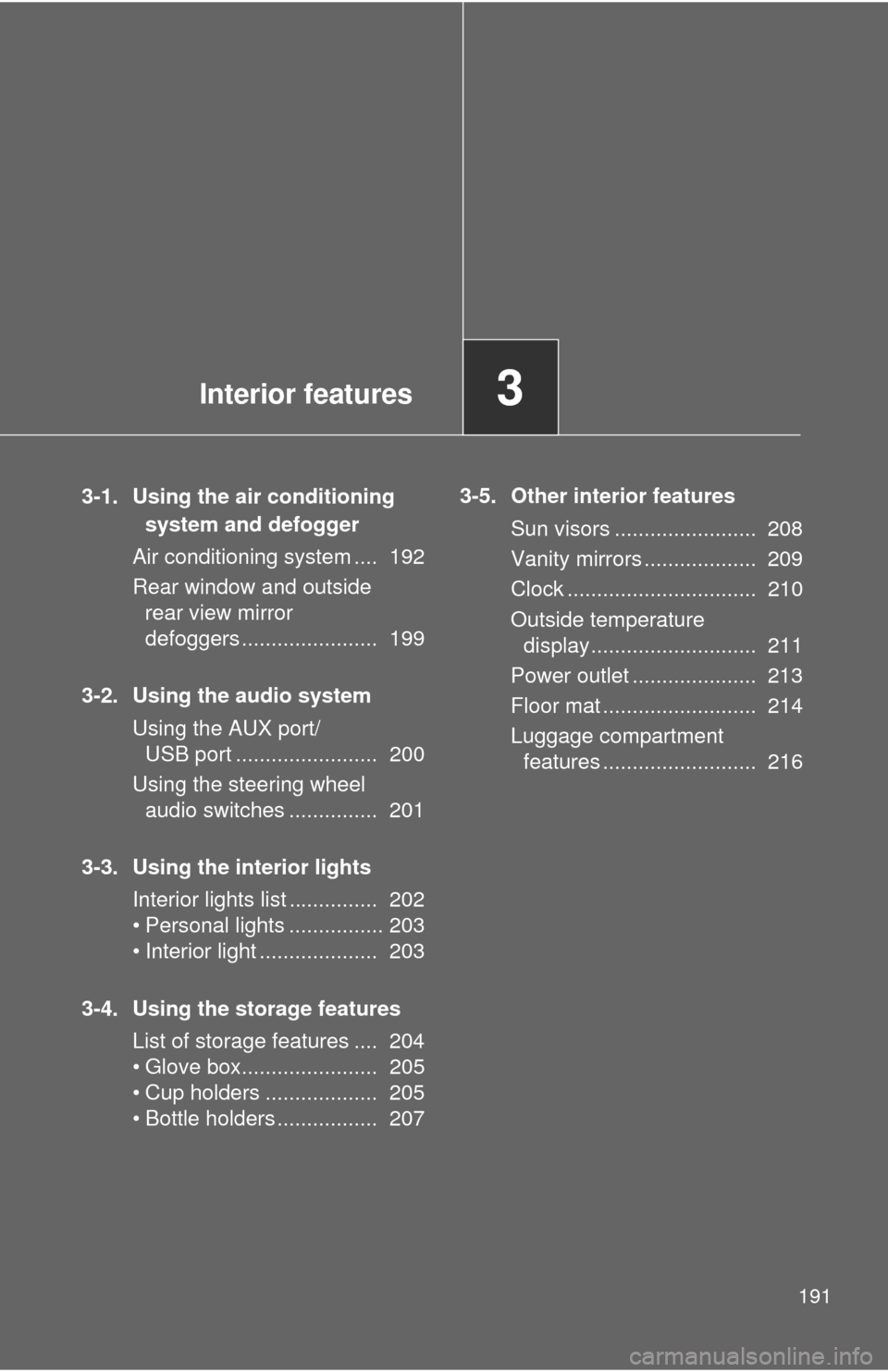
3-1. Using the air conditioning system and defogger
Air conditioning system .... 192
Rear window and outside rear view mirror
defoggers ....................... 199
3-2. Using the audio system Using the AUX port/USB port ........................ 200
Using the steering wheel audio switches ............... 201
3-3. Using the interior lights Interior lights list ............... 202
• Personal lights ................ 203
• Interior light .................... 203
3-4. Using the storage features List of storage features .... 204
• Glove box....................... 205
• Cup holders ................... 205
• Bottle holders ................. 207 3-5. Other interior features
Sun visors ........................ 208
Vanity mirrors ................... 209
Clock ................................ 210
Outside temperature display............................ 211
Power outlet ..................... 213
Floor mat .......................... 214
Luggage compartment features .......................... 216
Page 197 of 400
197
3-1. Using the air conditioning system
and defogger
3
Interior features
■Fogging up of the windows
●The windows will easily fog up when the humidify in the vehicle is high.
Turning on will dehumidify the air from the outlets and defog the
windshield effectively. (vehicles with an air conditioning on/off button)
● If you turn off, the windows may fog up more easily. (vehicles with
an air conditioning on/off button)
● The windows may fog up if the recirculated air mode is used.
■ Outside/recirculated air mode
When driving on dusty roads such as tunnels or in heavy traffic, set the out-
side/recirculated air mode button to the recirculated air mode. This is effec-
tive in preventing outside air from enter ing the vehicle interior. During cooling
operation, setting the recirculated air m ode will also cool the vehicle interior
effectively.
■ When the indicator light on goes off by itself (vehicles with an
air conditioning on/off button)
Press to turn off the dehumidification function and turn it on again.
There may be a problem in the air conditioning system if the indicator light
goes off again. Turn the air conditioning system off and have it inspected by
your Toyota dealer.
■ When the outside temperature falls to nearly 32°F (0°C) (vehicles with
an air conditioning on/off button)
The dehumidification function may not operate even when
is
pressed.
Page 202 of 400
202
3-3. Using the interior lights
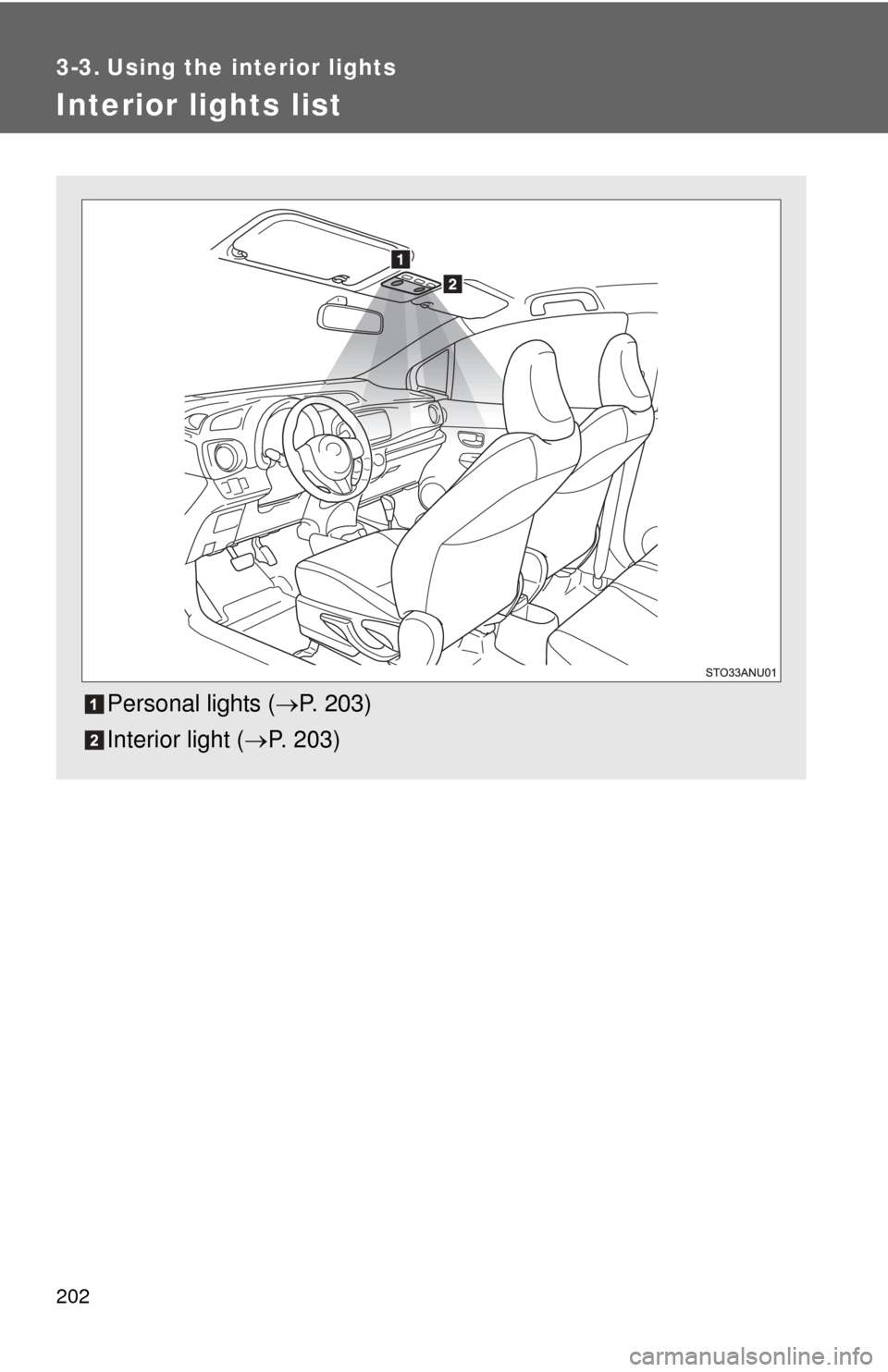
Interior lights list
Personal lights (P. 203)
Interior light ( P. 203)
Page 203 of 400
203
3-3. Using the interior lights
3
Interior features
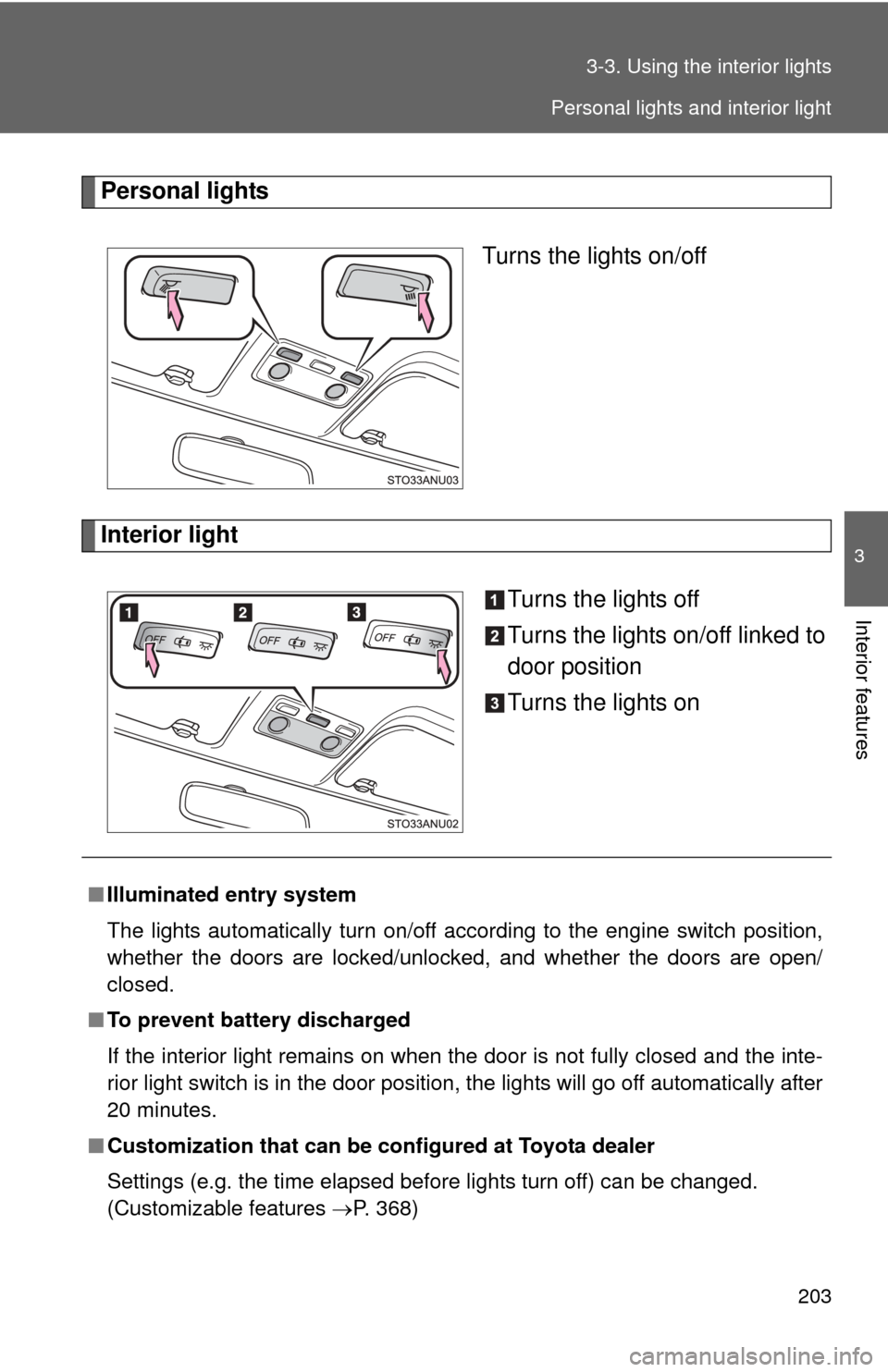
Personal lights
Turns the lights on/off
Interior light Turns the lights off
Turns the lights on/off linked to
door position
Turns the lights on
■Illuminated entry system
The lights automatically turn on/off according to the engine switch position,
whether the doors are locked/unlocked, and whether the doors are open/
closed.
■ To prevent battery discharged
If the interior light remains on when the door is not fully closed and the inte-
rior light switch is in the door position, the lights will go off automatically after
20 minutes.
■ Customization that can be co nfigured at Toyota dealer
Settings (e.g. the time elapsed before lights turn off) can be changed.
(Customizable features P. 368)
Personal lights and interior light
Page 219 of 400
Maintenance and care4
219
4-1. Maintenance and careCleaning and protecting the vehicle exterior......... 220
Cleaning and protecting the vehicle interior.......... 223
4-2. Maintenance Maintenance requirements .................. 226
General maintenance....... 228
Emission inspection and maintenance (I/M)
programs........................ 232 4-3. Do-it-yourself maintenance
Do-it-yourself service precautions .................... 233
Hood ................................ 236
Positioning a floor jack ..... 238
Engine compartment ........ 241
Tires ................................. 253
Tire inflation pressure ...... 261
Wheels ............................. 265
Air conditioning filter......... 268
Wireless remote control battery ............................ 270
Checking and replacing fuses .............................. 274
Light bulbs........................ 286
Page 225 of 400

225
4-1. Maintenance and care
4
Maintenance and care
NOTICE
■
Cleaning detergents
●Do not use the following types of detergent, as they may discolor the vehi-
cle interior or cause streaks or damage to painted surfaces:
• Non-seat portions: Organic substances such as benzene or gasoline,
alkaline or acidic solutions, dye, and bleach
• Seats: Alkaline or acidic solutions, such as thinner, benzene, and alco- hol
● Do not use polish wax or polish cleaner. The instrument panel’s or other
interior part’s painted surface may be damaged.
■ Preventing damage to leather surfaces
Observe the following precautions to avoid damage to and deterioration o\
f
leather surfaces:
●Remove any dust or dirt from leather surfaces immediately.
● Do not expose the vehicle to direct sunlight for extended periods of time.
Park the vehicle in the shade, especially during summer.
● Do not place items made of vinyl, plastic, or containing wax on the uphol-
stery, as they may stick to the leather surface if the vehicle interior heats
up significantly.
■ Water on the floor
Do not wash the vehicle floor with water.
Vehicle systems such as the audio system may be damaged if water comes
into contact with electrical components such as the audio system above or
under the floor of the vehicle. Water may also cause the body to rust.
■ Cleaning the inside of the rear window
●Do not use glass cleaner to clean the rear window, as this may cause
damage to the rear window defogger heater wires. Use a cloth dampened
with lukewarm water to gently wipe the window clean. Wipe the window in
strokes running parallel to the heater wires.
● Be careful not to scratch or damage the heater wires.