Engine TOYOTA YARIS 2012 User Guide
[x] Cancel search | Manufacturer: TOYOTA, Model Year: 2012, Model line: YARIS, Model: TOYOTA YARIS 2012Pages: 704, PDF Size: 27.58 MB
Page 48 of 704

48
YARIS_F (including HV)_WE_52C79E
1-1. Hybrid system (hybrid vehicle)
Hybrid system features
Hybrid vehicle has characteristics different from conventional vehi-
cles. Be sure you are closely familiar with the characteristics of your
vehicle, and operate with care.
The hybrid system combines the use of a gasoline engine and an
electric motor (traction motor) according to driving conditions,
improving fuel efficiency and reducing exhaust emissions.
Gasoline engine
Electric motor (Traction motor)
Page 49 of 704
49 1-1. Hybrid system (hybrid vehicle)
1
Before driving
YARIS_F (including HV)_WE_52C79E
Regenerative braking
In the following situations, kinetic energy is converted to electric energy and
deceleration force can be obtained in conjunction with the recharging of the
hybrid battery (traction battery).
The accelerator pedal is released.
The brake pedal is depressed with the shift lever in D or B.
When stopped/during start off
The gasoline engine stops
* when the vehicle is stopped. During
start off, the electric motor (traction motor) drives the vehicle. At
slow speeds or when traveling down a gentle slope, the engine
is stopped
* and the motor is used.
*: However, when the hybrid battery (traction battery) needs to be
charged or while the engine is being warmed up, the gasoline engine
may not stop automatically. (P. 50)
During normal driving
The gasoline engine is predominantly used. The electric motor
(traction motor) charges the hybrid battery (traction battery) as
necessary.
When accelerating sharply
The power of the hybrid battery (traction battery) is added to that
of the gasoline engine via the electric motor (traction motor).
When braking (regenerative braking)
The electric motor (traction motor) charges the hybrid battery
(traction battery).
Page 50 of 704
50 1-1. Hybrid system (hybrid vehicle)
YARIS_F (including HV)_WE_52C79E
EV indicator
Conditions in which the gasoline engine may not stop
The gasoline engine starts and stops automatically. However, it may not stop
automatically in the following conditions:
During gasoline engine warm-up
During hybrid battery (traction battery) charging
When the temperature of the hybrid battery (traction battery) is high or
low
When the heater is switched on
Charging the hybrid battery (traction battery)
As the gasoline engine charges the hybrid battery (traction battery), the
battery does not need to be charged from an outside source. However, if
the vehicle is left parked for a long time the hybrid battery will slowly dis-
charge. For this reason, be sure to drive the vehicle at least once every
few months for at least 30 minutes or 16 km (10 miles). If the hybrid bat-
tery becomes fully discharged and you are unable to jump-start the vehi-
cle with the 12-volt battery, contact any authorized Toyota dealer or
repairer, or another duly qualified and equipped professional.
If the shift lever is in N, the hybrid battery (traction battery) will not be
charged. Always put the shift lever in P when the vehicle is stopped.
When driving in heavy traffic, operate the vehicle with the shift lever in D
or B to avoid discharging the battery.
Charging the 12-volt battery
P. 631
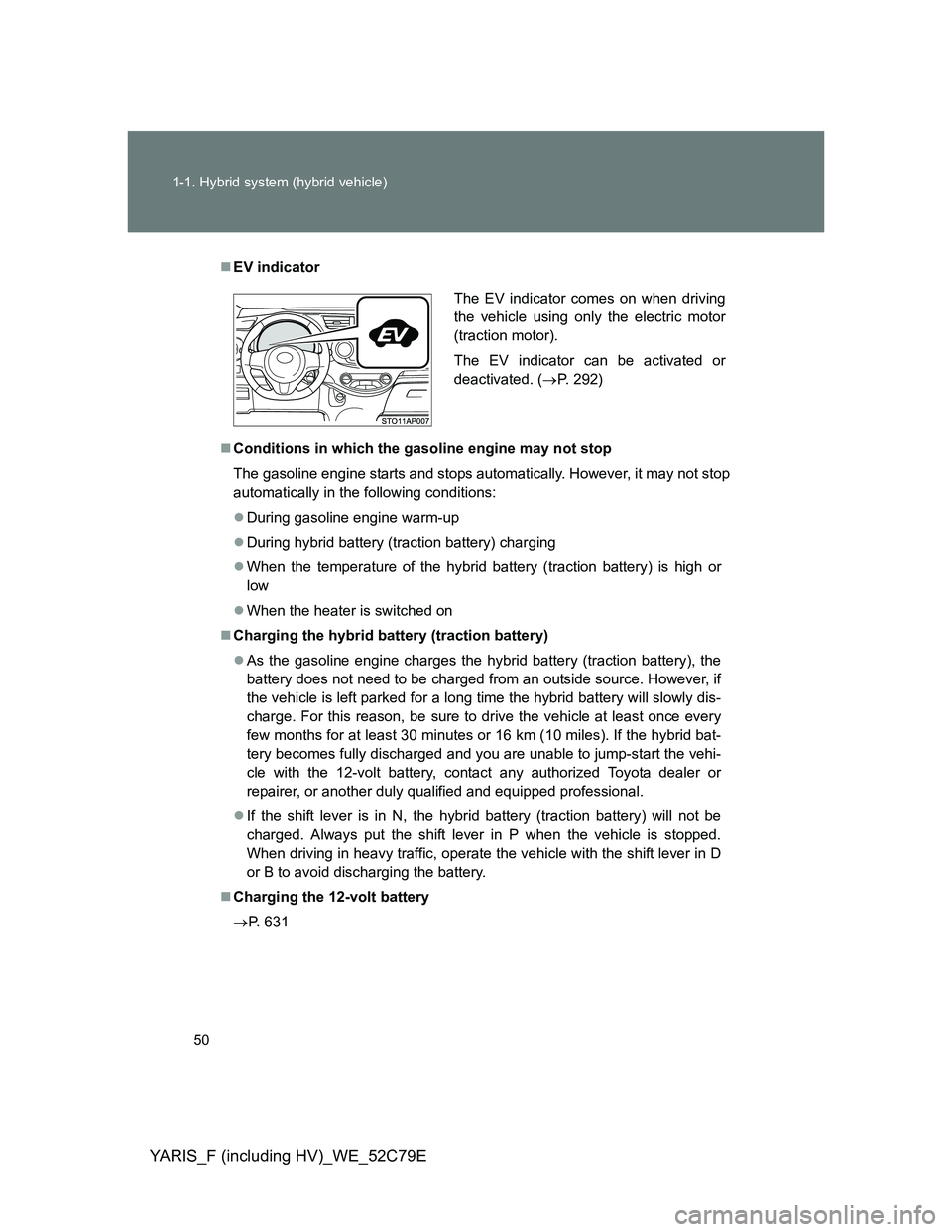
The EV indicator comes on when driving
the vehicle using only the electric motor
(traction motor).
The EV indicator can be activated or
deactivated. (P. 292)
Page 51 of 704
51 1-1. Hybrid system (hybrid vehicle)
1
Before driving
YARIS_F (including HV)_WE_52C79E
After the 12-volt battery has discharged or has been changed or
removed
The gasoline engine may not stop even if the vehicle is running on the hybrid
battery (traction battery). If this continues for a few days, contact any autho-
rized Toyota dealer or repairer, or another duly qualified and equipped pro-
fessional.
Sounds and vibrations specific to a hybrid vehicle
There may be no engine sounds or vibration even though the vehicle is able
to move. For safety, apply the parking brake and make sure to shift the shift
lever to P when parked.
The following sounds or vibrations may occur when the hybrid system is
operating and are not a malfunction:
Motor sounds may be heard from the engine compartment.
Sounds may be heard from the hybrid battery (traction battery) under the
rear seats when the hybrid system starts or stops.
Sounds from the hybrid system may be heard when the back door is
open.
Sounds may be heard from the transmission when the gasoline engine
starts or stops, when driving at low speeds, or during idling.
Engine sounds may be heard when accelerating sharply.
Sounds may be heard due to regenerative braking when the brake pedal
is depressed and accelerator is loosened.
Vibration may be felt when the gasoline engine starts or stops.
Cooling fan sounds may be heard from the air intake vent on the side of
the lower part of the rear left seats.
Maintenance, repair, recycling, and disposal
Contact any authorized Toyota dealer or repairer, or another duly qualified
and equipped professional regarding maintenance, repair, recycling and dis-
posal. Do not dispose of the vehicle yourself.
Page 58 of 704
58 1-1. Hybrid system (hybrid vehicle)
YARIS_F (including HV)_WE_52C79E
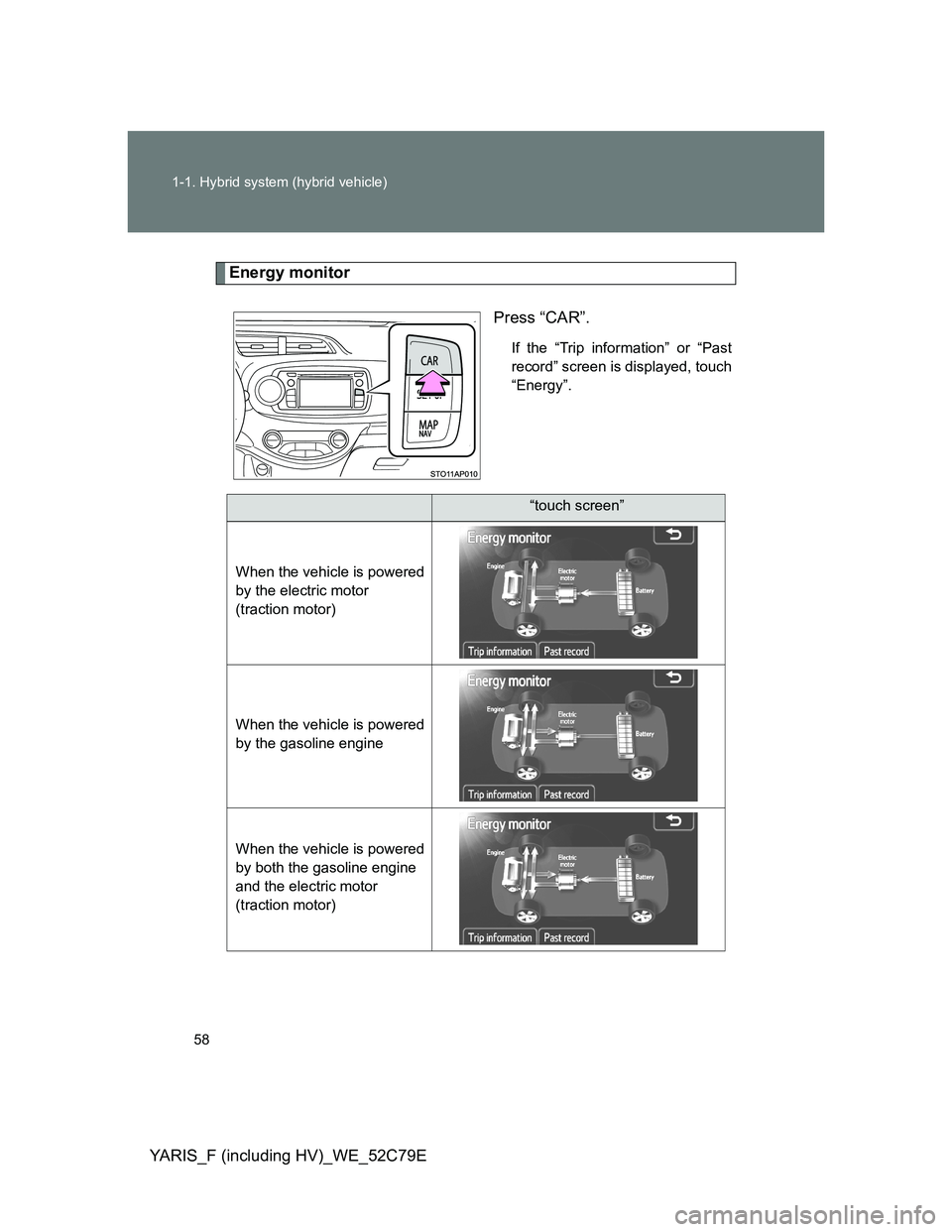
Energy monitor
Press “CAR”.
If the “Trip information” or “Past
record” screen is displayed, touch
“Energy”.
“touch screen”
When the vehicle is powered
by the electric motor
(traction motor)
When the vehicle is powered
by the gasoline engine
When the vehicle is powered
by both the gasoline engine
and the electric motor
(traction motor)
Page 62 of 704
62
1-1. Hybrid system (hybrid vehicle)
YARIS_F (including HV)_WE_52C79E
Hybrid vehicle driving tips
For economical and ecological driving, pay attention to the following
points:
Using Eco drive mode
P. 253
Use of Hybrid System Indicator
Eco-friendly driving is possible by keeping the indicator needle of
Hybrid System Indicator within Eco area. (P. 276)
When braking the vehicle
Make sure to operate the brakes gently and in good time. A greater
amount of electrical energy can be retained when slowing down.
Delays
Repeated acceleration and deceleration, as well as long waits at traffic
lights, will lead to bad fuel consumption. Check traffic reports before
leaving and avoid delays as much as possible. When encountering a
delay, gently release the brake pedal to allow the vehicle to move for-
ward slightly while avoiding overuse of the accelerator pedal. Doing so
can help control excessive gasoline consumption.
Highway driving
Control your speed and keep at a constant speed. Also, before stop-
ping at a toll booth or similar, allow plenty of time to release the acceler-
ator and gently apply the brakes. A greater amount of electrical energy
can be retained when slowing down.
Air conditioning
Use the air conditioning only when necessary. Doing so can help con-
trol excessive gasoline consumption.
In summer: In high temperatures, use the recirculated air mode. Doing
so will help to reduce the burden on the air conditioner and reduce fuel
consumption as well.
In winter: Because the gasoline engine will not automatically cut out
until the gasoline engine and the interior of the vehicle are warm, it will
consume fuel. Also, fuel consumption can be improved by avoiding
overuse of the heater such as setting the temperature too high.
Page 63 of 704
63 1-1. Hybrid system (hybrid vehicle)
1
Before driving
YARIS_F (including HV)_WE_52C79E
Checking tire inflation pressure
Make sure to check the tire inflation pressure frequently. Improper tire
inflation pressure can cause poor fuel consumption.
Also, as snow tires can cause large amounts of friction, their use on dry
roads can lead to poor fuel consumption. Use a tire that is appropriate
for the season.
Luggage
Carrying heavy luggage can lead to poor fuel consumption. Avoid car-
rying unnecessary luggage. Installing a large roof rack can also cause
poor fuel consumption.
Warming up before driving
Since the gasoline engine starts up and cuts out automatically when
cold, warming up the engine is unnecessary. Moreover, frequently driv-
ing short distances will cause the engine to repeatedly warm up, which
can lead to poor fuel consumption.
Page 69 of 704
69
1
Before driving
YARIS_F (including HV)_WE_52C79E
1-3. Opening, closing and locking the doors
Smart entr y & start system
: If equipped
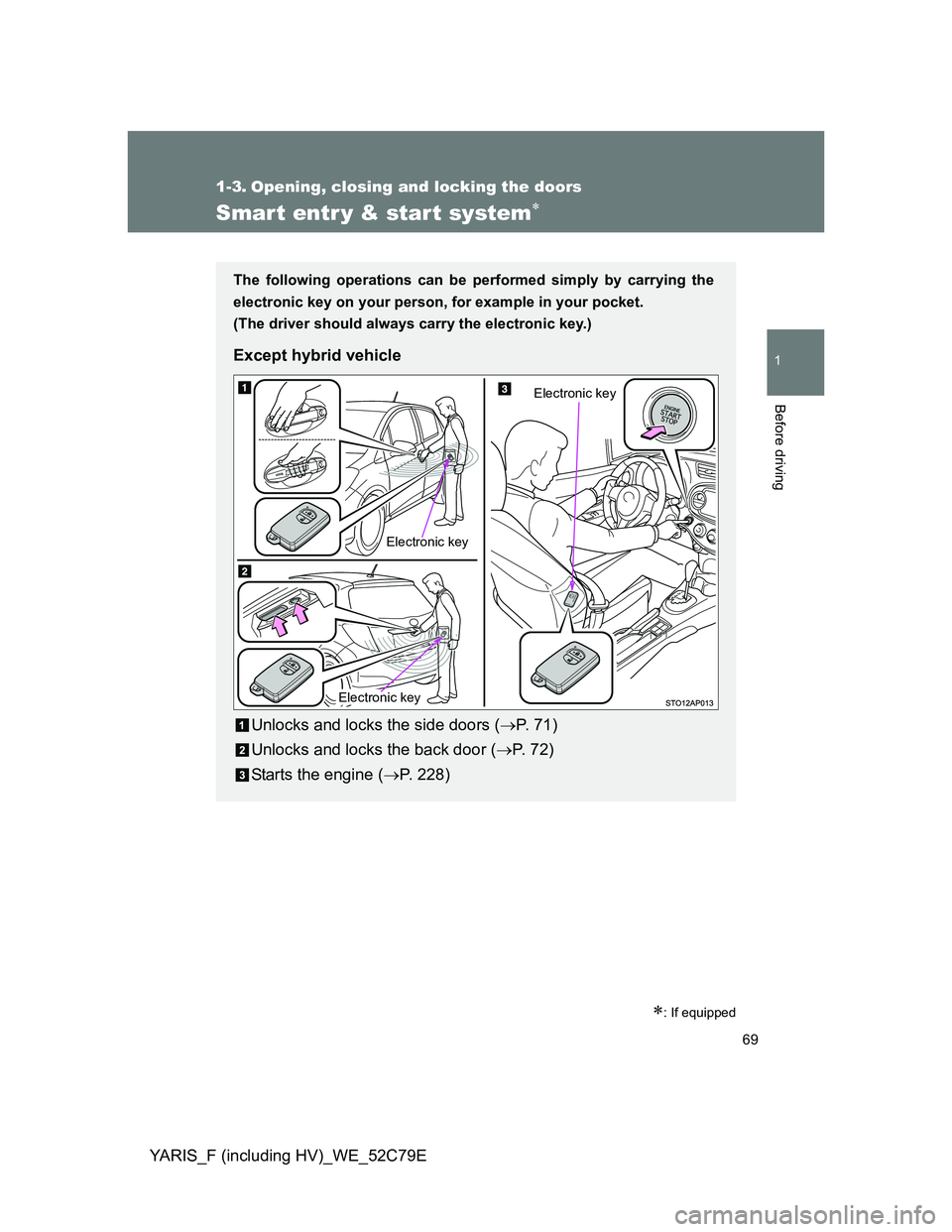
The following operations can be performed simply by carrying the
electronic key on your person, for example in your pocket.
(The driver should always carry the electronic key.)
Except hybrid vehicle
Unlocks and locks the side doors (P. 7 1 )
Unlocks and locks the back door (P. 72)
Starts the engine (P. 228)
Electronic key
Electronic keyElectronic key
Page 74 of 704
74 1-3. Opening, closing and locking the doors
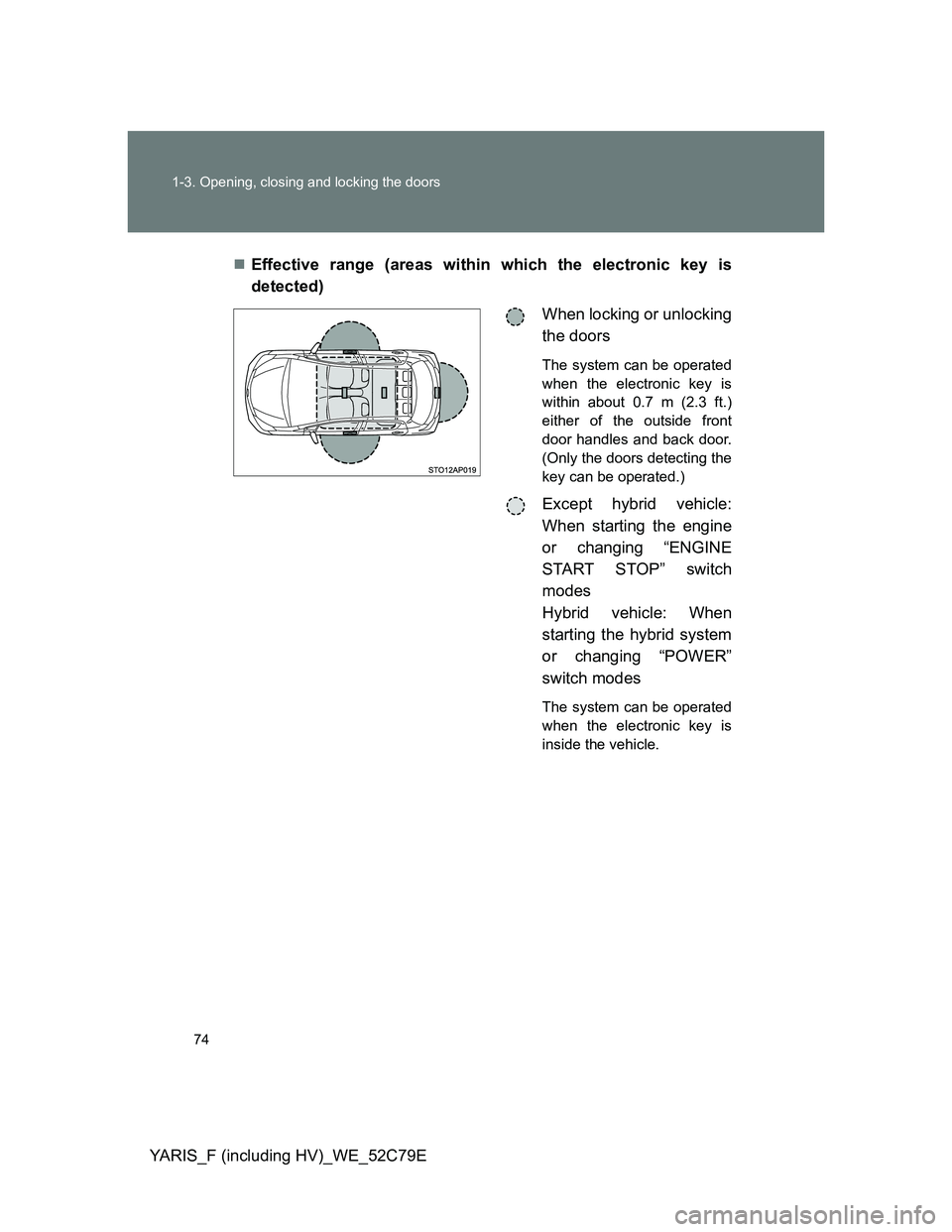
YARIS_F (including HV)_WE_52C79EEffective range (areas within which the electronic key is
detected)
When locking or unlocking
the doors
The system can be operated
when the electronic key is
within about 0.7 m (2.3 ft.)
either of the outside front
door handles and back door.
(Only the doors detecting the
key can be operated.)
Except hybrid vehicle:
When starting the engine
or changing “ENGINE
START STOP” switch
modes
Hybrid vehicle: When
starting the hybrid system
or changing “POWER”
switch modes
The system can be operated
when the electronic key is
inside the vehicle.
Page 76 of 704
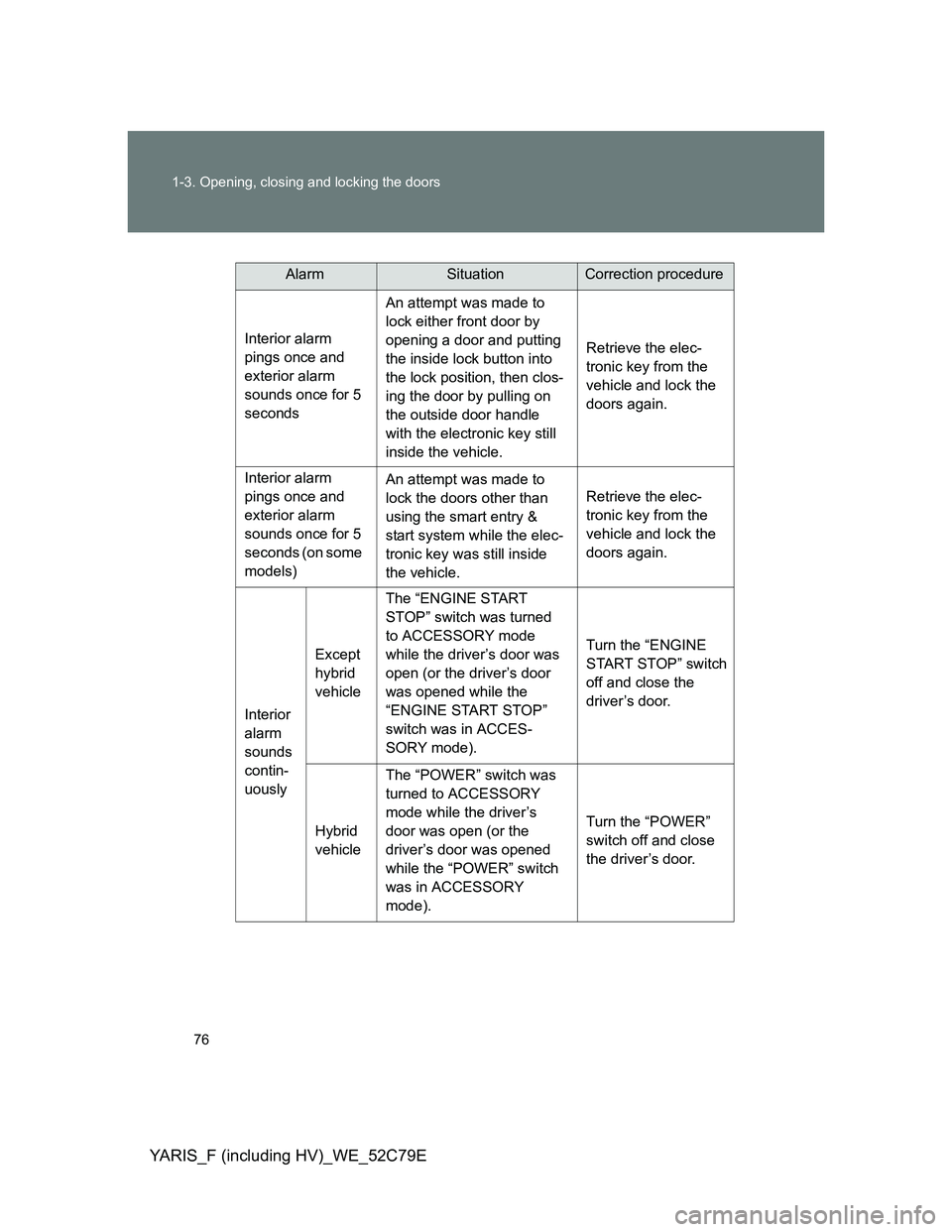
76 1-3. Opening, closing and locking the doors
YARIS_F (including HV)_WE_52C79E
AlarmSituationCorrection procedure
Interior alarm
pings once and
exterior alarm
sounds once for 5
secondsAn attempt was made to
lock either front door by
opening a door and putting
the inside lock button into
the lock position, then clos-
ing the door by pulling on
the outside door handle
with the electronic key still
inside the vehicle.Retrieve the elec-
tronic key from the
vehicle and lock the
doors again.
Interior alarm
pings once and
exterior alarm
sounds once for 5
seconds (on some
models)An attempt was made to
lock the doors other than
using the smart entry &
start system while the elec-
tronic key was still inside
the vehicle.Retrieve the elec-
tronic key from the
vehicle and lock the
doors again.
Interior
alarm
sounds
contin-
uouslyExcept
hybrid
vehicleThe “ENGINE START
STOP” switch was turned
to ACCESSORY mode
while the driver’s door was
open (or the driver’s door
was opened while the
“ENGINE START STOP”
switch was in ACCES-
SORY mode).Turn the “ENGINE
START STOP” switch
off and close the
driver’s door.
Hybrid
vehicleThe “POWER” switch was
turned to ACCESSORY
mode while the driver’s
door was open (or the
driver’s door was opened
while the “POWER” switch
was in ACCESSORY
mode).Turn the “POWER”
switch off and close
the driver’s door.