air condition TOYOTA YARIS 2012 User Guide
[x] Cancel search | Manufacturer: TOYOTA, Model Year: 2012, Model line: YARIS, Model: TOYOTA YARIS 2012Pages: 704, PDF Size: 27.58 MB
Page 78 of 704
78 1-3. Opening, closing and locking the doors
YARIS_F (including HV)_WE_52C79E
Conditions affecting operation
The smart entry & start system uses weak radio waves. In the following situ-
ations, the communication between the electronic key and the vehicle may
be affected, preventing the smart entry & start system, wireless remote con-
trol and engine immobilizer system from operating properly.
(Way of coping: P. 619)
When the electronic key battery is depleted
Near a TV tower, electric power plant, gas station, radio station, large dis-
play, airport or other facility that generates strong radio waves or electri-
cal noise
When the electronic key is in contact with, or is covered by the following
metallic objects
• Cards to which aluminum foil is attached
• Cigarette boxes that have aluminum foil inside
• Metallic wallets or bags
• Coins
• Hand warmers made of metal
• Media such as CDs and DVDs
When other wireless key (that emit radio waves) is being used nearby
When carrying the electronic key together with the following devices that
emit radio waves
• A portable radio, cellular phone, cordless phone or other wireless com-
munication device
• Another vehicle’s electronic key or a wireless key that emits radio
waves
• Personal computers or personal digital assistants (PDAs)
• Digital audio players
• Portable game systems
If window tint with a metallic content or metallic objects are attached to
the rear window
When the electronic key is placed near a battery charger or electronic
devices
Page 106 of 704
106 1-3. Opening, closing and locking the doors
YARIS_F (including HV)_WE_52C79E
Operation signals
The emergency flashers flash to indicate that the doors have been locked/
unlocked. (Locked: once; Unlocked: twice)
Door lock buzzer (vehicles with a smart entry & start system or a push-
button start system)
If an attempt to lock the doors is made when a door is not fully closed, a
buzzer sounds continuously. Fully close the door to stop the buzzer, and lock
the vehicle once more.
Security feature
If a door is not opened within approximately 30 seconds after the vehicle is
unlocked, the security feature automatically locks the vehicle again.
Conditions affecting operation
Vehicles without a smart entry & start system or a push-button start
system
The wireless remote control function may not operate normally in the follow-
ing situations:
When the wireless key battery is depleted
Near a TV tower, electric power plant, gas station, radio station, large dis-
play, airport or other facility that generates strong radio waves or electri-
cal noise
When carrying a portable radio, cellular phone or other wireless commu-
nication devices
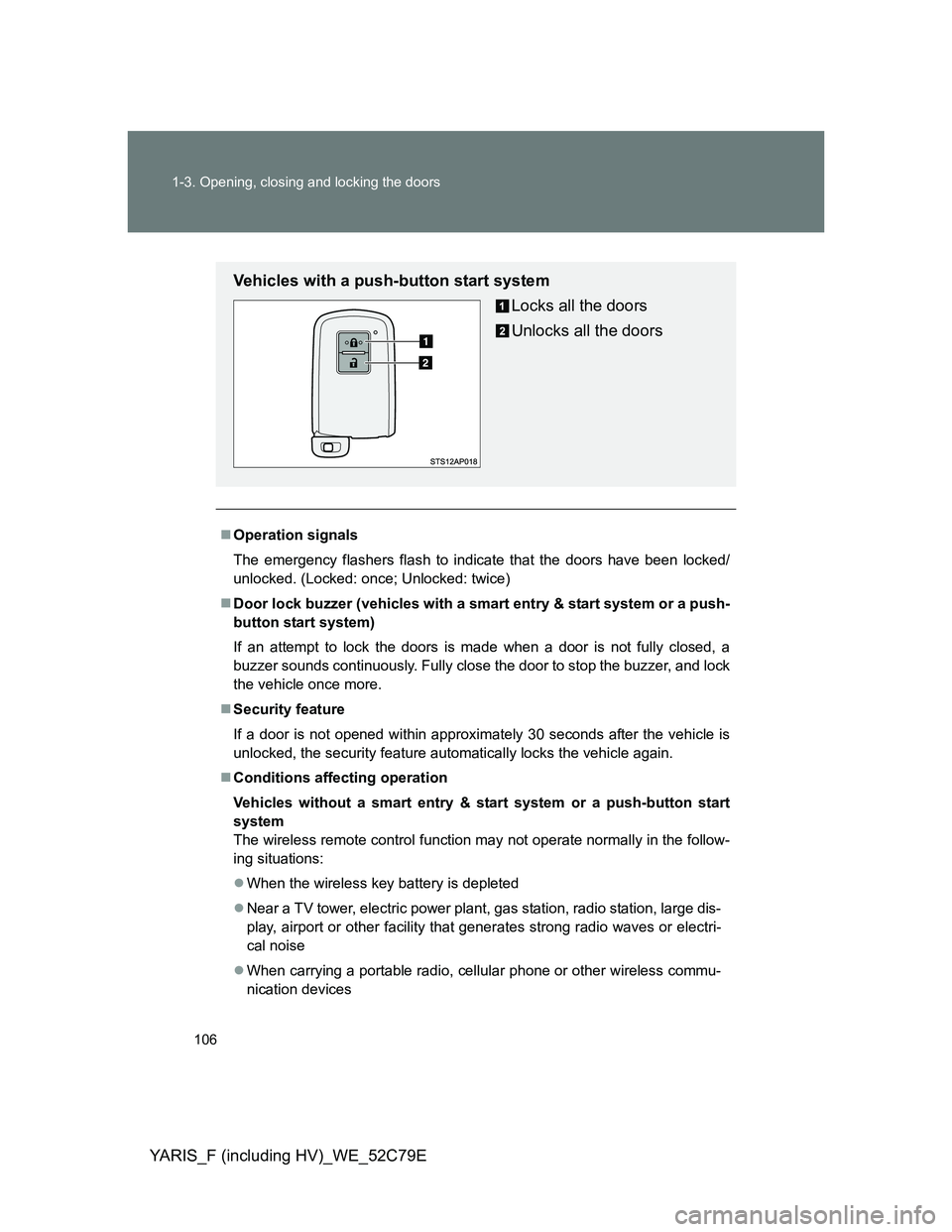
Vehicles with a push-button start system
Locks all the doors
Unlocks all the doors
Page 168 of 704
168 1-8. Safety information
YARIS_F (including HV)_WE_52C79E
If the SRS airbags deploy (inflate)
Bruising and slight abrasions may result from contact with a deploying
(inflating) SRS airbag.
A loud noise and white powder will be emitted.
Vehicles without SRS curtain shield airbags: Parts of the airbag module
(steering wheel hub, airbag cover and inflator) as well as the front seats
may be hot for several minutes. The airbag itself may also be hot.
Vehicles with SRS curtain shield airbags: Parts of the airbag module
(steering wheel hub, airbag cover and inflator) as well as the front seats,
parts of the front and rear pillars, and roof side rails, may be hot for sev-
eral minutes. The airbag itself may also be hot.
The windshield may crack.
SRS airbag deployment conditions (SRS front airbags)
The SRS front airbags will deploy in the event of an impact that exceeds
the set threshold level (the level of force corresponding to an approxi-
mately 20 - 30 km/h [12 - 18 mph] frontal collision with a fixed wall that
does not move or deform).
However, this threshold velocity will be considerably higher in the following
situations:
• If the vehicle strikes an object, such as a parked vehicle or sign pole,
which can move or deform on impact
• If the vehicle is involved in an underride collision, such as a collision in
which the front of the vehicle “underrides”, or goes under, the bed of a
truck
Depending on the type of collision, it is possible that only the seat belt
pretensioners will activate.
SRS airbag deployment conditions (SRS side airbags and SRS curtain
shield airbags [if equipped])
The SRS side and curtain shield airbags will deploy in the event of an impact
that exceeds the set threshold level (the level of force corresponding to the
impact force produced by an approximately 1500 kg [3300 lb.] vehicle collid-
ing with the vehicle cabin from a direction perpendicular to the vehicle orien-
tation at an approximate speed of 20 - 30 km/h [12 - 18 mph]).
Page 169 of 704
169 1-8. Safety information
1
Before driving
YARIS_F (including HV)_WE_52C79E
Conditions under which the SRS airbags may deploy (inflate), other
than a collision
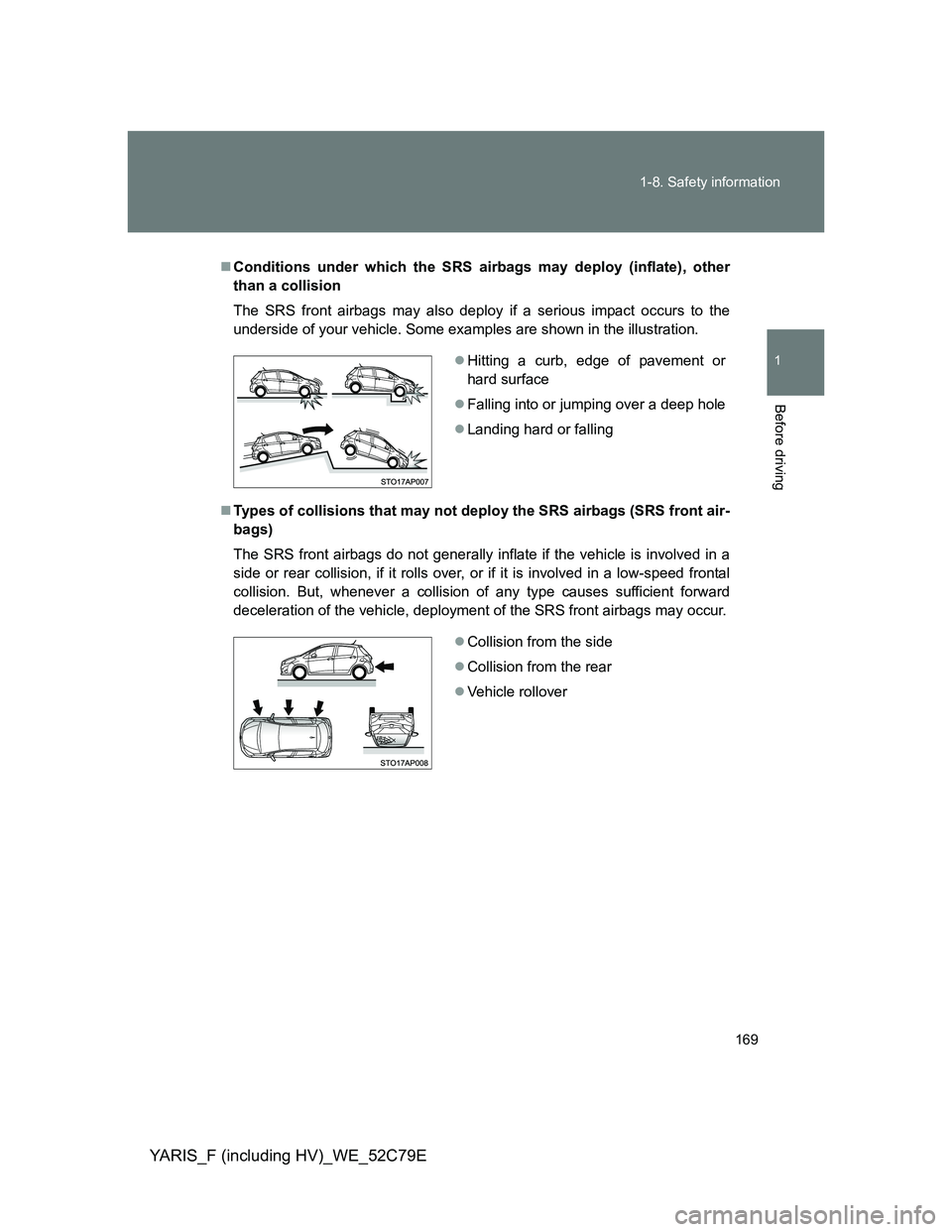
The SRS front airbags may also deploy if a serious impact occurs to the
underside of your vehicle. Some examples are shown in the illustration.
Types of collisions that may not deploy the SRS airbags (SRS front air-
bags)
The SRS front airbags do not generally inflate if the vehicle is involved in a
side or rear collision, if it rolls over, or if it is involved in a low-speed frontal
collision. But, whenever a collision of any type causes sufficient forward
deceleration of the vehicle, deployment of the SRS front airbags may occur.
Hitting a curb, edge of pavement or
hard surface
Falling into or jumping over a deep hole
Landing hard or falling
Collision from the side
Collision from the rear
Vehicle rollover
Page 223 of 704
223 2-1. Driving procedures
2
When driving
YARIS_F (including HV)_WE_52C79E
NOTICE
When encountering flooded roads
Do not drive on a road that has flooded after heavy rain etc. Doing so may
cause the following serious damage to the vehicle:
Engine stalling
Short in electrical components
Engine damage caused by water immersion
In the event that you drive on a flooded road and the vehicle is flooded, be
sure to have any authorized Toyota dealer or repairer, or another duly quali-
fied and equipped professional check the following:
Brake function
Except hybrid vehicle: Changes in quantity and quality of engine oil, trans-
mission fluid, etc.
Hybrid vehicle: Changes in quantity and quality of oil and fluid used for the
engine, hybrid transmission, etc.
Lubricant condition for the bearings and suspension joints (where possi-
ble), and the function of all joints, bearings, etc.
Page 234 of 704
234 2-1. Driving procedures
YARIS_F (including HV)_WE_52C79E
Conditions affecting operation
P. 7 8
Notes for the entry function
P. 7 9
If the engine does not start
The engine immobilizer system may not have been deactivated. (P. 155)
Contact any authorized Toyota dealer or repairer, or another duly qualified
and equipped professional.
Steering lock
After turning the “ENGINE START STOP” switch off and opening and closing
the doors, the steering wheel will be locked due to the steering lock function.
Operating the “ENGINE START STOP” switch again automatically cancels
the steering lock.
When the steering lock cannot be released
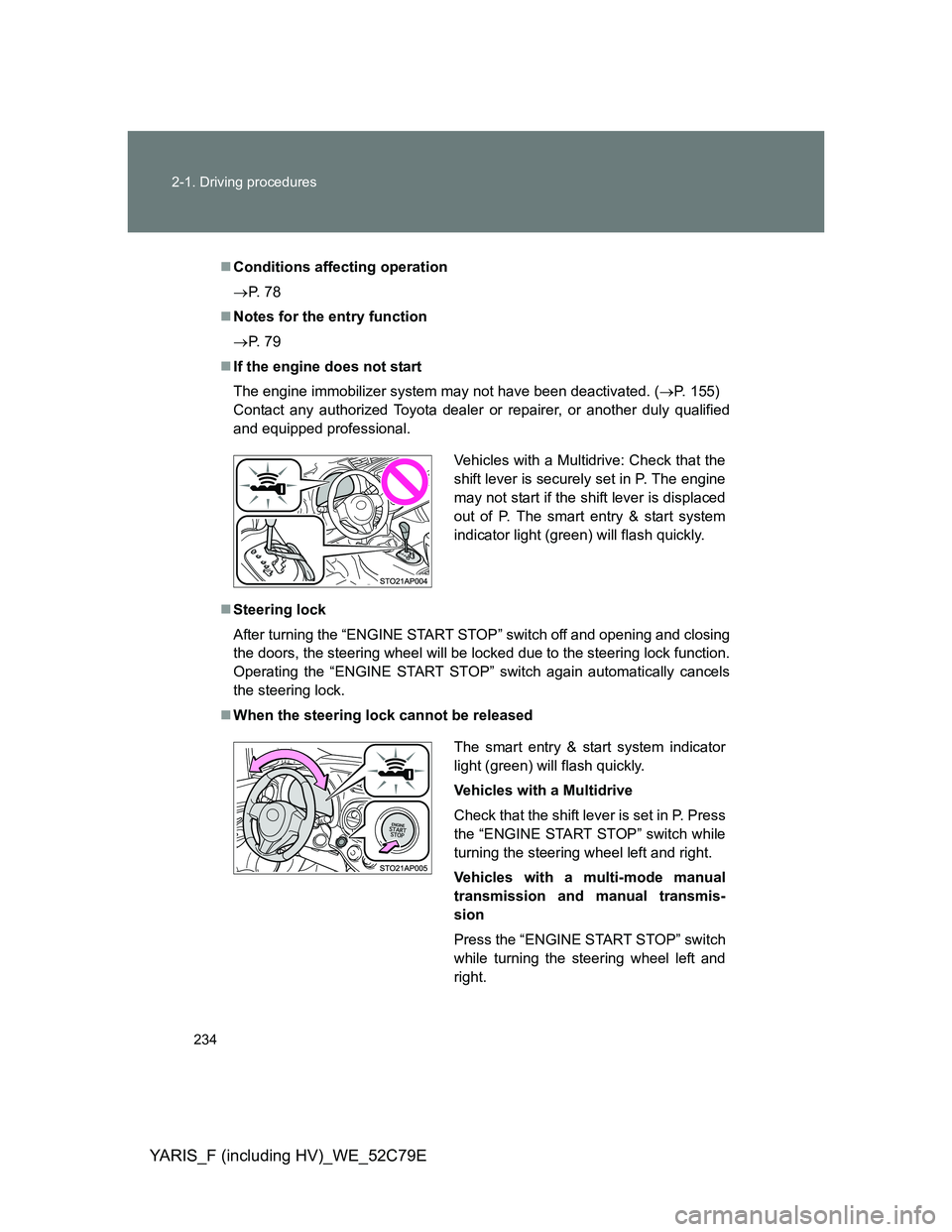
Vehicles with a Multidrive: Check that the
shift lever is securely set in P. The engine
may not start if the shift lever is displaced
out of P. The smart entry & start system
indicator light (green) will flash quickly.
The smart entry & start system indicator
light (green) will flash quickly.
Vehicles with a Multidrive
Check that the shift lever is set in P. Press
the “ENGINE START STOP” switch while
turning the steering wheel left and right.
Vehicles with a multi-mode manual
transmission and manual transmis-
sion
Press the “ENGINE START STOP” switch
while turning the steering wheel left and
right.
Page 240 of 704
240 2-1. Driving procedures
YARIS_F (including HV)_WE_52C79E
When stopping the hybrid system with the shift lever in a
position other than P
If the hybrid system is stopped with the shift lever in a position other
than P, the engine switch will not be turned off but instead be turned
to “ACC”. Perform the following procedure to turn the hybrid system
off:
Check that the parking brake is set.
Shift the shift lever to P. (P. 252)
Turn the engine switch to the “LOCK” position to stop the
hybrid system.
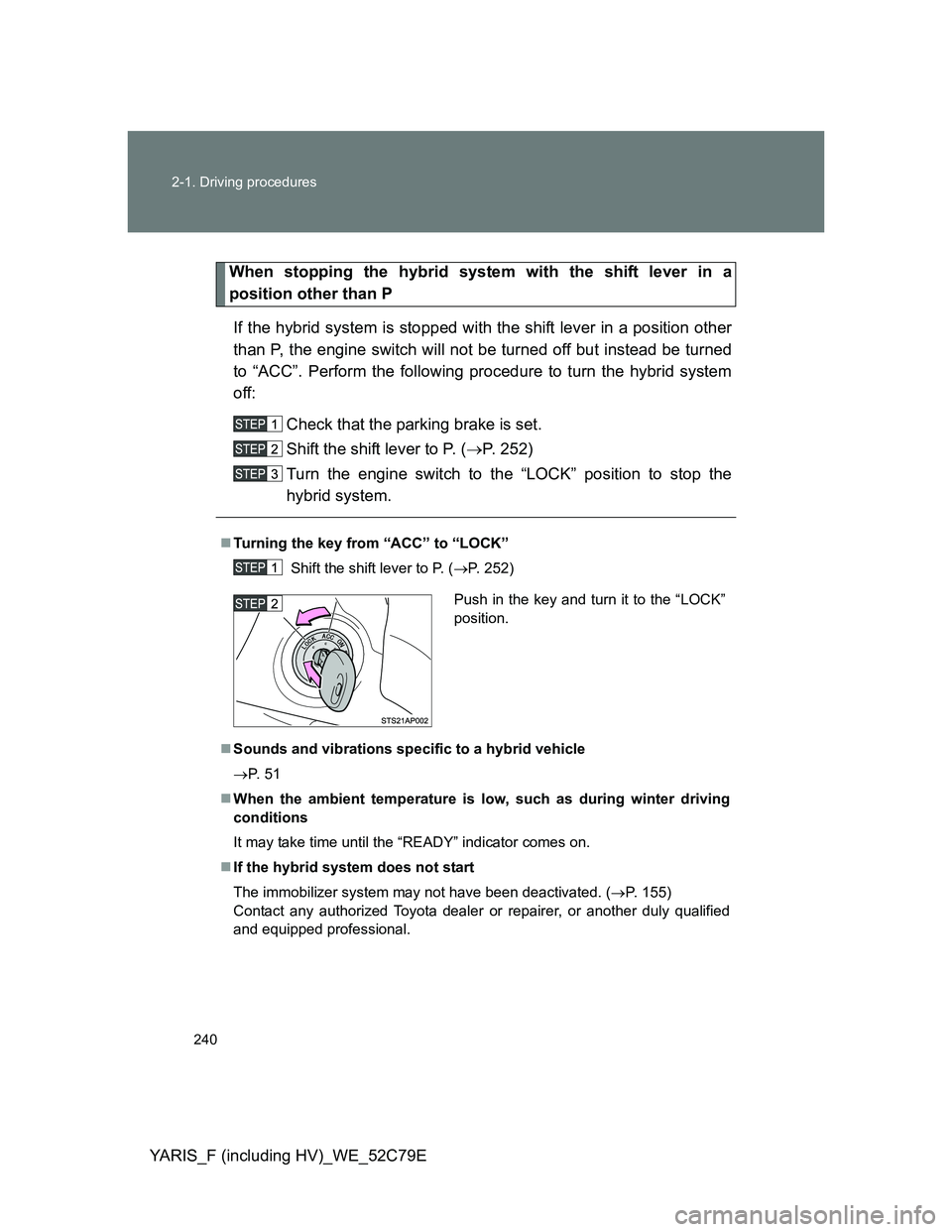
Turning the key from “ACC” to “LOCK”
Shift the shift lever to P. (P. 252)
Sounds and vibrations specific to a hybrid vehicle
P. 5 1
When the ambient temperature is low, such as during winter driving
conditions
It may take time until the “READY” indicator comes on.
If the hybrid system does not start
The immobilizer system may not have been deactivated. (P. 155)
Contact any authorized Toyota dealer or repairer, or another duly qualified
and equipped professional.
Push in the key and turn it to the “LOCK”
position.
Page 253 of 704
253 2-1. Driving procedures
2
When driving
YARIS_F (including HV)_WE_52C79E
Shift position purpose
*: To improve fuel efficiency and reduce noises, set the shift lever in the D
position for normal driving.
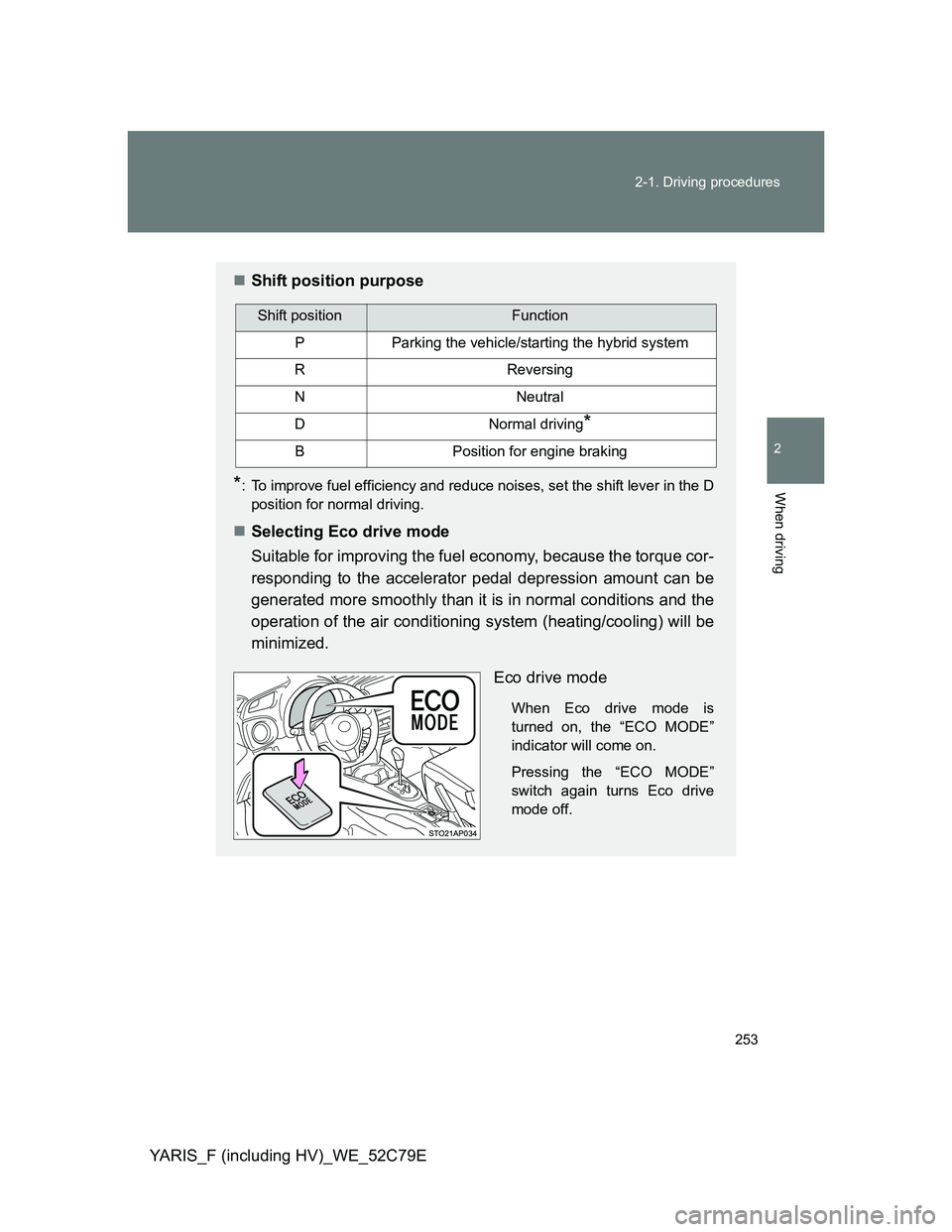
Selecting Eco drive mode
Suitable for improving the fuel economy, because the torque cor-
responding to the accelerator pedal depression amount can be
generated more smoothly than it is in normal conditions and the
operation of the air conditioning system (heating/cooling) will be
minimized.
Eco drive mode
When Eco drive mode is
turned on, the “ECO MODE”
indicator will come on.
Pressing the “ECO MODE”
switch again turns Eco drive
mode off.
Shift positionFunction
PParking the vehicle/starting the hybrid system
RReversing
NNeutral
DNormal driving*
BPosition for engine braking
Page 254 of 704
254 2-1. Driving procedures
YARIS_F (including HV)_WE_52C79E
Operation of the air conditioning system in Eco drive mode
Eco drive mode controls the heating/cooling operations and fan speed of the
air conditioning system to enhance fuel efficiency. (P. 368) To improve air
conditioning performance, adjust the temperature setting or fan speed, or
turn off Eco drive mode.
When in heavy traffic
If the shift lever is in N, the hybrid battery (traction battery) will not be
charged. To help prevent the battery from discharging, avoid putting the shift
lever in N for an extended period of time.
If the shift lever cannot be shifted from P
P. 616
CAUTION
When driving on slippery road surfaces
Do not accelerate or shift gears suddenly.
Sudden changes in engine braking may cause the vehicle to spin or skid,
resulting in an accident.
Page 296 of 704
296 2-3. Operating the lights and wipers
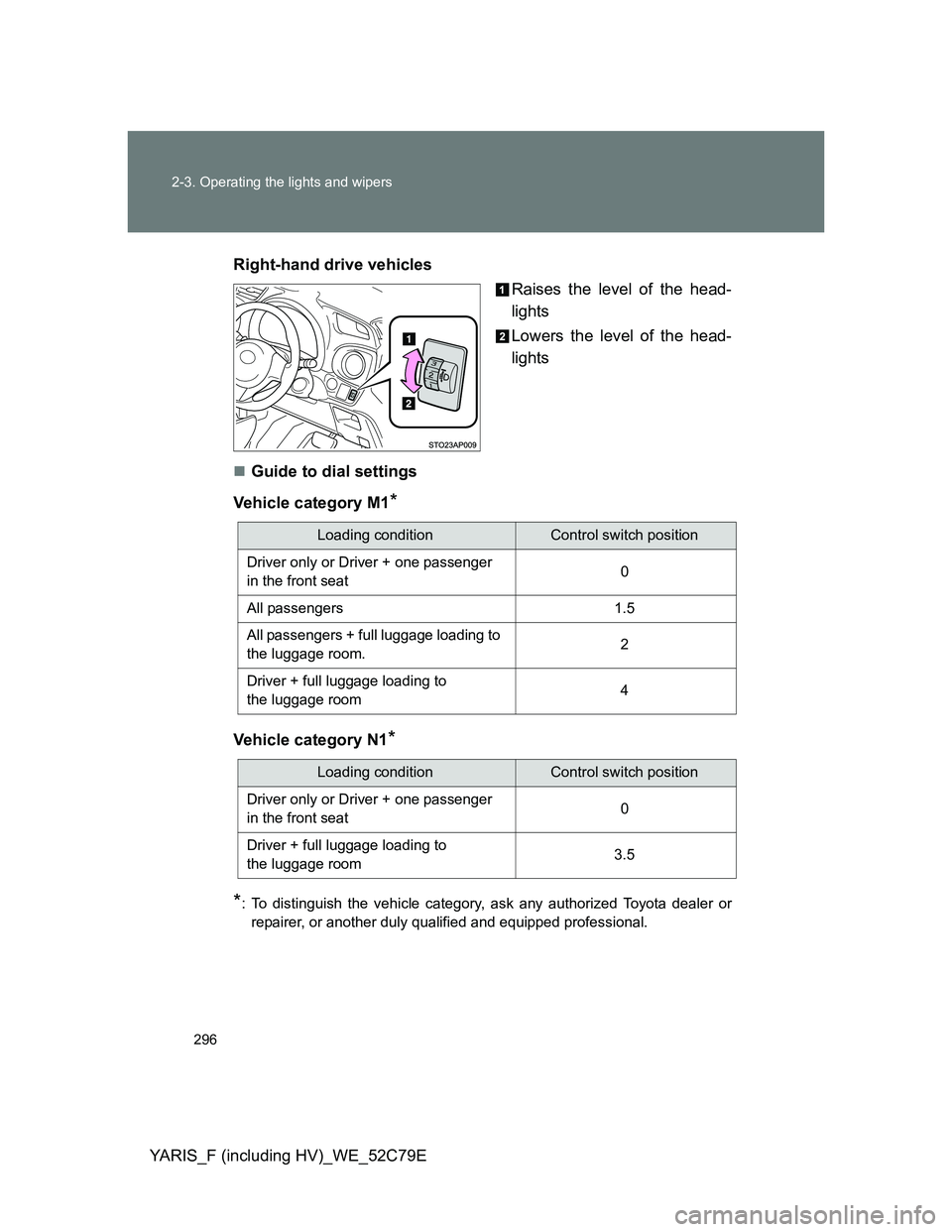
YARIS_F (including HV)_WE_52C79ERight-hand drive vehicles
Raises the level of the head-
lights
Lowers the level of the head-
lights
Guide to dial settings
Vehicle category M1
*
Vehicle category N1*
*
: To distinguish the vehicle category, ask any authorized Toyota dealer or
repairer, or another duly qualified and equipped professional.
Loading conditionControl switch position
Driver only or Driver + one passenger
in the front seat0
All passengers 1.5
All passengers + full luggage loading to
the luggage room.2
Driver + full luggage loading to
the luggage room4
Loading conditionControl switch position
Driver only or Driver + one passenger
in the front seat0
Driver + full luggage loading to
the luggage room3.5