clutch TOYOTA YARIS 2012 User Guide
[x] Cancel search | Manufacturer: TOYOTA, Model Year: 2012, Model line: YARIS, Model: TOYOTA YARIS 2012Pages: 704, PDF Size: 27.58 MB
Page 265 of 704
265
2-1. Driving procedures
2
When driving
YARIS_F (including HV)_WE_52C79E
Manual transmission
: If equipped
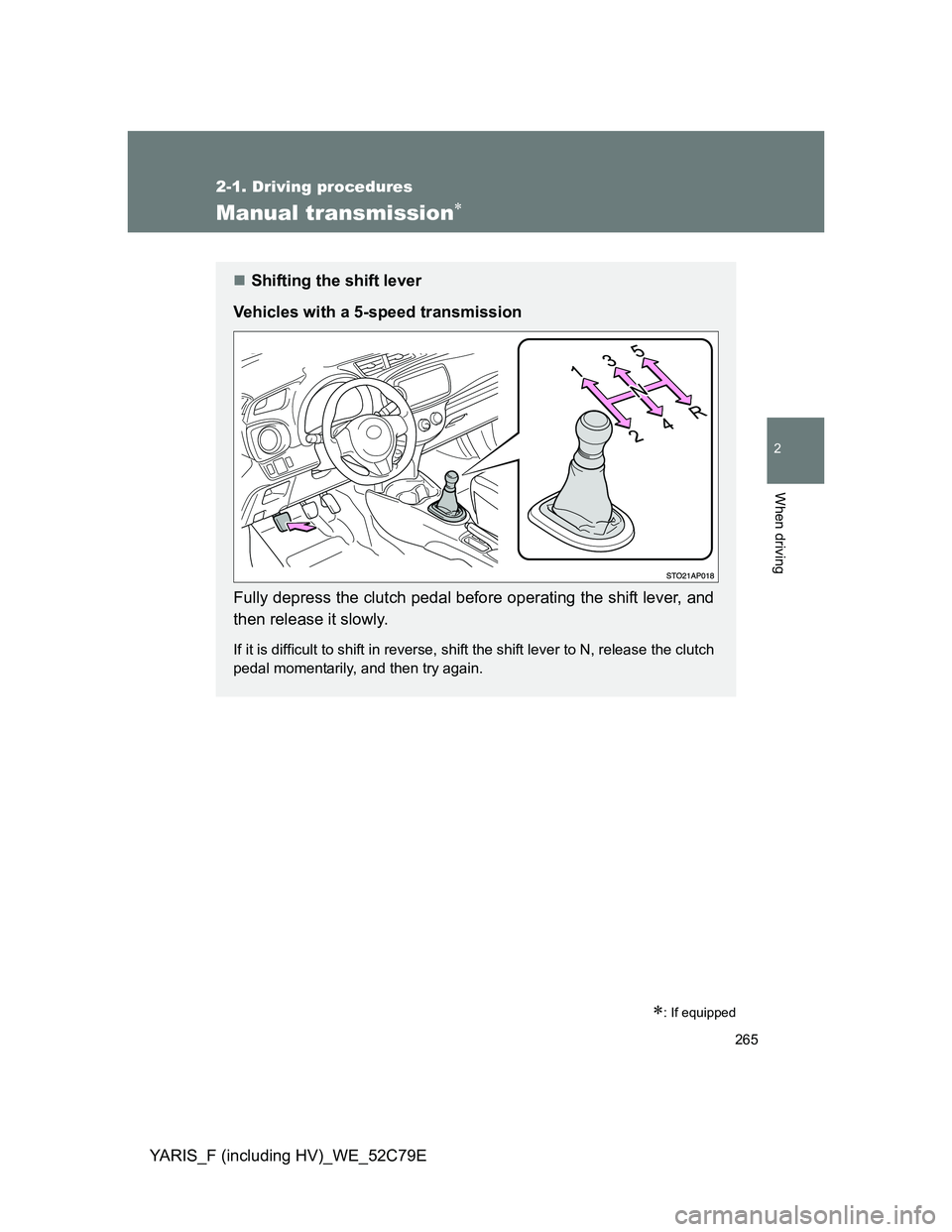
Shifting the shift lever
Vehicles with a 5-speed transmission
Fully depress the clutch pedal before operating the shift lever, and
then release it slowly.
If it is difficult to shift in reverse, shift the shift lever to N, release the clutch
pedal momentarily, and then try again.
Page 266 of 704
266 2-1. Driving procedures
YARIS_F (including HV)_WE_52C79E
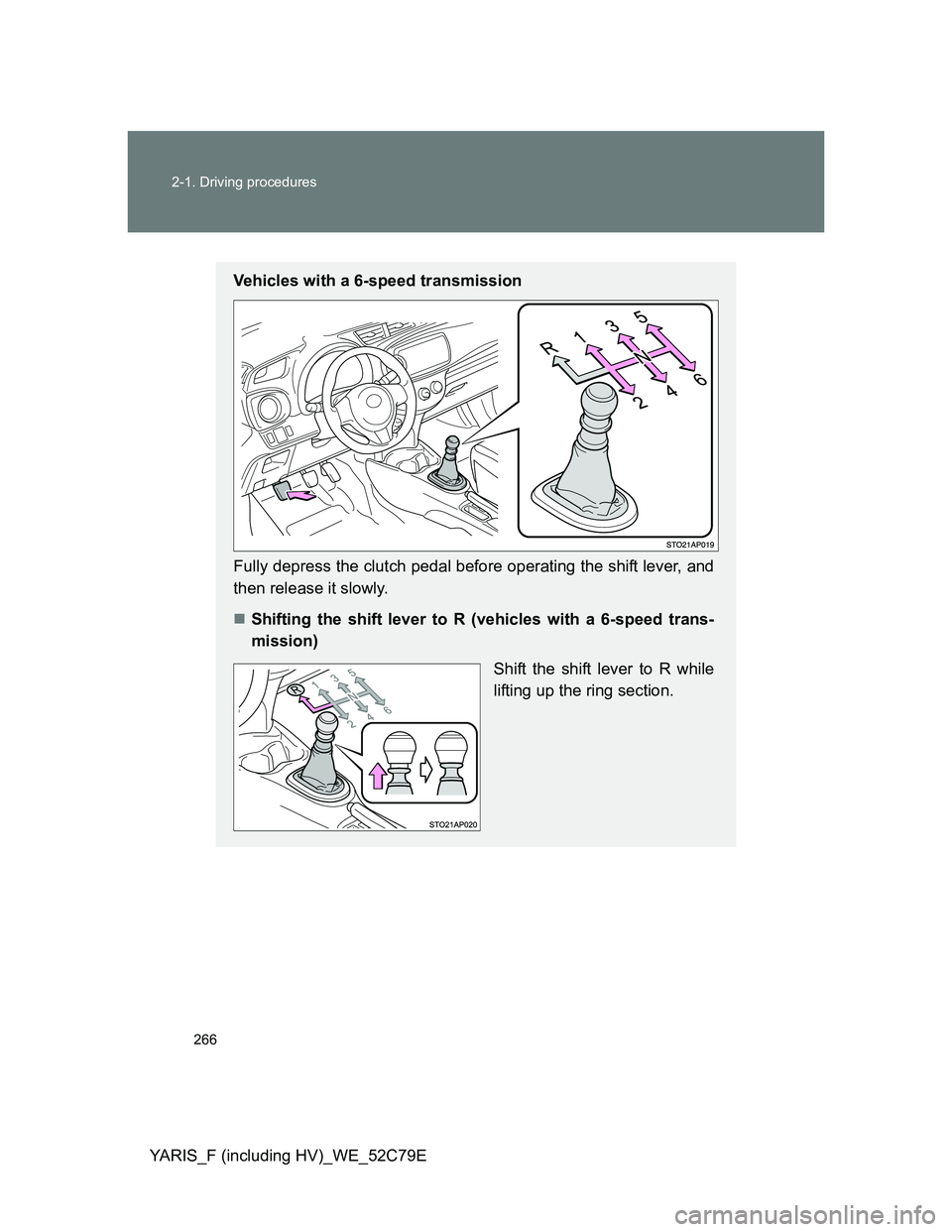
Vehicles with a 6-speed transmission
Fully depress the clutch pedal before operating the shift lever, and
then release it slowly.
Shifting the shift lever to R (vehicles with a 6-speed trans-
mission)
Shift the shift lever to R while
lifting up the ring section.
Page 267 of 704
267 2-1. Driving procedures
2
When driving
YARIS_F (including HV)_WE_52C79E
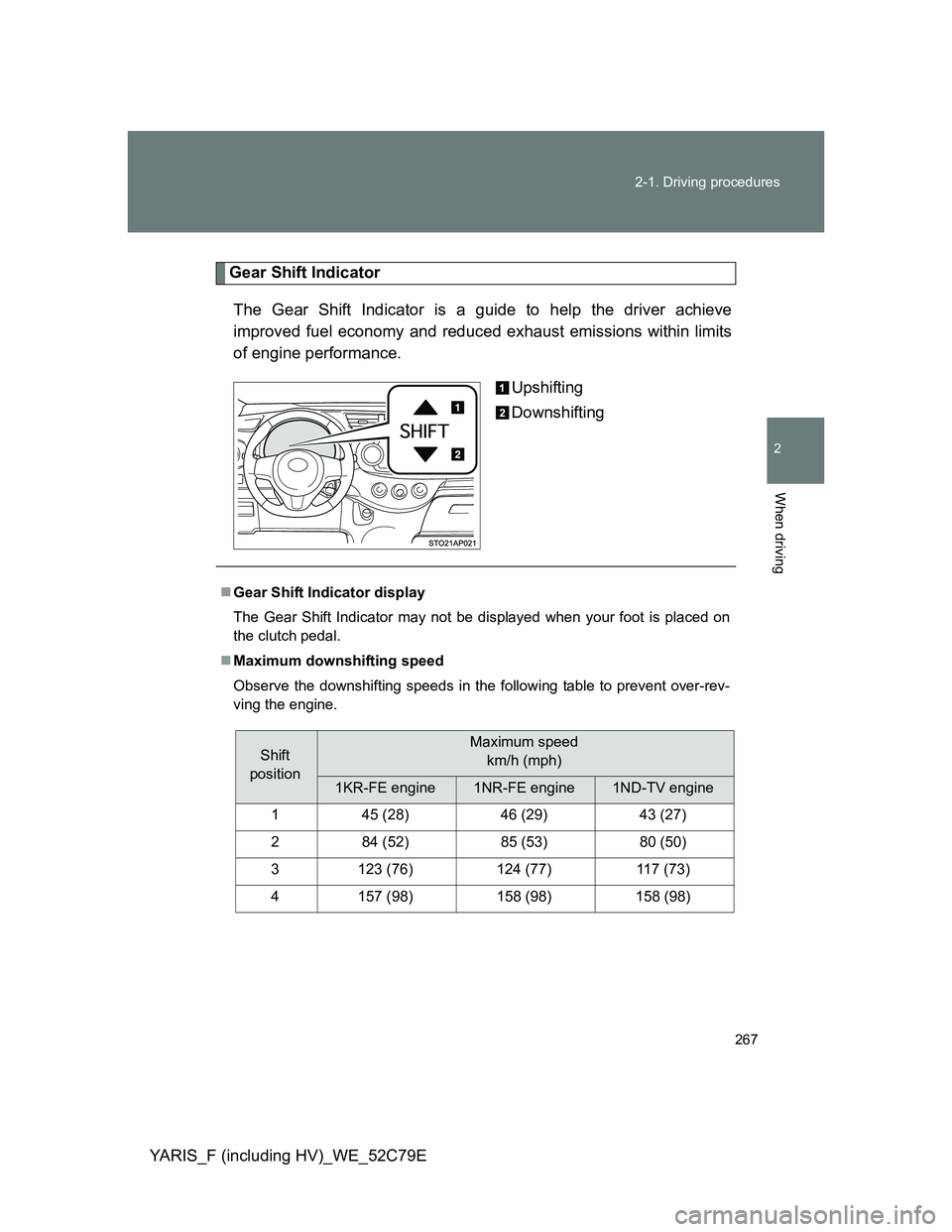
Gear Shift Indicator
The Gear Shift Indicator is a guide to help the driver achieve
improved fuel economy and reduced exhaust emissions within limits
of engine performance.
Upshifting
Downshifting
Gear Shift Indicator display
The Gear Shift Indicator may not be displayed when your foot is placed on
the clutch pedal.
Maximum downshifting speed
Observe the downshifting speeds in the following table to prevent over-rev-
ving the engine.
Shift
positionMaximum speed
km/h (mph)
1KR-FE engine1NR-FE engine1ND-TV engine
1 45 (28) 46 (29) 43 (27)
2 84 (52) 85 (53) 80 (50)
3 123 (76) 124 (77) 117 (73)
4 157 (98) 158 (98) 158 (98)
Page 268 of 704
268 2-1. Driving procedures
YARIS_F (including HV)_WE_52C79E
CAUTION
Gear Shift Indicator display
Refer to the display while considering actual traffic and road conditions. Fail-
ure to exercise judgment may lead to an accident.
NOTICE
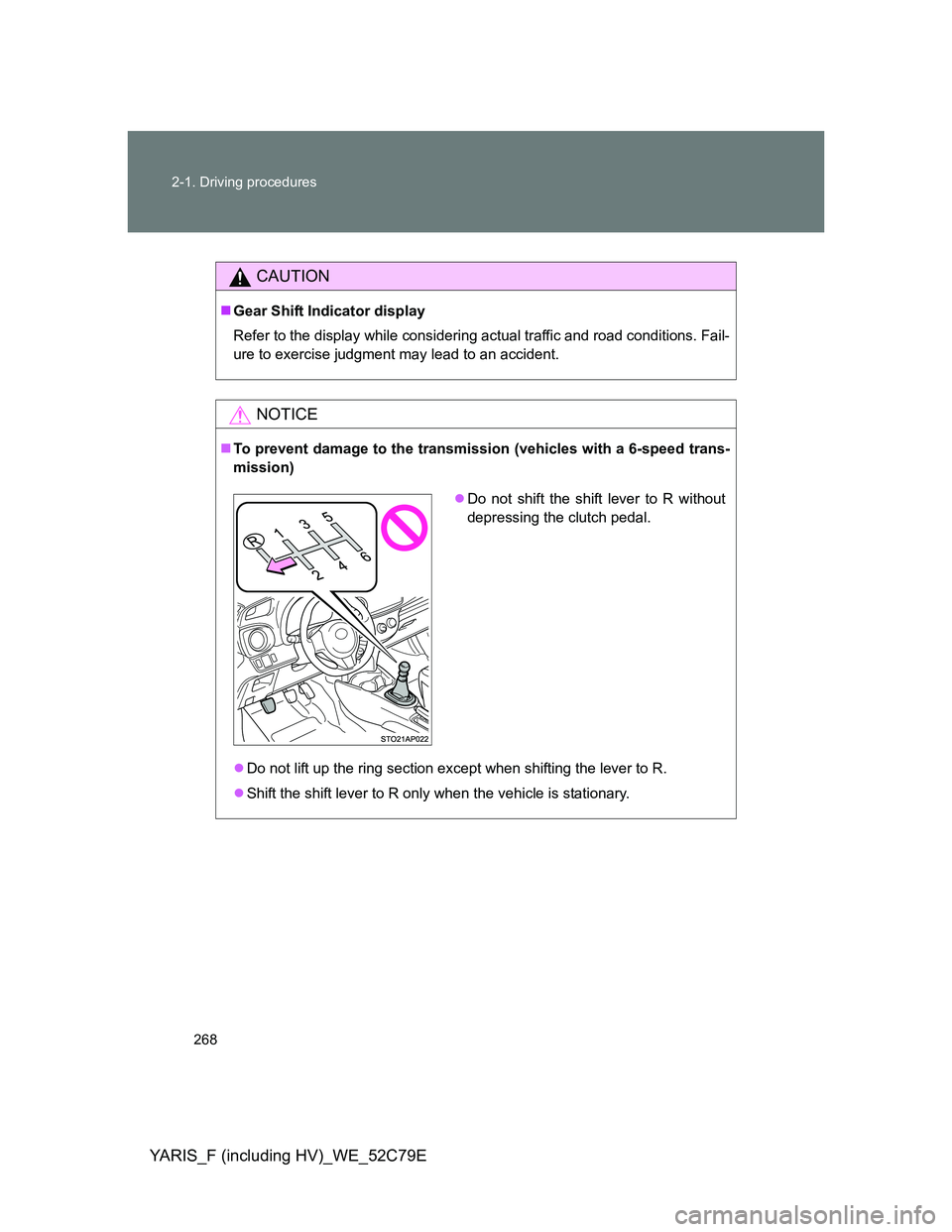
To prevent damage to the transmission (vehicles with a 6-speed trans-
mission)
Do not lift up the ring section except when shifting the lever to R.
Shift the shift lever to R only when the vehicle is stationary.
Do not shift the shift lever to R without
depressing the clutch pedal.
Page 312 of 704
312 2-4. Using other driving systems
YARIS_F (including HV)_WE_52C79E
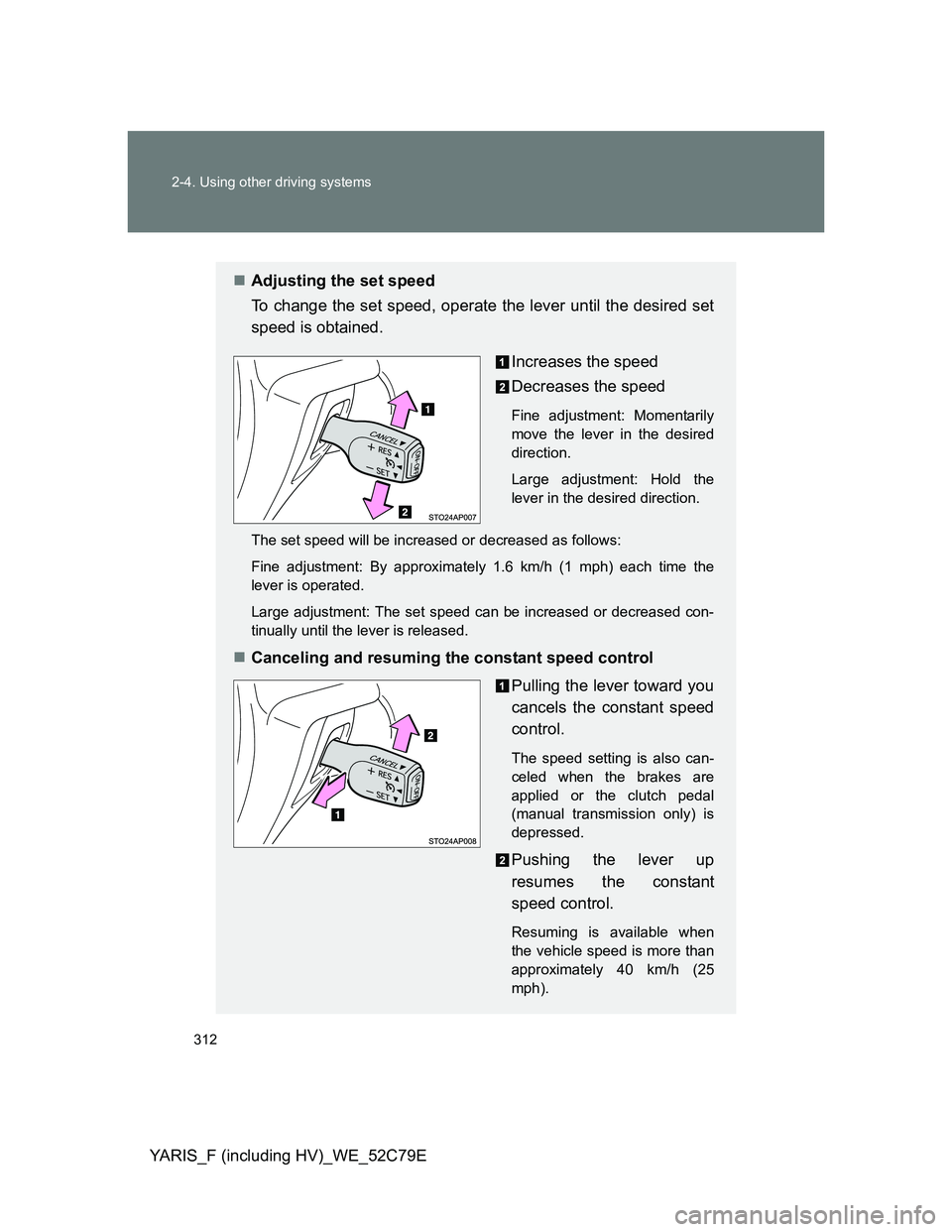
Adjusting the set speed
To change the set speed, operate the lever until the desired set
speed is obtained.
Increases the speed
Decreases the speed
Fine adjustment: Momentarily
move the lever in the desired
direction.
Large adjustment: Hold the
lever in the desired direction.
The set speed will be increased or decreased as follows:
Fine adjustment: By approximately 1.6 km/h (1 mph) each time the
lever is operated.
Large adjustment: The set speed can be increased or decreased con-
tinually until the lever is released.
Canceling and resuming the constant speed control
Pulling the lever toward you
cancels the constant speed
control.
The speed setting is also can-
celed when the brakes are
applied or the clutch pedal
(manual transmission only) is
depressed.
Pushing the lever up
resumes the constant
speed control.
Resuming is available when
the vehicle speed is more than
approximately 40 km/h (25
mph).
Page 318 of 704
318
2-4. Using other driving systems
YARIS_F (including HV)_WE_52C79E
Stop & Start system
: If equipped
Vehicles with a Multidrive:
The Stop & Start system stops and restarts the engine according to
the brake pedal and shift lever operation for stopping and starting
the vehicle.
Vehicles with a manual transmission:
The Stop & Start system stops and restarts the engine according to
the clutch pedal operation for stopping and starting the vehicle.
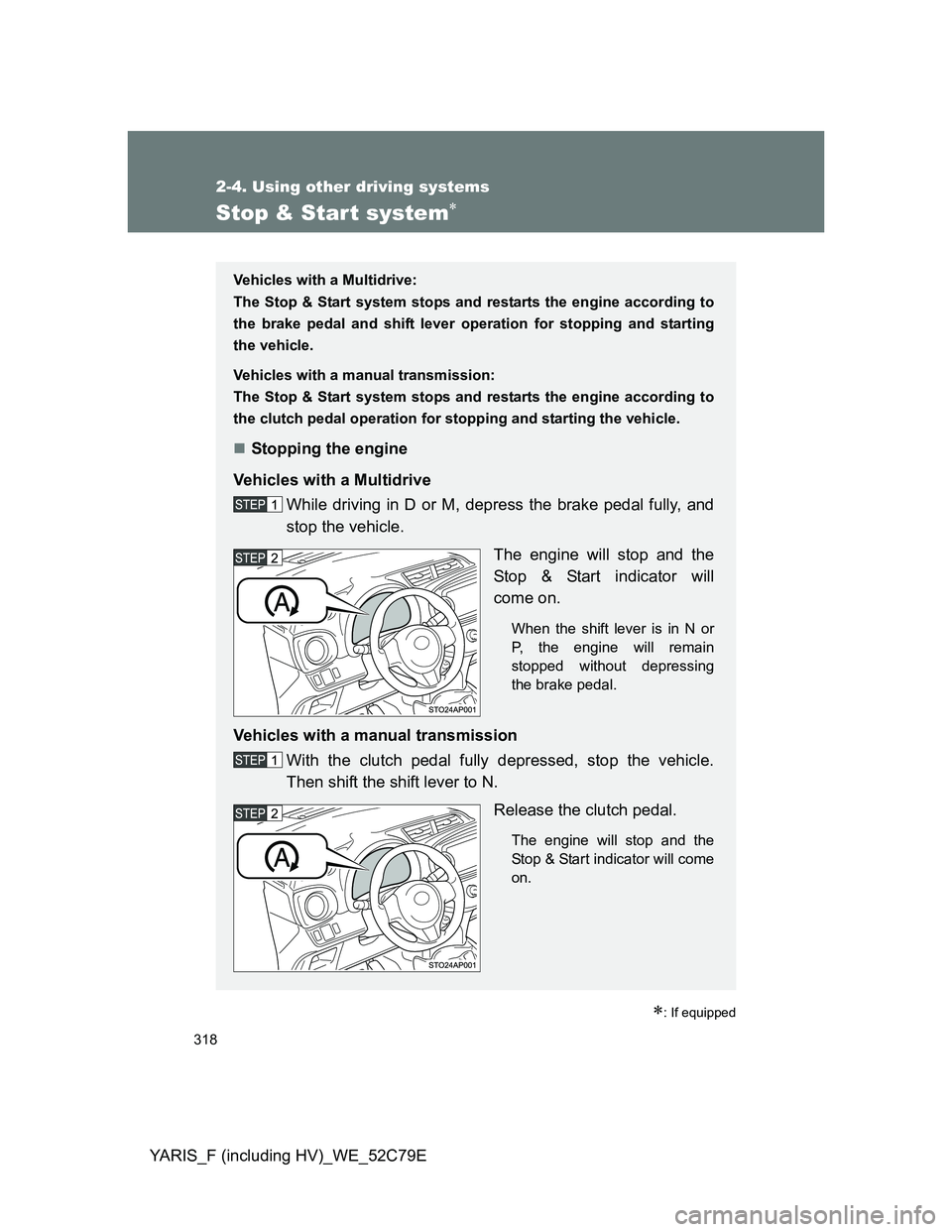
Stopping the engine
Vehicles with a Multidrive
While driving in D or M, depress the brake pedal fully, and
stop the vehicle.
The engine will stop and the
Stop & Start indicator will
come on.
When the shift lever is in N or
P, the engine will remain
stopped without depressing
the brake pedal.
Vehicles with a manual transmission
With the clutch pedal fully depressed, stop the vehicle.
Then shift the shift lever to N.
Release the clutch pedal.
The engine will stop and the
Stop & Start indicator will come
on.
Page 319 of 704
319 2-4. Using other driving systems
2
When driving
YARIS_F (including HV)_WE_52C79E
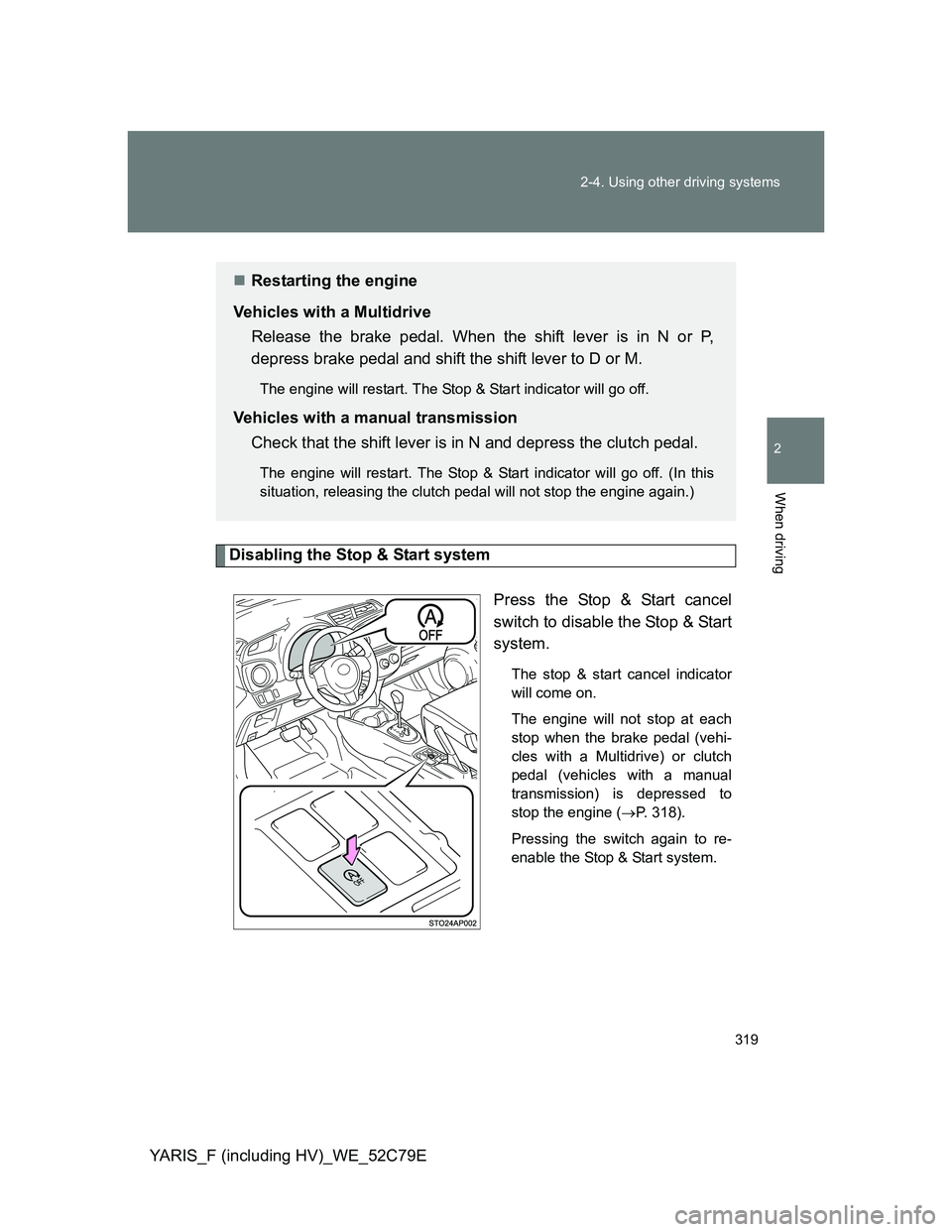
Disabling the Stop & Start system
Press the Stop & Start cancel
switch to disable the Stop & Start
system.
The stop & start cancel indicator
will come on.
The engine will not stop at each
stop when the brake pedal (vehi-
cles with a Multidrive) or clutch
pedal (vehicles with a manual
transmission) is depressed to
stop the engine (P. 318).
Pressing the switch again to re-
enable the Stop & Start system.
Restarting the engine
Vehicles with a Multidrive
Release the brake pedal. When the shift lever is in N or P,
depress brake pedal and shift the shift lever to D or M.
The engine will restart. The Stop & Start indicator will go off.
Vehicles with a manual transmission
Check that the shift lever is in N and depress the clutch pedal.
The engine will restart. The Stop & Start indicator will go off. (In this
situation, releasing the clutch pedal will not stop the engine again.)
Page 321 of 704
321 2-4. Using other driving systems
2
When driving
YARIS_F (including HV)_WE_52C79E
• The vehicle is stopped on a steep hill.
• The brake booster vacuum is low.
• A large amount of electricity is being used.
• At high altitude.
When the above conditions improve, the Stop & Start system will stop and
restart the engine from the next time the vehicle is stopped.
In the following situations, the engine may start even without the brake
pedal being released (vehicles with a Multidrive) or clutch pedal being
depressed (vehicles with a manual transmission).
• The brake pedal is pumped or strongly depressed.
• The air conditioning system is being used or turned on.
• Vehicles with an automatic air conditioning system only: The wind-
shield defogger is turned on.
• The battery is not sufficiently charged.
• The vehicle starts to roll on an incline.
• Vehicles with a Multidrive: The hood is opened when the shift lever is in
N or P.
• The accelerator pedal is depressed.
• A large amount of electricity is being used.
• Vehicles with a Multidrive: The driver’s door is opened.
• Vehicles with a Multidrive: The driver’s seat belt is unfastened.
In the following situations, it may take longer than normal for the Stop &
Start system to activate.
• The battery is discharged.
• After the battery terminals have been disconnected and reconnected
after a battery replacement, etc.
• The engine coolant temperature is low.
Automatic reactivation of the Stop & Start system
Vehicles without a smart entry & start system:
Even if the Stop & Start system is disabled by the Stop & Start cancel switch,
it will be automatically re-enabled once the engine switch is turned to the
“LOCK” position then to the “START” position.
Vehicles with a smart entry & start system:
Even if the Stop & Start system is disabled by the Stop & Start cancel switch,
it will be automatically re-enabled once the “ENGINE START STOP” switch
is turned off then the engine is started.
Page 323 of 704
323 2-4. Using other driving systems
2
When driving
YARIS_F (including HV)_WE_52C79E
Stop & Start system warning buzzer
If the engine is stopped by the Stop & Start system and either of the following
actions is performed, a buzzer will sound and the Stop & Start indicator will
flash (vehicles with a Multidrive), or a buzzer will sound (vehicles with a
manual transmission). This indicates that the engine is only stopped by the
Stop & Start system, not that the engine has been turned off completely.
Vehicles with a Multidrive: The driver’s door is opened when the shift
lever is in D or M.
Vehicles with a Multidrive: The shift lever is shifted into a position other
than N or P with the brake pedal released.
Vehicles with a manual transmission: The shift lever is shifted into a posi-
tion other than N with the clutch pedal released.
If the Stop & Start cancel indicator light continues to flash
The Stop & Start system may be malfunctioning. Contact any authorized
Toyota dealer or repairer, or another duly qualified and equipped profes-
sional.
If the windshield is fogged up while the engine is stopped by the Stop
& Start system
Vehicles with an automatic air conditioning system
Turn the windshield defogger on. (The engine will start due to the auto-
matic engine start function.) (P. 365)
Vehicles with a manual air conditioning system
• Vehicles with a Multidrive: Restart the engine by releasing the brake
pedal (when the shift lever is in D or M) or depress the brake pedal and
shift the shift lever to D or M (when the shift lever is in N or P) (P.
319), or by pressing the Stop & Start cancel switch, and then set the air
outlet selection dial to . (P. 357)
• Vehicles with a manual transmission: Restart the engine by depressing
the clutch pedal (P. 319), or by pressing the Stop & Start cancel
switch, and then set the air outlet selection dial to . (P. 357)
If the windshield fogs up frequently, press the Stop & Start cancel switch to
deactivate the system.
Page 336 of 704
336
YARIS_F (including HV)_WE_52C79E
2-5. Driving information
Cargo and luggage
CAUTION
Things that must not be carried in the luggage compartment
The following things may cause a fire if loaded in the luggage compartment:
Receptacles containing gasoline
Aerosol cans
Storage precautions
Observe the following precautions.
Failure to do so may result in death or serious injury.
Stow cargo and luggage in the luggage compartment whenever possible.
Do not stack anything in the luggage compartment higher than the seat-
backs.
Such items may be thrown about and possibly injure people in the vehicle
in the event of sudden braking or in an accident.
Do not place cargo or luggage in or on the following locations as the item
may get under the clutch, brake or accelerator pedal and prevent the ped-
als from being depressed properly, block the driver’s vision, or hit the
driver or passengers, causing an accident:
• At the feet of the driver
• On the front passenger or rear seats (when stacking items)
• On the luggage cover
• On the instrument panel
• On the dashboard
Take notice of the following information about storage precautions,
cargo capacity and load:
Stow cargo and luggage in the luggage compartment whenever
possible.
Be sure all items are secured in place.
To maintain vehicle balance while driving, position luggage
evenly within the luggage compartment.
For better fuel economy, do not carry unnecessary weight.