tow TOYOTA YARIS 2012 Owner's Manual
[x] Cancel search | Manufacturer: TOYOTA, Model Year: 2012, Model line: YARIS, Model: TOYOTA YARIS 2012Pages: 704, PDF Size: 27.58 MB
Page 314 of 704
314 2-4. Using other driving systems
YARIS_F (including HV)_WE_52C79E
If the cruise control indicator light comes in yellow (hybrid vehicle)
Press the “ON-OFF” button once to deactivate the system, and then press
the button again to reactivate the system.
If the cruise control speed cannot be set or if the cruise control cancels
immediately after being activated, there may be a malfunction in the cruise
control system. Have the vehicle inspected by any authorized Toyota dealer
or repairer, or another duly qualified and equipped professional.
CAUTION
To avoid operating the cruise control by mistake
Switch the cruise control off using the “ON-OFF” button when not in use.
Situations unsuitable for cruise control
Do not use cruise control in any of the following situations.
Doing so may result in loss of control and could cause an accident resulting
in death or serious injury.
In heavy traffic
On roads with sharp bends
On winding roads
On slippery roads, such as those covered with rain, ice or snow
On steep hills
Vehicle speed may exceed the set speed when driving down a steep hill.
When your vehicle is towing a trailer
Page 316 of 704
316 2-4. Using other driving systems
YARIS_F (including HV)_WE_52C79E
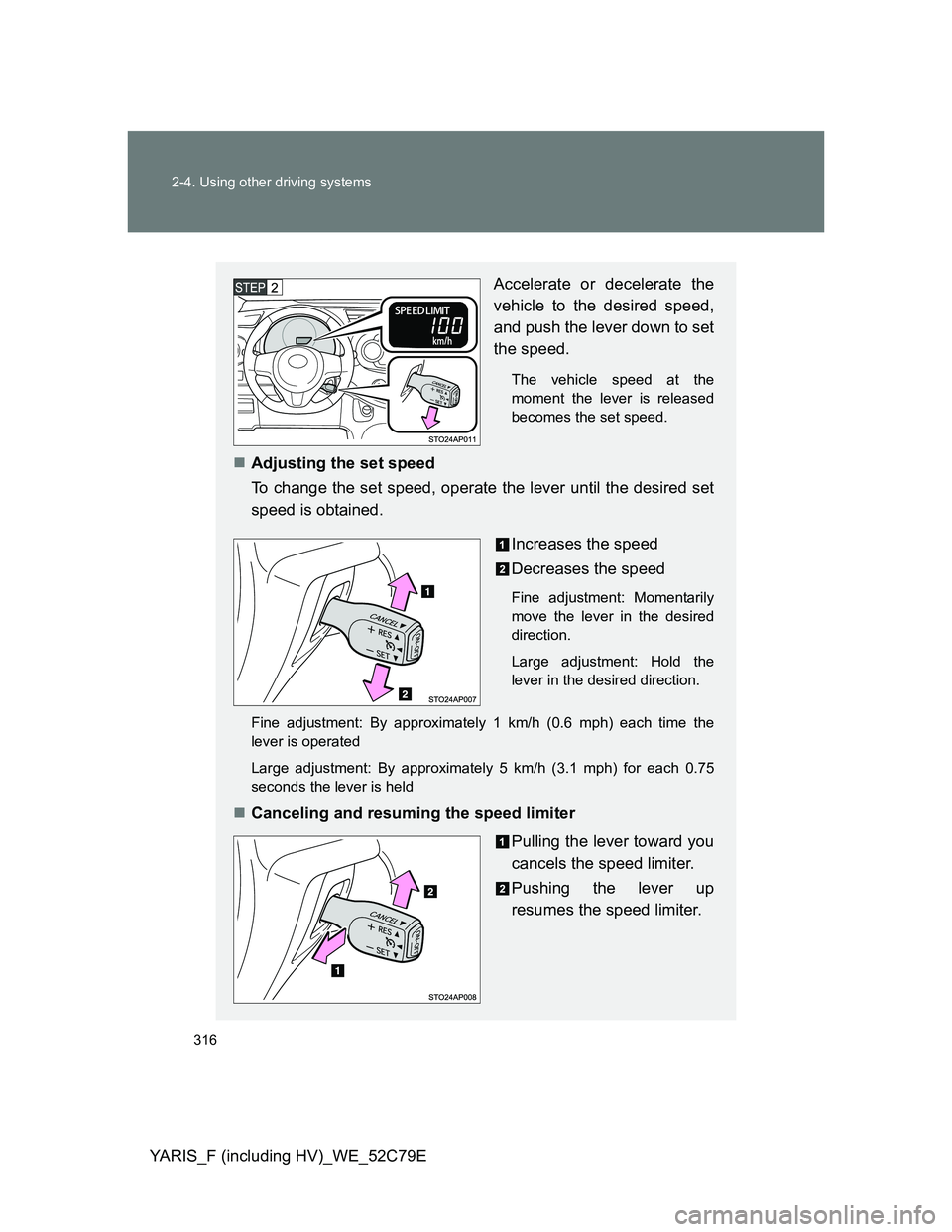
Accelerate or decelerate the
vehicle to the desired speed,
and push the lever down to set
the speed.
The vehicle speed at the
moment the lever is released
becomes the set speed.
Adjusting the set speed
To change the set speed, operate the lever until the desired set
speed is obtained.
Increases the speed
Decreases the speed
Fine adjustment: Momentarily
move the lever in the desired
direction.
Large adjustment: Hold the
lever in the desired direction.
Fine adjustment: By approximately 1 km/h (0.6 mph) each time the
lever is operated
Large adjustment: By approximately 5 km/h (3.1 mph) for each 0.75
seconds the lever is held
Canceling and resuming the speed limiter
Pulling the lever toward you
cancels the speed limiter.
Pushing the lever up
resumes the speed limiter.
Page 317 of 704
317 2-4. Using other driving systems
2
When driving
YARIS_F (including HV)_WE_52C79E
Speed limiter can be set when
The speed limiter can be set at any vehicle speed. However, if the speed lim-
iter is set while the vehicle speed is below 30 km/h (18 mph), the speed lim-
iter will be set to 30 km/h (18 mph).
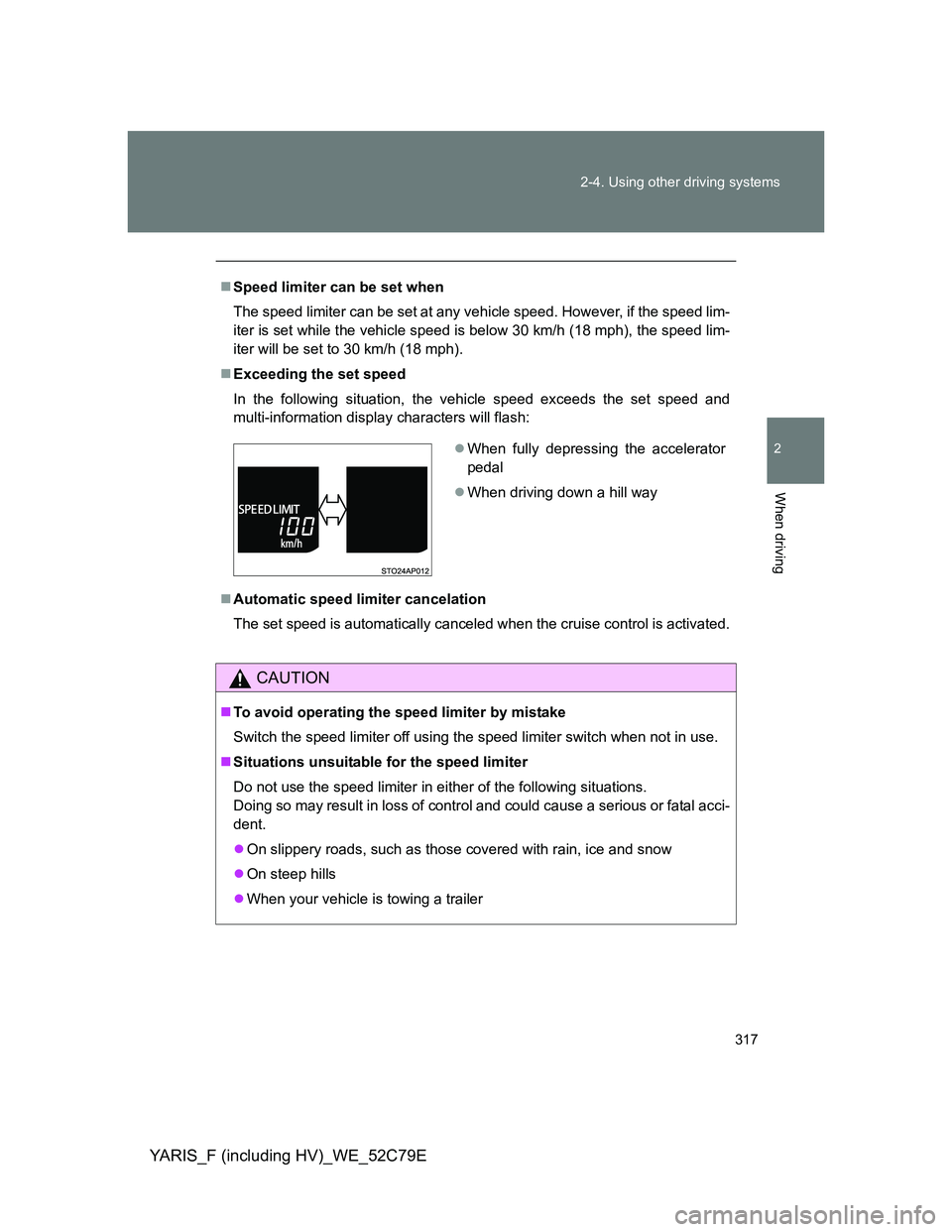
Exceeding the set speed
In the following situation, the vehicle speed exceeds the set speed and
multi-information display characters will flash:
Automatic speed limiter cancelation
The set speed is automatically canceled when the cruise control is activated.
CAUTION
To avoid operating the speed limiter by mistake
Switch the speed limiter off using the speed limiter switch when not in use.
Situations unsuitable for the speed limiter
Do not use the speed limiter in either of the following situations.
Doing so may result in loss of control and could cause a serious or fatal acci-
dent.
On slippery roads, such as those covered with rain, ice and snow
On steep hills
When your vehicle is towing a trailer
When fully depressing the accelerator
pedal
When driving down a hill way
Page 336 of 704
336
YARIS_F (including HV)_WE_52C79E
2-5. Driving information
Cargo and luggage
CAUTION
Things that must not be carried in the luggage compartment
The following things may cause a fire if loaded in the luggage compartment:
Receptacles containing gasoline
Aerosol cans
Storage precautions
Observe the following precautions.
Failure to do so may result in death or serious injury.
Stow cargo and luggage in the luggage compartment whenever possible.
Do not stack anything in the luggage compartment higher than the seat-
backs.
Such items may be thrown about and possibly injure people in the vehicle
in the event of sudden braking or in an accident.
Do not place cargo or luggage in or on the following locations as the item
may get under the clutch, brake or accelerator pedal and prevent the ped-
als from being depressed properly, block the driver’s vision, or hit the
driver or passengers, causing an accident:
• At the feet of the driver
• On the front passenger or rear seats (when stacking items)
• On the luggage cover
• On the instrument panel
• On the dashboard
Take notice of the following information about storage precautions,
cargo capacity and load:
Stow cargo and luggage in the luggage compartment whenever
possible.
Be sure all items are secured in place.
To maintain vehicle balance while driving, position luggage
evenly within the luggage compartment.
For better fuel economy, do not carry unnecessary weight.
Page 342 of 704
342
2-5. Driving information
YARIS_F (including HV)_WE_52C79E
Trailer towing (hybrid vehicle)
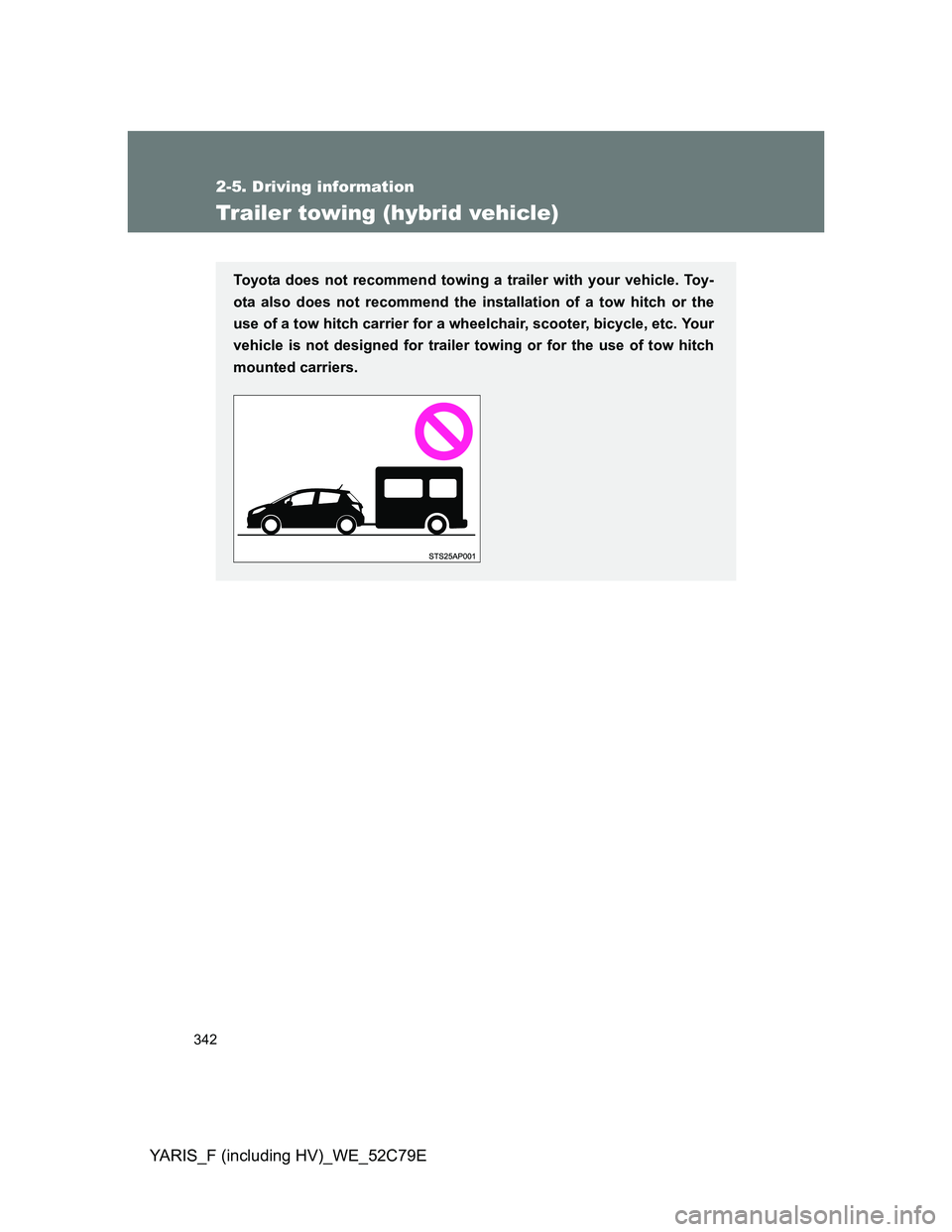
Toyota does not recommend towing a trailer with your vehicle. Toy-
ota also does not recommend the installation of a tow hitch or the
use of a tow hitch carrier for a wheelchair, scooter, bicycle, etc. Your
vehicle is not designed for trailer towing or for the use of tow hitch
mounted carriers.
Page 343 of 704
![TOYOTA YARIS 2012 Owners Manual 343
2-5. Driving information
2
When driving
YARIS_F (including HV)_WE_52C79E
Trailer towing (except hybrid vehicle [except for South Africa])
Your vehicle is designed primarily as a passenger carrying](/img/14/49156/w960_49156-342.png "TOYOTA YARIS 2012 Owners Manual 343
2-5. Driving information
2
When driving
YARIS_F (including HV)_WE_52C79E
Trailer towing (except hybrid vehicle [except for South Africa])
Your vehicle is designed primarily as a passenger carrying")
343
2-5. Driving information
2
When driving
YARIS_F (including HV)_WE_52C79E
Trailer towing (except hybrid vehicle [except for South Africa])
Your vehicle is designed primarily as a passenger carrying vehicle.
Towing a trailer will have an adverse effect on handling, perfor-
mance, braking, durability, and fuel consumption. Your safety and
satisfaction depend on the proper use of correct equipment and cau-
tious driving habits. For your safety and the safety of others, do not
overload the vehicle or trailer.
To tow a trailer safely, use extreme care and drive the vehicle in
accordance with the trailer’s characteristics and operating condi-
tions.
Toyota warranties do not apply to damage or malfunction caused by
towing a trailer for commercial purposes.
Ask your local authorized Toyota dealer or repairer, or another duly
qualified and equipped professional, for further details before tow-
ing, as there are additional legal requirements in some countries.
Weight limits
Check the allowable towing capacity, GVM (Gross Vehicle
Mass), MPAC (Maximum Permissible Axle Capacity), and per-
missible drawbar load before towing. (P. 654)
Towing hitch/bracket
Toyota recommends the use of the Toyota hitch/bracket for your
vehicle. Other products of a suitable nature and comparable
quality may also be used.
Page 344 of 704
344 2-5. Driving information
YARIS_F (including HV)_WE_52C79E
Important points regarding trailer loads
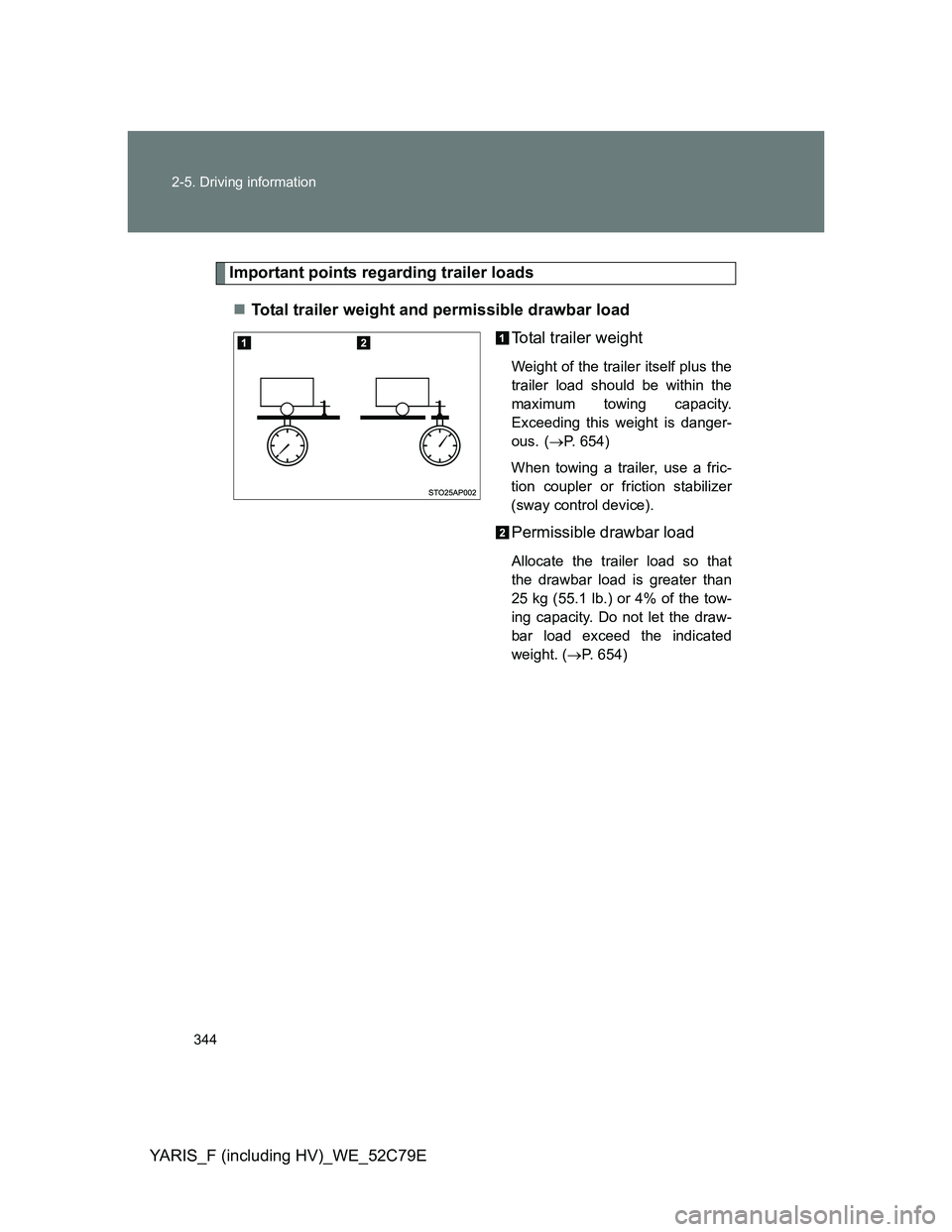
Total trailer weight and permissible drawbar load
Total trailer weight
Weight of the trailer itself plus the
trailer load should be within the
maximum towing capacity.
Exceeding this weight is danger-
ous.
(P. 654)
When towing a trailer, use a fric-
tion coupler or friction stabilizer
(sway control device).
Permissible drawbar load
Allocate the trailer load so that
the drawbar load is greater than
25 kg (55.1 lb.) or 4% of the tow-
ing capacity. Do not let the draw-
bar load exceed the indicated
weight. (P. 654)
Page 345 of 704
345 2-5. Driving information
2
When driving
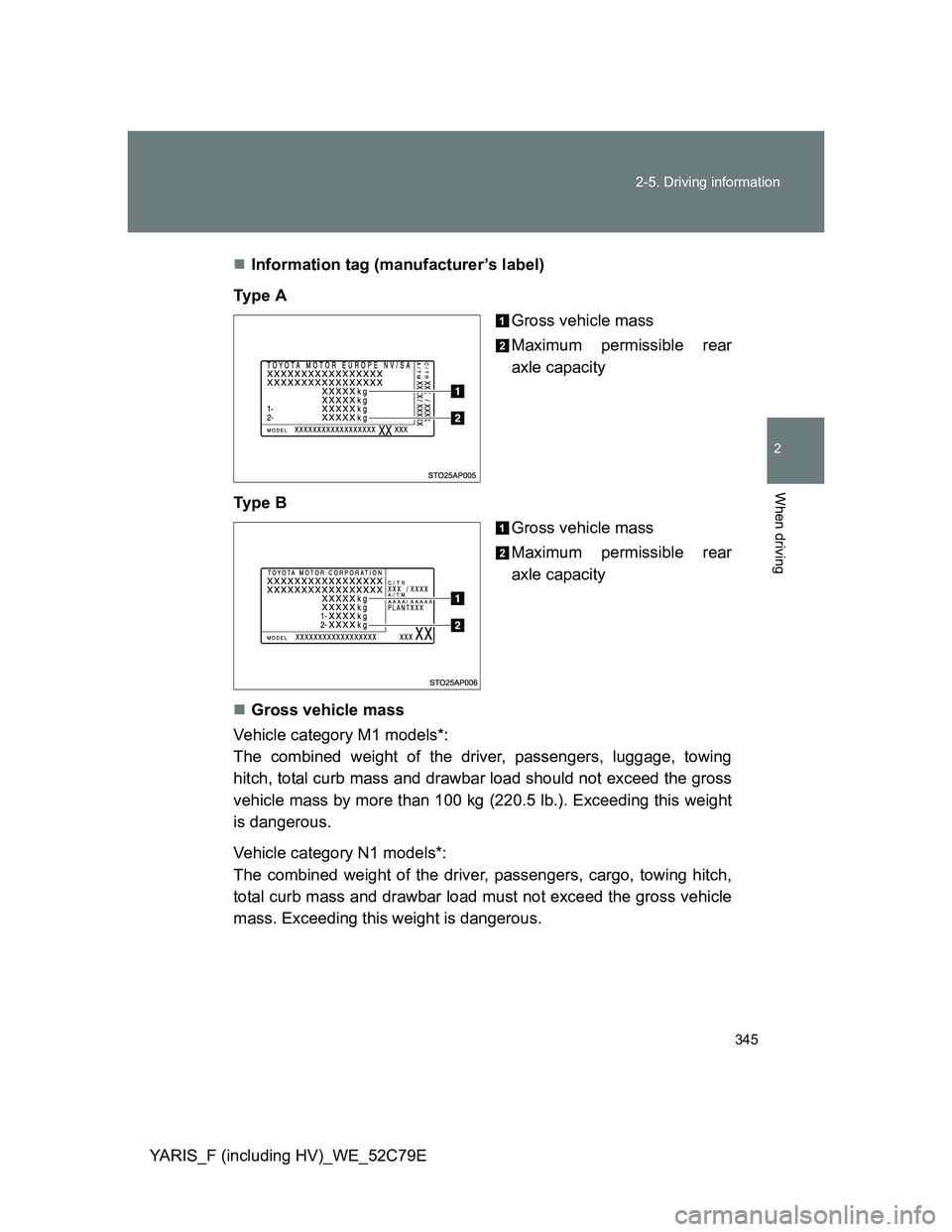
YARIS_F (including HV)_WE_52C79EInformation tag (manufacturer’s label)
Ty p e A
Gross vehicle mass
Maximum permissible rear
axle capacity
Ty p e B
Gross vehicle mass
Maximum permissible rear
axle capacity
Gross vehicle mass
Vehicle category M1 models*:
The combined weight of the driver, passengers, luggage, towing
hitch, total curb mass and drawbar load should not exceed the gross
vehicle mass by more than 100 kg (220.5 lb.). Exceeding this weight
is dangerous.
Vehicle category N1 models*:
The combined weight of the driver, passengers, cargo, towing hitch,
total curb mass and drawbar load must not exceed the gross vehicle
mass. Exceeding this weight is dangerous.
Page 346 of 704
346 2-5. Driving information
YARIS_F (including HV)_WE_52C79EMaximum permissible rear axle capacity
Vehicle category M1 models
*:
The weight borne by the rear axle should not exceed the maximum
permissible rear axle capacity by 15% or more. Exceeding this weight
is dangerous.
Vehicle category N1 models
*:
The weight borne by the rear axle should not exceed the maximum
permissible rear axle capacity. Exceeding this weight is dangerous.
The values for towing capacity were derived from testing conducted
at sea level. Take note that engine output and towing capacity will be
reduced at high altitudes.
*: To distinguish the vehicle category, ask any authorized Toyota dealer or
repairer, or another duly qualified and equipped professional.
CAUTION
When the gross vehicle mass limit or maximum permissible axle
capacity is exceeded (vehicle category M1 models*)
Do not exceed the established speed limit for towing a trailer in built-up
areas or 100 km/h (62 mph), whichever is lower.
Failing to observe this precaution may lead to an accident causing death or
serious injury.
Page 347 of 704
347 2-5. Driving information
2
When driving
YARIS_F (including HV)_WE_52C79E
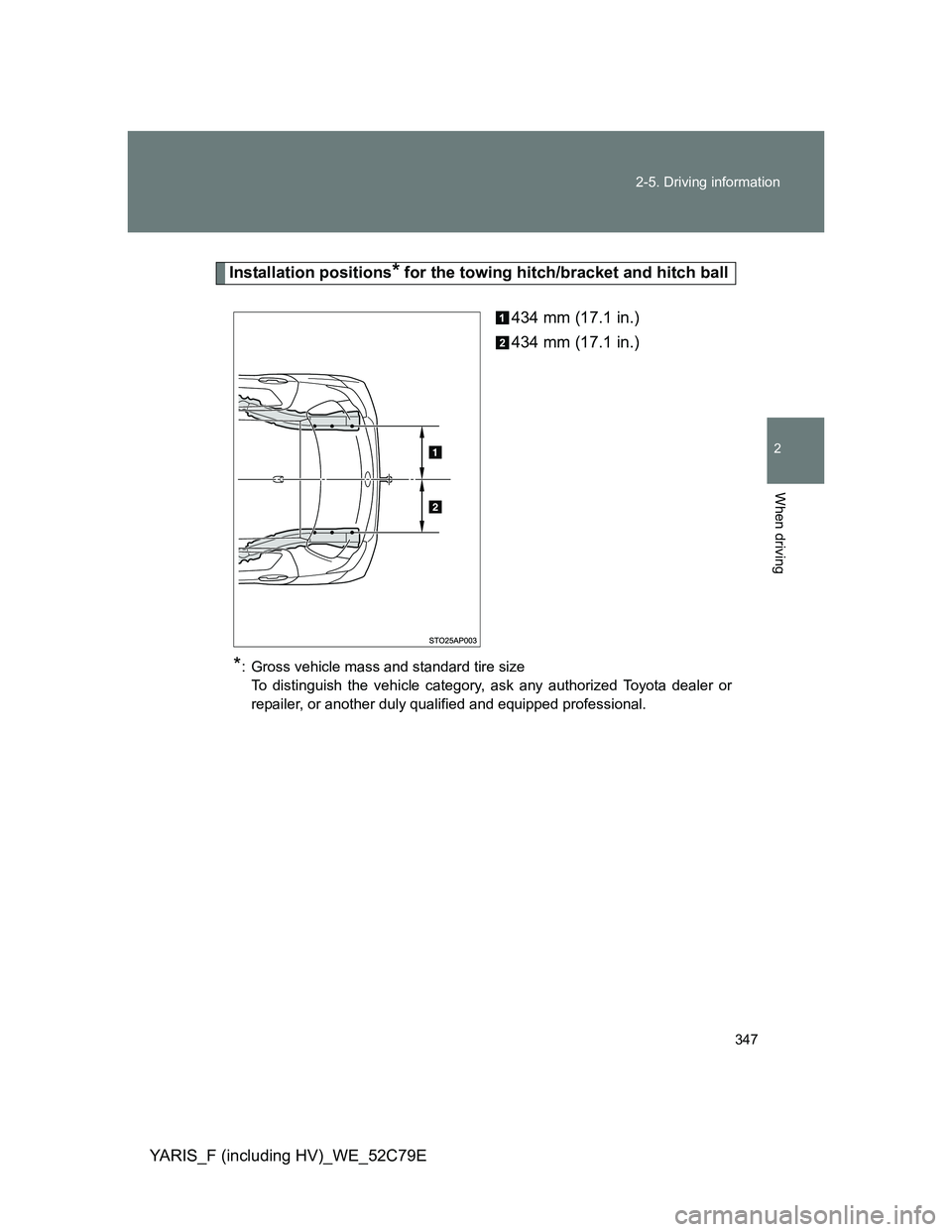
Installation positions* for the towing hitch/bracket and hitch ball
434 mm (17.1 in.)
434 mm (17.1 in.)
*: Gross vehicle mass and standard tire size
To distinguish the vehicle category, ask any authorized Toyota dealer or
repailer, or another duly qualified and equipped professional.