transmission TOYOTA YARIS 2012 Service Manual
[x] Cancel search | Manufacturer: TOYOTA, Model Year: 2012, Model line: YARIS, Model: TOYOTA YARIS 2012Pages: 704, PDF Size: 27.58 MB
Page 313 of 704
313 2-4. Using other driving systems
2
When driving
YARIS_F (including HV)_WE_52C79E
Cruise control can be set when
Vehicles with a hybrid transmission: The shift lever is in D.
Vehicles with a Multidrive: The shift lever is in the D or range 4 or higher
of M has been selected.
Vehicles with a paddle shift switch: Range 4 or higher has been selected
by using the paddle shift.
Vehicle speed is above approximately 40 km/h (25 mph).
Accelerating after setting the vehicle speed
The vehicle can be accelerated normally. After acceleration, the set
speed resumes.
Even without canceling the cruise control, the set speed can be
increased by first accelerating the vehicle to the desired speed and then
pushing the lever down to set the new speed.
Automatic cruise control cancelation
Cruise control will stop maintaining the vehicle speed in any of the following
situations.
Actual vehicle speed falls more than approximately 16 km/h (10 mph)
below the preset vehicle speed.
At this time, the memorized set speed is not retained.
Actual vehicle speed is below approximately 40 km/h (25 mph).
VSC is activated (if equipped).
Speed limiter is activated (if equipped).
If the cruise control indicator light flashes (except hybrid vehicle)
Press the “ON-OFF” button once to deactivate the system, and then press
the button again to reactivate the system.
If the cruise control speed cannot be set or if the cruise control cancels
immediately after being activated, there may be a malfunction in the cruise
control system. Have the vehicle inspected by any authorized Toyota dealer
or repairer, or another duly qualified and equipped professional.
Page 318 of 704
318
2-4. Using other driving systems
YARIS_F (including HV)_WE_52C79E
Stop & Start system
: If equipped
Vehicles with a Multidrive:
The Stop & Start system stops and restarts the engine according to
the brake pedal and shift lever operation for stopping and starting
the vehicle.
Vehicles with a manual transmission:
The Stop & Start system stops and restarts the engine according to
the clutch pedal operation for stopping and starting the vehicle.
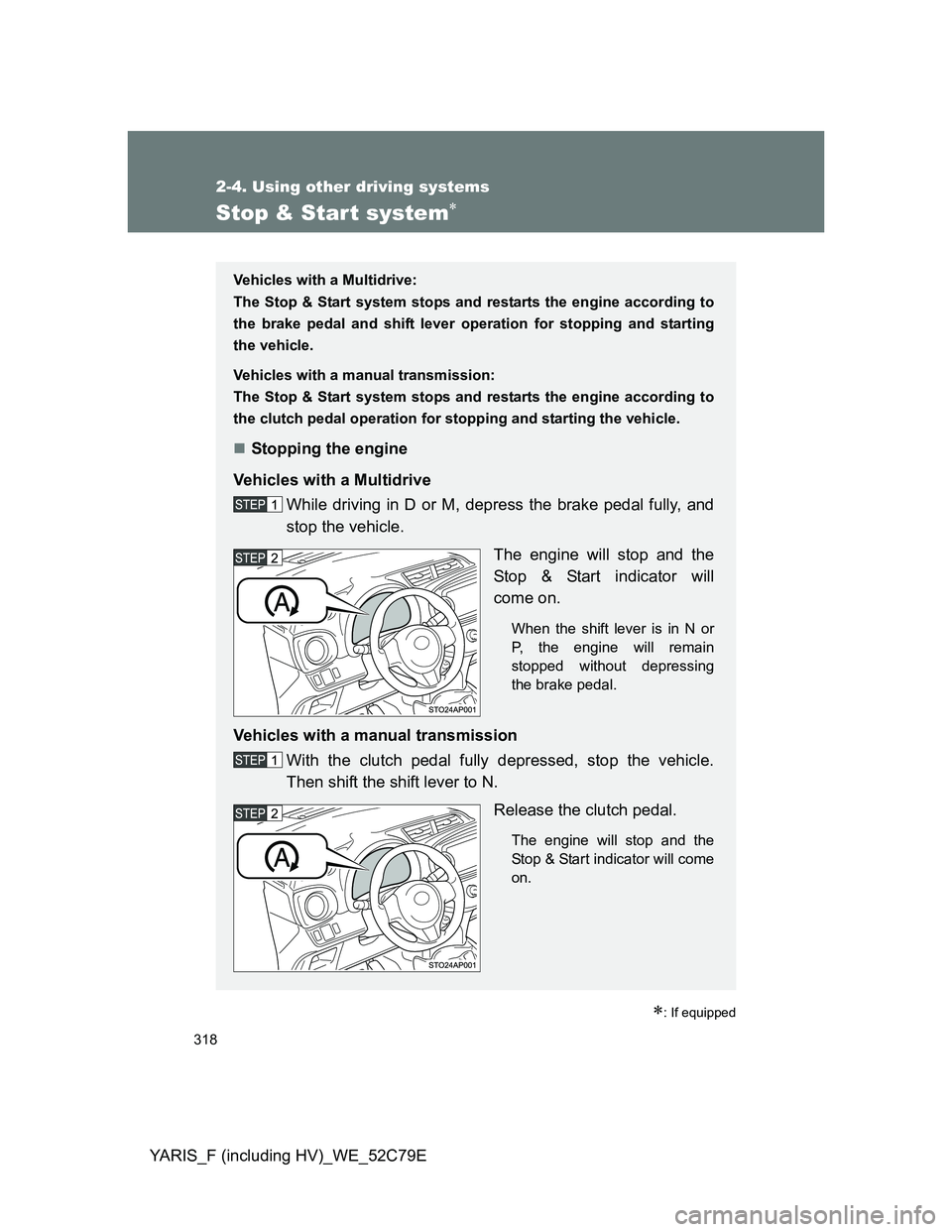
Stopping the engine
Vehicles with a Multidrive
While driving in D or M, depress the brake pedal fully, and
stop the vehicle.
The engine will stop and the
Stop & Start indicator will
come on.
When the shift lever is in N or
P, the engine will remain
stopped without depressing
the brake pedal.
Vehicles with a manual transmission
With the clutch pedal fully depressed, stop the vehicle.
Then shift the shift lever to N.
Release the clutch pedal.
The engine will stop and the
Stop & Start indicator will come
on.
Page 319 of 704
319 2-4. Using other driving systems
2
When driving
YARIS_F (including HV)_WE_52C79E
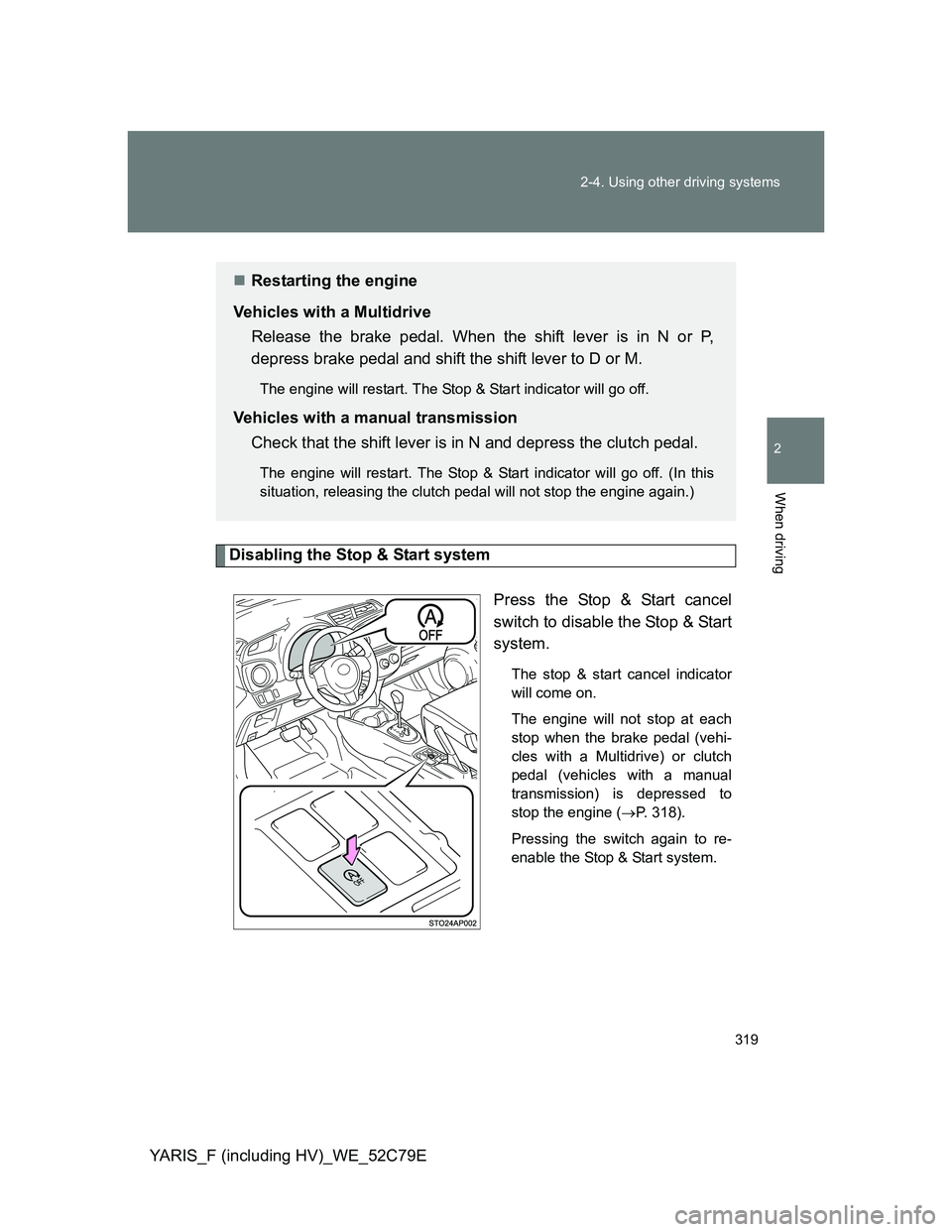
Disabling the Stop & Start system
Press the Stop & Start cancel
switch to disable the Stop & Start
system.
The stop & start cancel indicator
will come on.
The engine will not stop at each
stop when the brake pedal (vehi-
cles with a Multidrive) or clutch
pedal (vehicles with a manual
transmission) is depressed to
stop the engine (P. 318).
Pressing the switch again to re-
enable the Stop & Start system.
Restarting the engine
Vehicles with a Multidrive
Release the brake pedal. When the shift lever is in N or P,
depress brake pedal and shift the shift lever to D or M.
The engine will restart. The Stop & Start indicator will go off.
Vehicles with a manual transmission
Check that the shift lever is in N and depress the clutch pedal.
The engine will restart. The Stop & Start indicator will go off. (In this
situation, releasing the clutch pedal will not stop the engine again.)
Page 320 of 704
320 2-4. Using other driving systems
YARIS_F (including HV)_WE_52C79EIf the Stop & Start cancel switch is pressed while the vehicle is
stopped
When the engine is stopped by the Stop & Start system, press-
ing the Stop & Start cancel switch will restart the engine.
From the next time the vehicle is stopped (after Stop & Start sys-
tem has been turned off), the engine will not be stopped.
With the Stop & Start system disabled, pressing the Stop & Start
cancel switch will re-enable the system but not stop the engine.
From the next time the vehicle is stopped (after Stop & Start sys-
tem has been turned on), the engine will be stopped.
Operating conditions
The Stop & Start system is operational when all of the following condi-
tions are met:
• The engine is adequately warmed up.
• The battery is sufficiently charged.
• The driver’s door is closed.
• Vehicles with a Multidrive: The driver’s seat belt is fastened.
• The hood is closed.
• The accelerator pedal is not being depressed.
• The shift lever is not in R.
In the following circumstances the engine may not be stopped by the
Stop & Start system. This is not a malfunction of the Stop & Start system.
• Engine coolant temperature or transmission fluid temperature is too
low or too high.
• The air conditioning system is being used when the vehicle interior
temperature is extremely high such as after the vehicle was parked
under the hot sun.
• Vehicles with an automatic air conditioning system only: The wind-
shield defogger is being used.
• The battery is not sufficiently charged, or is undergoing a periodic
recharge.
• Due to traffic or other circumstances the vehicle is stopped repeatedly,
resulting in the amount of time the engine is stopped by the Stop &
Start system to become excessively high.
• The brake pedal is not depressed firmly.
Page 321 of 704
321 2-4. Using other driving systems
2
When driving
YARIS_F (including HV)_WE_52C79E
• The vehicle is stopped on a steep hill.
• The brake booster vacuum is low.
• A large amount of electricity is being used.
• At high altitude.
When the above conditions improve, the Stop & Start system will stop and
restart the engine from the next time the vehicle is stopped.
In the following situations, the engine may start even without the brake
pedal being released (vehicles with a Multidrive) or clutch pedal being
depressed (vehicles with a manual transmission).
• The brake pedal is pumped or strongly depressed.
• The air conditioning system is being used or turned on.
• Vehicles with an automatic air conditioning system only: The wind-
shield defogger is turned on.
• The battery is not sufficiently charged.
• The vehicle starts to roll on an incline.
• Vehicles with a Multidrive: The hood is opened when the shift lever is in
N or P.
• The accelerator pedal is depressed.
• A large amount of electricity is being used.
• Vehicles with a Multidrive: The driver’s door is opened.
• Vehicles with a Multidrive: The driver’s seat belt is unfastened.
In the following situations, it may take longer than normal for the Stop &
Start system to activate.
• The battery is discharged.
• After the battery terminals have been disconnected and reconnected
after a battery replacement, etc.
• The engine coolant temperature is low.
Automatic reactivation of the Stop & Start system
Vehicles without a smart entry & start system:
Even if the Stop & Start system is disabled by the Stop & Start cancel switch,
it will be automatically re-enabled once the engine switch is turned to the
“LOCK” position then to the “START” position.
Vehicles with a smart entry & start system:
Even if the Stop & Start system is disabled by the Stop & Start cancel switch,
it will be automatically re-enabled once the “ENGINE START STOP” switch
is turned off then the engine is started.
Page 323 of 704
323 2-4. Using other driving systems
2
When driving
YARIS_F (including HV)_WE_52C79E
Stop & Start system warning buzzer
If the engine is stopped by the Stop & Start system and either of the following
actions is performed, a buzzer will sound and the Stop & Start indicator will
flash (vehicles with a Multidrive), or a buzzer will sound (vehicles with a
manual transmission). This indicates that the engine is only stopped by the
Stop & Start system, not that the engine has been turned off completely.
Vehicles with a Multidrive: The driver’s door is opened when the shift
lever is in D or M.
Vehicles with a Multidrive: The shift lever is shifted into a position other
than N or P with the brake pedal released.
Vehicles with a manual transmission: The shift lever is shifted into a posi-
tion other than N with the clutch pedal released.
If the Stop & Start cancel indicator light continues to flash
The Stop & Start system may be malfunctioning. Contact any authorized
Toyota dealer or repairer, or another duly qualified and equipped profes-
sional.
If the windshield is fogged up while the engine is stopped by the Stop
& Start system
Vehicles with an automatic air conditioning system
Turn the windshield defogger on. (The engine will start due to the auto-
matic engine start function.) (P. 365)
Vehicles with a manual air conditioning system
• Vehicles with a Multidrive: Restart the engine by releasing the brake
pedal (when the shift lever is in D or M) or depress the brake pedal and
shift the shift lever to D or M (when the shift lever is in N or P) (P.
319), or by pressing the Stop & Start cancel switch, and then set the air
outlet selection dial to . (P. 357)
• Vehicles with a manual transmission: Restart the engine by depressing
the clutch pedal (P. 319), or by pressing the Stop & Start cancel
switch, and then set the air outlet selection dial to . (P. 357)
If the windshield fogs up frequently, press the Stop & Start cancel switch to
deactivate the system.
Page 339 of 704
339 2-5. Driving information
2
When driving
YARIS_F (including HV)_WE_52C79E
Check for and remove any excess ice or snow that may have
accumulated on the exterior lights, vehicle’s roof, chassis,
around the tires or on the brakes.
Remove any snow or mud from the bottom of your shoes
before getting in the vehicle.
When driving the vehicle
Accelerate the vehicle slowly, keep a safe distance between you
and the vehicle ahead, and drive at a reduced speed suitable to
road conditions.
When parking the vehicle (in the winter time or in the cold
latitudes)
Park the vehicle and move the shift lever to P (vehicles with a
hybrid transmission or a Multidrive), E, M or R (vehicles with a
multi-mode manual transmission), and 1 or R (vehicles with a
manual transmission) without setting the parking brake. The
parking brake may freeze up, preventing it from being released.
If necessary, block the wheels to prevent inadvertent sliding or
creeping.
Page 352 of 704
352 2-5. Driving information
YARIS_F (including HV)_WE_52C79ETransmission information
Vehicles with a Multidrive and multi-mode manual transmission:
To maintain engine braking efficiency, when using engine braking,
do not use the transmission in D. Transmission shift gear position
must be in 4 in the M mode. (P. 255, 260)
Vehicles with a manual transmission:
To maintain engine braking efficiency, when using engine braking,
do not use the transmission in 5 and 6 (vehicles with a 6-speed
manual transmission) gear. (P. 265)
If the engine overheats
Towing a loaded trailer up a long, steep incline in temperatures
exceeding 30C (85F) may result in the engine overheating. If the
high engine coolant temperature warning light flashes or comes
on, turn the air conditioning off immediately, leave the road and
stop the vehicle in a safe place. (P. 635)
When parking the vehicle
Always place wheel chocks under the wheels of both the vehicle
and trailer. Firmly set the parking brake and shift the shift lever to P
for Multidrives, E, M or R for multi-mode manual transmissions,
and 1 or R for manual transmissions.
Page 440 of 704
440 3-5. Other interior features
YARIS_F (including HV)_WE_52C79E
CAUTION
Observe the following precautions.
Failure to do so may cause the driver’s floor mat to slip, possibly interfering
with the pedals while driving. An unexpectedly high speed may result or it may
become difficult to stop the vehicle, leading to a serious accident.
When installing the driver’s floor mat
Do not use floor mats designed for other models or different model year
vehicles, even if they are Toyota Genuine floor mats.
Only use floor mats designed for the driver’s seat.
Always install the floor mat securely using the retaining hooks (clips) pro-
vided.
Do not use two or more floor mats on top of each other.
Do not place the floor mat bottom-side up or upside-down.
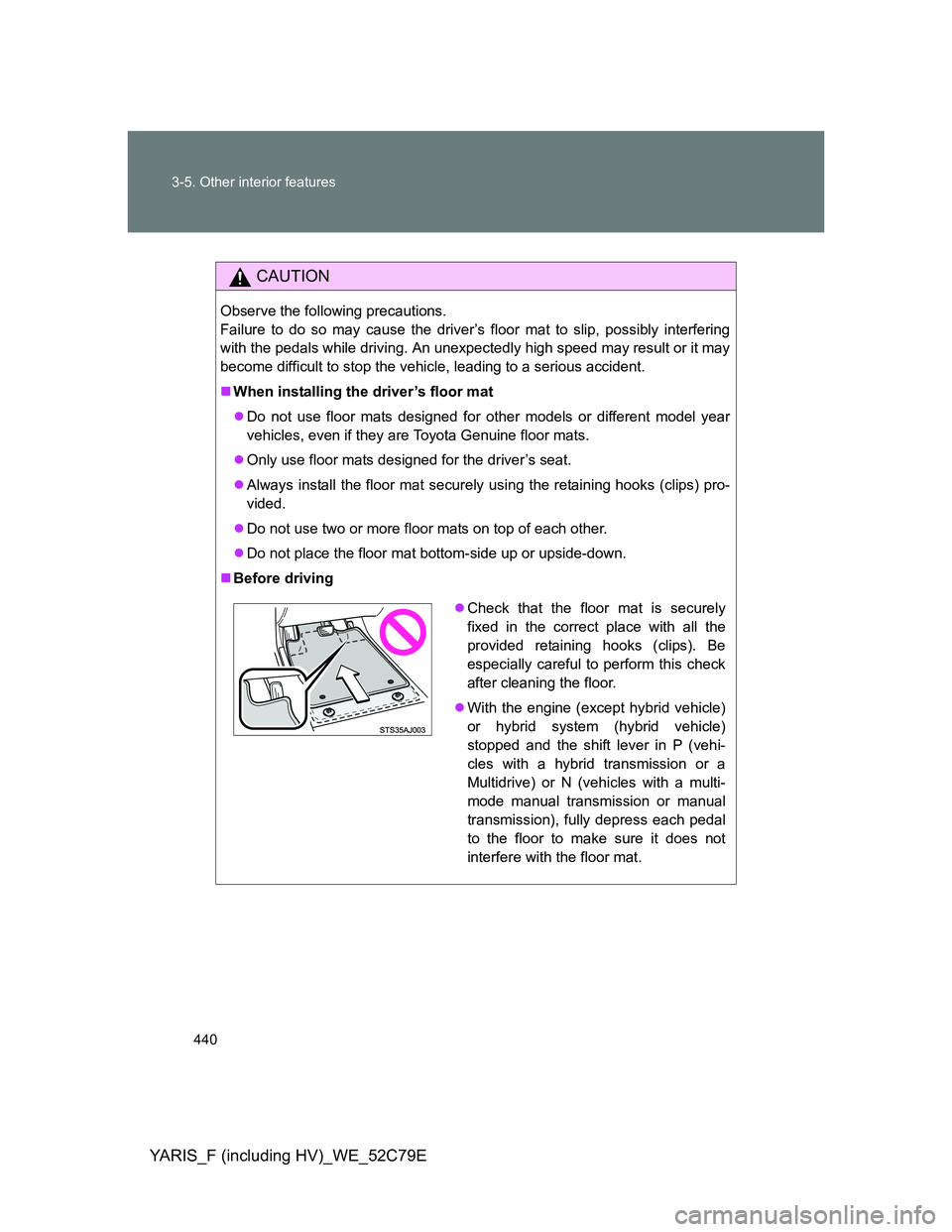
Before driving
Check that the floor mat is securely
fixed in the correct place with all the
provided retaining hooks (clips). Be
especially careful to perform this check
after cleaning the floor.
With the engine (except hybrid vehicle)
or hybrid system (hybrid vehicle)
stopped and the shift lever in P (vehi-
cles with a hybrid transmission or a
Multidrive) or N (vehicles with a multi-
mode manual transmission or manual
transmission), fully depress each pedal
to the floor to make sure it does not
interfere with the floor mat.
Page 455 of 704
455 4-2. Maintenance
4
Maintenance and care
YARIS_F (including HV)_WE_52C79E
Where to go for service?
In order to maintain your vehicle in the best possible condition, Toyota rec-
ommends that all repairs and service operations be carried out by autho-
rized Toyota dealers or repairers or other duly qualified and equipped
professionals. For repairs and services covered by your warranty, please
visit an authorized Toyota dealer or repairer, who will use genuine Toyota
parts in repairing any difficulties you may encounter. There can also be
advantages in utilizing authorized Toyota dealers or repairers for non-war-
ranty repairs and services, as members of the Toyota network will be able to
expertly assist you with any difficulties you may encounter.
Your Toyota dealer or repairer, or another duly qualified and equipped pro-
fessional will perform all of the scheduled maintenance on your vehicle reli-
ably and economically due to their experience with Toyota vehicles.
Does your vehicle need repairs?
Be on the alert for changes in performance and sounds, and visual tip-offs
that indicate service is needed. Some important clues are:
Engine misses, stumbling, or pinging
Appreciable loss of power
Strange engine noises
A fluid leak under the vehicle (However, water dripping from the air condi-
tioning system after use is normal.)
Change in exhaust sound (This may indicate a dangerous carbon mon-
oxide leak. Drive with the windows open and have the exhaust system
checked immediately.)
Flat-looking tires, excessive tire squeal when cornering, uneven tire wear
Vehicle pulls to one side when driving straight on a level road
Strange noises related to suspension movement
Loss of brake effectiveness, spongy feeling brake pedal or clutch pedal
(vehicles with a manual transmission), pedal almost touches the floor,
vehicle pulls to one side when braking
Engine coolant temperature continually higher than normal
If you notice any of these clues, take your vehicle to any authorized Toyota
dealer or repairer, or another duly qualified and equipped professional as
soon as possible. Your vehicle may need adjustment or repair.