Break TOYOTA YARIS 2012 Owners Manual
[x] Cancel search | Manufacturer: TOYOTA, Model Year: 2012, Model line: YARIS, Model: TOYOTA YARIS 2012Pages: 704, PDF Size: 27.58 MB
Page 123 of 704
123 1-3. Opening, closing and locking the doors
1
Before driving
YARIS_F (including HV)_WE_52C79E
CAUTION
Do not pull on the back door damper stay to close the back door, and do
not hang on the back door damper stay.
Doing so may cause hands to be caught or the back door damper stay to
break, causing an accident.
If a bicycle carrier or similar heavy object is attached to the back door, it
may fall closed again after being opened, causing someone’s hands, head
or neck to be caught and injured. When installing an accessory part to the
back door, using a genuine Toyota part is recommended.
NOTICE
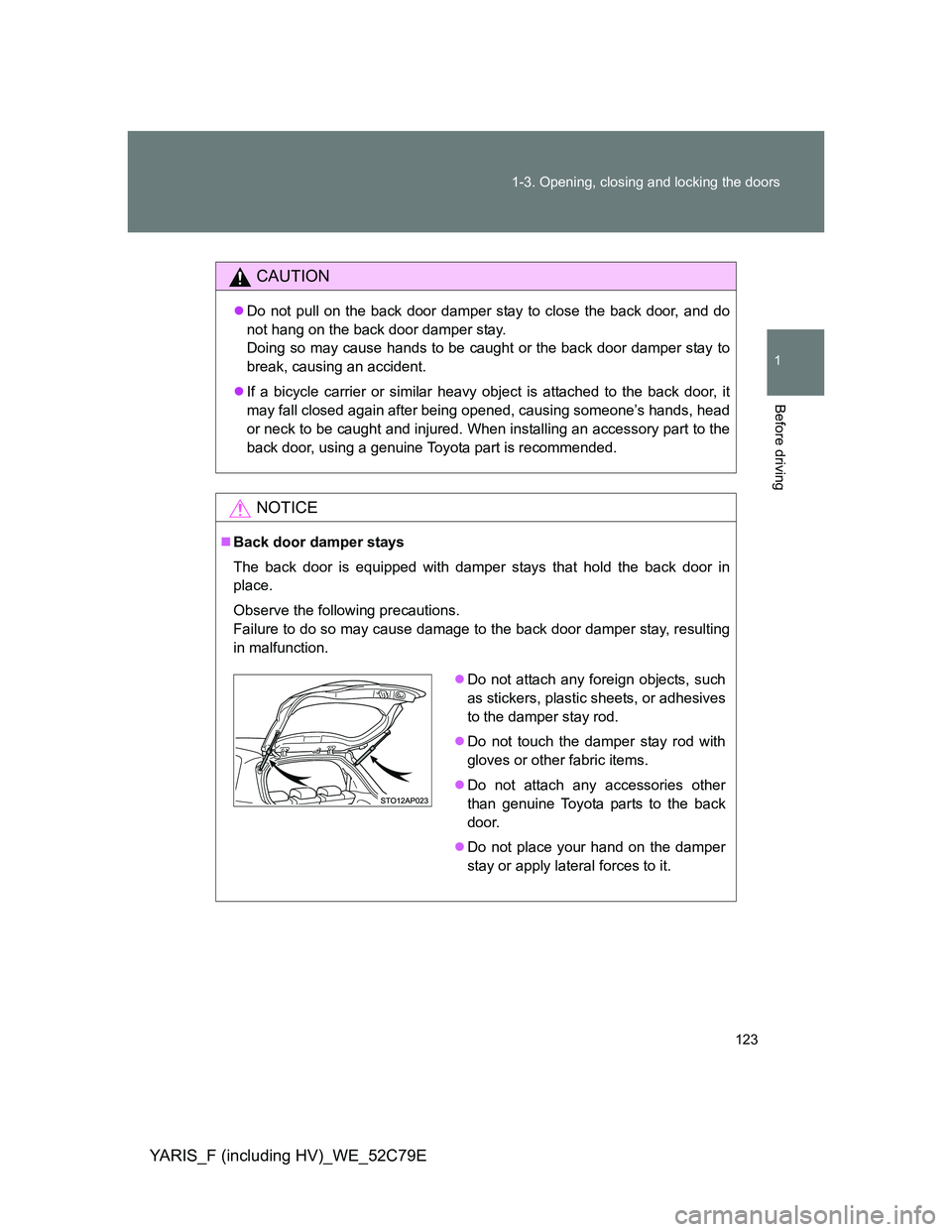
Back door damper stays
The back door is equipped with damper stays that hold the back door in
place.
Observe the following precautions.
Failure to do so may cause damage to the back door damper stay, resulting
in malfunction.
Do not attach any foreign objects, such
as stickers, plastic sheets, or adhesives
to the damper stay rod.
Do not touch the damper stay rod with
gloves or other fabric items.
Do not attach any accessories other
than genuine Toyota parts to the back
door.
Do not place your hand on the damper
stay or apply lateral forces to it.
Page 209 of 704
209 2-1. Driving procedures
2
When driving
YARIS_F (including HV)_WE_52C79E
Engine speed while driving (vehicles with a hybrid transmission and a
Multidrive)
In the following conditions, the engine speed may become high while driving.
This is due to automatic up-shifting control or down-shifting implementation
to meet driving conditions. It does not indicate sudden acceleration.
The vehicle is judged to be driving uphill or downhill
When the accelerator pedal is released
Breaking in your new Toyota
To extend the life of the vehicle, observing the following precautions is rec-
ommended:
Except hybrid vehicle
For the first 300 km (186 miles):
Avoid sudden stops.
For the first 800 km (500 miles):
Do not tow a trailer.
For the first 1000 km (621 miles):
• Do not drive at extremely high speeds.
• Avoid sudden acceleration.
• Do not drive continuously in low gears.
• Do not drive at a constant speed for extended periods.
Hybrid vehicle
For the first 300 km (186 miles):
Avoid sudden stops.
For the first 1600 km (994 miles):
• Do not drive at extremely high speeds.
• Avoid sudden acceleration.
• Do not drive at a constant speed for extended periods.
Page 349 of 704
349 2-5. Driving information
2
When driving
YARIS_F (including HV)_WE_52C79E
Tire information
Ensure that your vehicle's tires are properly inflated. Adjust the tire pres-
sure to the recommended pressure. (P. 672)
Increase the air pressure of the trailer tires in accordance with the total
trailer weight and according to the values recommended by the manufac-
turer of your trailer.
Trailer lights
Check that the turn signal lights and stoplights are operating correctly every
time you hitch up the trailer. Directly wiring up to your vehicle may damage
the electrical system and stop the lights from functioning correctly.
Break-in schedule
Toyota recommends that vehicles fitted with new power train components
should not be used for towing trailers for the first 800 km (500 miles).
Safety checks before towing
Check that the maximum load limit for the towing hitch/bracket and hitch
ball is not exceeded. Bear in mind that the coupling weight of the trailer
will add to the load exerted on the vehicle. Also make sure that the total
load exerted on the vehicle is within the range of the weight limits.
(P. 344)
Ensure that the trailer load is secure.
Supplementary outside rear view mirrors should be added to the vehicle
if the traffic behind cannot be clearly seen with standard mirrors. Adjust
the extending arms of these mirrors on both sides of the vehicle so that
they always provide maximum visibility of the road behind.
Maintenance
Maintenance must be performed more frequently when using the vehicle
for towing due to the greater weight burden placed on the vehicle com-
pared to normal driving.
Retighten all bolts securing the hitching ball and bracket after towing for
approximately 1000 km (600 miles).
Page 424 of 704
424 3-4. Using the storage features
YARIS_F (including HV)_WE_52C79E
CAUTION
Items unsuitable for the bottle holder
Do not place anything other than a bottle in the bottle holders.
Other items may be thrown out of the holders in the event of an accident or
sudden braking and cause injury.
NOTICE
Items that should not be stowed in the bottle holders
Put the cap on before stowing a bottle. Do not place open bottles in the bot-
tle holders, or glasses and paper cups containing liquid. The contents may
spill and glasses may break.
Bottle holders
Page 501 of 704
501 4-3. Do-it-yourself maintenance
4
Maintenance and care
YARIS_F (including HV)_WE_52C79E
CAUTION
When replacing wheels
Do not use wheels that are a different size from those recommended in the
Owner’s Manual, as this may result in a loss of handling control.
Never use an inner tube in a leaking wheel which is designed for a tube-
less tire. Doing so may result in an accident, causing death or serious
injury.
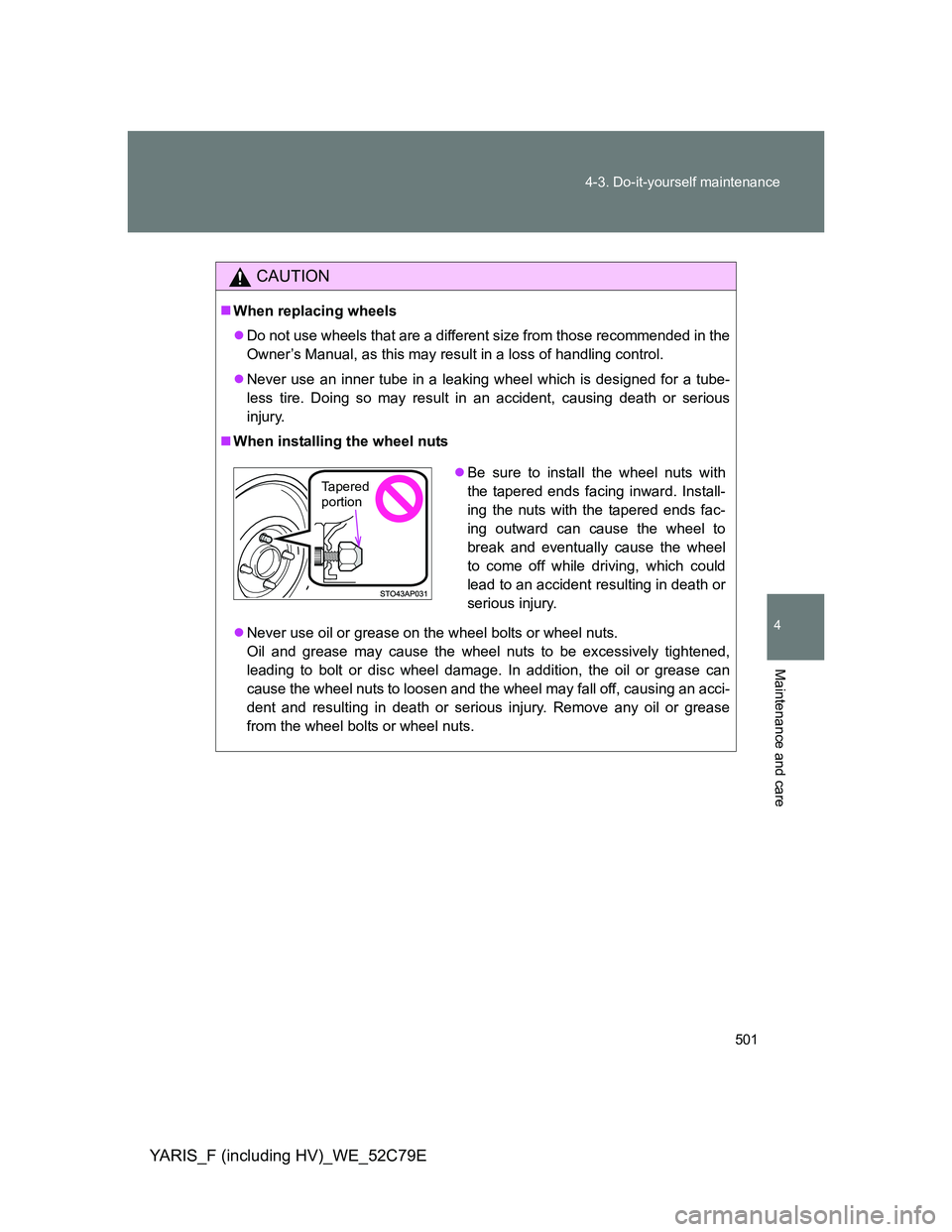
When installing the wheel nuts
Never use oil or grease on the wheel bolts or wheel nuts.
Oil and grease may cause the wheel nuts to be excessively tightened,
leading to bolt or disc wheel damage. In addition, the oil or grease can
cause the wheel nuts to loosen and the wheel may fall off, causing an acci-
dent and resulting in death or serious injury. Remove any oil or grease
from the wheel bolts or wheel nuts.
Be sure to install the wheel nuts with
the tapered ends facing inward. Install-
ing the nuts with the tapered ends fac-
ing outward can cause the wheel to
break and eventually cause the wheel
to come off while driving, which could
lead to an accident resulting in death or
serious injury.Tapered
portion
Page 534 of 704
534 4-3. Do-it-yourself maintenance
YARIS_F (including HV)_WE_52C79E
CAUTION
To prevent system breakdowns and vehicle fire
Observe the following precautions.
Failure to do so may cause damage, and possibly a fire or injury.
Never use a fuse of a higher amperage rating than that indicated, or use
any other object in place of a fuse.
Always use a genuine Toyota fuse or equivalent.
Never replace a fuse with a wire, even as a temporary fix.
This can cause extensive damage or even fire.
Do not modify the fuses or fuse boxes.
Fuse box near the power control unit (hybrid vehicle)
Never check or replace the fuses as there are high voltage parts and wiring
near the fuse box.
Doing so may cause electric shock, resulting in death or serious injury.
NOTICE
Before replacing fuses
Have the cause of electrical overload determined and repaired by any autho-
rized Toyota dealer or repairer, or another duly qualified and equipped pro-
fessional as soon as possible.
Page 552 of 704
552
YARIS_F (including HV)_WE_52C79E
5-1. Essential information
Emergency flashers
Emergency flashers
Except hybrid vehicle: If the emergency flashers are used for a long time
while the engine is not operating, the battery may discharge.
Hybrid vehicle: If the emergency flashers are used for a long time while
the hybrid system is not operating (while the “READY” indicator is not illu-
minated), the 12-volt battery may discharge.
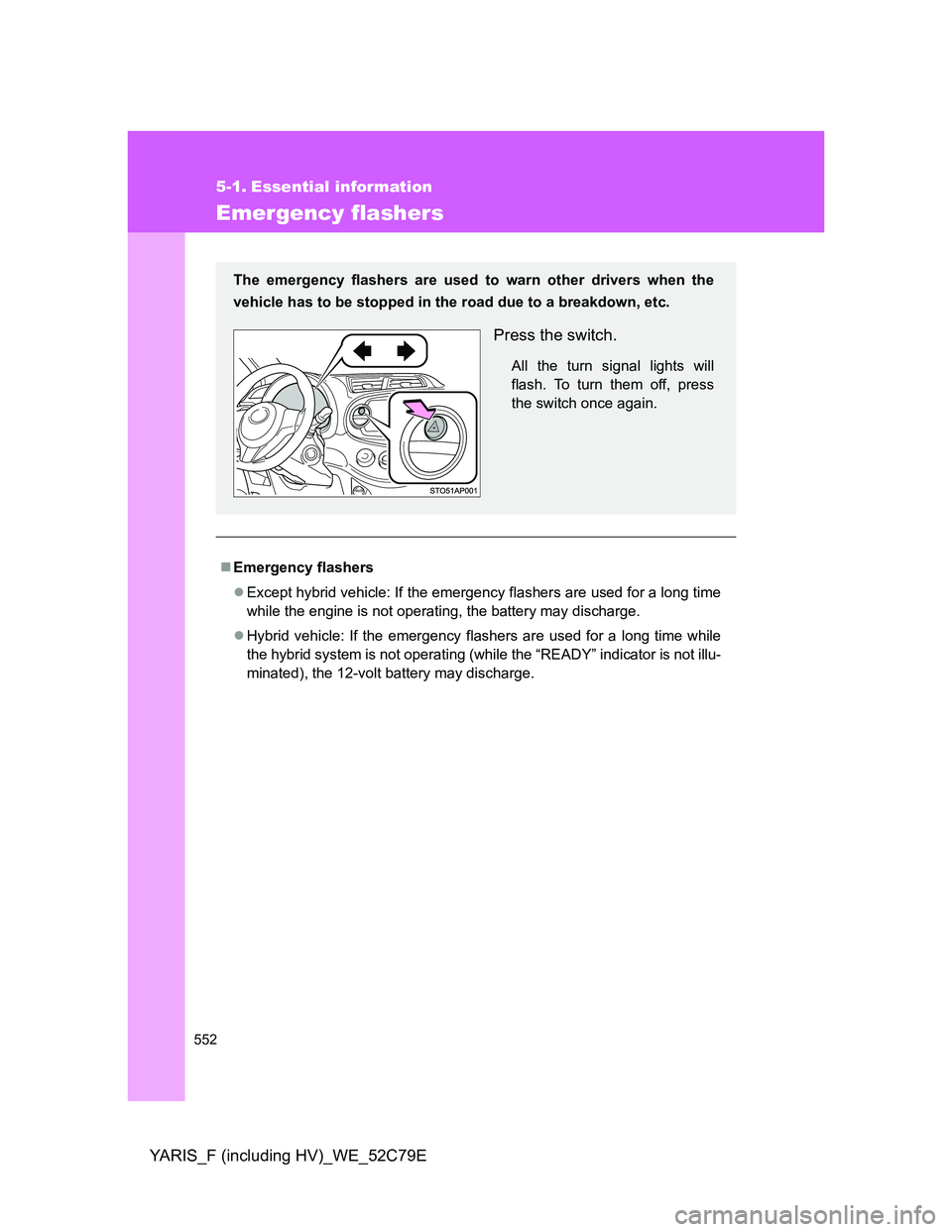
The emergency flashers are used to warn other drivers when the
vehicle has to be stopped in the road due to a breakdown, etc.
Press the switch.
All the turn signal lights will
flash. To turn them off, press
the switch once again.
Page 688 of 704
688 Alphabetical index
YARIS_F (including HV)_WE_52C79E
Brake
Fluid ...................................... 671
Parking brake ........................ 271
Brake assist.............................. 326
Break-in tips ............................. 209
Brightness control
Instrument panel light
control ................................. 291
Care
Exterior.................................. 446
Interior ................................... 451
Seat belts .............................. 452
CD player .................................. 385
Chains ....................................... 338
Child-protectors ....................... 117
Child restraint system
Baby seats, definition ............ 181
Baby seats, installation ......... 190
Child seats, definition ............ 181
Child seats, installation ......... 190
Installing CRS with ISOFIX
rigid anchors ....................... 194
Installing CRS with seat
belts .................................... 191
Installing CRS with top
straps .................................. 195
Junior seats, definition .......... 181
Junior seats, installation........ 190Child safety
Airbag precautions ................ 172
Battery precautions ....... 484, 629
Child-protectors .................... 117
Child restraint system ........... 181
How your child should wear
the seat belt ........................ 136
Installing child restraints ....... 190
Power window lock switch .... 147
Power window precautions ... 150
Removed key battery
precautions ......................... 509
Seat belt precautions ............ 137
Seat heater
precautions ......................... 435
12-volt battery
precautions ................. 492, 634
Cigarette lighter ....................... 431
Cleaning
Exterior ................................. 446
Interior................................... 451
Seat belts .............................. 452
Clock ......................................... 428
Condenser ................................ 481
Cooling system
Engine overheating ............... 635
Hybrid system overheating ... 639
Cruise control
Cruise control........................ 311
Indicator ................................ 311
Cup holders.............................. 422
Curtain shield airbags ............. 166
Customizable features ............ 682
C
Page 689 of 704
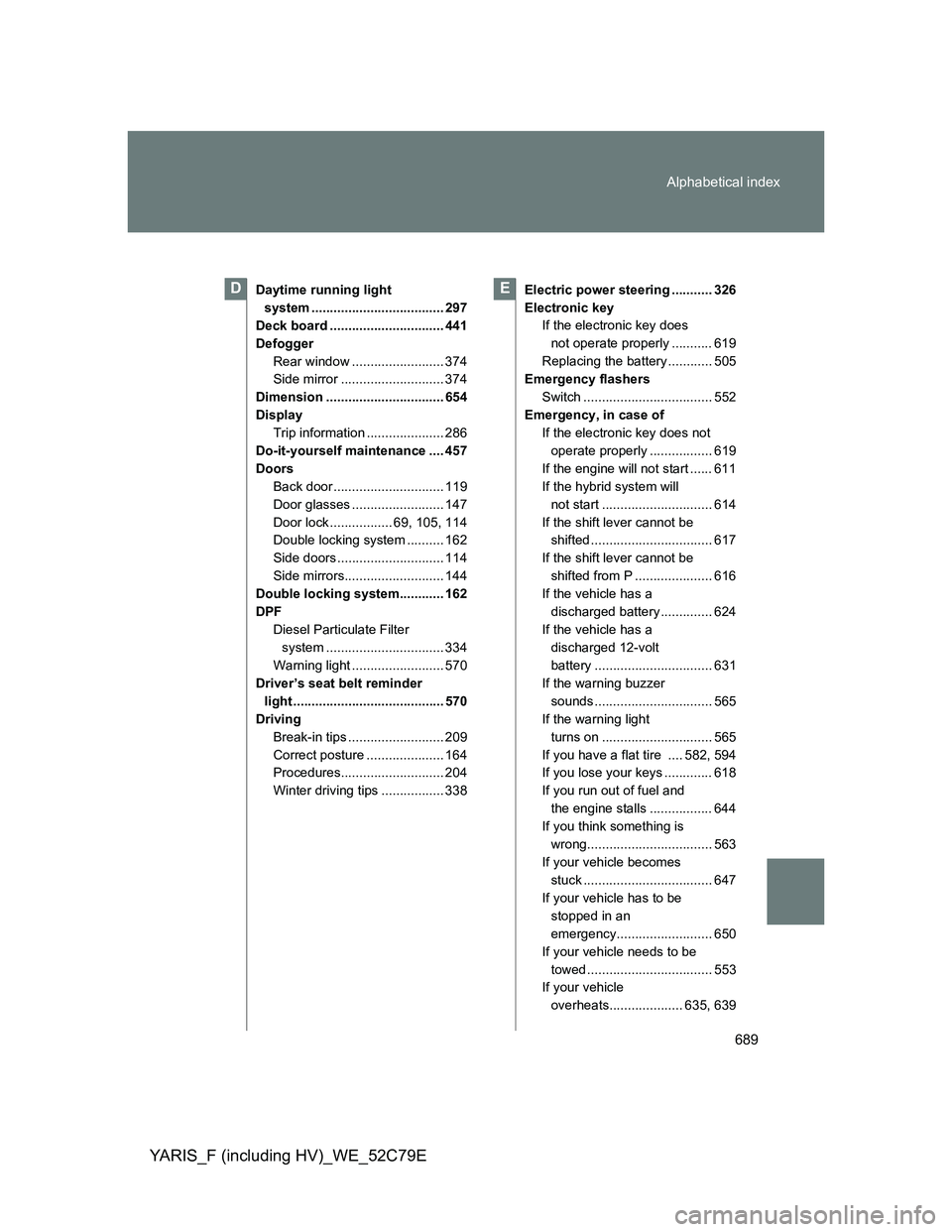
689 Alphabetical index
YARIS_F (including HV)_WE_52C79E
Daytime running light
system .................................... 297
Deck board ............................... 441
Defogger
Rear window ......................... 374
Side mirror ............................ 374
Dimension ................................ 654
Display
Trip information ..................... 286
Do-it-yourself maintenance .... 457
Doors
Back door .............................. 119
Door glasses ......................... 147
Door lock ................. 69, 105, 114
Double locking system .......... 162
Side doors ............................. 114
Side mirrors........................... 144
Double locking system............ 162
DPF
Diesel Particulate Filter
system ................................ 334
Warning light ......................... 570
Driver’s seat belt reminder
light ......................................... 570
Driving
Break-in tips .......................... 209
Correct posture ..................... 164
Procedures............................ 204
Winter driving tips ................. 338Electric power steering ........... 326
Electronic key
If the electronic key does
not operate properly ........... 619
Replacing the battery ............ 505
Emergency flashers
Switch ................................... 552
Emergency, in case of
If the electronic key does not
operate properly ................. 619
If the engine will not start ...... 611
If the hybrid system will
not start .............................. 614
If the shift lever cannot be
shifted ................................. 617
If the shift lever cannot be
shifted from P ..................... 616
If the vehicle has a
discharged battery .............. 624
If the vehicle has a
discharged 12-volt
battery ................................ 631
If the warning buzzer
sounds ................................ 565
If the warning light
turns on .............................. 565
If you have a flat tire .... 582, 594
If you lose your keys ............. 618
If you run out of fuel and
the engine stalls ................. 644
If you think something is
wrong.................................. 563
If your vehicle becomes
stuck ................................... 647
If your vehicle has to be
stopped in an
emergency.......................... 650
If your vehicle needs to be
towed .................................. 553
If your vehicle
overheats.................... 635, 639DE