accu TOYOTA YARIS 2012 Owners Manual
[x] Cancel search | Manufacturer: TOYOTA, Model Year: 2012, Model line: YARIS, Model: TOYOTA YARIS 2012Pages: 704, PDF Size: 27.58 MB
Page 42 of 704

YARIS_F (including HV)_WE_52C79E
42
Scrapping of your Toyota
The SRS airbag and seat belt pretensioner devices in your Toyota contain
explosive chemicals. If the vehicle is scrapped with the airbags and seat belt
pretensioners left as they are, this may cause an accident such as fire. Be
sure to have the systems of the SRS airbag and seat belt pretensioner
removed and disposed of by a qualified service shop or by any authorized
Toyota dealer or repairer, or another duly qualified and equipped profes-
sional, before you scrap your vehicle.
Your vehicle contains batteries and/or accumulators. Do not discard them into
the environment but cooperate with separate collection (Directive 2006/66/
EC).
Page 338 of 704
338
2-5. Driving information
YARIS_F (including HV)_WE_52C79E
Winter driving tips
Carry out the necessary preparations and inspections before driving
the vehicle in winter. Always drive the vehicle in a manner appropri-
ate to the prevailing weather conditions.
Pre-winter preparations
Use fluids that are appropriate to the prevailing outside tem-
peratures.
• Engine oil
• Engine coolant
• Washer fluid
• Power control unit coolant (hybrid vehicle)
Except hybrid vehicle: Have a service technician inspect the
condition of the battery.
Hybrid vehicle: Have a service technician inspect the condi-
tion of the 12-volt battery.
Have the vehicle fitted with four snow tires or purchase a set
of tire chains for the front tires.
Ensure that all tires are the same size and brand, and that their wear
level is not noticeably different with each other. Also make sure that
chains match the size of the tires.
Before driving the vehicle
Perform the following according to the driving conditions:
Do not try to forcibly open a window or move a wiper that is
frozen. Pour warm water over the frozen area to melt the ice.
Wipe away the water immediately to prevent it from freezing.
To ensure proper operation of the climate control system fan,
remove any snow that has accumulated on the air inlet vents
in front of the windshield.
Page 339 of 704
339 2-5. Driving information
2
When driving
YARIS_F (including HV)_WE_52C79E
Check for and remove any excess ice or snow that may have
accumulated on the exterior lights, vehicle’s roof, chassis,
around the tires or on the brakes.
Remove any snow or mud from the bottom of your shoes
before getting in the vehicle.
When driving the vehicle
Accelerate the vehicle slowly, keep a safe distance between you
and the vehicle ahead, and drive at a reduced speed suitable to
road conditions.
When parking the vehicle (in the winter time or in the cold
latitudes)
Park the vehicle and move the shift lever to P (vehicles with a
hybrid transmission or a Multidrive), E, M or R (vehicles with a
multi-mode manual transmission), and 1 or R (vehicles with a
manual transmission) without setting the parking brake. The
parking brake may freeze up, preventing it from being released.
If necessary, block the wheels to prevent inadvertent sliding or
creeping.
Page 362 of 704
362 3-1. Using the air conditioning system and defogger
YARIS_F (including HV)_WE_52C79E
Air conditioning odors
During use, various odors from inside and outside the vehicle may enter
into and accumulate in the air conditioning system. This may then cause
odor to be emitted from the vents.
To reduce potential odors from occurring:
It is recommended that the air conditioning system be set to outside air
mode prior to turning the vehicle off.
An odor comes from the air conditioning system due to the Stop &
Start system operation (vehicles with a Stop & Start system)
When the engine is stopped due to the Stop & Start system, an odor caused
by moisture may be detected. This does not indicate a malfunction.
Air conditioning filter
P. 502
CAUTION
To prevent the windshield from fogging up
Do not use during cool air operation in extremely humid weather. The
difference between the temperature of the outside air and that of the wind-
shield can cause the outer surface of the windshield to fog up, blocking your
vision.
NOTICE
To prevent battery discharge
Do not leave the air conditioning system on longer than necessary when the
engine is stopped.
Page 370 of 704
370 3-1. Using the air conditioning system and defogger
YARIS_F (including HV)_WE_52C79E
When the indicator light on goes off by itself
Press to turn off the dehumidification function and turn it on again.
There may be a problem in the air conditioning system if the indicator light
goes off again. Turn the air conditioning system off and have it inspected by
any authorized Toyota dealer or repairer, or another duly qualified and
equipped professional.
Air conditioning odors
During use, various odors from inside and outside the vehicle may enter
into and accumulate in the air conditioning system. This may then cause
odor to be emitted from the vents.
To reduce potential odors from occurring:
• It is recommended that the air conditioning system be set to outside air
mode prior to turning the vehicle off.
• The start timing of the blower may be delayed for a short period of time
immediately after the air conditioning system is started in AUTO mode.
An odor comes from the air conditioning system due to the Stop &
Start system operation (vehicles with a Stop & Start system)
When the engine is stopped due to the Stop & Start system, an odor caused
by moisture may be detected. This does not indicate a malfunction.
Air conditioning filter
P. 502
CAUTION
To prevent the windshield from fogging up
Do not use
during cool air operation in extremely humid weather. The
difference between the temperature of the outside air and that of the wind-
shield can cause the outer surface of the windshield to fog up, blocking your
vision.
Page 461 of 704
461 4-3. Do-it-yourself maintenance
4
Maintenance and care
YARIS_F (including HV)_WE_52C79E
NOTICE
If you remove the air cleaner filter
Driving with the air cleaner filter removed may cause excessive engine wear
due to dirt in the air. Also, a backfire could cause a fire in the engine com-
partment.
If the fluid level is low or high
It is normal for the brake fluid level to go down slightly as the brake pads
wear or when the fluid level in the accumulator is high.
If the reservoir needs frequent refilling, it may indicate a serious problem.
Page 476 of 704
476 4-3. Do-it-yourself maintenance
YARIS_F (including HV)_WE_52C79E
Engine oil consumption
The amount of engine oil consumed depends on the oil viscosity, the
quality of the oil and the way the vehicle is driven.
More oil is consumed under driving conditions such as high speeds and
frequent acceleration and deceleration.
A new engine consumes more oil.
When judging the amount of oil consumption, keep in mind that the oil
may have become diluted, making it difficult to judge the true level accu-
rately.
Oil consumption: Max. 1.0 L/1000 km (1.1 qt./600 miles, 0.9 Imp. qt./600
miles)
If your vehicle consumes more than 1.0 L (1.1 qt., 0.9 Imp. qt.) every
1000 km (600 miles), contact any authorized Toyota dealer or repairer, or
another duly qualified and equipped professional.
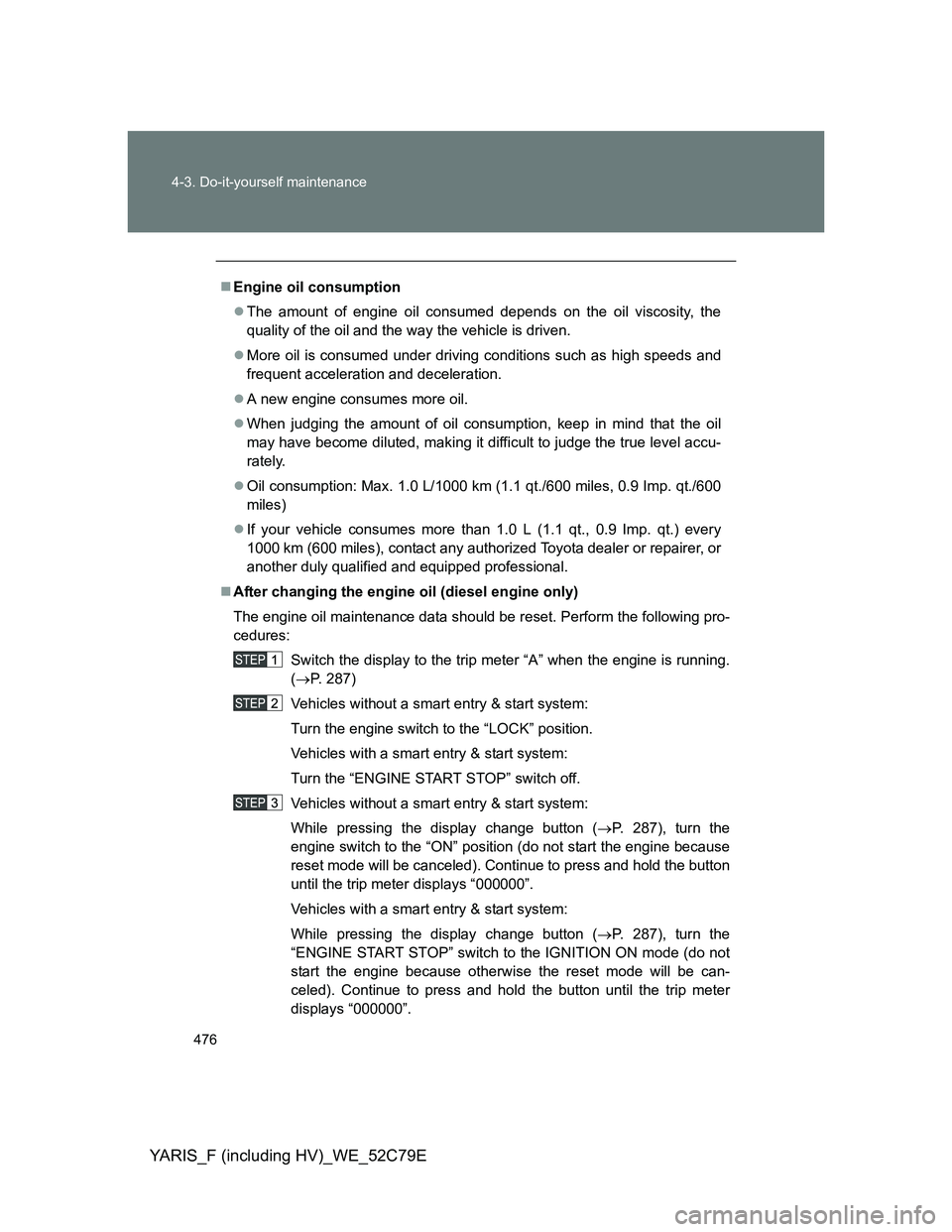
After changing the engine oil (diesel engine only)
The engine oil maintenance data should be reset. Perform the following pro-
cedures:
Switch the display to the trip meter “A” when the engine is running.
(P. 287)
Vehicles without a smart entry & start system:
Turn the engine switch to the “LOCK” position.
Vehicles with a smart entry & start system:
Turn the “ENGINE START STOP” switch off.
Vehicles without a smart entry & start system:
While pressing the display change button (P. 287), turn the
engine switch to the “ON” position (do not start the engine because
reset mode will be canceled). Continue to press and hold the button
until the trip meter displays “000000”.
Vehicles with a smart entry & start system:
While pressing the display change button (P. 287), turn the
“ENGINE START STOP” switch to the IGNITION ON mode (do not
start the engine because otherwise the reset mode will be can-
celed). Continue to press and hold the button until the trip meter
displays “000000”.
Page 498 of 704
498
4-3. Do-it-yourself maintenance
YARIS_F (including HV)_WE_52C79E
Tire inflation pressure
Effects of incorrect tire inflation pressure
Driving with incorrect tire inflation pressure may result in the following:
Reduced fuel efficiency
Reduced driving comfort and tire life
Reduced safety
Damage to the drive train
If a tire needs frequent inflating, have it checked by any authorized Toyota
dealer or repairer, or another duly qualified and equipped professional.
Instructions for checking tire inflation pressure
When checking tire inflation pressure, observe the following:
Check only when the tires are cold.
If your vehicle has been parked for at least 3 hours or has not been
driven for more than 1.5 km or 1 mile, you will get an accurate cold tire
inflation pressure reading.
Always use a tire pressure gauge.
The appearance of the tire can be misleading. In addition, tire inflation
pressure that is even just a few pounds off can affect ride quality and
handling.
Do not reduce tire inflation pressure after driving. It is normal for tire infla-
tion pressure to be higher after driving.
Never exceed the vehicle capacity weight.
Passengers and luggage weight should be placed so that the vehicle is
balanced.
Make sure to maintain proper tire inflation pressure. Tire inflation
pressure should be checked at least once per month. However, Toy-
ota recommends that tire inflation pressure be checked once every
two weeks. (P. 672)
Page 569 of 704
5
569 5-2. Steps to take in an emergency
When trouble arises
YARIS_F (including HV)_WE_52C79E
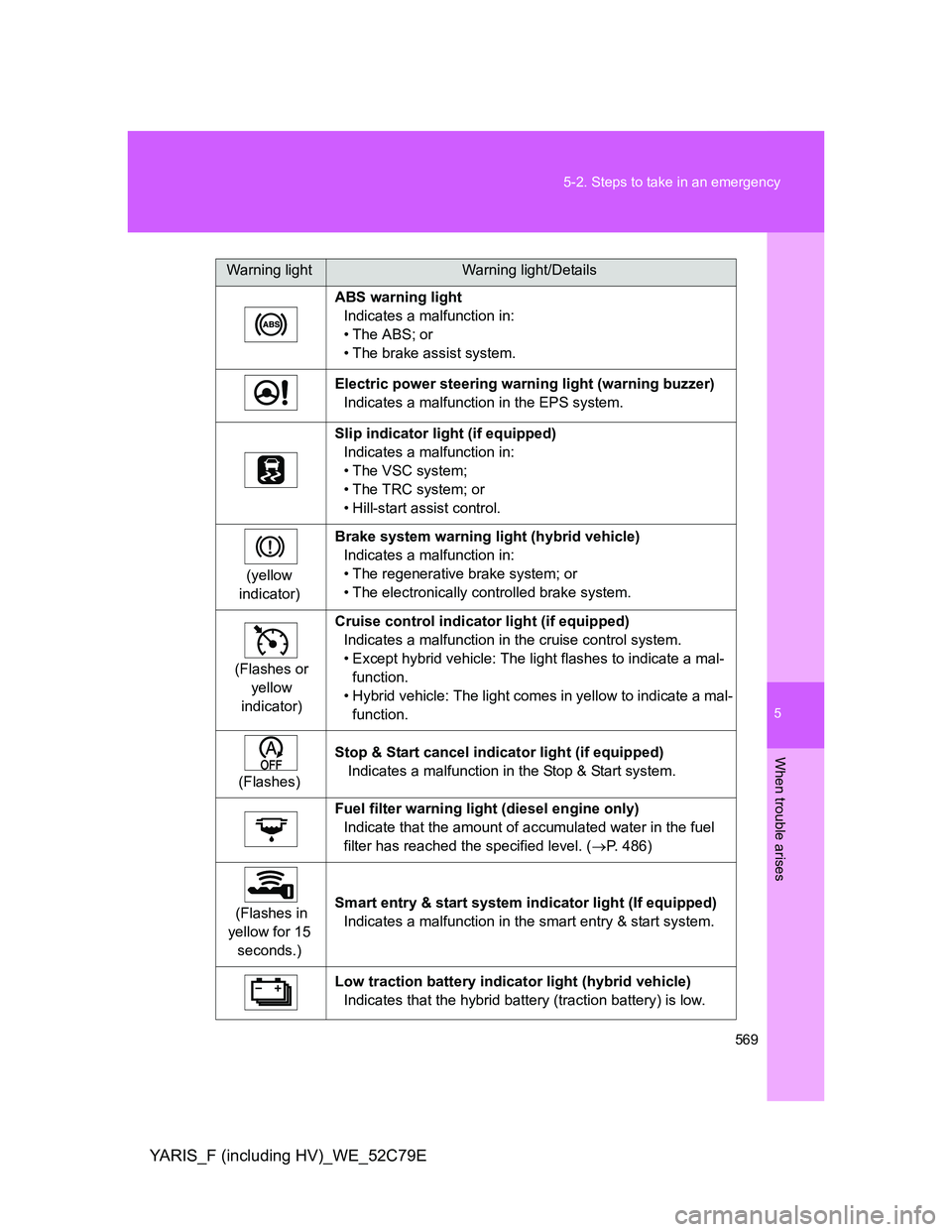
ABS warning light
Indicates a malfunction in:
• The ABS; or
• The brake assist system.
Electric power steering warning light (warning buzzer)
Indicates a malfunction in the EPS system.
Slip indicator light (if equipped)
Indicates a malfunction in:
• The VSC system;
• The TRC system; or
• Hill-start assist control.
(yellow
indicator)Brake system warning light (hybrid vehicle)
Indicates a malfunction in:
• The regenerative brake system; or
• The electronically controlled brake system.
(Flashes or
yellow
indicator)Cruise control indicator light (if equipped)
Indicates a malfunction in the cruise control system.
• Except hybrid vehicle: The light flashes to indicate a mal-
function.
• Hybrid vehicle: The light comes in yellow to indicate a mal-
function.
(Flashes)Stop & Start cancel indicator light (if equipped)
Indicates a malfunction in the Stop & Start system.
Fuel filter warning light (diesel engine only)
Indicate that the amount of accumulated water in the fuel
filter has reached the specified level. (P. 486)
(Flashes in
yellow for 15
seconds.)Smart entry & start system indicator light (If equipped)
Indicates a malfunction in the smart entry & start system.
Low traction battery indicator light (hybrid vehicle)
Indicates that the hybrid battery (traction battery) is low.
Warning lightWarning light/Details
Page 572 of 704
572 5-2. Steps to take in an emergency
YARIS_F (including HV)_WE_52C79E
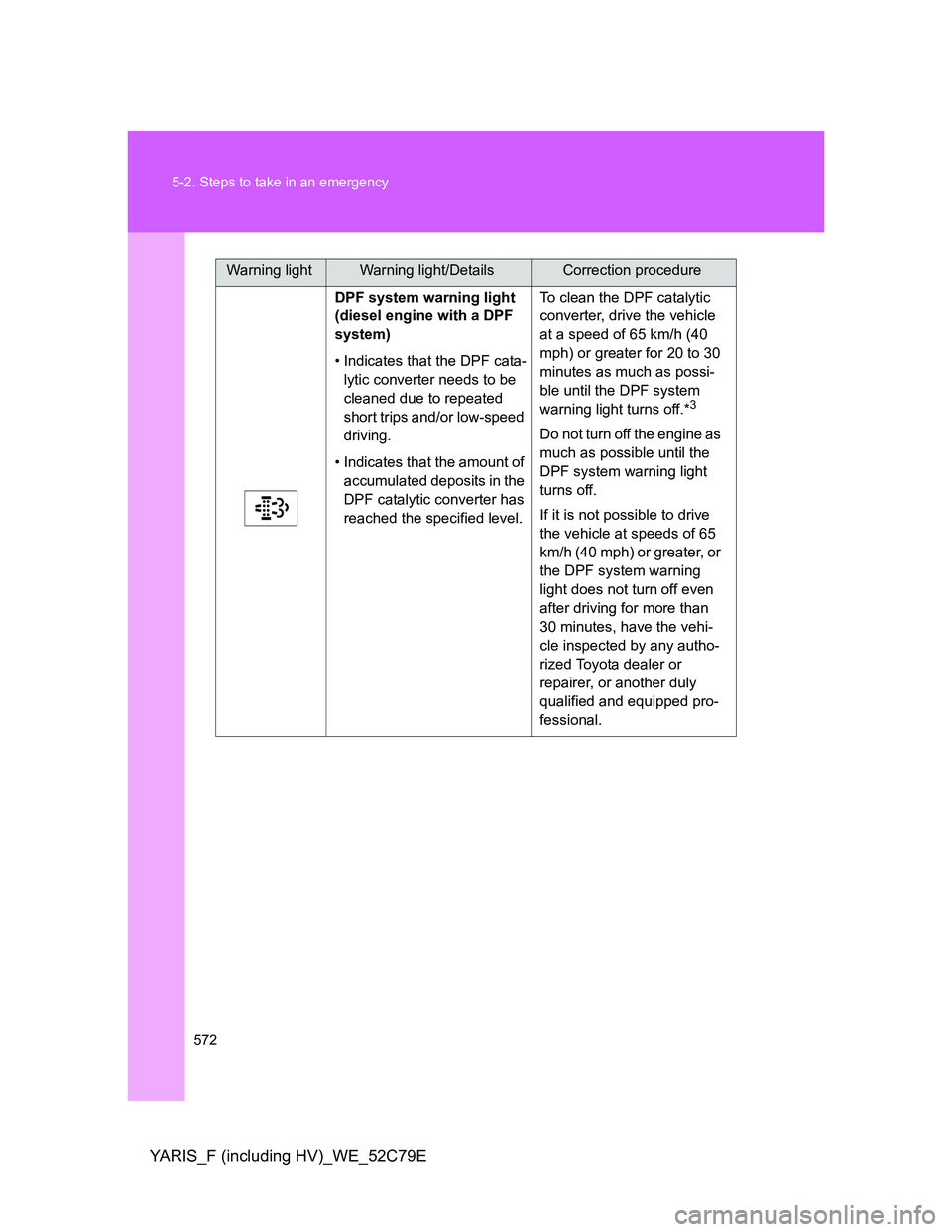
DPF system warning light
(diesel engine with a DPF
system)
• Indicates that the DPF cata-
lytic converter needs to be
cleaned due to repeated
short trips and/or low-speed
driving.
• Indicates that the amount of
accumulated deposits in the
DPF catalytic converter has
reached the specified level.To clean the DPF catalytic
converter, drive the vehicle
at a speed of 65 km/h (40
mph) or greater for 20 to 30
minutes as much as possi-
ble until the DPF system
warning light turns off.*
3
Do not turn off the engine as
much as possible until the
DPF system warning light
turns off.
If it is not possible to drive
the vehicle at speeds of 65
km/h (40 mph) or greater, or
the DPF system warning
light does not turn off even
after driving for more than
30 minutes, have the vehi-
cle inspected by any autho-
rized Toyota dealer or
repairer, or another duly
qualified and equipped pro-
fessional.
Warning lightWarning light/DetailsCorrection procedure