light TOYOTA YARIS 2013 3.G Owners Manual
[x] Cancel search | Manufacturer: TOYOTA, Model Year: 2013, Model line: YARIS, Model: TOYOTA YARIS 2013 3.GPages: 400, PDF Size: 9 MB
Page 314 of 400
314 5-2. Steps to take in an emergency
CAUTION
Your vehicle has also been equipped with a TPMS (tire pressure warning
system) malfunction indicator to indicate when the system is not operat-
ing properly. The TPMS (tire pressure warning system) malfunction indi-
cator is combined with the low tire pressure telltale (tire pressure
warning light). When the system det ects a malfunction, the telltale will
flash for approximately one minute an d then remain continuously illumi-
nated. This sequence will continue upon subsequent vehicle start-ups as
long as the malfunction exists. When the malfunction indi cator is illumi-
nated, the system may not be able to detect or signal low tire pressure
as intended.
TPMS (tire pressure warning system) malfunctions may occur for a vari-
ety of reasons, including the installati on of replacement or alternate tires
or wheels on the vehicle that prevent the TPMS (tire pressure warning
system) from functioning properly. Always check the TPMS (tire pres-
sure warning system) malfunction te lltale after replacing one or more
tires or wheels on your vehicle to ensure that the replacement or alter-
nate tires and wheels allow the TPMS (tire pressure warning system) to
continue to function properly.
NOTICE
■Precaution when installing a different tire (vehicles with a tire pres-
sure warning system)
When a tire of a different specification or maker is installed, the tire pres-
sure warning system may not operate properly.
Page 318 of 400
318 5-2. Steps to take in an emergency
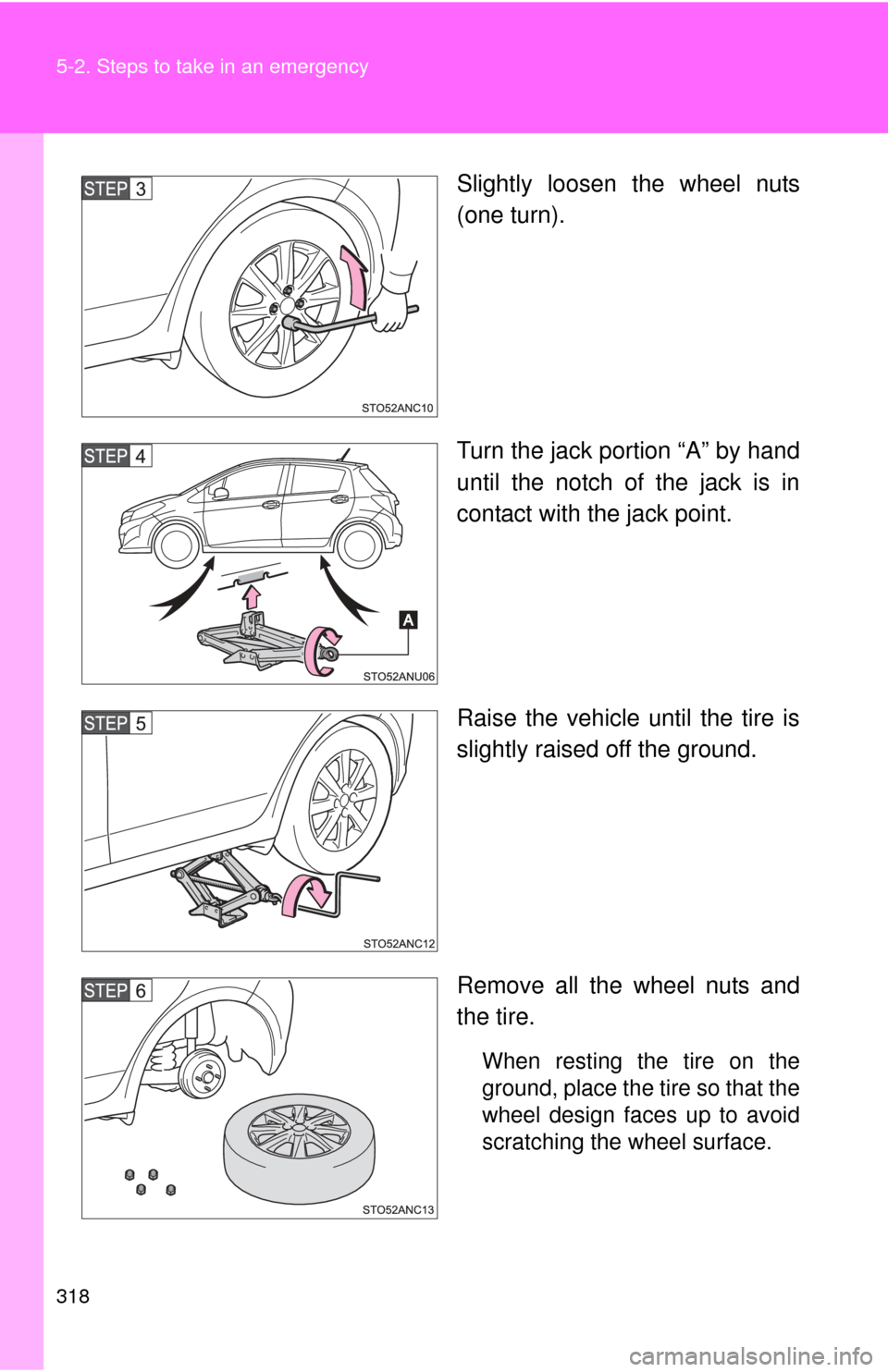
Slightly loosen the wheel nuts
(one turn).
Turn the jack portion “A” by hand
until the notch of the jack is in
contact with the jack point.
Raise the vehicle until the tire is
slightly raised off the ground.
Remove all the wheel nuts and
the tire.
When resting the tire on the
ground, place the tire so that the
wheel design faces up to avoid
scratching the wheel surface.
Page 322 of 400
322 5-2. Steps to take in an emergency
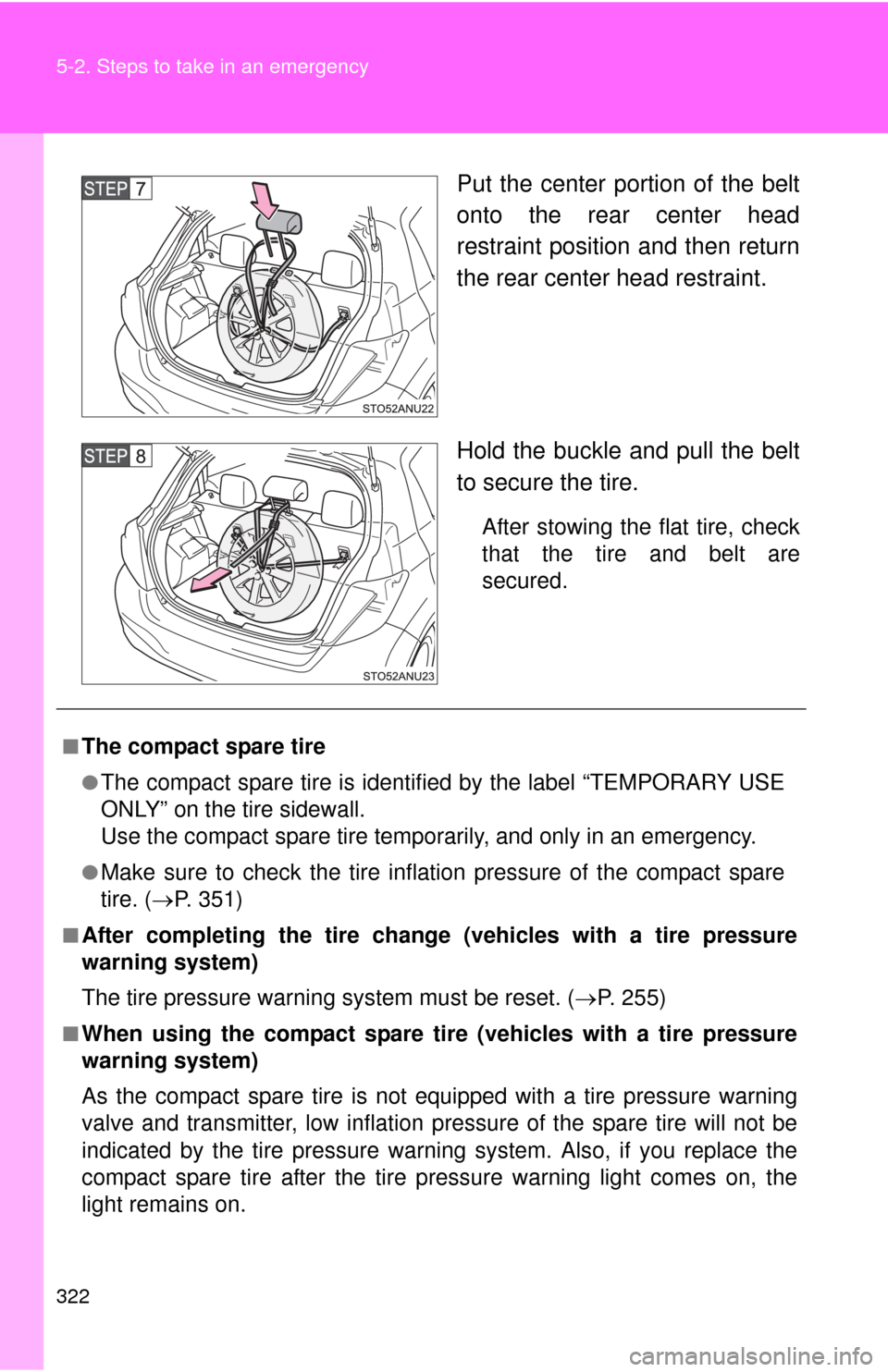
Put the center portion of the belt
onto the rear center head
restraint position and then return
the rear center head restraint.
Hold the buckle and pull the belt
to secure the tire.
After stowing the flat tire, check
that the tire and belt are
secured.
■The compact spare tire
●The compact spare tire is identified by the label “TEMPORARY USE
ONLY” on the tire sidewall.
Use the compact spare tire temporarily, and only in an emergency.
●Make sure to check the tire inflation pressu re of the compact spare
tire. ( P. 351)
■After completing the tire change (vehicles with a tire pressure
warning system)
The tire pressure warnin g system must be reset. ( P. 255)
■When using the compact spare tire (vehicles with a tire pressure
warning system)
As the compact spare tire is not equipped with a tire pressure warning
valve and transmitter, low inflation pressure of the spare tire will not be
indicated by the tire pressure warn ing system. Also, if you replace the
compact spare tire after the tire pressure warning light comes on, the
light remains on.
Page 327 of 400
5
When trouble arises
327
5-2. Steps to take in an emergency
If the engine will not star t
If the engine will not start even though correct starting procedures
are being followed ( P. 124), consider each of the following points:
■The engine will not start even though the starter motor
operates normally.
One of the following may be the cause of the problem:
●There may not be sufficient fuel in the vehicle’s tank.
Refuel the vehicle.
● The engine may be flooded.
Try to restart the engine again following correct starting proce-
dures. ( P. 124)
● Vehicles with engine immobilizer system: There may be a
malfunction in the engine immobilizer system. (P. 7 2 )
■ The starter motor turns over slowly, the interior lights and
headlights are dim, or the horn does not sound or sounds at
a low volume.
One of the following may be the cause of the problem:
●The battery may be discharged. ( P. 330)
● The battery terminal connec tions may be loose or corroded.
■ The starter motor does not turn over, the interior lights and
headlights do not turn on, or the horn does not sound.
One of the following may be the cause of the problem:
● One or both of the battery terminals may be disconnected.
● The battery may be discharged. ( P. 330)
Contact your Toyota dealer if the problem cannot be repaired, or if
repair procedures are unknown.
Page 330 of 400
330
5-2. Steps to take in an emergency
If the vehicle batter y is discharged
The following procedures may be used to start the engine if the
vehicle’s battery is discharged.
You can also call your Toyota de aler or qualified repair shop.
If you have a set of jumper (or boo ster) cables and a second vehi-
cle with a 12-volt battery, you can jump start your vehicle by follow-
ing the steps below.
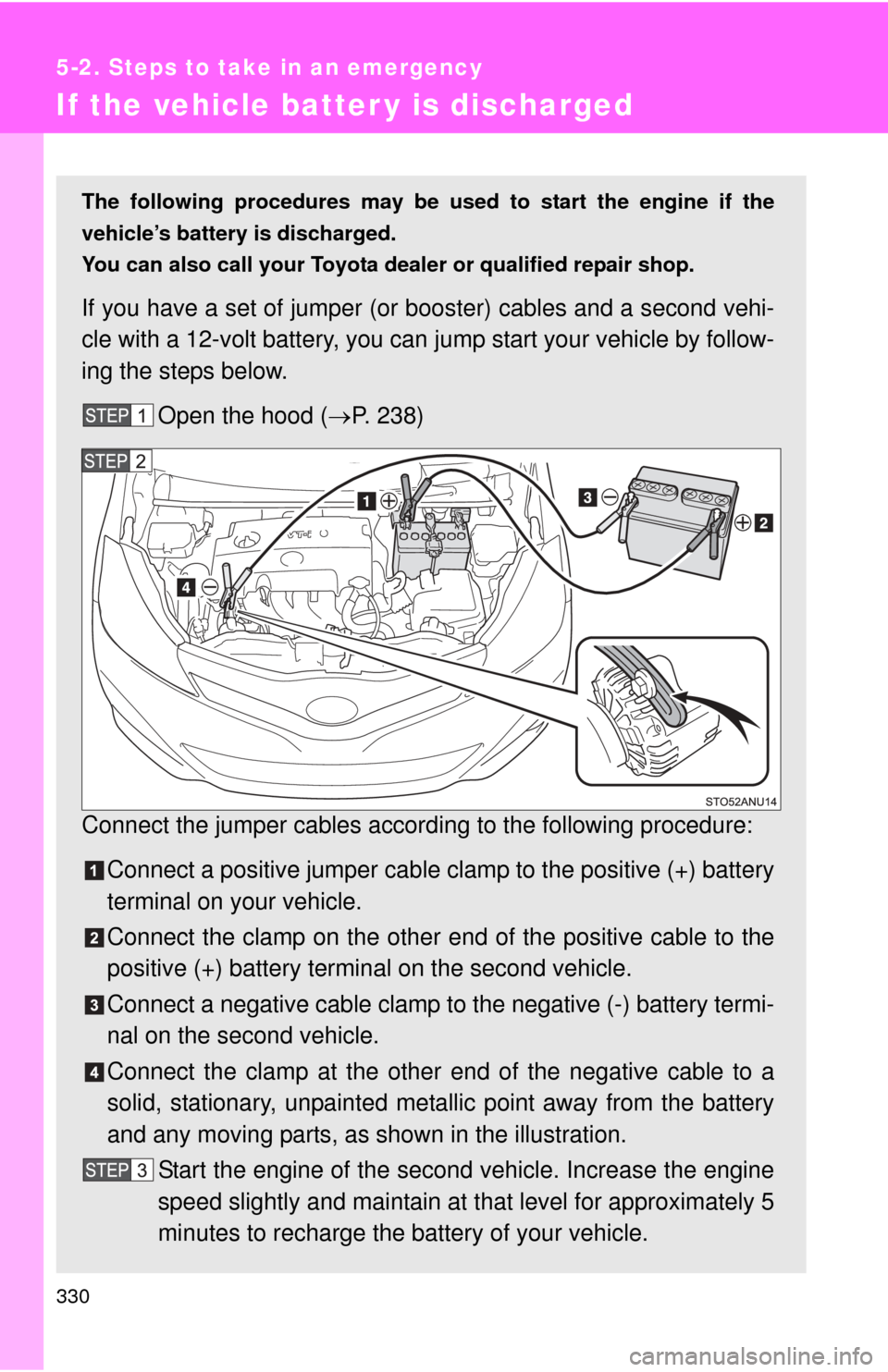
Open the hood ( P. 238)
Connect the jumper cables accord ing to the following procedure:
Connect a positive jumper cable clamp to the positive (+) battery
terminal on your vehicle.
Connect the clamp on the other e nd of the positive cable to the
positive (+) battery termin al on the second vehicle.
Connect a negative cable clamp to the negative (-) battery termi-
nal on the second vehicle.
Connect the clamp at the other end of the negative cable to a
solid, stationary, unpainted metallic point away from the battery
and any moving parts, as shown in the illustration.
Start the engine of the second vehicle. Increase the engine
speed slightly and maintain at that level for approximately 5
minutes to recharge the battery of your vehicle.
Page 331 of 400
5
When trouble arises
331
5-2. Steps to take in an emergency
■
Starting the engine when the battery is discharged (vehicles with an
automatic transmission)
The engine cannot be started by push-starting.
■ To prevent battery discharge
●Turn off the headlights and the air conditioning system while the engine is
off.
● Turn off any unnecessary electrical components when the vehicle is run-
ning at a low speed for an extended period, such as in heavy traffic.
■ When the battery is removed or di scharged (vehicles with an alarm
system)
Make sure that the key is not inside the vehicle when recharging or replacing
the battery. The key may be locked in the vehicle if the alarm is activated.
( P. 75)
■ Charging the battery
The electricity stored in the battery will discharge gradually even when the
vehicle is not in use, due to natural discharge and the draining effects of cer-
tain electrical appliances. If the vehicle is left for a long time, the battery may
discharge, and the engine may be unable to start. (The battery recharges
automatically during driving.)
Maintain the engine speed of the second vehicle and start
the engine of your vehicle by turning the engine switch to
the “ON” position.
Once the vehicle’s engine has started, remove the jumper
cables in the exact reverse or der from which they were con-
nected.
Once the engine starts, have the vehicle inspected at your Toyota
dealer as soon as possible.
Page 332 of 400
332 5-2. Steps to take in an emergency
CAUTION
■Avoiding battery fires or explosions
Observe the following precautions to prevent accidentally igniting the flam-
mable gas that may be emitted from the battery:
●Make sure each jumper cable is connected to the correct terminal and that
it is not unintentionally in contact with any other than the intended terminal.
● Do not allow the + and - clamps of the jumper cables to come into contact
with each other.
● Do not smoke, use matches, cigarette lighters or allow open flame near
the battery.
■ Battery precautions
The battery contains poisonous and corrosive acidic electrolyte, while
related parts contain lead and lead compounds. Observe the following pre-
cautions when handling the battery:
●When working with the battery, always wear safety glasses and take care
not to allow any battery fluids (acid) to come into contact with skin, clothing
or the vehicle body.
● Do not lean over the battery.
● In the event that battery fluid comes into contact with the skin or eyes,
immediately wash the affected area with water and seek medical attention.
Place a wet sponge or cloth over the affected area until medical attention
can be received.
● Always wash your hands after handling the battery support, terminals, and
other battery-related parts.
● Do not allow children near the battery.
■ To prevent damaging to the vehicle
Do not pull- or push-start the vehicle as the three-way catalytic converter
may overheat and become a fire hazard.
Page 334 of 400
334
5-2. Steps to take in an emergency
If your vehicle overheats
The following may indicate that your vehicle is overheating.
●The high engine coolant te mperature warning light (P. 306)
comes on or flashes, or a loss of engine power is experienced.
(For example, the vehicl e speed does not increase.)
● Steam comes out from under the hood.
Follow the correction pro cedure as described below.
Stop the vehicle in a safe place and turn off the air condi-
tioning system, and then stop the engine.
If you see steam:
Carefully lift the hood after the steam subsides.
If you do not see steam: Carefully lift the hood.
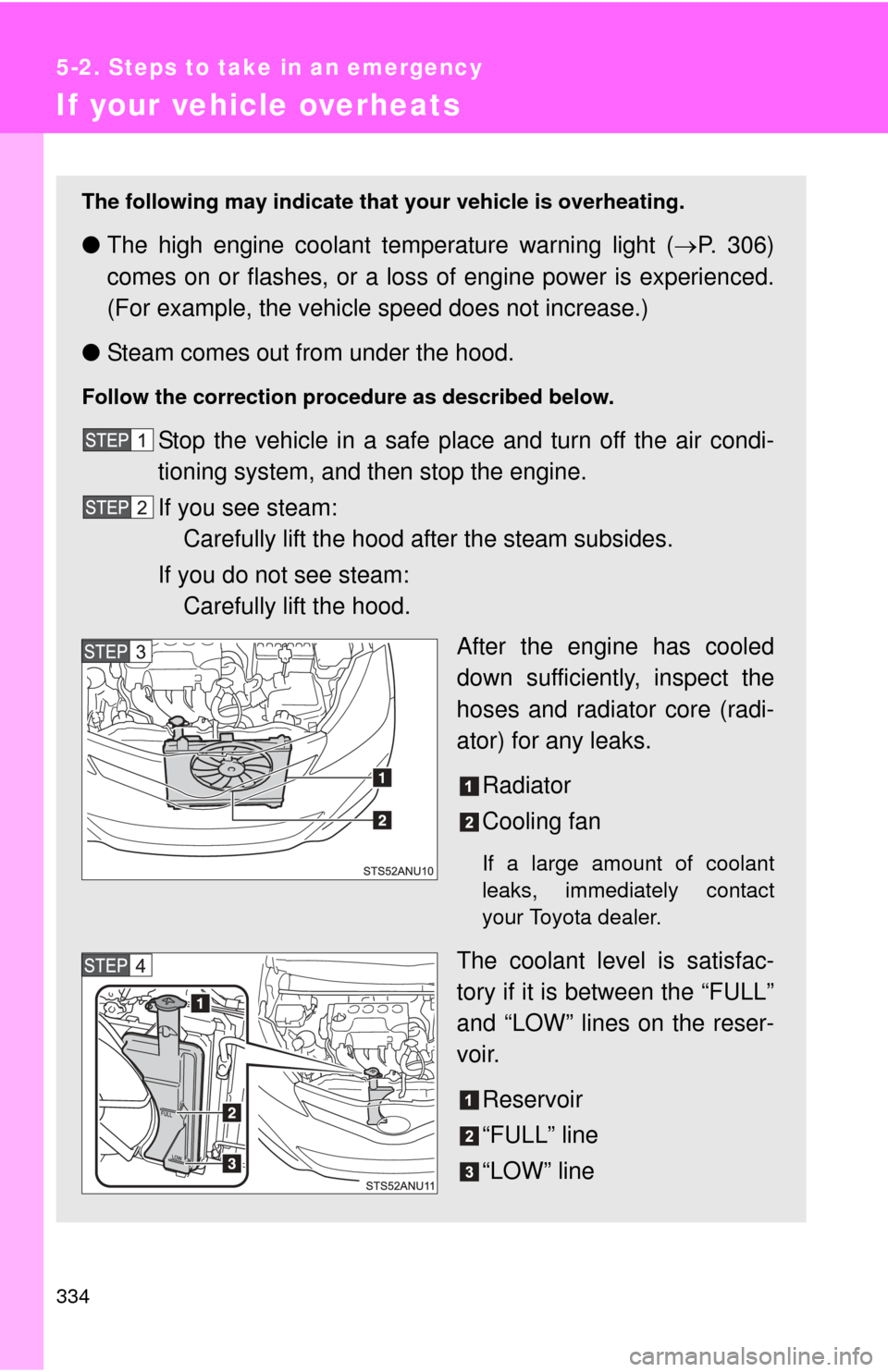
After the engine has cooled
down sufficiently, inspect the
hoses and radiator core (radi-
ator) for any leaks.
Radiator
Cooling fan
If a large amount of coolant
leaks, immediately contact
your Toyota dealer.
The coolant level is satisfac-
tory if it is between the “FULL”
and “LOW” lines on the reser-
voir.Reservoir
“FULL” line
“LOW” line
Page 352 of 400
352 6-1. Specifications
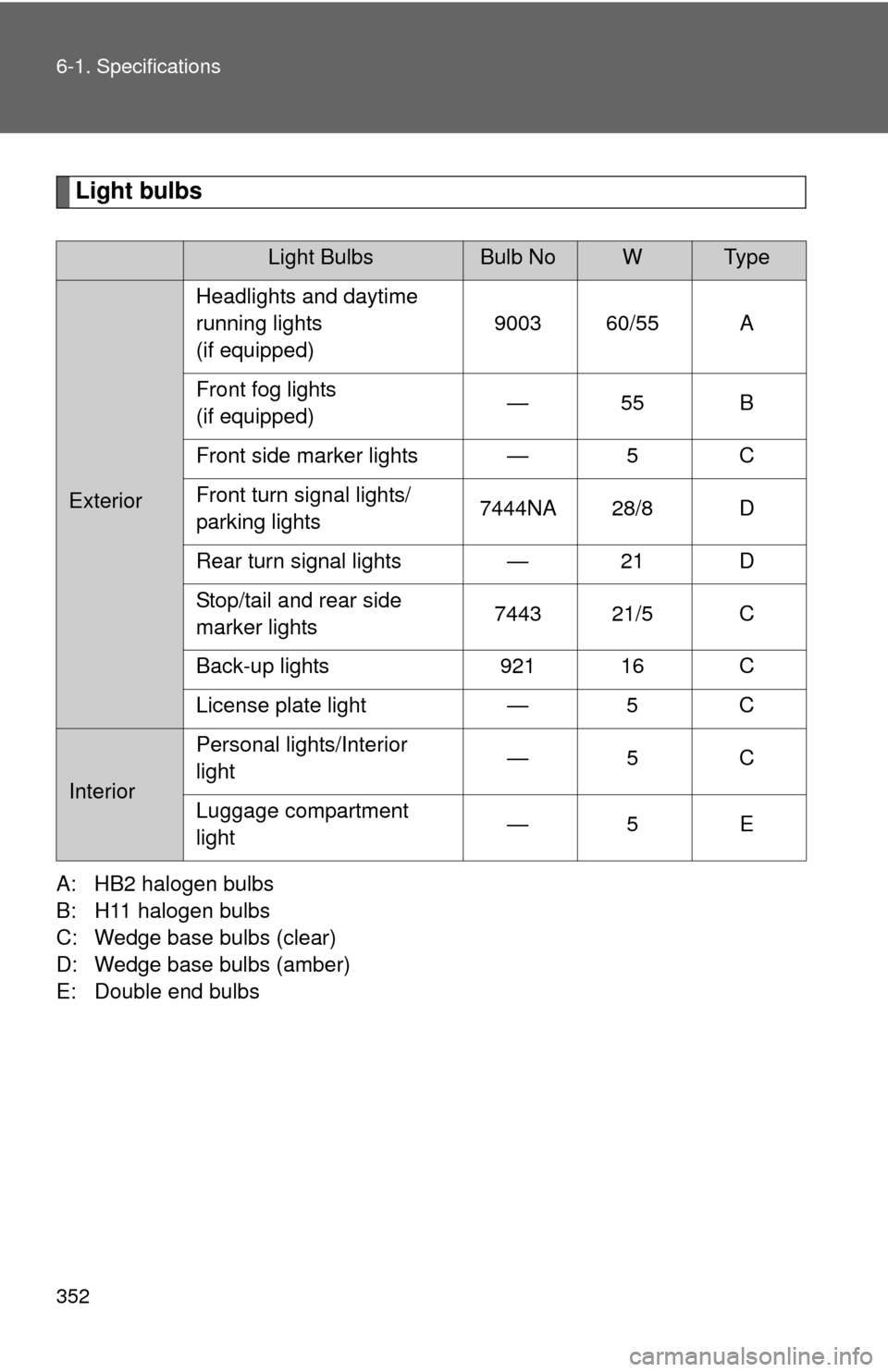
Light bulbs
A: HB2 halogen bulbs
B: H11 halogen bulbs
C: Wedge base bulbs (clear)
D: Wedge base bulbs (amber)
E: Double end bulbs
Light BulbsBulb NoWTy p e
ExteriorHeadlights and daytime
running lights
(if equipped)
9003 60/55 A
Front fog lights
(if equipped) —55 B
Front side marker lights — 5 C
Front turn signal lights/
parking lights 7444NA 28/8 D
Rear turn signal lights — 21 D
Stop/tail and rear side
marker lights 7443 21/5 C
Back-up lights 921 16 C
License plate light — 5 C
Interior Personal lights/Interior
light
—5 C
Luggage compartment
light —5 E
Page 355 of 400
355
6-1. Specifications
6
Vehicle specifications
■
If your engine knocks
●Consult your Toyota dealer.
● You may occasionally notice light knocking for a short time while acceler-
ating or driving uphill. This is normal and there is no need for concern.
NOTICE
■Notice on fuel quality
●Do not use improper fuels. If improper fuels are used, the engine will be
damaged.
● Do not use leaded gasoline.
Leaded gasoline can cause damage to your vehicle’s three-way catalytic
converters causing the emission control system to malfunction.
● Do not use gasohol other than the type previously stated.
Other gasohol may cause fuel system damage or vehicle performance
problems.
● Using unleaded gasoline with an octane number or rating lower than the
level previously stated will cause persistent heavy knocking.
At worst, this will lead to engine damage.
■ Fuel-related poor driveability
If poor driveability is encountered after using a different type of fuel (poor hot
starting, vaporization, engine knocking, etc.), discontinue the use of that type
of fuel.
■ When refueling with gasohol
Take care not to spill gasohol. It can damage your vehicle’s paint.