Battery TOYOTA YARIS 2013 3.G Owner's Manual
[x] Cancel search | Manufacturer: TOYOTA, Model Year: 2013, Model line: YARIS, Model: TOYOTA YARIS 2013 3.GPages: 400, PDF Size: 9 MB
Page 243 of 400
243
4-3. Do-it-yourself maintenance
4
Maintenance and care
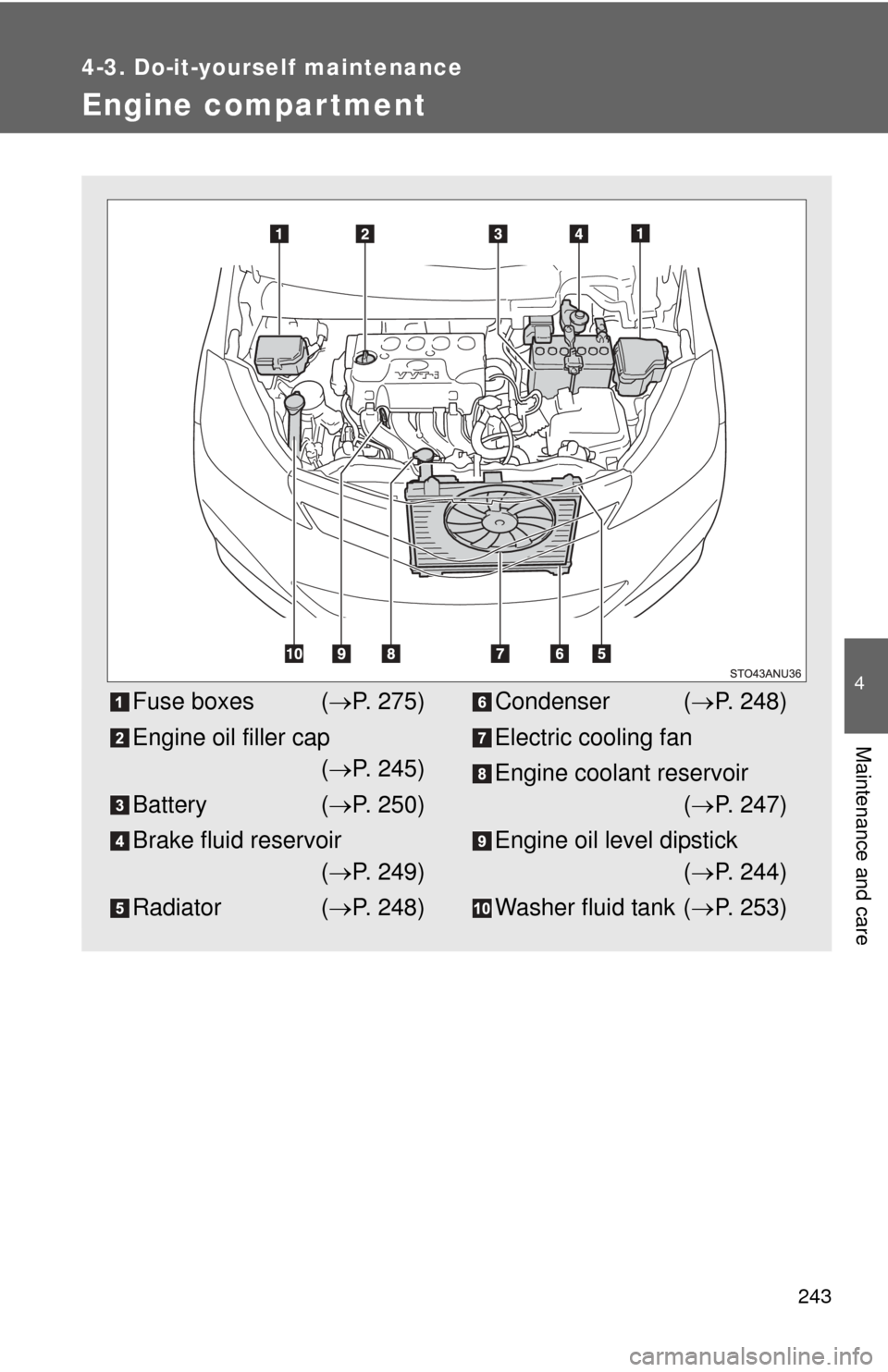
Engine compar tment
Fuse boxes (P. 275)
Engine oil filler cap ( P. 245)
Battery ( P. 250)
Brake fluid reservoir ( P. 249)
Radiator ( P. 248)Condenser ( P. 248)
Electric cooling fan
Engine coolant reservoir ( P. 247)
Engine oil level dipstick ( P. 244)
Washer fluid tank ( P. 253)
Page 250 of 400
250 4-3. Do-it-yourself maintenance
BatteryCheck the battery as follows:
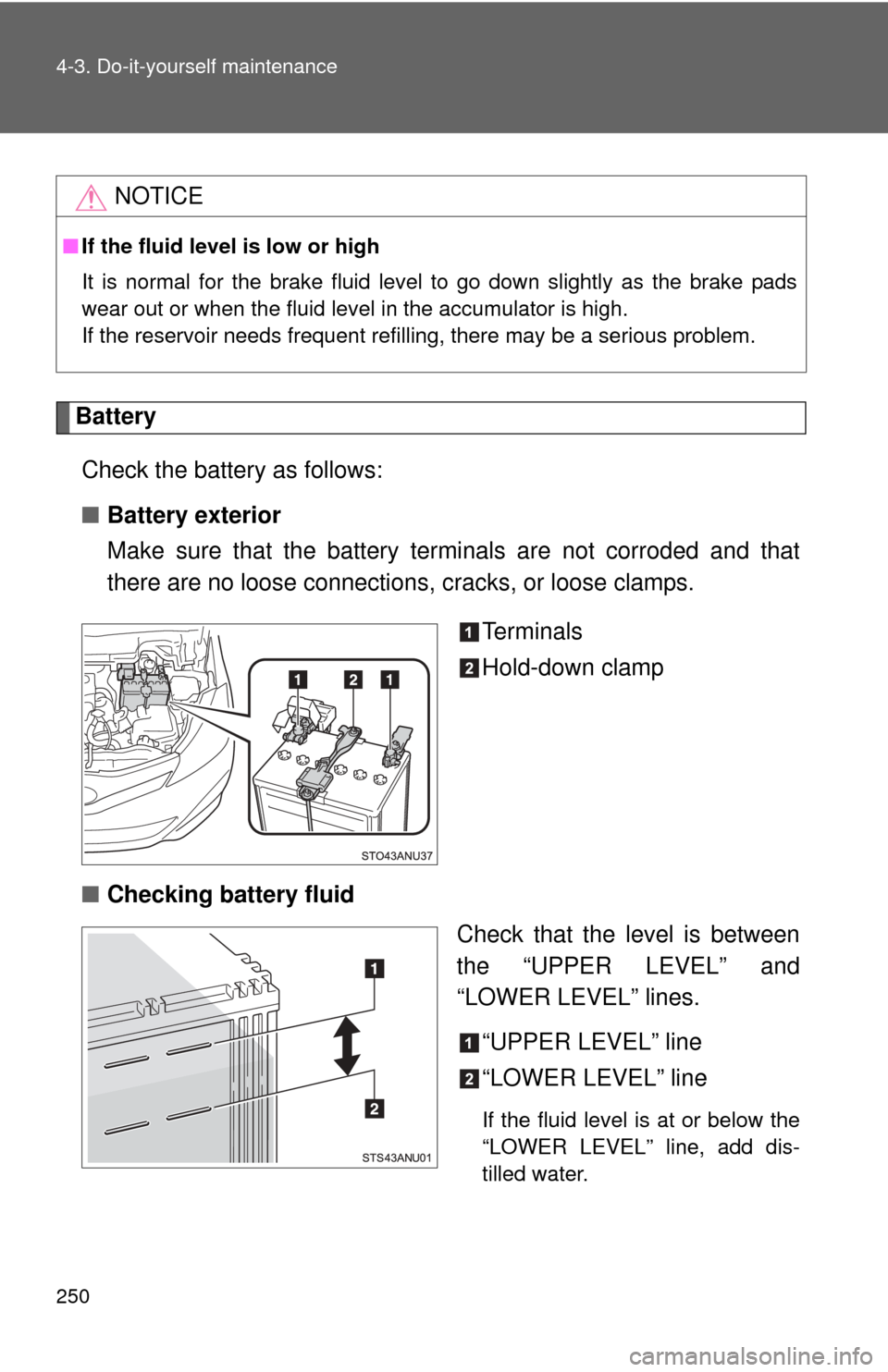
■ Battery exterior
Make sure that the battery terminals are not corroded and that
there are no loose connections, cracks, or loose clamps.
Te r m i n a l s
Hold-down clamp
■ Checking battery fluid
Check that the level is between
the “UPPER LEVEL” and
“LOWER LEVEL” lines.
“UPPER LEVEL” line
“LOWER LEVEL” line
If the fluid level is at or below the
“LOWER LEVEL” line, add dis-
tilled water.
NOTICE
■If the fluid level is low or high
It is normal for the brake fluid level to go down slightly as the brake pads
wear out or when the fluid level in the accumulator is high.
If the reservoir needs frequent refilling, there may be a serious proble\
m.
Page 251 of 400
251
4-3. Do-it-yourself maintenance
4
Maintenance and care
■
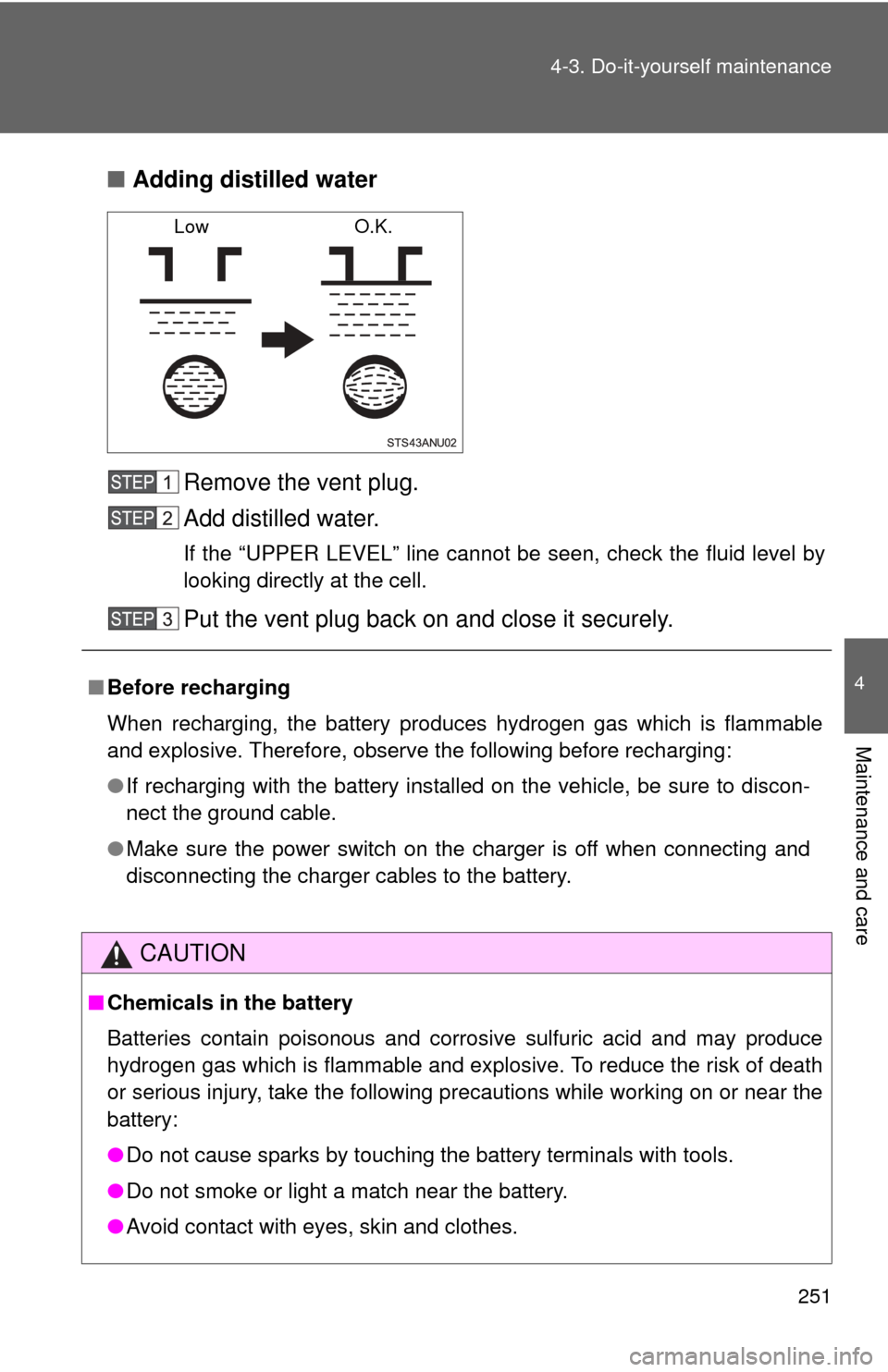
Adding distilled water
Remove the vent plug.
Add distilled water.
If the “UPPER LEVEL” line cannot be seen, check the fluid level by
looking directly at the cell.
Put the vent plug back on and close it securely.
LowO.K.
■Before recharging
When recharging, the battery produces hydrogen gas which is flammable
and explosive. Therefore, observe the following before recharging:
●If recharging with the battery installed on the vehicle, be sure to discon-
nect the ground cable.
● Make sure the power switch on the charger is off when connecting and
disconnecting the charger cables to the battery.
CAUTION
■Chemicals in the battery
Batteries contain poisonous and corrosive sulfuric acid and may produce
hydrogen gas which is flammable and explosive. To reduce the risk of death
or serious injury, take the following precautions while working on or near the
battery:
●Do not cause sparks by touching the battery terminals with tools.
● Do not smoke or light a match near the battery.
● Avoid contact with eyes, skin and clothes.
Page 252 of 400
252 4-3. Do-it-yourself maintenance
CAUTION
●Never inhale or swallow electrolyte.
● Wear protective safety glasses when working near the battery.
● Keep children away from the battery.
■ Where to safety charge the battery
Always charge the battery in an open area. Do not charge the battery in a
garage or closed room where there is insufficient ventilation.
■ Emergency measures regarding electrolyte
●If electrolyte gets in your eyes
Flush your eyes with clean water for at least 15 minutes and get immedi-
ate medical attention. If possible, continue to apply water with a sponge or
cloth while traveling to the nearest medical facility.
● If electrolyte gets on your skin
Wash the affected area thoroughly. If you feel pain or burning, get medical
attention immediately.
● If electrolyte gets on your clothes
It can soak through clothing on to your skin. Immediately take off the cloth-
ing and follow the procedure above if necessary.
● If you accidentally swallow electrolyte
Drink a large quantity of water or milk. Get emergency medical attention
immediately.
NOTICE
■When recharging the battery
Never recharge the battery while the engine is running. Also, be sure all
accessories are turned off.
■ When adding distilled water
Avoid overfilling. Water spilled during battery recharging may cause corro-
sion.
Page 271 of 400
271
4-3. Do-it-yourself maintenance
4
Maintenance and care
Wireless remote control batter y
: If equipped
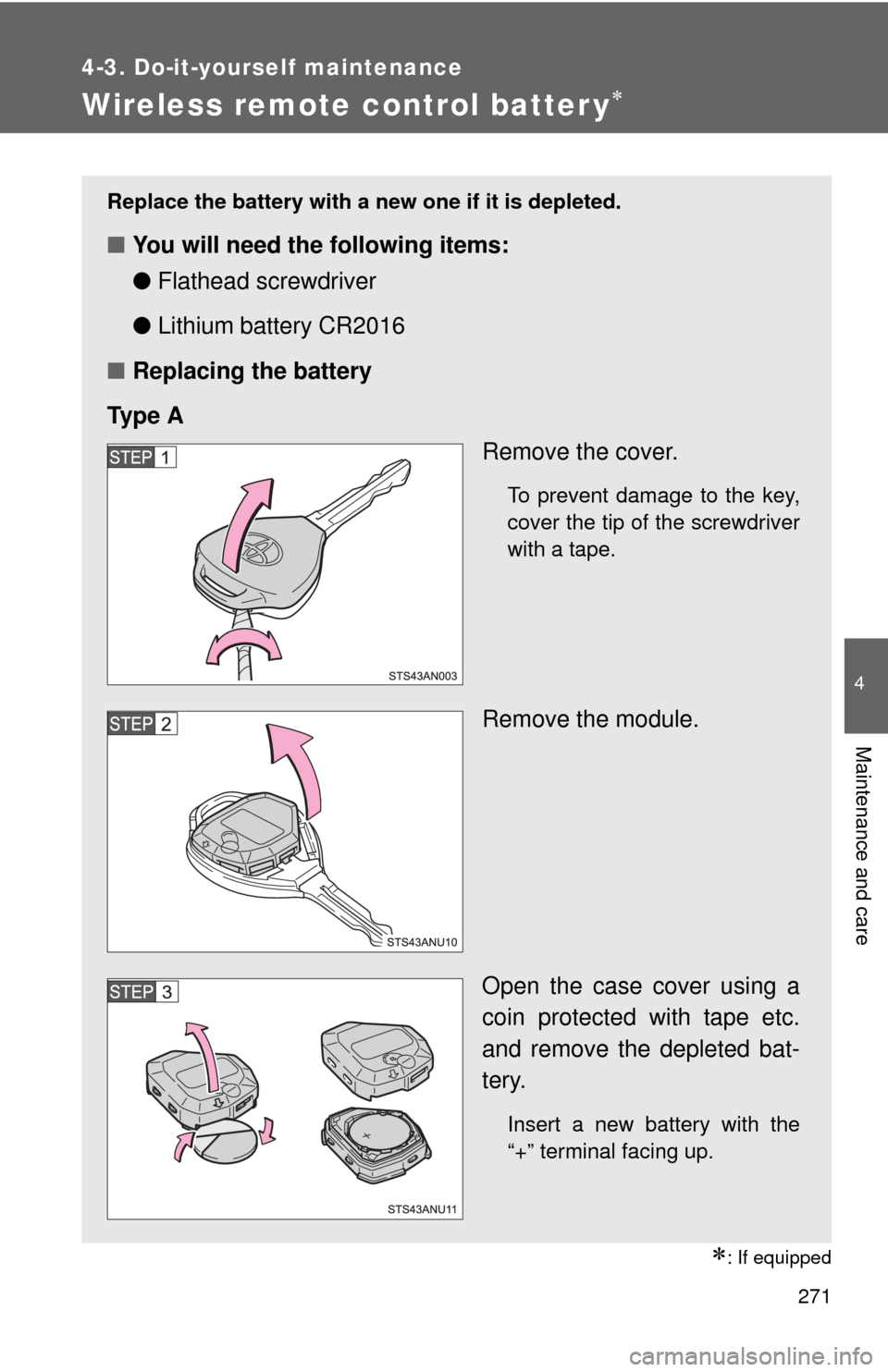
Replace the battery with a new one if it is depleted.
■You will need the following items:
●Flathead screwdriver
● Lithium battery CR2016
■ Replacing the battery
Ty p e A Remove the cover.
To prevent damage to the key,
cover the tip of the screwdriver
with a tape.
Remove the module.
Open the case cover using a
coin protected with tape etc.
and remove the depleted bat-
tery.
Insert a new battery with the
“+” terminal facing up.
Page 272 of 400
272 4-3. Do-it-yourself maintenance
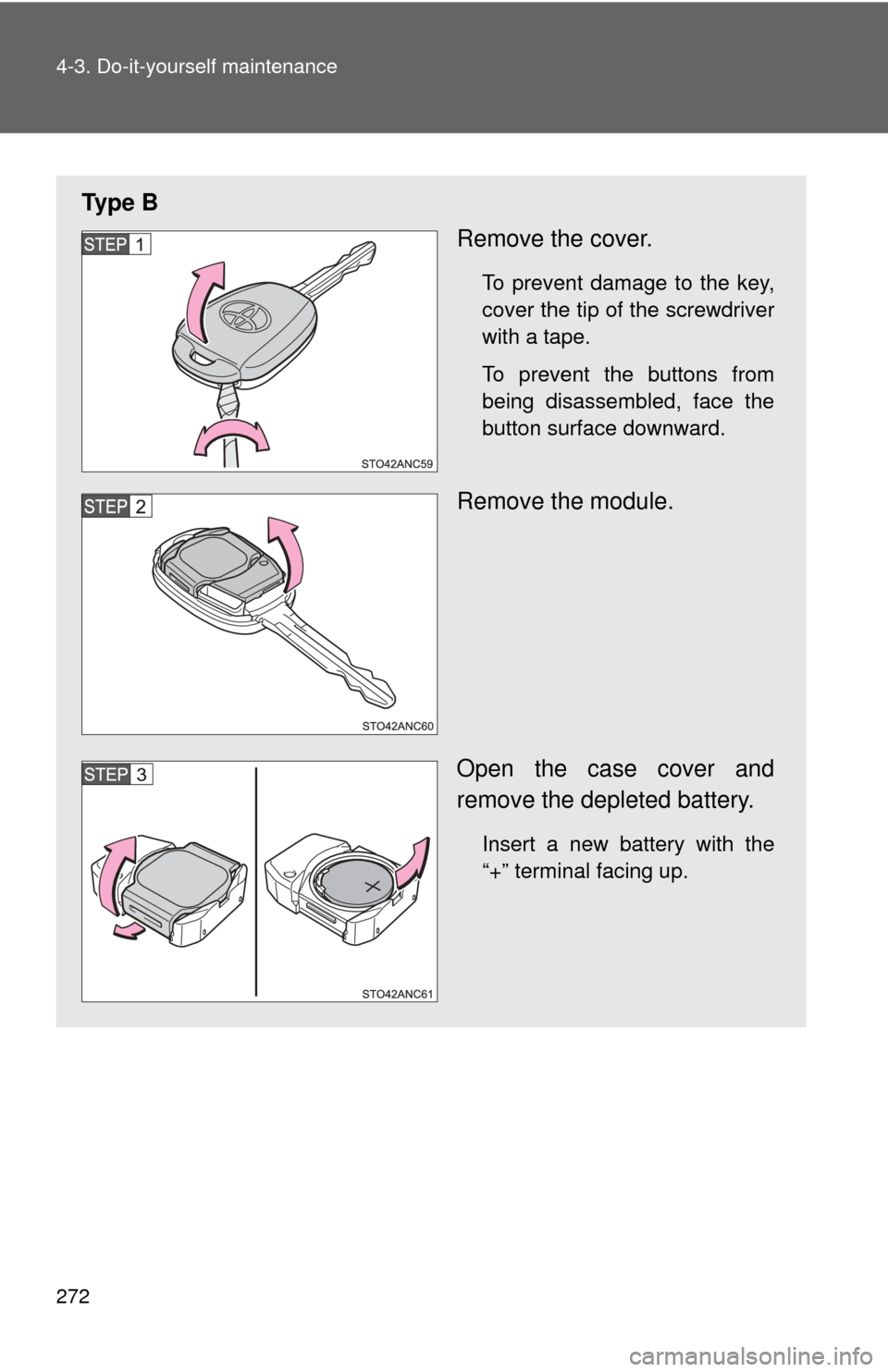
Ty p e BRemove the cover.
To prevent damage to the key,
cover the tip of the screwdriver
with a tape.
To prevent the buttons from
being disassembled, face the
button surface downward.
Remove the module.
Open the case cover and
remove the depleted battery.
Insert a new battery with the
“+” terminal facing up.
Page 273 of 400
273
4-3. Do-it-yourself maintenance
4
Maintenance and care
■
Use a CR2016 lithium battery
●Batteries can be purchased at your Toyota dealer, local electrical appli-
ance shops or camera stores.
● Replace only with the same or equivalent type recommended by the
manufacturer.
● Dispose of used batteries according to local laws.
■ If the key battery is depleted
The following symptoms may occur:
●The wireless remote control will not function properly.
● The operational range will be reduced.
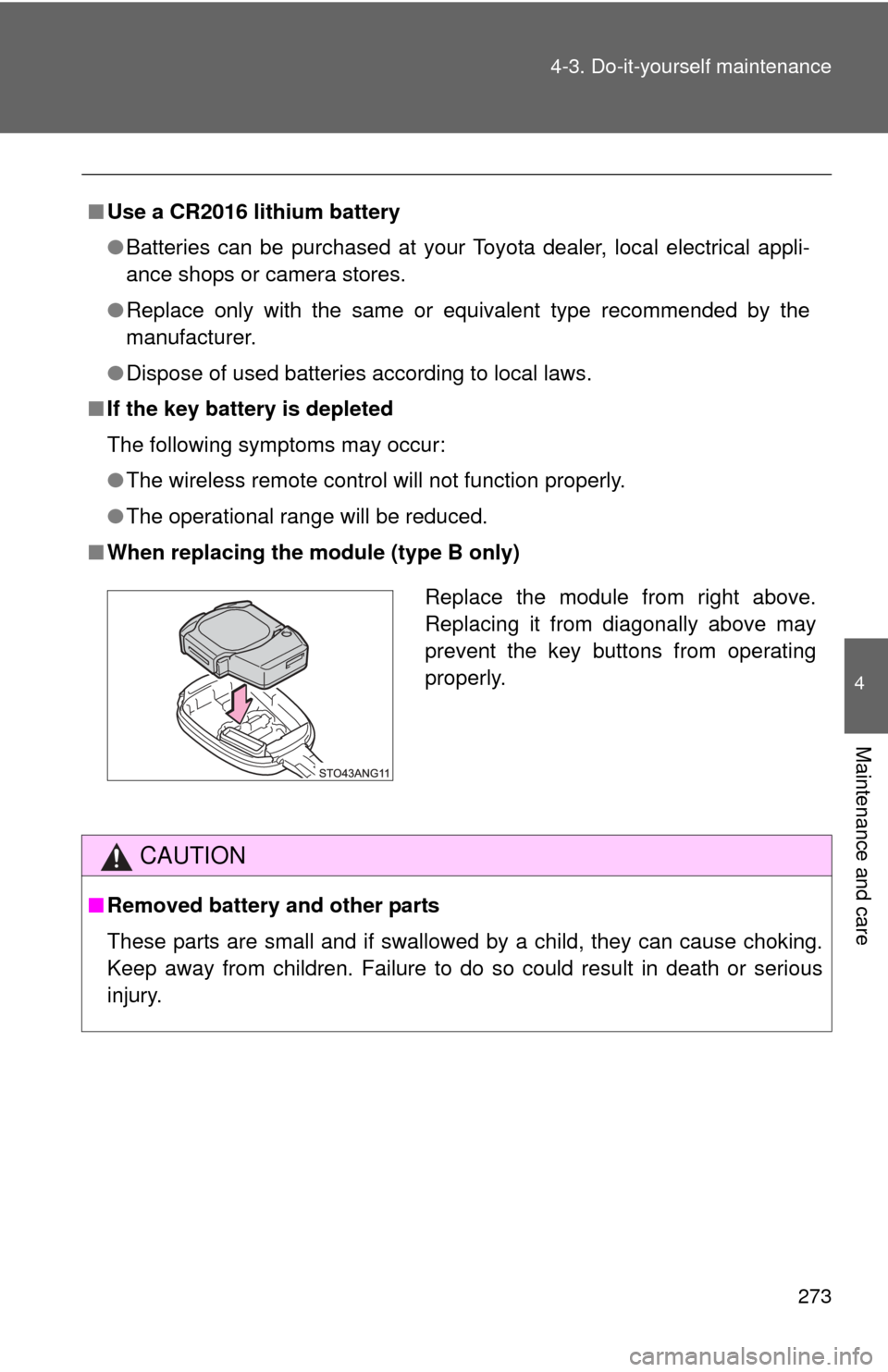
■ When replacing the module (type B only)
CAUTION
■Removed battery and other parts
These parts are small and if swallowed by a child, they can cause choking.
Keep away from children. Failure to do so could result in death or serious
injury.
Replace the module from right above.
Replacing it from diagonally above may
prevent the key buttons from operating
properly.
Page 274 of 400
274 4-3. Do-it-yourself maintenance
NOTICE
■For normal operation after replacing the battery
Observe the following precautions to prevent accidents:
●Always work with dry hands.
Moisture may cause the battery to rust.
● Do not touch or move any other components inside the remote control.
● Do not bend either of the battery terminals.
Page 276 of 400
276 4-3. Do-it-yourself maintenance
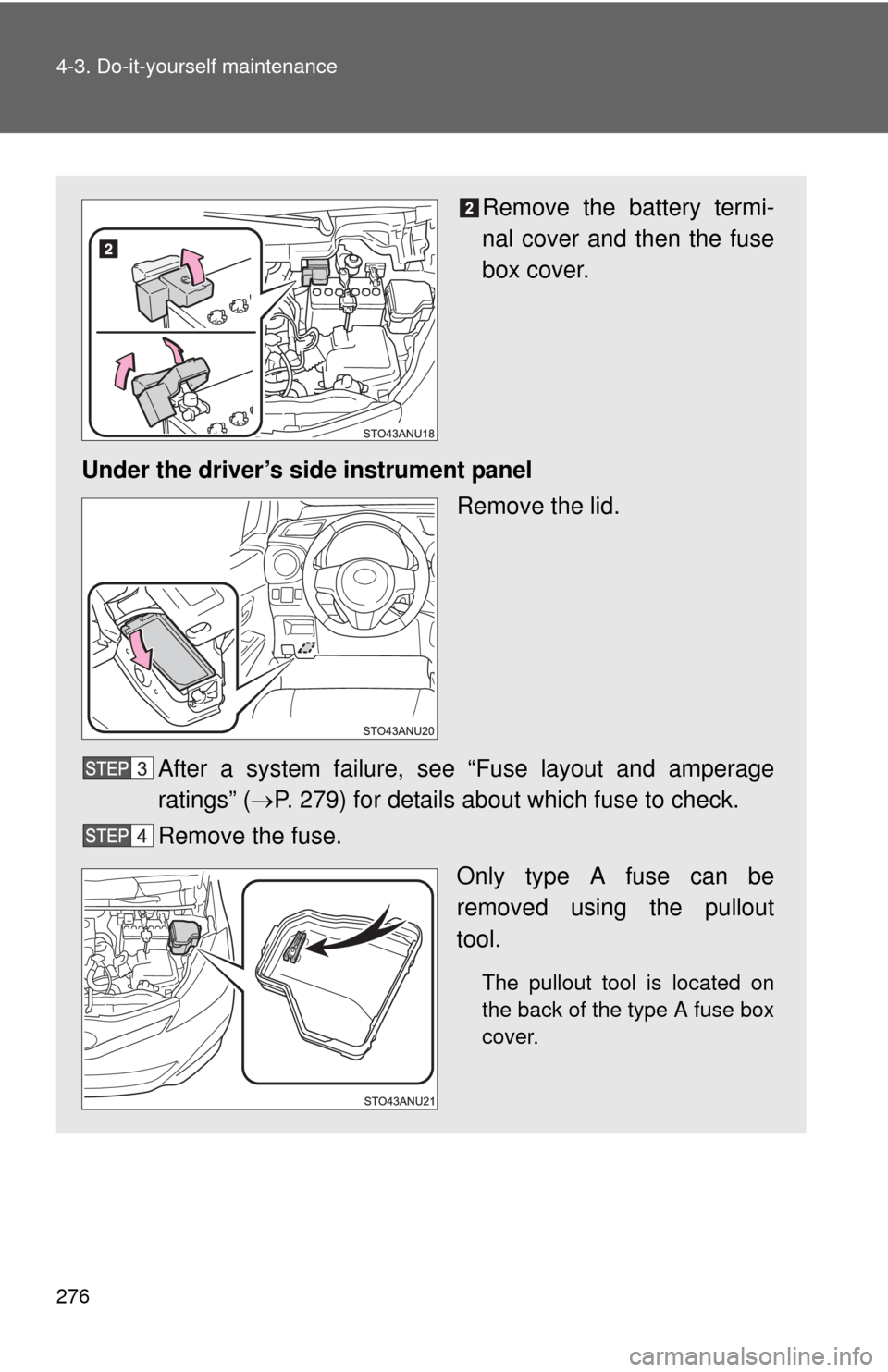
Remove the battery termi-
nal cover and then the fuse
box cover.
Under the driver’s side instrument panel Remove the lid.
After a system failure, s ee “Fuse layout and amperage
ratings” ( P. 279) for details about which fuse to check.
Remove the fuse.
Only type A fuse can be
removed using the pullout
tool.
The pullout tool is located on
the back of the type A fuse box
cover.
Page 295 of 400
When trouble arises5
295
5-1. Essential informationEmergency flashers ......... 296
If your vehicle needs to be towed ........................ 297
If you think something is wrong ............................. 303
Fuel pump shut off system ........................... 304 5-2. Steps to take in
an emergency
If a warning light turns on or a warning buzzer
sounds..
......................... 305
If you have a flat tire......... 315
If the engine will not start ................................ 327
If the shift lever cannot be shifted from P (vehicles
with an automatic
transmission) ................. 328
If you lose your keys ........ 329
If the vehicle battery is discharged ..................... 330
If your vehicle overheats ....................... 334
If the vehicle becomes stuck .............................. 337
If your vehicle has to be stopped in
an emergency ................ 339