brake TOYOTA YARIS 2013 Owners Manual
[x] Cancel search | Manufacturer: TOYOTA, Model Year: 2013, Model line: YARIS, Model: TOYOTA YARIS 2013Pages: 712, PDF Size: 30.2 MB
Page 627 of 712
5
627 5-2. Steps to take in an emergency
When trouble arises
YARIS_F (including HV)_WE_52E26E
Starting the hybrid system (hybrid vehicle)
Ensure that the shift lever is in P and firmly depress the brake
pedal.
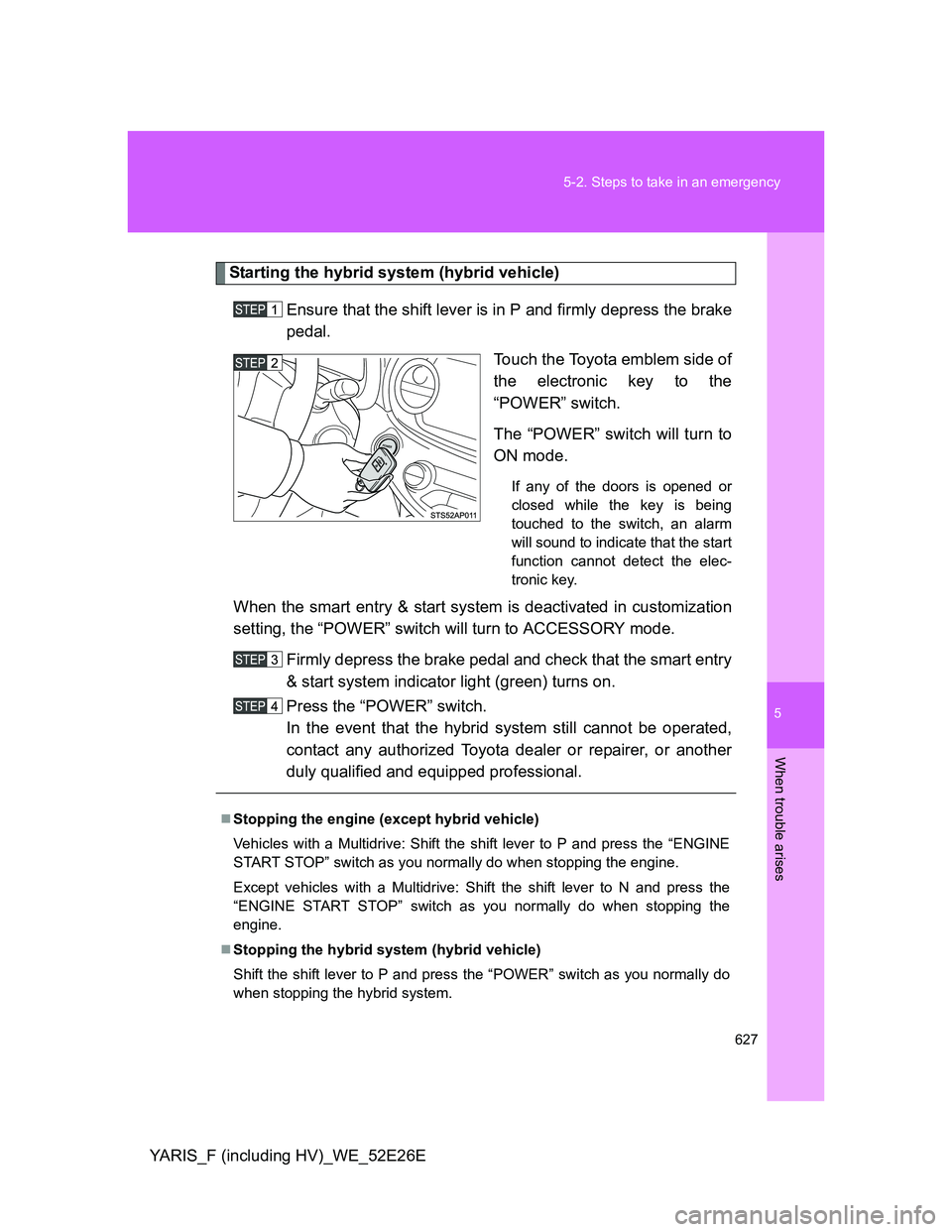
Touch the Toyota emblem side of
the electronic key to the
“POWER” switch.
The “POWER” switch will turn to
ON mode.
If any of the doors is opened or
closed while the key is being
touched to the switch, an alarm
will sound to indicate that the start
function cannot detect the elec-
tronic key.
When the smart entry & start system is deactivated in customization
setting, the “POWER” switch will turn to ACCESSORY mode.
Firmly depress the brake pedal and check that the smart entry
& start system indicator light (green) turns on.
Press the “POWER” switch.
In the event that the hybrid system still cannot be operated,
contact any authorized Toyota dealer or repairer, or another
duly qualified and equipped professional.
Stopping the engine (except hybrid vehicle)
Vehicles with a Multidrive: Shift the shift lever to P and press the “ENGINE
START STOP” switch as you normally do when stopping the engine.
Except vehicles with a Multidrive: Shift the shift lever to N and press the
“ENGINE START STOP” switch as you normally do when stopping the
engine.
Stopping the hybrid system (hybrid vehicle)
Shift the shift lever to P and press the “POWER” switch as you normally do
when stopping the hybrid system.
Page 628 of 712
628 5-2. Steps to take in an emergency
YARIS_F (including HV)_WE_52E26E
Replacing the key battery
As the above procedure is a temporary measure, it is recommended that the
electronic key battery be replaced immediately when the battery is depleted.
(P. 501)
Changing “ENGINE START STOP” switch modes (except hybrid vehi-
cle)
Vehicles with a Multidrive or multi-mode manual transmission: Release
the brake pedal and press the “ENGINE START STOP” switch in
above. (P. 625, 626)
The engine does not start and modes will be changed each time the
switch is pressed. (P. 230)
Vehicles with a manual transmission: Release the clutch pedal and press
the “ENGINE START STOP” switch in
above. (P. 626)
The engine does not start and modes will be changed each time the
switch is pressed. (P. 230)
Changing “POWER” switch modes (hybrid vehicle)
Release the brake pedal and press the “POWER” switch in above.
(P. 627)
The hybrid system does not start and modes will be changed each time the
switch is pressed. (P. 243)
If the doors cannot be locked or unlocked by the smart entry & start
system
Lock and unlock the doors by the mechanical key or wireless remote control.
When the electronic key does not work properly
Make sure that the smart entry & start system has not been deactivated in
the customization setting. If it is off, turn the function on.
(Customizable features P. 689)
Page 654 of 712
654
5-2. Steps to take in an emergency
YARIS_F (including HV)_WE_52E26E
If the vehicle becomes stuck
Carry out the following procedures if the tires spin or the vehicle
becomes stuck in mud, dirt or snow:
Vehicles with a hybrid transmission or a Multidrive: Stop the
engine (except hybrid vehicle) or hybrid system (hybrid
vehicle). Set the parking brake and shift the shift lever to P.
Vehicles with a multi-mode manual transmission or a man-
ual transmission: Stop the engine. Set the parking brake
and shift the shift lever to N.
Remove the mud, snow or sand from around the front
wheels.
Place wood, stones or some other material under the front
wheels to help provide traction.
Restart the engine (except hybrid vehicle) or hybrid system
(hybrid vehicle).
Vehicles with a hybrid transmission or a Multidrive: Shift the
shift lever to the D or R and carefully apply the accelerator
to free the vehicle.
Vehicles with a multi-mode manual transmission: Shift the
shift lever to E, M or R and carefully apply the accelerator to
free the vehicle.
Vehicles with a manual transmission: Shift the shift lever to
1 or R and carefully apply the accelerator to free the vehi-
cle.
Page 657 of 712
5
657
5-2. Steps to take in an emergency
When trouble arises
YARIS_F (including HV)_WE_52E26E
If your vehicle has to be stopped in an emergency
Only in an emergency, such as if it becomes impossible to stop the
vehicle in the normal way, stop the vehicle using the following pro-
cedure:
Steadily step on the brake pedal with both feet and firmly
depress it.
Do not pump the brake pedal repeatedly as this will increase the
effort required to slow the vehicle.
Shift the shift lever to N.
If the shift lever is shifted to N
After slowing down, stop the vehicle in a safe place by the
road.
Stop the engine (except hybrid vehicle) or hybrid system
(hybrid vehicle).
If the shift lever cannot be shifted to N
Keep depressing the brake pedal with both feet to reduce
vehicle speed as much as possible.
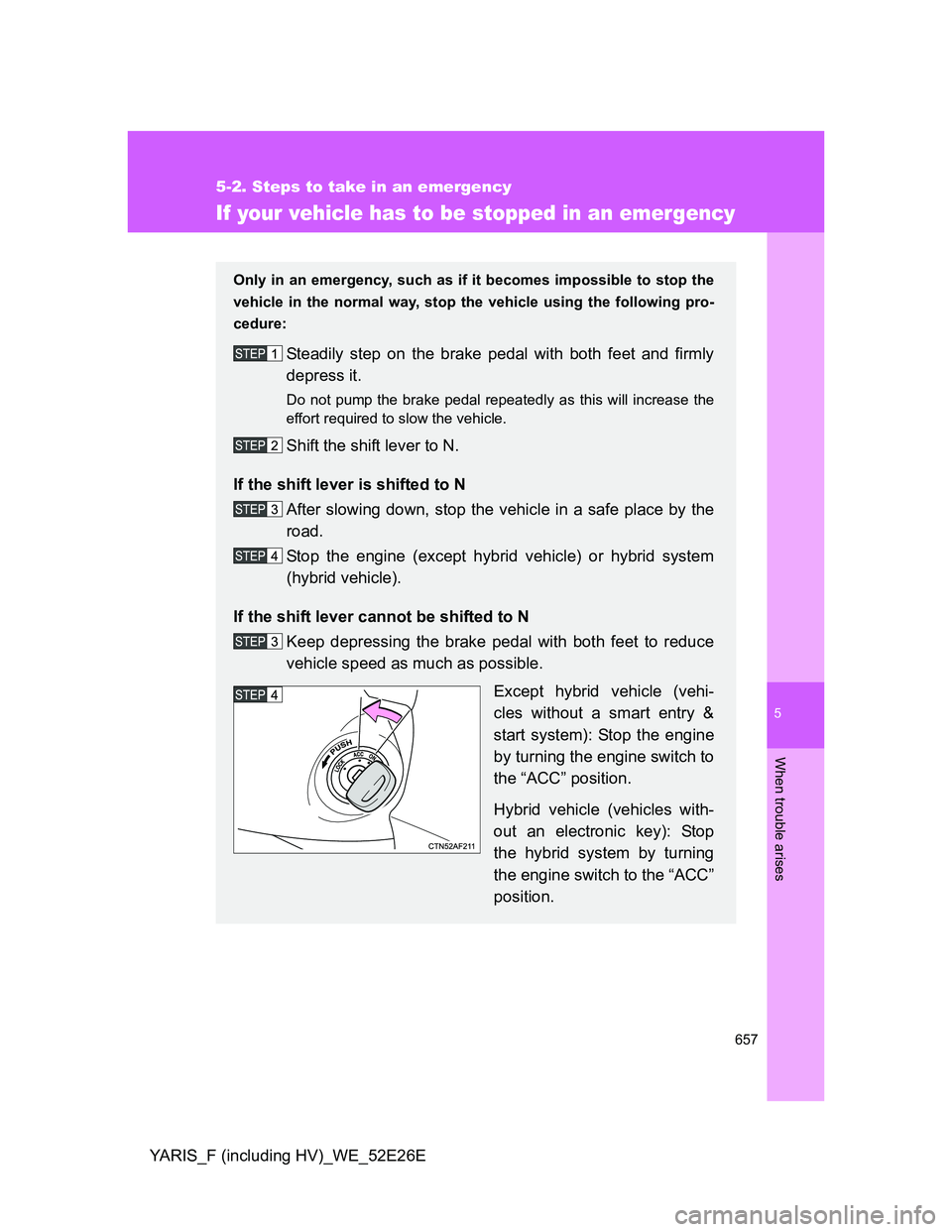
Except hybrid vehicle (vehi-
cles without a smart entry &
start system): Stop the engine
by turning the engine switch to
the “ACC” position.
Hybrid vehicle (vehicles with-
out an electronic key): Stop
the hybrid system by turning
the engine switch to the “ACC”
position.
Page 658 of 712
658 5-2. Steps to take in an emergency
YARIS_F (including HV)_WE_52E26E
CAUTION
If the engine has to be turned off while driving (except hybrid vehicle)
Power assist for the brakes and steering wheel will be lost, making the
brake pedal harder to depress and the steering wheel heavier to turn.
Decelerate as much as possible before turning off the engine.
Vehicles without a smart entry & start system: Never attempt to remove
the key, as doing so will lock the steering wheel.
If the hybrid system has to be turned off while driving (hybrid vehicle)
Power assist for the brakes and steering wheel will be lost, making the
brake pedal harder to depress and the steering wheel heavier to turn.
Decelerate as much as possible before turning off the hybrid system.
Vehicles without an electronic key: Never attempt to remove the key, as
doing so will lock the steering wheel.
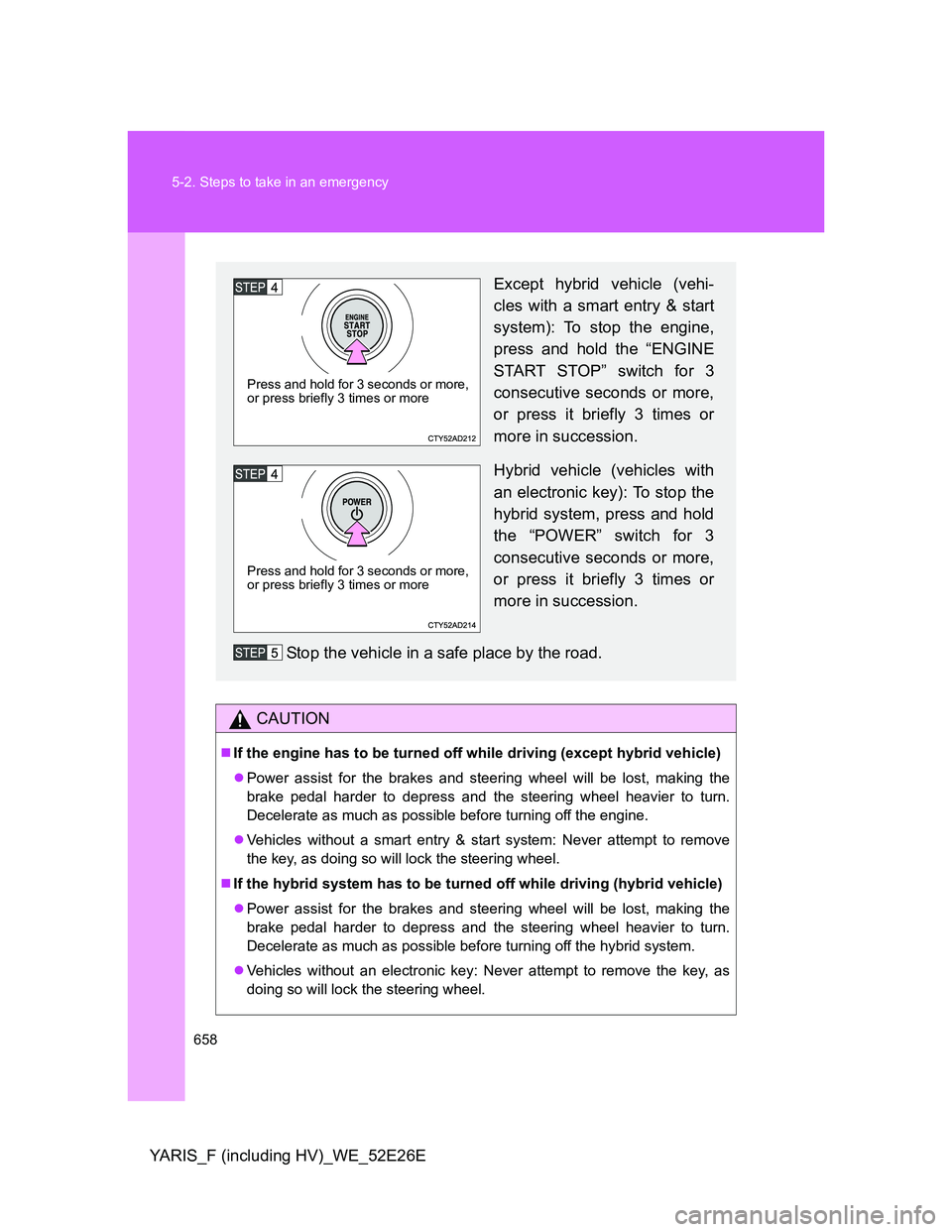
Except hybrid vehicle (vehi-
cles with a smart entry & start
system): To stop the engine,
press and hold the “ENGINE
START STOP” switch for 3
consecutive seconds or more,
or press it briefly 3 times or
more in succession.
Hybrid vehicle (vehicles with
an electronic key): To stop the
hybrid system, press and hold
the “POWER” switch for 3
consecutive seconds or more,
or press it briefly 3 times or
more in succession.
Stop the vehicle in a safe place by the road.
Press and hold for 3 seconds or more,
or press briefly 3 times or more
Press and hold for 3 seconds or more,
or press briefly 3 times or more
Page 661 of 712
661 6-1. Specifications
6
Vehicle specifications
YARIS_F(including HV)_WE_52E26E
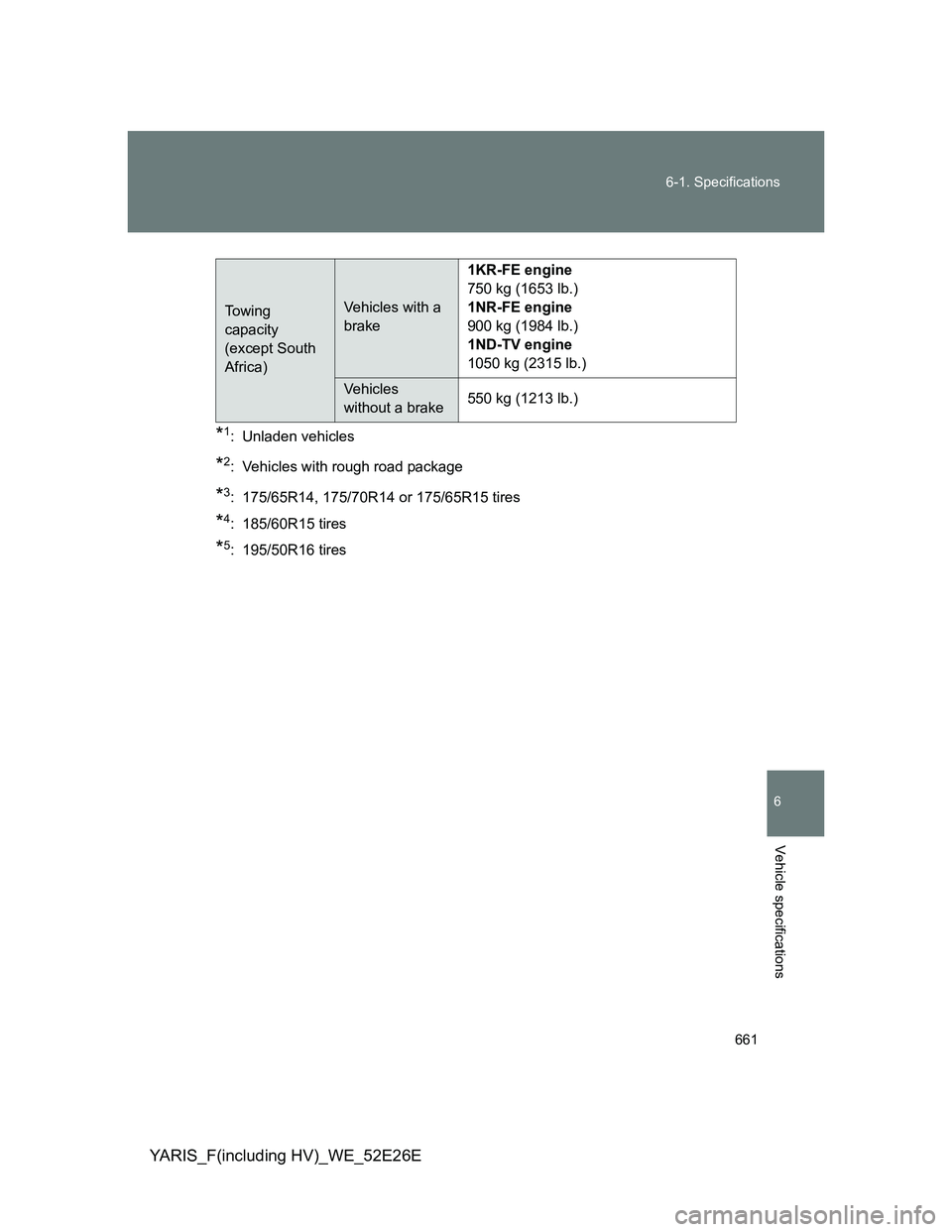
*1: Unladen vehicles
*2: Vehicles with rough road package
*3: 175/65R14, 175/70R14 or 175/65R15 tires
*4: 185/60R15 tires
*5: 195/50R16 tires
To w i n g
capacity
(except South
Africa)Vehicles with a
brake1KR-FE engine
750 kg (1653 lb.)
1NR-FE engine
900 kg (1984 lb.)
1ND-TV engine
1050 kg (2315 lb.)
Vehicles
without a brake550 kg (1213 lb.)
Page 678 of 712
678 6-1. Specifications
YARIS_F(including HV)_WE_52E26E
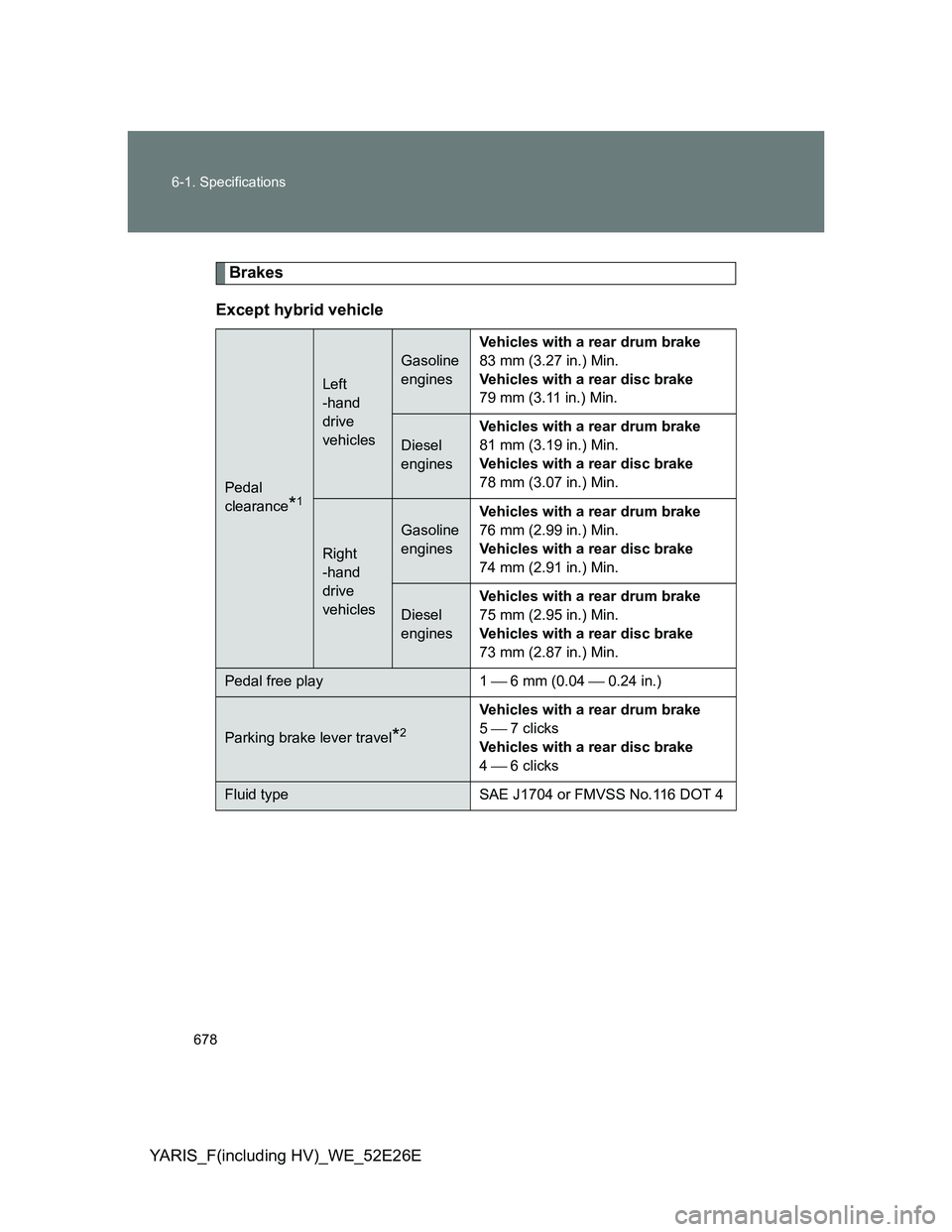
Brakes
Except hybrid vehicle
Pedal
clearance
*1
Left
-hand
drive
vehicles
Gasoline
enginesVehicles with a rear drum brake
83 mm (3.27 in.) Min.
Vehicles with a rear disc brake
79 mm (3.11 in.) Min.
Diesel
enginesVehicles with a rear drum brake
81 mm (3.19 in.) Min.
Vehicles with a rear disc brake
78 mm (3.07 in.) Min.
Right
-hand
drive
vehicles
Gasoline
enginesVehicles with a rear drum brake
76 mm (2.99 in.) Min.
Vehicles with a rear disc brake
74 mm (2.91 in.) Min.
Diesel
enginesVehicles with a rear drum brake
75 mm (2.95 in.) Min.
Vehicles with a rear disc brake
73 mm (2.87 in.) Min.
Pedal free play 1 6 mm (0.04 0.24 in.)
Parking brake lever travel*2
Vehicles with a rear drum brake
5 7 clicks
Vehicles with a rear disc brake
4 6 clicks
Fluid type SAE J1704 or FMVSS No.116 DOT 4
Page 679 of 712
679 6-1. Specifications
6
Vehicle specifications
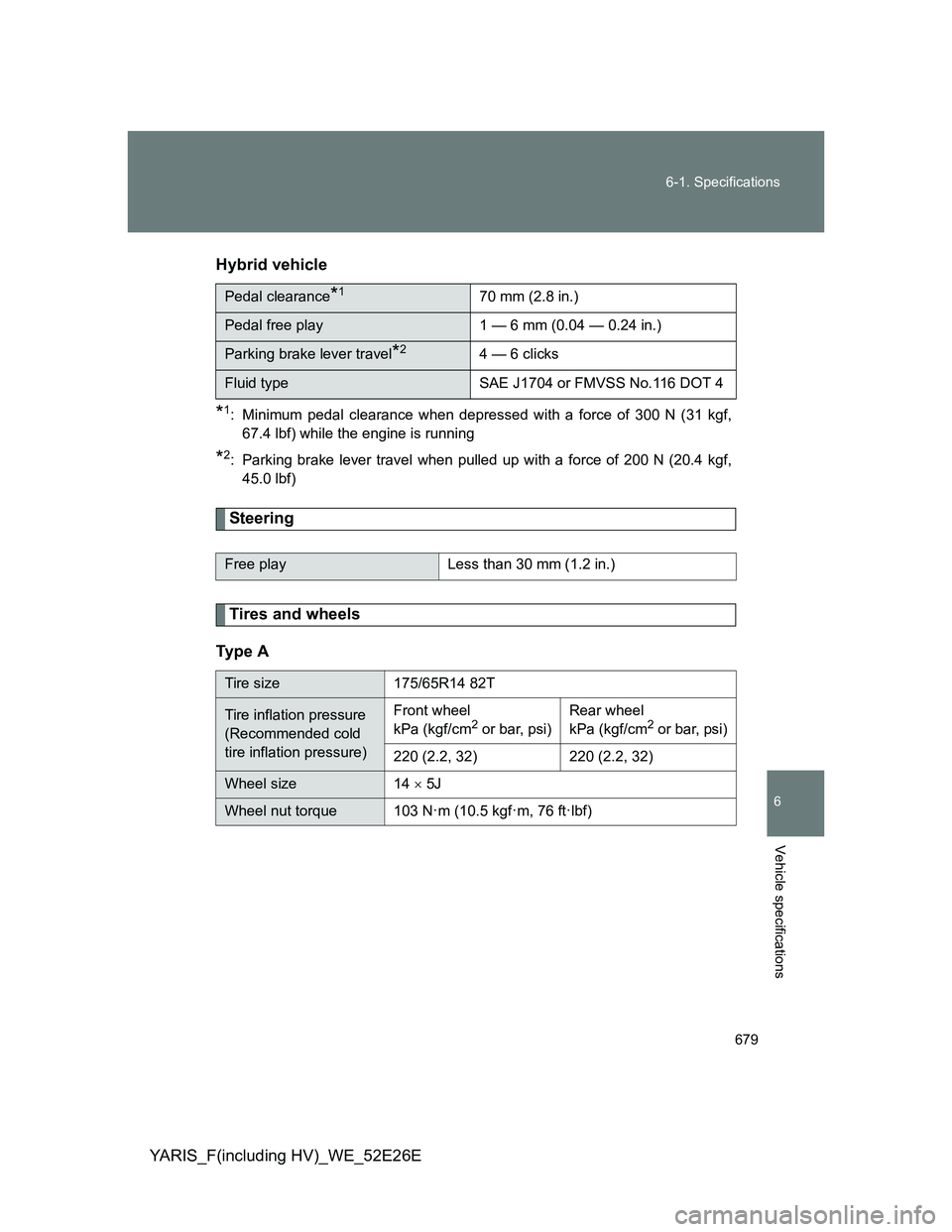
YARIS_F(including HV)_WE_52E26EHybrid vehicle
*1: Minimum pedal clearance when depressed with a force of 300 N (31 kgf,
67.4 lbf) while the engine is running
*2: Parking brake lever travel when pulled up with a force of 200 N (20.4 kgf,
45.0 lbf)
Steering
Tires and wheels
Ty p e A
Pedal clearance*170 mm (2.8 in.)
Pedal free play 1 — 6 mm (0.04 — 0.24 in.)
Parking brake lever travel*24 — 6 clicks
Fluid type SAE J1704 or FMVSS No.116 DOT 4
Free play Less than 30 mm (1.2 in.)
Tire size 175/65R14 82T
Tire inflation pressure
(Recommended cold
tire inflation pressure)Front wheel
kPa (kgf/cm2 or bar, psi)Rear wheel
kPa (kgf/cm2 or bar, psi)
220 (2.2, 32) 220 (2.2, 32)
Wheel size 14 5J
Wheel nut torque 103 N·m (10.5 kgf·m, 76 ft·lbf)
Page 694 of 712
694
YARIS_F(including HV)_WE_52E26E
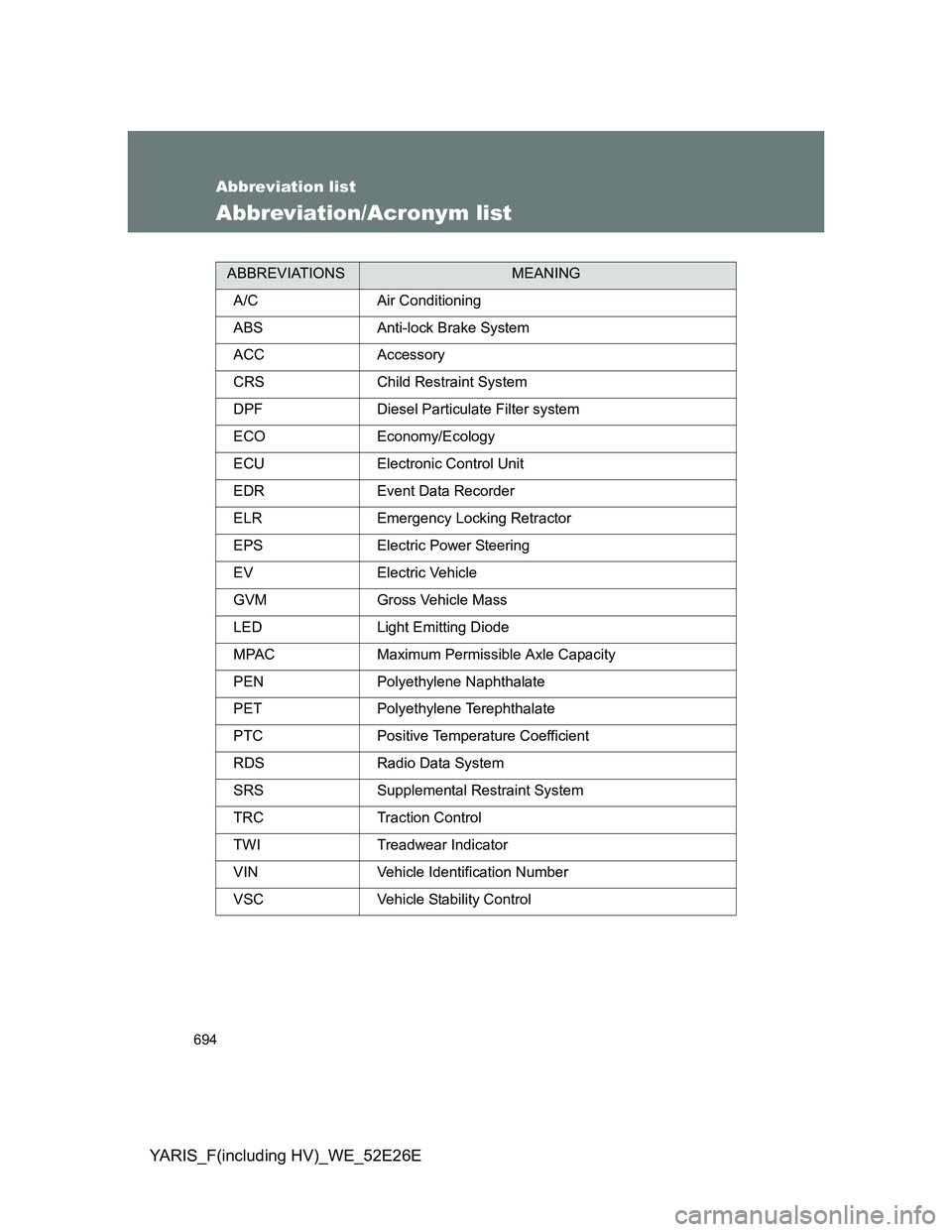
Abbreviation list
Abbreviation/Acronym list
ABBREVIATIONSMEANING
A/C Air Conditioning
ABS Anti-lock Brake System
ACC Accessory
CRS Child Restraint System
DPF Diesel Particulate Filter system
ECO Economy/Ecology
ECU Electronic Control Unit
EDR Event Data Recorder
ELR Emergency Locking Retractor
EPS Electric Power Steering
EV Electric Vehicle
GVM Gross Vehicle Mass
LED Light Emitting Diode
MPAC Maximum Permissible Axle Capacity
PEN Polyethylene Naphthalate
PET Polyethylene Terephthalate
PTC Positive Temperature Coefficient
RDS Radio Data System
SRS Supplemental Restraint System
TRC Traction Control
TWI Treadwear Indicator
VIN Vehicle Identification Number
VSC Vehicle Stability Control
Page 695 of 712
695
YARIS_F(including HV)_WE_52E26E
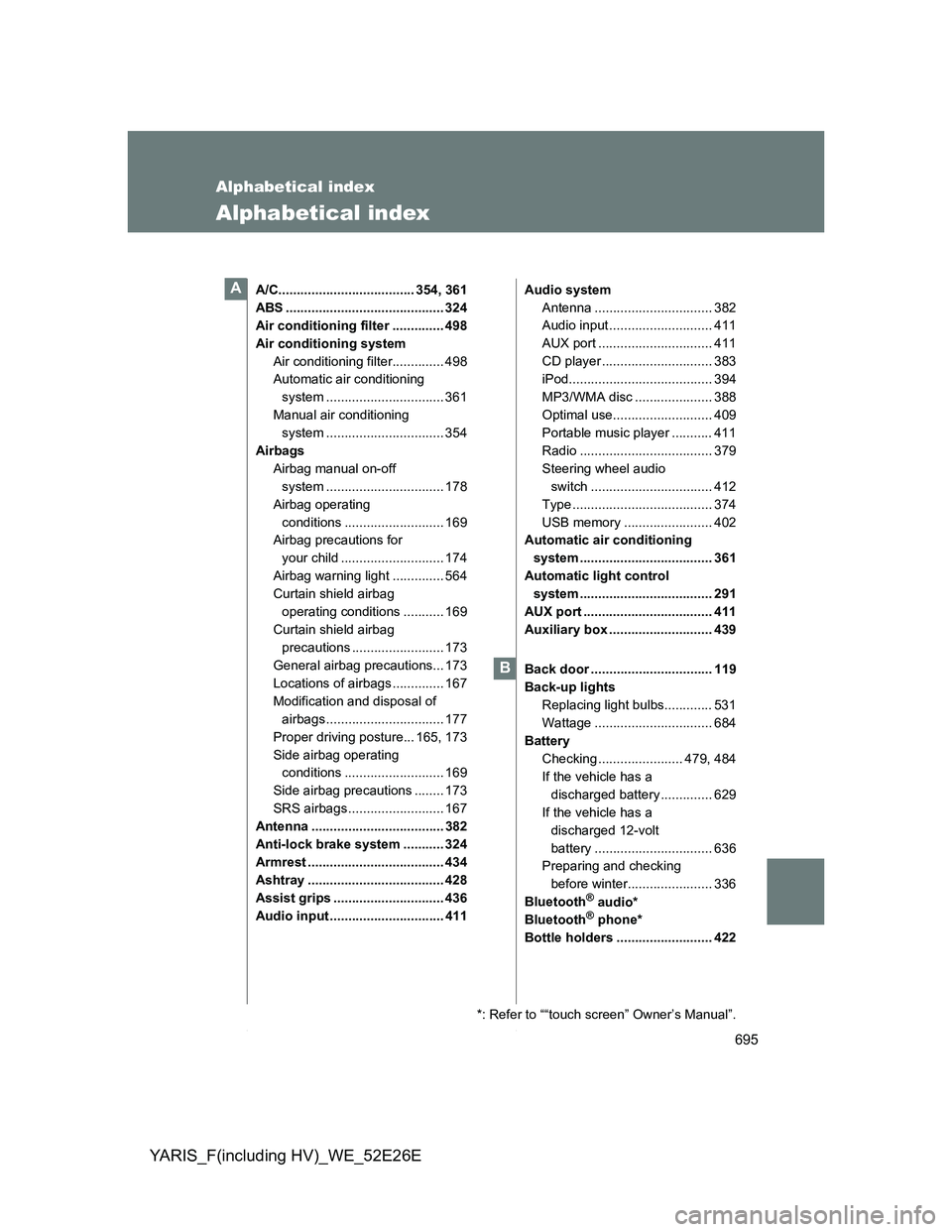
Alphabetical index
Alphabetical index
A/C..................................... 354, 361
ABS ........................................... 324
Air conditioning filter .............. 498
Air conditioning system
Air conditioning filter.............. 498
Automatic air conditioning
system ................................ 361
Manual air conditioning
system ................................ 354
Airbags
Airbag manual on-off
system ................................ 178
Airbag operating
conditions ........................... 169
Airbag precautions for
your child ............................ 174
Airbag warning light .............. 564
Curtain shield airbag
operating conditions ........... 169
Curtain shield airbag
precautions ......................... 173
General airbag precautions... 173
Locations of airbags .............. 167
Modification and disposal of
airbags ................................ 177
Proper driving posture... 165, 173
Side airbag operating
conditions ........................... 169
Side airbag precautions ........ 173
SRS airbags .......................... 167
Antenna .................................... 382
Anti-lock brake system ........... 324
Armrest ..................................... 434
Ashtray ..................................... 428
Assist grips .............................. 436
Audio input ............................... 411Audio system
Antenna ................................ 382
Audio input ............................ 411
AUX port ............................... 411
CD player .............................. 383
iPod....................................... 394
MP3/WMA disc ..................... 388
Optimal use........................... 409
Portable music player ........... 411
Radio .................................... 379
Steering wheel audio
switch ................................. 412
Type ...................................... 374
USB memory ........................ 402
Automatic air conditioning
system .................................... 361
Automatic light control
system .................................... 291
AUX port ................................... 411
Auxiliary box ............................ 439
Back door ................................. 119
Back-up lights
Replacing light bulbs............. 531
Wattage ................................ 684
Battery
Checking ....................... 479, 484
If the vehicle has a
discharged battery .............. 629
If the vehicle has a
discharged 12-volt
battery ................................ 636
Preparing and checking
before winter....................... 336
Bluetooth
® audio*
Bluetooth® phone*
Bottle holders .......................... 422
A
B
*: Refer to ““touch screen” Owner’s Manual”.