light TOYOTA YARIS 2014 3.G Repair Manual
[x] Cancel search | Manufacturer: TOYOTA, Model Year: 2014, Model line: YARIS, Model: TOYOTA YARIS 2014 3.GPages: 400, PDF Size: 9 MB
Page 153 of 400

153
2-3. Operating the lights and wipers
2
When driving
NOTICE
■
When the windshield is dry
Do not use the wiper, as it may damage the windshield.
■ When the washer fluid tank is empty
Do not operate the switch continually as the washer fluid pump may over-
heat.
■ When a nozzle becomes blocked
In this case, contact your Toyota dealer.
Do not try to clear it with a pin or other object. The nozzle will be damaged.
Page 154 of 400
154
2-3. Operating the lights and wipers
Rear window wiper and washer
: If equipped
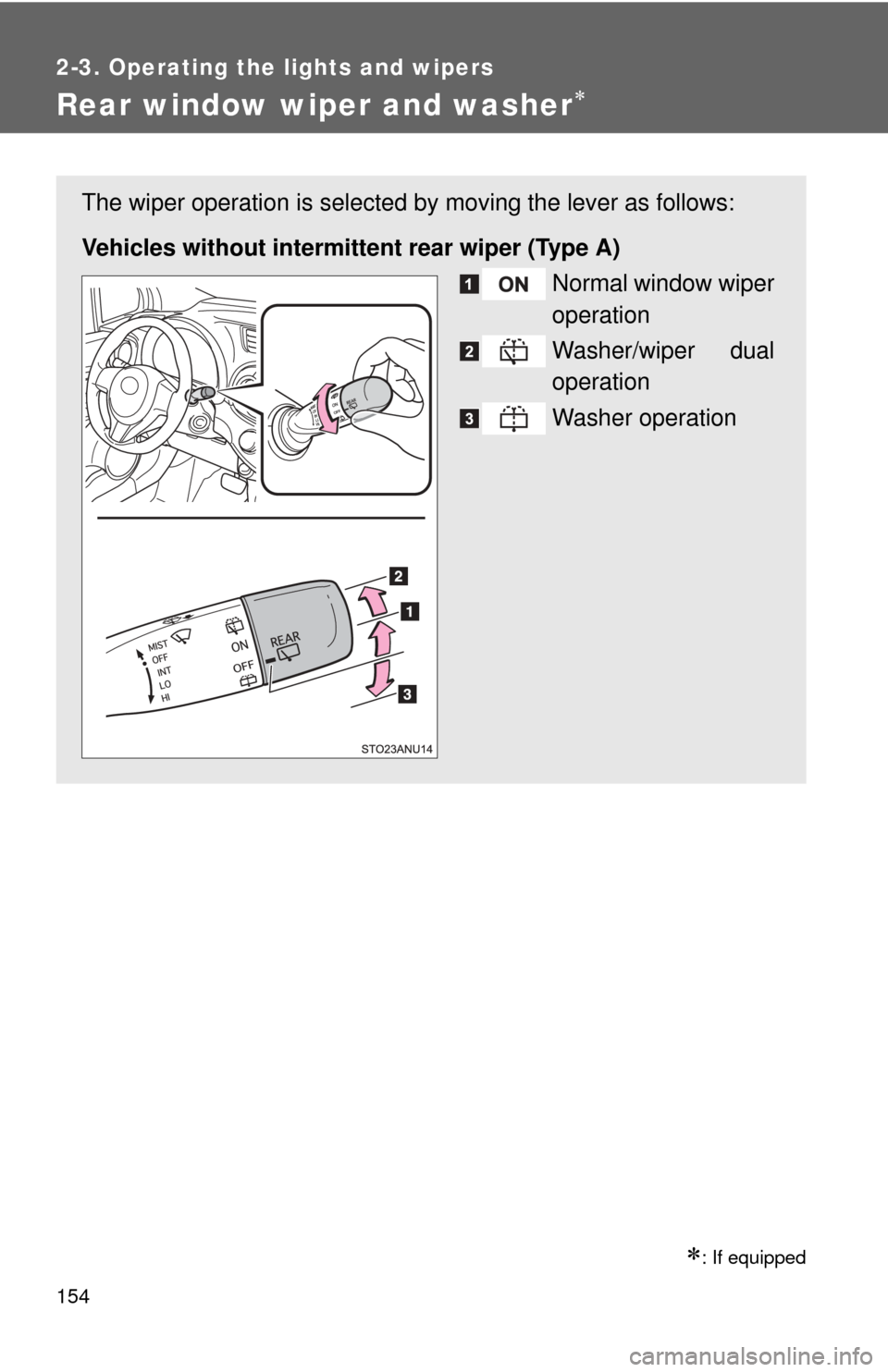
The wiper operation is selected by moving the lever as follows:
Vehicles without intermitte nt rear wiper (Type A)
Normal window wiper
operation
Washer/wiper dual
operation
Washer operation
Page 155 of 400
155
2-3. Operating the lights and wipers
2
When driving
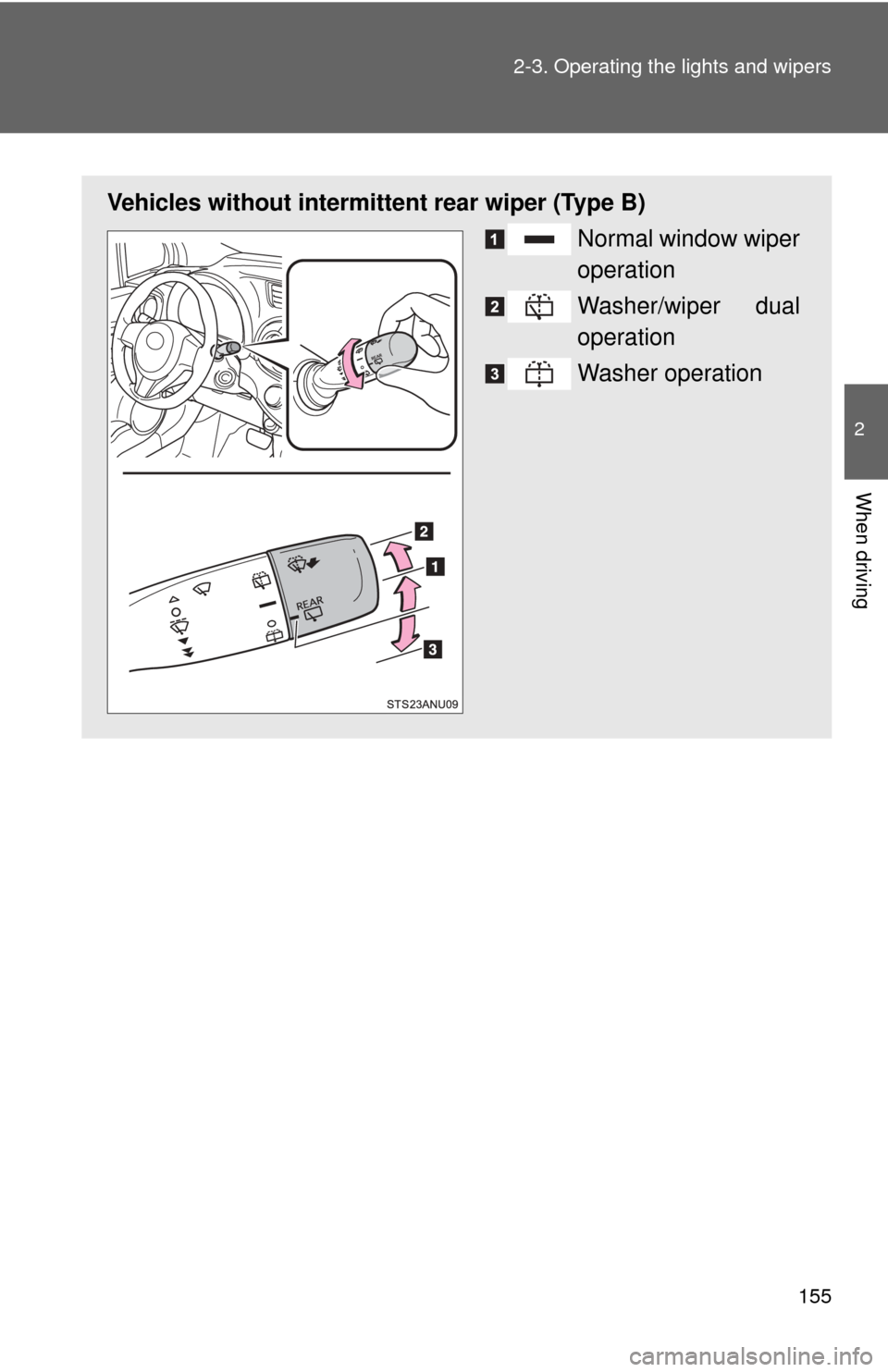
Vehicles without intermitte
nt rear wiper (Type B)
Normal window wiper
operation
Washer/wiper dual
operation
Washer operation
Page 156 of 400
156 2-3. Operating the lights and wipers
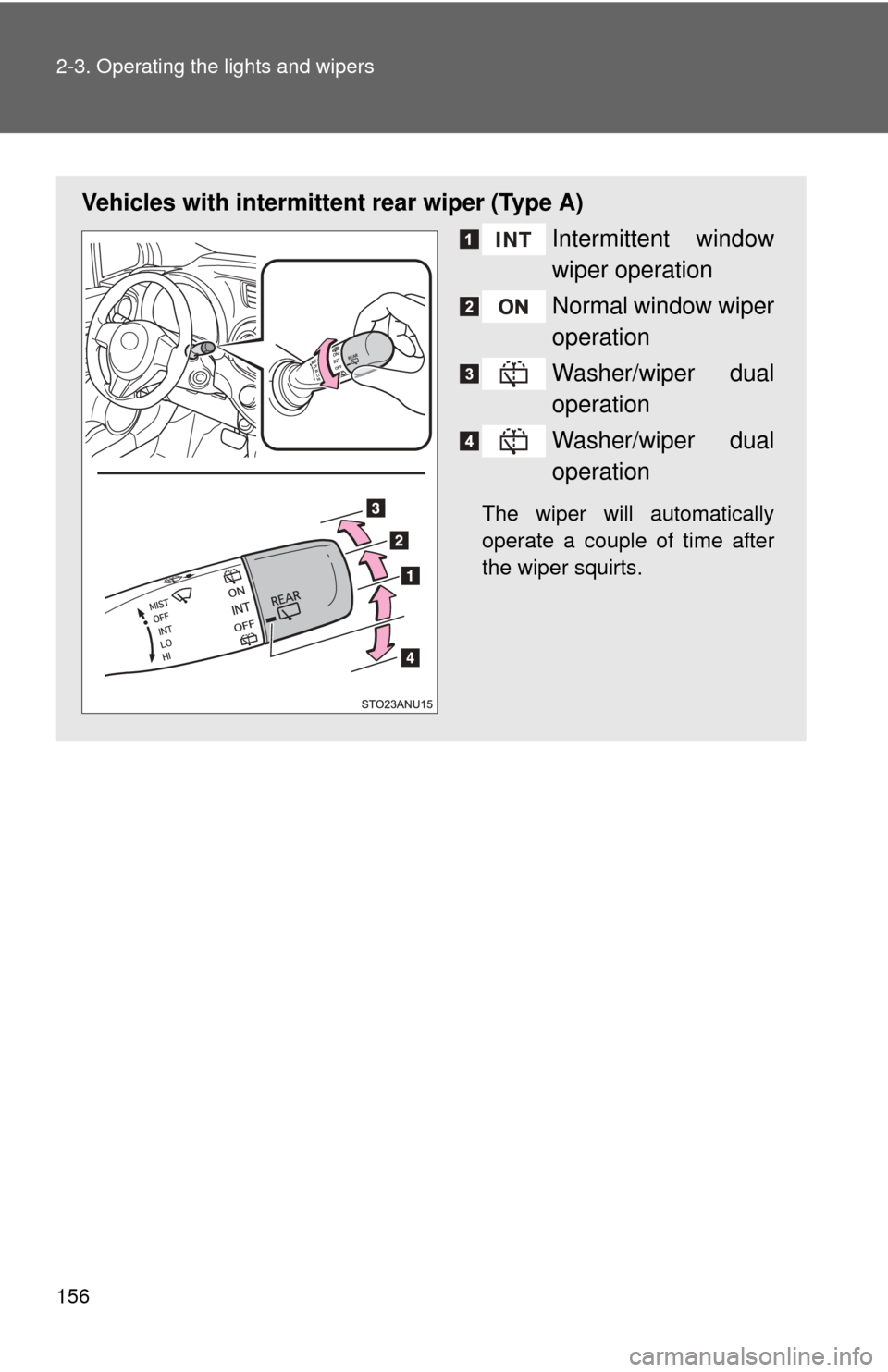
Vehicles with intermittent rear wiper (Type A)
Intermittent window
wiper operation
Normal window wiper
operation
Washer/wiper dual
operation
Washer/wiper dual
operation
The wiper will automatically
operate a couple of time after
the wiper squirts.
Page 157 of 400
157
2-3. Operating the lights and wipers
2
When driving
■
The rear window wiper and washer can be operated when
The engine switch is in the “ON” position.
■ If no washer fluid sprays
Check that the washer nozzle is not blocked, if there is washer fluid in the
washer fluid reservoir.
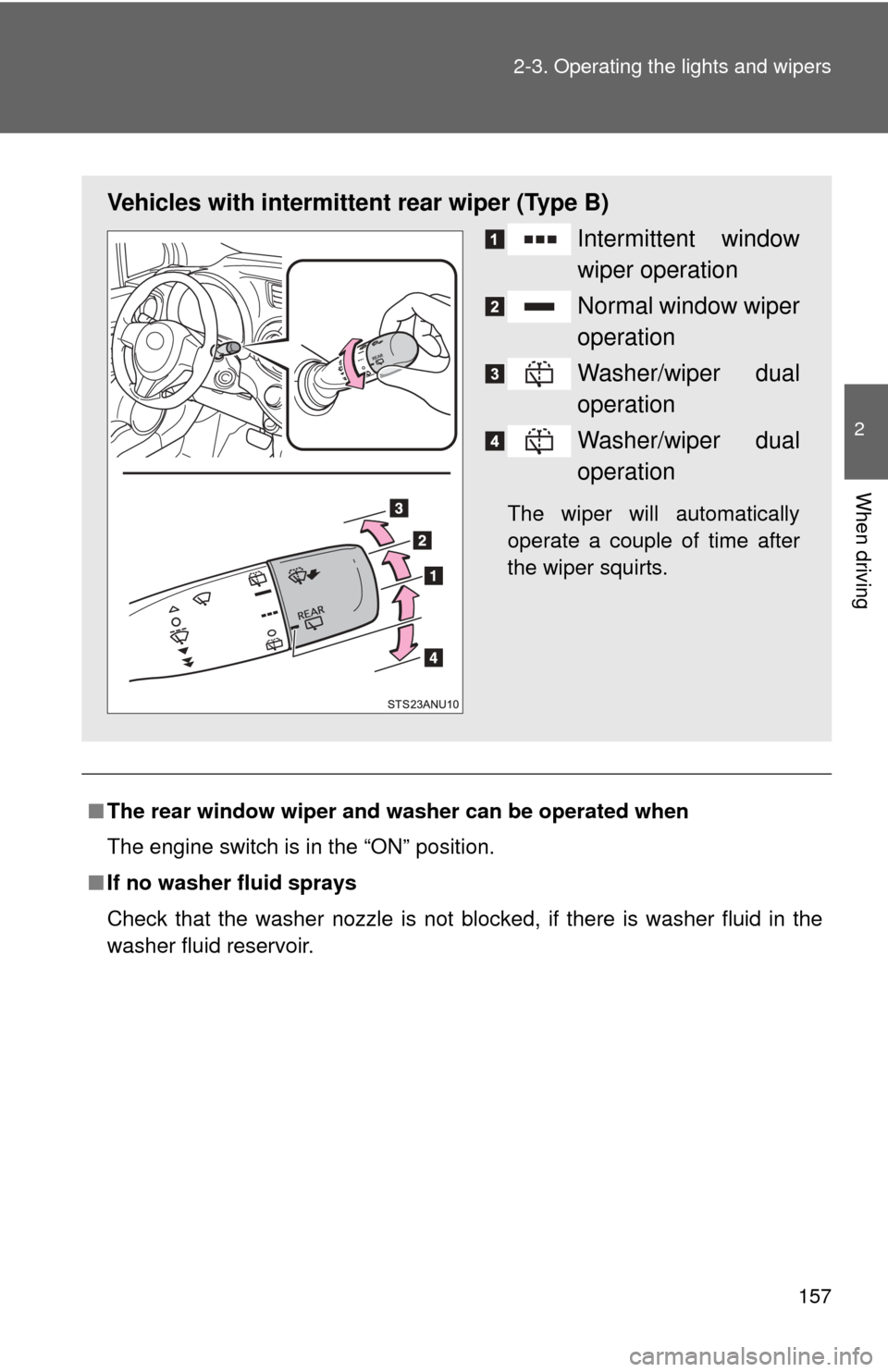
Vehicles with intermitte nt rear wiper (Type B)
Intermittent window
wiper operation
Normal window wiper
operation
Washer/wiper dual
operation
Washer/wiper dual
operation
The wiper will automatically
operate a couple of time after
the wiper squirts.
Page 158 of 400

158 2-3. Operating the lights and wipers
NOTICE
■When the rear window is dry
Do not use the wiper, as it may damage the rear window.
■ When the washer fluid tank is empty
Do not operate the switch continually as the washer fluid pump may over-
heat.
■ When a nozzle becomes blocked
In this case, contact your Toyota dealer.
Do not try to clear it with a pin or other object. The nozzle will be damaged.
Page 161 of 400

161
2-4. Using other
driving systems
2
When driving
■Cruise control can be set when
●The shift lever is in the D or range 3. (vehicles with an automatic trans-
mission)
● Vehicle speed is above approximately 25 mph (40 km/h).
■ Accelerating after setting the vehicle speed
●The vehicle can be accelerated normally. After acceleration, the set
speed resumes.
● Even without canceling the cruise control, the set speed can be
increased by first accelerating the vehicle to the desired speed and then
pushing the lever down to set the new speed.
■ Automatic cruise control cancelation
Cruise control will stop maintaining the vehicle speed in any of the following
situations.
●Actual vehicle speed falls more than approximately 10 mph (16 km/h)
below the preset vehicle speed.
At this time, the memorized set speed is not retained.
● Actual vehicle speed is below approximately 25 mph (40 km/h).
● VSC is activated.
■ If the cruise control indicator light flashes
Press the “ON-OFF” button once to deactivate the system, and then press
the button again to reactivate the system.
If the cruise control speed cannot be set or if the cruise control cancels
immediately after being activated, there may be a malfunction in the cruise
control system. Have the vehicle inspected by your Toyota dealer.
Page 164 of 400
164 2-4. Using other driving systems
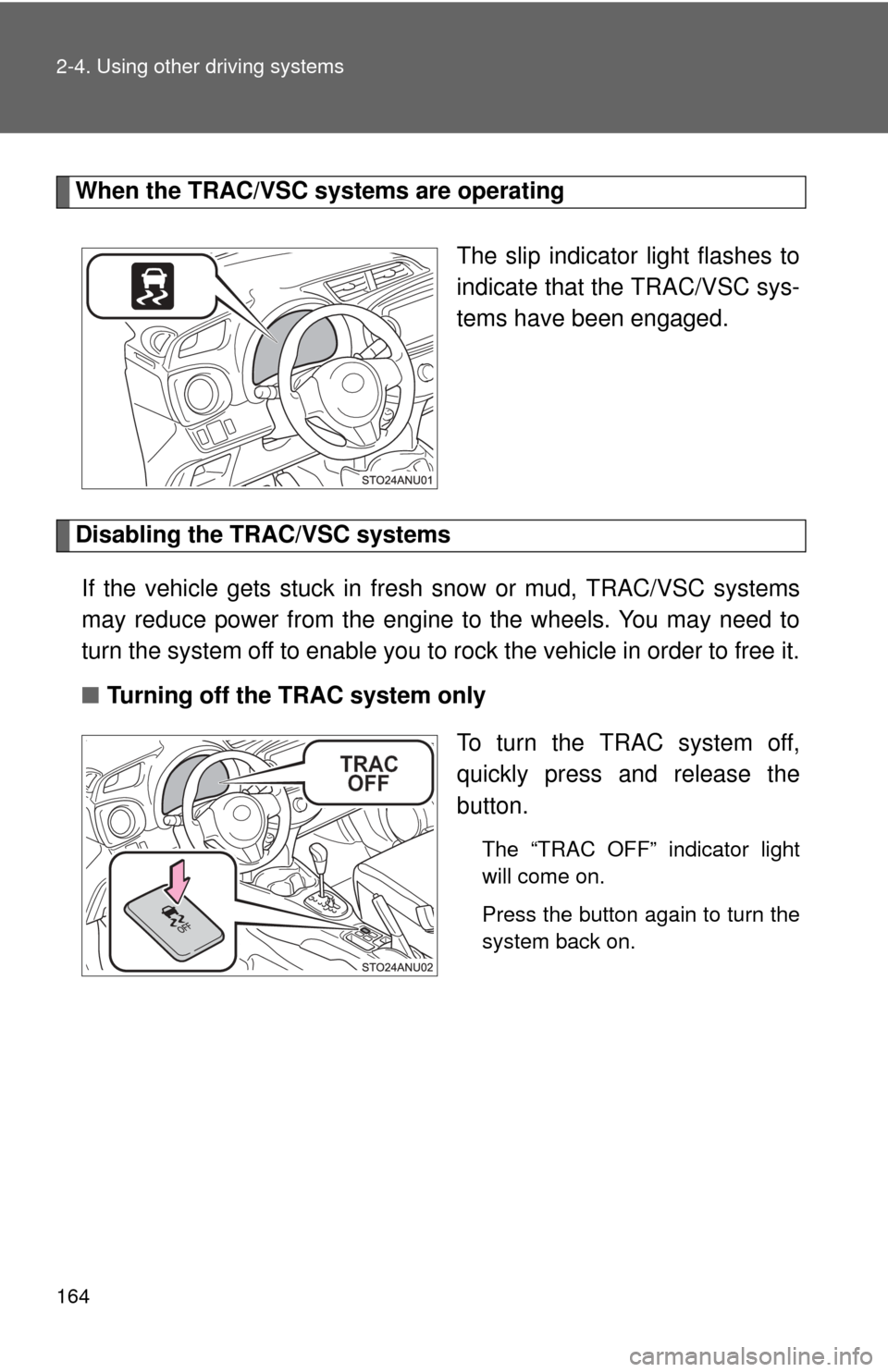
When the TRAC/VSC systems are operatingThe slip indicator light flashes to
indicate that the TRAC/VSC sys-
tems have been engaged.
Disabling the TRAC/VSC systemsIf the vehicle gets stuck in fres h snow or mud, TRAC/VSC systems
may reduce power from the engine to the wheels. You may need to
turn the system off to enable you to rock the vehicle in order to free it.
■ Turning off the TRAC system only
To turn the TRAC system off,
quickly press and release the
button.
The “TRAC OFF” indicator light
will come on.
Press the button again to turn the
system back on.
Page 165 of 400
165
2-4. Using other
driving systems
2
When driving
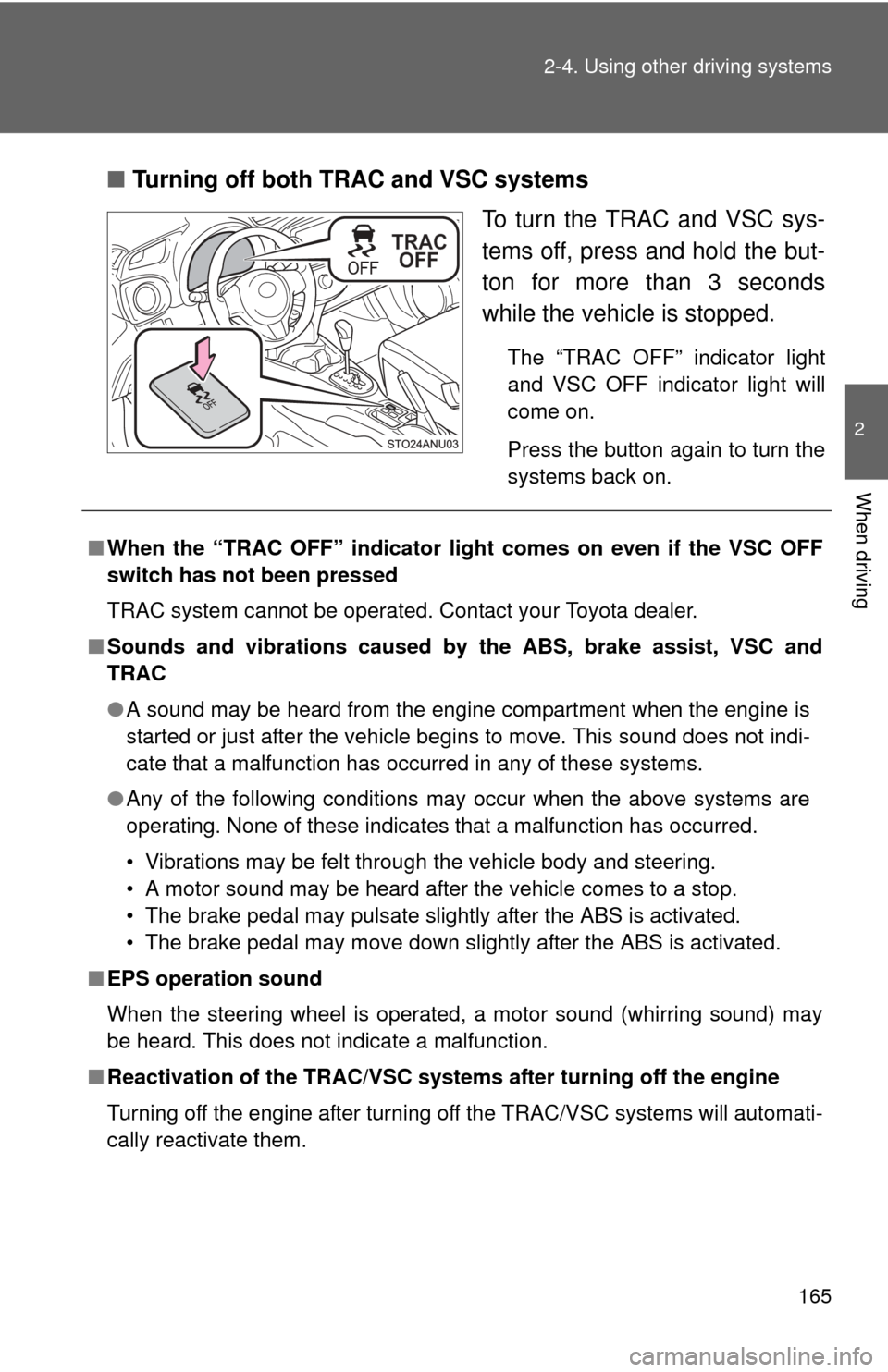
■Turning off both TRAC and VSC systems
To turn the TRAC and VSC sys-
tems off, press and hold the but-
ton for more than 3 seconds
while the vehicle is stopped.
The “TRAC OFF” indicator light
and VSC OFF indicator light will
come on.
Press the button again to turn the
systems back on.
■When the “TRAC OFF” indicator light comes on even if the VSC OFF
switch has not been pressed
TRAC system cannot be operated. Contact your Toyota dealer.
■ Sounds and vibrations caused by the ABS, brake assist, VSC and
TRAC
● A sound may be heard from the engine compartment when the engine is
started or just after the vehicle begins to move. This sound does not indi-
cate that a malfunction has occurred in any of these systems.
● Any of the following conditions may occur when the above systems are
operating. None of these indicates that a malfunction has occurred.
• Vibrations may be felt through the vehicle body and steering.
• A motor sound may be heard after the vehicle comes to a stop.
• The brake pedal may pulsate slightly after the ABS is activated.
• The brake pedal may move down slightly after the ABS is activated.
■ EPS operation sound
When the steering wheel is operated, a motor sound (whirring sound) may
be heard. This does not indicate a malfunction.
■ Reactivation of the TRAC/VSC systems after turning off the engine
Turning off the engine after turning off the TRAC/VSC systems will automati-
cally reactivate them.
Page 167 of 400

167
2-4. Using other
driving systems
2
When driving
CAUTION
■TRAC may not operate effectively when
Directional control and power may not be achievable while driving on slip-
pery road surfaces, even if the TRAC system is operating.
Be especially careful and drive the vehicle in conditions where stability and
power may be lost.
■ When the VSC is activated
The slip indicator flashes. Always drive carefully. Reckless driving may
cause an accident. Exercise particular care when the indicator light flashes.
■ When the TRAC/VSC syst ems are turned off
Be especially careful and drive at a speed appropriate to the road condi-
tions. Do not turn the TRAC/VSC systems off unless necessary, as these are
the systems to help ensure vehicle stability and driving force by automati-
cally controlling braking and engine outputs.
■ Replacing tires
Observe the following precautions.
Failure to do so may cause the ABS, VSC and TRAC systems not to function
correctly.
●Make sure that all tires are of the specified size, brand, tread pattern and
total load capacity.
● Do not use tires of noticeably different wear level.
● Make sure that the tires are inflated to the recommended tire inflation
pressure level. ( P. 351)
Contact your Toyota dealer for further information when replacing tires or
wheels.
■ Handling of tires and the suspension
Using tires with any kind of problem or modifying the suspension will affect
the driving assist systems, and may cause a system to malfunction.