cargo TOYOTA YARIS 2014 3.G Owners Manual
[x] Cancel search | Manufacturer: TOYOTA, Model Year: 2014, Model line: YARIS, Model: TOYOTA YARIS 2014 3.GPages: 400, PDF Size: 9 MB
Page 3 of 400

1
2
3
4
5
6
7
3
2-4. Using other driving systemsCruise control ...................... 159
Driving assist systems ........ 163
2-5. Driving information Cargo and luggage ............. 168
Vehicle load limits ............... 172
Winter driving tips ............... 173
Trailer towing (except 3-door models
for Canada) ....................... 177
Trailer towing (3-door models
for Canada) ....................... 178
Dinghy towing (vehicles with an automatic
transmission) .................... 188
Dinghy towing (vehicles with a manual
transmission) .................... 189
3-1. Using the air conditioning system and defogger
Air conditioning system ....... 192
Rear window and outside rear view mirror
defoggers .......................... 199
3-2. Using the audio system Using the AUX port/USB port ........................... 200
Using the steering wheel audio switches .................. 201 3-3. Using the interior lights
Interior lights list ................. 202
• Personal lights................... 203
• Interior light ...................... 203
3-4. Using the storage features List of storage features ....... 204
• Glove box ......................... 205
• Cup holders ...................... 205
• Bottle holders ................... 207
3-5. Other interior features Sun visors........................... 208
Vanity mirrors ..................... 209
Clock .................................. 210
Outside temperature display .............................. 211
Power outlet ....................... 213
Assist grips ......................... 214
Floor mat ............................ 215
Luggage compartment features ............................ 217
4-1. Maintenance and care Cleaning and protecting the vehicle exterior ........... 222
Cleaning and protecting the vehicle interior ............ 225
3Interior features
4Maintenance and care
Page 111 of 400
When driving2
111
2-1. Driving proceduresDriving the vehicle............ 112
Engine (ignition) switch .... 124
Automatic transmission .... 127
Manual transmission ........ 129
Turn signal lever .............. 130
Parking brake ................... 131
Horn ................................. 132
2-2. Instrument cluster Gauges and meters ......... 133
Indicators and warning lights .............................. 136
Multi-information display............................ 140
2-3. Operating the lights and wipers
Headlight switch ............... 145
Fog light switch ................ 149
Windshield wiper and washer ........................... 151
Rear window wiper and washer ........................... 154 2-4. Using other driving systems
Cruise control ................... 159
Driving assist systems ..... 163
2-5. Driving information Cargo and luggage .......... 168
Vehicle load limits ............ 172
Winter driving tips ............ 173
Trailer towing (except 3-door models
for Canada) .................... 177
Trailer towing (3-door models for Canada) ....... 178
Dinghy towing (vehicles with an automatic
transmission) ................. 188
Dinghy towing (vehicles with a manual
transmission) ................. 189
Page 168 of 400
168
2-5. Driving information
Cargo and luggage
Capacity and distributionCargo capacity depends on the total weight of the occupants.
(Cargo capacity) = (Total load capacity) (Total weight of occupants)
Steps for Determining Correct Load Limit—
(1) Locate the statement “The co mbined weight of occupants and
cargo should never exceed XXX kg or XXX lbs.” on your vehicle’s
placard.
(2) Determine the combined weight of the driver and passengers that
will be riding in your vehicle.
(3)Subtract the combined weight of the driver and passengers from XXX kg or XXX lbs.
(4) The resulting figure equals the av ailable amount of cargo and lug-
gage load capacity.
For example, if the “XXX” amount equals 1400 lbs. and there will
be five 150 lb passengers in your vehicle, the amount of available
cargo and luggage load capacity is 650 lbs. (1400 750 (5 150)
= 650 lbs.)
(5) Determine the combined weight of luggage and cargo being loaded on the vehicle. That weight may not safely exceed the
available cargo and luggage load capacity calculated in Step 4.
Take notice of the following information about storage precau-
tions, cargo capacity and load:
●Stow cargo and luggage in the luggage compartment whenever
possible.
● Be sure all items are secured in place.
● To maintain vehicle balance while driving, position luggage
evenly within the luggage compartment.
● For better fuel economy, do no t carry unnecessary weight.
Page 169 of 400
169
2-5. Driving information
2
When driving
(6) If your vehicle will be towing a tr
ailer, load from your trailer will be
transferred to your vehicle. Consult this manual to determine how
this reduces the available cargo and luggage load capacity of your
vehicle.
Except 3-door models for Canada:
Toyota does not recommend towing a trailer with your vehicle. Your
vehicle is not designed for trailer towing.
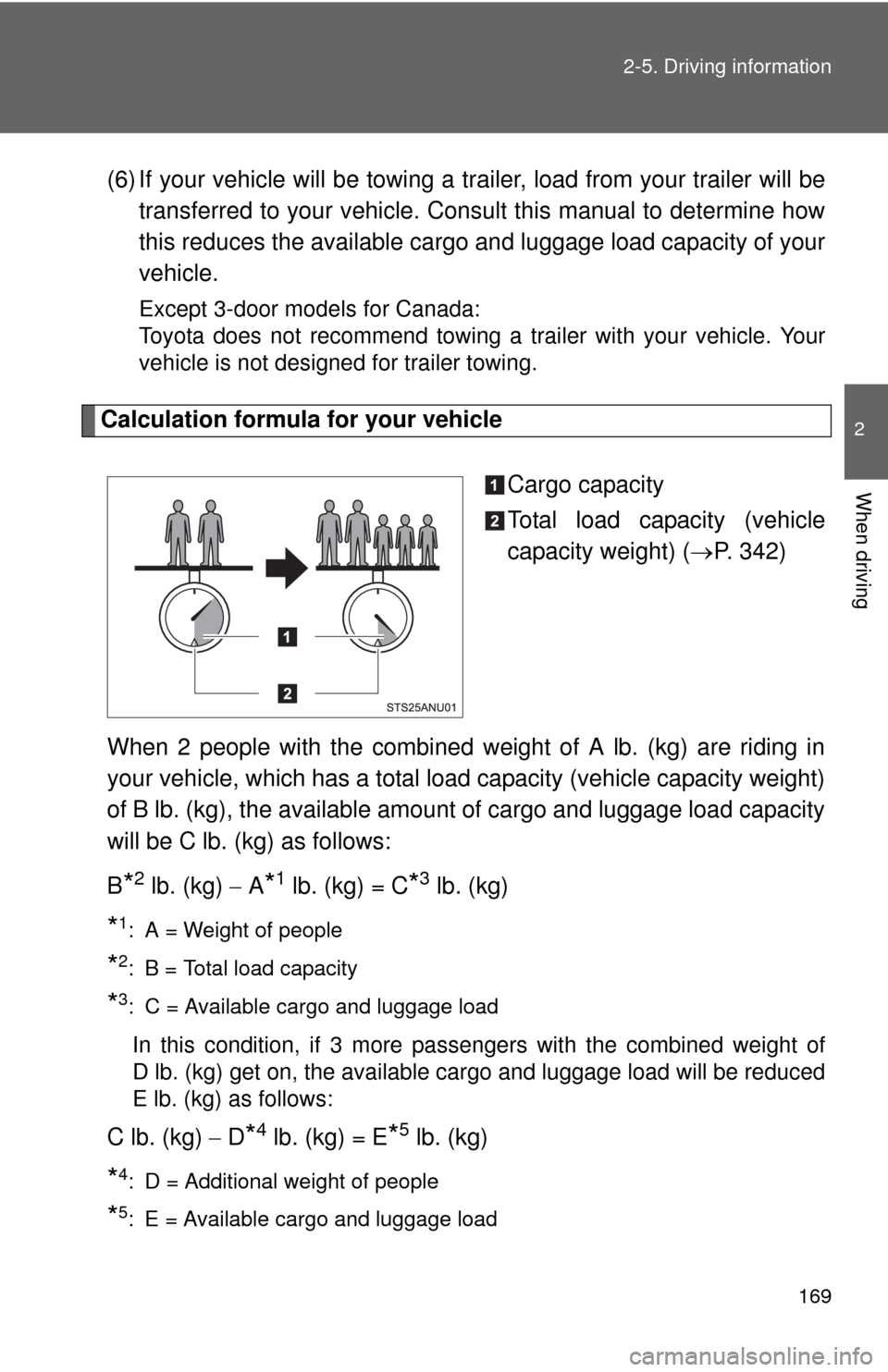
Calculation formula for your vehicle
Cargo capacity
Total load capacity (vehicle
capacity weight) (P. 342)
When 2 people with the combined weight of A lb. (kg) are riding in
your vehicle, which has a total load capacity (vehicle capacity weight)
of B lb. (kg), the available amount of cargo and luggage load capacity
will be C lb. (kg) as follows:
B
*2 lb. (kg) A*1 lb. (kg) = C*3 lb. (kg)
*1: A = Weight of people
*2: B = Total load capacity
*3: C = Available cargo and luggage load
In this condition, if 3 more pa ssengers with the combined weight of
D lb. (kg) get on, the available ca rgo and luggage load will be reduced
E lb. (kg) as follows:
C lb. (kg) D*4 lb. (kg) = E*5 lb. (kg)
*4: D = Additional weight of people
*5: E = Available cargo and luggage load
Page 170 of 400
170 2-5. Driving information
As shown in the example above, if the number of occupants
increases, the cargo and luggage load will be reduced by an amount
that equals the increased weight du e to the additional occupants. In
other words, if an increase in the number of occupants causes an
excess of the total load capacity (combined weight of occupants plus
cargo and luggage load), you must reduce the cargo and luggage on
your vehicle.
CAUTION
■Things that must not be carried in the luggage compartment
The following things may cause a fire if loaded in the luggage compart-
ment:
●Receptacles containing gasoline
●Aerosol cans
■Storage precautions
Observe the following precautions.
Failure to do so may result in death or serious injury.
●Stow cargo and luggage in the luggage compartment whenever possi-
ble.
●Do not stack cargo and luggage in the luggage compartment higher
than the seatbacks.
Such items may be thrown about and possibly injure people in the
vehicle in the event of sudden braking or in an accident.
●Do not place cargo or luggage in or on the following locations as the
item may get under the clutch, brake or accelerator pedal and prevent
the pedals from being depressed properly, block the driver’s vision, or
hit the driver or passengers, causing an accident:
• At the feet of the driver
• On the front passenger or rear seats (when stacking items)
• On the luggage cover
• On the instrument panel
• On the dashboard
●Secure all items in the occupant compartment, as they may shift and
injure someone in the event of an accident or sudden braking.
Page 171 of 400

171
2-5. Driving information
2
When driving
CAUTION
●When you fold down the rear seats, long items should not be place
directly behind the front seats.
●Never allow anyone to ride in the luggage compartment. It is not
designed for passengers. They should ride in their seats with their seat
belts properly fastened. Otherwise,
they are much more likely to suffer
death or serious bodily injury, in the event of sudden braking or an
accident.
■Capacity and distribution
●Do not exceed the maximum axle weight rating or the total vehicle
weight rating.
●Even if the total load of occupant’s weight and the cargo load is less
than the total load capacity, do no t apply the load unevenly. Improper
loading may cause deterioration of st eering or braking control which
may cause death or serious injury.
Page 172 of 400
172
2-5. Driving information
Vehicle load limits
■Total load capacity and seating capacity
These details are also described on the tire and loading information
label.(P. 262)
CAUTION
■Overloading the vehicle
Do not overload the vehicle.
It may not only cause damage to the ti res, but also degrade steering and
braking ability, resulting in an accident.
Vehicle load limits include total load capacity, seating capacity,
towing capacity and cargo capacity.
■ Total load capacity (vehicle capacity weight): ( P. 342)
Total load capacity means the combined weight of occupants,
cargo and luggage.
■ Seating capacity: 5 occupants (Front 2, Rear 3)
Seating capacity means the ma ximum number of occupants
whose estimated average weight is 150 lb. (68 kg) per person.
■ Towing capacity (3-door models for Canada): ( P. 342)
Towing capacity means the maximum gross trailer weight (trailer
weight plus its cargo weight) that your vehicle is able to tow.
■ Towing capacity (except 3-door models for Canada)
Toyota does not recommend towing a trailer with your vehicle.
■ Cargo capacity
Cargo capacity may increase or decrease depending on the
weight and the number of occupants.
Page 179 of 400

179
2-5. Driving information
2
When driving
Towing related term
Towing related termMeaning
GVWR (Gross Vehicle
Weight Rating)
The maximum allowable gross vehicle
weight. The gross vehicle weight is the
total weight of the vehicle. When towing
a trailer, it is the sum of the vehicle
weight (including the occupants, cargo
and any optional equipment installed on
the vehicle) and the tongue load.
GAWR (Gross Axle Weight
Rating) The maximum allowable gross axle
weight. The gross axle weight is the load
placed on each axle (front and rear).
Gross trailer weight The sum of the trailer weight and the
weight of the cargo in the trailer
Towing capacity The maximum allowable gross trailer
weight. Towing capacity is calculated
considering the base vehicle with neces-
sary vehicle equipment and occupants.
Additional optional equipment, passen-
gers and cargo in the vehicle will reduce
the towing capacity, gross trailer weight
include the trailer, cargo and necessary
equipment for towing.
Tongue load The load placed on the trailer hitch ball
Page 180 of 400
180 2-5. Driving information
Trailer tongue load● A recommended tongue load varies in accordance with the types
of trailers or towing as described below.
● In order to ensure the recommended values shown below, the
trailer must be loaded by referring to the following instructions.
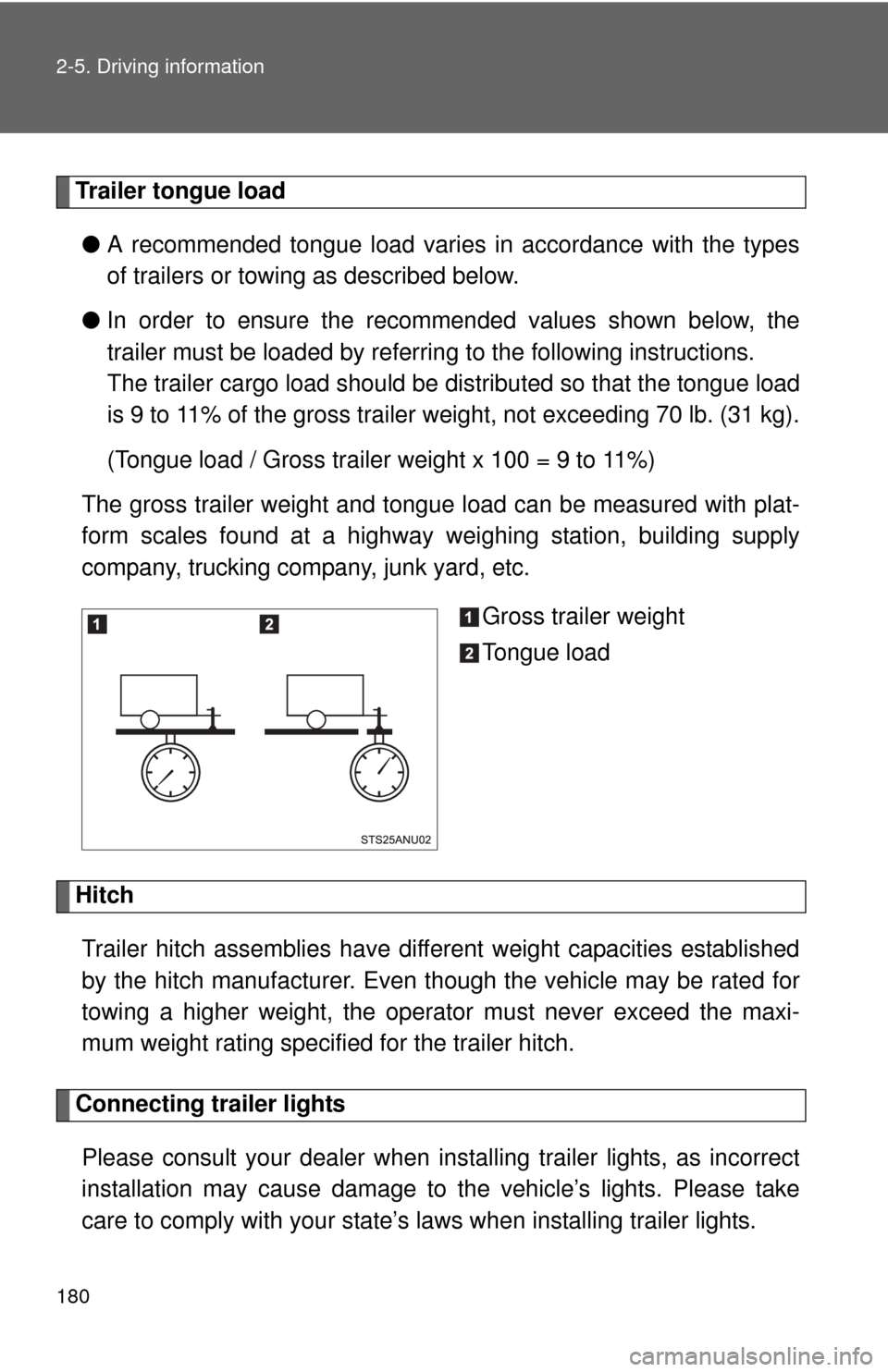
The trailer cargo load should be distributed so that the tongue load
is 9 to 11% of the gross trailer weight, not exceeding 70 lb. (31 kg).
(Tongue load / Gross trailer weight x 100 = 9 to 11%)
The gross trailer weight and tongue l oad can be measured with plat-
form scales found at a highway we ighing station, building supply
company, trucking company, junk yard, etc.
Gross trailer weight
Tongue load
Hitch
Trailer hitch assemblies have different weight capacities established
by the hitch manufacturer. Even th ough the vehicle may be rated for
towing a higher weight, the operat or must never exceed the maxi-
mum weight rating specified for the trailer hitch.
Connecting trailer lights
Please consult your dealer when inst alling trailer lights, as incorrect
installation may cause damage to the vehicle’s lights. Please take
care to comply with your state’ s laws when installing trailer lights.
Page 184 of 400

184 2-5. Driving information
■Before towing
Check that the following conditions are met:
●Ensure that your vehicle’s tires are properly inflated. ( P. 351)
● Trailer tires should be inflated according to the trailer manufacturer’s rec-
ommendation.
● All trailer lights work as required by law.
● All lights work each time you connect them.
● The trailer ball is set at the proper height for the coupler on the trai\
ler.
● The trailer is level when it is hitched.
Do not drive if the trailer is not level, and check for improper tongue
weight, overloading, worn suspension, or other possible causes.
● The trailer cargo is securely loaded.
● The rear view mirrors conform to any federal, state/provincial or local
regulations. If they do not, install rear view mirrors appropriate for towing
purposes.
■ Break-in schedule
If your vehicle is new or equipped with any new power train components
(such as an engine, transmission, differential and wheel bearing), Toyota
recommends that you do not tow a trailer until it has been driven for over 500
miles (800 km).
However, avoid full throttle acceleration.
■ Maintenance
●If you tow a trailer, your vehicle will require more frequent maintenance
due to the additional load. (See “Scheduled Maintenance Guide” or
“Owner’s Manual Supplement”.)
● Retighten the fixing bolts of the towing ball and bracket after approxi-
mately 600 miles (1000 km) of trailer towing.