light TOYOTA YARIS 2014 Owners Manual
[x] Cancel search | Manufacturer: TOYOTA, Model Year: 2014, Model line: YARIS, Model: TOYOTA YARIS 2014Pages: 712, PDF Size: 30.2 MB
Page 639 of 712
5
639 5-2. Steps to take in an emergency
When trouble arises
YARIS_F (including HV)_WE_52E26E
The hybrid system may not start on the first attempt after the 12-volt bat-
tery has recharged but will start normally after the second attempt. This is
not a malfunction.
Vehicles with an electronic key: The “POWER” switch mode is memo-
rized by the vehicle. When the 12-volt battery is reconnected, the system
will return to the mode it was in before the 12-volt battery was dis-
charged. Before disconnecting the 12-volt battery, turn the “POWER”
switch off.
If the “POWER” switch was in ACCESSORY or ON mode before the 12-
volt battery was discharged, the audio system and/or air conditioning
system may operate when the 12-volt battery is reconnected.
Charging the 12-volt battery
The electricity stored in the 12-volt battery will discharge gradually even
when the vehicle is not in use, due to natural discharge and the draining
effects of certain electrical appliances. If the vehicle is left for a long time, the
12-volt battery may discharge, and the hybrid system may be unable to start.
(The 12-volt battery recharges automatically while the hybrid system is oper-
ating.)
CAUTION
Avoiding 12-volt battery fires or explosions
Observe the following precautions to prevent accidentally igniting the flam-
mable gas that may be emitted from the 12-volt battery:
Make sure each jumper cable is connected to the correct terminal and that
it is not unintentionally in contact with anything other than the intended ter-
minal.
Do not allow the other end of the jumper cable connected to the “+” termi-
nal to come into contact with any other parts or metal surfaces in the area,
such as brackets or unpainted metal.
Do not allow the + and - clamps of the jumper cables to come into contact
with each other.
Do not smoke, use matches, cigarette lighters or allow open flame near
the 12-volt battery.
Page 642 of 712
642
5-2. Steps to take in an emergency
YARIS_F (including HV)_WE_52E26E
If your vehicle overheats (except hybrid vehicle)
Correction procedures
Stop the vehicle in a safe place and turn off the air condition-
ing system, and then stop the engine.
If you see steam:
Carefully lift the hood after the steam subsides.
If you do not see steam:
Carefully lift the hood.
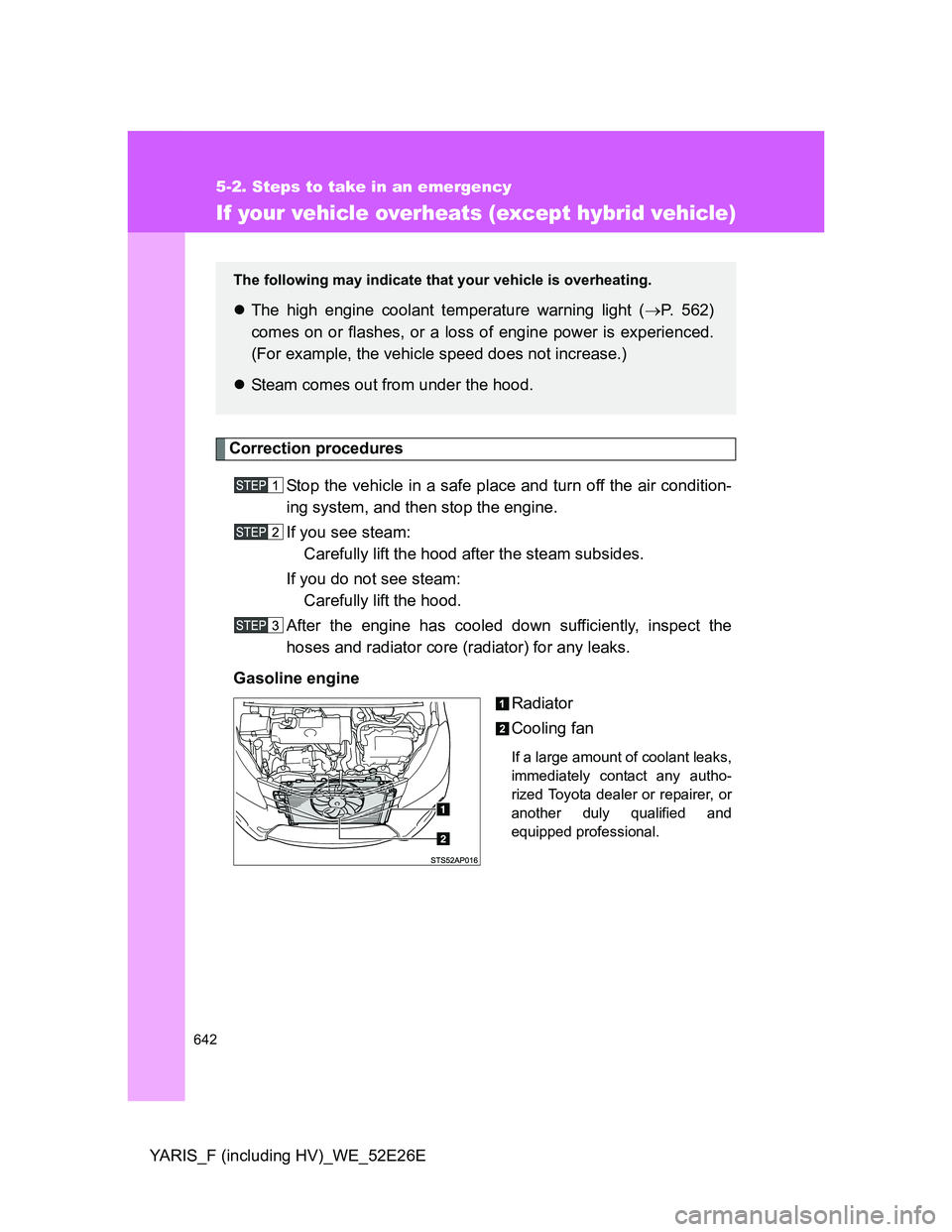
After the engine has cooled down sufficiently, inspect the
hoses and radiator core (radiator) for any leaks.
Gasoline engine
Radiator
Cooling fan
If a large amount of coolant leaks,
immediately contact any autho-
rized Toyota dealer or repairer, or
another duly qualified and
equipped professional.
The following may indicate that your vehicle is overheating.
The high engine coolant temperature warning light (P. 562)
comes on or flashes, or a loss of engine power is experienced.
(For example, the vehicle speed does not increase.)
Steam comes out from under the hood.
Page 646 of 712
646
5-2. Steps to take in an emergency
YARIS_F (including HV)_WE_52E26E
If your vehicle overheats (hybrid vehicle)
Correction procedures
If the high engine coolant temperature warning light comes on
or flashes
Stop the vehicle in a safe place and turn off the air condition-
ing system, and then stop the hybrid system.
If you see steam:
Carefully lift the hood after the steam subsides.
If you do not see steam:
Carefully lift the hood.
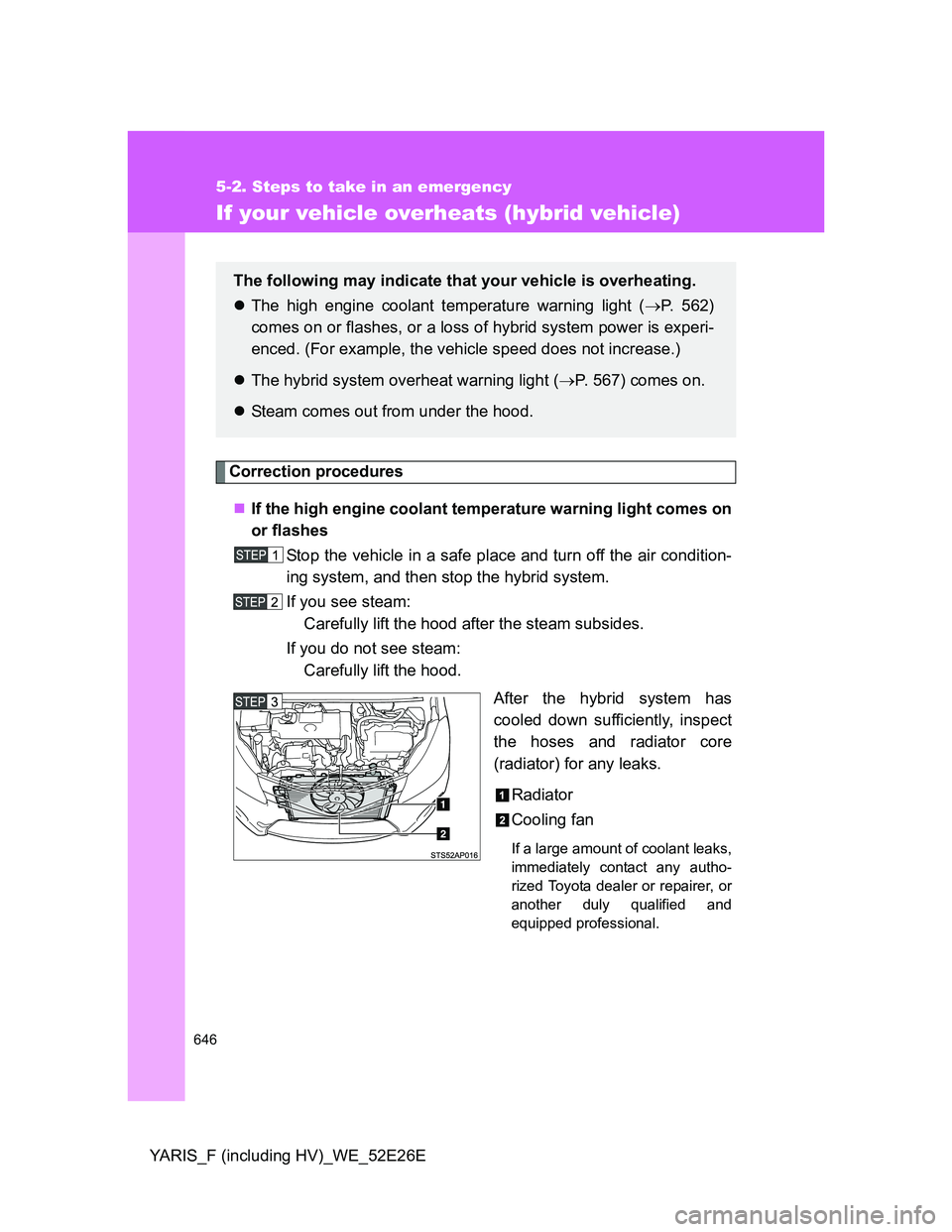
After the hybrid system has
cooled down sufficiently, inspect
the hoses and radiator core
(radiator) for any leaks.
Radiator
Cooling fan
If a large amount of coolant leaks,
immediately contact any autho-
rized Toyota dealer or repairer, or
another duly qualified and
equipped professional.
The following may indicate that your vehicle is overheating.
The high engine coolant temperature warning light (P. 562)
comes on or flashes, or a loss of hybrid system power is experi-
enced. (For example, the vehicle speed does not increase.)
The hybrid system overheat warning light (P. 567) comes on.
Steam comes out from under the hood.
Page 648 of 712
648 5-2. Steps to take in an emergency
YARIS_F (including HV)_WE_52E26EIf the hybrid system overheat warning light comes on
Stop the vehicle in a safe place.
Stop the hybrid system and carefully lift the hood.
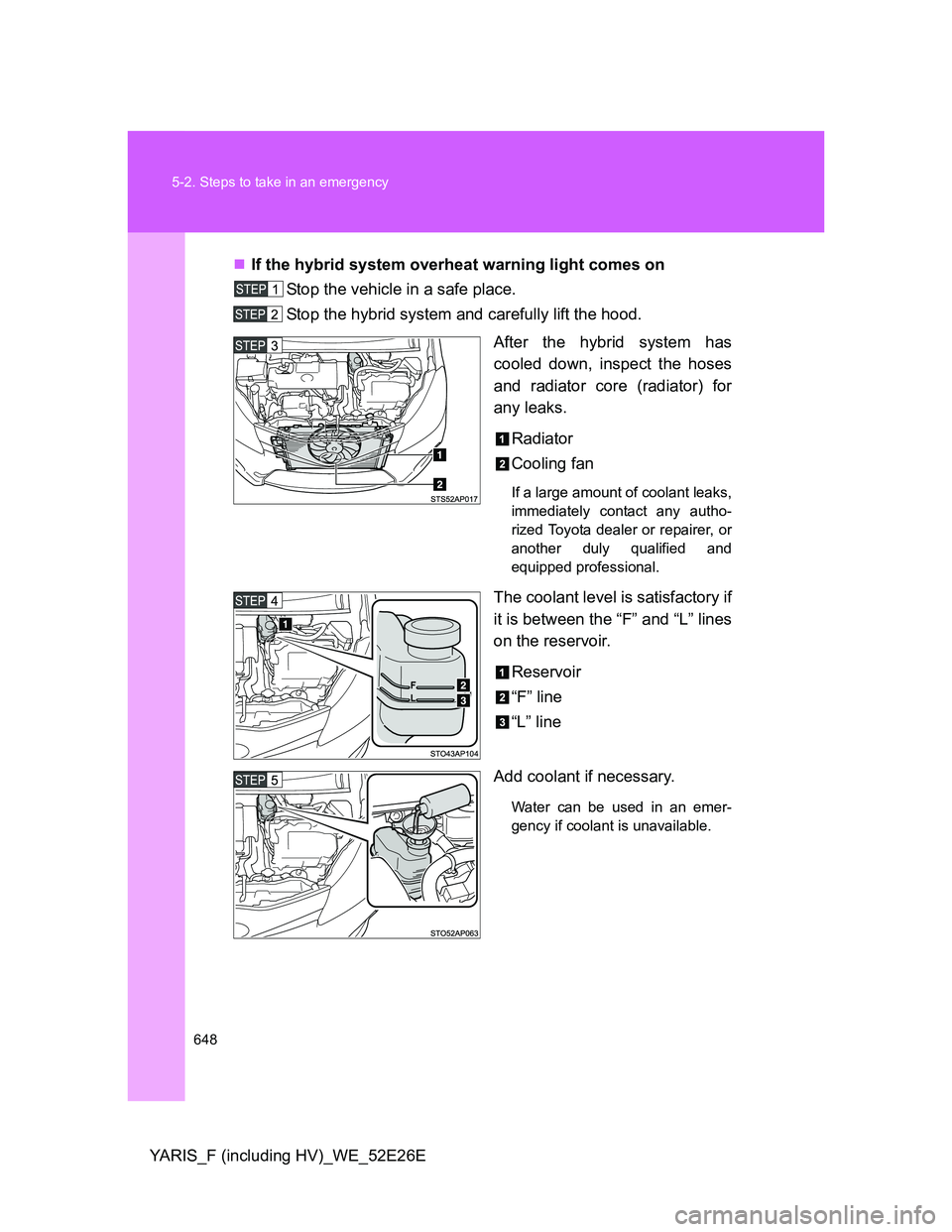
After the hybrid system has
cooled down, inspect the hoses
and radiator core (radiator) for
any leaks.
Radiator
Cooling fan
If a large amount of coolant leaks,
immediately contact any autho-
rized Toyota dealer or repairer, or
another duly qualified and
equipped professional.
The coolant level is satisfactory if
it is between the “F” and “L” lines
on the reservoir.
Reservoir
“F” line
“L” line
Add coolant if necessary.
Water can be used in an emer-
gency if coolant is unavailable.
Page 649 of 712
5
649 5-2. Steps to take in an emergency
When trouble arises
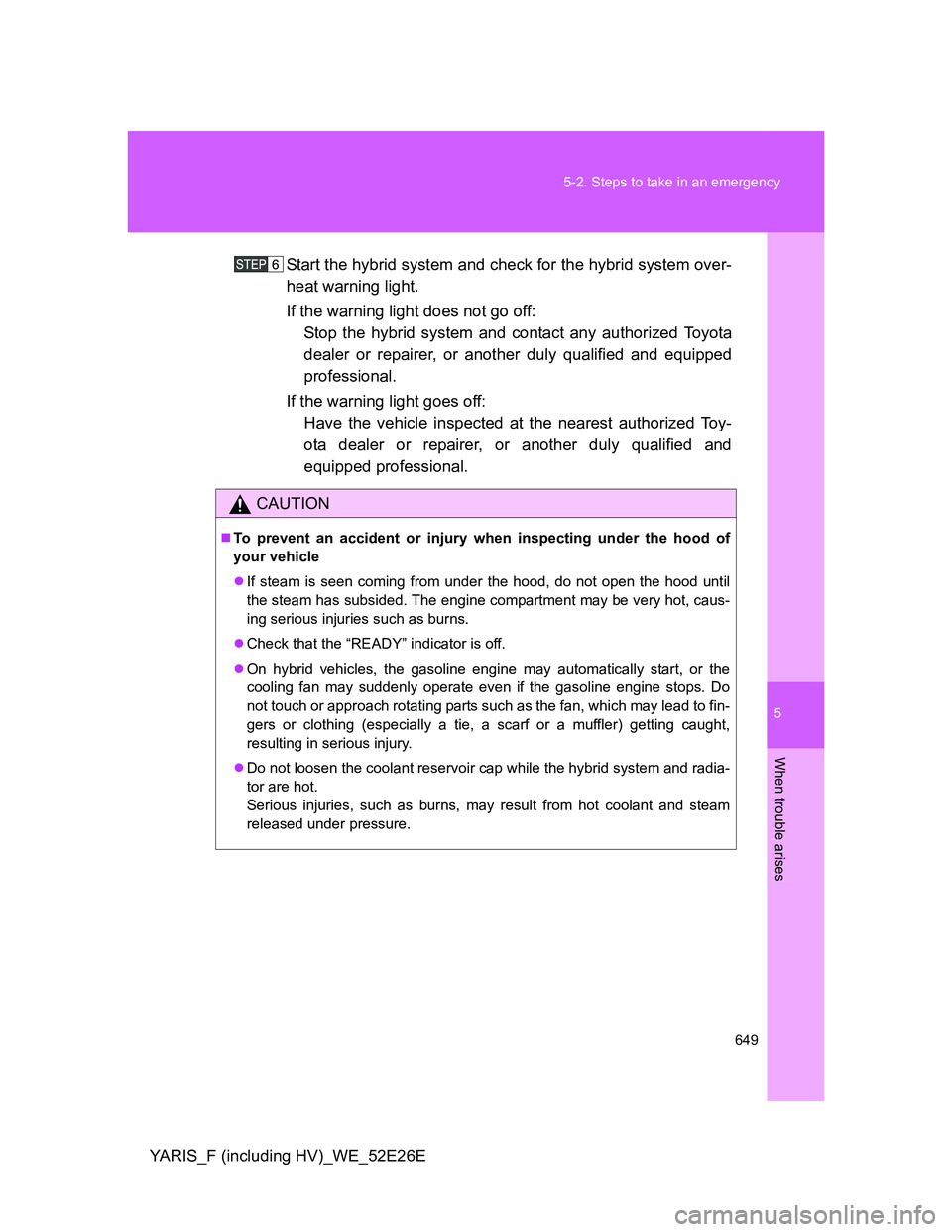
YARIS_F (including HV)_WE_52E26EStart the hybrid system and check for the hybrid system over-
heat warning light.
If the warning light does not go off:
Stop the hybrid system and contact any authorized Toyota
dealer or repairer, or another duly qualified and equipped
professional.
If the warning light goes off:
Have the vehicle inspected at the nearest authorized Toy-
ota dealer or repairer, or another duly qualified and
equipped professional.
CAUTION
To prevent an accident or injury when inspecting under the hood of
your vehicle
If steam is seen coming from under the hood, do not open the hood until
the steam has subsided. The engine compartment may be very hot, caus-
ing serious injuries such as burns.
Check that the “READY” indicator is off.
On hybrid vehicles, the gasoline engine may automatically start, or the
cooling fan may suddenly operate even if the gasoline engine stops. Do
not touch or approach rotating parts such as the fan, which may lead to fin-
gers or clothing (especially a tie, a scarf or a muffler) getting caught,
resulting in serious injury.
Do not loosen the coolant reservoir cap while the hybrid system and radia-
tor are hot.
Serious injuries, such as burns, may result from hot coolant and steam
released under pressure.
Page 653 of 712
5
653 5-2. Steps to take in an emergency
When trouble arises
YARIS_F (including HV)_WE_52E26E
NOTICE
When restarting the engine
Do not crank the engine before refueling and operating the priming pump.
This may damage the engine and fuel system.
Vehicles without a smart entry & start system: Do not crank the engine for
more than 30 seconds at a time. This may overheat the starter and wiring
system.
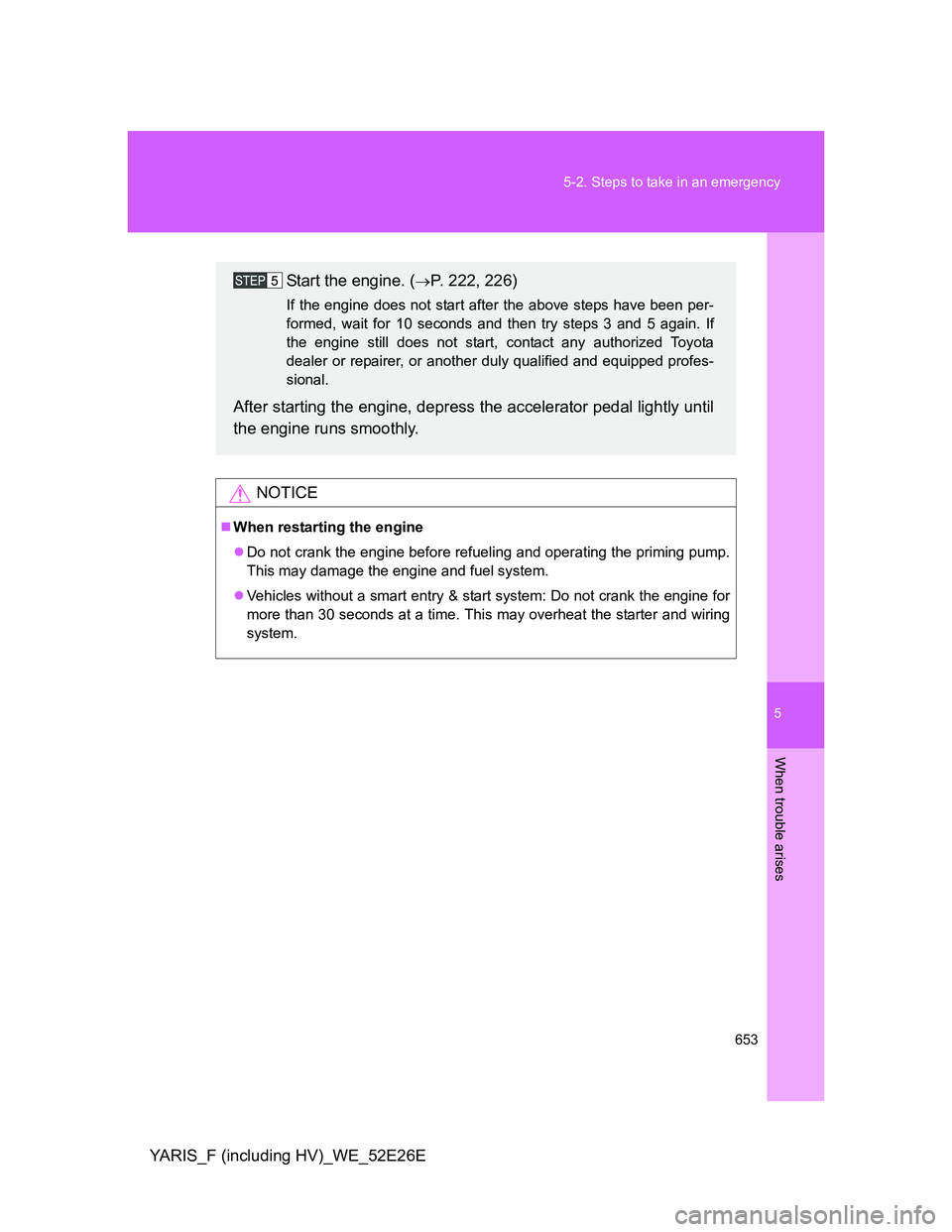
Start the engine. (P. 222, 226)
If the engine does not start after the above steps have been per-
formed, wait for 10 seconds and then try steps 3 and 5 again. If
the engine still does not start, contact any authorized Toyota
dealer or repairer, or another duly qualified and equipped profes-
sional.
After starting the engine, depress the accelerator pedal lightly until
the engine runs smoothly.
Page 675 of 712
675 6-1. Specifications
6
Vehicle specifications
YARIS_F(including HV)_WE_52E26E
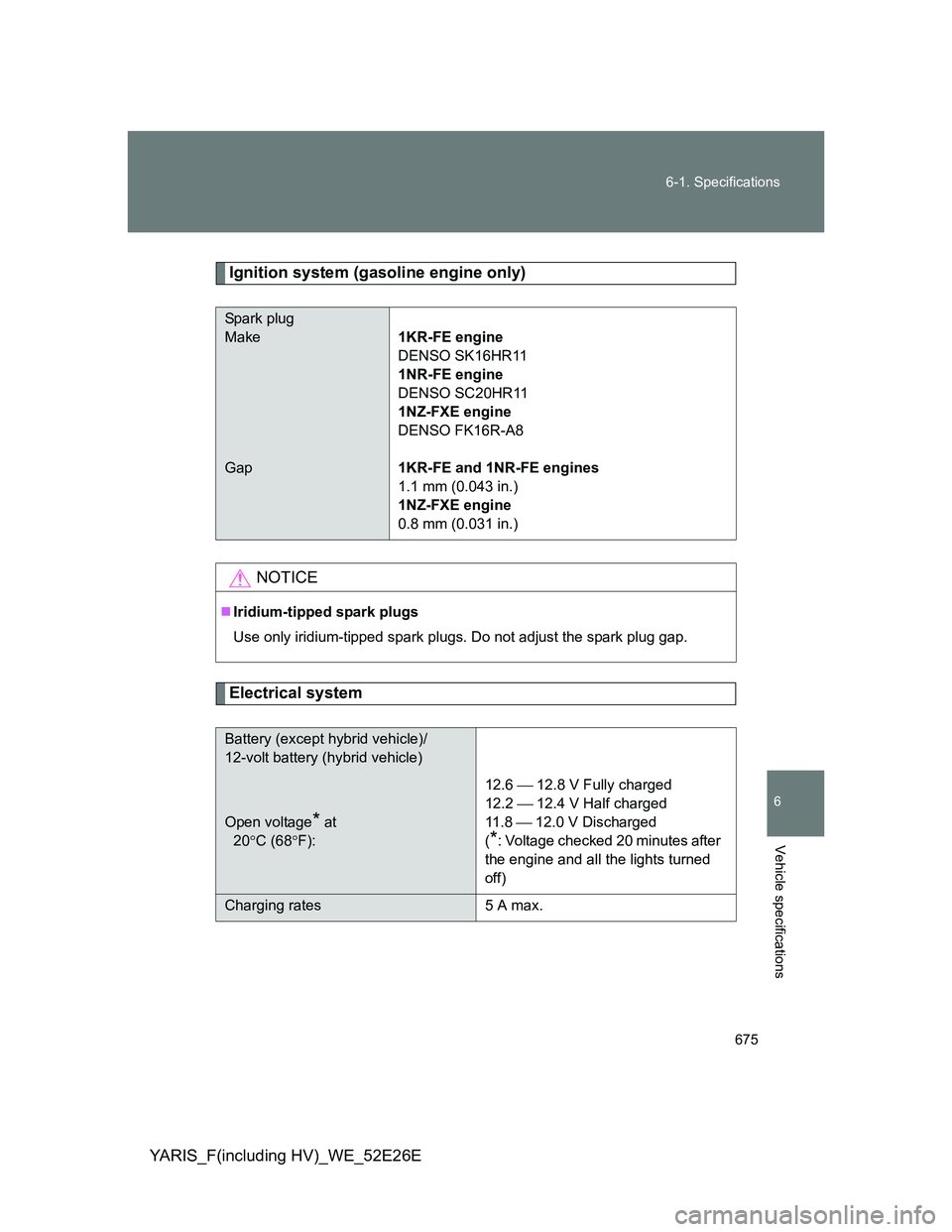
Ignition system (gasoline engine only)
Electrical system
Spark plug
Make
Gap1KR-FE engine
DENSO SK16HR11
1NR-FE engine
DENSO SC20HR11
1NZ-FXE engine
DENSO FK16R-A8
1KR-FE and 1NR-FE engines
1.1 mm (0.043 in.)
1NZ-FXE engine
0.8 mm (0.031 in.)
NOTICE
Iridium-tipped spark plugs
Use only iridium-tipped spark plugs. Do not adjust the spark plug gap.
Battery (except hybrid vehicle)/
12-volt battery (hybrid vehicle)
Open voltage* at
20C (68F):12.6 12.8 V Fully charged
12.2 12.4 V Half charged
11 . 8 12.0 V Discharged
(
*: Voltage checked 20 minutes after
the engine and all the lights turned
off)
Charging rates 5 A max.
Page 684 of 712
684 6-1. Specifications
YARIS_F(including HV)_WE_52E26E
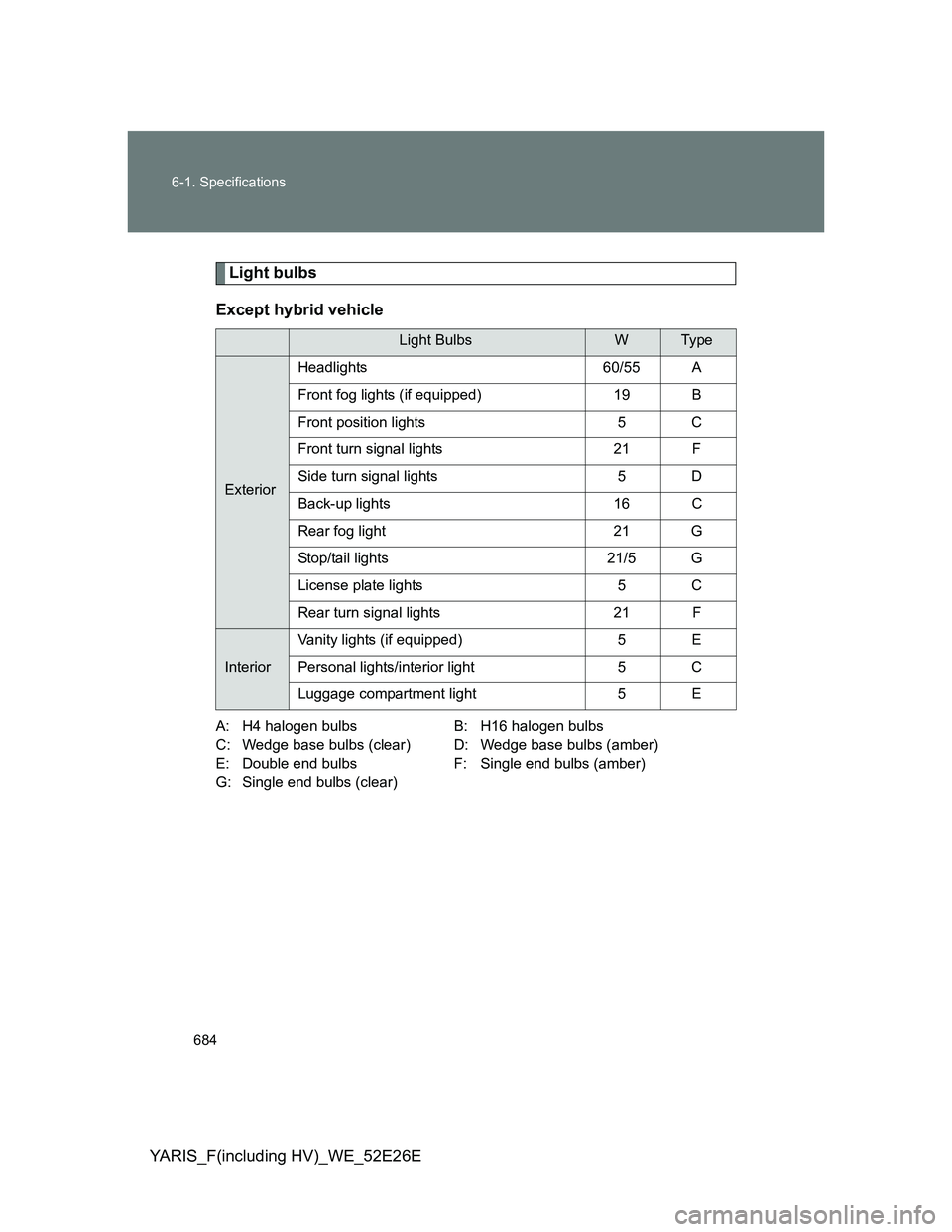
Light bulbs
Except hybrid vehicle
A: H4 halogen bulbs B: H16 halogen bulbs
C: Wedge base bulbs (clear) D: Wedge base bulbs (amber)
E: Double end bulbs F: Single end bulbs (amber)
G: Single end bulbs (clear)
Light BulbsWTy p e
ExteriorHeadlights 60/55 A
Front fog lights (if equipped) 19 B
Front position lights 5 C
Front turn signal lights 21 F
Side turn signal lights 5 D
Back-up lights 16 C
Rear fog light 21 G
Stop/tail lights 21/5 G
License plate lights 5 C
Rear turn signal lights 21 F
InteriorVanity lights (if equipped) 5 E
Personal lights/interior light 5 C
Luggage compartment light 5 E
Page 685 of 712
685 6-1. Specifications
6
Vehicle specifications
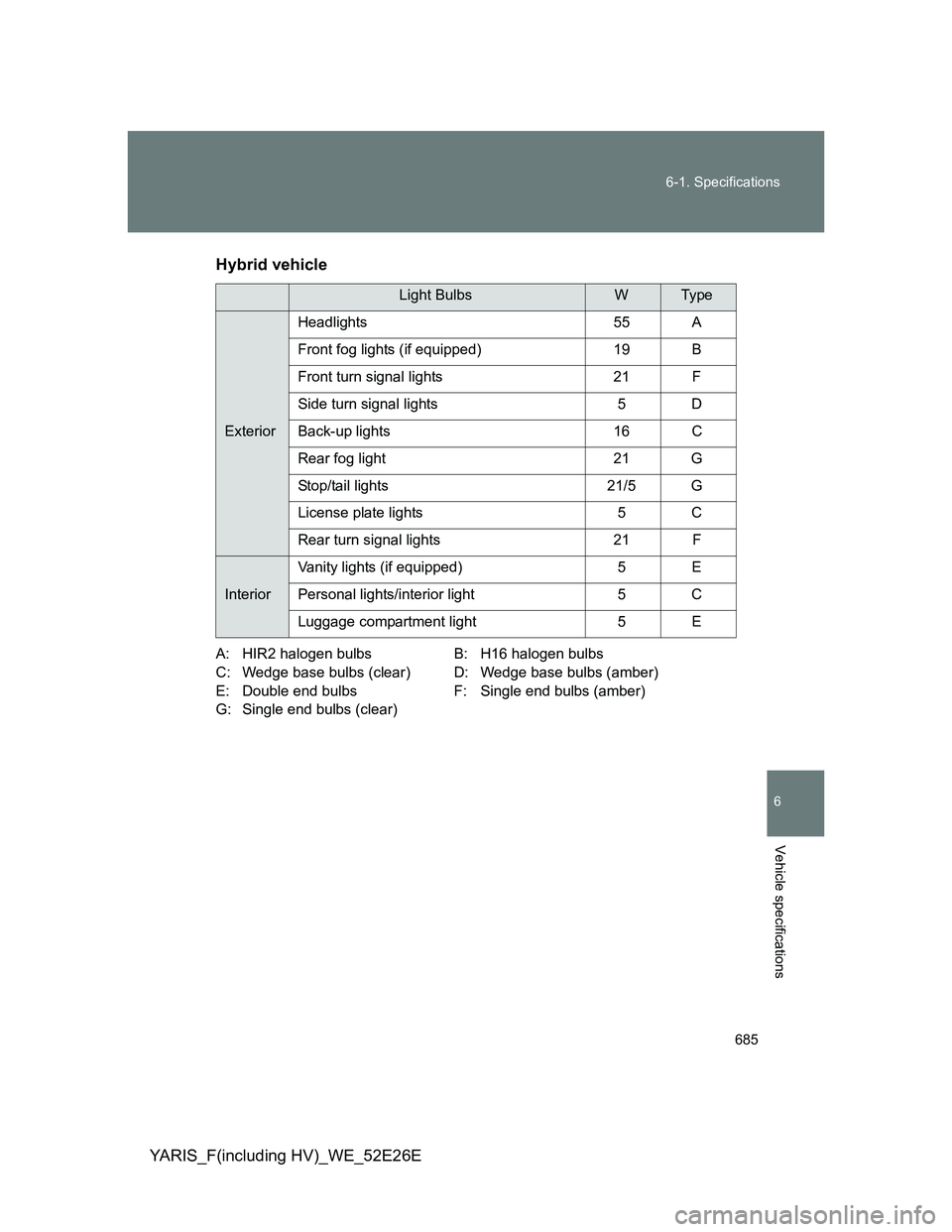
YARIS_F(including HV)_WE_52E26EHybrid vehicle
A: HIR2 halogen bulbs B: H16 halogen bulbs
C: Wedge base bulbs (clear) D: Wedge base bulbs (amber)
E: Double end bulbs F: Single end bulbs (amber)
G: Single end bulbs (clear)
Light BulbsWTy p e
ExteriorHeadlights 55 A
Front fog lights (if equipped) 19 B
Front turn signal lights 21 F
Side turn signal lights 5 D
Back-up lights 16 C
Rear fog light 21 G
Stop/tail lights 21/5 G
License plate lights 5 C
Rear turn signal lights 21 F
InteriorVanity lights (if equipped) 5 E
Personal lights/interior light 5 C
Luggage compartment light 5 E
Page 687 of 712
687 6-1. Specifications
6
Vehicle specifications
YARIS_F(including HV)_WE_52E26E
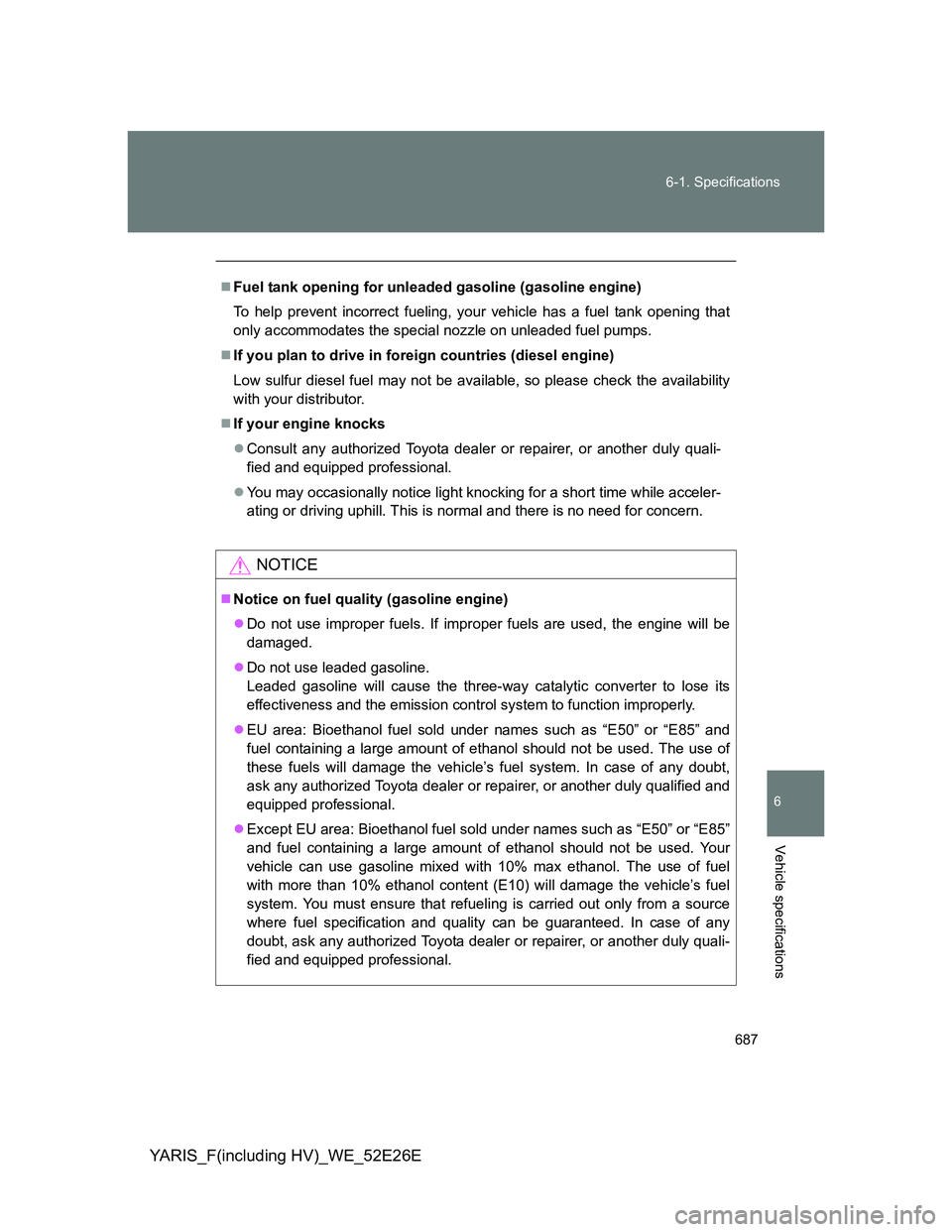
Fuel tank opening for unleaded gasoline (gasoline engine)
To help prevent incorrect fueling, your vehicle has a fuel tank opening that
only accommodates the special nozzle on unleaded fuel pumps.
If you plan to drive in foreign countries (diesel engine)
Low sulfur diesel fuel may not be available, so please check the availability
with your distributor.
If your engine knocks
Consult any authorized Toyota dealer or repairer, or another duly quali-
fied and equipped professional.
You may occasionally notice light knocking for a short time while acceler-
ating or driving uphill. This is normal and there is no need for concern.
NOTICE
Notice on fuel quality (gasoline engine)
Do not use improper fuels. If improper fuels are used, the engine will be
damaged.
Do not use leaded gasoline.
Leaded gasoline will cause the three-way catalytic converter to lose its
effectiveness and the emission control system to function improperly.
EU area: Bioethanol fuel sold under names such as “E50” or “E85” and
fuel containing a large amount of ethanol should not be used. The use of
these fuels will damage the vehicle’s fuel system. In case of any doubt,
ask any authorized Toyota dealer or repairer, or another duly qualified and
equipped professional.
Except EU area: Bioethanol fuel sold under names such as “E50” or “E85”
and fuel containing a large amount of ethanol should not be used. Your
vehicle can use gasoline mixed with 10% max ethanol. The use of fuel
with more than 10% ethanol content (E10) will damage the vehicle’s fuel
system. You must ensure that refueling is carried out only from a source
where fuel specification and quality can be guaranteed. In case of any
doubt, ask any authorized Toyota dealer or repairer, or another duly quali-
fied and equipped professional.