ECO mode TOYOTA YARIS 2014 Repair Manual
[x] Cancel search | Manufacturer: TOYOTA, Model Year: 2014, Model line: YARIS, Model: TOYOTA YARIS 2014Pages: 712, PDF Size: 30.2 MB
Page 620 of 712
620 5-2. Steps to take in an emergency
YARIS_F (including HV)_WE_52E26E
Emergency start function (vehicles with an electronic key)
When the hybrid system does not start, the following steps can be
used as an interim measure to start the hybrid system if the
“POWER” switch is functioning normally:
Shift the shift lever to P.
Set the parking brake.
Turn the “POWER” switch to ACCESSORY mode.
Press and hold the “POWER” switch for about 15 seconds
while depressing the brake pedal firmly.
Even if the hybrid system can be started using the above steps, the
system may be malfunctioning. Have the vehicle inspected by any
authorized Toyota dealer or repairer, or another duly qualified and
equipped professional.
The Interior lights and headlights do not turn on, or the horn
does not sound.
One of the following may be the cause of the problem:
One or both of the 12-volt battery terminals may be discon-
nected.
The 12-volt battery may be discharged. (P. 636)
Contact any authorized Toyota dealer or repairer, or another duly
qualified and equipped professional if the problem cannot be repaired,
or if repair procedures are unknown.
Page 628 of 712
628 5-2. Steps to take in an emergency
YARIS_F (including HV)_WE_52E26E
Replacing the key battery
As the above procedure is a temporary measure, it is recommended that the
electronic key battery be replaced immediately when the battery is depleted.
(P. 501)
Changing “ENGINE START STOP” switch modes (except hybrid vehi-
cle)
Vehicles with a Multidrive or multi-mode manual transmission: Release
the brake pedal and press the “ENGINE START STOP” switch in
above. (P. 625, 626)
The engine does not start and modes will be changed each time the
switch is pressed. (P. 230)
Vehicles with a manual transmission: Release the clutch pedal and press
the “ENGINE START STOP” switch in
above. (P. 626)
The engine does not start and modes will be changed each time the
switch is pressed. (P. 230)
Changing “POWER” switch modes (hybrid vehicle)
Release the brake pedal and press the “POWER” switch in above.
(P. 627)
The hybrid system does not start and modes will be changed each time the
switch is pressed. (P. 243)
If the doors cannot be locked or unlocked by the smart entry & start
system
Lock and unlock the doors by the mechanical key or wireless remote control.
When the electronic key does not work properly
Make sure that the smart entry & start system has not been deactivated in
the customization setting. If it is off, turn the function on.
(Customizable features P. 689)
Page 632 of 712
632 5-2. Steps to take in an emergency
YARIS_F (including HV)_WE_52E26E
Vehicles without a smart entry & start system: Maintain the
engine speed of the second vehicle and turn the engine
switch to the “ON” position, then start the vehicle’s engine.
Vehicles with a smart entry & start system: Maintain the
engine speed of the second vehicle and turn the “ENGINE
START STOP” switch to IGNITION ON mode, then start the
vehicle’s engine.
Once the vehicle’s engine has started, remove the jumper
cables in the exact reverse order from which they were con-
nected.
Once the engine starts, have the vehicle inspected at any autho-
rized Toyota dealer or repairer, or another duly qualified and
equipped professional as soon as possible.
Page 633 of 712
5
633 5-2. Steps to take in an emergency
When trouble arises
YARIS_F (including HV)_WE_52E26E
Starting the engine when the battery is discharged (vehicles with a
Multidrive)
The engine cannot be started by push-starting.
To prevent battery discharge
Turn off the headlights and the audio system while the engine is off.
Turn off any unnecessary electrical components when the vehicle is run-
ning at a low speed for an extended period, such as in heavy traffic.
Charging the battery
The electricity stored in the battery will discharge gradually even when the
vehicle is not in use, due to natural discharge and the draining effects of cer-
tain electrical appliances. If the vehicle is left for a long time, the battery may
discharge, and the engine may be unable to start. (The battery recharges
automatically during driving.)
Precautions when the battery is discharged (vehicles with a smart
entry & start system)
In some cases, it may not be possible to unlock the doors using the smart
entry & start system when the battery is discharged. Use the wireless
remote control or the mechanical key to lock or unlock the doors.
The engine may not start on the first attempt after the battery has
recharged but will start normally after the second attempt. This is not a
malfunction.
The “ENGINE START STOP” switch mode is memorized by the vehicle.
When the battery is reconnected, the system will return to the mode it
was in before the battery was discharged. Before disconnecting the bat-
tery, turn the “ENGINE START STOP” switch off.
If you are unsure what mode the “ENGINE START STOP” switch was in
before the battery discharged, be especially careful when reconnecting
the battery.
Page 638 of 712

638 5-2. Steps to take in an emergency
YARIS_F (including HV)_WE_52E26E
Starting the hybrid system when the 12-volt battery is discharged
The hybrid system cannot be started by push-starting.
To prevent 12-volt battery discharge
Turn off the headlights and the audio system while the hybrid system is
off.
Turn off any unnecessary electrical components when the vehicle is run-
ning at a low speed for an extended period, such as in heavy traffic.
Precautions when the 12-volt battery is discharged
In some cases, it may not be possible to unlock the doors using the smart
entry & start system immediately after the 12-volt battery has been dis-
connected and reconnected. Use the wireless remote control or the
mechanical key to lock or unlock the doors.
Maintain the engine speed of the second vehicle and start
the hybrid system of your vehicle by turning the engine
switch (vehicles without an electronic key) to “ON” position
or “POWER” switch (vehicles with an electronic key) to ON
mode.
Make sure the “READY” indicator comes on. If the indicator
does not come on, contact any authorized Toyota dealer or
repairer, or another duly qualified and equipped profes-
sional.
Once the hybrid system has started, remove the jumper
cables in the exact reverse order from which they were con-
nected.
Close the exclusive jump starting terminal cover, and rein-
stall the fuse box cover to its original position.
When installing, first hook the fuse box cover onto the two rear
tabs.
Once the hybrid system starts, have the vehicle inspected at any
authorized Toyota dealer or repairer, or another duly qualified and
equipped professional as soon as possible.
Page 639 of 712
5
639 5-2. Steps to take in an emergency
When trouble arises
YARIS_F (including HV)_WE_52E26E
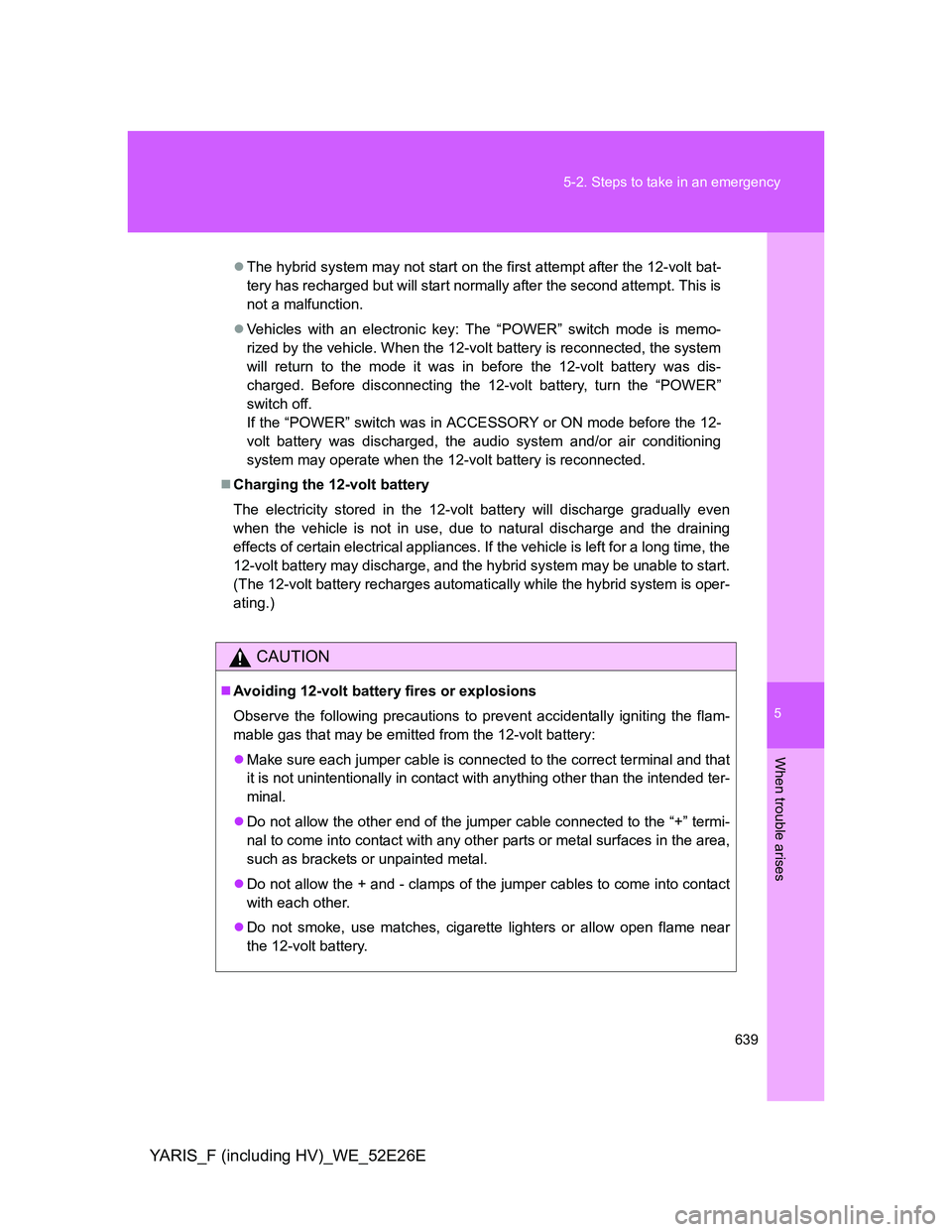
The hybrid system may not start on the first attempt after the 12-volt bat-
tery has recharged but will start normally after the second attempt. This is
not a malfunction.
Vehicles with an electronic key: The “POWER” switch mode is memo-
rized by the vehicle. When the 12-volt battery is reconnected, the system
will return to the mode it was in before the 12-volt battery was dis-
charged. Before disconnecting the 12-volt battery, turn the “POWER”
switch off.
If the “POWER” switch was in ACCESSORY or ON mode before the 12-
volt battery was discharged, the audio system and/or air conditioning
system may operate when the 12-volt battery is reconnected.
Charging the 12-volt battery
The electricity stored in the 12-volt battery will discharge gradually even
when the vehicle is not in use, due to natural discharge and the draining
effects of certain electrical appliances. If the vehicle is left for a long time, the
12-volt battery may discharge, and the hybrid system may be unable to start.
(The 12-volt battery recharges automatically while the hybrid system is oper-
ating.)
CAUTION
Avoiding 12-volt battery fires or explosions
Observe the following precautions to prevent accidentally igniting the flam-
mable gas that may be emitted from the 12-volt battery:
Make sure each jumper cable is connected to the correct terminal and that
it is not unintentionally in contact with anything other than the intended ter-
minal.
Do not allow the other end of the jumper cable connected to the “+” termi-
nal to come into contact with any other parts or metal surfaces in the area,
such as brackets or unpainted metal.
Do not allow the + and - clamps of the jumper cables to come into contact
with each other.
Do not smoke, use matches, cigarette lighters or allow open flame near
the 12-volt battery.
Page 654 of 712
654
5-2. Steps to take in an emergency
YARIS_F (including HV)_WE_52E26E
If the vehicle becomes stuck
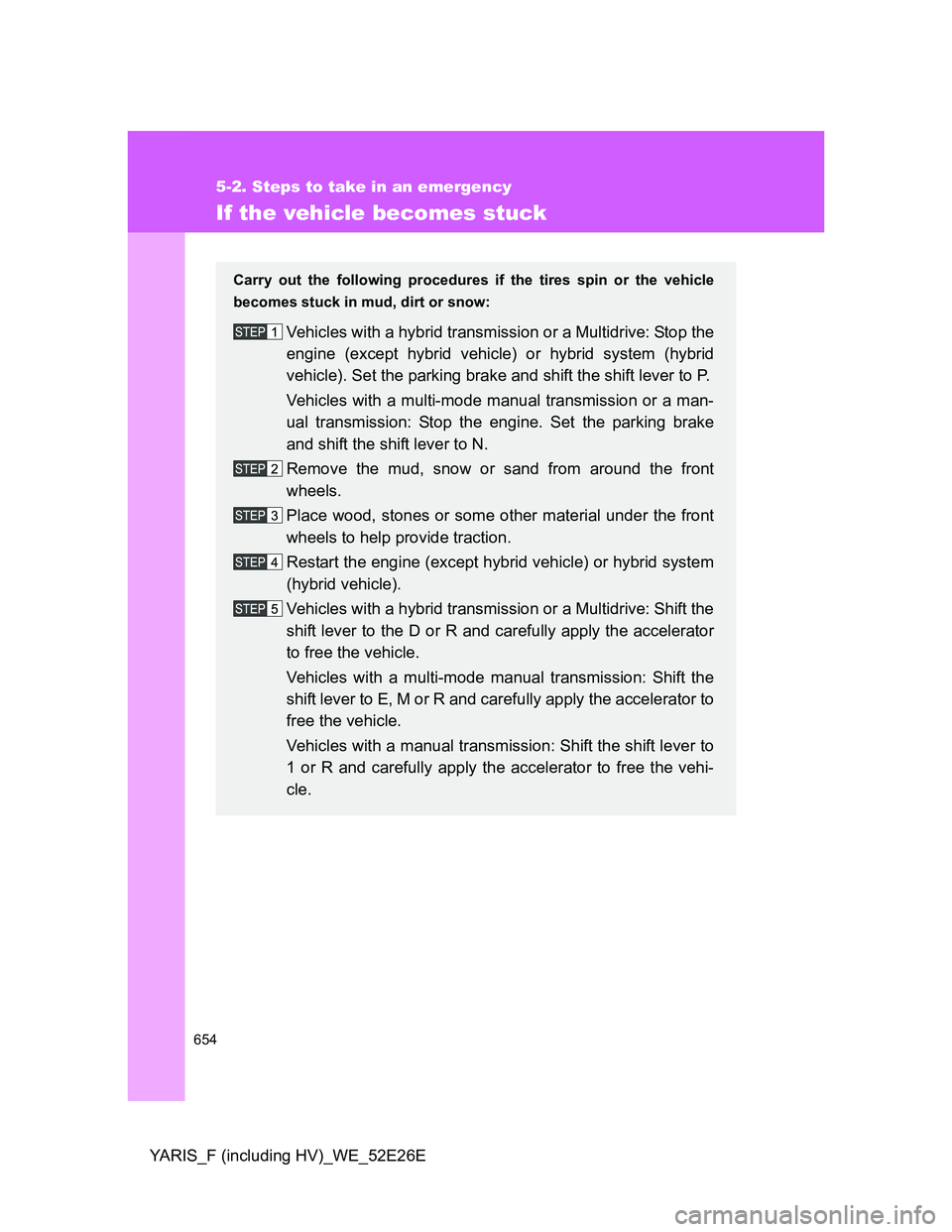
Carry out the following procedures if the tires spin or the vehicle
becomes stuck in mud, dirt or snow:
Vehicles with a hybrid transmission or a Multidrive: Stop the
engine (except hybrid vehicle) or hybrid system (hybrid
vehicle). Set the parking brake and shift the shift lever to P.
Vehicles with a multi-mode manual transmission or a man-
ual transmission: Stop the engine. Set the parking brake
and shift the shift lever to N.
Remove the mud, snow or sand from around the front
wheels.
Place wood, stones or some other material under the front
wheels to help provide traction.
Restart the engine (except hybrid vehicle) or hybrid system
(hybrid vehicle).
Vehicles with a hybrid transmission or a Multidrive: Shift the
shift lever to the D or R and carefully apply the accelerator
to free the vehicle.
Vehicles with a multi-mode manual transmission: Shift the
shift lever to E, M or R and carefully apply the accelerator to
free the vehicle.
Vehicles with a manual transmission: Shift the shift lever to
1 or R and carefully apply the accelerator to free the vehi-
cle.
Page 667 of 712
667 6-1. Specifications
6
Vehicle specifications
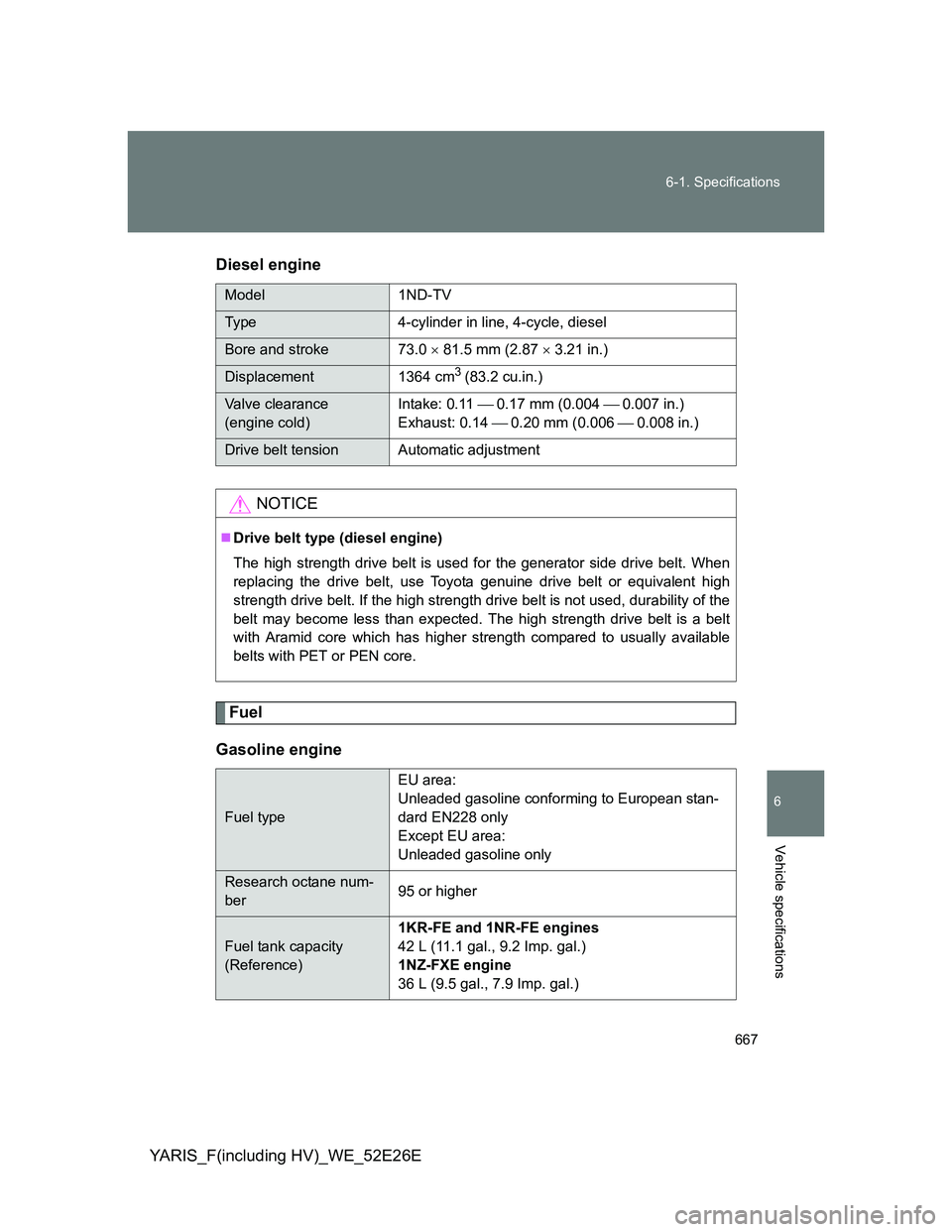
YARIS_F(including HV)_WE_52E26EDiesel engine
Fuel
Gasoline engine
Model 1ND-TV
Type 4-cylinder in line, 4-cycle, diesel
Bore and stroke 73.0 81.5 mm (2.87 3.21 in.)
Displacement 1364 cm3 (83.2 cu.in.)
Valve clearance
(engine cold)Intake: 0.11 0.17 mm (0.004 0.007 in.)
Exhaust: 0.14 0.20 mm (0.006 0.008 in.)
Drive belt tension Automatic adjustment
NOTICE
Drive belt type (diesel engine)
The high strength drive belt is used for the generator side drive belt. When
replacing the drive belt, use Toyota genuine drive belt or equivalent high
strength drive belt. If the high strength drive belt is not used, durability of the
belt may become less than expected. The high strength drive belt is a belt
with Aramid core which has higher strength compared to usually available
belts with PET or PEN core.
Fuel typeEU area:
Unleaded gasoline conforming to European stan-
dard EN228 only
Except EU area:
Unleaded gasoline only
Research octane num-
ber95 or higher
Fuel tank capacity
(Reference)1KR-FE and 1NR-FE engines
42 L (11.1 gal., 9.2 Imp. gal.)
1NZ-FXE engine
36 L (9.5 gal., 7.9 Imp. gal.)
Page 681 of 712
681 6-1. Specifications
6
Vehicle specifications
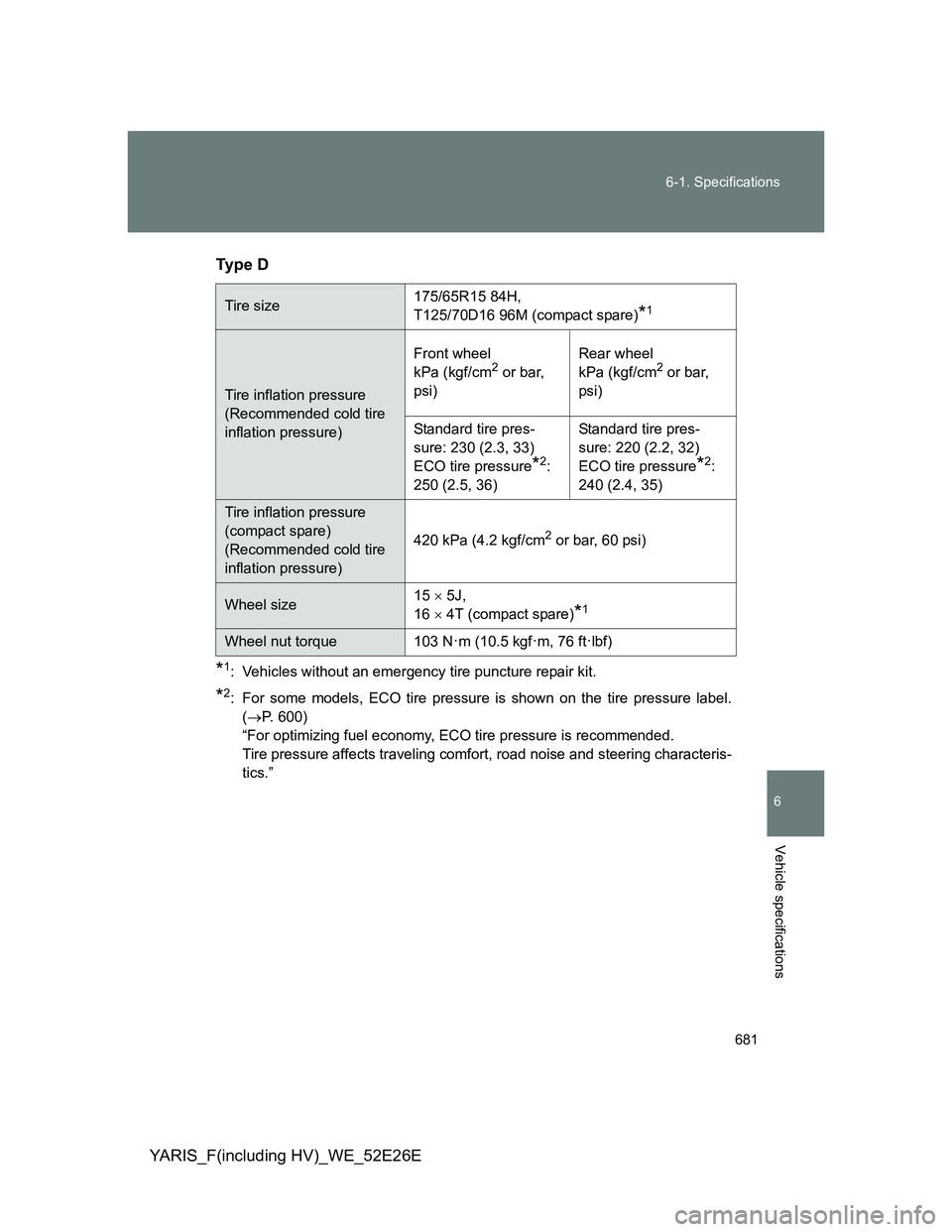
YARIS_F(including HV)_WE_52E26ETy p e D
*1: Vehicles without an emergency tire puncture repair kit.
*2: For some models, ECO tire pressure is shown on the tire pressure label.
(P. 600)
“For optimizing fuel economy, ECO tire pressure is recommended.
Tire pressure affects traveling comfort, road noise and steering characteris-
tics.”
Tire size175/65R15 84H,
T125/70D16 96M (compact spare)*1
Tire inflation pressure
(Recommended cold tire
inflation pressure)Front wheel
kPa (kgf/cm
2 or bar,
psi)Rear wheel
kPa (kgf/cm2 or bar,
psi)
Standard tire pres-
sure: 230 (2.3, 33)
ECO tire pressure
*2:
250 (2.5, 36)Standard tire pres-
sure: 220 (2.2, 32)
ECO tire pressure*2:
240 (2.4, 35)
Tire inflation pressure
(compact spare)
(Recommended cold tire
inflation pressure)420 kPa (4.2 kgf/cm
2 or bar, 60 psi)
Wheel size15 5J,
16 4T (compact spare)*1
Wheel nut torque 103 N·m (10.5 kgf·m, 76 ft·lbf)
Page 691 of 712
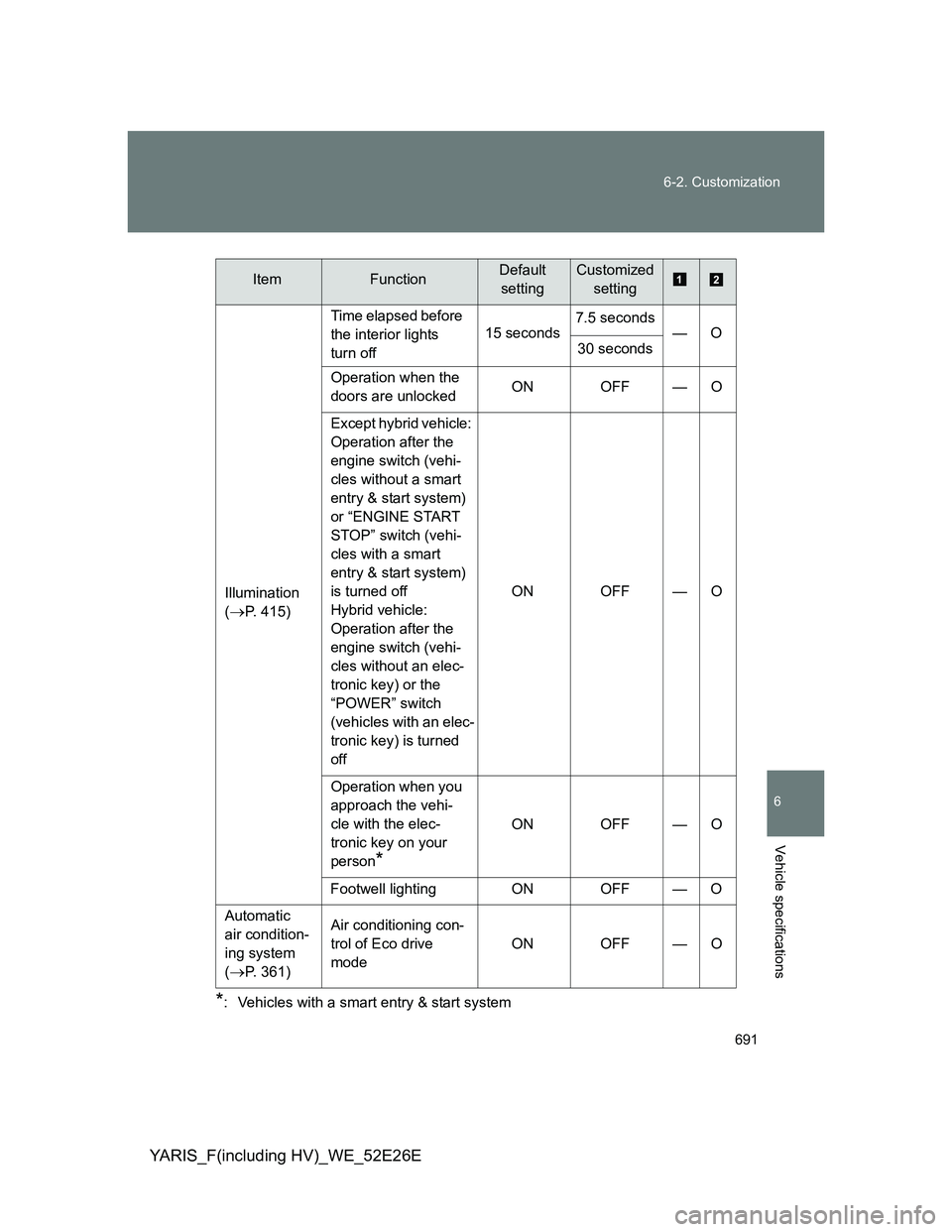
691 6-2. Customization
6
Vehicle specifications
YARIS_F(including HV)_WE_52E26E
*: Vehicles with a smart entry & start systemIllumination
(
P. 415)Time elapsed before
the interior lights
turn off15 seconds7.5 seconds
—O
30 seconds
Operation when the
doors are unlockedON OFF — O
Except hybrid vehicle:
Operation after the
engine switch (vehi-
cles without a smart
entry & start system)
or “ENGINE START
STOP” switch (vehi-
cles with a smart
entry & start system)
is turned off
Hybrid vehicle:
Operation after the
engine switch (vehi-
cles without an elec-
tronic key) or the
“POWER” switch
(vehicles with an elec-
tronic key) is turned
offON OFF — O
Operation when you
approach the vehi-
cle with the elec-
tronic key on your
person
*
ON OFF — O
Footwell lighting ON OFF — O
Automatic
air condition-
ing system
(
P. 361)Air conditioning con-
trol of Eco drive
modeON OFF — O
ItemFunctionDefault
settingCustomized
setting