light TOYOTA YARIS 2016 3.G Owners Manual
[x] Cancel search | Manufacturer: TOYOTA, Model Year: 2016, Model line: YARIS, Model: TOYOTA YARIS 2016 3.GPages: 368, PDF Size: 7.86 MB
Page 291 of 368
2917-2. Steps to take in an emergency
7
When trouble arises
■The compact spare tire
●The compact spare tire is identified by the label “TEMPORARY USE
ONLY” on the tire sidewall.
Use the compact spare tire temporarily, and only in an emergency.
●Make sure to check the tire inflatio n pressure of the compact spare tire.
( P. 315)
■After completing the tire change (vehicles with a tire pressure warn-
ing system)
The tire pressure warning system must be reset. ( P. 224)
■When using the compact spare tire (vehicles with a tire pressure
warning system)
As the compact spare tire is not equipped with a tire pressure warning
valve and transmitter, lo w inflation pressure of the spare tire will not be
indicated by the tire pressure warning system. Also, if you replace the
compact spare tire after the tire pressure warning light comes on, the light
remains on.
■If you have a flat front tire on a road covered with snow or ice
Install the compact spare tire on one of the rear wheels of the vehicle.
Perform the following steps and fit tire chains to the front tires:
Replace a rear tire with the compact spare tire.
Replace the flat front tire with the tire removed from the rear of the
vehicle.
Fit tire chains to the front tires.
1
2
3
Page 294 of 368
2947-2. Steps to take in an emergency
If the engine will not start
One of the following may be the cause of the problem:
●There may not be sufficient fuel in the vehicle’s tank.
Refuel the vehicle.
● The engine may be flooded.
Try to restart the engine again following correct starting procedures.
( P. 136)
● Vehicles with engine immobilizer system: There may be a malfunc-
tion in the engine i mmobilizer system. ( P. 6 7 )
One of the following may be the cause of the problem:
● The battery may be discharged. ( P. 297)
● The battery terminal connections may be loose or corroded.
If the engine will not start even though correct starting proce-
dures are being followed ( P. 136), consider each of the follow-
ing points:
The engine will not start even though the starter motor operates
normally.
The starter motor turns over slowly, the interior lights and head-
lights are dim, or the horn does not sound or sounds at a low
volume.
Page 295 of 368
2957-2. Steps to take in an emergency
7
When trouble arises
One of the following may be the cause of the problem:
●One or both of the battery terminals may be disconnected.
● The battery may be discharged. ( P. 297)
● There may be a malfunction in the steering lock system (vehicles
with a smart entry & start system).
Contact your Toyota dealer if the problem cannot be repaired, or if repair
procedures are unknown.
The starter motor does not turn ov er, the interior lights and head-
lights do not turn on, or the horn does not sound.
Page 298 of 368
2987-2. Steps to take in an emergency
Start the engine of the second vehicle. Increase the engine speed
slightly and maintain at that level for approximately 5 minutes to
recharge the batter y of your vehicle.
Maintain the engine speed of t he second vehicle and start the
engine of your vehicle.
Once the vehicle’s engine has started, remove the jumper cables in
the exact reverse order from which they were connected.
Once the engine starts, have the vehicle inspected at your Toyota
dealer as soon as possible.
■ Starting the engine when the battery is discharged (vehicles with an
automatic transmission)
The engine cannot be started by push-starting.
■ To prevent battery discharge
●Turn off the headlights and the audio system while the engine is not running.
● Turn off any unnecessary electrical components when the vehicle is running
at a low speed for an extended period, such as in heavy traffic.
■ Charging the battery
The electricity stored in the battery will discharge gradually even when the
vehicle is not in use, due to natural discharge and the draining effects of cer-
tain electrical appliances. If the vehicle is left for a long time, the battery may
discharge, and the engine may be unable to start. (The battery recharges
automatically during driving.)
3
4
5
Page 299 of 368
2997-2. Steps to take in an emergency
7
When trouble arises
WARNING
■Avoiding battery fires or explosions
Observe the following precautions to prevent accidentally igniting the flam-
mable gas that may be emitted from the battery:
● Make sure each jumper cable is connected to the correct terminal and that
it is not unintentionally in contact with anything other than the intended ter-
minal.
● Do not allow the + and - clamps of the jumper cables to come into contact
with each other.
● Do not smoke, use matches, cigarette lighters or allow open flame near
the battery.
■ Battery precautions
The battery contains poisonous and corrosive acidic electrolyte, while
related parts contain lead and lead compounds. Observe the following pre-
cautions when handling the battery:
● When working with the battery, always wear safety glasses and take care
not to allow any battery fluids (acid) to come into contact with skin, clothing
or the vehicle body.
● Do not lean over the battery.
● In the event that battery fluid comes into contact with the skin or eyes,
immediately wash the affected area with water and seek medical attention.
Place a wet sponge or cloth over the affected area until medical attention
can be received.
● Always wash your hands after handling the battery support, terminals, and
other battery-related parts.
● Do not allow children near the battery.
■ To prevent damage to the vehicle
Do not pull- or push-start the vehicle as the three-way catalytic converter
may overheat and become a fire hazard.
NOTICE
■When handling jumper cables
When connecting the jumper cables, ensure that they do not become entan-
gled in the cooling fans or engine drive belt.
Page 300 of 368
3007-2. Steps to take in an emergency
If your vehicle overheats
●The high engine coolant temperature warning light ( P. 272)
comes on or flashes, or a loss of engine power is experienced. (For
example, the vehicle sp eed does not increase.)
● Steam comes out from under the hood.
Stop the vehicle in a safe place and turn off the air conditioning sys-
tem, and then stop the engine.
If you see steam:
Carefully lift the hood after the steam subsides.
If you do not see steam:
Carefully lift the hood.
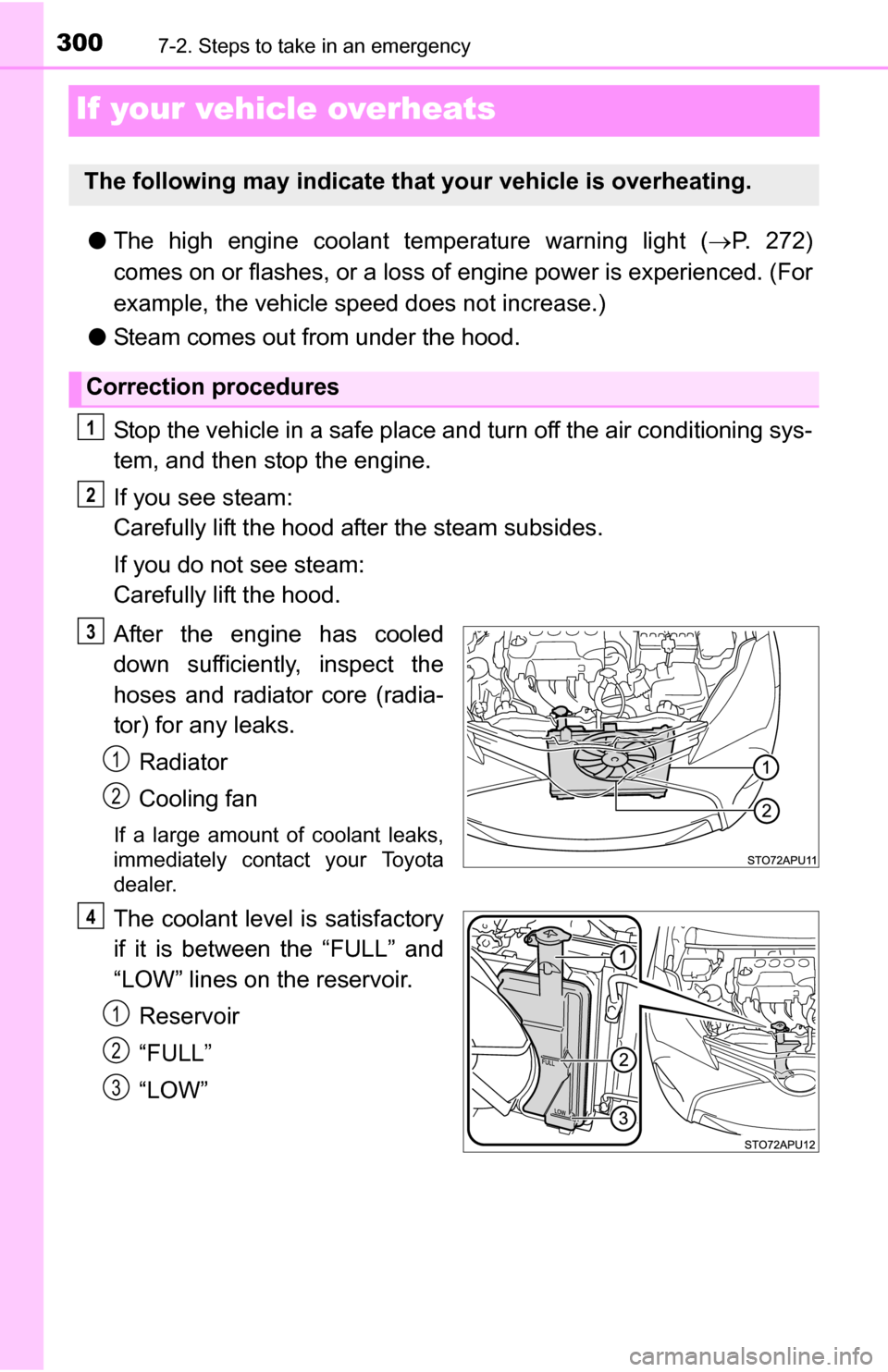
After the engine has cooled
down sufficient ly, inspect the
hoses and radiator core (radia-
tor) for any leaks.
Radiator
Cooling fan
If a large amount of coolant leaks,
immediately contact your Toyota
dealer.
The coolant level is satisfactory
if it is between the “FULL” and
“LOW” lines on the reservoir.Reservoir
“FULL”
“LOW”
The following may indicate that your vehicle is overheating.
Correction procedures
1
2
3
1
2
4
1
2
3
Page 312 of 368
3128-1. Specifications
*: The fluid capacity is the reference quantity. If replacement is necessary,contact your Toyota dealer.
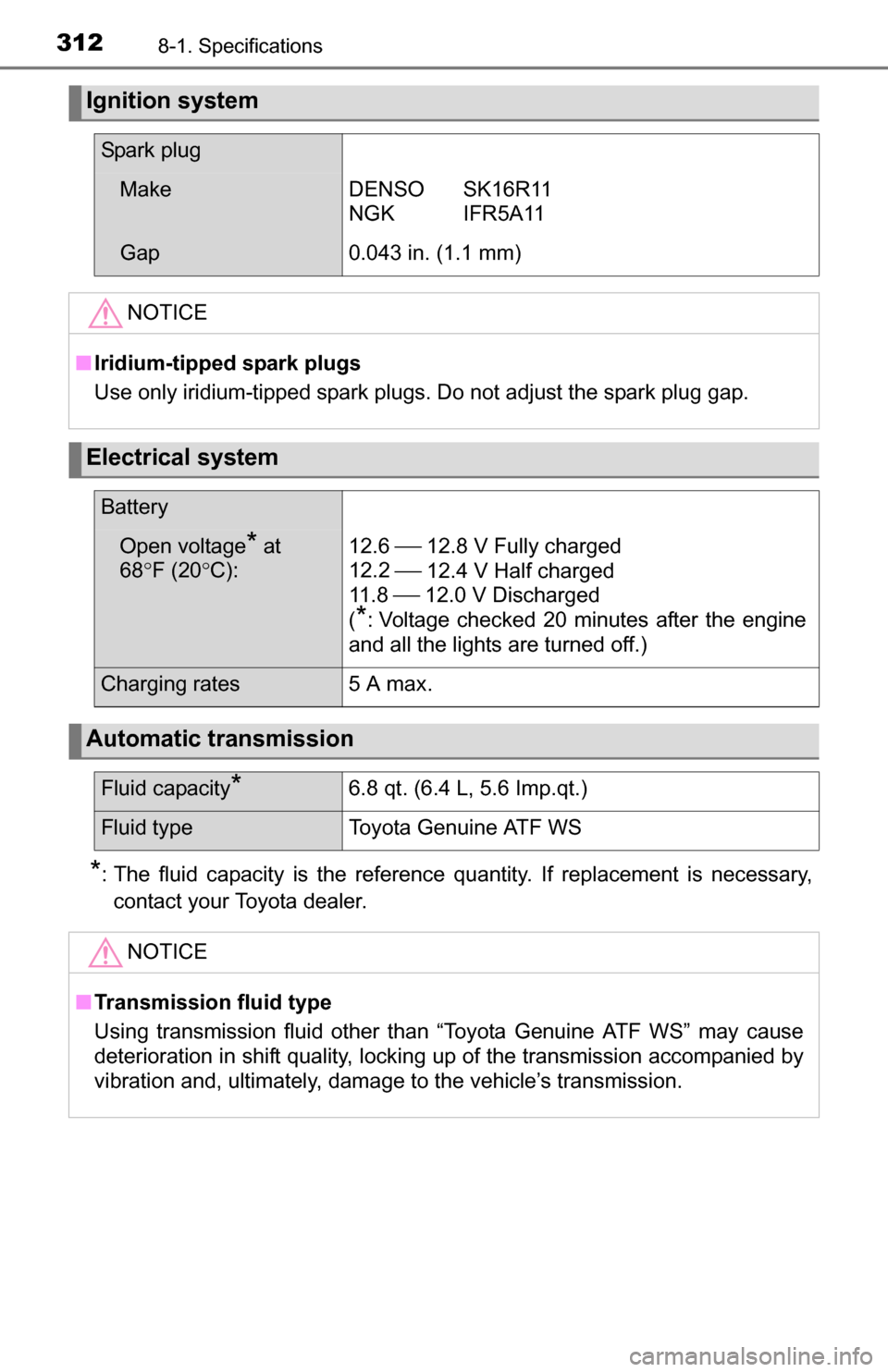
Ignition system
Spark plug
MakeDENSO SK16R11
NGK IFR5A11
Gap0.043 in. (1.1 mm)
NOTICE
■ Iridium-tipped spark plugs
Use only iridium-tipped spark plugs. Do not adjust the spark plug gap.
Electrical system
Battery
Open voltage* at
68 F (20 C): 12.6 12.8 V Fully charged
12.2
12.4 V Half charged
11 . 8
12.0 V Discharged
(
*: Voltage checked 20 minutes after the engine
and all the lights are turned off.)
Charging rates 5 A max.
Automatic transmission
Fluid capacity*6.8 qt. (6.4 L, 5.6 Imp.qt.)
Fluid typeToyota Genuine ATF WS
NOTICE
■Transmission fluid type
Using transmission fluid other than “Toyota Genuine ATF WS” may cause
deterioration in shift quality, locking up of the transmission accompanied by
vibration and, ultimately, damage to the vehicle’s transmission.
Page 316 of 368
3168-1. Specifications
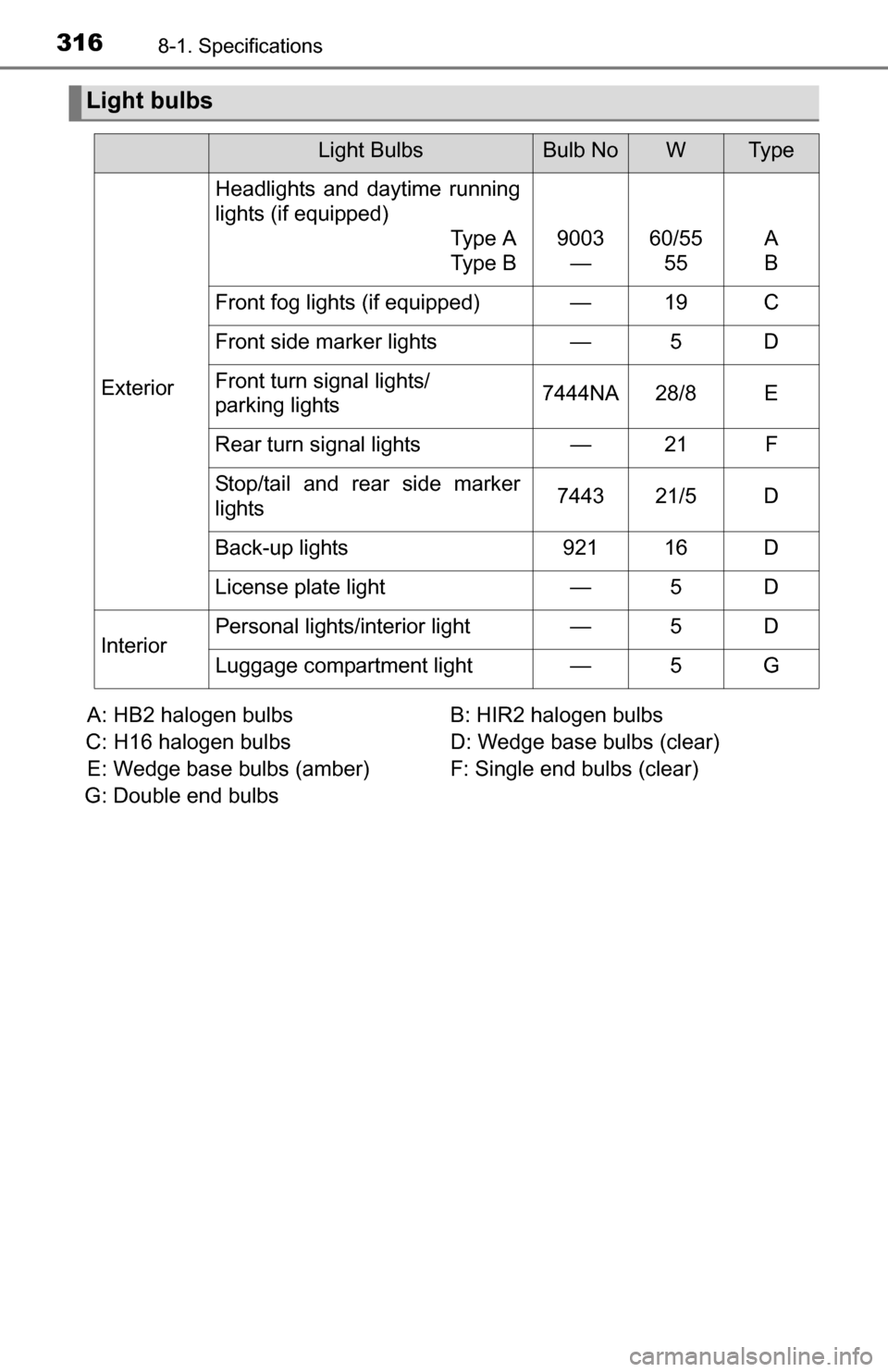
A: HB2 halogen bulbs B: HIR2 halogen bulbs
C: H16 halogen bulbs D: Wedge base bulbs (clear)
E: Wedge base bulbs (amber) F: Single end bulbs (clear)
G: Double end bulbs
Light bulbs
Light BulbsBulb NoWTy p e
Exterior Headlights and daytime running
lights (if equipped)
Type A
Type B9003
— 60/55
55 A
B
Front fog lights (if equipped) — 19 C
Front side marker lights — 5 D
Front turn signal lights/
parking lights 7444NA 28/8 E
Rear turn signal lights — 21 F
Stop/tail and rear side marker
lights 7443 21/5 D
Back-up lights 921 16 D
License plate light — 5 D
Interior
Personal lights/interior light —5D
Luggage compartment light —5G
Page 319 of 368
3198-1. Specifications
8
Vehicle specifications
■If your engine knocks
●Consult your Toyota dealer.
● You may occasionally notice light knocking for a short time while accelerat-
ing or driving uphill. This is normal and there is no need for concern.
NOTICE
■Notice on fuel quality
● Do not use improper fuels. If improper fuels are used, the engine will be
damaged.
● Do not use leaded gasoline.
Leaded gasoline can cause damage to your vehicle’s three-way catalytic
converters causing the emission control system to malfunction.
● Do not use gasohol other than the type previously stated.
Other gasohol may cause fuel system damage or vehicle performance
problems.
● Using unleaded gasoline with an octane number or rating lower than the
level previously stated will cause persistent heavy knocking.
At worst, this will lead to engine damage.
■ Fuel-related poor driveability
If poor driveability (poor hot starting, vaporization, engine knocking, etc.) is
encountered after using a different type of fuel, discontinue the use of that
type of fuel.
■ When refueling with gasohol
Take care not to spill gasohol. It can damage your vehicle’s paint.
Page 329 of 368
3298-1. Specifications
8
Vehicle specifications
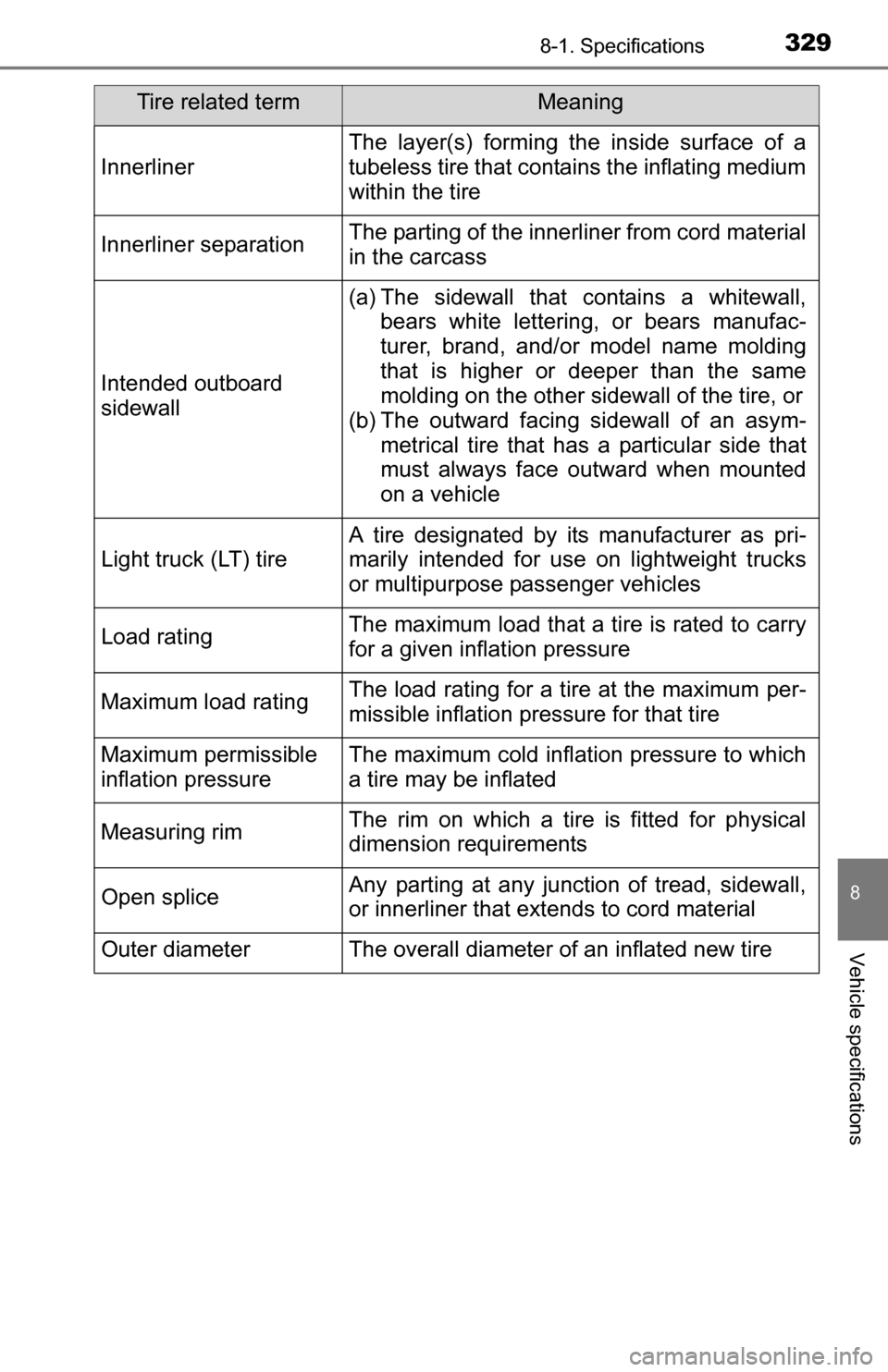
Innerliner
The layer(s) forming the inside surface of a
tubeless tire that contains the inflating medium
within the tire
Innerliner separationThe parting of the innerliner from cord material
in the carcass
Intended outboard
sidewall
(a) The sidewall that contains a whitewall,bears white lettering, or bears manufac-
turer, brand, and/or model name molding
that is higher or deeper than the same
molding on the other sidewall of the tire, or
(b) The outward facing sidewall of an asym- metrical tire that has a particular side that
must always face outward when mounted
on a vehicle
Light truck (LT) tire
A tire designated by its manufacturer as pri-
marily intended for use on lightweight trucks
or multipurpose passenger vehicles
Load ratingThe maximum load that a tire is rated to carry
for a given inflation pressure
Maximum load ratingThe load rating for a tire at the maximum per-
missible inflation pressure for that tire
Maximum permissible
inflation pressureThe maximum cold inflat ion pressure to which
a tire may be inflated
Measuring rimThe rim on which a tire is fitted for physical
dimension requirements
Open spliceAny parting at any junction of tread, sidewall,
or innerliner that extends to cord material
Outer diameterThe overall diameter of an inflated new tire
Tire related termMeaning