fuel TOYOTA YARIS 2016 3.G Owner's Manual
[x] Cancel search | Manufacturer: TOYOTA, Model Year: 2016, Model line: YARIS, Model: TOYOTA YARIS 2016 3.GPages: 368, PDF Size: 7.86 MB
Page 201 of 368
2016-2. Maintenance
6
Maintenance and care
■Resetting the maintenance required reminder light (except Canada)
After the required maintenance is performed according to the maintenance
schedule, please reset the reminder light.
To reset the reminder light, follow the procedures described below:
Switch the display to the trip meter “A” when the engine is running.
( P. 7 8 )
Turn the engine switch to the “LOCK” position.
While pressing the display change button ( P. 79), turn the engine
switch to the “ON” position (do not start the engine because reset mode
will be canceled). Continue to press and hold the button until the trip
meter displays “000000”.
■ Allow inspection and repairs to be performed by a Toyota dealer
●Toyota technicians are well-trained specialists and are kept up to date with
the latest service information. They are well informed about the operations
of all systems on your vehicle.
● Keep a copy of the repair order. It proves that the maintenance that has
been performed is under warranty cove rage. If any problem should arise
while your vehicle is under warranty, your Toyota dealer will promptly take
care of it.
WARNING
■ If your vehicle is not properly maintained
Improper maintenance could result in serious damage to the vehicle and
possible death or serious injury.
■ Handling of the battery
● Engine exhaust, some of its constituents, and a wide variety of automobile
components contain or emit chemicals known to the State of California to
cause cancer and birth defects and other reproductive harm. Work in a
well ventilated area.
● Oils, fuels and fluids contained in vehicles as well as waste produced by
component wear contain or emit chemicals known to the State of Califor-
nia to cause cancer and birth defects or other reproductive harm. Avoid
exposure and wash any affected area immediately.
● Battery posts, terminals and related accessories contain lead and lead
compounds which are known to cause brain damage. Wash your hands
after handling. ( P. 219)
1
2
3
Page 205 of 368
2056-2. Maintenance
6
Maintenance and care
Emission inspection and maintenance (I/M)
programs
The OBD system determines that a problem exists somewhere in the
emission control system. Your vehicl e may not pass the I/M test and
may need to be repaired. Contact your Toyota dealer to service the
vehicle.
● When the battery is disconnected or discharged
Readiness codes that are set duri ng ordinary driving are erased.
Also, depending on your driving habits, the readiness codes may
not be completely set.
● When the fuel tank cap is loose
The malfunction indicator lamp comes on indicating a temporary
malfunction and your vehicle may not pass the I/M test.
The error code in the OBD system will not be cleared unless the vehi-
cle is driven 40 or more times.
Contact your Toyota dealer to prepare the vehicle for re-testing.
Some states have vehicle emission inspection programs which
include OBD (On Board Diagnos tics) checks. The OBD system
monitors the operation of the emission control system.
If the malfunction indicator lamp comes on
Your vehicle may not pass the I/M test in the following situations:
When the malfunction indicator lamp still remains on after sev-
eral driving trips
If your vehicle does not pass the I/M test
Page 208 of 368
2086-3. Do-it-yourself maintenance
WARNING
The engine compartment contains many mechanisms and fluids that may
move suddenly, become hot, or become electrically energized. To avoid death
or serious injury, observe the following precautions.
■When working on the engine compartment
● Keep hands, clothing and tools away from the moving fan and engine
drive belt.
● Be careful not to touch the engine, radiator, exhaust manifold, etc., right
after driving as they may be hot. Oil and other fluids may also be hot.
● Do not leave anything that may burn easily, such as paper and rags, in the
engine compartment.
● Do not smoke, cause sparks or expose an open flame to fuel on the bat-
tery. Fuel and battery fumes are flammable.
● Be extremely cautious when working on the battery. It contains poisonous
and corrosive sulfuric acid.
■ When working near the electric cooling fan or radiator grille
Be sure the engine switch is in the “LOCK” position.
With the engine switch in the “ON” position, the electric cooling \
fan may
automatically start to run if the air conditioning is on and/or the coolant tem-
perature is high. ( P. 218)
■ Safety glasses
Wear safety glasses to prevent flying or falling material, fluid spray, etc.
from getting in your eyes.
NOTICE
■If you remove the air cleaner filter
Driving with the air cleaner filter removed may cause excessive engine wear
due to dirt in the air.
Page 233 of 368
2336-3. Do-it-yourself maintenance
6
Maintenance and care
■Tire inflation pressure check interval
You should check tire inflation pressure every two weeks, or at least once
a month.
Do not forget to check the spare.
■Effects of incorrect tire inflation pressure
Driving with incorrect tire inflation pressure may result in the following:
●Reduced fuel economy
●Reduced driving comfort and poor handling
●Reduced tire life due to wear
●Reduced safety
●Damage to the drive train
If a tire needs frequent inflating, have it checked by your Toyota dealer.
■Instructions for checking tire inflation pressure
When checking tire inflation pressure, observe the following:
●Check only when the tires are cold.
If your vehicle has been parked for at least 3 hours or has not been
driven for more than 1 mile or 1.5 km, you will get an accurate cold tire
inflation pressure reading.
●Always use a tire pressure gauge.
It is difficult to judge if a tire is properly inflated based only on its appear-
ance.
●It is normal for the tire inflation pressure to be higher after driving as
heat is generated in the tire. Do not reduce tire inflation pressure after
driving.
●Never exceed the vehicle capacity weight.
Passengers and luggage weight should be placed so that the vehicle is
balanced.
Page 261 of 368
261
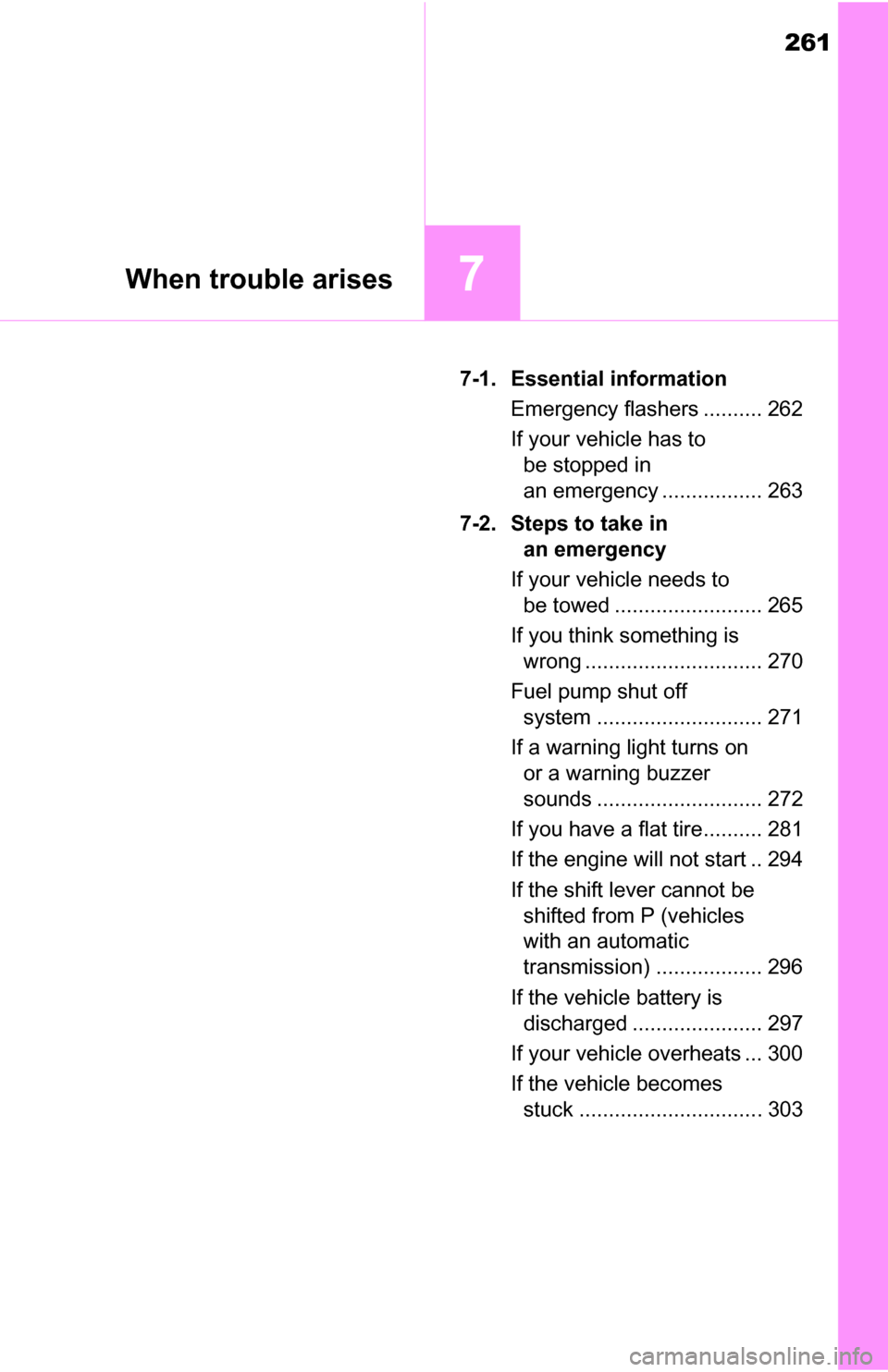
7When trouble arises
7-1. Essential informationEmergency flashers .......... 262
If your vehicle has to be stopped in
an emergency ................. 263
7-2. Steps to take in an emergency
If your vehicle needs to be towed ......................... 265
If you think something is wrong .............................. 270
Fuel pump shut off system ............................ 271
If a warning light turns on or a warning buzzer
sounds ............................ 272
If you have a flat tire.......... 281
If the engine will not start .. 294
If the shift lever cannot be shifted from P (vehicles
with an automatic
transmission) .................. 296
If the vehicle battery is discharged ...................... 297
If your vehicle overheats ... 300
If the vehicle becomes stuck ............................... 303
Page 271 of 368
271
7
When trouble arises
7-2. Steps to take in an emergency
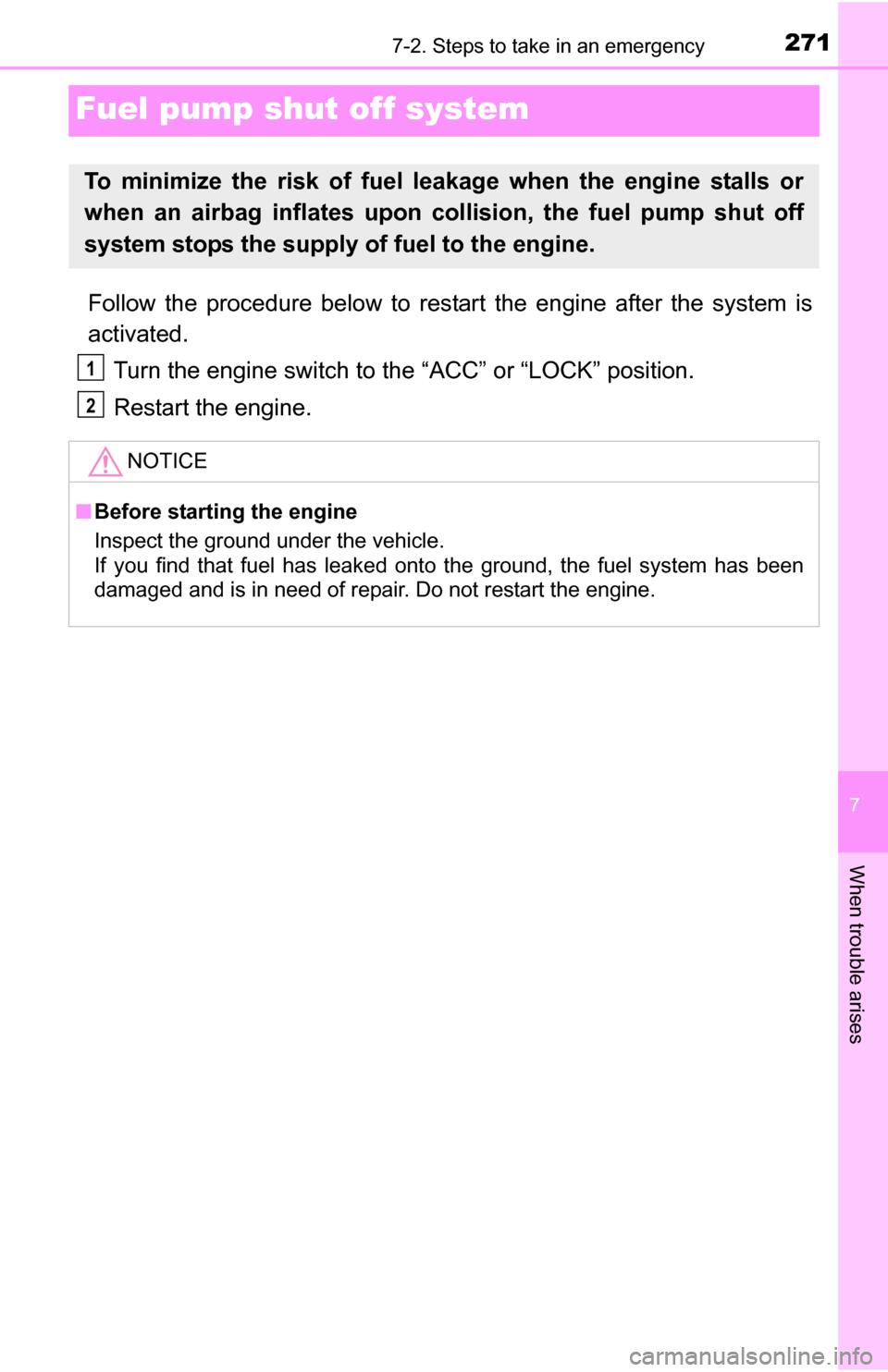
Fuel pump shut off system
Follow the procedure below to restart the engine after the system is
activated.Turn the engine switch to the “ACC” or “LOCK” position.
Restart the engine.
To minimize the risk of fuel leakage when the engine stalls or
when an airbag inflates upon collision, the fuel pump shut off
system stops the supply of fuel to the engine.
NOTICE
■Before starting the engine
Inspect the ground under the vehicle.
If you find that fuel has leaked onto the ground, the fuel system has been
damaged and is in need of repair. Do not restart the engine.
1
2
Page 274 of 368
2747-2. Steps to take in an emergency
(Yellow)
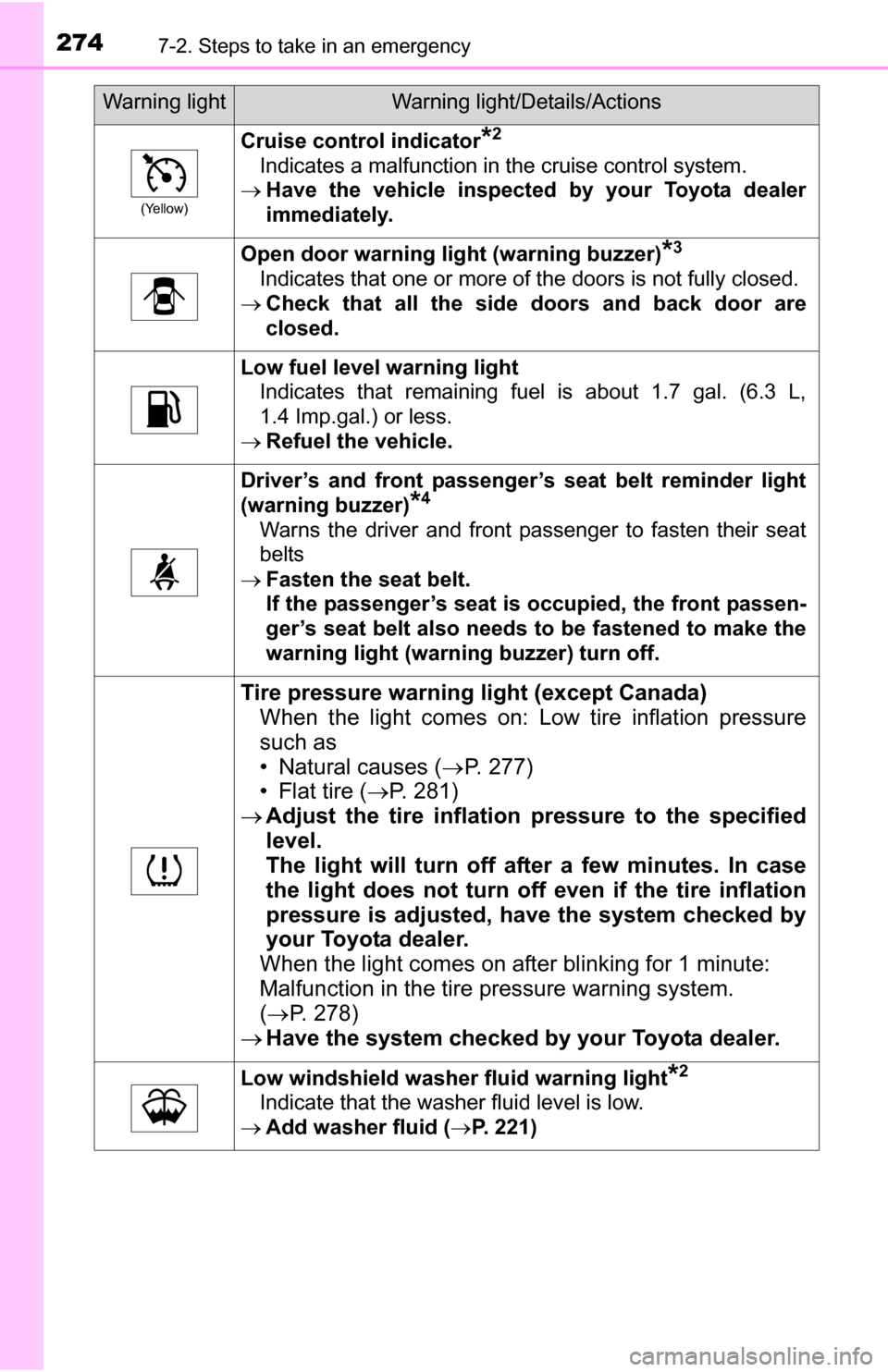
Cruise control indicator*2
Indicates a malfunction in the cruise control system.
Have the vehicle inspected by your Toyota dealer
immediately.
Open door warning light (warning buzzer)*3
Indicates that one or more of the doors is not fully closed.
Check that all the side doors and back door are
closed.
Low fuel level warning light
Indicates that remaining fuel is about 1.7 gal. (6.3 L,
1.4 Imp.gal.) or less.
Refuel the vehicle.
Driver’s and front passenger’s seat belt reminder light
(warning buzzer)
*4
Warns the driver and front passenger to fasten their seat
belts
Fasten the seat belt.
If the passenger’s seat is occupied, the front passen-
ger’s seat belt also needs to be fastened to make the
warning light (warning buzzer) turn off.
Tire pressure warning light (except Canada) When the light comes on: Low tire inflation pressure
such as
• Natural causes ( P. 277)
• Flat tire ( P. 281)
Adjust the tire inflation pressure to the specified
level.
The light will turn off after a few minutes. In case
the light does not turn off even if the tire inflation
pressure is adjusted, have the system checked by
your Toyota dealer.
When the light comes on after blinking for 1 minute:
Malfunction in the tire pressure warning system.
( P. 278)
Have the system checked by your Toyota dealer.
Low windshield washer fluid warning light*2
Indicate that the washer fluid level is low.
Add washer fluid ( P. 221)
Warning lightWarning light/Details/Actions
Page 276 of 368
2767-2. Steps to take in an emergency
■SRS warning light
This warning light system monitors the airbag sensor assembly, front impact
sensors, side impact sensors, driver’s seat belt buckle switch, front passen-
ger occupant classification system (ECU and sensors), “AIR BAG ON” indica-
tor, “AIR BAG OFF” indicator, front passenger’s seat belt buckle switch, seat
belt pretensioner assemblies, airbags, interconnecting wiring and power
sources. ( P. 34)
■ Front passenger detection sensor, passenger seat belt reminder and
warning buzzer
● If luggage is placed on the front passenger seat, the front passenger detec-
tion sensor may cause the warning light to flash and the warning buzzer to
sound even if a passenger is not sitting in the seat.
● If a cushion is placed on the seat, the sensor may not detect a passenger,
and the warning light may not operate properly.
■ Electric power steering system warning light (warning buzzer)
When the battery charge becomes insufficient or the voltage temporarily
drops, the electric power steering system warning light may come on and the
warning buzzer may sounds.
■ If the malfunction indicator la mp comes on while driving
First check the following:
● Is the fuel tank empty?
If it is, fill the fuel tank immediately.
● Is the fuel tank cap loose?
If it is, tighten it securely.
The malfunction indicator lamp will go off after several driving trips.
If the malfunction indicator lamp does not go off even after several trips, con-
tact your Toyota dealer as soon as possible.
■
When the tire pressure warning light comes on (vehicles with a tire
pressure warning system)
Check the tire inflation pressure and adjust to the appropriate level. Push-
ing the tire pressure warning reset switch will not turn off the tire pressure
warning light.
Page 279 of 368
2797-2. Steps to take in an emergency
7
When trouble arises
WARNING
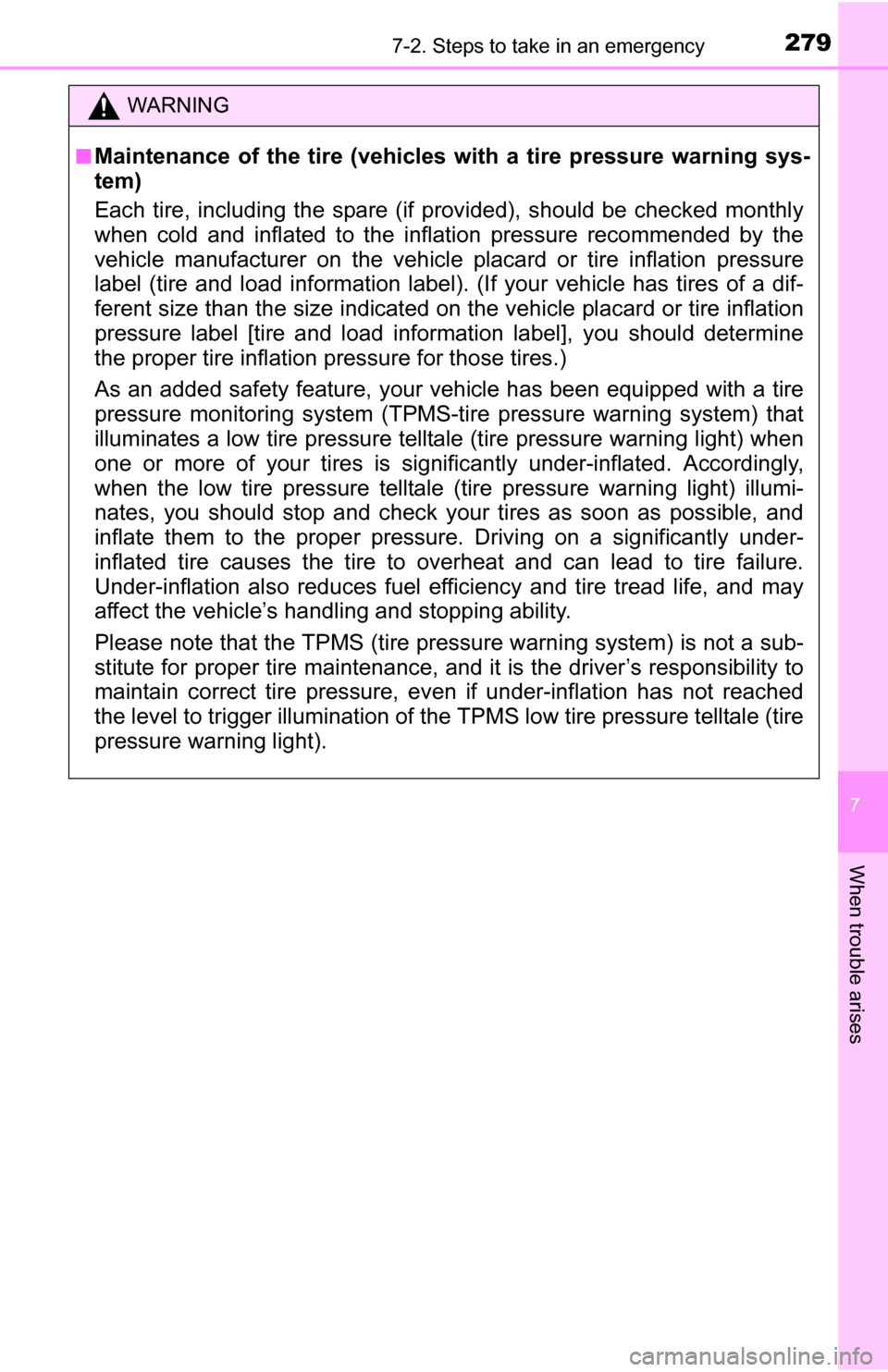
■Maintenance of the tire (vehicles with a tire pressure warning sys-
tem)
Each tire, including the spare (if provided), should be checked monthly
when cold and inflated to the inflation pressure recommended by the
vehicle manufacturer on the vehicle placard or tire inflation pressure
label (tire and load information label). (If your vehicle has tires of a dif-
ferent size than the size indicated on the vehicle placard or tire inflation
pressure label [tire and load information label], you should determine
the proper tire inflation pressure for those tires.)
As an added safety feature, your vehicle has been equipped with a tire
pressure monitoring system (TPMS-ti re pressure warning system) that
illuminates a low tire pre ssure telltale (tire pressure warning light) when
one or more of your tires is significantly under-inflated. Accordingly,
when the low tire pressure telltale (tire pressure warning light) illumi-
nates, you should stop and check your tires as soon as possible, and
inflate them to the proper pressure. Driving on a significantly under-
inflated tire causes the tire to overheat and can lead to tire failure.
Under-inflation also reduces fuel effi ciency and tire tread life, and may
affect the vehicle’s hand ling and stopping ability.
Please note that the TPMS (tire pres sure warning system) is not a sub-
stitute for proper ti re maintenance, and it is the driver’s responsibility to
maintain correct tire pressure, even if under-inflation has not reached
the level to trigger illumina tion of the TPMS low tire pressure telltale (tire
pressure warning light).
Page 294 of 368
2947-2. Steps to take in an emergency
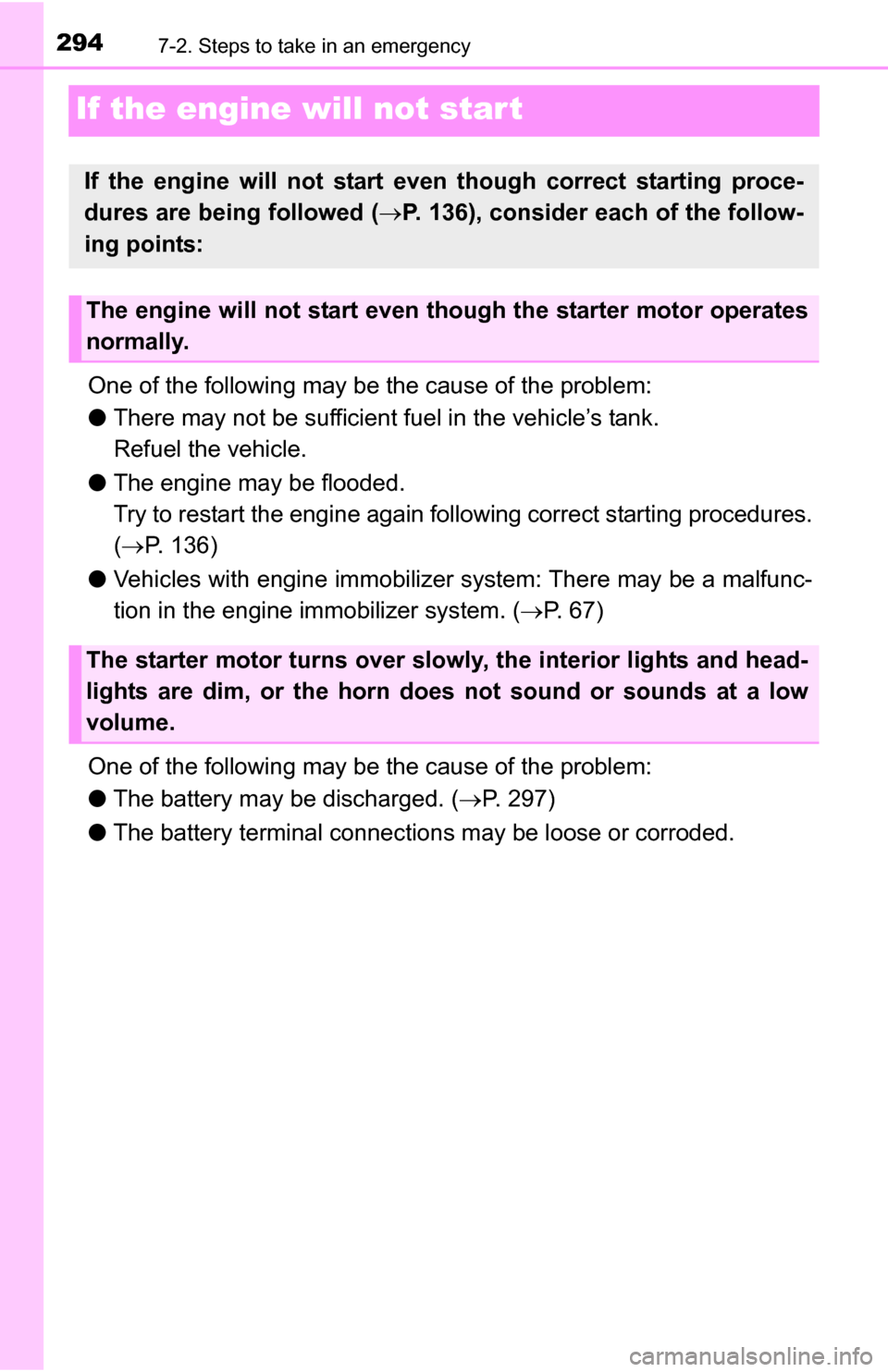
If the engine will not start
One of the following may be the cause of the problem:
●There may not be sufficient fuel in the vehicle’s tank.
Refuel the vehicle.
● The engine may be flooded.
Try to restart the engine again following correct starting procedures.
( P. 136)
● Vehicles with engine immobilizer system: There may be a malfunc-
tion in the engine i mmobilizer system. ( P. 6 7 )
One of the following may be the cause of the problem:
● The battery may be discharged. ( P. 297)
● The battery terminal connections may be loose or corroded.
If the engine will not start even though correct starting proce-
dures are being followed ( P. 136), consider each of the follow-
ing points:
The engine will not start even though the starter motor operates
normally.
The starter motor turns over slowly, the interior lights and head-
lights are dim, or the horn does not sound or sounds at a low
volume.