ESP TOYOTA YARIS 2016 Owner's Manual
[x] Cancel search | Manufacturer: TOYOTA, Model Year: 2016, Model line: YARIS, Model: TOYOTA YARIS 2016Pages: 592, PDF Size: 10.44 MB
Page 426 of 592
424
YARIS_SEDAN_OM_OM99M18z_(U)
5-3. Owner Maintenance
Owner Maintenance Precautions
The owner or a qualified service technician should make these vehicle
inspections at the indicated intervals to ensure safe and dependable
operation.
Bring any problem to the attention of your Toyota dealer or qualified
service technician as soon as possible.
■When Refueling
●Brake and clutch fluid level ( →P. 434)
● Engine coolant level ( →P. 431)
● Engine oil level ( →P. 430)
● Washer fluid level ( →P. 435)
■At Least Monthly
Tire inflation pressures ( →P. 446)
■At Least Twice a Year (For Example, Every Spring and Fall)
You can do the following scheduled maintenance items if you have
some mechanical ability and a few basic tools and if you closely fol-
low the directions in this manual.
● Engine coolant ( →P. 431)
● Engine oil ( →P. 429)
Improper or incomplete service may result in problems. This sec-
tion gives instructions only for items that are easy to perform.
As explained in the Introduction ( →P. 418), several procedures can
be done only by a qualified service technician with special tools.
Improper owner maintenance during the warranty period may affect
warranty coverage. Refer to Introduction ( →P. 418) for owner’s
responsibility in protecting your investment. For details, read the
separate Toyota Warranty and Maintenance Guide provided with
the vehicle. If you are unsure about any servicing or maintenance
procedure, have it done by your Toyota dealer.
There are strict environmental laws regarding the disposal of waste
oil and fluids. Please dispose of your waste properly and with due
regard to the environment.
We recommend that you entrust the oil and fluid changes of your
vehicle to your Toyota dealer.
YARIS_SEDAN_OM_OM99M18z_(U).book Page 424 Monday, June 1, 2015 9:22 PM
Page 427 of 592
YARIS_SEDAN_OM_OM99M18z_(U)
4255-3. Owner Maintenance
5
Maintenance and Care
WARNING
■Do not perform maintenance work if you lack sufficient knowledge and
experience or the proper tools and equipment to do the work. Have
maintenance work done by a qualified technician
Performing maintenance work on a vehicle is dangerous if not done prop-
erly. You can be seriously injured while performing some maintenance pro-
cedures.
■ If you must run the engine while working under the hood, make certain
that you remove all jewelry (especially rings, bracelets, watches, and
necklaces) and all neckties, scarves, and similar loose clothing before
getting near the engine or cooling fan which may turn on unexpectedly
Working under the hood with the engine running is dangerous. It becomes
even more dangerous when you wear jewelry or loose clothing.
Either can become entangled in moving parts and result in injury.
■ Switch the ignition to off and make sure the fan is not running
before attempting to work near the cooling fan
Working near the cooling fan when it is running is dangerous. The fan could
continue running indefinitely even if the engine has stopped and the engine
compartment temperature is high. You could be hit by the fan and seriously
injured.
■ Do not leave items in the engine compartment
After you have finished checking or doing servicing in the engine compart-
ment, do not forget and leave items such as tools or rags in the engine com-
partment.
Tools or other items left in the engine compartment could cause engine
damage or a fire leading to an unexpected accident.
YARIS_SEDAN_OM_OM99M18z_(U).book Page 425 Monday, June 1, 2015 9:22 PM
Page 431 of 592
429
YARIS_SEDAN_OM_OM99M18z_(U)
5-3. Owner Maintenance
5
Maintenance and Care
Engine Oil
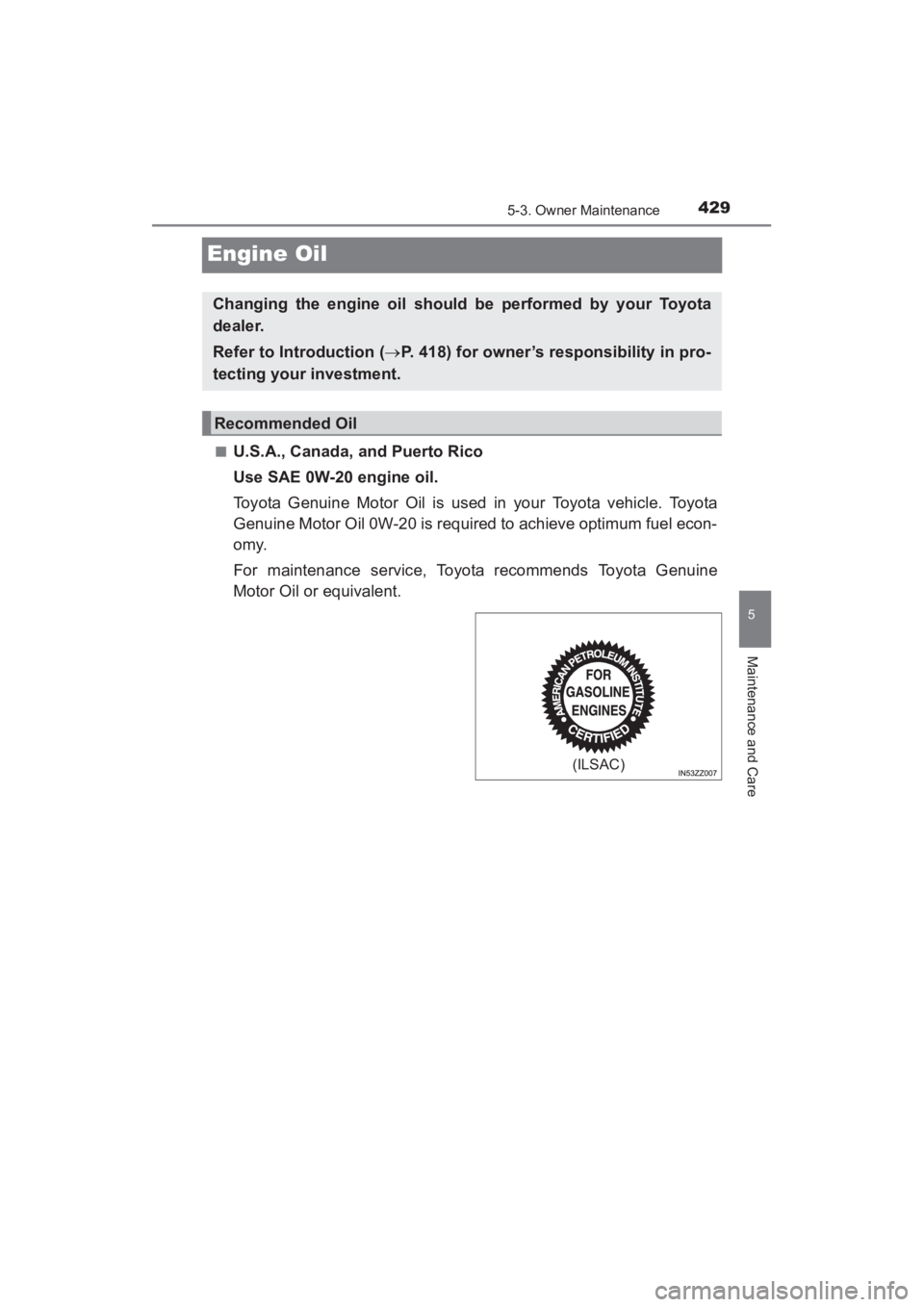
■U.S.A., Canada, and Puerto Rico
Use SAE 0W-20 engine oil.
Toyota Genuine Motor Oil is used in your Toyota vehicle. Toyota
Genuine Motor Oil 0W-20 is required to achieve optimum fuel econ-
omy.
For maintenance service, Toyota recommends Toyota Genuine
Motor Oil or equivalent.
Changing the engine oil should be performed by your Toyota
dealer.
Refer to Introduction (→P. 418) for owner’s responsibility in pro-
tecting your investment.
Recommended Oil
(ILSAC)
YARIS_SEDAN_OM_OM99M18z_(U).book Page 429 Monday, June 1, 2015 9:22 PM
Page 474 of 592
4725-4. Appearance Care
YARIS_SEDAN_OM_OM99M18z_(U)
■Maintaining the Finish
●Toyota is not responsible for scratches caused by automatic car washes or
improper washing.
● Scratches are more noticeable on vehicles with darker paint finishes.
● A spot remover to remove oil, tar, and similar materials will usually also take
off the wax. Rewax these areas even if the rest of the vehicle does not need
it.
WARNING
■Dry off brakes that have become wet by driving slowly, releasing the
accelerator pedal and lightly applying the brakes several times until
the brake performance returns to normal
Driving with wet brakes is dangerous. Increased stopping distance or the
vehicle pulling to one side when braking could result in a serious accident.
Light braking will indicate whether the brakes have been affected.
NOTICE
●Do not spray water in the engine compartment. Otherwise, it could result in
engine-starting problems or damage to electrical parts.
● When washing and waxing the vehicle, be careful not to apply excessive
force to any single area of the vehicle.
● Do not use steel wool, abrasive cl eaners, or strong detergents containing
highly alkaline or caustic agents on chrome- plated or anodized aluminum
parts. This may damage the protective coating; also, cleaners and deter-
gents may discolor or deteriorate the paint.
YARIS_SEDAN_OM_OM99M18z_(U).book Page 472 Monday, June 1, 2015 9:22 PM
Page 487 of 592
YARIS_SEDAN_OM_OM99M18z_(U)
4856-2. Flat Tire
6
If Trouble Arises
Your Toyota has a temporary spare tire. The temporary spare tire is
lighter and smaller than a conventional tire, and is designed only for
emergency use and should be used only for VERY short periods.
Temporary spare tires should NEVER be used for long drives or
extended periods.
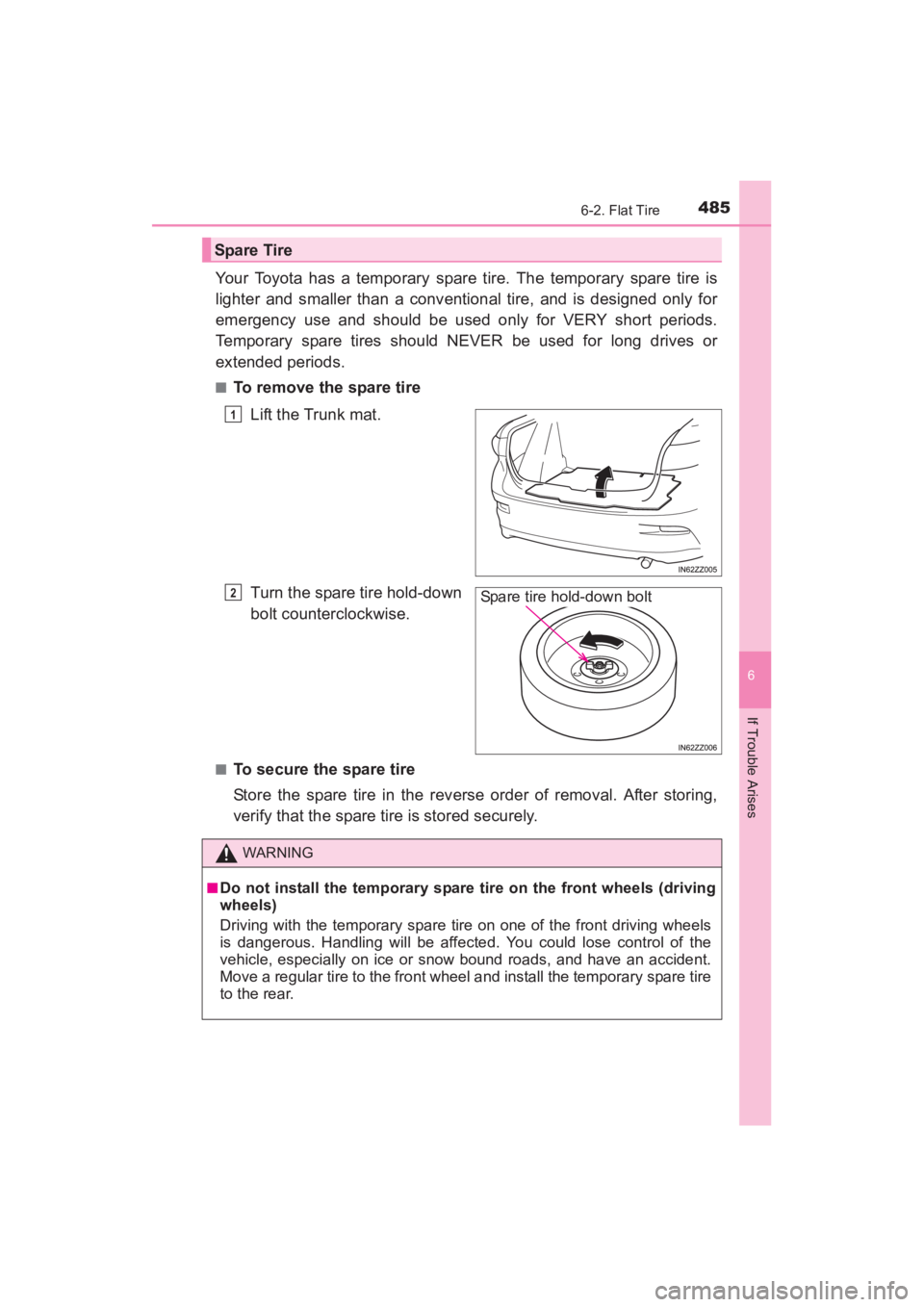
■To remove the spare tireLift the Trunk mat.
Turn the spare tire hold-down
bolt counterclockwise.
■To secure the spare tire
Store the spare tire in the reverse order of removal. After storing,
verify that the spare tire is stored securely.
Spare Tire
1
Spare tire hold-down bolt2
WARNING
■Do not install the temporary spare tire on the front wheels (driving
wheels)
Driving with the temporary spare tire on one of the front driving wheels
is dangerous. Handling will be affected. You could lose control of the
vehicle, especially on ice or snow bound roads, and have an accident.
Move a regular tire to the front wheel and install the temporary spare tire
to the rear.
YARIS_SEDAN_OM_OM99M18z_(U).book Page 485 Monday, June 1, 2015 9:22 PM
Page 535 of 592
533
YARIS_SEDAN_OM_OM99M18z_(U)
7-2. Warranty
7
Customer Information and Reporting Safety Defects
Add-On Non-Genuine Par ts and Accesso-
ries
Non-genuine parts and accessories for Toyota vehicles can be found
in stores.
These may fit your vehicle, but they are not approved by Toyota for
use with Toyota vehicles. When you install non-genuine parts or
accessories, they could affect your vehicle’s performance or safety
systems; the Toyota warranty doesn’t cover this. Before you install
any non-genuine parts or accessories, consult your Toyota dealer.
Toyota assumes no responsibility for death, injury, or expenses that
may result from the installation of add-on non-genuine parts or acces-
sories.
WARNING
■Always consult your Toyota dealer before you install non-genuine
parts or accessories
Improperly designed parts or accessories could seriously affect your vehi-
cle’s performance or safety systems. This could cause you to have an acci-
dent or increase your chances of injuries in an accident.
■ Be very careful in choosing and inst alling add-on electrical equipment,
such as mobile telephones, two-way radios, stereo systems, and car
alarm systems
Incorrectly choosing or installing improper add-on equipment or choosing
an improper installer is dangerous. Essential systems could be damaged,
causing engine stalling, airbag (SRS) activation, ABS/TCS/DSC inactiva-
tion, or a fire in the vehicle.
YARIS_SEDAN_OM_OM99M18z_(U).book Page 533 Monday, June 1, 2015 9:22 PM
Page 536 of 592
534
YARIS_SEDAN_OM_OM99M18z_(U)
7-3. Cell Phones
Cell Phones War ning
WARNING
■Please comply with the legal regulations concerning the use of com-
munication equipment in vehicles in your country
Use of any electrical devices such as cell phones, computers, portable
radios, vehicle navigation or other devices by the driver while the vehicle is
moving is dangerous. Dialing a number on a cell phone while driving also
ties-up the driver’s hands. Use of these devices will cause the driver to be
distracted and could lead to a serious accident. If a passenger is unable to
use the device, pull off the right-of-way to a safe area before use.
If use of a cell phone is necessary despite this warning, use a hands-free
system to at least leave the hands free to drive the vehicle. Never use a cell
phone or other electrical devices while the vehicle is moving and, instead,
concentrate on the full-time job of driving.
YARIS_SEDAN_OM_OM99M18z_(U).book Page 534 Monday, June 1, 2015 9:22 PM
Page 541 of 592
YARIS_SEDAN_OM_OM99M18z_(U)
5397-6. Uniform Tire Quality Grading System (UTQGS)
7
Customer Information and Reporting Safety Defects
The temperature grades A (the highest), B, and C, represent the tire’s
resistance to the generation of heat and its ability to dissipate heat
when tested under controlled conditions on a specified indoor labora-
tory test wheel.
Sustained high temperature can cause the material of the tire to
degenerate and reduce tire life, and excessive temperatures can lead
to sudden tire failure.
Grade C corresponds to a level of performance which all passenger
vehicle tires must meet under the Federal Motor Vehicle Safety Stan-
dard No. 109. Grades B and A represent higher levels of performance
on the laboratory test wheel than the minimum required by law.
These grades will be added to the sidewalls of passenger vehicle tires
over the next several years according to a schedule established by
the NHTSA and the tire manufacturers.
The grade of tires available as standard or optional equipment on
Toyota vehicles may vary with respect to grade.
ALL PASSENGER VEHICLE TIRES MUST CONFORM TO THESE
GRADES AND TO ALL OTHER FEDERAL TIRE-SAFETY REQUIRE-
MENTS.
Temperature-A, B, C
WARNING
■Keep your vehicle’s tires properly inflated and not overloaded
Driving with improperly inflated or overloaded tires is dangerous. Exces-
sive speed, underinflation, or excessive loading, either separately or in
combination, can cause heat buildup and possible tire failure. The tem-
perature grade for this tire is established for a tire that is properly
inflated and not overloaded.
YARIS_SEDAN_OM_OM99M18z_(U).book Page 539 Monday, June 1, 2015 9:22 PM
Page 559 of 592
YARIS_SEDAN_OM_OM99M18z_(U)
5577-7. Tire Information (U.S.A.)
7
Customer Information and Reporting Safety Defects
GCWR (Gross Combination Weight Rating) is the maximum allowable
weight of the vehicle - including all cargo and passengers - that the
vehicle can handle without risking damage. The GCW must never
exceed the GCWR.
WARNING
■Do not tow a trailer with this vehicle
Towing a trailer with this vehicle is dangerous because it has not been
designed to tow a trailer and doing so will affect the drive system which
could result in vehicle damage.
■Overloaded Vehicle
Overloading a vehicle is dangerous. The results of overloading can
have serious consequences in terms of passenger safety. Too much
weight on a vehicle’s suspension system can cause spring or shock
absorber failure, brake failure, handling or steering problems, irregular
tire wear, tire failure or other damage.
Overloading makes a vehicle harder to drive and control. It also
increases the distance required for stopping. In cases of serious over-
loading, brakes can fail completely, particularly on steep grades. The
load a tire will carry safely is a combination of the size of the tire, its load
range, and corresponding inflation pressure.
Never overload the vehicle and always observe the vehicle’s weight rat-
ings from the vehicle’s Safety Certification and Tire and Load Informa-
tion labels.
■Never Exceed Axle Weight Rating Limits
Exceeding the Safety Certification Label axle weight rating limits is dan-
gerous and could result in death or serious injury as a result of substan-
dard vehicle handling, performance, engine, transmission and/or
structural damage, serious damage to the vehicle, or loss of control.
Always keep the vehicle within the axle weight rating limits.
■Never Exceed GVWR or GAWR Specifications
Exceeding the GVWR or the GAWR specified on the certification label is
dangerous. Exceeding any vehicle rating limitation could result in a seri-
ous accident, injury, or damage to the vehicle.
Do not use replacement tires with lower load carrying capacities than
the originals because they may lower the vehicle’s GVWR and GAWR
limitations. Replacement tires with a higher limit than the originals do
not increase the GVWR and GAWR limitations. Never exceed the
GVWR or the GAWR specified on the certification label.
YARIS_SEDAN_OM_OM99M18z_(U).book Page 557 Monday, June 1, 2015 9:22 PM
Page 562 of 592
560
YARIS_SEDAN_OM_OM99M18z_(U)
7-8. Declaration of Conformity
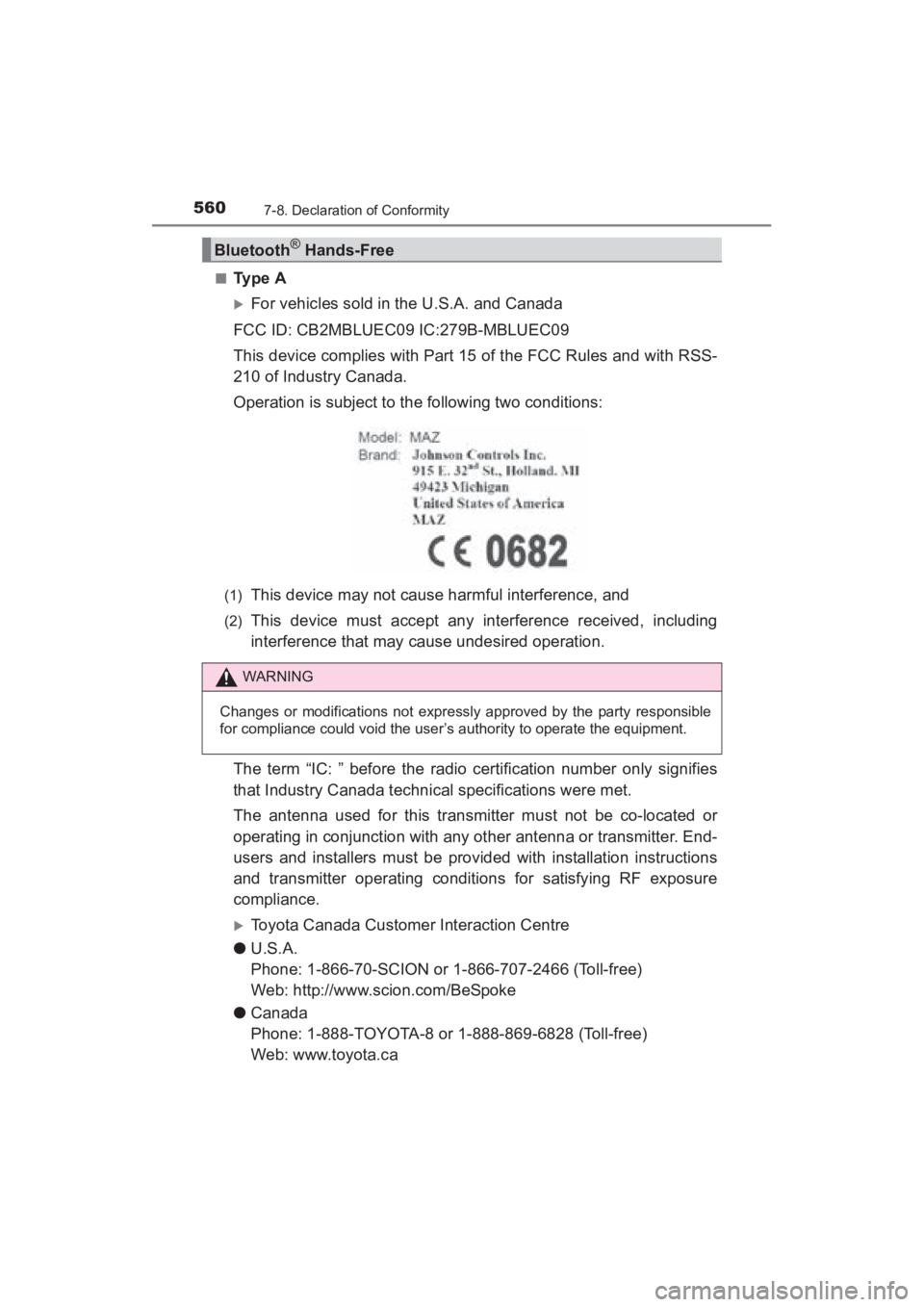
■Ty p e A
XFor vehicles sold in the U.S.A. and Canada
FCC ID: CB2MBLUEC09 IC:279B-MBLUEC09
This device complies with Part 15 of the FCC Rules and with RSS-
210 of Industry Canada.
Operation is subject to the following two conditions:
(1)This device may not cause harmful interference, and
(2)This device must accept any interference received, including
interference that may cause undesired operation.
The term “IC: ” before the radio certification number only signifies
that Industry Canada technical specifications were met.
The antenna used for this transmitter must not be co-located or
operating in conjunction with any other antenna or transmitter. End-
users and installers must be provided with installation instructions
and transmitter operating conditions for satisfying RF exposure
compliance.
XToyota Canada Customer Interaction Centre
● U.S.A.
Phone: 1-866-70-SCION or 1-866-707-2466 (Toll-free)
Web: http://www.scion.com/BeSpoke
● Canada
Phone: 1-888-TOYOTA-8 or 1-888-869-6828 (Toll-free)
Web: www.toyota.ca
Bluetooth® Hands-Free
WARNING
Changes or modifications not expressly approved by the party responsible
for compliance could void the user’s authority to operate the equipment.
YARIS_SEDAN_OM_OM99M18z_(U).book Page 560 Monday, June 1, 2015 9:22 PM