suspension TOYOTA YARIS 2016 Owners Manual
[x] Cancel search | Manufacturer: TOYOTA, Model Year: 2016, Model line: YARIS, Model: TOYOTA YARIS 2016Pages: 592, PDF Size: 10.44 MB
Page 68 of 592
66
YARIS_SEDAN_OM_OM99M18z_(U)
1-4. SRS Air Bags
WARNING
■Do not touch the components of the supplemental restraint system
after the air bags have inflated
Touching the components of the supplemental restraint system after the air
bags have inflated is dangerous. Immediately after inflation, they are very
hot. You could get burned.
■ Never install any front-end equipment to your vehicle
Installation of front-end equipment, such as frontal protection bar (kangaroo
bar, bull bar, push bar, or other similar devices), snowplow, or winches, is
dangerous. The air bag crash sensor system could be affected. This could
cause air bags to inflate unexpectedly, or it could prevent the air bags from
inflating during an accident. Front occupants could be seriously injured.
■ Do not modify the suspension
Modifying the vehicle suspension is dangerous. If the vehicle’s height or the
suspension is modified, the vehicle will be unable to accurately detect a col-
lision or roll-over accident resulting in incorrect or unexpected air bag
deployment and the possibility of serious injuries.
■ To prevent false detection by the air bag sensor system, heed the fol-
lowing
● Do not use tires or wheels other than those specified for your Toyota:
Use of any tire or wheel other than those specified for your Toyota ( →P. 570)
is dangerous. Use of such wheels will prevent the vehicle’s accident detec-
tions system from accurately detecting a collision or roll-over accident result-
ing in incorrect or unexpected air bag deployment and the possibility of
serious injuries.
● Do not overload your vehicle:
Overloading your vehicle is dangerous as it could prevent the air bag
crash sensor system from accurately detecting a collision or roll-over acci-
dent resulting in incorrect or unexpected air bag deployment and the pos-
sibility of serious injuries. The gross axle weight rating (GAWR) and the
gross vehicle weight rating (GVWR) for your vehicle are on the Motor
Vehicle Safety Standard Label on the driver’s door frame. Do not exceed
these ratings.
● Do not drive the vehicle off-road:
Driving your Toyota off-road is dangerous because the vehicle has not
been designed to do so. Driving the vehicle off-road could prevent the air
bag crash sensor system from accurately detecting a collision or roll-over
accident resulting in incorrect or unexpected air bag deployment and the
possibility of serious injuries.
YARIS_SEDAN_OM_OM99M18z_(U).book Page 66 Monday, June 1, 2015 9:22 PM
Page 138 of 592
136
YARIS_SEDAN_OM_OM99M18z_(U)
2-8. Driving Tips
Driving on Uneven Road
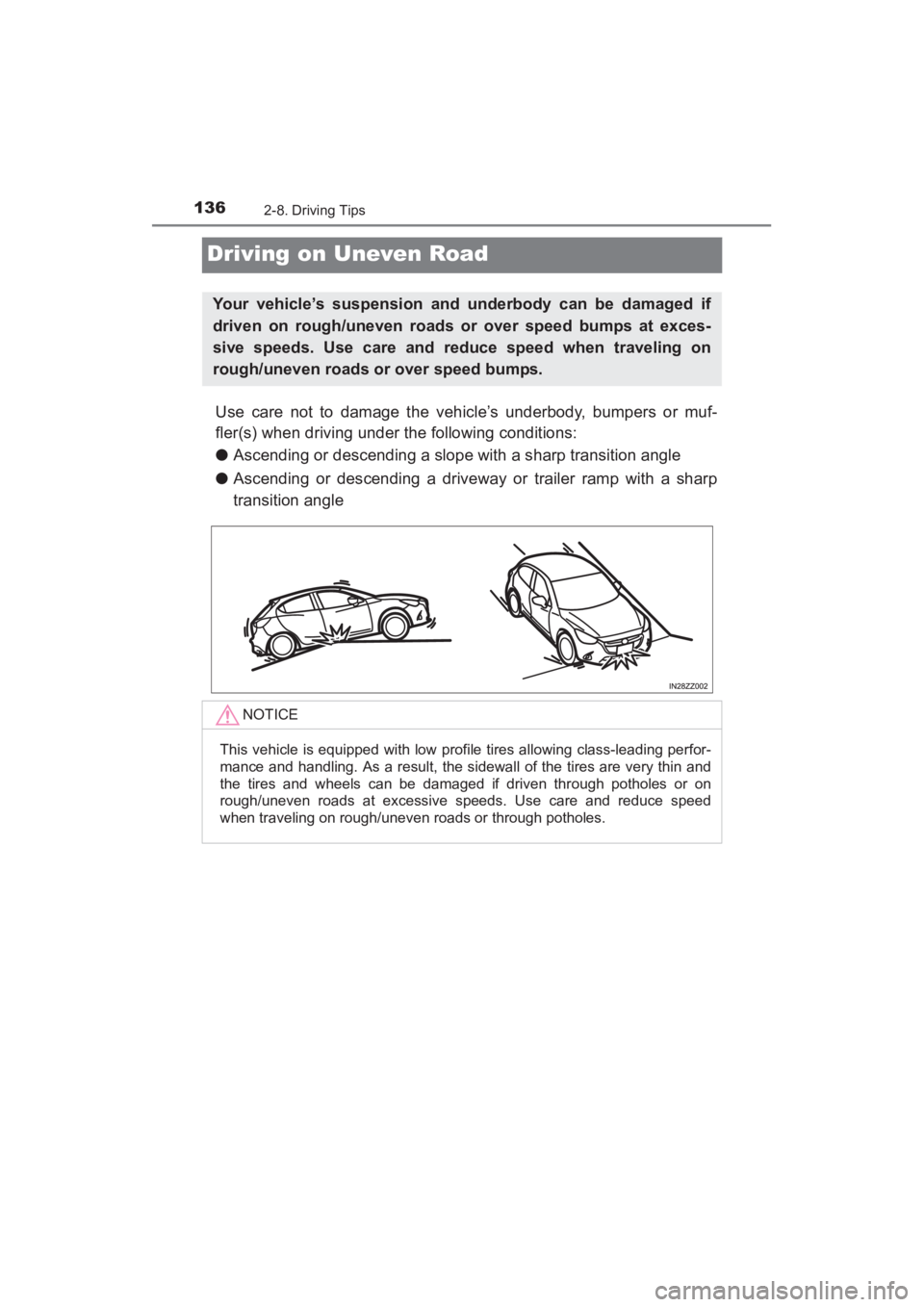
Use care not to damage the vehicle’s underbody, bumpers or muf-
fler(s) when driving under the following conditions:
●Ascending or descending a slope with a sharp transition angle
● Ascending or descending a driveway or trailer ramp with a sharp
transition angle
Your vehicle’s suspension and underbody can be damaged if
driven on rough/uneven roads or over speed bumps at exces-
sive speeds. Use care and reduce speed when traveling on
rough/uneven roads or over speed bumps.
NOTICE
This vehicle is equipped with low prof ile tires allowing class-leading perfor-
mance and handling. As a result, the sidewall of the tires are very thin and
the tires and wheels can be damaged if driven through potholes or on
rough/uneven roads at excessive speeds. Use care and reduce speed
when traveling on rough/uneven roads or through potholes.
YARIS_SEDAN_OM_OM99M18z_(U).book Page 136 Monday, June 1, 2015 9:22 PM
Page 211 of 592
YARIS_SEDAN_OM_OM99M18z_(U)
2093-10. Active Safety System
3
When Driving
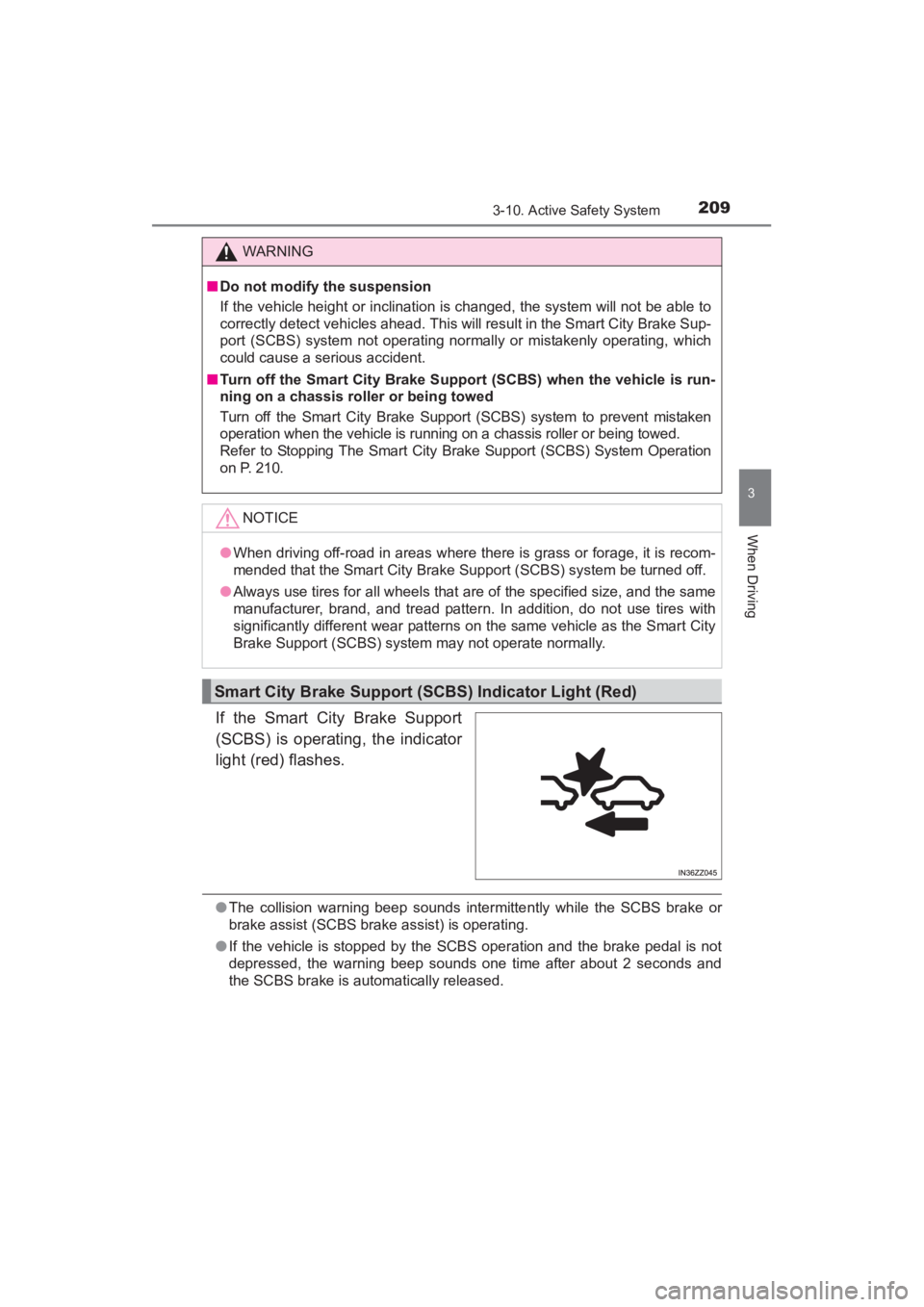
If the Smart City Brake Support
(SCBS) is operating, the indicator
light (red) flashes.
●The collision warning beep sounds intermittently while the SCBS brake or
brake assist (SCBS brake assist) is operating.
● If the vehicle is stopped by the SCBS operation and the brake pedal is not
depressed, the warning beep sounds one time after about 2 seconds and
the SCBS brake is automatically released.
WARNING
■Do not modify the suspension
If the vehicle height or inclination is changed, the system will not be able to
correctly detect vehicles ahead. This will result in the Smart City Brake Sup-
port (SCBS) system not operating normally or mistakenly operating, which
could cause a serious accident.
■ Turn off the Smart City Brake Suppor t (SCBS) when the vehicle is run-
ning on a chassis roller or being towed
Turn off the Smart City Brake Support (SCBS) system to prevent mistaken
operation when the vehicle is running on a chassis roller or being towed.
Refer to Stopping The Smart City Brake Support (SCBS) System Operation
on P. 210.
NOTICE
●When driving off-road in ar eas where there is grass or forage, it is recom-
mended that the Smart City Brake Support (SCBS) system be turned off.
● Always use tires for all wheels that are of the specified size, and the same
manufacturer, brand, and tread pattern. In addition, do not use tires with
significantly different wear patterns on the same vehicle as the Smart City
Brake Support (SCBS) system may not operate normally.
Smart City Brake Support (SCBS) Indicator Light (Red)
YARIS_SEDAN_OM_OM99M18z_(U).book Page 209 Monday, June 1, 2015 9:22 PM
Page 559 of 592
YARIS_SEDAN_OM_OM99M18z_(U)
5577-7. Tire Information (U.S.A.)
7
Customer Information and Reporting Safety Defects
GCWR (Gross Combination Weight Rating) is the maximum allowable
weight of the vehicle - including all cargo and passengers - that the
vehicle can handle without risking damage. The GCW must never
exceed the GCWR.
WARNING
■Do not tow a trailer with this vehicle
Towing a trailer with this vehicle is dangerous because it has not been
designed to tow a trailer and doing so will affect the drive system which
could result in vehicle damage.
■Overloaded Vehicle
Overloading a vehicle is dangerous. The results of overloading can
have serious consequences in terms of passenger safety. Too much
weight on a vehicle’s suspension system can cause spring or shock
absorber failure, brake failure, handling or steering problems, irregular
tire wear, tire failure or other damage.
Overloading makes a vehicle harder to drive and control. It also
increases the distance required for stopping. In cases of serious over-
loading, brakes can fail completely, particularly on steep grades. The
load a tire will carry safely is a combination of the size of the tire, its load
range, and corresponding inflation pressure.
Never overload the vehicle and always observe the vehicle’s weight rat-
ings from the vehicle’s Safety Certification and Tire and Load Informa-
tion labels.
■Never Exceed Axle Weight Rating Limits
Exceeding the Safety Certification Label axle weight rating limits is dan-
gerous and could result in death or serious injury as a result of substan-
dard vehicle handling, performance, engine, transmission and/or
structural damage, serious damage to the vehicle, or loss of control.
Always keep the vehicle within the axle weight rating limits.
■Never Exceed GVWR or GAWR Specifications
Exceeding the GVWR or the GAWR specified on the certification label is
dangerous. Exceeding any vehicle rating limitation could result in a seri-
ous accident, injury, or damage to the vehicle.
Do not use replacement tires with lower load carrying capacities than
the originals because they may lower the vehicle’s GVWR and GAWR
limitations. Replacement tires with a higher limit than the originals do
not increase the GVWR and GAWR limitations. Never exceed the
GVWR or the GAWR specified on the certification label.
YARIS_SEDAN_OM_OM99M18z_(U).book Page 557 Monday, June 1, 2015 9:22 PM