engine TOYOTA YARIS 2016 Owners Manual
[x] Cancel search | Manufacturer: TOYOTA, Model Year: 2016, Model line: YARIS, Model: TOYOTA YARIS 2016Pages: 540, PDF Size: 34.12 MB
Page 484 of 540
4848-2. Steps to take in an emergency
YARIS_F_WE_52G04E
WARNING
■Avoiding battery fires or explosions
Observe the following precautions to prevent accidentally igniting the flam-
mable gas that may be emitted from the battery:
● Make sure each jumper cable is connected to the correct terminal and that
it is not unintentionally in contact with anything other than the intended ter-
minal.
● Do not allow the + and - clamps of the jumper cables to come into contact
with each other.
● Do not smoke, use matches, cigarette lighters or allow open flame near
the battery.
■ Battery precautions
The battery contains poisonous and corrosive acidic electrolyte, while
related parts contain lead and lead compounds. Observe the following pre-
cautions when handling the battery:
● When working with the battery, always wear safety glasses and take care
not to allow any battery fluids (acid) to come into contact with skin, clothing
or the vehicle body.
● Do not lean over the battery.
● In the event that battery fluid comes into contact with the skin or eyes,
immediately wash the affected area with water and seek medical attention.
Place a wet sponge or cloth over the affected area until medical attention
can be received.
● Always wash your hands after handling the battery support, terminals, and
other battery-related parts.
● Do not allow children near the battery.
■ To prevent damage to the vehicle
Do not pull- or push-start the vehicle as the three-way catalytic converter
(gasoline engine) or catalytic conv erter (diesel engine) may overheat and
become a fire hazard.
NOTICE
■ When handling jumper cables
When connecting the jumper cables, ensure that they do not become entan-
gled in the cooling fans or engine drive belt.
Page 485 of 540
4858-2. Steps to take in an emergency
8
When trouble arises
YARIS_F_WE_52G04E
If your vehicle overheats
●The high engine coolant temperature warning light (P. 431)
comes on or flashes, or a loss of engine power is experienced. (For
example, the vehicle speed does not increase.)
● Steam comes out from under the hood.
Stop the vehicle in a safe place and turn off the air conditioning sys-
tem, and then stop the engine.
If you see steam:
Carefully lift the hood after the steam subsides.
If you do not see steam:
Carefully lift the hood.
After the engine has cooled down sufficiently, inspect the hoses and
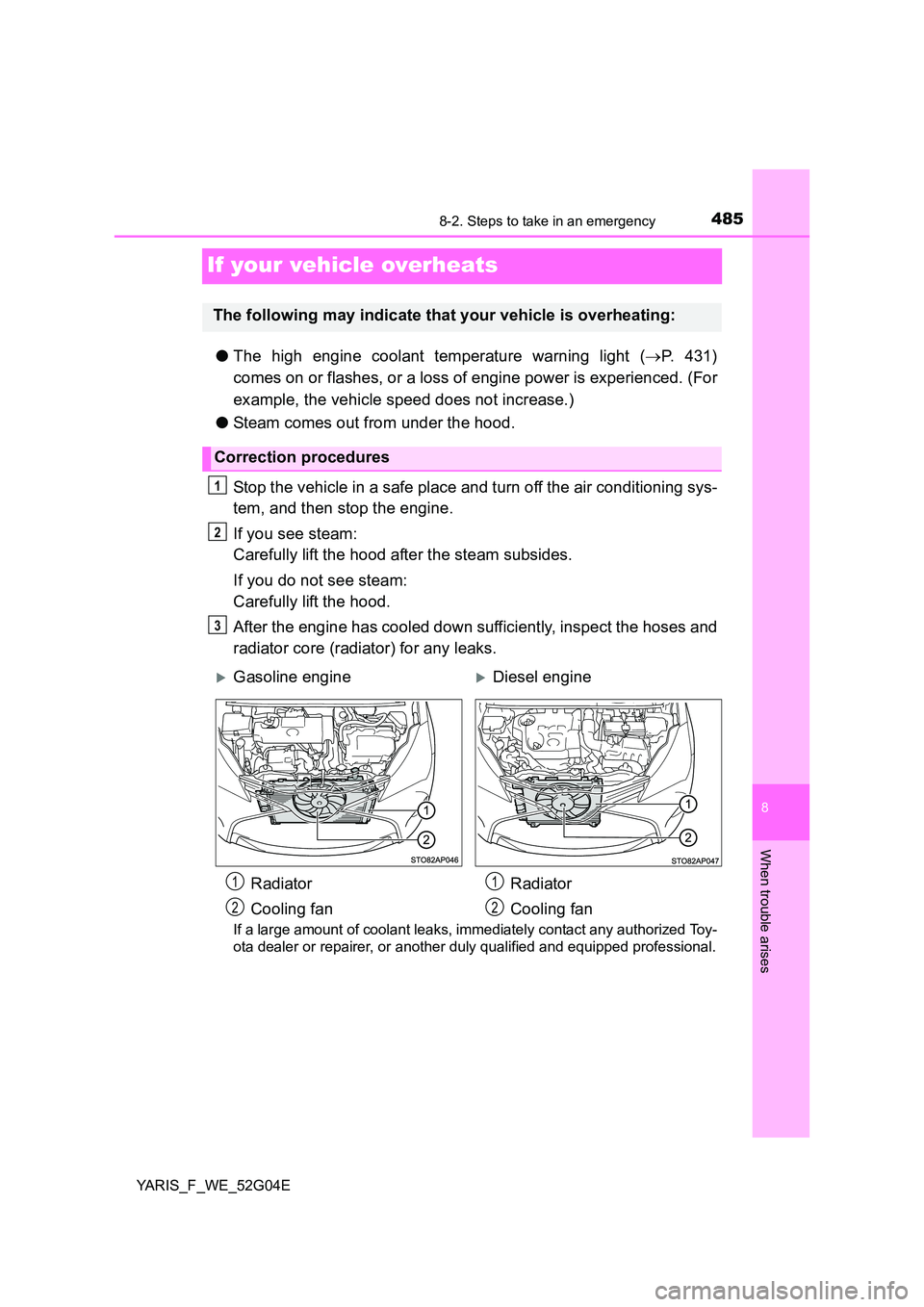
radiator core (radiator) for any leaks.
If a large amount of coolant leaks, immediately contact any authorized Toy-
ota dealer or repairer, or another duly qualified and equipped professional.
The following may indicate that your vehicle is overheating:
Correction procedures
1
2
3
Gasoline engineDiesel engine
Radiator
Cooling fan
Radiator
Cooling fan
1
2
1
2
Page 486 of 540
4868-2. Steps to take in an emergency
YARIS_F_WE_52G04E
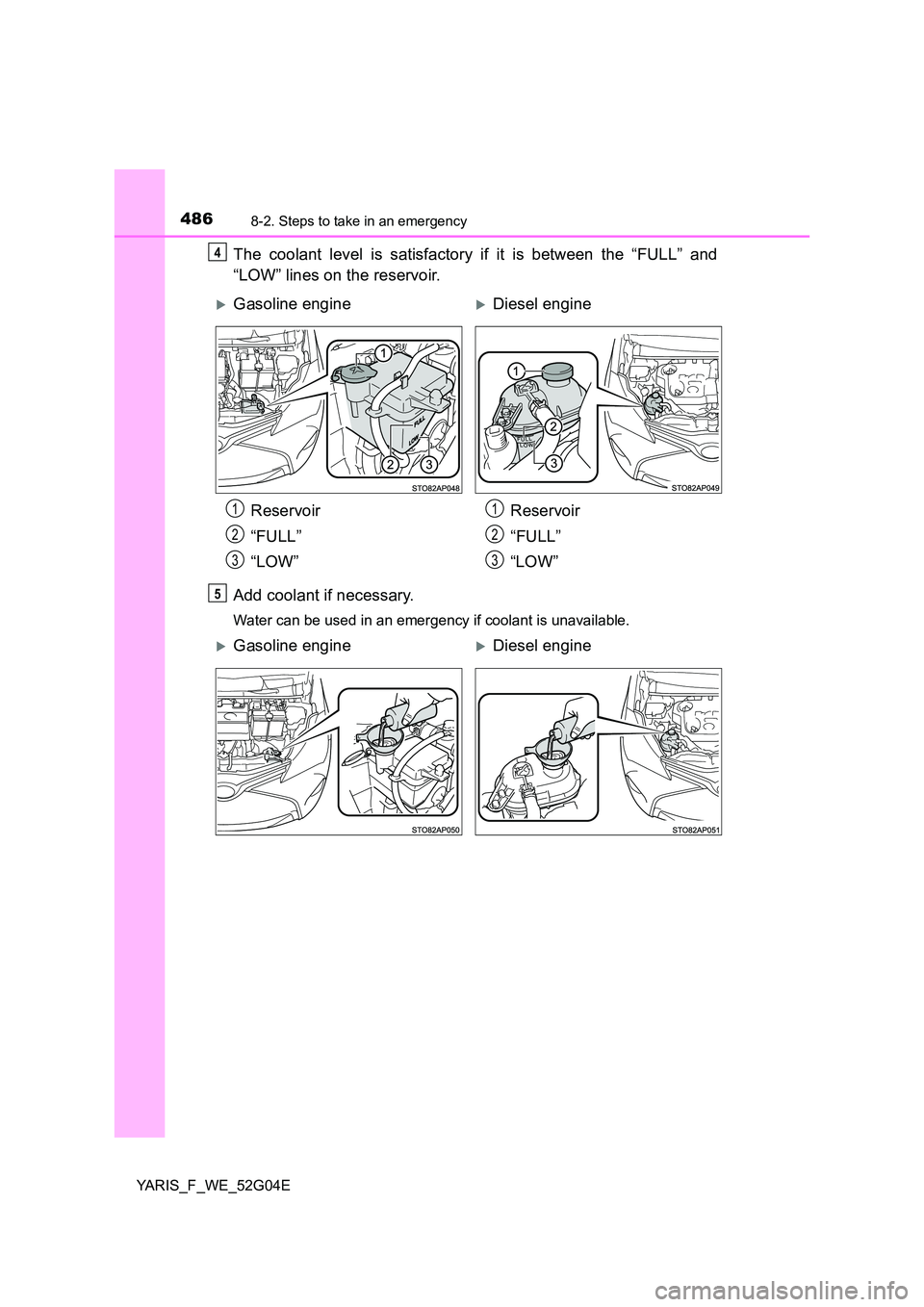
The coolant level is satisfactory if it is between the “FULL” and
“LOW” lines on the reservoir.
Add coolant if necessary.
Water can be used in an emergency if coolant is unavailable.
4
Gasoline engineDiesel engine
Reservoir
“FULL”
“LOW”
Reservoir
“FULL”
“LOW”
1
2
3
1
2
3
5
Gasoline engineDiesel engine
Page 487 of 540
4878-2. Steps to take in an emergency
8
When trouble arises
YARIS_F_WE_52G04E
Start the engine and turn the air conditioning system on to check
that the radiator cooling fan operates and to check for coolant leaks
from the radiator or hoses.
The fan operates when the air conditioning system is turned on immedi-
ately after a cold start. Confirm that the fan is operating by checking the fan
sound and air flow. If it is difficult to check these, turn the air conditioning
system on and off repeatedly.
(The fan may not operate in freezing temperatures.)
If the fan is not operating:
Stop the engine immediately and contact any authorized Toyota
dealer or repairer, or another duly qualified and equipped profes-
sional.
If the fan is operating:
Have the vehicle inspected at the nearest authorized Toyota dealer
or repairer, or another duly qualified and equipped professional.
6
7
Page 488 of 540
4888-2. Steps to take in an emergency
YARIS_F_WE_52G04E
WARNING
■To prevent an accident or injury when inspecting under the hood of
your vehicle
Observe the following precautions.
Failure to do so may result in serious injury such as burns.
● If steam is seen coming from under the hood, do not open the hood until
the steam has subsided. The engine compartment may be very hot.
● Keep hands and clothing (especially a tie, a scarf or a muffler) away from
the fan and belts while the engine is operating.
● Do not loosen the radiator cap or the coolant reservoir cap while the
engine and radiator are hot.
NOTICE
■ When adding engine coolant
Add coolant slowly after the engine has cooled down sufficiently. Adding
cool coolant to a hot engine too quickly can cause damage to the engine.
■ To prevent damage to the cooling system
Observe the following precautions.
● Avoid contaminating the coolant with foreign matter (such as sand or dust
etc.).
● Do not use any coolant additives.
Page 489 of 540
4898-2. Steps to take in an emergency
8
When trouble arises
YARIS_F_WE_52G04E
If you run out of fuel and the engine stalls
(diesel engine only)
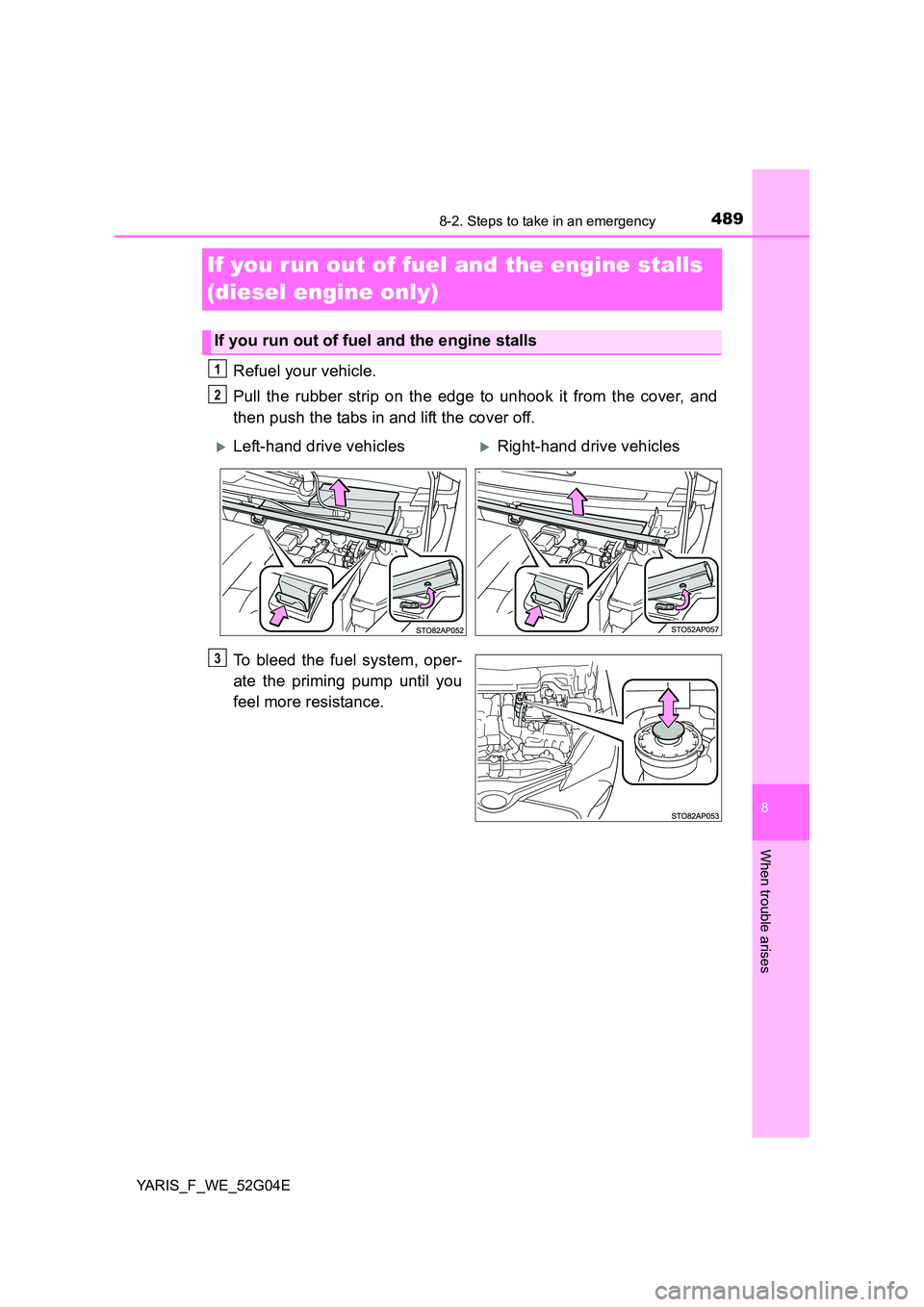
Refuel your vehicle.
Pull the rubber strip on the edge to unhook it from the cover, and
then push the tabs in and lift the cover off.
To bleed the fuel system, oper-
ate the priming pump until you
feel more resistance.
If you run out of fuel and the engine stalls
1
2
Left-hand drive vehiclesRight-hand drive vehicles
3
Page 490 of 540
4908-2. Steps to take in an emergency
YARIS_F_WE_52G04E
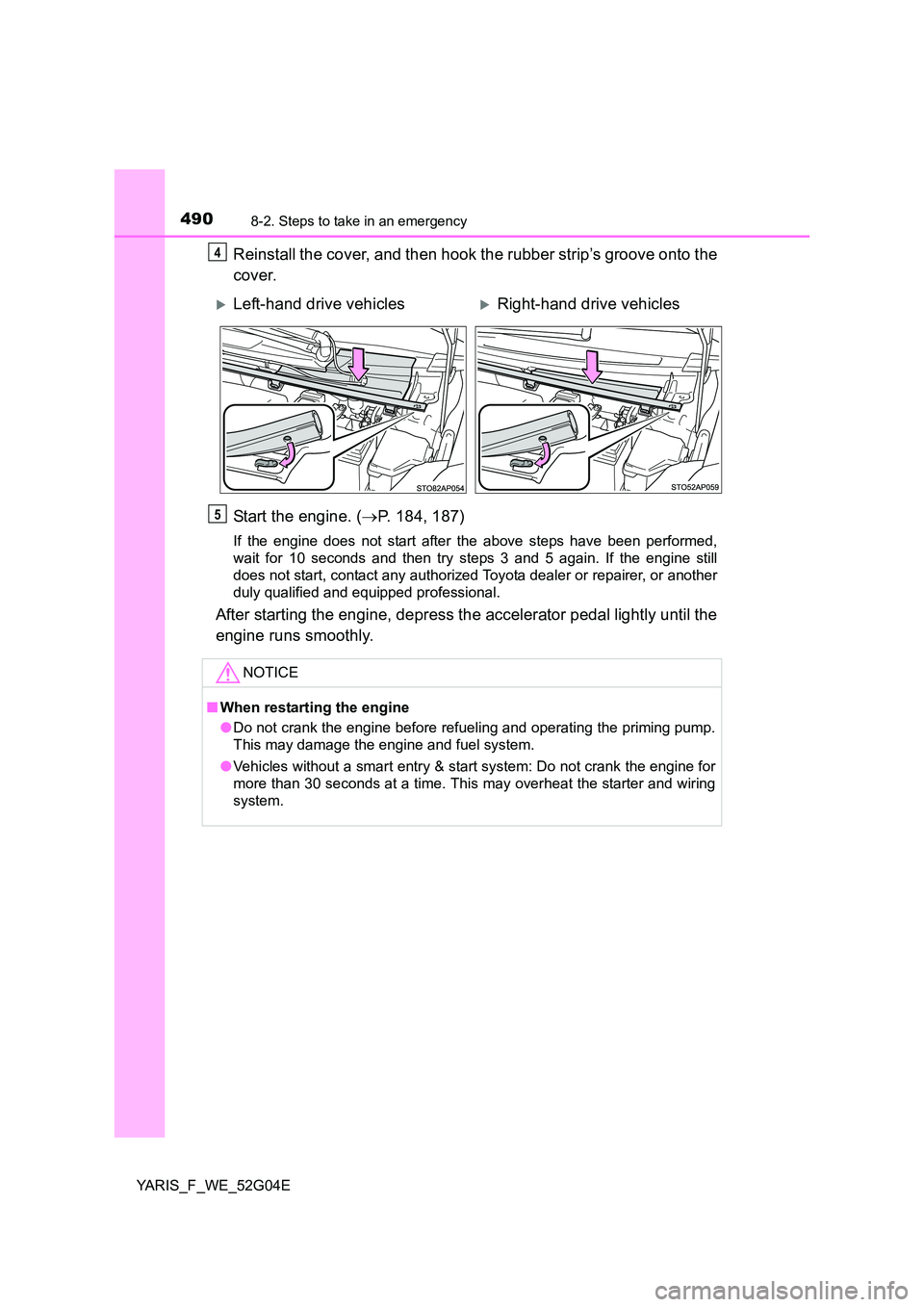
Reinstall the cover, and then hook the rubber strip’s groove onto the
cover.
Start the engine. ( P. 184, 187)
If the engine does not start after the above steps have been performed,
wait for 10 seconds and then try steps 3 and 5 again. If the engine still
does not start, contact any authorized Toyota dealer or repairer, or another
duly qualified and equipped professional.
After starting the engine, depress the accelerator pedal lightly until the
engine runs smoothly.
4
Left-hand drive vehiclesRight-hand drive vehicles
NOTICE
■ When restarting the engine
● Do not crank the engine before refueling and operating the priming pump.
This may damage the engine and fuel system.
● Vehicles without a smart entry & start system: Do not crank the engine for
more than 30 seconds at a time. This may overheat the starter and wiring
system.
5
Page 491 of 540
4918-2. Steps to take in an emergency
8
When trouble arises
YARIS_F_WE_52G04E
If the vehicle becomes stuck
Stop the engine. Set the parking brake and shift the shift lever to P
(Multidrive) or N (manual transmission).
Remove the mud, snow or sand from around the front wheels.
Place wood, stones or some other material under the front wheels
to help provide traction.
Restart the engine.
Shift the shift lever to D or R (Multidrive) or 1 or R (manual trans-
mission) and release the parking brake. Then, while exercising cau-
tion, depress the accelerator pedal.
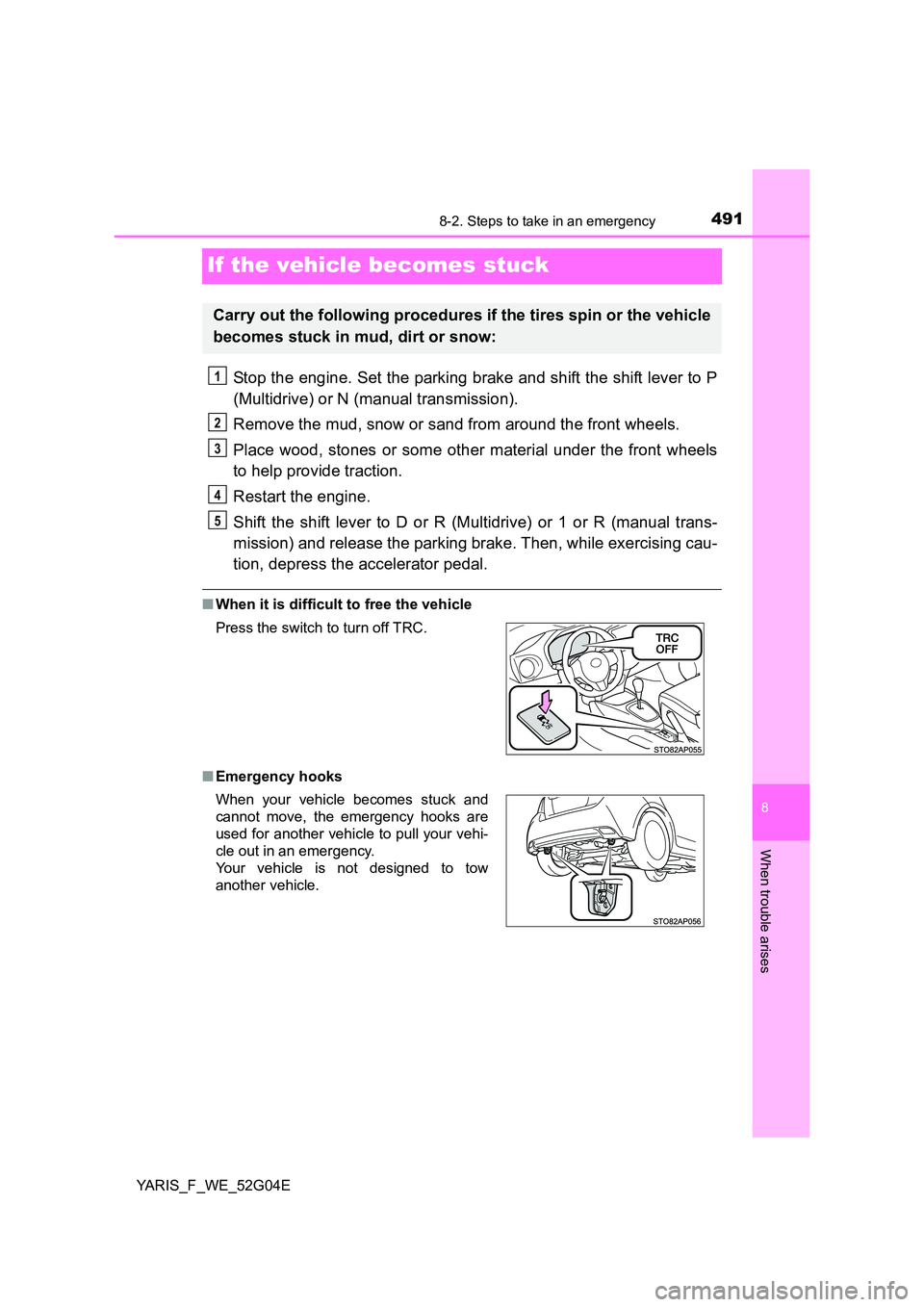
■ When it is difficult to free the vehicle
■ Emergency hooks
Carry out the following procedures if the tires spin or the vehicle
becomes stuck in mud, dirt or snow:
Press the switch to turn off TRC.
When your vehicle becomes stuck and
cannot move, the emergency hooks are
used for another vehicle to pull your vehi-
cle out in an emergency.
Your vehicle is not designed to tow
another vehicle.
1
2
3
4
5
Page 494 of 540
4949-1. Specifications
YARIS_F_WE_52G04E
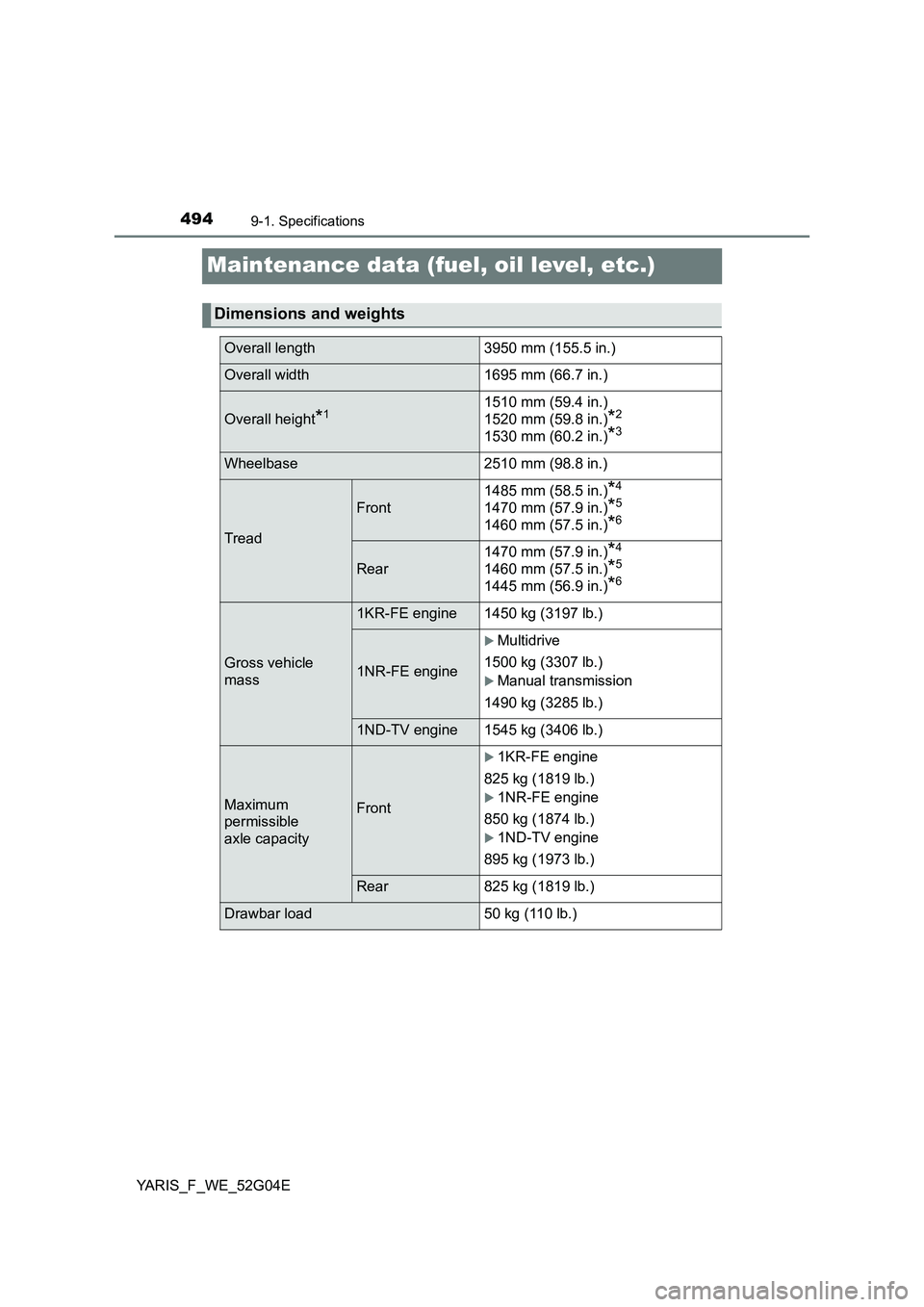
Maintenance data (fuel, oil level, etc.)
Dimensions and weights
Overall length 3950 mm (155.5 in.)
Overall width 1695 mm (66.7 in.)
Overall height*11510 mm (59.4 in.)
1520 mm (59.8 in.)*2
1530 mm (60.2 in.)*3
Wheelbase 2510 mm (98.8 in.)
Tread
Front
1485 mm (58.5 in.)*4
1470 mm (57.9 in.)*5
1460 mm (57.5 in.)*6
Rear
1470 mm (57.9 in.)*4
1460 mm (57.5 in.)*5
1445 mm (56.9 in.)*6
Gross vehicle
mass
1KR-FE engine 1450 kg (3197 lb.)
1NR-FE engine
Multidrive
1500 kg (3307 lb.)
Manual transmission
1490 kg (3285 lb.)
1ND-TV engine 1545 kg (3406 lb.)
Maximum
permissible
axle capacity
Front
1KR-FE engine
825 kg (1819 lb.)
1NR-FE engine
850 kg (1874 lb.)
1ND-TV engine
895 kg (1973 lb.)
Rear 825 kg (1819 lb.)
Drawbar load 50 kg (110 lb.)
Page 495 of 540
4959-1. Specifications
9
Vehicle specifications
YARIS_F_WE_52G04E
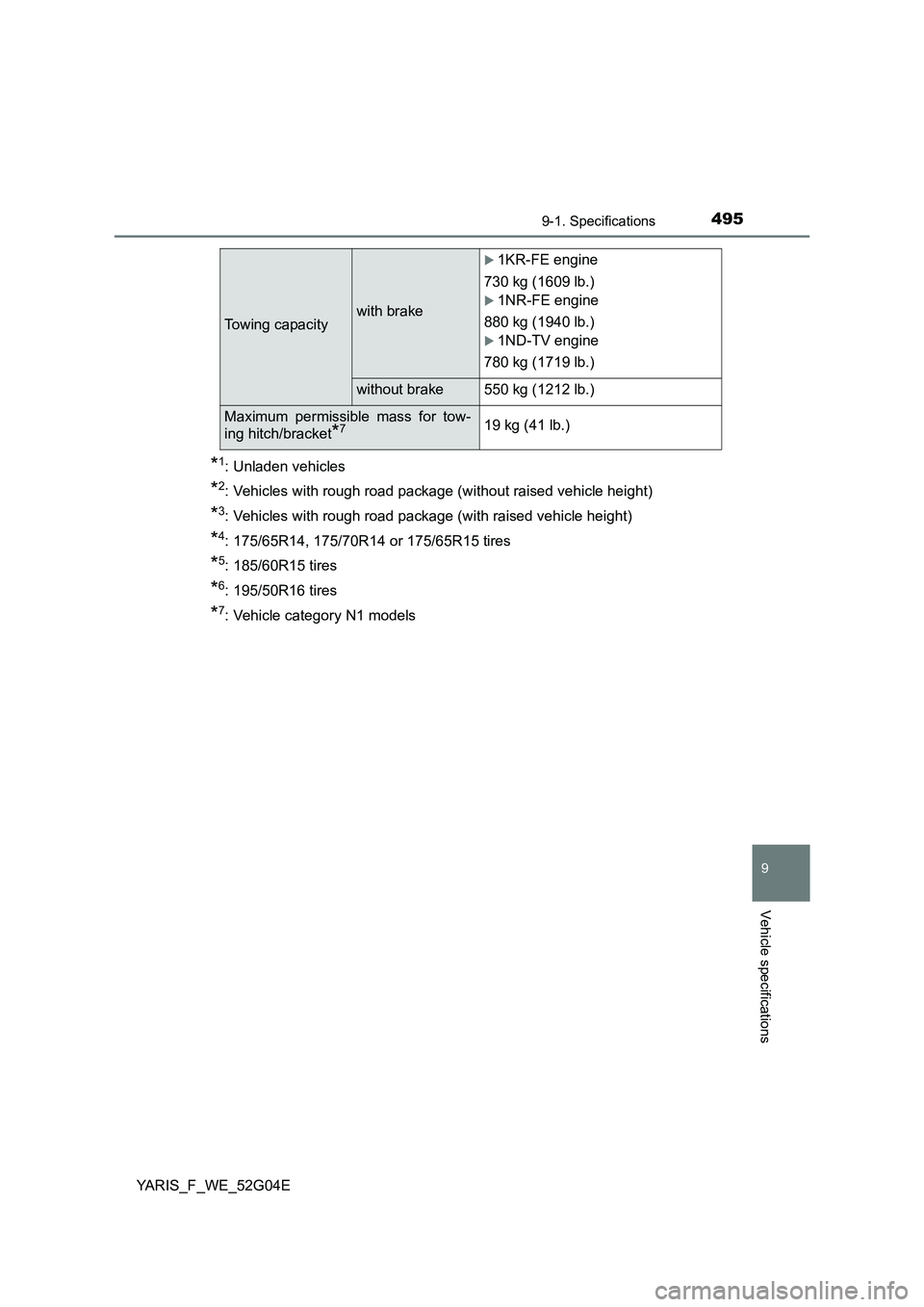
*1: Unladen vehicles
*2: Vehicles with rough road package (without raised vehicle height)
*3: Vehicles with rough road package (with raised vehicle height)
*4: 175/65R14, 175/70R14 or 175/65R15 tires
*5: 185/60R15 tires
*6: 195/50R16 tires
*7: Vehicle category N1 models
Towing capacity with brake
1KR-FE engine
730 kg (1609 lb.)
1NR-FE engine
880 kg (1940 lb.)
1ND-TV engine
780 kg (1719 lb.)
without brake 550 kg (1212 lb.)
Maximum permissible mass for tow-
ing hitch/bracket*719 kg (41 lb.)