flat tire TOYOTA YARIS 2016 Owner's Manual
[x] Cancel search | Manufacturer: TOYOTA, Model Year: 2016, Model line: YARIS, Model: TOYOTA YARIS 2016Pages: 540, PDF Size: 34.12 MB
Page 390 of 540
3907-3. Do-it-yourself maintenance
YARIS_F_WE_52G04E
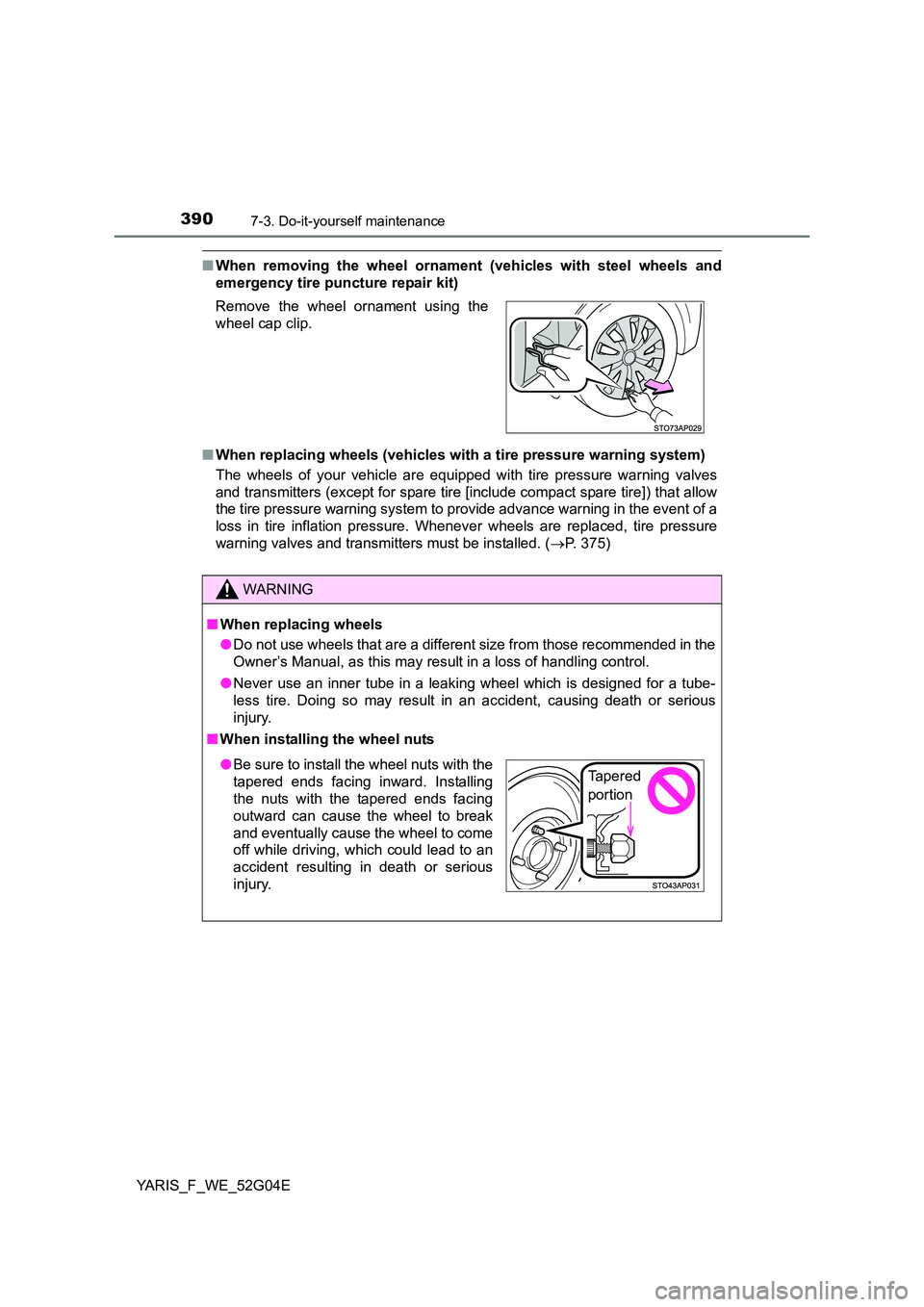
■When removing the wheel ornament (vehicles with steel wheels and
emergency tire puncture repair kit)
■ When replacing wheels (vehicles with a tire pressure warning system)
The wheels of your vehicle are equipped with tire pressure warning valves
and transmitters (except for spare tire [inc lude compact spare tire]) that allow
the tire pressure warning system to provide advance warning in the event of a
loss in tire inflation pressure. Whenever wheels are replaced, tire pressure
warning valves and transmitters must be installed. ( P. 375)
Remove the wheel ornament using the
wheel cap clip.
WARNING
■ When replacing wheels
● Do not use wheels that are a different size from those recommended in the
Owner’s Manual, as this may result in a loss of handling control.
● Never use an inner tube in a leaking wheel which is designed for a tube-
less tire. Doing so may result in an accident, causing death or serious
injury.
■ When installing the wheel nuts
●Be sure to install the wheel nuts with the
tapered ends facing inward. Installing
the nuts with the tapered ends facing
outward can cause the wheel to break
and eventually cause the wheel to come
off while driving, which could lead to an
accident resulting in death or serious
injury.
Tapered
portion
Page 419 of 540
419
8When trouble arises
YARIS_F_WE_52G04E
8-1. Essential information
Emergency flashers ........... 420
If your vehicle has to
be stopped in
an emergency .................. 421
8-2. Steps to take in
an emergency
If your vehicle needs to
be towed .......................... 423
If you think something is
wrong ............................... 429
Fuel pump shut off system
(gasoline engine only) ..... 430
If a warning light turns on
or a warning buzzer
sounds ............................. 431
If you have a flat tire
(vehicles with
a spare tire) ..................... 445
If you have a flat tire
(vehicles with
an emergency tire
puncture repair kit)........... 460
If the engine will not start ... 475
If the shift lever cannot be
shifted from P (vehicles
with a Multidrive).............. 477
If the electronic key does
not operate properly
(vehicles with a smart
entry & start system)........ 478
If the vehicle battery is
discharged ....................... 480
If your vehicle overheats .... 485
If you run out of fuel and
the engine stalls
(diesel engine only) ......... 489
If the vehicle becomes
stuck ................................ 491
Page 429 of 540
4298-2. Steps to take in an emergency
8
When trouble arises
YARIS_F_WE_52G04E
If you think something is wrong
●Fluid leaks under the vehicle
(Water dripping from the air conditioning after use is normal)
● Flat-looking tires or uneven tire wear
● High engine coolant temperature warning light flashes or comes on
● Low engine coolant temperature indicator comes on or does not
come on continuously
● Changes in exhaust sound
● Excessive tire squeal when cornering
● Strange noises related to the suspension system
● Pinging or other noises related to the engine
● Engine misfire, stumbling or running roughly
● Appreciable loss of power
● Vehicle pulls heavily to one side when braking
● Vehicle pulls heavily to one side when driving on a level road
● Loss of brake effectiveness, spongy feeling, pedal almost touches
the floor
If you notice any of the following symptoms, your vehicle proba-
bly needs adjustment or repair. Contact any authorized Toyota
dealer or repairer, or another duly qualified and equipped pro-
fessional as soon as possible.
Visible symptoms
Audible symptoms
Operational symptoms
Page 435 of 540
4358-2. Steps to take in an emergency
8
When trouble arises
YARIS_F_WE_52G04E
(Flashes in yellow for 15 seconds.)
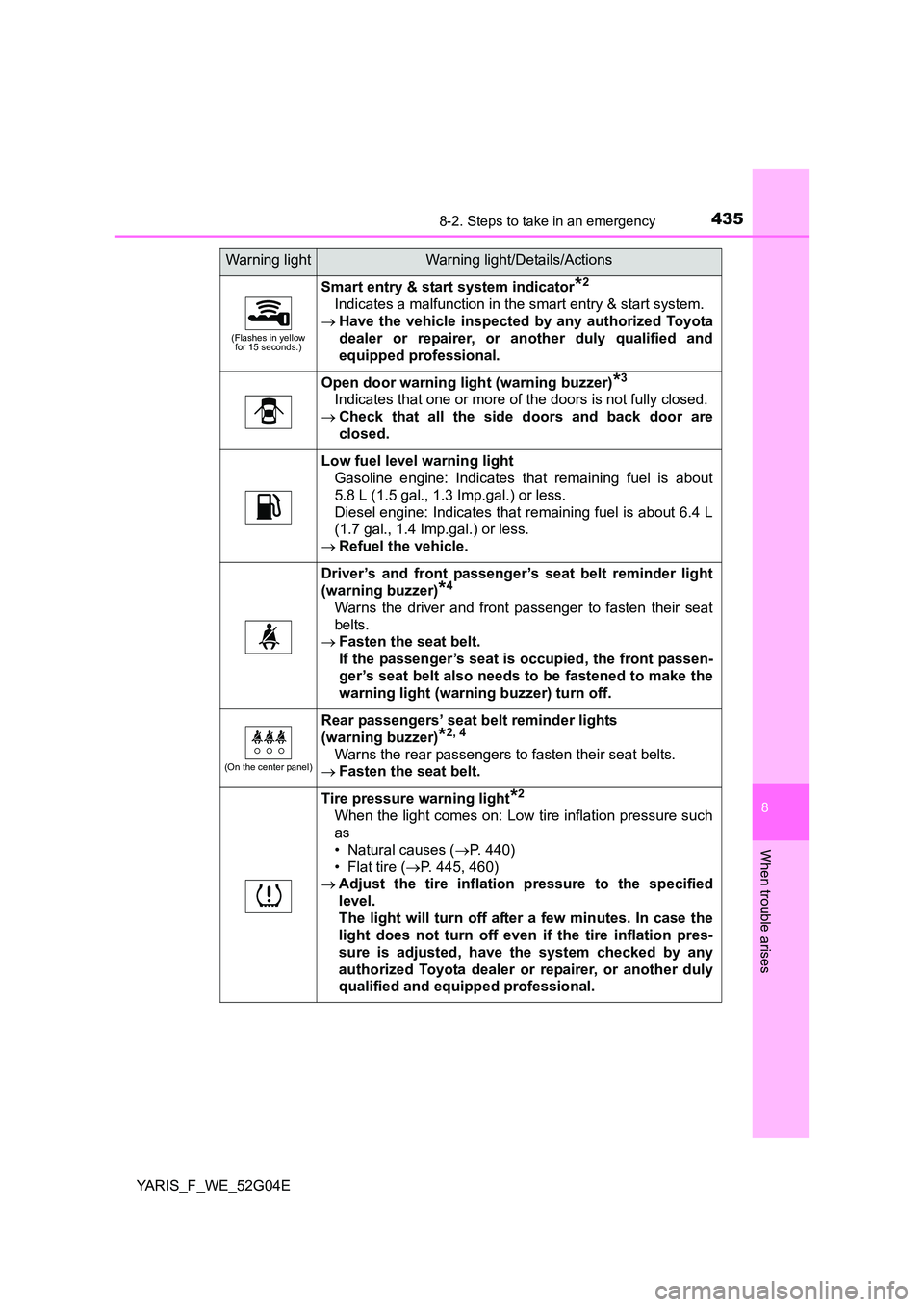
Smart entry & start system indicator*2
Indicates a malfunction in the smart entry & start system.
Have the vehicle inspected by any authorized Toyota
dealer or repairer, or another duly qualified and
equipped professional.
Open door warning light (warning buzzer)*3
Indicates that one or more of the doors is not fully closed.
Check that all the side doors and back door are
closed.
Low fuel level warning light
Gasoline engine: Indicates that remaining fuel is about
5.8 L (1.5 gal., 1.3 Imp.gal.) or less.
Diesel engine: Indicates that remaining fuel is about 6.4 L
(1.7 gal., 1.4 Imp.gal.) or less.
Refuel the vehicle.
Driver’s and front passenger’s seat belt reminder light
(warning buzzer)*4
Warns the driver and front passenger to fasten their seat
belts.
Fasten the seat belt.
If the passenger’s seat is occupied, the front passen-
ger’s seat belt also needs to be fastened to make the
warning light (warning buzzer) turn off.
(On the center panel)
Rear passengers’ seat belt reminder lights
(warning buzzer)*2, 4
Warns the rear passengers to fasten their seat belts.
Fasten the seat belt.
Tire pressure warning light*2
When the light comes on: Low tire inflation pressure such
as
• Natural causes ( P. 440)
• Flat tire ( P. 445, 460)
Adjust the tire inflation pressure to the specified
level.
The light will turn off after a few minutes. In case the
light does not turn off even if the tire inflation pres-
sure is adjusted, have the system checked by any
authorized Toyota dealer or repairer, or another duly
qualified and equipped professional.
Warning lightWarning light/Details/Actions
Page 439 of 540
4398-2. Steps to take in an emergency
8
When trouble arises
YARIS_F_WE_52G04E
■ If the engine oil change reminder light flashes (diesel engine with a DPF
system)
Repeated short trips and/or low-speed dr iving may cause the oil to degrade
sooner than usual, regardless of the actual distance driven. If this happens,
the engine oil change reminder light will flash.
■ Engine oil change reminder light comes on (diesel engine only)
Vehicles without a DPF system
Replace the engine oil and oil filter when the engine oil change reminder light
does not come on even if you have driven over 40000 km (25000 miles) after
the engine oil was changed.
There is a possibility that the engine oil change reminder light has been illumi-
nated when you have driven less than 40000 km (25000 miles) based on a
usage or driving condition.
Vehicles with a DPF system
Replace the engine oil and oil filter when the engine oil change reminder light
does not come on even if you have driven over 15000 km (9300 miles) after
the engine oil was changed.
There is a possibility that the engine oil change reminder light has been illumi-
nated when you have driven less than 15000 km (9300 miles) based on a
usage or driving condition.
■ When the tire pressure warning light comes on (vehicles with a tire pres-
sure warning system)
Inspect the appearance of the tire to check that the tire is not punctured.
If the tire is punctured: P. 445, 460
If the tire is not punctured:
Carry out the following procedure after the tire temperature has lowered suffi-
ciently.
● Check the tire inflation pressure and adjust to the appropriate level.
● If the warning light does not go out even after several minutes, check that
the tire inflation pressure is at the specified level and carry out initialization.
The warning light may come on again if the above operations are conducted
without first allowing the tire temperature to lower sufficiently.
Page 440 of 540
4408-2. Steps to take in an emergency
YARIS_F_WE_52G04E
■ The tire pressure warning light may come on due to natural causes
(vehicles with a tire pressure warning system)
The tire pressure warning light may come on due to natural causes such as
natural air leaks and tire inflation pressure changes caused by temperature.
In this case, adjusting the tire inflation pressure will turn off the warning light
(after a few minutes).
■ When a tire is replaced with a spare tire (vehicles with a tire pressure
warning system)
The spare tire is not equipped with a tire pressure warning valve and trans-
mitter. If a tire goes flat, the tire pressure warning light will not turn off even
though the flat tire has been replaced with the spare tire. Replace the spare
tire with the repaired tire and adjust the tire inflation pressure. The tire pres-
sure warning light will go off after a few minutes.
■ If the tire pressure warning system is not functioning (vehicles with a
tire pressure warning system)
The tire pressure warning system will be disabled in the following conditions:
(When the condition becomes normal, the system will work properly.)
● If tires not equipped with tire pressure warning valves and transmitters are
used
● If the ID code on the tire pressure warning valves and transmitters is not
registered in the tire pressure warning computer
● If the tire inflation pressure is 500 kPa (5.1 kgf/cm2 or bar, 73 psi) or higher
The tire pressure warning system may be disabled in the following conditions:
(When the condition becomes normal, the system will work properly.)
● If electronic devices or facilities using similar radio wave frequencies are
nearby
● If a radio set at a similar frequency is in use in the vehicle
● If a window tint that affects the radio wave signals is installed
● If there is a lot of snow or ice on the vehicle, particularly around the wheels
or wheel housings
● If non-genuine Toyota wheels are used (Even if you use Toyota wheels, the
tire pressure warning system may not work properly with some types of
tires.)
● If tire chains are used
■ If the tire pressure warning light frequently comes on after blinking for 1
minute (vehicles with a tire pressure warning system)
If the tire pressure warning light frequently comes on after blinking for 1
minute when the engine switch is turned on, have it checked by any autho-
rized Toyota dealer or repairer, or another duly qualified and equipped profes-
sional.
Page 441 of 540
4418-2. Steps to take in an emergency
8
When trouble arises
YARIS_F_WE_52G04E
WARNING
■When the electric power steering system warning light comes on
The steering wheel may become extremely heavy.
If the steering wheel becomes heavier than usual when operating, hold
firmly and operate using more force than usual.
■ When driving to clean the DPF catalytic converter
When driving, pay sufficient attention to weather, road conditions, terrain
and traffic conditions, and be sure to observe traffic laws and/or regulations.
Failure to do so may cause an unexpected accident, resulting in death or
serious injury.
■ If the tire pressure warning light comes on (vehicles with a tire pres-
sure warning system)
Be sure to observe the following precautions. Failure to do so could cause a
loss of vehicle control and result in death or serious injury.
● Stop your vehicle in a safe place as soon as possible. Adjust the tire infla-
tion pressure immediately.
● If the tire pressure warning light comes on even after tire inflation pressure
adjustment, it is probable that you have a flat tire. Check the tires. If a tire
is flat, change it with the spare tire and have the flat tire repaired by the
nearest authorized Toyota dealer or repairer, or another duly qualified and
equipped professional.
● Avoid abrupt maneuvering and braking. If the vehicle tires deteriorate, you
could lose control of the steering wheel or the brakes.
■ If a blowout or sudden air leakage should occur (vehicles with a tire
pressure warning system)
The tire pressure warning system may not activate immediately.
Page 445 of 540
4458-2. Steps to take in an emergency
8
When trouble arises
YARIS_F_WE_52G04E
If you have a flat tire (vehicles with a spare
tire)
● Stop the vehicle on a hard, flat surface.
● Set the parking brake.
● Shift the shift lever to P (Multidrive) or R (manual transmission).
● Stop the engine.
● Turn on the emergency flashers. (P. 420)
Your vehicle is equipped with a spare tire. The flat tire can be
replaced with the spare tire.
For details about tires: P. 3 7 3
WARNING
■If you have a flat tire
Do not continue driving with a flat tire.
Driving even a short distance with a flat tire can damage the tire and the
wheel beyond repair, which could result in an accident.
Before jacking up the vehicle
Page 447 of 540
4478-2. Steps to take in an emergency
8
When trouble arises
YARIS_F_WE_52G04E
WARNING
■Using the tire jack
Observe the following precautions.
Improper use of the tire jack may cause the vehicle to suddenly fall off the
jack, leading to death or serious injury.
● Do not use the tire jack for any purpose other than replacing tires or install-
ing and removing tire chains.
● Only use the tire jack that comes with this vehicle for replacing a flat tire.
Do not use it on other vehicles, and do not use other tire jacks for replac-
ing tires on this vehicle.
● Put the jack properly in its jack point.
● Do not put any part of your body under the vehicle while it is supported by
the jack.
● Do not start the engine or drive the vehicle while the vehicle is supported
by the jack.
● Do not raise the vehicle while someone is inside.
● When raising the vehicle, do not put an object on or under the jack.
● Do not raise the vehicle to a height greater than that required to replace
the tire.
● Use a jack stand if it is necessary to get under the vehicle.
● When lowering the vehicle, make sure that there is no-one near the vehi-
cle. If there are people nearby, warn them vocally before lowering.
Page 450 of 540
4508-2. Steps to take in an emergency
YARIS_F_WE_52G04E
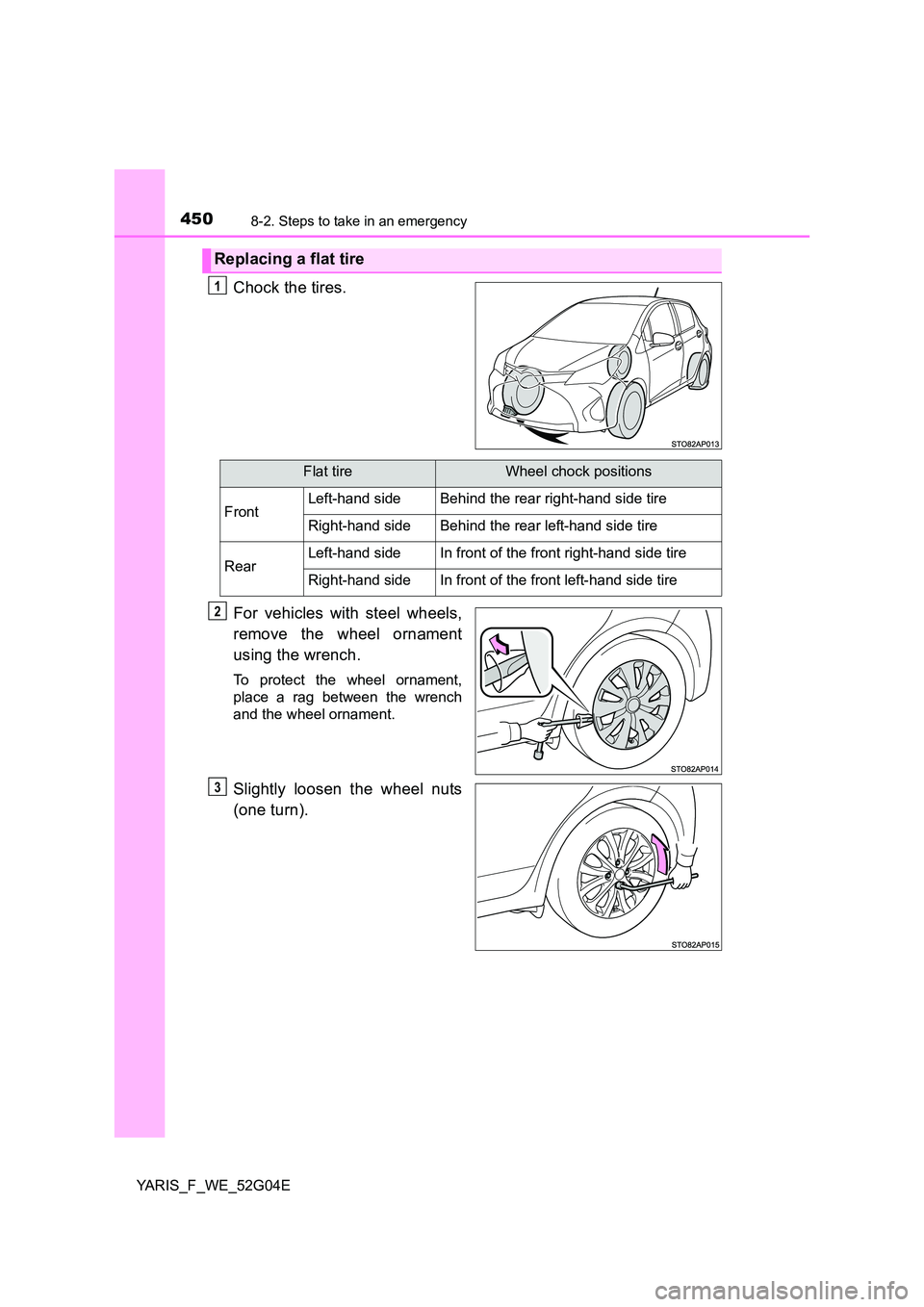
Chock the tires.
For vehicles with steel wheels,
remove the wheel ornament
using the wrench.
To protect the wheel ornament,
place a rag between the wrench
and the wheel ornament.
Slightly loosen the wheel nuts
(one turn).
Replacing a flat tire
1
Flat tireWheel chock positions
FrontLeft-hand sideBehind the rear right-hand side tire
Right-hand sideBehind the rear left-hand side tire
RearLeft-hand sideIn front of the front right-hand side tire
Right-hand sideIn front of the front left-hand side tire
2
3