tow TOYOTA YARIS 2016 Owner's Manual
[x] Cancel search | Manufacturer: TOYOTA, Model Year: 2016, Model line: YARIS, Model: TOYOTA YARIS 2016Pages: 540, PDF Size: 34.12 MB
Page 179 of 540
1794-1. Before driving
4
Driving
YARIS_F_WE_52G04E
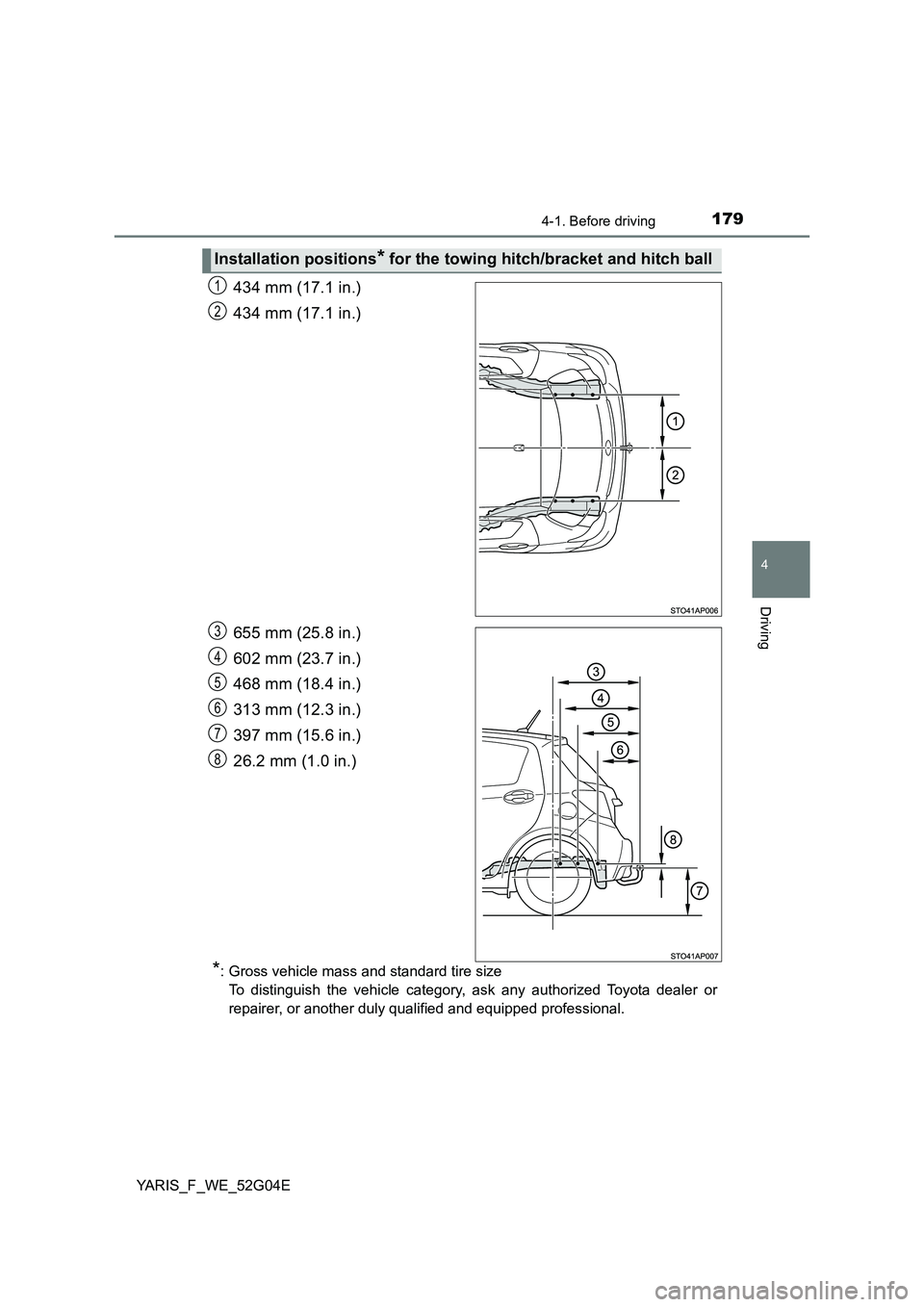
434 mm (17.1 in.)
434 mm (17.1 in.)
655 mm (25.8 in.)
602 mm (23.7 in.)
468 mm (18.4 in.)
313 mm (12.3 in.)
397 mm (15.6 in.)
26.2 mm (1.0 in.)
*: Gross vehicle mass and standard tire size
To distinguish the vehicle category, ask any authorized Toyota dealer or
repairer, or another duly qualified and equipped professional.
Installation positions* for the towing hitch/bracket and hitch ball
1
2
3
4
5
6
7
8
Page 180 of 540
1804-1. Before driving
YARIS_F_WE_52G04E
■Tire information
● Increase the tire inflation pressure to 20.0 kPa (0.2 kgf/cm2 or bar, 3 psi)
greater than the recommended value when towing. ( P. 509)
● Increase the air pressure of the trailer tires in accordance with the total
trailer weight and according to the values recommended by the manufac-
turer of your trailer.
■ Tr a i l e r l i g h ts
Check that the turn signal lights and stoplights are operating correctly every
time you hitch up the trailer. Direct ly wiring up to your vehicle may damage
the electrical system and stop the lights from functioning correctly.
■ Break-in schedule
Toyota recommends that vehicles fitted with new power train components
should not be used for towing trailers for the first 800 km (500 miles).
■ Safety checks before towing
● Check that the maximum load limit for the towing hitch/bracket and hitch ball
is not exceeded. Bear in mind that the coupling weight of the trailer will add
to the load exerted on the vehicle. Also make sure that the total load exerted
on the vehicle is within the range of the weight limits. ( P. 176)
● Ensure that the trailer load is secure.
● Supplementary outside rear view mirrors should be added to the vehicle if
the traffic behind cannot be clearly seen with standard mirrors. Adjust the
extending arms of these mirrors on both sides of the vehicle so that they
always provide maximum visibility of the road behind.
■ Maintenance
● Maintenance must be performed more frequently when using the vehicle for
towing due to the greater weight burden placed on the vehicle compared to
normal driving.
● Retighten all bolts securing the hitching ball and bracket after towing for
approximately 1000 km (600 miles).
Page 181 of 540
1814-1. Before driving
4
Driving
YARIS_F_WE_52G04E
Your vehicle will handle differently when towing a trailer. In order to
avoid accident, death or serious injury, keep the following in mind
when towing:
■Checking connections between trailer and lights
Stop the vehicle and check the operation of the connection between
the trailer and lights after driving for a brief period as well as before
starting off.
■Practicing driving with a coupled trailer
● Get the feel for turning, stopping and reversing with the trailer
coupled by practicing in an area with no or light traffic.
● When reversing with a coupled trailer, hold the section of the
steering wheel nearest to you and rotate clockwise to turn the
trailer left or counterclockwise to turn it right. Always rotate a little
at a time to prevent steering error. Have someone guide you
when reversing to lessen the risk of an accident.
■Increasing vehicle-to-vehicle distance
At a speed of 10 km/h (6 mph), the distance to the vehicle running
ahead of you should be equivalent to or greater than the combined
length of your vehicle and trailer. Avoid sudden braking that may
cause skidding. Otherwise, the vehicle may spin out of control. This
is especially true when driving on wet or slippery road surfaces.
NOTICE
■ When the rear bumper strengthening material is aluminum
Ensure the steel bracket part does not come directly in contact with that
area.
When steel and aluminum come into contact, there is a reaction similar to
corrosion, which will weaken the section concerned and may result in dam-
age. Apply a rust inhibitor to parts that will come in contact when attaching a
steel bracket.
Guidance
Page 182 of 540
1824-1. Before driving
YARIS_F_WE_52G04E
■Sudden acceleration/steering input/cornering
Executing sharp turns when towing may result in the trailer colliding
with your vehicle. Decelerate well in advance when approaching
turns and take them slowly and carefully to avoid sudden braking.
■Important points regarding turning
The wheels of the trailer will travel closer to the inside of the curve
than the wheels of the vehicle. To make allowance for this, take the
turns wider than you would normally do.
■Important points regarding stability
Vehicle movement resulting from uneven road surfaces and strong
crosswinds will affect handling. The vehicle may also be rocked by
passing buses or large trucks. Frequently check behind when mov-
ing alongside such vehicles. As soon as such vehicle movement
occurs, immediately start to decelerate smoothly by slowly applying
the brakes. Always steer the vehicle straight ahead while braking.
■Passing other vehicles
Consider the total combined length of your vehicle and trailer and
ensure that the vehicle-to-vehicle distance is sufficient before exe-
cuting lane changes.
■Transmission information
Vehicles with a Multidrive
To maintain engine braking efficiency, when using engine braking,
do not use the transmission in D. Transmission shift gear position
must be in 4 in the M mode. ( P. 193)
Vehicles with a manual transmission
To maintain engine braking efficiency, when using engine braking,
do not use the transmission in 5 and 6 (vehicles with a 6-speed
manual transmission) gear. ( P. 198)
Page 183 of 540
1834-1. Before driving
4
Driving
YARIS_F_WE_52G04E
■If the engine overheats
Towing a loaded trailer up a long, steep incline in temperatures
exceeding 30 C (85F) may result in the engine overheating. If the
high engine coolant temperature warning light flashes or comes on,
turn the air conditioning off immediately, leave the road and stop the
vehicle in a safe place. ( P. 485)
■When parking the vehicle
Always place wheel chocks under the wheels of both the vehicle
and trailer. Firmly set the parking brake and shift the shift lever to P
for Multidrives or 1 or R for manual transmissions.
WARNING
Follow all the instructions described in this section. Failure to do so could
cause an accident resulting in death or serious injury.
■ Trailer towing precautions
When towing, make sure that none of the weight limits are exceeded.
( P. 176)
■ Vehicle speed in towing
Observe the legal maximum speeds for trailer towing.
■ Before descending hills or long declines
Reduce speed and downshift. However, never downshift suddenly while
descending steep or long downhill grades.
■ Operation of the brake pedal
Do not hold the brake pedal depressed often or for long periods of time.
Doing so may result in the brake overheating or reduce braking effects.
■ To avoid accident or injury
● Vehicles with a cruise control: Do not use cruise control when you are tow-
ing.
● Vehicles with a compact spare tire: Do not tow a trailer when the compact
spare tire is installed on your vehicle.
● Vehicles with an emergency tire puncture repair kit: Do not tow a trailer
when the tire installed is repaired with the emergency tire puncture repair
kit.
Page 205 of 540
2054-3. Operating the lights and wipers
4
Driving
YARIS_F_WE_52G04E
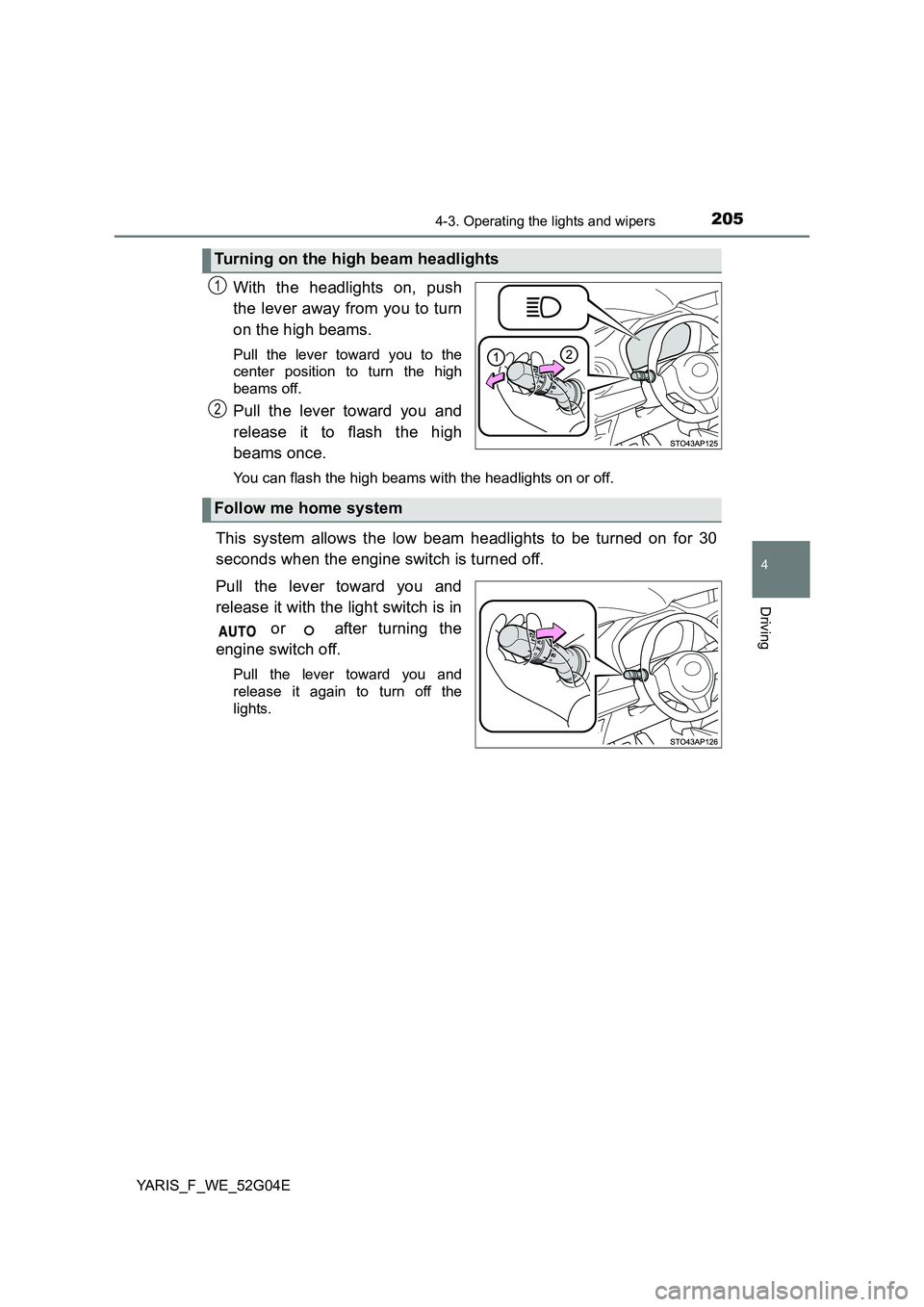
With the headlights on, push
the lever away from you to turn
on the high beams.
Pull the lever toward you to the
center position to turn the high
beams off.
Pull the lever toward you and
release it to flash the high
beams once.
You can flash the high beams with the headlights on or off.
This system allows the low beam headlights to be turned on for 30
seconds when the engine switch is turned off.
Pull the lever toward you and
release it with the light switch is in
or after turning the
engine switch off.
Pull the lever toward you and
release it again to turn off the
lights.
Turning on the high beam headlights
1
2
Follow me home system
Page 215 of 540
2154-3. Operating the lights and wipers
4
Driving
YARIS_F_WE_52G04E
● When the sensor sensitivity ring is turned toward high while in “AUTO”
mode, the wiper will operate once to indicate that the sensor sensitivity is
enhanced.
● If the temperature of the raindrop sensor is 90°C (194°F) or higher, or -15°C
(5°F) or lower, automatic operation may not occur. In this case, operate the
wiper in any mode other than “AUTO” mode.
■ If no windshield washer fluid sprays
Check that the washer nozzle is not blocked, if there is washer fluid in the
windshield washer fluid reservoir.
WARNING
■ Caution regarding the use of windshield wiper in “AUTO” mode (vehi-
cles with a rain-sensing windshield wiper)
The windshield wiper may operate unexpectedly if the sensor is touched or
the windshield is subject to vibration in “AUTO” mode. Take care that your
fingers, etc., do not become caught in the windshield wiper.
■ Caution regarding the use of washer fluid
When it is cold, do not use the washer fluid until the windshield becomes
warm. The fluid may freeze on the windshield and cause low visibility. This
may lead to an accident, resulting in death or serious injury.
NOTICE
■ When the windshield is dry
Do not use the wiper, as they may damage the windshield.
■ When there is no washer fluid spray from the nozzle
Damage to the washer fluid pump may be caused if the lever is pulled
toward you and held continually.
■ When a nozzle becomes blocked
In this case, contact any authorized Toyota dealer or repairer, or another
duly qualified and equipped professional.
Do not try to clear it with a pin or other object. The nozzle will be damaged.
Page 235 of 540
2354-5. Toyota Safety Sense
4
Driving
YARIS_F_WE_52G04E
WARNING
■Cautions regarding the assist functions of the system
By means of warnings and brake control, the pre-crash safety system is intended to assist the driver in avoiding collisions through the process ofLOOK-JUDGE-ACT. There are limits to the degree of assistance the system can provide, so keep in mind the following important points.
● Assisting the driver in watching the road The pre-crash safety system is only able to detect vehicles directly in frontof your vehicle, and only within a limi ted range. It does not allow for care- less or inattentive driving, and is not a system that can assist the driver in low-visibility conditions. It is still necessary for the driver to pay close atten- tion to the vehicle’s surroundings.
● Assisting the driver in making correct judgement When attempting to estimate the possibility of a collision, the only data available to the pre-crash safety system is that from vehicles it has detected directly in front of the vehicle. Therefore, it is absolutely neces-sary for the driver to remain vigila nt and to determine whether or not there is a possibility of collision in any given situation.
● Assisting the driver in taking action The pre-crash brake assist and pre- crash braking functions are designed to help avoid a collision or reduce the severity of a collision, as such theyonly operate when the system has determined that the possibility of a col- lision is high. This system is not capable of automatically avoiding a colli- sion or bringing the vehicle to a stop safely, without appropriate operationsbeing performed by the driver. For this reason, when encountering a dan-gerous situation the driver must take direct and immediate action in order to ensure the safety of all involved.
NOTICE
■ To avoid malfunction of the system
In the following situations, disable the pre-crash safety system. The system may operate even if there is no possibility of a collision.
● When inspecting the vehicle using a drum tester such as a chassis dyna- mometer or speedometer tester, or when using an on vehicle wheel bal-ancer
● When transporting the vehicle via boat, truck, or similar means of transpor- tation
● When the front part of the vehicle is raised or lowered, such as if tires of a different size than specified are used or if the suspension components are modified
● When the vehicle is being towed
Page 244 of 540
2444-5. Toyota Safety Sense
YARIS_F_WE_52G04E
● High beam may be turned on or off when unexpected by the driver.
● In the situations below, the system may not be able to correctly detect the surrounding brightness levels, and may flash or expose nearby pedestrians to the high beam. Therefore, you shoul d consider turning the high beams on or off manually rather than relying on the Automatic High Beam system.
• In bad weather (rain, snow, fog, sandstorms, etc.) • The windshield is obscured by fog, mist, ice, dirt, etc.• The windshield is cracked or damaged.• The front sensor is deformed or dirty. • The front sensor temperature is extremely high. • Surrounding brightness levels are equal to those of headlights, tail lightsor fog lights.• Vehicles ahead have headlights or tail lights that are either switched off,dirty, are changing color, or are not aimed properly.• When driving through an area of intermittently changing brightness anddarkness. • When frequently and repeatedly driving ascending/descending roads, or roads with rough, bumpy or uneven surfaces (such as stone-pavedroads, gravel tracks, etc.).• When frequently and repeatedly taking curves or driving on a windingroad.• There is a highly reflective object ahead of the vehicle, such as a sign or a mirror. • The back of a vehicle ahead is highly reflective, such as a container on atruck.• The vehicle’s headlights are damaged or dirty.• The vehicle is listing or titling, due to a flat tire, a trailer being towed, etc.• The driver believes that the high beam may be causing problems or dis- tress to other drivers or pedestrians nearby.
■ If the Automatic High Beam indicator comes on in yellow
It may indicate a malfunction in the system. Contact any authorized Toyota dealer or repairer, or another duly qualified and equipped professional.
WARNING
■ Limitations of the Automatic High Beam
Do not rely on the Automatic High Beam. Always drive safely, taking care to
observe your surroundings and turning high beam on or off manually if nec-
essary.
NOTICE
■ Notes when using the Automatic High Beam system
Observe the following to ensure that the Automatic High Beam functions
correctly.
● Do not overload the vehicle.
● Do not modify the vehicle.
Page 246 of 540
2464-6. Using the driving support systems
YARIS_F_WE_52G04E
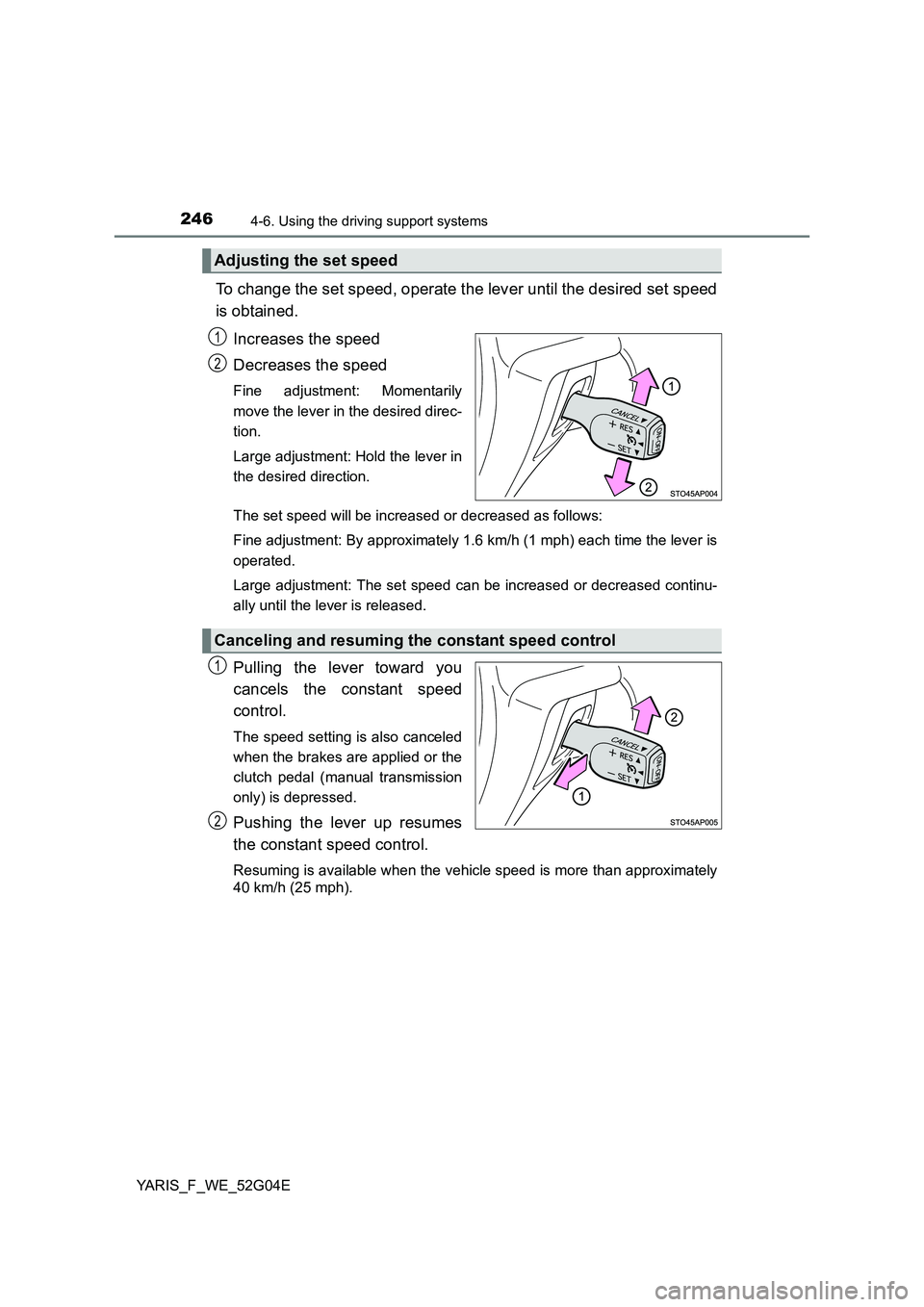
To change the set speed, operate the lever until the desired set speed
is obtained.
Increases the speed
Decreases the speed
Fine adjustment: Momentarily
move the lever in the desired direc-
tion.
Large adjustment: Hold the lever in
the desired direction.
The set speed will be increased or decreased as follows:
Fine adjustment: By approximately 1.6 km/h (1 mph) each time the lever is
operated.
Large adjustment: The set speed can be increased or decreased continu-
ally until the lever is released.
Pulling the lever toward you
cancels the constant speed
control.
The speed setting is also canceled
when the brakes are applied or the
clutch pedal (manual transmission
only) is depressed.
Pushing the lever up resumes
the constant speed control.
Resuming is available when the vehicle speed is more than approximately
40 km/h (25 mph).
Adjusting the set speed
1
2
Canceling and resuming the constant speed control
1
2