towing TOYOTA YARIS 2016 Owner's Manual
[x] Cancel search | Manufacturer: TOYOTA, Model Year: 2016, Model line: YARIS, Model: TOYOTA YARIS 2016Pages: 540, PDF Size: 34.12 MB
Page 424 of 540
4248-2. Steps to take in an emergency
YARIS_F_WE_52G04E
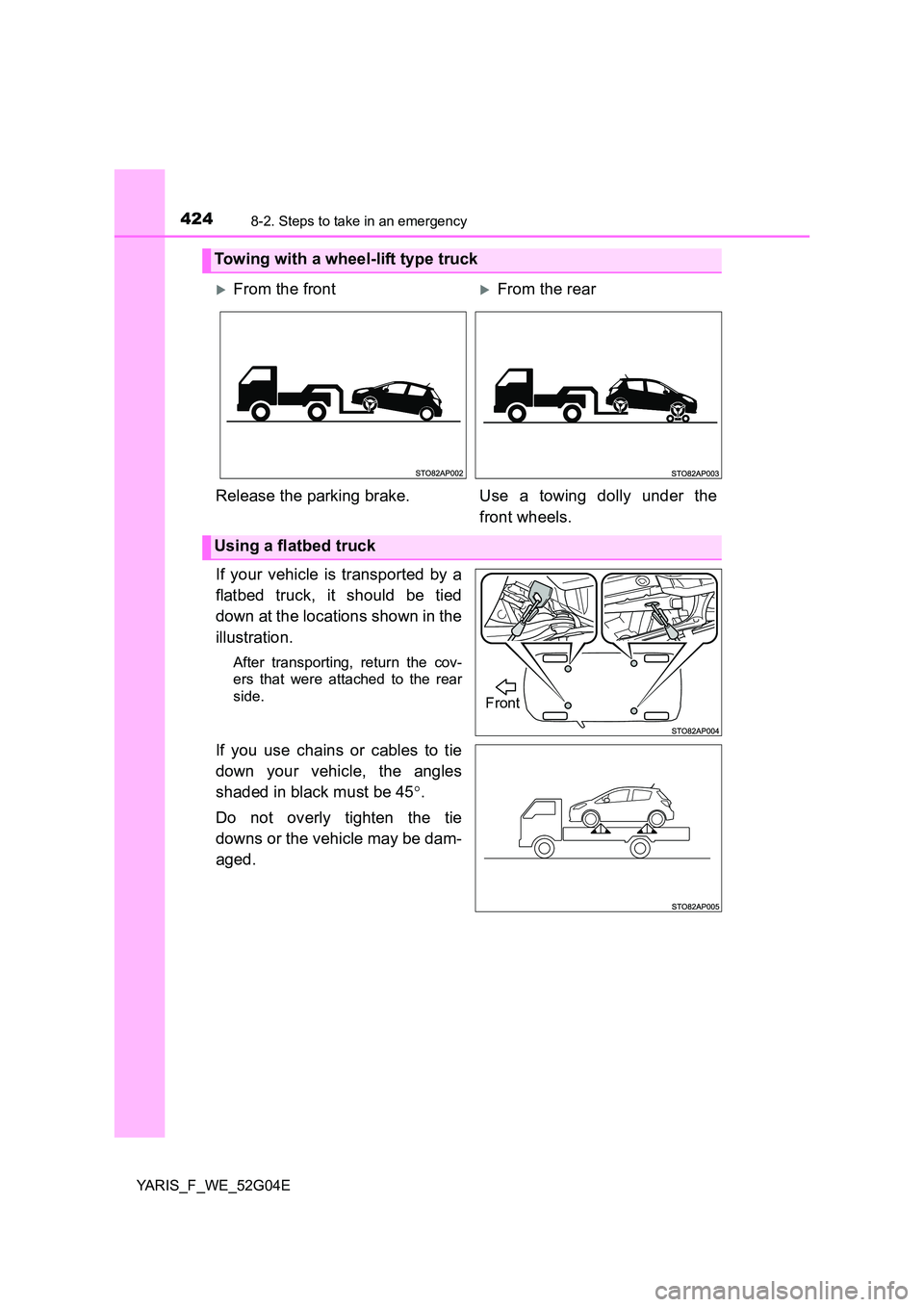
If your vehicle is transported by a
flatbed truck, it should be tied
down at the locations shown in the
illustration.
After transporting, return the cov-
ers that were attached to the rear
side.
If you use chains or cables to tie
down your vehicle, the angles
shaded in black must be 45 .
Do not overly tighten the tie
downs or the vehicle may be dam-
aged.
Towing with a wheel-lift type truck
From the frontFrom the rear
Release the parking brake. Use a towing dolly under the
front wheels.
Using a flatbed truck
Front
Page 425 of 540
4258-2. Steps to take in an emergency
8
When trouble arises
YARIS_F_WE_52G04E
If a tow truck is not available in an emergency, your vehicle may be
temporarily towed using cables or chains secured to the emergency
towing eyelets. This should only be attempted on hard surfaced roads
for at most 80 km (50 miles) at under 30 km/h (18 mph).
A driver must be in the vehicle to steer and operate the brakes. The
vehicle’s wheels, drive train, axles, steering and brakes must be in
good condition.
For vehicles with a Multidrive, only the front towing eyelets may be
used.
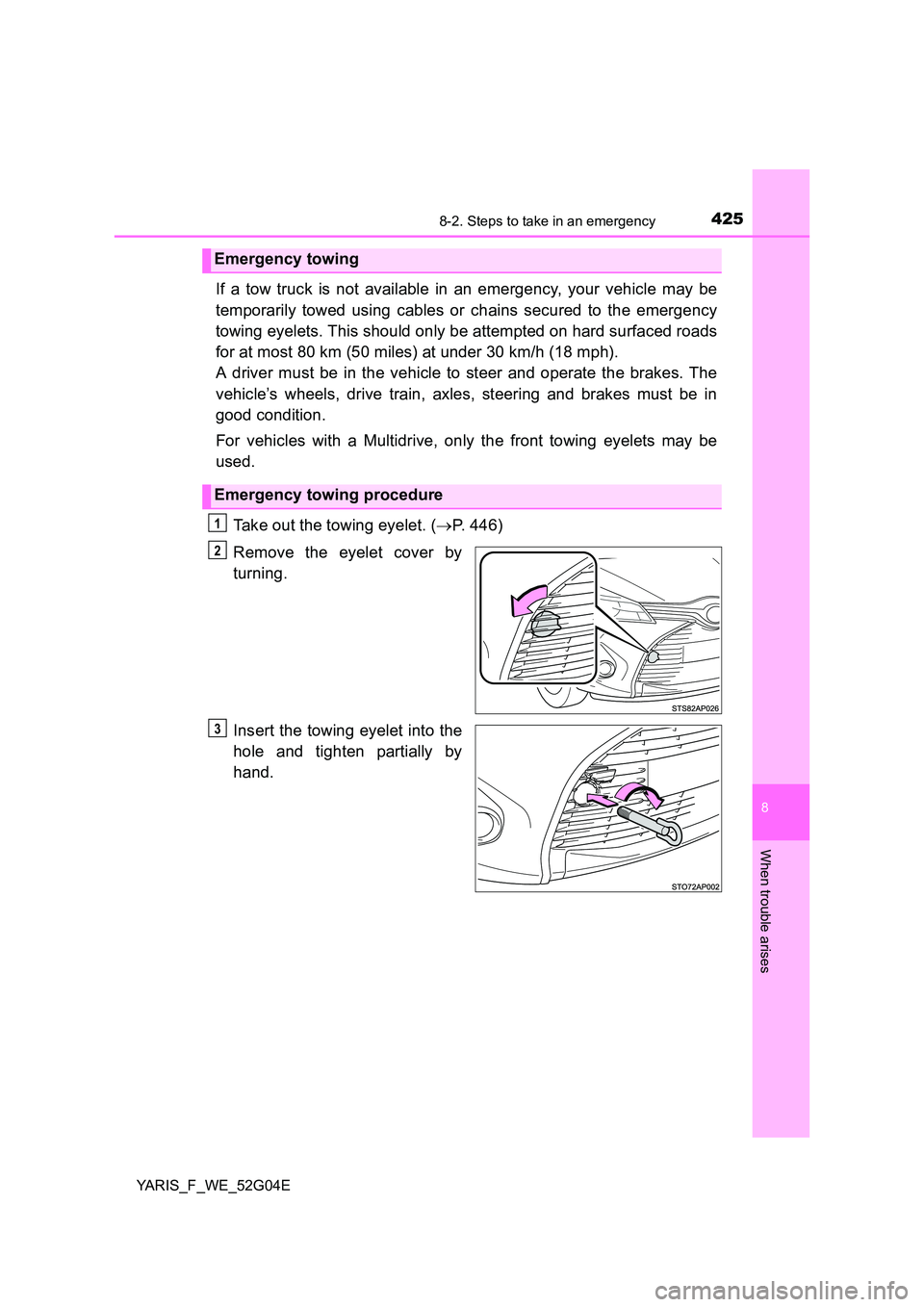
Take out the towing eyelet. ( P. 446)
Remove the eyelet cover by
turning.
Insert the towing eyelet into the
hole and tighten partially by
hand.
Emergency towing
Emergency towing procedure
1
2
3
Page 426 of 540
4268-2. Steps to take in an emergency
YARIS_F_WE_52G04E
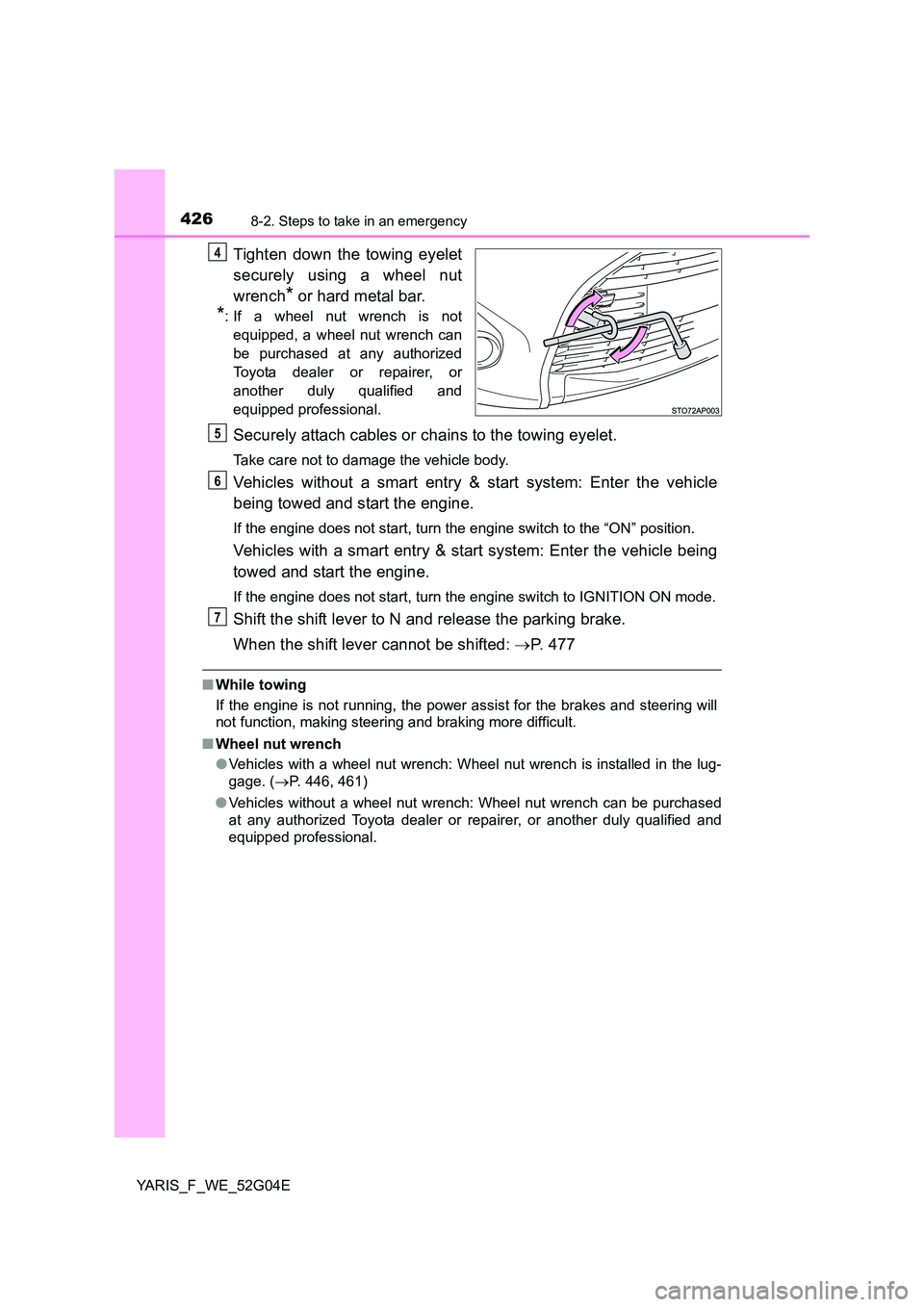
Tighten down the towing eyelet
securely using a wheel nut
wrench* or hard metal bar.
*: If a wheel nut wrench is not
equipped, a wheel nut wrench can
be purchased at any authorized
Toyota dealer or repairer, or
another duly qualified and
equipped professional.
Securely attach cables or chains to the towing eyelet.
Take care not to damage the vehicle body.
Vehicles without a smart entry & start system: Enter the vehicle
being towed and start the engine.
If the engine does not start, turn the engine switch to the “ON” position.
Vehicles with a smart entry & start system: Enter the vehicle being
towed and start the engine.
If the engine does not start, turn the engine switch to IGNITION ON mode.
Shift the shift lever to N and release the parking brake.
When the shift lever cannot be shifted: P. 477
■While towing
If the engine is not running, the power assist for the brakes and steering will
not function, making steering and braking more difficult.
■ Wheel nut wrench
● Vehicles with a wheel nut wrench: Wheel nut wrench is installed in the lug-
gage. ( P. 446, 461)
● Vehicles without a wheel nut wrench: Wheel nut wrench can be purchased
at any authorized Toyota dealer or repairer, or another duly qualified and
equipped professional.
4
5
6
7
Page 427 of 540
4278-2. Steps to take in an emergency
8
When trouble arises
YARIS_F_WE_52G04E
WARNING
Observe the following precautions.
Failure to do so may result in death or serious injury.
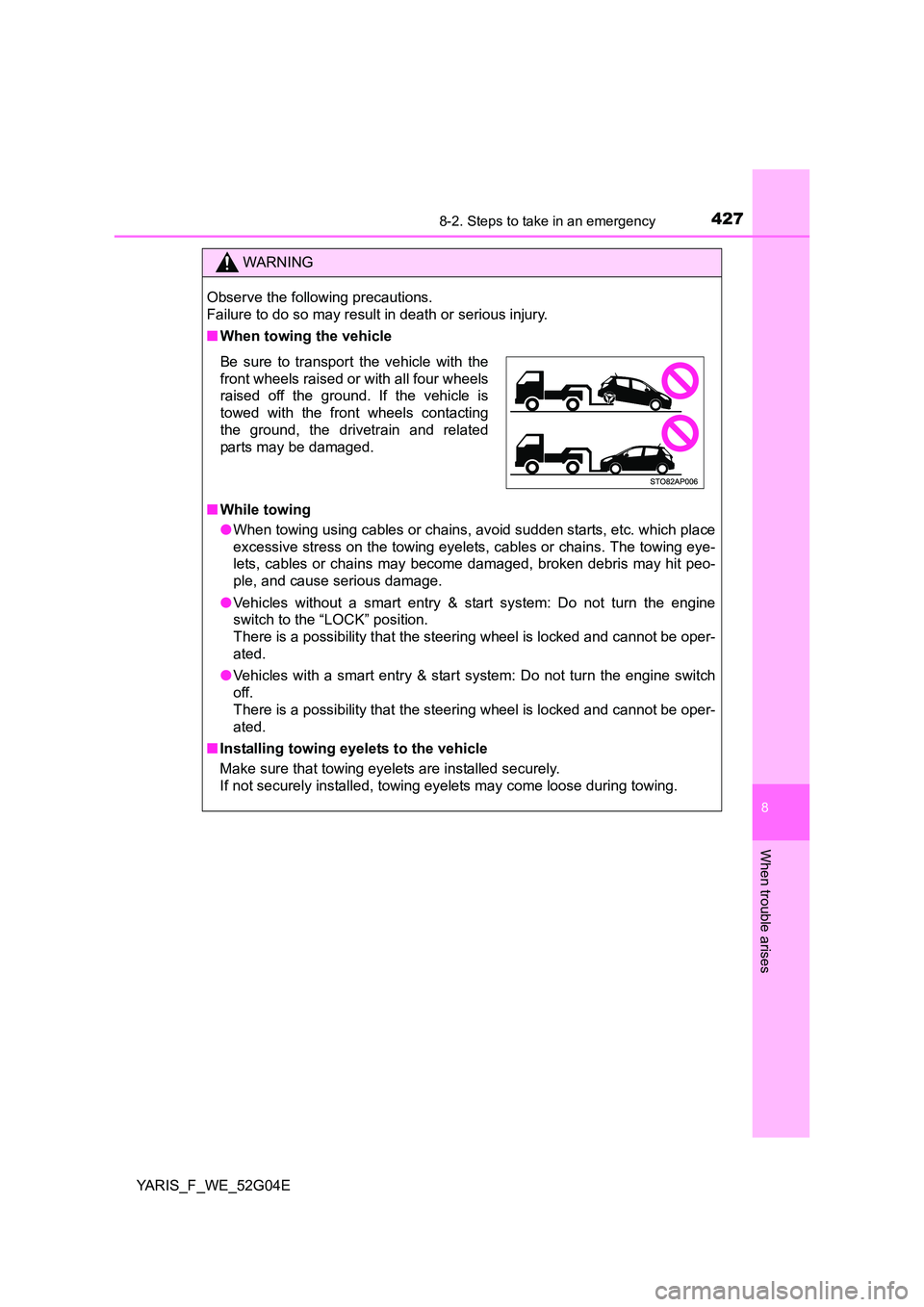
■ When towing the vehicle
■ While towing
● When towing using cables or chains, avoid sudden starts, etc. which place
excessive stress on the towing eyelets, cables or chains. The towing eye-
lets, cables or chains may become damaged, broken debris may hit peo-
ple, and cause serious damage.
● Vehicles without a smart entry & start system: Do not turn the engine
switch to the “LOCK” position.
There is a possibility that the steering wheel is locked and cannot be oper-
ated.
● Vehicles with a smart entry & start system: Do not turn the engine switch
off.
There is a possibility that the steering wheel is locked and cannot be oper-
ated.
■ Installing towing eyelets to the vehicle
Make sure that towing eyelets are installed securely.
If not securely installed, towing eyelets may come loose during towing.
Be sure to transport the vehicle with the
front wheels raised or with all four wheels
raised off the ground. If the vehicle is
towed with the front wheels contacting
the ground, the drivetrain and related
parts may be damaged.
Page 428 of 540
4288-2. Steps to take in an emergency
YARIS_F_WE_52G04E
NOTICE
■To prevent damage to the vehicle when towing using a wheel-lift type
truck
● Vehicles without a smart entry & start system: Do not tow the vehicle from
the rear when the engine switch is in the “LOCK” position or the key is
removed.
The steering lock mechanism is not strong enough to hold the front wheels
straight.
● Vehicles with a smart entry & start system: Do not tow the vehicle from the
rear when the engine switch is off. The steering lock mechanism is not
strong enough to hold the front wheels straight.
● When raising the vehicle, ensure adequate ground clearance for towing at
the opposite end of the raised vehicle. Without adequate clearance, the
vehicle could be damaged while being towed.
■ To prevent damage to the vehicle when towing with a sling-type truck
Do not tow with a sling-type truck, either from the front or rear.
■ To prevent damage to the vehicle during emergency towing
Do not secure cables or chains to the suspension components.
Page 446 of 540
4468-2. Steps to take in an emergency
YARIS_F_WE_52G04E
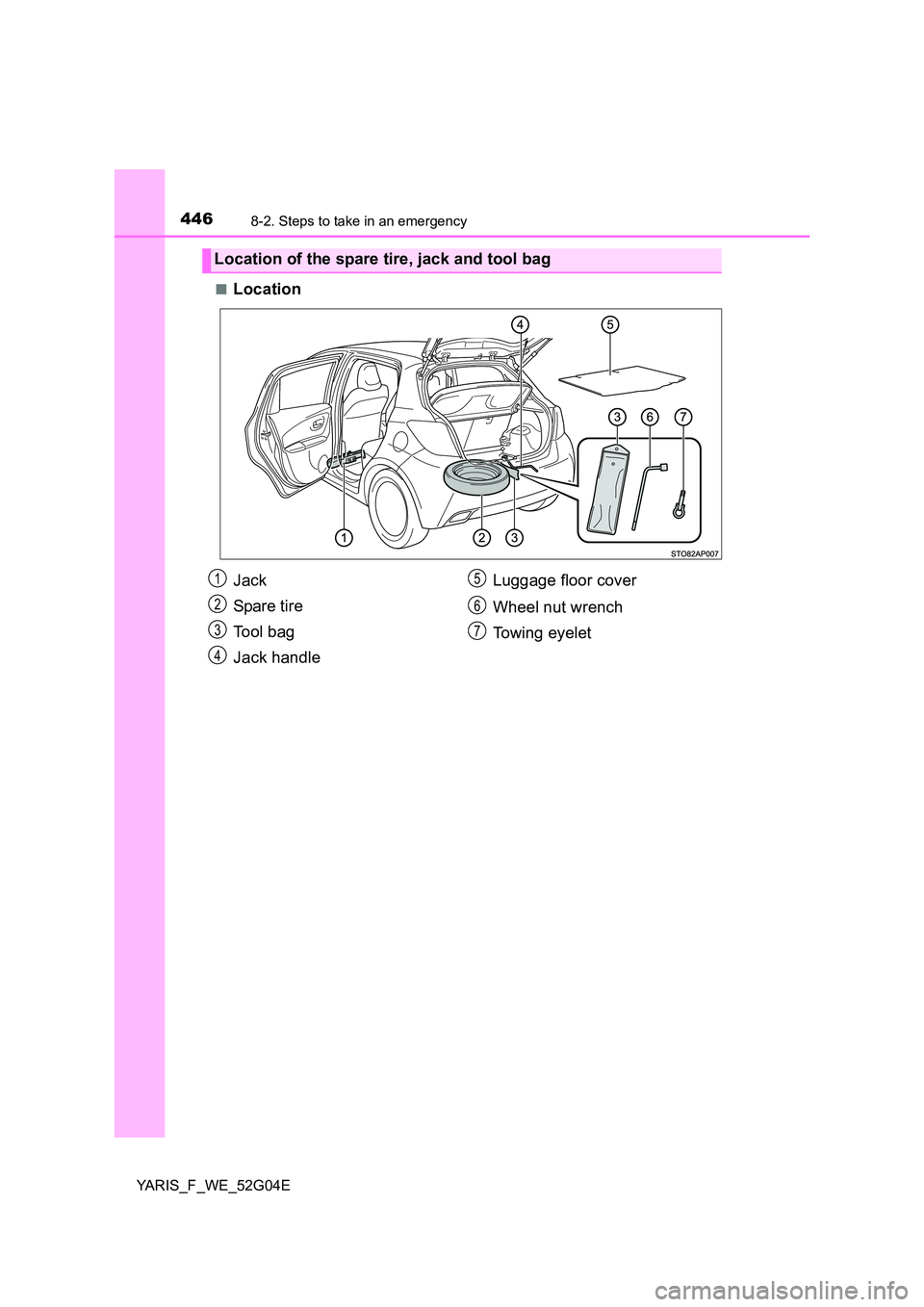
■Location
Location of the spare tire, jack and tool bag
Jack
Spare tire
Tool bag
Jack handle
Luggage floor cover
Wheel nut wrench
Towing eyelet
1
2
3
4
5
6
7
Page 461 of 540
4618-2. Steps to take in an emergency
8
When trouble arises
YARIS_F_WE_52G04E
*: Use of the jack, jack handle and wheel nut wrench. (if equipped) (P. 446)
A jack, jack handle and wheel nut wrench can be purchased at any autho-
rized Toyota dealer or repairer, or another duly qualified and equipped pro-
fessional.
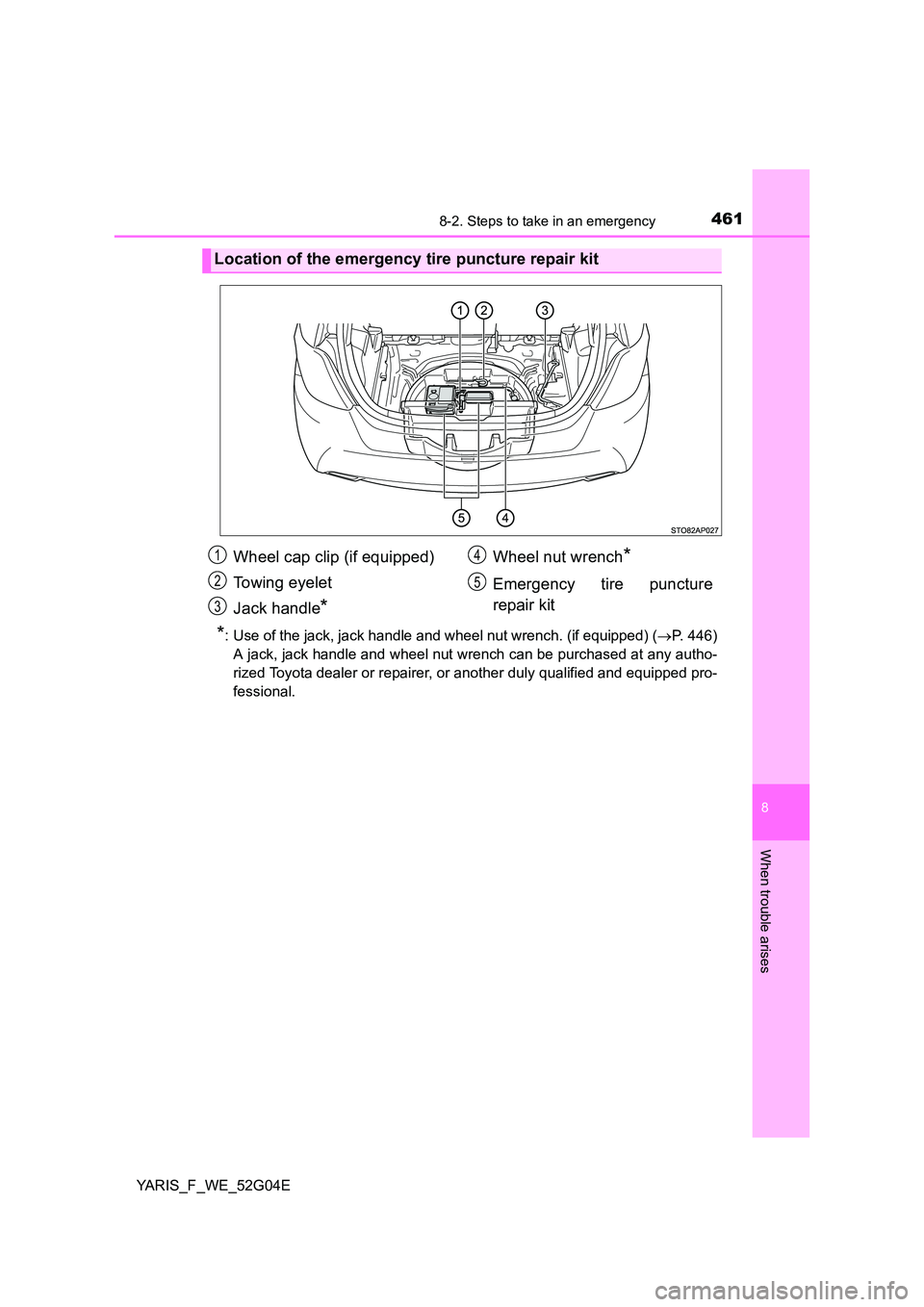
Location of the emergency tire puncture repair kit
Wheel cap clip (if equipped)
Towing eyelet
Jack handle*
Wheel nut wrench*
Emergency tire puncture
repair kit
1
2
3
4
5
Page 492 of 540
4928-2. Steps to take in an emergency
YARIS_F_WE_52G04E
WARNING
■When attempting to free a stuck vehicle
If you choose to push the vehicle back and forth to free it, make sure the
surrounding area is clear to avoid striking other vehicles, objects or people.
The vehicle may also lunge forward or lunge back suddenly as it becomes
free. Use extreme caution.
■ When shifting the shift lever
Be careful not to shift the shift lever with the accelerator pedal depressed.
This may lead to unexpected rapid acceleration of the vehicle that may
cause an accident resulting in death or serious injury.
NOTICE
■ To avoid damage to the transmission and other components
● Avoid spinning the front wheels and depressing the accelerator pedal
more than necessary.
● If the vehicle remains stuck even after these procedures are performed,
the vehicle may require towing to be freed.
Page 495 of 540
4959-1. Specifications
9
Vehicle specifications
YARIS_F_WE_52G04E
*1: Unladen vehicles
*2: Vehicles with rough road package (without raised vehicle height)
*3: Vehicles with rough road package (with raised vehicle height)
*4: 175/65R14, 175/70R14 or 175/65R15 tires
*5: 185/60R15 tires
*6: 195/50R16 tires
*7: Vehicle category N1 models
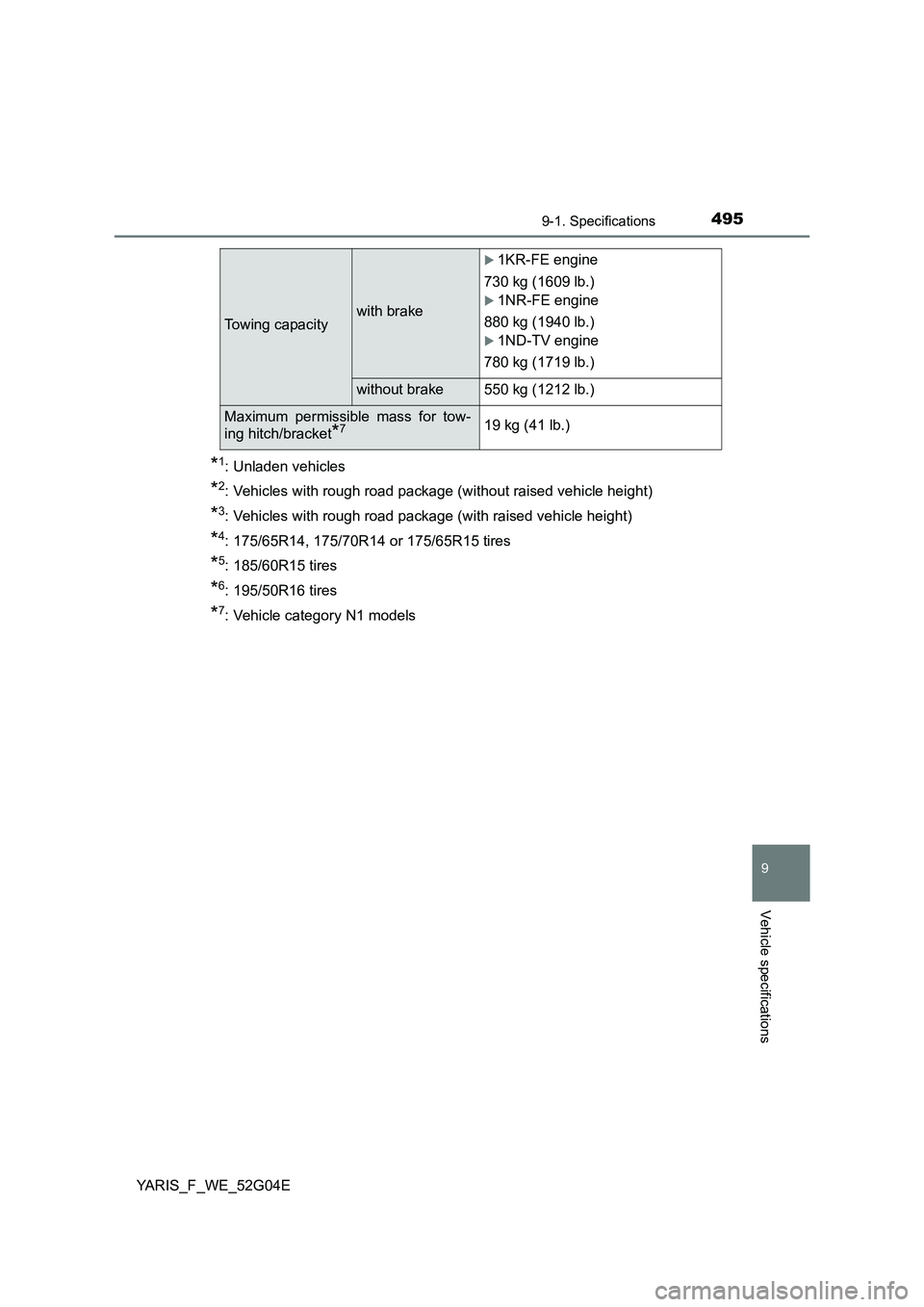
Towing capacity with brake
1KR-FE engine
730 kg (1609 lb.)
1NR-FE engine
880 kg (1940 lb.)
1ND-TV engine
780 kg (1719 lb.)
without brake 550 kg (1212 lb.)
Maximum permissible mass for tow-
ing hitch/bracket*719 kg (41 lb.)
Page 511 of 540
5119-1. Specifications
9
Vehicle specifications
YARIS_F_WE_52G04E
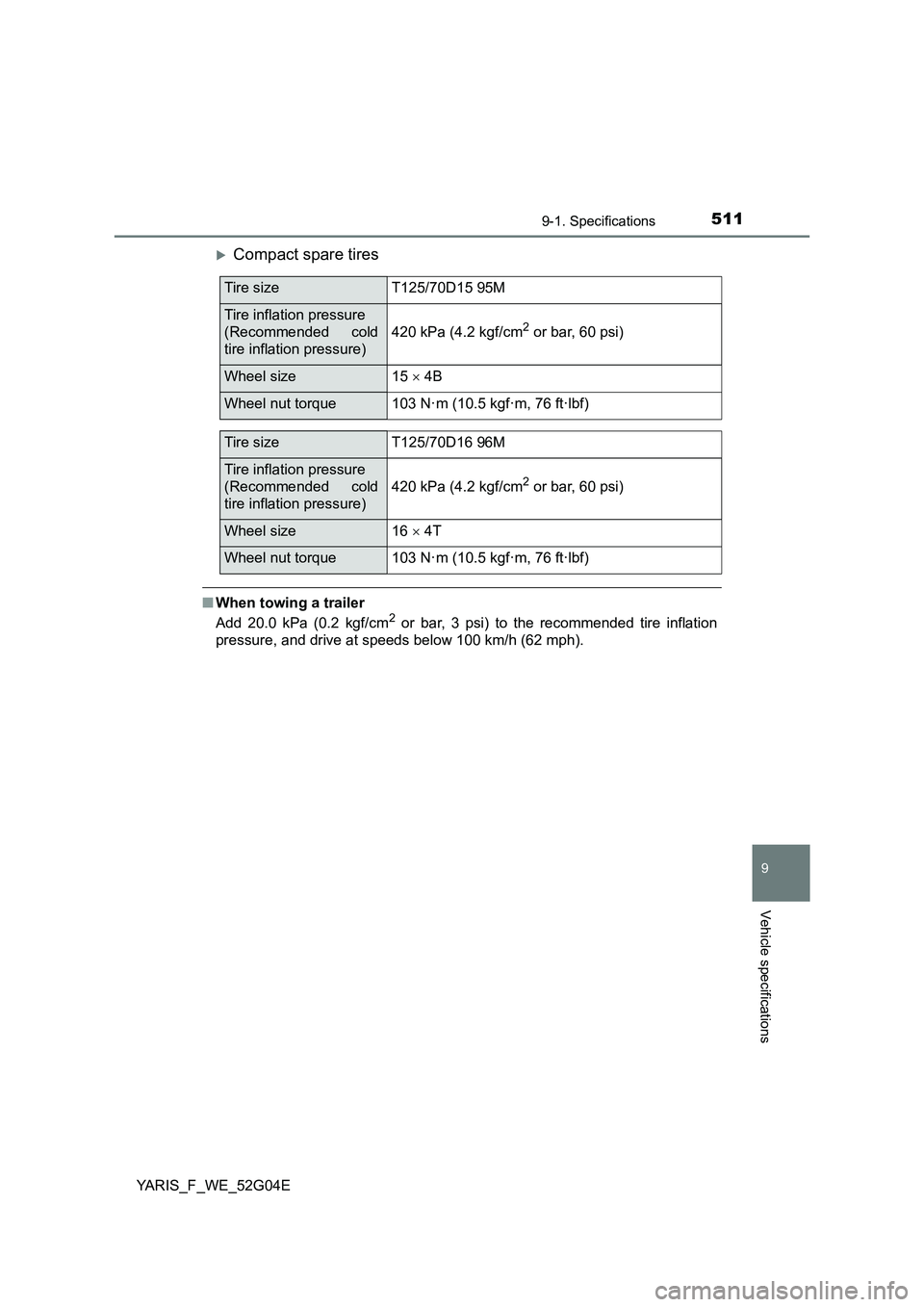
Compact spare tires
■When towing a trailer
Add 20.0 kPa (0.2 kgf/cm2 or bar, 3 psi) to the recommended tire inflation
pressure, and drive at speeds below 100 km/h (62 mph).
Tire sizeT125/70D15 95M
Tire inflation pressure
(Recommended cold
tire inflation pressure)
420 kPa (4.2 kgf/cm2 or bar, 60 psi)
Wheel size15 4B
Wheel nut torque103 N·m (10.5 kgf·m, 76 ft·lbf)
Tire sizeT125/70D16 96M
Tire inflation pressure
(Recommended cold
tire inflation pressure)
420 kPa (4.2 kgf/cm2 or bar, 60 psi)
Wheel size16 4T
Wheel nut torque103 N·m (10.5 kgf·m, 76 ft·lbf)