stop start TOYOTA YARIS 2016 Owner's Guide
[x] Cancel search | Manufacturer: TOYOTA, Model Year: 2016, Model line: YARIS, Model: TOYOTA YARIS 2016Pages: 540, PDF Size: 34.12 MB
Page 192 of 540
1924-2. Driving procedures
YARIS_F_WE_52G04E
NOTICE
■To prevent battery discharge
● Do not leave the engine switch in ACCESSORY or IGNITION ON mode
for long periods of time without the engine running.
● If the smart entry & start system indicator (green) is illuminated, the engine
switch is not off. When exiting the vehicle, always check that the engine
switch is off.
● On vehicles with a Multidrive, do not stop the engine when the shift lever is
in a position other than P. If the engine is stopped in another shift lever
position, the engine switch will not be turned off but instead be turned to
ACCESSORY mode. If the vehicle is left in ACCESSORY mode, battery
discharge may occur.
■ When starting the engine
● Do not race a cold engine.
● If the engine becomes difficult to start or stalls frequently, have your vehi-
cle checked by any authorized Toyota dealer or repairer, or another duly
qualified and equipped professional immediately.
■ Symptoms indicating a malfunction with the engine switch
If the engine switch seems to be operating somewhat differently than usual,
such as the switch sticking slightly, there may be a malfunction.
Contact any authorized Toyota dealer or repairer, or another duly qualified
and equipped professional immediately.
Page 193 of 540
193
4
4-2. Driving procedures
Driving
YARIS_F_WE_52G04E
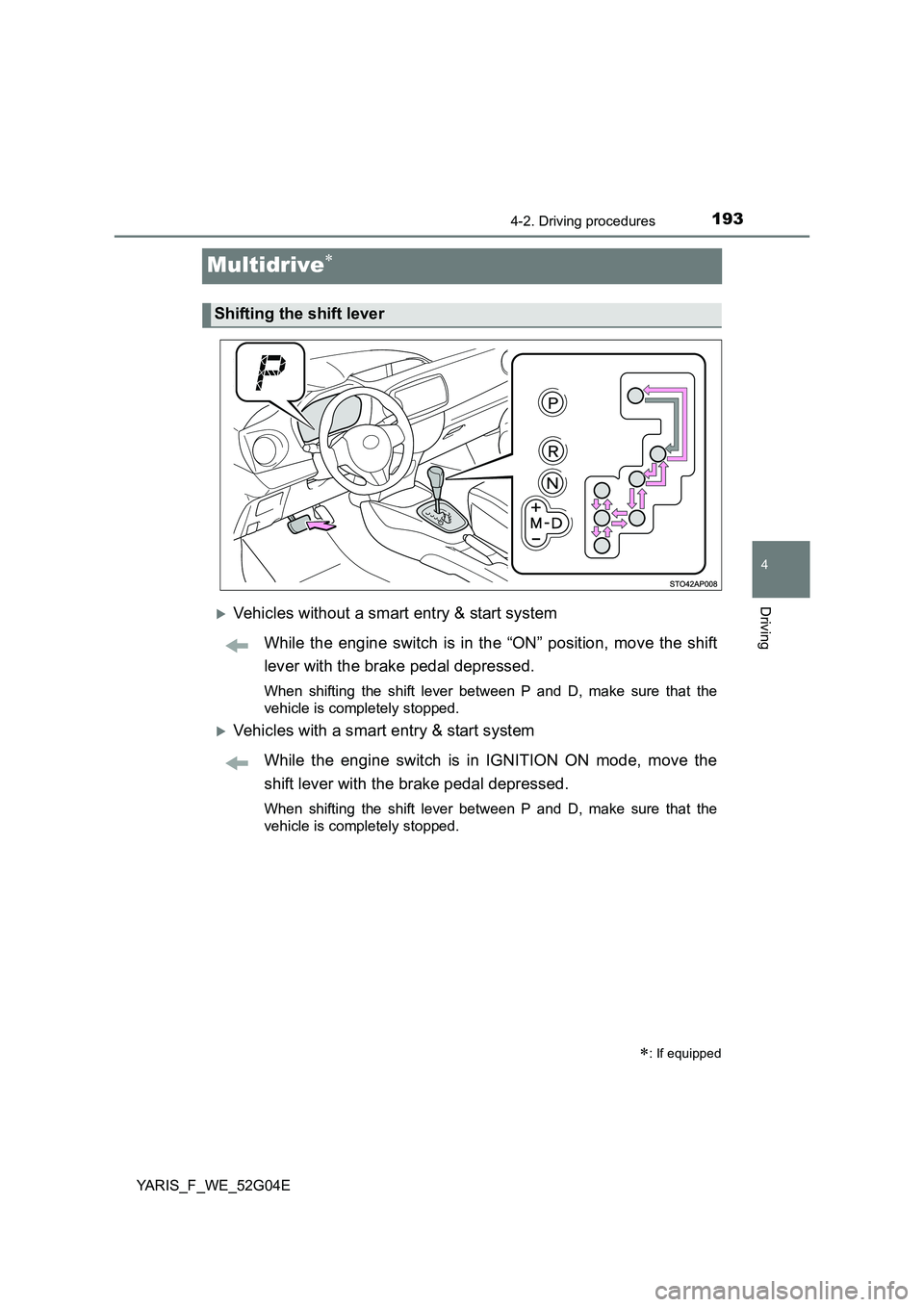
Multidrive
Vehicles without a smart entry & start system
While the engine switch is in the “ON” position, move the shift
lever with the brake pedal depressed.
When shifting the shift lever between P and D, make sure that the
vehicle is completely stopped.
Vehicles with a smart entry & start system
While the engine switch is in IGNITION ON mode, move the
shift lever with the brake pedal depressed.
When shifting the shift lever between P and D, make sure that the
vehicle is completely stopped.
: If equipped
Shifting the shift lever
Page 197 of 540
1974-2. Driving procedures
4
Driving
YARIS_F_WE_52G04E
■ When the vehicle comes to a stop with the shift lever in the M position
● The transmission will automatically downshift to M1 once the vehicle is
stopped.
● After a stop, the vehicle will start off in M1.
● When the vehicle is stopped, the transmission is set at M1.
■ If the shift lever cannot be shifted from P
P. 477
■ If the “M” indicator flashes or a buzzer beeps after shifting the shift lever
to M
This may indicate a malfunction in the Multidrive system. Have the vehicle
inspected by any authorized Toyota dealer or repairer, or another duly quali-
fied and equipped professional immediately.
(In this situation, the transmission will operate in the same manner as when
the shift lever is in D.)
■ Downshift restriction warning buzzer (vehicles with a 7-speed sport
sequential shiftmatic mode)
To help ensure safety and driving performance, downshifting operation may
sometimes be restricted. In some circumstances, downshifting may not be
possible even when the shift lever or paddle shift switches are operated. (A
buzzer will sound twice.)
WARNING
■ When driving on slippery road surfaces
Do not accelerate or shift gears suddenly.
Sudden changes in engine braking may cause the vehicle to spin or skid,
resulting in an accident.
Page 225 of 540
2254-5. Toyota Safety Sense
4
Driving
YARIS_F_WE_52G04E
NOTICE
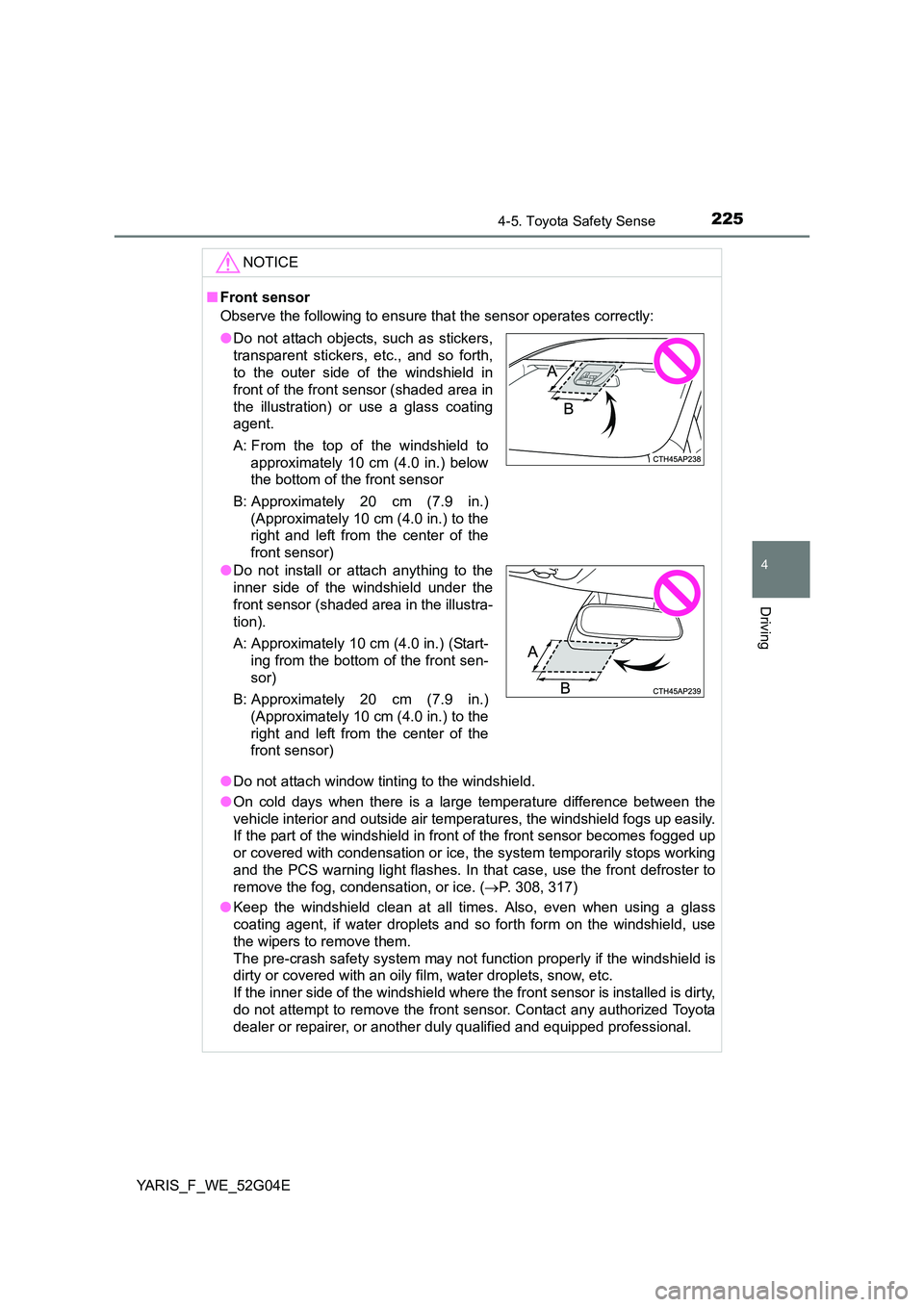
■Front sensor
Observe the following to ensure that the sensor operates correctly:
● Do not attach window tinting to the windshield.
● On cold days when there is a large temperature difference between the
vehicle interior and outside air temperatures, the windshield fogs up easily.
If the part of the windshield in front of the front sensor becomes fogged up
or covered with condensation or ice, the system temporarily stops working
and the PCS warning light flashes. In that case, use the front defroster to
remove the fog, condensation, or ice. ( P. 308, 317)
● Keep the windshield clean at all times. Also, even when using a glass
coating agent, if water droplets and so forth form on the windshield, use
the wipers to remove them.
The pre-crash safety system may not function properly if the windshield is
dirty or covered with an oily film, water droplets, snow, etc.
If the inner side of the windshield where the front sensor is installed is dirty,
do not attempt to remove the front sensor. Contact any authorized Toyota
dealer or repairer, or another dul y qualified and equipped professional.
●Do not attach objects, such as stickers,
transparent stickers, etc., and so forth,
to the outer side of the windshield in
front of the front sensor (shaded area in
the illustration) or use a glass coating
agent.
A: From the top of the windshield to
approximately 10 cm (4.0 in.) below
the bottom of the front sensor
B: Approximately 20 cm (7.9 in.)
(Approximately 10 cm (4.0 in.) to the
right and left from the center of the
front sensor)
● Do not install or attach anything to the
inner side of the windshield under the
front sensor (shaded area in the illustra-
tion).
A: Approximately 10 cm (4.0 in.) (Start-
ing from the bottom of the front sen-
sor)
B: Approximately 20 cm (7.9 in.)
(Approximately 10 cm (4.0 in.) to the
right and left from the center of the
front sensor)
Page 230 of 540
2304-5. Toyota Safety Sense
YARIS_F_WE_52G04E
■Operational conditions
The pre-crash safety system is enabled and determines that the possibility of
a frontal collision with a vehicle (e xcept motorcycles and bicycles) is high.
● Pre-crash warning:
• Vehicle speed is approximately 15 to 140 km/h (10 to 86 mph).
• The relative speed between your vehicle and the vehicle ahead is greater
than approximately 15 km/h (10 mph).
● Pre-crash brake assist:
• Vehicle speed is approximately 30 to 80 km/h (19 to 49 mph).
• The relative speed between your vehicle and the vehicle ahead is greater
than approximately 30 km/h (19 mph).
● Pre-crash braking:
• Vehicle speed is approximately 10 to 80 km/h (7 to 49 mph).
• The relative speed between your vehicle and the vehicle ahead is greater
than approximately 10 km/h (7 mph).
When the brake pedal is stepped on, the system judges if evasion actions are
being done by the driver and the start timing for pre-crash braking may be
delayed.
During the following, the driver operations takes precedence and the system
may not operate:
● The accelerator pedal is depressed strongly
● The steering wheel is turned sharply or abruptly
In case of the following, the system will not operate:
● If a battery terminal has been disconnected and reconnected and then the
vehicle has not been driven for a certain amount of time
● If VSC is disabled (only the pre-crash warning function will be operational)
● If the PCS warning light is flashing or illuminated
● When the shift position is in R
■ Cancelation of the pre-crash braking
● If either of the following situations occur while the pre-crash braking function
is operating, it will be canceled:
• The accelerator pedal is depressed strongly.
• The steering wheel is turned sharply or abruptly.
● If the vehicle is stopped by the operation of the pre-crash braking function,
the operation of the pre-crash braking function will be canceled after the
vehicle has been stopped for approximately 2 seconds.
Page 251 of 540
2514-6. Using the driving support systems
4
Driving
YARIS_F_WE_52G04E
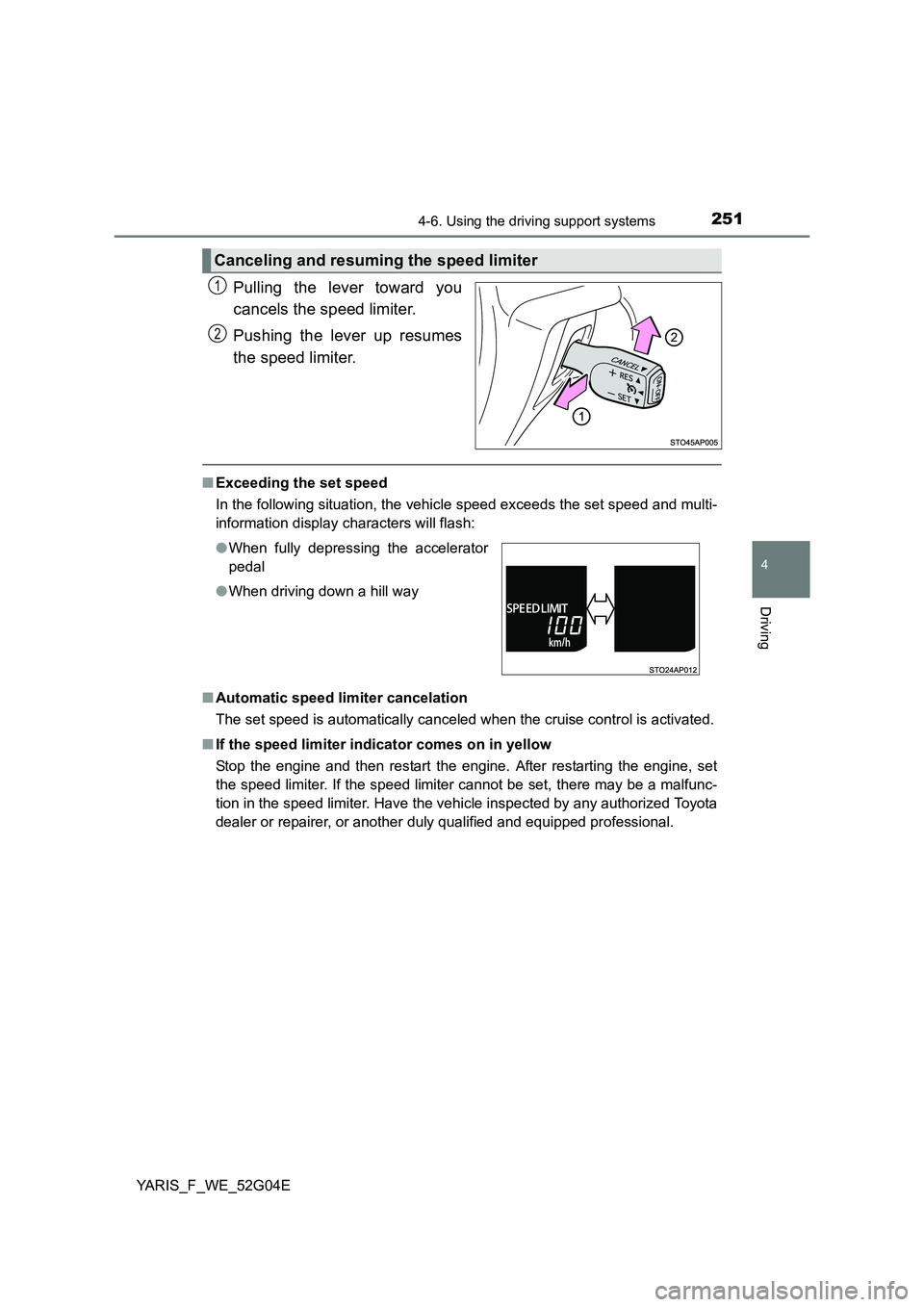
Pulling the lever toward you
cancels the speed limiter.
Pushing the lever up resumes
the speed limiter.
■ Exceeding the set speed
In the following situation, the vehicle speed exceeds the set speed and multi-
information display characters will flash:
■ Automatic speed limiter cancelation
The set speed is automatically canceled when the cruise control is activated.
■ If the speed limiter indicator comes on in yellow
Stop the engine and then restart the engine. After restarting the engine, set
the speed limiter. If the speed limiter cannot be set, there may be a malfunc-
tion in the speed limiter. Have the vehicle inspected by any authorized Toyota
dealer or repairer, or another duly qualified and equipped professional.
Canceling and resuming the speed limiter
1
2
● When fully depressing the accelerator
pedal
● When driving down a hill way
Page 253 of 540
253
4
4-6. Using the driving support systems
Driving
YARIS_F_WE_52G04E
Stop & star t system
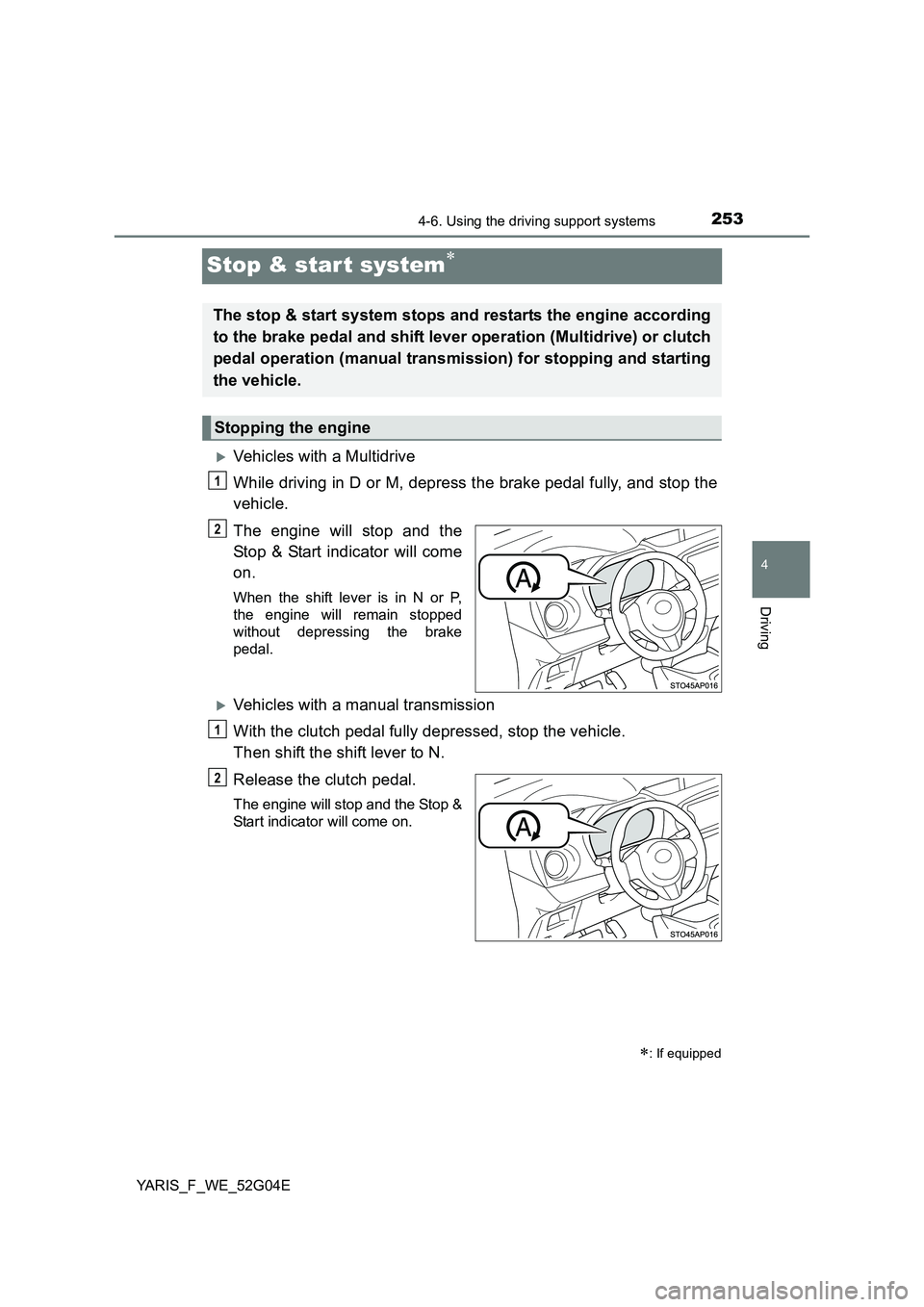
Vehicles with a Multidrive
While driving in D or M, depress the brake pedal fully, and stop the
vehicle.
The engine will stop and the
Stop & Start indicator will come
on.
When the shift lever is in N or P,
the engine will remain stopped
without depressing the brake
pedal.
Vehicles with a manual transmission
With the clutch pedal fully depressed, stop the vehicle.
Then shift the shift lever to N.
Release the clutch pedal.
The engine will stop and the Stop &
Start indicator will come on.
: If equipped
The stop & start system stops and restarts the engine according
to the brake pedal and shift lever operation (Multidrive) or clutch
pedal operation (manual transmission) for stopping and starting
the vehicle.
Stopping the engine
1
2
1
2
Page 254 of 540
2544-6. Using the driving support systems
YARIS_F_WE_52G04E
Vehicles with a Multidrive
Release the brake pedal. When the shift lever is in N or P, depress
brake pedal and shift the shift lever to D or M.
The engine will restart. The Stop & Start indicator will go off.
Vehicles with a manual transmission
Check that the shift lever is in N and depress the clutch pedal.
The engine will restart. The Stop & Start indicator will go off. (In this situa-
tion, releasing the clutch pedal will not stop the engine again.)
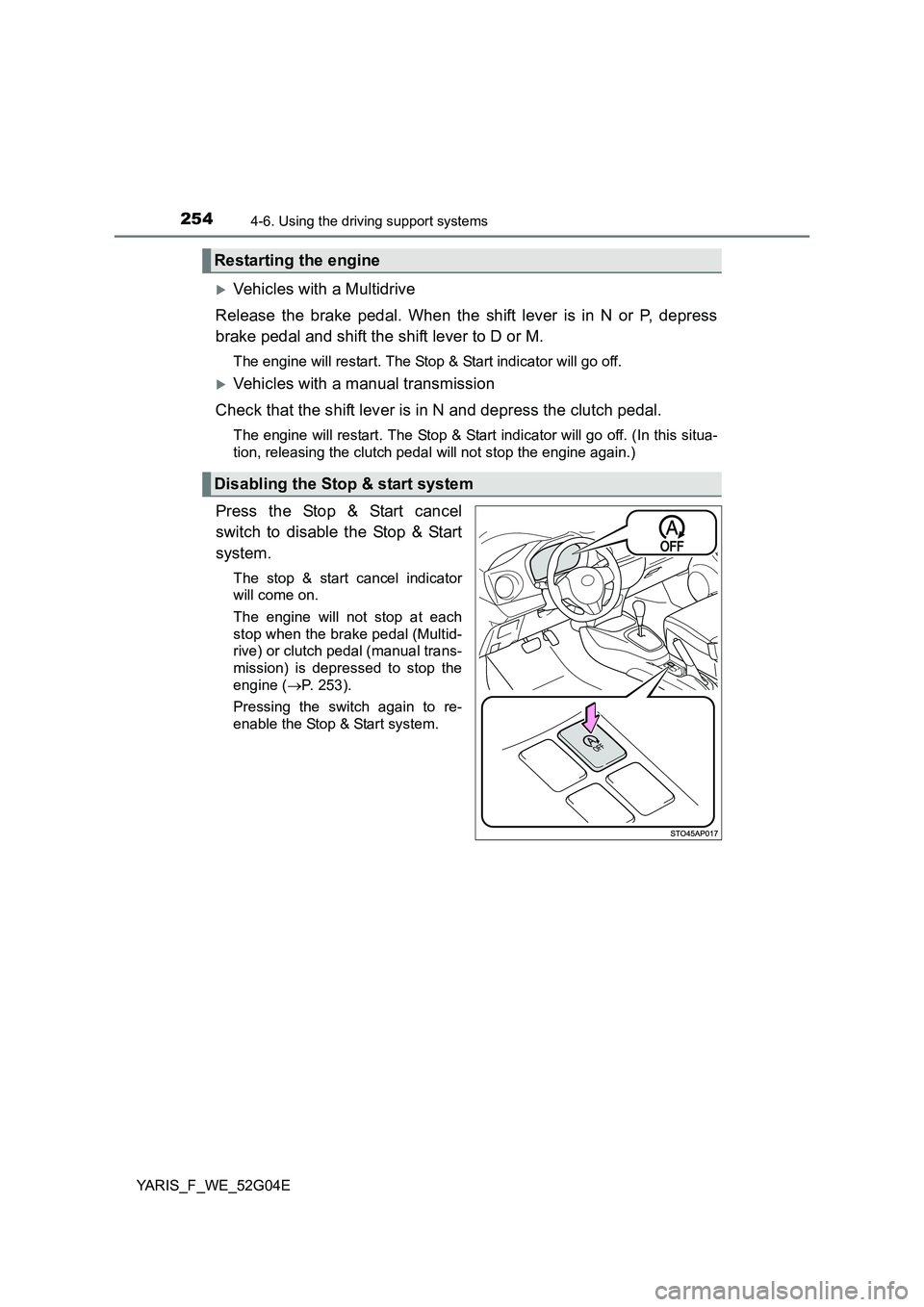
Press the Stop & Start cancel
switch to disable the Stop & Start
system.
The stop & start cancel indicator
will come on.
The engine will not stop at each
stop when the brake pedal (Multid-
rive) or clutch pedal (manual trans-
mission) is depressed to stop the
engine ( P. 253).
Pressing the switch again to re-
enable the Stop & Start system.
Restarting the engine
Disabling the Stop & start system
Page 255 of 540
2554-6. Using the driving support systems
4
Driving
YARIS_F_WE_52G04E
■If the Stop & Start cancel switch is pressed while the vehicle is
stopped
● When the engine is stopped by the Stop & Start system, pressing
the Stop & Start cancel switch will restart the engine.
From the next time the vehicle is stopped (after Stop & Start sys-
tem has been turned off), the engine will not be stopped.
● With the Stop & Start system disabled, pressing the Stop & Start
cancel switch will re-enable the system but not stop the engine.
From the next time the vehicle is stopped (after Stop & Start sys-
tem has been turned on), the engine will be stopped.
■ Operating conditions
● The Stop & Start system is operational when all of the following conditions
are met:
• The engine is adequately warmed up.
• The battery is sufficiently charged.
• The driver’s door is closed.
• The driver’s seat belt is fastened.
• The hood is closed.
• The accelerator pedal is not being depressed.
• Vehicles with a Multidrive: The brake pedal is firmly depressed.
• Vehicles with a Multidrive: The shift lever is not in R.
• Vehicles with a manual transmission: The clutch pedal is not being
depressed.
• Vehicles with a manual transmission: The shift lever is in N.
● In the following circumstances the engine may not be stopped by the Stop &
Start system. This is not a malfunction of the Stop & Start system.
• Engine coolant temperature or transmi ssion fluid temperature is too low
or too high.
• The outside temperature is extremely low.
• The air conditioning system is being used when the outside temperature
is high or low.
• The air conditioning system is being used when the vehicle interior tem-
perature is extremely high such as after the vehicle was parked under the
hot sun.
• Vehicles with an automatic air c onditioning system: The windshield
defogger is being used.
• The battery is not sufficiently charged, or is undergoing a periodic
recharge.
• Due to traffic or other circumstances the vehicle is stopped repeatedly,
resulting in the amount of time the engine is stopped by the Stop & Start
system to become excessively high.
Page 256 of 540
2564-6. Using the driving support systems
YARIS_F_WE_52G04E
• The driver’s seat belt is unfastened.
• The driver’s door is opened.
• The hood is opened.
• The vehicle is stopped on a steep hill.
• The brake booster vacuum is low.
• A large amount of electricity is being used.
• At high altitude.
When the above conditions improve, the Stop & Start system will stop and
restart the engine from the next time the vehicle is stopped.
● In the following situations, the engine may start even without the brake
pedal being released (Multidrive) or clutch pedal being depressed (manual
transmission).
• The brake pedal is pumped or strongly depressed.
• The air conditioning system is being used or turned on.
• Vehicles with an automatic air c onditioning system: The windshield
defogger is turned on.
• The battery is not sufficiently charged.
• The vehicle starts to roll on an incline.
• Vehicles with a Multidrive: The hood is opened when the shift lever is in N
or P.
• Vehicles with a Multidrive: The shift lever is shifted into a position other
than N or P.
• The accelerator pedal is depressed.
• A large amount of electricity is being used.
• The driver’s door is opened.
• The driver’s seat belt is unfastened.
● In the following situations, it may take longer than normal for the Stop & Start
system to activate.
• The battery is discharged.
• After the battery terminals have been disconnected and reconnected
after a battery replacement, etc.
• The engine coolant temperature is low.
■ Automatic reactivation of the Stop & Start system
Vehicles without a smart entry & start system
Even if the Stop & Start system is disabled by the Stop & Start cancel switch,
it will be automatically re-enabled once the engine switch is turned to the
“LOCK” position then to the “START” position.
Vehicles with a smart entry & start system
Even if the Stop & Start system is disabled by the Stop & Start cancel switch,
it will be automatically re-enabled once the engine switch is turned off then
the engine is started.