light TOYOTA YARIS 2016 Workshop Manual
[x] Cancel search | Manufacturer: TOYOTA, Model Year: 2016, Model line: YARIS, Model: TOYOTA YARIS 2016Pages: 540, PDF Size: 34.12 MB
Page 181 of 540
1814-1. Before driving
4
Driving
YARIS_F_WE_52G04E
Your vehicle will handle differently when towing a trailer. In order to
avoid accident, death or serious injury, keep the following in mind
when towing:
■Checking connections between trailer and lights
Stop the vehicle and check the operation of the connection between
the trailer and lights after driving for a brief period as well as before
starting off.
■Practicing driving with a coupled trailer
● Get the feel for turning, stopping and reversing with the trailer
coupled by practicing in an area with no or light traffic.
● When reversing with a coupled trailer, hold the section of the
steering wheel nearest to you and rotate clockwise to turn the
trailer left or counterclockwise to turn it right. Always rotate a little
at a time to prevent steering error. Have someone guide you
when reversing to lessen the risk of an accident.
■Increasing vehicle-to-vehicle distance
At a speed of 10 km/h (6 mph), the distance to the vehicle running
ahead of you should be equivalent to or greater than the combined
length of your vehicle and trailer. Avoid sudden braking that may
cause skidding. Otherwise, the vehicle may spin out of control. This
is especially true when driving on wet or slippery road surfaces.
NOTICE
■ When the rear bumper strengthening material is aluminum
Ensure the steel bracket part does not come directly in contact with that
area.
When steel and aluminum come into contact, there is a reaction similar to
corrosion, which will weaken the section concerned and may result in dam-
age. Apply a rust inhibitor to parts that will come in contact when attaching a
steel bracket.
Guidance
Page 183 of 540
1834-1. Before driving
4
Driving
YARIS_F_WE_52G04E
■If the engine overheats
Towing a loaded trailer up a long, steep incline in temperatures
exceeding 30 C (85F) may result in the engine overheating. If the
high engine coolant temperature warning light flashes or comes on,
turn the air conditioning off immediately, leave the road and stop the
vehicle in a safe place. ( P. 485)
■When parking the vehicle
Always place wheel chocks under the wheels of both the vehicle
and trailer. Firmly set the parking brake and shift the shift lever to P
for Multidrives or 1 or R for manual transmissions.
WARNING
Follow all the instructions described in this section. Failure to do so could
cause an accident resulting in death or serious injury.
■ Trailer towing precautions
When towing, make sure that none of the weight limits are exceeded.
( P. 176)
■ Vehicle speed in towing
Observe the legal maximum speeds for trailer towing.
■ Before descending hills or long declines
Reduce speed and downshift. However, never downshift suddenly while
descending steep or long downhill grades.
■ Operation of the brake pedal
Do not hold the brake pedal depressed often or for long periods of time.
Doing so may result in the brake overheating or reduce braking effects.
■ To avoid accident or injury
● Vehicles with a cruise control: Do not use cruise control when you are tow-
ing.
● Vehicles with a compact spare tire: Do not tow a trailer when the compact
spare tire is installed on your vehicle.
● Vehicles with an emergency tire puncture repair kit: Do not tow a trailer
when the tire installed is repaired with the emergency tire puncture repair
kit.
Page 186 of 540
1864-2. Driving procedures
YARIS_F_WE_52G04E
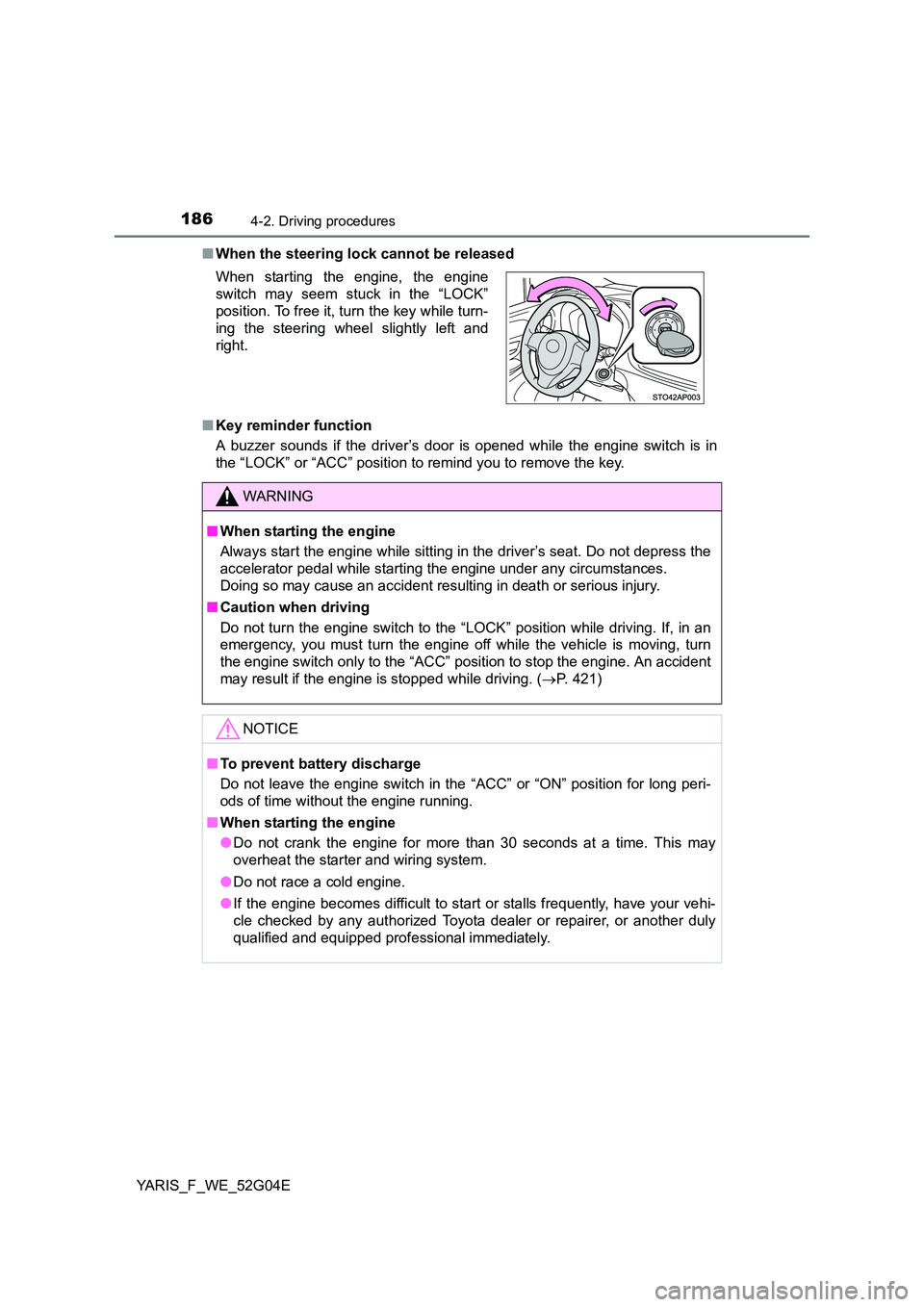
■ When the steering lock cannot be released
■ Key reminder function
A buzzer sounds if the driver’s door is opened while the engine switch is in
the “LOCK” or “ACC” position to remind you to remove the key.
When starting the engine, the engine
switch may seem stuck in the “LOCK”
position. To free it, turn the key while turn-
ing the steering wheel slightly left and
right.
WARNING
■ When starting the engine
Always start the engine while sitting in the driver’s seat. Do not depress the
accelerator pedal while starting the engine under any circumstances.
Doing so may cause an accident resulting in death or serious injury.
■ Caution when driving
Do not turn the engine switch to the “LOCK” position while driving. If, in an
emergency, you must turn the engine off while the vehicle is moving, turn
the engine switch only to the “ACC” position to stop the engine. An accident
may result if the engine is stopped while driving. ( P. 421)
NOTICE
■To prevent battery discharge
Do not leave the engine switch in the “ACC” or “ON” position for long peri-
ods of time without the engine running.
■ When starting the engine
● Do not crank the engine for more than 30 seconds at a time. This may
overheat the starter and wiring system.
● Do not race a cold engine.
● If the engine becomes difficult to start or stalls frequently, have your vehi-
cle checked by any authorized Toyota dealer or repairer, or another duly
qualified and equipped professional immediately.
Page 187 of 540
187
4
4-2. Driving procedures
Driving
YARIS_F_WE_52G04E
Engine (ignition) switch (vehicles with a
smar t entr y & start system)
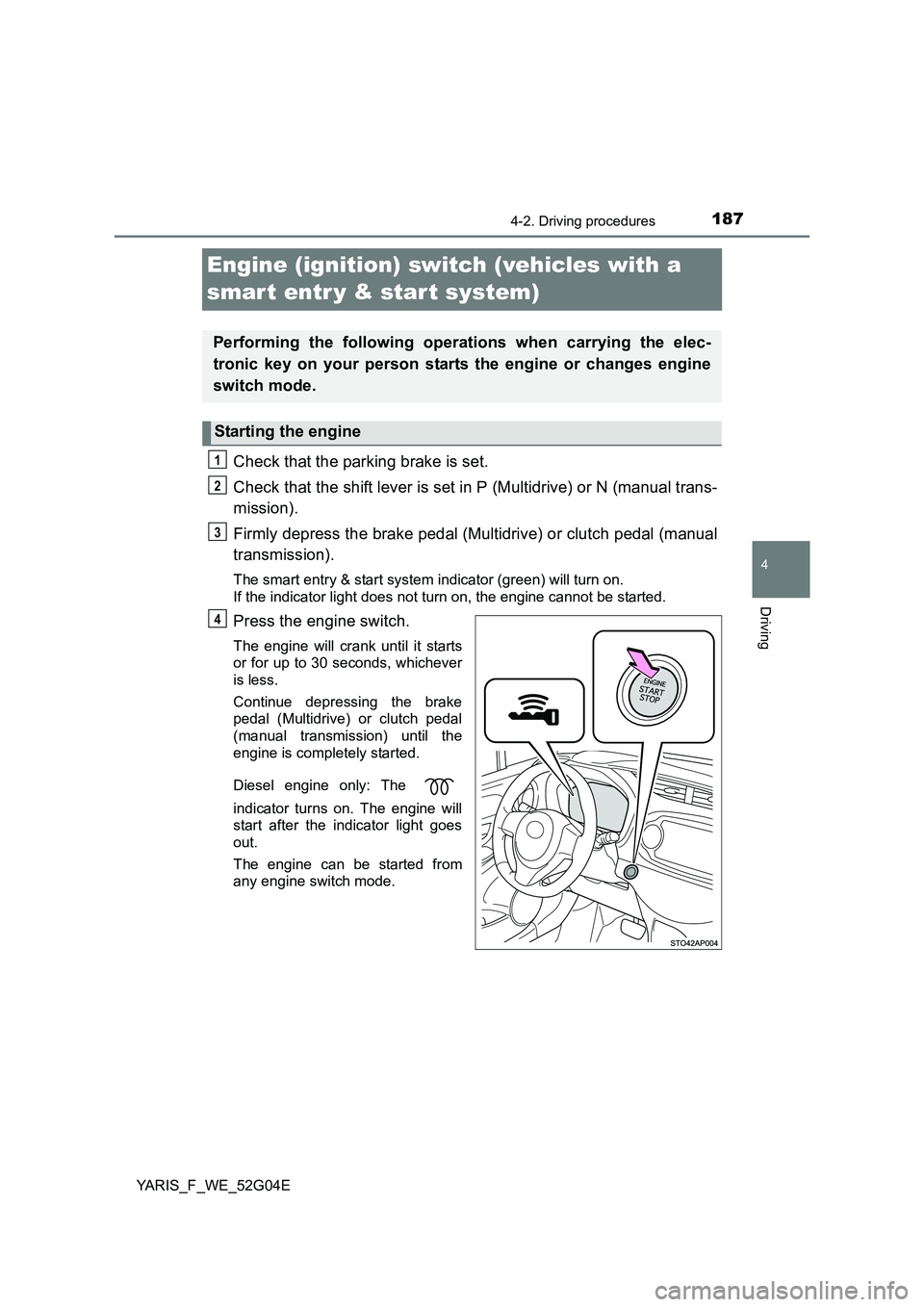
Check that the parking brake is set.
Check that the shift lever is set in P (Multidrive) or N (manual trans-
mission).
Firmly depress the brake pedal (Multidrive) or clutch pedal (manual
transmission).
The smart entry & start system indicator (green) will turn on.
If the indicator light does not turn on, the engine cannot be started.
Press the engine switch.
The engine will crank until it starts
or for up to 30 seconds, whichever
is less.
Continue depressing the brake
pedal (Multidrive) or clutch pedal
(manual transmission) until the
engine is completely started.
Diesel engine only: The
indicator turns on. The engine will
start after the indicator light goes
out.
The engine can be started from
any engine switch mode.
Performing the following operations when carrying the elec-
tronic key on your person starts the engine or changes engine
switch mode.
Starting the engine
1
2
3
4
Page 192 of 540
1924-2. Driving procedures
YARIS_F_WE_52G04E
NOTICE
■To prevent battery discharge
● Do not leave the engine switch in ACCESSORY or IGNITION ON mode
for long periods of time without the engine running.
● If the smart entry & start system indicator (green) is illuminated, the engine
switch is not off. When exiting the vehicle, always check that the engine
switch is off.
● On vehicles with a Multidrive, do not stop the engine when the shift lever is
in a position other than P. If the engine is stopped in another shift lever
position, the engine switch will not be turned off but instead be turned to
ACCESSORY mode. If the vehicle is left in ACCESSORY mode, battery
discharge may occur.
■ When starting the engine
● Do not race a cold engine.
● If the engine becomes difficult to start or stalls frequently, have your vehi-
cle checked by any authorized Toyota dealer or repairer, or another duly
qualified and equipped professional immediately.
■ Symptoms indicating a malfunction with the engine switch
If the engine switch seems to be operating somewhat differently than usual,
such as the switch sticking slightly, there may be a malfunction.
Contact any authorized Toyota dealer or repairer, or another duly qualified
and equipped professional immediately.
Page 202 of 540
2024-2. Driving procedures
YARIS_F_WE_52G04E
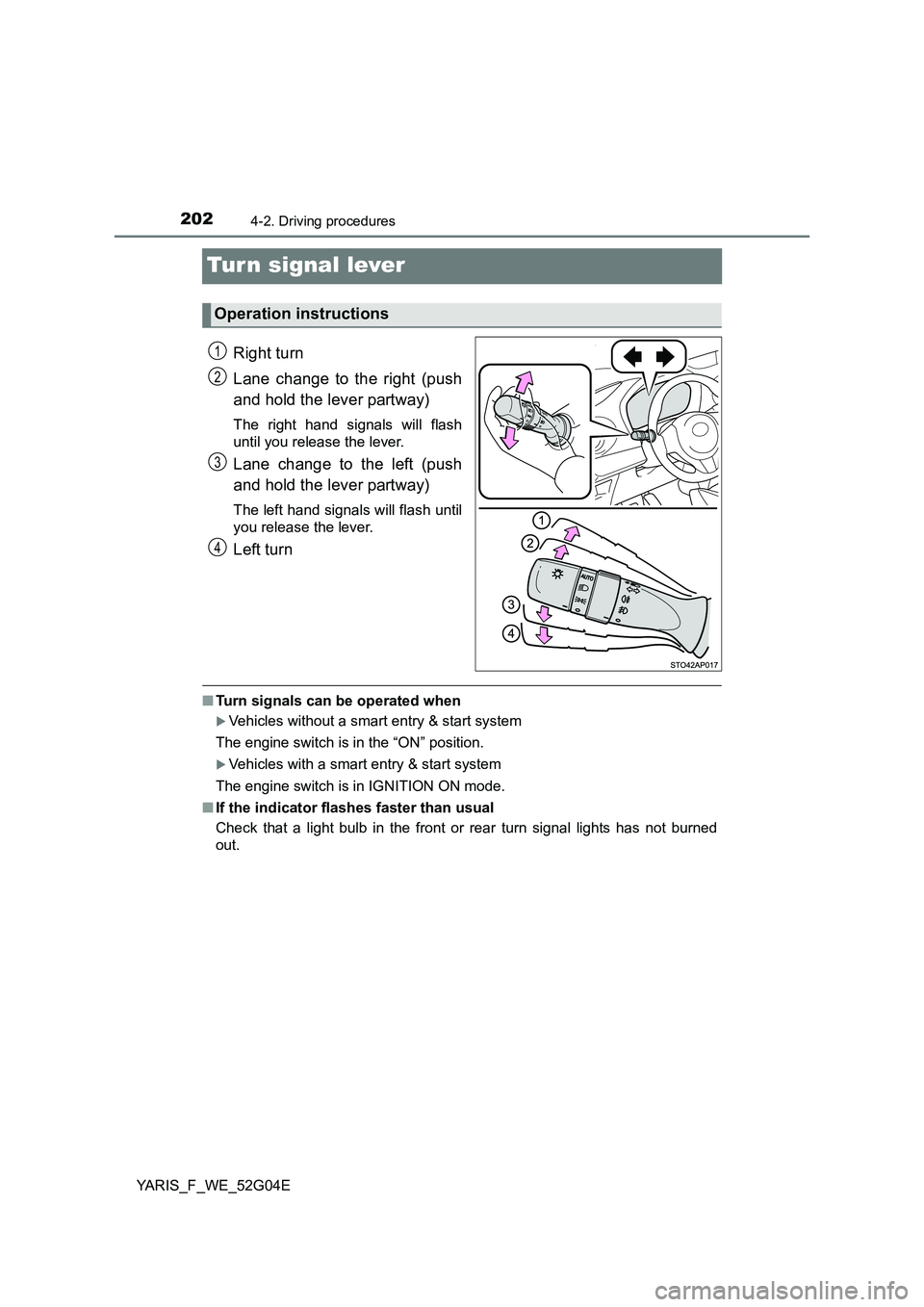
Turn signal lever
Right turn
Lane change to the right (push
and hold the lever partway)
The right hand signals will flash
until you release the lever.
Lane change to the left (push
and hold the lever partway)
The left hand signals will flash until
you release the lever.
Left turn
■ Turn signals can be operated when
Vehicles without a smart entry & start system
The engine switch is in the “ON” position.
Vehicles with a smart entry & start system
The engine switch is in IGNITION ON mode.
■ If the indicator flashes faster than usual
Check that a light bulb in the front or rear turn signal lights has not burned
out.
Operation instructions
1
2
3
4
Page 203 of 540
203
4
4-2. Driving procedures
Driving
YARIS_F_WE_52G04E
Parking brake
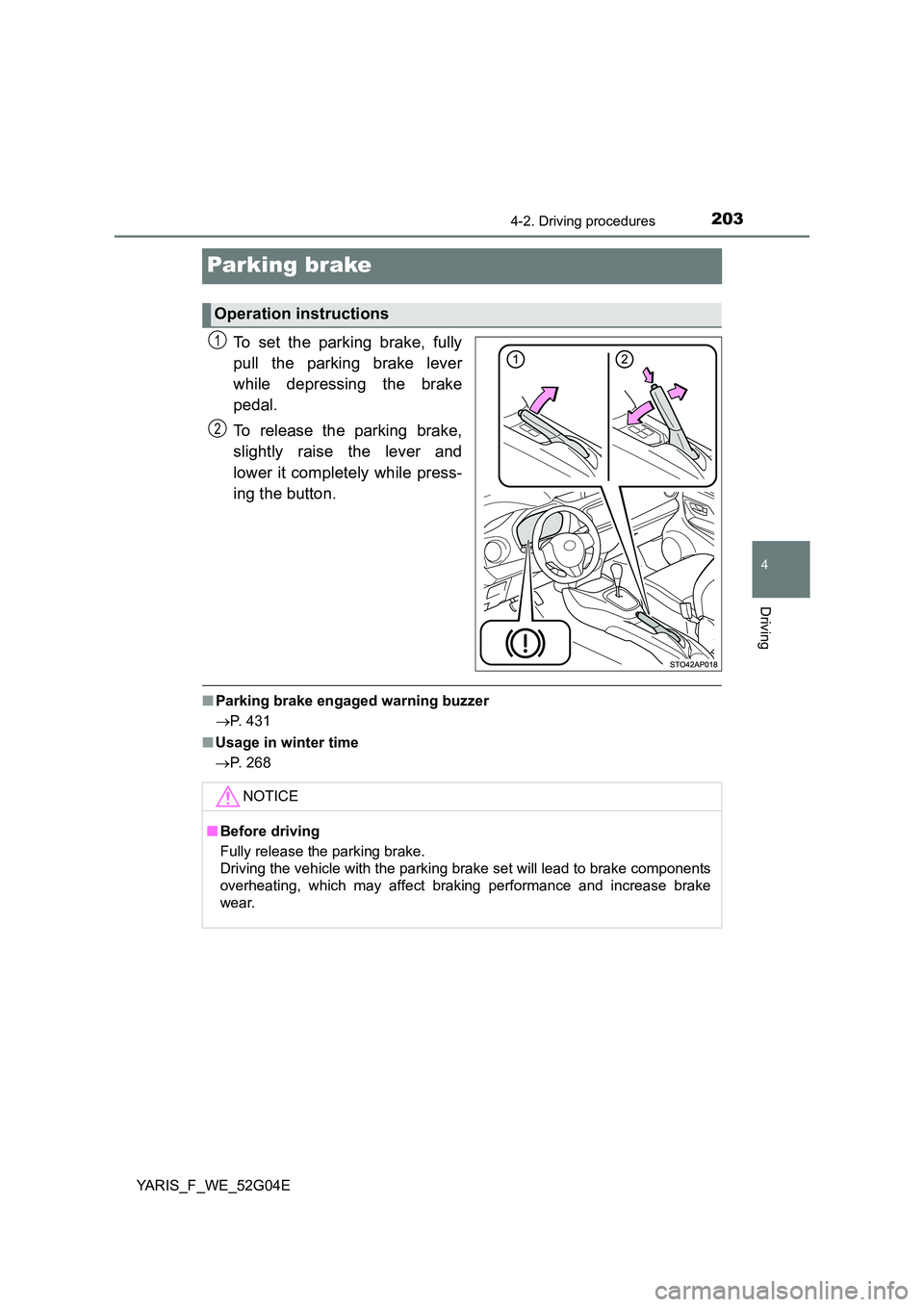
To set the parking brake, fully
pull the parking brake lever
while depressing the brake
pedal.
To release the parking brake,
slightly raise the lever and
lower it completely while press-
ing the button.
■ Parking brake engaged warning buzzer
P. 431
■ Usage in winter time
P. 268
Operation instructions
1
2
NOTICE
■Before driving
Fully release the parking brake.
Driving the vehicle with the parking brake set will lead to brake components
overheating, which may affect braking performance and increase brake
wear.
Page 204 of 540
2044-3. Operating the lights and wipers
YARIS_F_WE_52G04E
Headlight switch
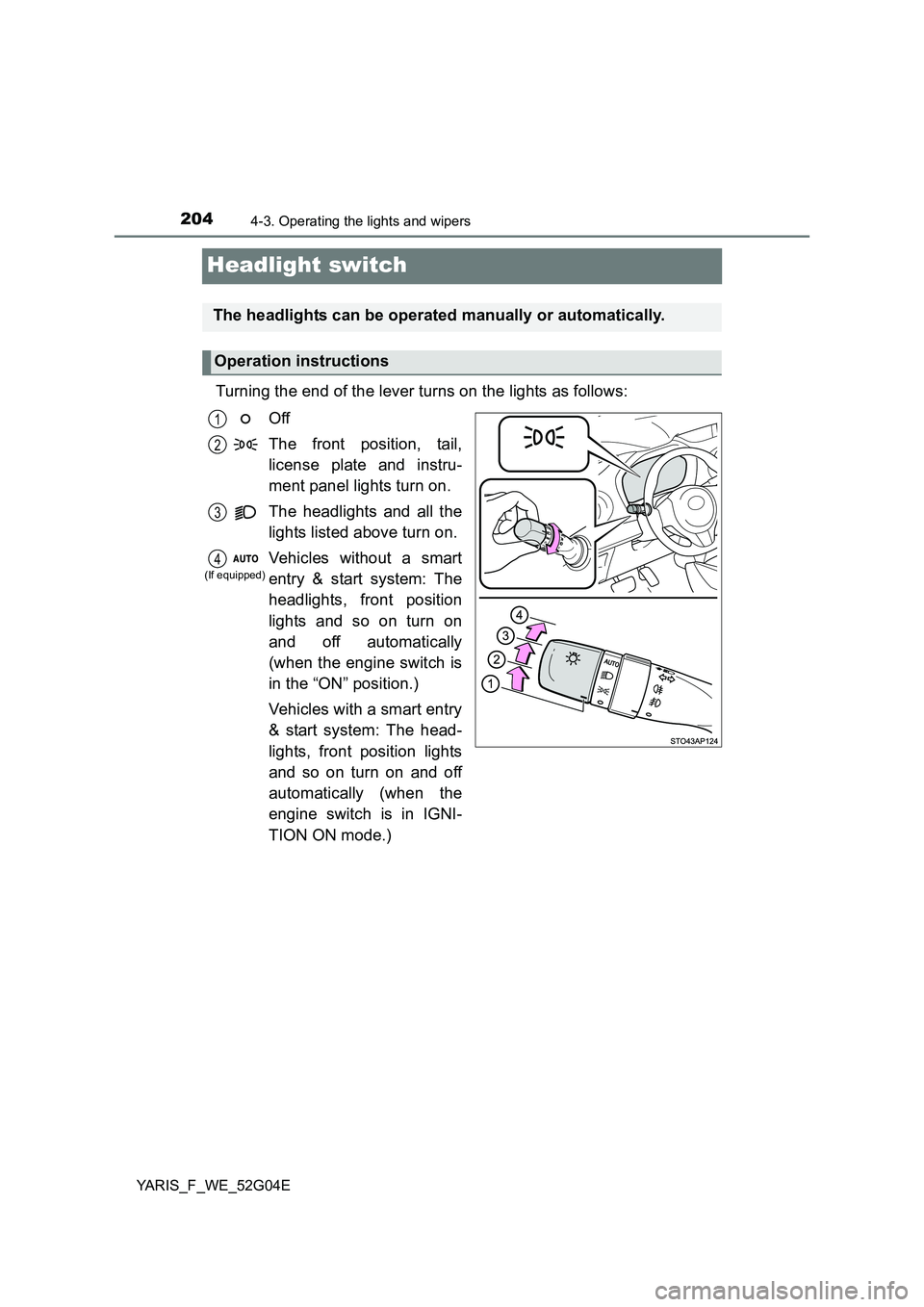
Turning the end of the lever turns on the lights as follows:
Off
The front position, tail,
license plate and instru-
ment panel lights turn on.
The headlights and all the
lights listed above turn on.
Vehicles without a smart
entry & start system: The
headlights, front position
lights and so on turn on
and off automatically
(when the engine switch is
in the “ON” position.)
Vehicles with a smart entry
& start system: The head-
lights, front position lights
and so on turn on and off
automatically (when the
engine switch is in IGNI-
TION ON mode.)
The headlights can be operated manually or automatically.
Operation instructions
1
2
3
4(If equipped)
Page 205 of 540
2054-3. Operating the lights and wipers
4
Driving
YARIS_F_WE_52G04E
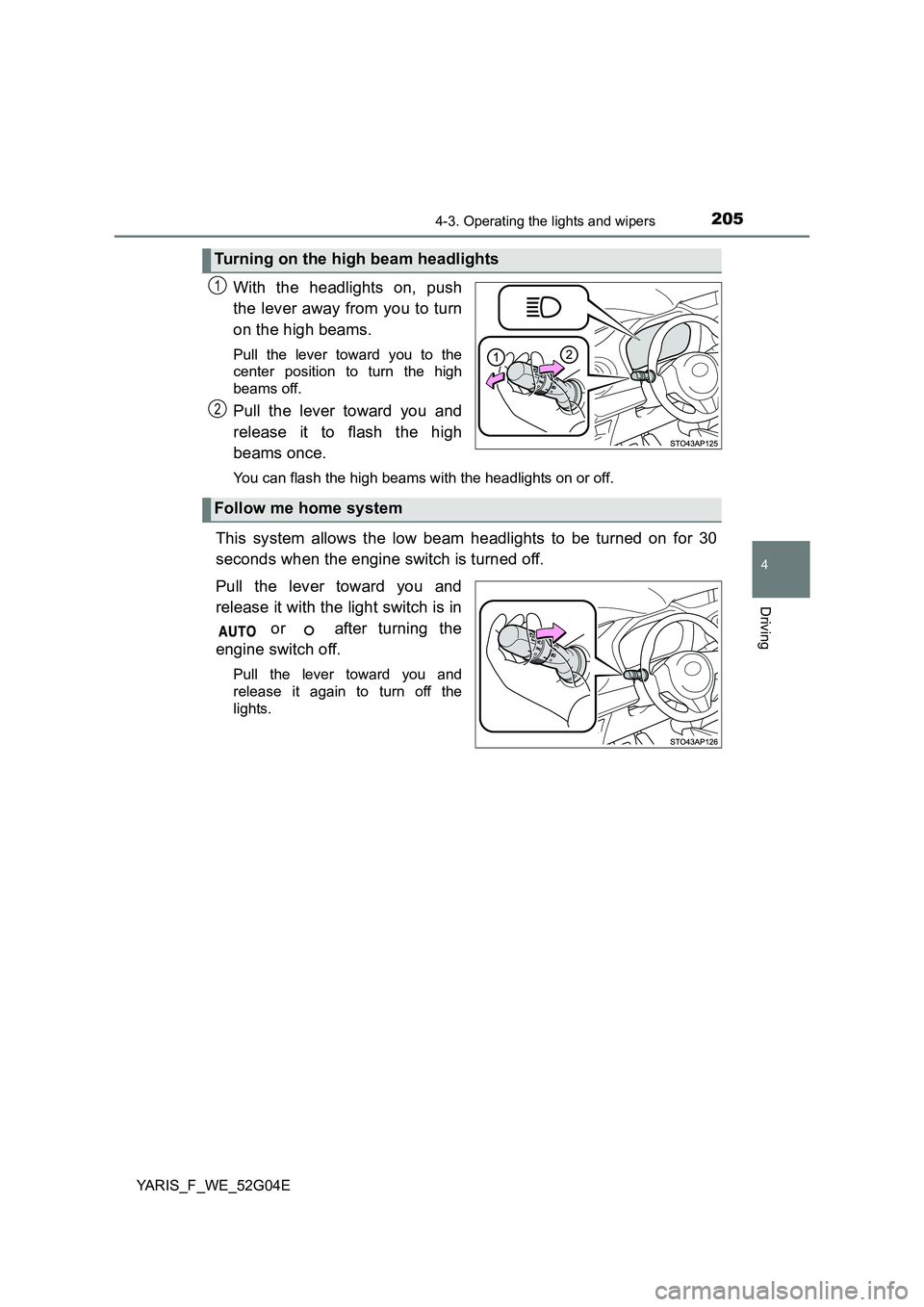
With the headlights on, push
the lever away from you to turn
on the high beams.
Pull the lever toward you to the
center position to turn the high
beams off.
Pull the lever toward you and
release it to flash the high
beams once.
You can flash the high beams with the headlights on or off.
This system allows the low beam headlights to be turned on for 30
seconds when the engine switch is turned off.
Pull the lever toward you and
release it with the light switch is in
or after turning the
engine switch off.
Pull the lever toward you and
release it again to turn off the
lights.
Turning on the high beam headlights
1
2
Follow me home system
Page 206 of 540
2064-3. Operating the lights and wipers
YARIS_F_WE_52G04E
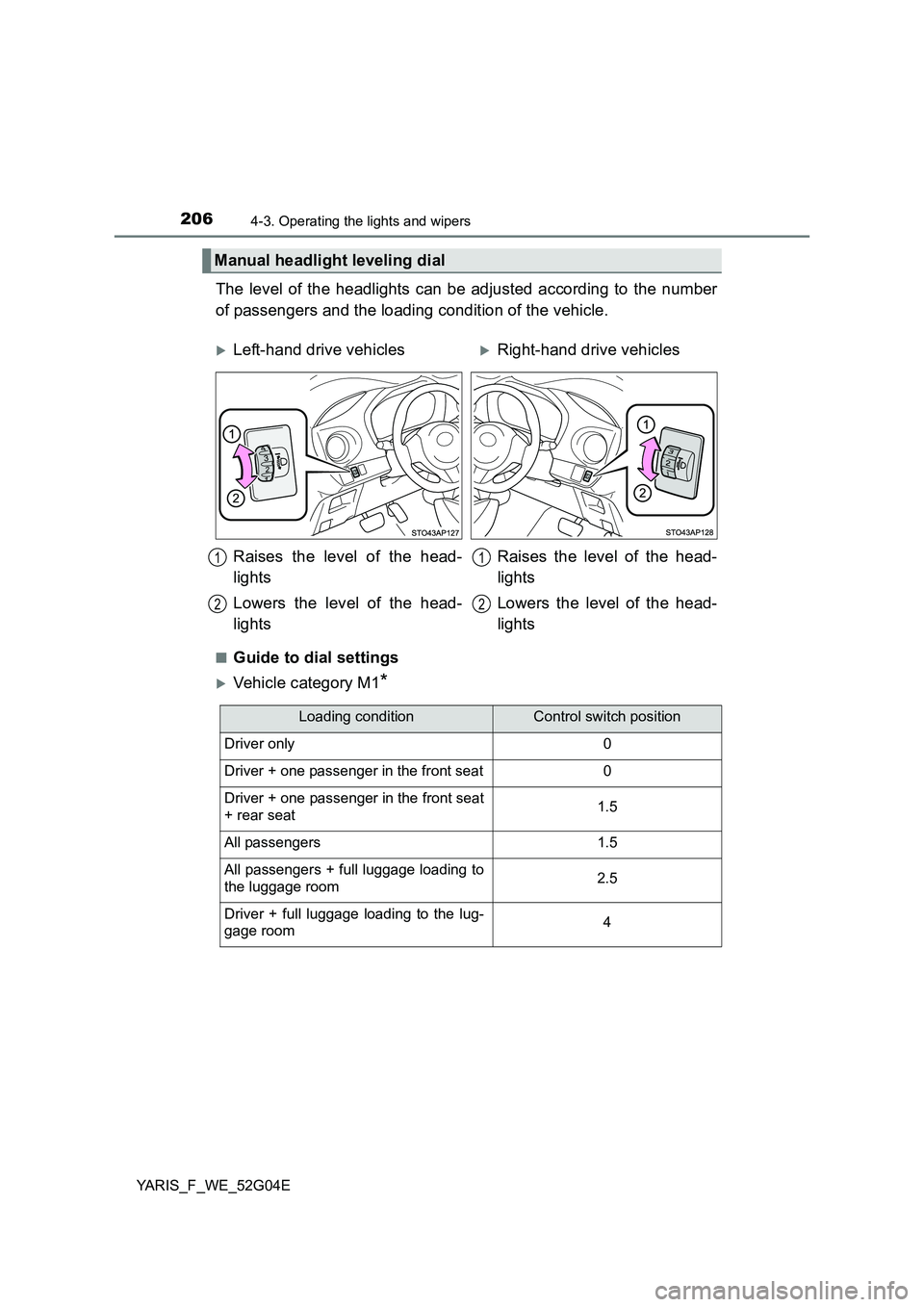
The level of the headlights can be adjusted according to the number
of passengers and the loading condition of the vehicle.
■Guide to dial settings
Vehicle category M1*
Manual headlight leveling dial
Left-hand drive vehiclesRight-hand drive vehicles
Raises the level of the head-
lights
Lowers the level of the head-
lights
Raises the level of the head-
lights
Lowers the level of the head-
lights
1
2
1
2
Loading conditionControl switch position
Driver only0
Driver + one passenger in the front seat0
Driver + one passenger in the front seat
+ rear seat1.5
All passengers1.5
All passengers + full luggage loading to
the luggage room2.5
Driver + full luggage loading to the lug-
gage room4