steering TOYOTA YARIS 2016 Workshop Manual
[x] Cancel search | Manufacturer: TOYOTA, Model Year: 2016, Model line: YARIS, Model: TOYOTA YARIS 2016Pages: 540, PDF Size: 34.12 MB
Page 444 of 540
4448-2. Steps to take in an emergency
YARIS_F_WE_52G04E
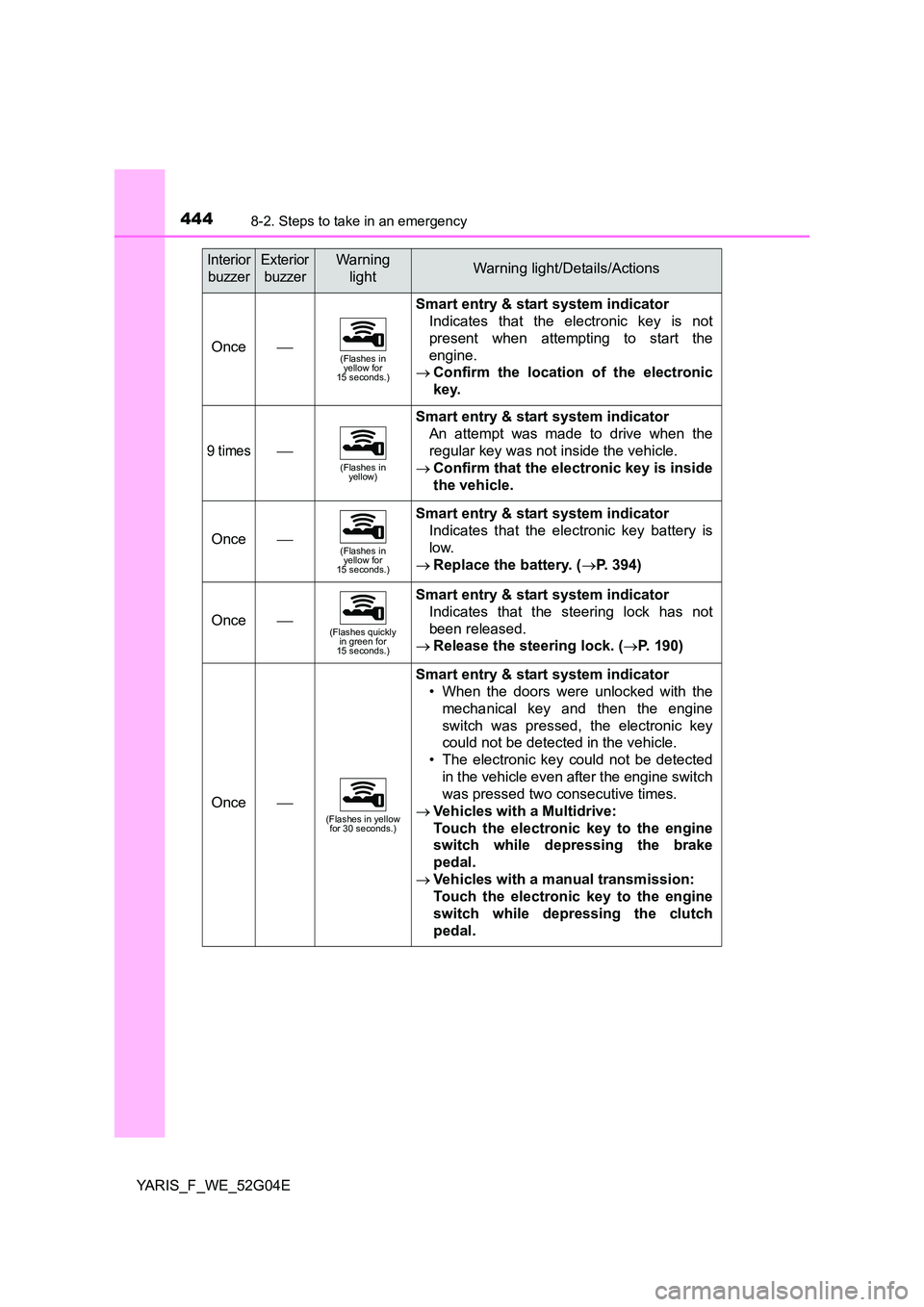
Once(Flashes in yellow for 15 seconds.)
Smart entry & start system indicator
Indicates that the electronic key is not
present when attempting to start the
engine.
Confirm the location of the electronic
key.
9 times(Flashes in yellow)
Smart entry & start system indicator
An attempt was made to drive when the
regular key was not inside the vehicle.
Confirm that the electronic key is inside
the vehicle.
Once(Flashes in yellow for 15 seconds.)
Smart entry & start system indicator
Indicates that the electronic key battery is
low.
Replace the battery. (P. 394)
Once(Flashes quickly in green for 15 seconds.)
Smart entry & start system indicator
Indicates that the steering lock has not
been released.
Release the steering lock. (P. 190)
Once(Flashes in yellow for 30 seconds.)
Smart entry & start system indicator
• When the doors were unlocked with the
mechanical key and then the engine
switch was pressed, the electronic key
could not be detected in the vehicle.
• The electronic key could not be detected
in the vehicle even after the engine switch
was pressed two consecutive times.
Vehicles with a Multidrive:
Touch the electronic key to the engine
switch while depressing the brake
pedal.
Vehicles with a manual transmission:
Touch the electronic key to the engine
switch while depressing the clutch
pedal.
Interior
buzzer
Exterior
buzzer
Warning
lightWarning light/Details/Actions
Page 458 of 540
4588-2. Steps to take in an emergency
YARIS_F_WE_52G04E
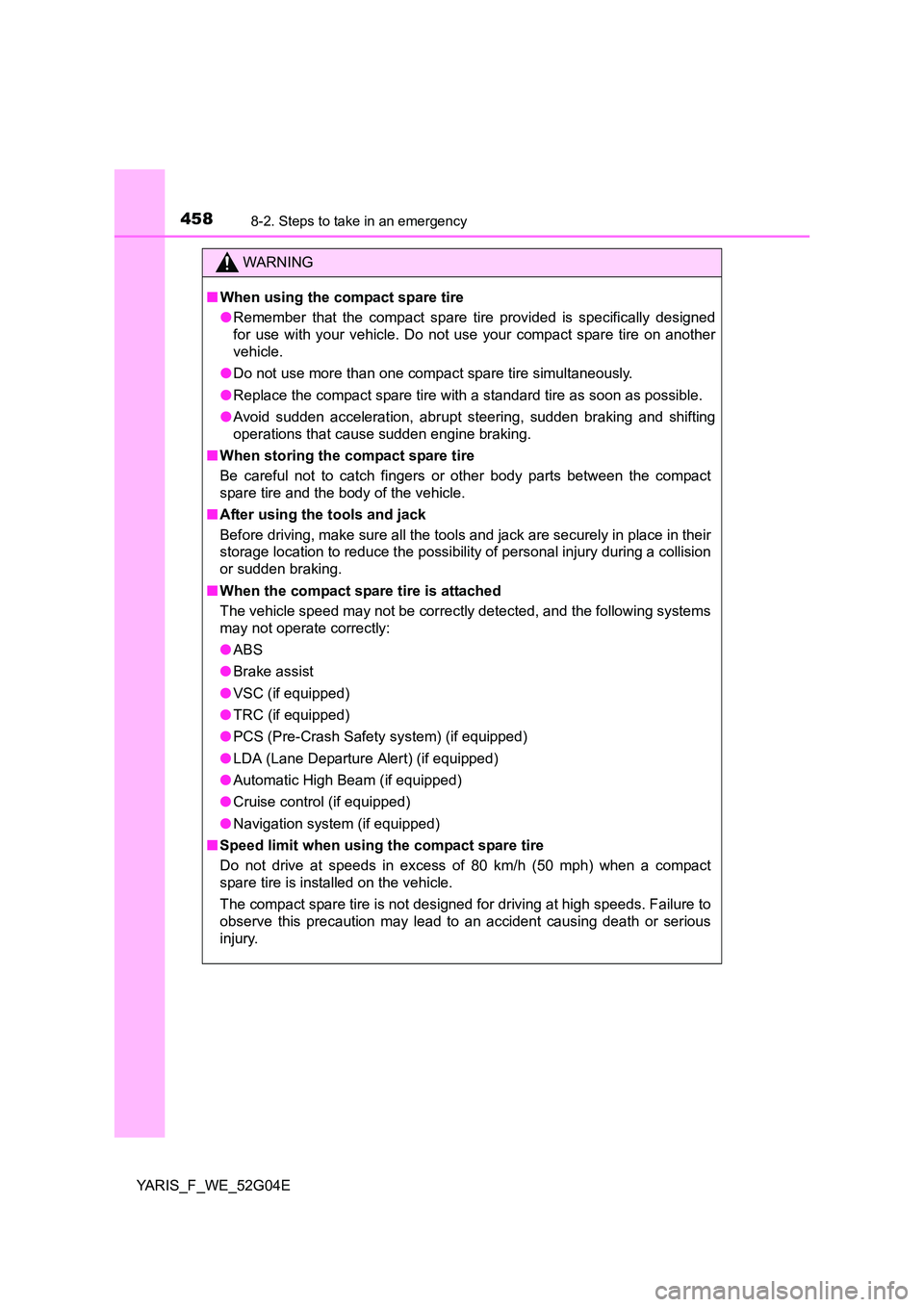
WARNING
■When using the compact spare tire
● Remember that the compact spare tire provided is specifically designed
for use with your vehicle. Do not use your compact spare tire on another
vehicle.
● Do not use more than one compact spare tire simultaneously.
● Replace the compact spare tire with a standard tire as soon as possible.
● Avoid sudden acceleration, abrupt steering, sudden braking and shifting
operations that cause sudden engine braking.
■ When storing the compact spare tire
Be careful not to catch fingers or other body parts between the compact
spare tire and the body of the vehicle.
■ After using the tools and jack
Before driving, make sure all the tools and jack are securely in place in their
storage location to reduce the possibility of personal injury during a collision
or sudden braking.
■ When the compact spare tire is attached
The vehicle speed may not be correctly detected, and the following systems
may not operate correctly:
● ABS
● Brake assist
● VSC (if equipped)
● TRC (if equipped)
● PCS (Pre-Crash Safety system) (if equipped)
● LDA (Lane Departure Alert) (if equipped)
● Automatic High Beam (if equipped)
● Cruise control (if equipped)
● Navigation system (if equipped)
■ Speed limit when using the compact spare tire
Do not drive at speeds in excess of 80 km/h (50 mph) when a compact
spare tire is installed on the vehicle.
The compact spare tire is not designed for driving at high speeds. Failure to
observe this precaution may lead to an accident causing death or serious
injury.
Page 473 of 540
4738-2. Steps to take in an emergency
8
When trouble arises
YARIS_F_WE_52G04E
WARNING
●Connect the valve and hose securely with the tire installed on the vehicle.
If the hose is not properly connected to the valve, air leakage may occur
as sealant may be sprayed out.
● If the hose comes off the valve while inflating the tire, there is a risk that
the hose will move abruptly due to air pressure.
● After inflation of the tire has completed, the sealant may splatter when the
hose is disconnected or some air is let out of the tire.
● Follow the operation procedure to repair the tire. If the procedures not fol-
lowed, the sealant may spray out.
● Keep back from the tire while it is being repaired, as there is a chance of it
bursting while the repair operation is being performed. If you notice any
cracks or deformation of the tire, turn off the compressor switch and stop
the repair operation immediately.
● The repair kit may overheat if operated for a long period of time. Do not
operate the repair kit continuously for more than 40 minutes.
● Parts of the repair kit become hot during operation. Be careful when han-
dling the repair kit during and after operation. Do not touch the metal part
around the connecting area between the bottle and compressor. It will be
extremely hot.
● Do not attach the vehicle speed warning sticker to an area other than the
one indicated. If the sticker is attached to an area where an SRS airbag is
located, such as the pad of the steering wheel, it may prevent the SRS air-
bag from operating properly.
■ Driving to spread the liquid sealant evenly
Observe the following precautions to reduce the risk of accidents.
Failing to do so may result in a loss of vehicle control and cause death or
serious injury.
● Drive the vehicle carefully at a low speed. Be especially careful when turn-
ing and cornering.
● If the vehicle does not drive straight or you feel a pull through the steering
wheel, stop the vehicle and check the following.
• Tire condition. The tire may have separated from the wheel.
• Tire inflation pressure. If the tire inflation pressure is 130 kPa (1.3 kgf/cm2
or bar, 19 psi) or less, the tire may be severely damaged.
Page 476 of 540
4768-2. Steps to take in an emergency
YARIS_F_WE_52G04E
One of the following may be the cause of the problem:
● One or both of the battery terminals may be disconnected.
● The battery may be discharged. (P. 480)
● There may be a malfunction in the steering lock system (vehicles
with a smart entry & start system).
Contact any authorized Toyota dealer or repairer, or another duly qualified
and equipped professional, if the problem cannot be repaired, or if repair
procedures are unknown.
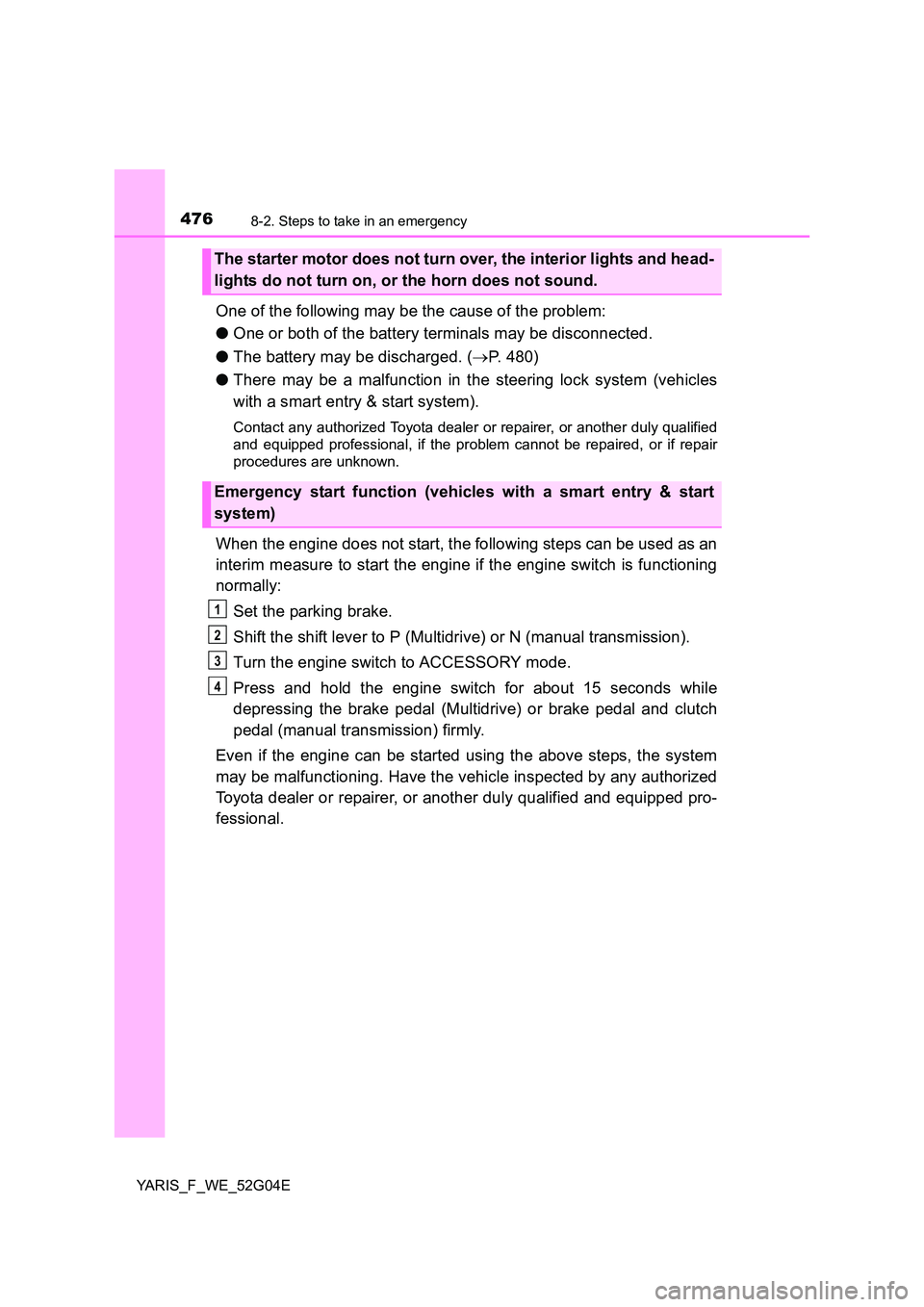
When the engine does not start, the following steps can be used as an
interim measure to start the engine if the engine switch is functioning
normally:
Set the parking brake.
Shift the shift lever to P (Multidrive) or N (manual transmission).
Turn the engine switch to ACCESSORY mode.
Press and hold the engine switch for about 15 seconds while
depressing the brake pedal (Multidrive) or brake pedal and clutch
pedal (manual transmission) firmly.
Even if the engine can be started using the above steps, the system
may be malfunctioning. Have the vehicle inspected by any authorized
Toyota dealer or repairer, or another duly qualified and equipped pro-
fessional.
The starter motor does not turn over, the interior lights and head-
lights do not turn on, or the horn does not sound.
Emergency start function (vehicles with a smart entry & start
system)
1
2
3
4
Page 508 of 540
5089-1. Specifications
YARIS_F_WE_52G04E
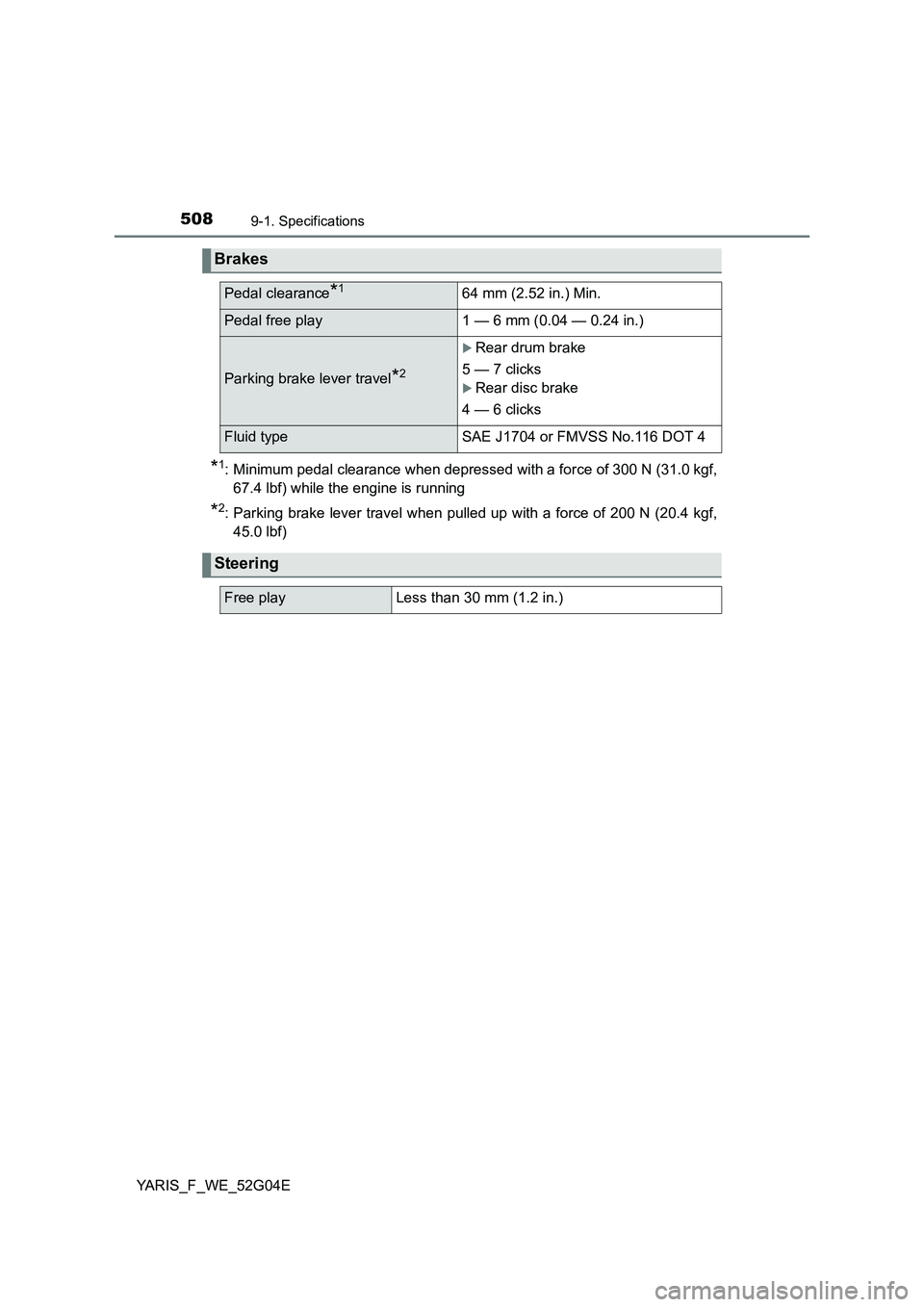
*1: Minimum pedal clearance when depressed with a force of 300 N (31.0 kgf,
67.4 lbf) while the engine is running
*2: Parking brake lever travel when pulled up with a force of 200 N (20.4 kgf,
45.0 lbf)
Brakes
Pedal clearance*164 mm (2.52 in.) Min.
Pedal free play1 — 6 mm (0.04 — 0.24 in.)
Parking brake lever travel*2
Rear drum brake
5 — 7 clicks
Rear disc brake
4 — 6 clicks
Fluid typeSAE J1704 or FMVSS No.116 DOT 4
Steering
Free playLess than 30 mm (1.2 in.)
Page 509 of 540
5099-1. Specifications
9
Vehicle specifications
YARIS_F_WE_52G04E
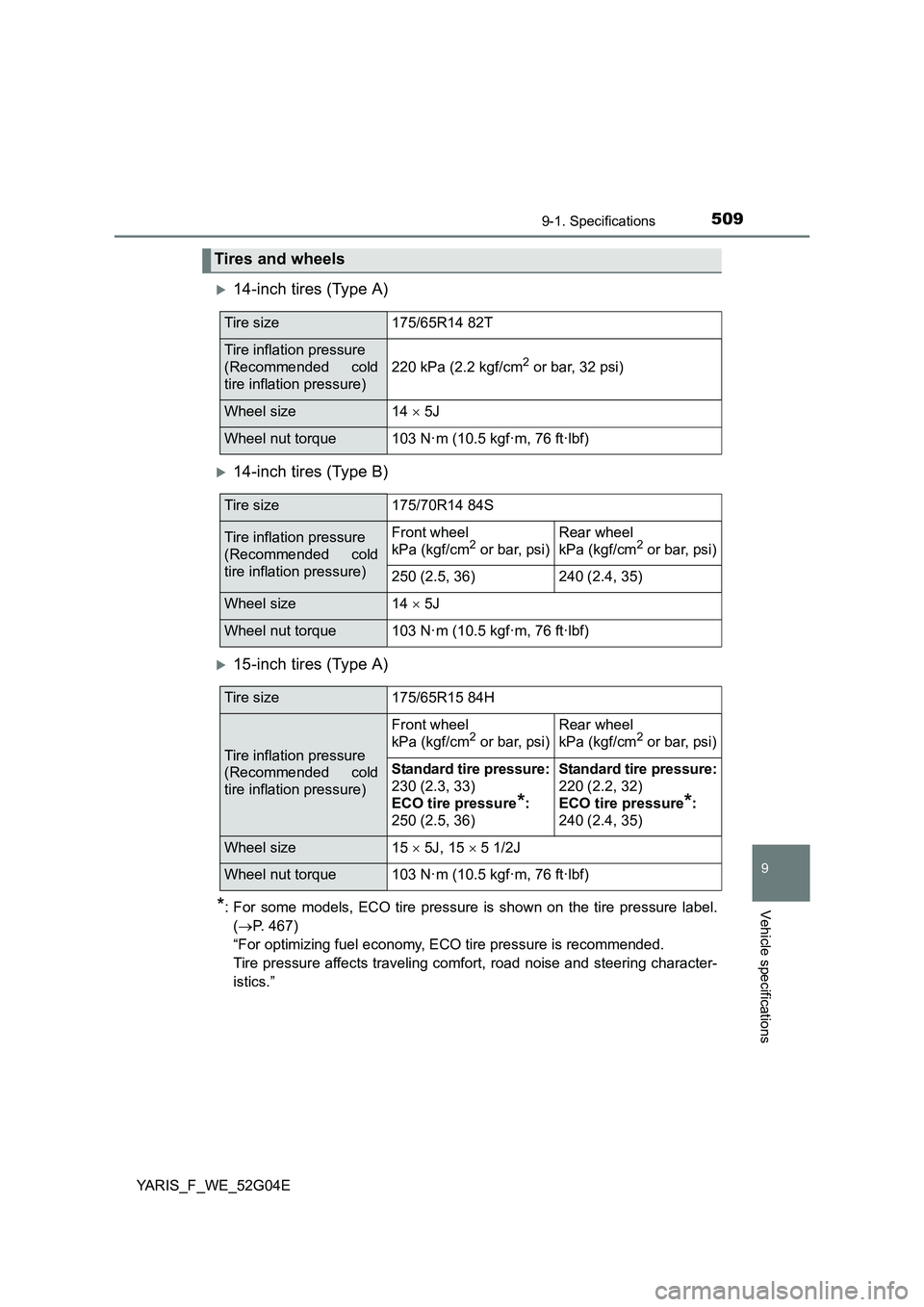
14-inch tires (Type A)
14-inch tires (Type B)
15-inch tires (Type A)
*: For some models, ECO tire pressure is shown on the tire pressure label.
( P. 467)
“For optimizing fuel economy, ECO tire pressure is recommended.
Tire pressure affects traveling comfort, road noise and steering character-
istics.”
Tires and wheels
Tire size175/65R14 82T
Tire inflation pressure
(Recommended cold
tire inflation pressure)
220 kPa (2.2 kgf/cm2 or bar, 32 psi)
Wheel size14 5J
Wheel nut torque103 N·m (10.5 kgf·m, 76 ft·lbf)
Tire size175/70R14 84S
Tire inflation pressure
(Recommended cold
tire inflation pressure)
Front wheel
kPa (kgf/cm2 or bar, psi)
Rear wheel
kPa (kgf/cm2 or bar, psi)
250 (2.5, 36)240 (2.4, 35)
Wheel size14 5J
Wheel nut torque103 N·m (10.5 kgf·m, 76 ft·lbf)
Tire size175/65R15 84H
Tire inflation pressure
(Recommended cold
tire inflation pressure)
Front wheel
kPa (kgf/cm2 or bar, psi)
Rear wheel
kPa (kgf/cm2 or bar, psi)
Standard tire pressure:
230 (2.3, 33)
ECO tire pressure*:
250 (2.5, 36)
Standard tire pressure:
220 (2.2, 32)
ECO tire pressure*:
240 (2.4, 35)
Wheel size15 5J, 15 5 1/2J
Wheel nut torque103 N·m (10.5 kgf·m, 76 ft·lbf)
Page 523 of 540
523What to do if... (Troubleshooting)
YARIS_F_WE_52G04E
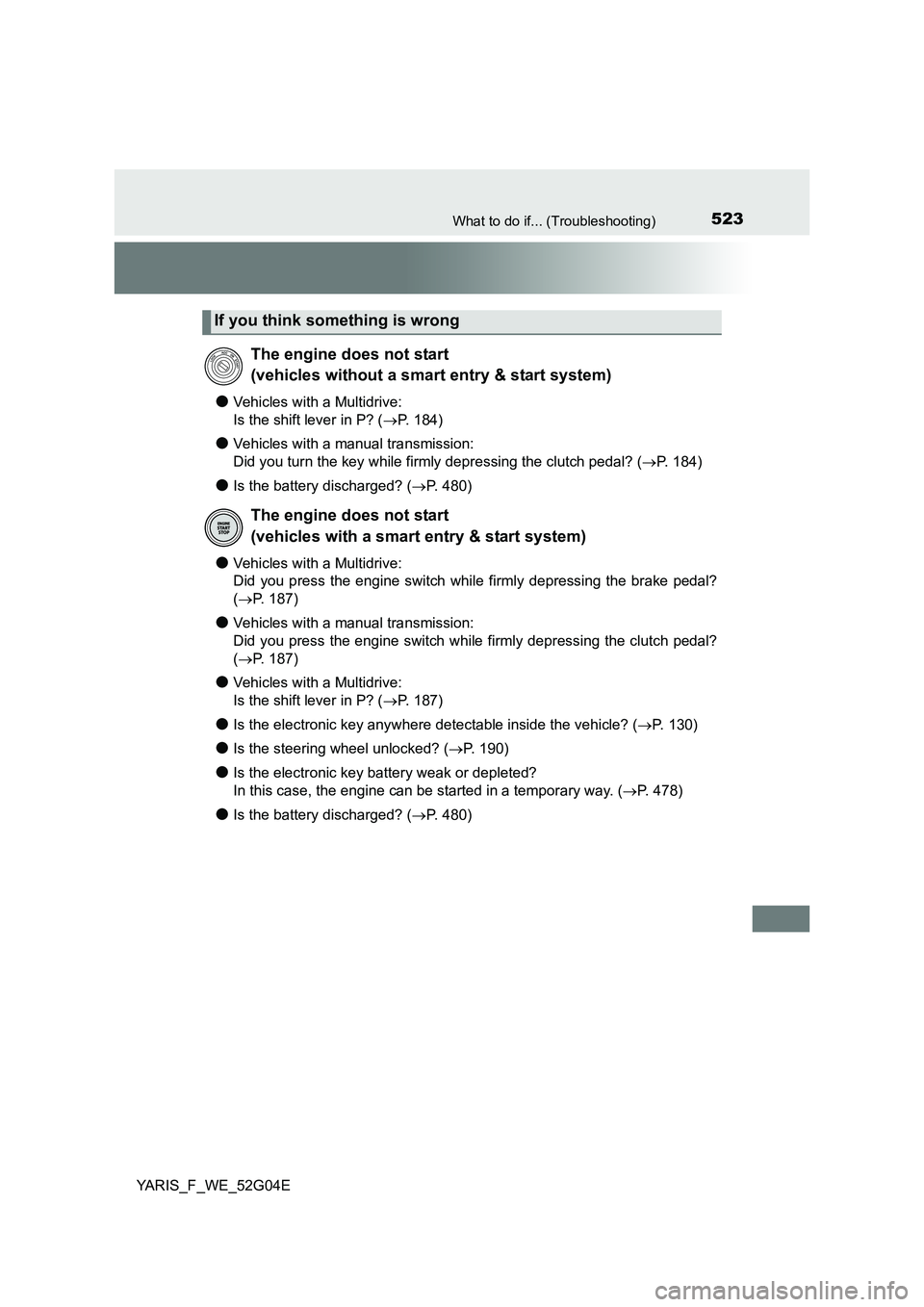
●Vehicles with a Multidrive:
Is the shift lever in P? ( P. 184)
●Vehicles with a manual transmission:
Did you turn the key while firmly depressing the clutch pedal? ( P. 184)
●Is the battery discharged? (P. 480)
●Vehicles with a Multidrive:
Did you press the engine switch while firmly depressing the brake pedal?
( P. 187)
●Vehicles with a manual transmission:
Did you press the engine switch while firmly depressing the clutch pedal?
( P. 187)
●Vehicles with a Multidrive:
Is the shift lever in P? ( P. 187)
●Is the electronic key anywhere detectable inside the vehicle? (P. 130)
●Is the steering wheel unlocked? (P. 190)
●Is the electronic key battery weak or depleted?
In this case, the engine can be started in a temporary way. ( P. 478)
●Is the battery discharged? (P. 480)
If you think something is wrong
The engine does not start
(vehicles without a smart entry & start system)
The engine does not start
(vehicles with a smart entry & start system)
Page 524 of 540
524What to do if... (Troubleshooting)
YARIS_F_WE_52G04E
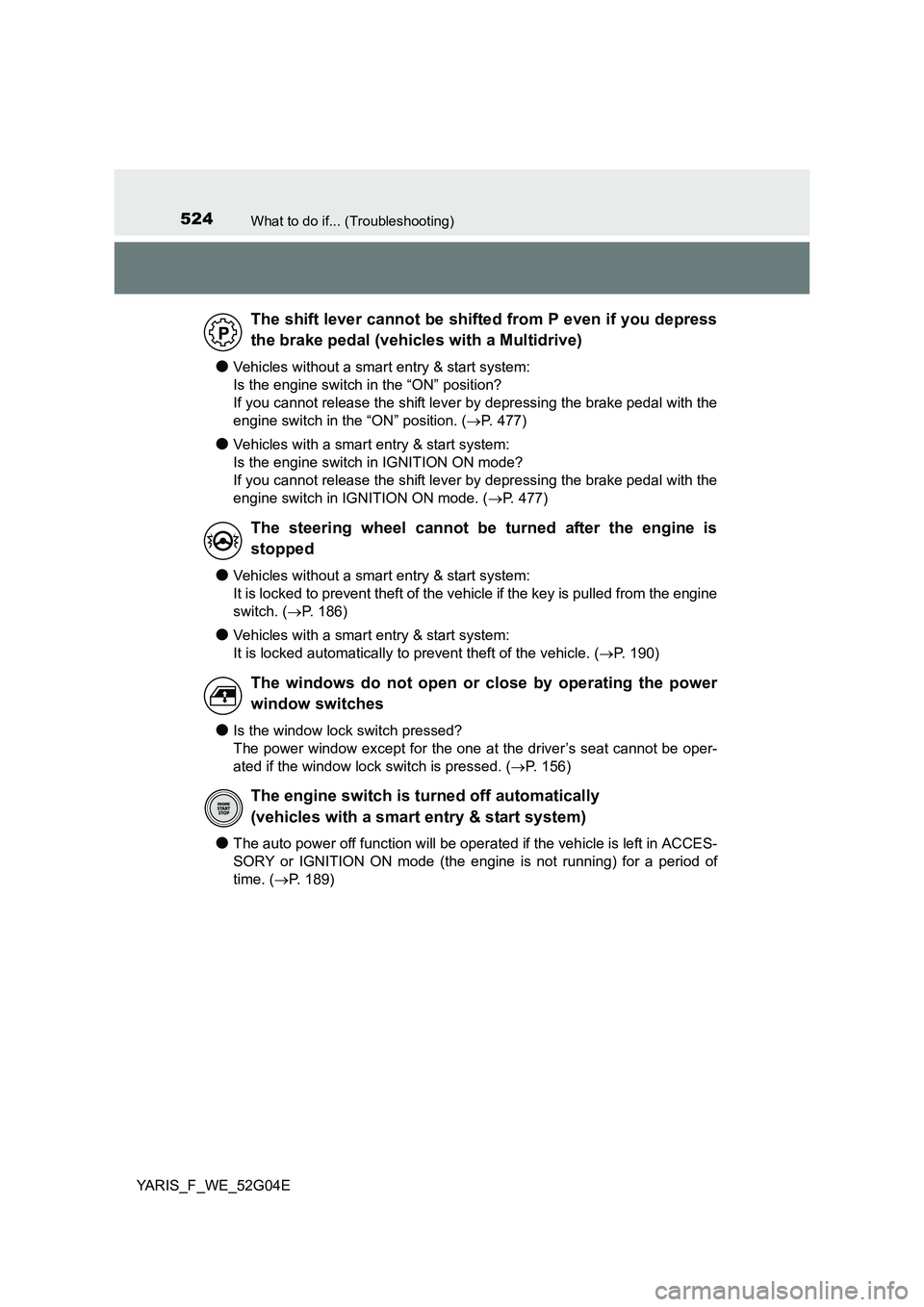
●Vehicles without a smart entry & start system:
Is the engine switch in the “ON” position?
If you cannot release the shift lever by depressing the brake pedal with the
engine switch in the “ON” position. ( P. 477)
●Vehicles with a smart entry & start system:
Is the engine switch in IGNITION ON mode?
If you cannot release the shift lever by depressing the brake pedal with the
engine switch in IGNITION ON mode. ( P. 477)
●Vehicles without a smart entry & start system:
It is locked to prevent theft of the vehicle if the key is pulled from the engine
switch. ( P. 186)
●Vehicles with a smart entry & start system:
It is locked automatically to prevent theft of the vehicle. ( P. 190)
●Is the window lock switch pressed?
The power window except for the one at the driver’s seat cannot be oper-
ated if the window lock switch is pressed. ( P. 156)
●The auto power off function will be operated if the vehicle is left in ACCES-
SORY or IGNITION ON mode (the engine is not running) for a period of
time. ( P. 189)
The shift lever cannot be shifted from P even if you depress
the brake pedal (vehicles with a Multidrive)
The steering wheel cannot be turned after the engine is
stopped
The windows do not open or close by operating the power
window switches
The engine switch is turned off automatically
(vehicles with a smart entry & start system)
Page 526 of 540
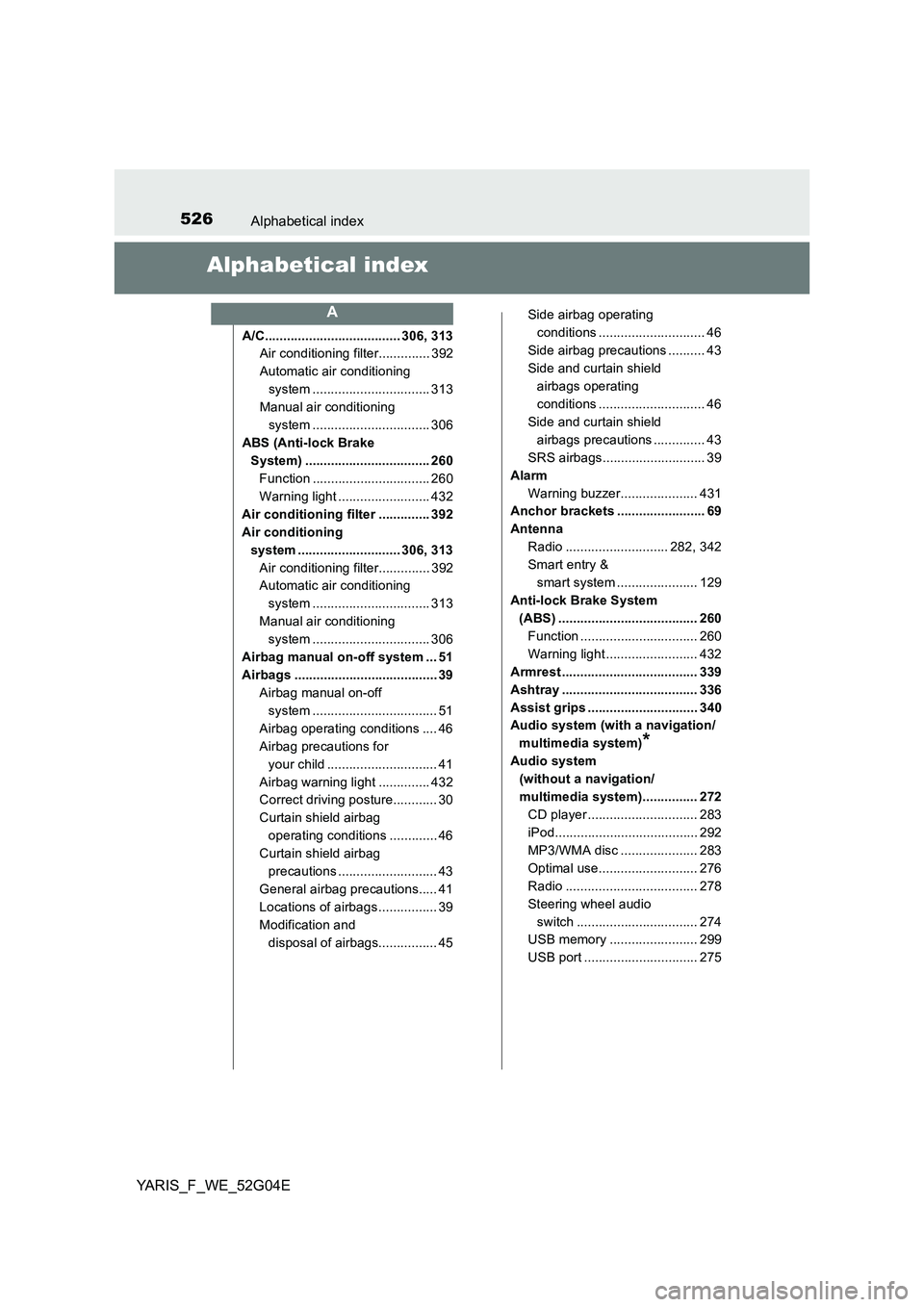
526Alphabetical index
YARIS_F_WE_52G04E
Alphabetical index
A/C..................................... 306, 313
Air conditioning filter.............. 392
Automatic air conditioning
system ................................ 313
Manual air conditioning
system ................................ 306
ABS (Anti-lock Brake
System) .................................. 260
Function ................................ 260
Warning light ......................... 432
Air conditioning filter .............. 392
Air conditioning
system ............................ 306, 313
Air conditioning filter.............. 392
Automatic air conditioning
system ................................ 313
Manual air conditioning
system ................................ 306
Airbag manual on-off system ... 51
Airbags ....................................... 39
Airbag manual on-off
system .................................. 51
Airbag operating conditions .... 46
Airbag precautions for
your child .............................. 41
Airbag warning light .............. 432
Correct driving posture............ 30
Curtain shield airbag
operating conditions ............. 46
Curtain shield airbag
precautions ........................... 43
General airbag precautions..... 41
Locations of airbags................ 39
Modification and
disposal of airbags................ 45
Side airbag operating
conditions ............................. 46
Side airbag precautions .......... 43
Side and curtain shield
airbags operating
conditions ............................. 46
Side and curtain shield
airbags precautions .............. 43
SRS airbags............................ 39
Alarm
Warning buzzer..................... 431
Anchor brackets ........................ 69
Antenna
Radio ............................ 282, 342
Smart entry &
smart system ...................... 129
Anti-lock Brake System
(ABS) ...................................... 260
Function ................................ 260
Warning light ......................... 432
Armrest ..................................... 339
Ashtray ..................................... 336
Assist grips .............................. 340
Audio system (with a navigation/
multimedia system)*
Audio system
(without a navigation/
multimedia system)............... 272
CD player .............................. 283
iPod....................................... 292
MP3/WMA disc ..................... 283
Optimal use........................... 276
Radio .................................... 278
Steering wheel audio
switch ................................. 274
USB memory ........................ 299
USB port ............................... 275
A
Page 529 of 540
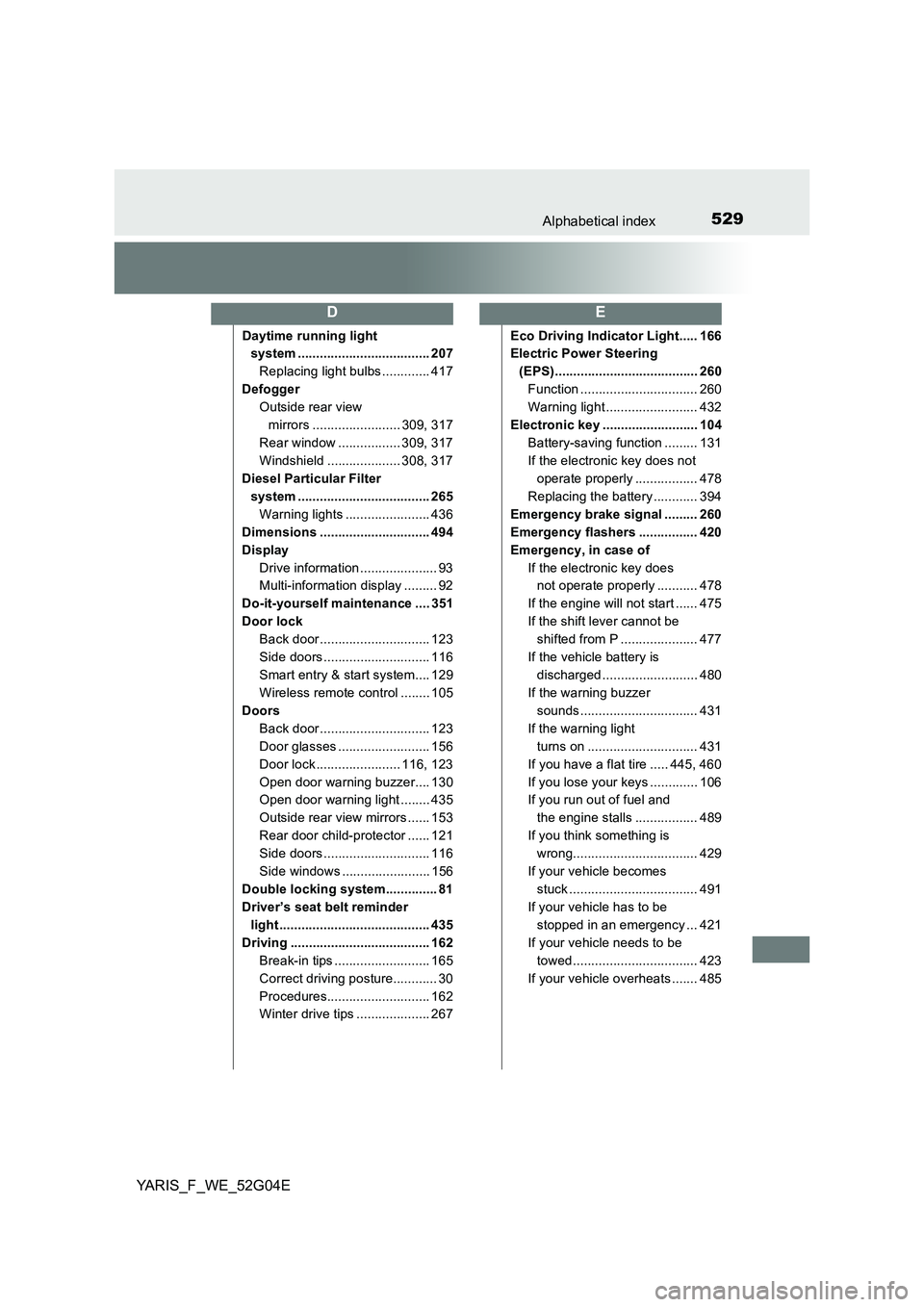
529Alphabetical index
YARIS_F_WE_52G04E
Daytime running light
system .................................... 207
Replacing light bulbs ............. 417
Defogger
Outside rear view
mirrors ........................ 309, 317
Rear window ................. 309, 317
Windshield .................... 308, 317
Diesel Particular Filter
system .................................... 265
Warning lights ....................... 436
Dimensions .............................. 494
Display
Drive information ..................... 93
Multi-information display ......... 92
Do-it-yourself maintenance .... 351
Door lock
Back door .............................. 123
Side doors ............................. 116
Smart entry & start system.... 129
Wireless remote control ........ 105
Doors
Back door .............................. 123
Door glasses ......................... 156
Door lock ....................... 116, 123
Open door warning buzzer.... 130
Open door warning light ........ 435
Outside rear view mirrors ...... 153
Rear door child-protector ...... 121
Side doors ............................. 116
Side windows ........................ 156
Double locking system.............. 81
Driver’s seat belt reminder
light ......................................... 435
Driving ...................................... 162
Break-in tips .......................... 165
Correct driving posture............ 30
Procedures............................ 162
Winter drive tips .................... 267
Eco Driving Indicator Light..... 166
Electric Power Steering
(EPS)....................................... 260
Function ................................ 260
Warning light ......................... 432
Electronic key .......................... 104
Battery-saving function ......... 131
If the electronic key does not
operate properly ................. 478
Replacing the battery ............ 394
Emergency brake signal ......... 260
Emergency flashers ................ 420
Emergency, in case of
If the electronic key does
not operate properly ........... 478
If the engine will not start ...... 475
If the shift lever cannot be
shifted from P ..................... 477
If the vehicle battery is
discharged .......................... 480
If the warning buzzer
sounds................................ 431
If the warning light
turns on .............................. 431
If you have a flat tire ..... 445, 460
If you lose your keys ............. 106
If you run out of fuel and
the engine stalls ................. 489
If you think something is
wrong.................................. 429
If your vehicle becomes
stuck ................................... 491
If your vehicle has to be
stopped in an emergency ... 421
If your vehicle needs to be
towed .................................. 423
If your vehicle overheats ....... 485
DE