catalytic converter TOYOTA YARIS 2016 Owners Manual
[x] Cancel search | Manufacturer: TOYOTA, Model Year: 2016, Model line: YARIS, Model: TOYOTA YARIS 2016Pages: 540, PDF Size: 34.12 MB
Page 265 of 540
265
4
4-6. Using the driving support systems
Driving
YARIS_F_WE_52G04E
Diesel par ticulate filter system
Cleaning the DPF catalytic converter is performed as necessary in
accordance with driving conditions.
The DPF system has the following characteristics:
● Idle speed increases during cleaning
● The smell of the exhaust gas changes
● When starting the engine, white-colored steam (water vapor) may
be expelled during cleaning
● Acceleration performance may degrade during cleaning
■Replacing the engine oil
P. 361
: If equipped
When the deposit collected by the filter reaches a predetermined
amount, it is automatically cleaned.
Cleaning the DPF catalytic converter
Equipment characteristics
Page 432 of 540
4328-2. Steps to take in an emergency
YARIS_F_WE_52G04E
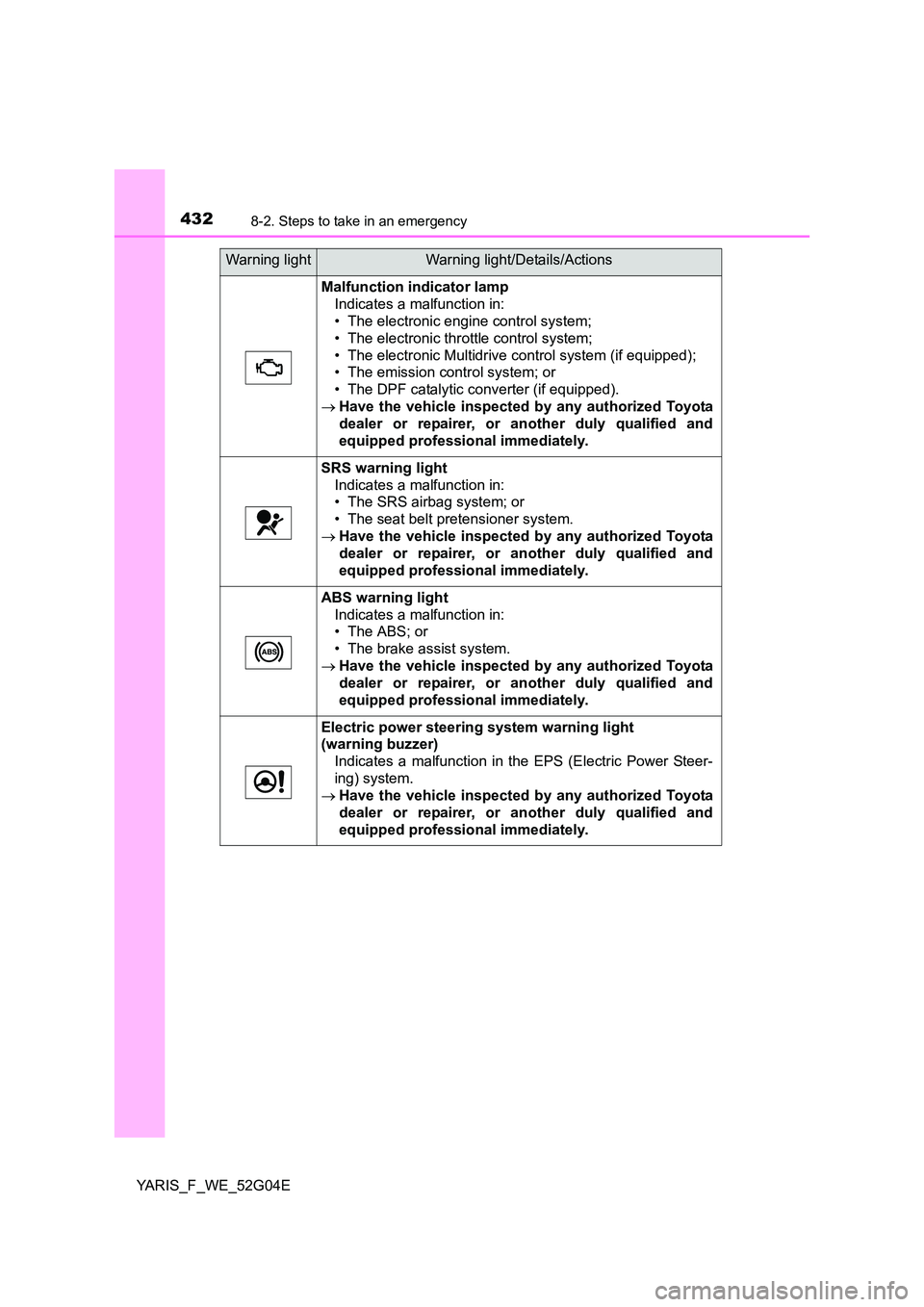
Malfunction indicator lamp
Indicates a malfunction in:
• The electronic engine control system;
• The electronic throttle control system;
• The electronic Multidrive control system (if equipped);
• The emission control system; or
• The DPF catalytic converter (if equipped).
Have the vehicle inspected by any authorized Toyota
dealer or repairer, or another duly qualified and
equipped professional immediately.
SRS warning light
Indicates a malfunction in:
• The SRS airbag system; or
• The seat belt pretensioner system.
Have the vehicle inspected by any authorized Toyota
dealer or repairer, or another duly qualified and
equipped professional immediately.
ABS warning light
Indicates a malfunction in:
• The ABS; or
• The brake assist system.
Have the vehicle inspected by any authorized Toyota
dealer or repairer, or another duly qualified and
equipped professional immediately.
Electric power steering system warning light
(warning buzzer)
Indicates a malfunction in the EPS (Electric Power Steer-
ing) system.
Have the vehicle inspected by any authorized Toyota
dealer or repairer, or another duly qualified and
equipped professional immediately.
Warning lightWarning light/Details/Actions
Page 436 of 540
4368-2. Steps to take in an emergency
YARIS_F_WE_52G04E
Low engine oil level warning light (diesel engine only)
Indicates that engine oil level is low.
Check the level of engine oil, and add if necessary.
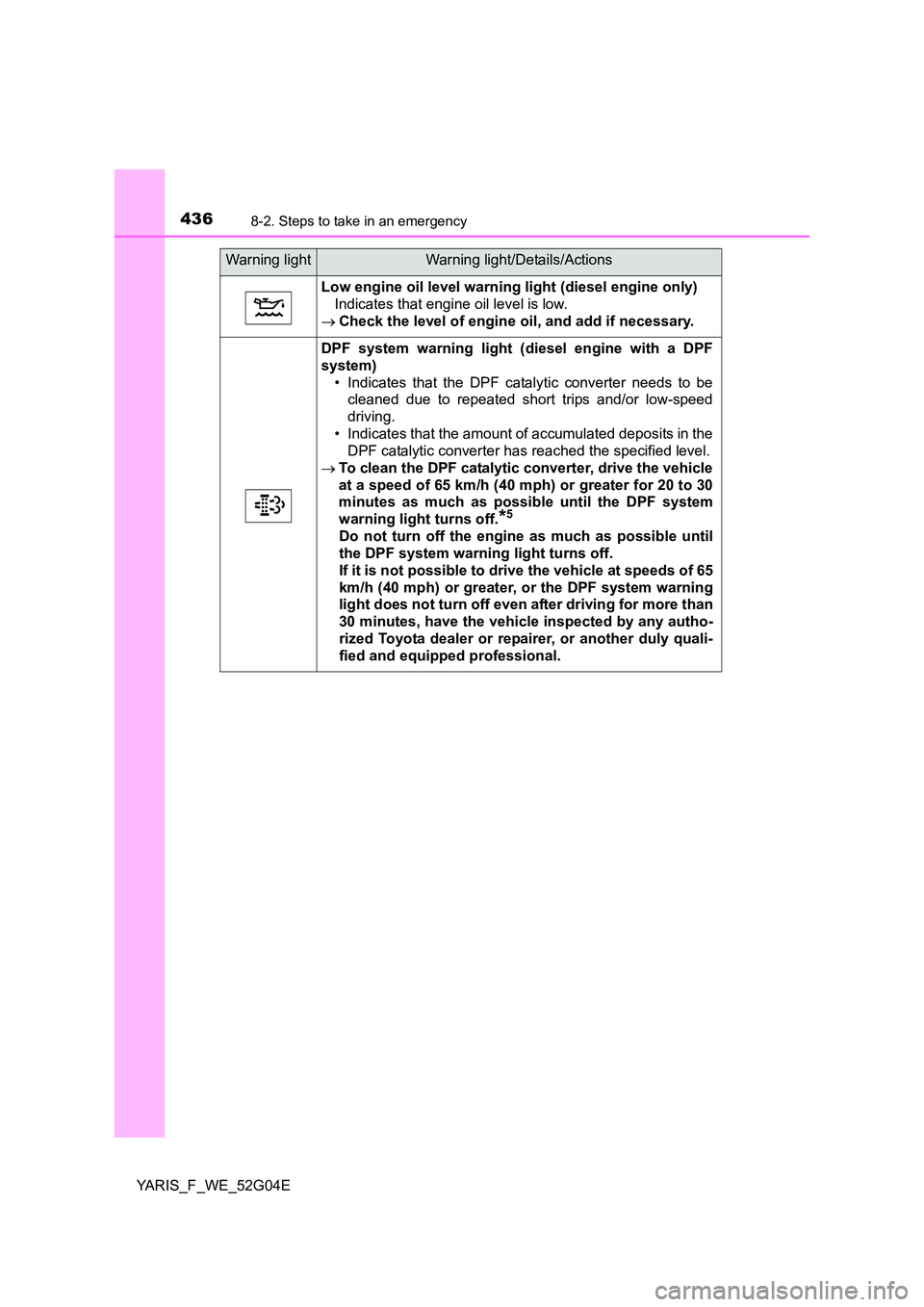
DPF system warning light (diesel engine with a DPF
system)
• Indicates that the DPF catalytic converter needs to be
cleaned due to repeated short trips and/or low-speed
driving.
• Indicates that the amount of accumulated deposits in the
DPF catalytic converter has reached the specified level.
To clean the DPF catalytic converter, drive the vehicle
at a speed of 65 km/h (40 mph) or greater for 20 to 30
minutes as much as possible until the DPF system
warning light turns off.*5
Do not turn off the engine as much as possible until
the DPF system warning light turns off.
If it is not possible to drive the vehicle at speeds of 65
km/h (40 mph) or greater, or the DPF system warning
light does not turn off even after driving for more than
30 minutes, have the vehicle inspected by any autho-
rized Toyota dealer or repairer, or another duly quali-
fied and equipped professional.
Warning lightWarning light/Details/Actions
Page 441 of 540
4418-2. Steps to take in an emergency
8
When trouble arises
YARIS_F_WE_52G04E
WARNING
■When the electric power steering system warning light comes on
The steering wheel may become extremely heavy.
If the steering wheel becomes heavier than usual when operating, hold
firmly and operate using more force than usual.
■ When driving to clean the DPF catalytic converter
When driving, pay sufficient attention to weather, road conditions, terrain
and traffic conditions, and be sure to observe traffic laws and/or regulations.
Failure to do so may cause an unexpected accident, resulting in death or
serious injury.
■ If the tire pressure warning light comes on (vehicles with a tire pres-
sure warning system)
Be sure to observe the following precautions. Failure to do so could cause a
loss of vehicle control and result in death or serious injury.
● Stop your vehicle in a safe place as soon as possible. Adjust the tire infla-
tion pressure immediately.
● If the tire pressure warning light comes on even after tire inflation pressure
adjustment, it is probable that you have a flat tire. Check the tires. If a tire
is flat, change it with the spare tire and have the flat tire repaired by the
nearest authorized Toyota dealer or repairer, or another duly qualified and
equipped professional.
● Avoid abrupt maneuvering and braking. If the vehicle tires deteriorate, you
could lose control of the steering wheel or the brakes.
■ If a blowout or sudden air leakage should occur (vehicles with a tire
pressure warning system)
The tire pressure warning system may not activate immediately.
Page 484 of 540
4848-2. Steps to take in an emergency
YARIS_F_WE_52G04E
WARNING
■Avoiding battery fires or explosions
Observe the following precautions to prevent accidentally igniting the flam-
mable gas that may be emitted from the battery:
● Make sure each jumper cable is connected to the correct terminal and that
it is not unintentionally in contact with anything other than the intended ter-
minal.
● Do not allow the + and - clamps of the jumper cables to come into contact
with each other.
● Do not smoke, use matches, cigarette lighters or allow open flame near
the battery.
■ Battery precautions
The battery contains poisonous and corrosive acidic electrolyte, while
related parts contain lead and lead compounds. Observe the following pre-
cautions when handling the battery:
● When working with the battery, always wear safety glasses and take care
not to allow any battery fluids (acid) to come into contact with skin, clothing
or the vehicle body.
● Do not lean over the battery.
● In the event that battery fluid comes into contact with the skin or eyes,
immediately wash the affected area with water and seek medical attention.
Place a wet sponge or cloth over the affected area until medical attention
can be received.
● Always wash your hands after handling the battery support, terminals, and
other battery-related parts.
● Do not allow children near the battery.
■ To prevent damage to the vehicle
Do not pull- or push-start the vehicle as the three-way catalytic converter
(gasoline engine) or catalytic conv erter (diesel engine) may overheat and
become a fire hazard.
NOTICE
■ When handling jumper cables
When connecting the jumper cables, ensure that they do not become entan-
gled in the cooling fans or engine drive belt.
Page 504 of 540
5049-1. Specifications
YARIS_F_WE_52G04E
Vehicles with a DPF system*
“Toyota Genuine Motor Oil” is used in your Toyota vehicle. Toyota
recommends the use of approved “Toyota Genuine Motor Oil”.
Another motor oil of matching quality can also be used.
Oil grade: ACEA C2
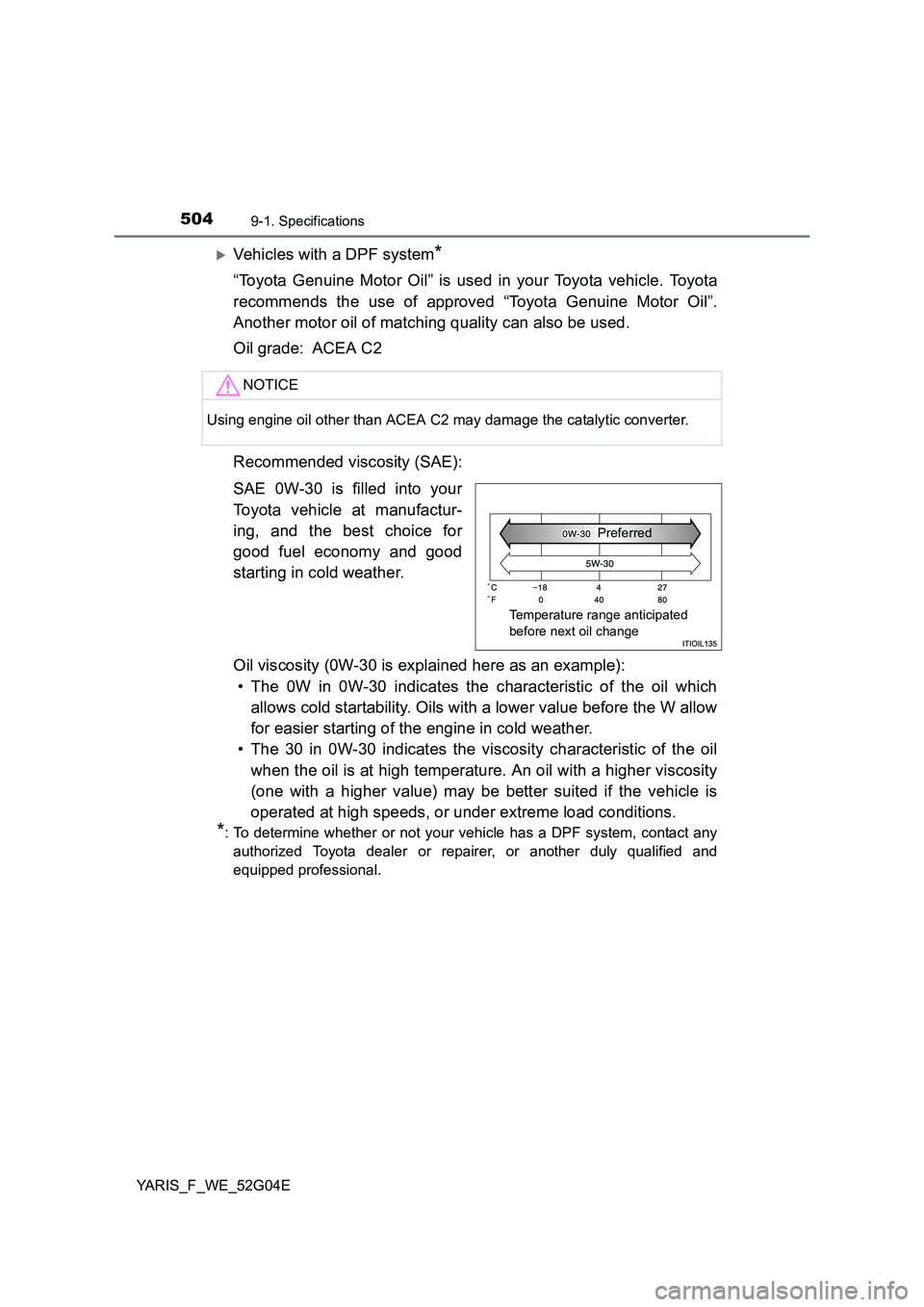
Recommended viscosity (SAE):
SAE 0W-30 is filled into your
Toyota vehicle at manufactur-
ing, and the best choice for
good fuel economy and good
starting in cold weather.
Oil viscosity (0W-30 is explained here as an example):
• The 0W in 0W-30 indicates the characteristic of the oil which
allows cold startability. Oils with a lower value before the W allow
for easier starting of the engine in cold weather.
• The 30 in 0W-30 indicates the viscosity characteristic of the oil
when the oil is at high temperature. An oil with a higher viscosity
(one with a higher value) may be better suited if the vehicle is
operated at high speeds, or under extreme load conditions.
*: To determine whether or not your vehicle has a DPF system, contact any
authorized Toyota dealer or repairer, or another duly qualified and
equipped professional.
NOTICE
Using engine oil other than ACEA C2 may damage the catalytic converter.
Temperature range anticipated
before next oil change
Preferred
Page 514 of 540
5149-1. Specifications
YARIS_F_WE_52G04E
NOTICE
■Notice on fuel quality (gasoline engine)
● Do not use improper fuels. If improper fuels are used, the engine will be damaged.
● Do not use leaded gasoline. Leaded gasoline will cause the three-way catalytic converter to lose itseffectiveness and the emission control system to function improperly.
● EU area: Bioethanol fuel sold under names such as “E50” or “E85” and fuel containing a large amount of ethanol should not be used. The use ofthese fuels will damage the vehicle’s fuel system. In case of any doubt, ask any authorized Toyota dealer or repairer, or another duly qualified and equipped professional.
● Except EU area: Bioethanol fuel sold under names such as “E50” or “E85” and fuel containing a large amount of ethanol should not be used. Your vehicle can use gasoline mixed with 10% max ethanol. The use of fuelwith more than 10% ethanol content (E10) will damage the vehicle’s fuel system. You must ensure that refueling is carried out only from a source where fuel specification and quality can be guaranteed. In case of anydoubt, ask any authorized Toyota dealer or repairer, or another duly quali- fied and equipped professional.
● Do not use the methanol blended gasoline such as M15, M85, M100. The use of gasoline containing methanol may cause engine damage or failure.
■ Notice on fuel quality (diesel engine)
● Do not use improper fuels. If improper fuels are used, the engine will be damaged.
● Do not use a fuel that contains more than 50 ppm of sulfur. Use of such a high sulfur fuel may damage the engine.
● EU area: FAME (Fatty Acid Methyl Ester) fuel sold under names such as “B30” or “B100” and fuel containing a large amount of FAME should not beused. The use of these fuels will damage the vehicle’s fuel system. In case of any doubt, ask any authorized Toyota dealer or repairer, or another duly qualified and equipped professional.
● Except EU area (except Russia): FAME (Fatty Acid Methyl Ester) fuel sold under names such as “B30” or “B100” and fuel containing a large amount of FAME should not be used. Your vehicle can use diesel mixed with 5%max biodiesel FAME (B5). The use of fuel with more than 5% FAME con- tent (B5) will damage the vehicle’s fuel system. You must ensure that refu- eling is carried out only from a source where fuel specification and qualitycan be guaranteed. In case of any doubt, ask any authorized Toyota dealer or repairer, or another dul y qualified and equipped professional.
● Except EU area (Russia): FAME (Fatty Acid Methyl Ester) fuel sold under name such as “B30” or “B100” and fuel containing a large amount of FAME should not be used. The use of these fuel will damage the vehicle’s fuel system. In case of anydoubt, ask any authorized Toyota dealer or repairer, or another duly quali- fied and equipped professional.