Fuel system TOYOTA YARIS 2017 3.G User Guide
[x] Cancel search | Manufacturer: TOYOTA, Model Year: 2017, Model line: YARIS, Model: TOYOTA YARIS 2017 3.GPages: 396, PDF Size: 7.08 MB
Page 291 of 396

291
7When trouble arises
7-1. Essential informationEmergency flashers .......... 292
If your vehicle has to be stopped in
an emergency ................. 293
7-2. Steps to take in an emergency
If your vehicle needs to be towed ......................... 295
If you think something is wrong .............................. 300
Fuel pump shut off system ............................ 301
If a warning light turns on or a warning buzzer
sounds ............................ 302
If you have a flat tire.......... 312
If the engine will not start .. 325
If the vehicle battery is discharged ...................... 327
If your vehicle overheats ... 330
If the vehicle becomes stuck ............................... 333
Page 301 of 396
301
7
When trouble arises
7-2. Steps to take in an emergency
Fuel pump shut off system
Follow the procedure below to restart the engine after the system is
activated.Turn the engine switch to the “ACC” or “LOCK” position.
Restart the engine.
To minimize the risk of fuel le akage when the engine stalls or
when an airbag inflates upon collision, the fuel pump shut off
system stops the supply of fuel to the engine.
NOTICE
■ Before starting the engine
Inspect the ground under the vehicle.
If you find that fuel has leaked onto the ground, the fuel system has been
damaged and is in need of repair. Do not restart the engine.
1
2
Page 304 of 396
3047-2. Steps to take in an emergency
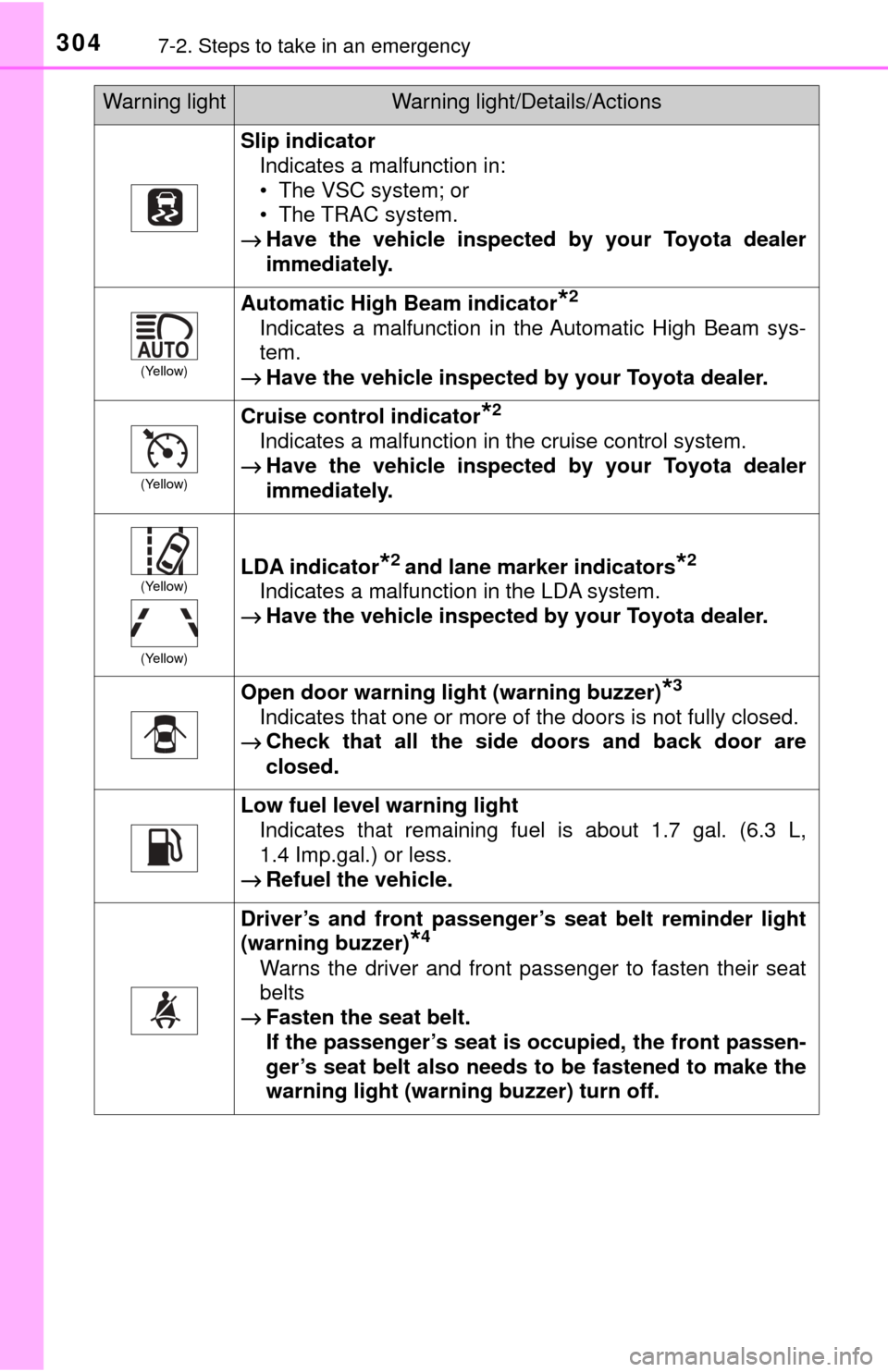
Slip indicatorIndicates a malfunction in:
• The VSC system; or
• The TRAC system.
→ Have the vehicle inspected by your Toyota dealer
immediately.
(Yellow)
Automatic High Beam indicator*2
Indicates a malfunction in the Automatic High Beam sys-
tem.
→ Have the vehicle inspected by your Toyota dealer.
(Yellow)
Cruise control indicator*2
Indicates a malfunction in the cruise control system.
→ Have the vehicle inspected by your Toyota dealer
immediately.
(Yellow)
(Yellow)LDA indicator*2 and lane marker indicators*2
Indicates a malfunction in the LDA system.
→ Have the vehicle inspected by your Toyota dealer.
Open door warning light (warning buzzer)*3
Indicates that one or more of the doors is not fully closed.
→ Check that all the side doors and back door are
closed.
Low fuel level warning light
Indicates that remaining fuel is about 1.7 gal. (6.3 L,
1.4 Imp.gal.) or less.
→ Refuel the vehicle.
Driver’s and front passenger’ s seat belt reminder light
(warning buzzer)
*4
Warns the driver and front passenger to fasten their seat
belts
→ Fasten the seat belt.
If the passenger’s seat is occupied, the front passen-
ger’s seat belt also needs to be fastened to make the
warning light (warning buzzer) turn off.
Warning lightWarning light/Details/Actions
Page 307 of 396
3077-2. Steps to take in an emergency
7
When trouble arises
■SRS warning light
This warning light system monitors the airbag sensor assembly, front impact
sensors, side impact sensors, driver’s seat belt buckle switch, front passen-
ger occupant classification system (ECU and sensors), “AIR BAG ON” indica-
tor, “AIR BAG OFF” indicator, front passenger’s seat belt buckle switch, seat
belt pretensioner assemblies, airbags, interconnecting wiring and power
sources. ( →P. 34)
■ Front passenger detection sensor, passenger seat belt reminder and
warning buzzer
● If luggage is placed on the front passenger seat, the front passenger de\
tec-
tion sensor may cause the warning light to flash and the warning buzzer to
sound even if a passenger is not sitting in the seat.
● If a cushion is placed on the seat, the sensor may not detect a passenger,
and the warning light may not operate properly.
■ Electric power steering system warning light (warning buzzer)
When the battery charge becomes insufficient or the voltage temporarily
drops, the electric power steering system warning light may come on and \
the
warning buzzer may sounds.
■ If the malfunction indicator la mp comes on while driving
First check the following:
● Is the fuel tank empty?
If it is, fill the fuel tank immediately.
● Is the fuel tank cap loose?
If it is, tighten it securely.
The malfunction indicator lamp will go off after several driving trips.
If the malfunction indicator lamp does not go off even after several trips, con-
tact your Toyota dealer as soon as possible.
■
When the tire pressure warning light comes on (vehicles with a tire
pressure warning system)
Check the tire inflation pressure and adjust to the appropriate level. Push-
ing the tire pressure warning reset switch will not turn off the tire pressure
warning light.
Page 310 of 396

3107-2. Steps to take in an emergency
WARNING
■Maintenance of the tire (vehicles with a tire pressure warning sys-
tem)
Each tire, including the spare (if provided), should be checked monthly
when cold and inflated to the inflation pressure recommended by the
vehicle manufacturer on the vehicle placard or tire inflation pressure
label (tire and load information label). (If your vehicle has tires of a dif-
ferent size than the size indicated on the vehicle placard or tire inflation
pressure label [tire and load information label], you should determine
the proper tire inflation pressure for those tires.)
As an added safety feature, your vehicle has been equipped with a tire
pressure monitoring system (TPMS-ti re pressure warning system) that
illuminates a low tire pre ssure telltale (tire pressure warning light) when
one or more of your tires is significantly under-inflated. Accordingly,
when the low tire pressure telltale (tire pressure warning light) illumi-
nates, you should stop and check your tires as soon as possible, and
inflate them to the proper pressure. Driving on a significantly under-
inflated tire causes the tire to overheat and can lead to tire failure.
Under-inflation also reduces fuel effi ciency and tire tread life, and may
affect the vehicle’s hand ling and stopping ability.
Please note that the TPMS (tire pressure warning system) is not a sub-
stitute for proper ti re maintenance, and it is the driver’s responsibility to
maintain correct tire pressure, even if under-inflation has not reached
the level to trigger illumination of the TPMS low tire pressure telltale (tire
pressure warning light).
Page 325 of 396
325
7
When trouble arises
7-2. Steps to take in an emergency
If the engine will not start
One of the following may be the cause of the problem:
●There may not be sufficient fuel in the vehicle’s tank.
Refuel the vehicle.
● The engine may be flooded.
Try to restart the engine again following correct starting procedures.
(→ P. 136)
● Vehicles with engine immobilizer system: There may be a malfunc-
tion in the engine i mmobilizer system. (→ P. 6 7 )
One of the following may be the cause of the problem:
● The battery may be discharged. ( →P. 327)
● The battery terminal connections may be loose or corroded.
If the engine will not start eve n though correct starting proce-
dures are being followed ( →P. 136), consider each of the follow-
ing points:
The engine will not start even though the starter motor operates
normally.
The starter motor turns over slowly, the interior lights and head-
lights are dim, or the horn does not sound or sounds at a low
volume.
Page 340 of 396
3408-1. Specifications
*: The engine oil capacity is a reference quantity to be used when changingthe engine oil. Warm up and turn off the engine, wait more than 5 minutes,
and check the oil level on the dipstick.
■
Engine oil selection
“Toyota Genuine Motor Oil” is us ed in your Toyota vehicle. Use
Toyota approved “Toyota Genuine Motor Oil” or equivalent to satisfy
the following grade and viscosity.
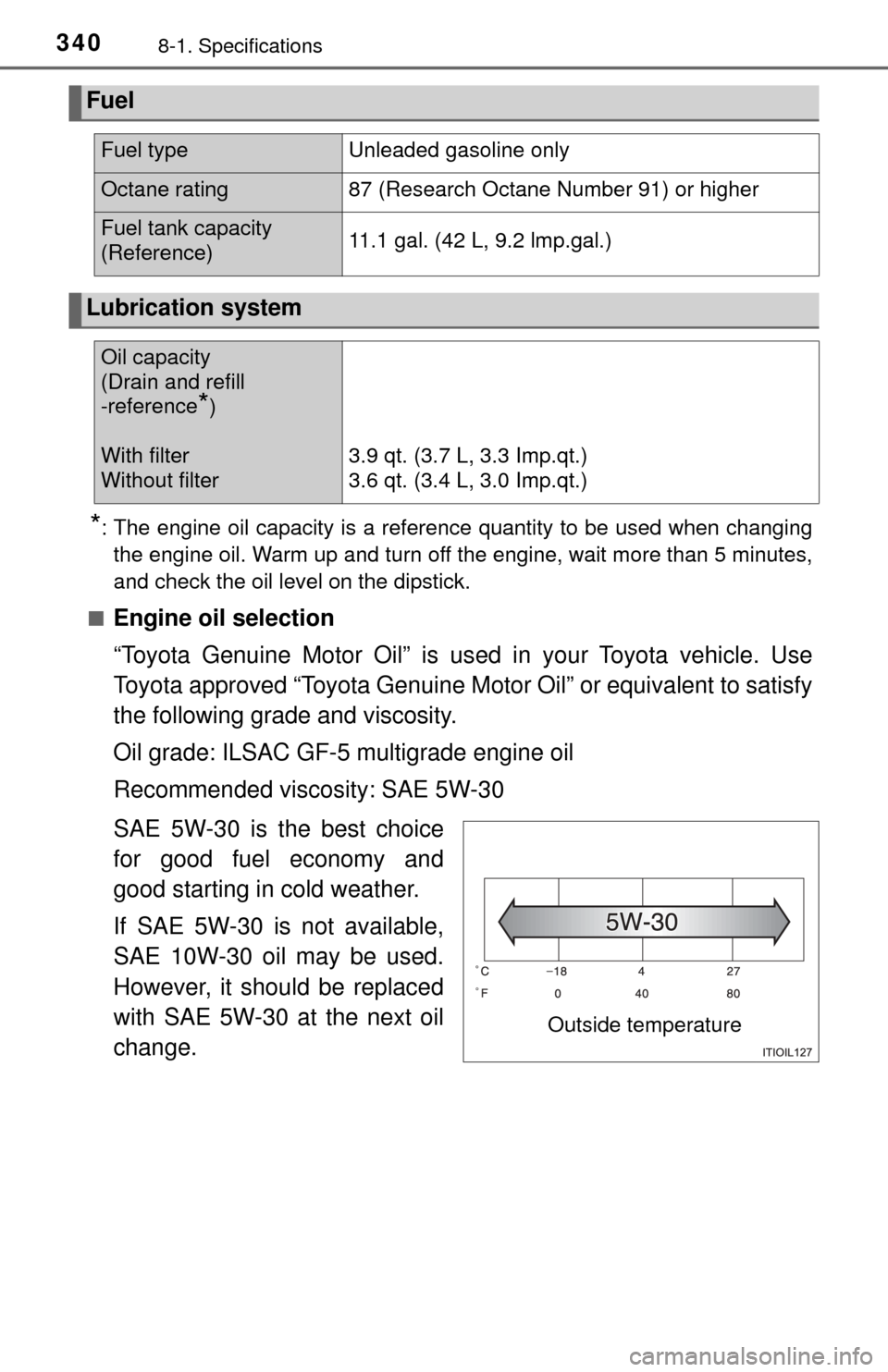
Oil grade: ILSAC GF-5 multigrade engine oil
Recommended viscosity: SAE 5W-30
SAE 5W-30 is the best choice
for good fuel economy and
good starting in cold weather.
If SAE 5W-30 is not available,
SAE 10W-30 oil may be used.
However, it should be replaced
with SAE 5W-30 at the next oil
change.
Fuel
Fuel typeUnleaded gasoline only
Octane rating87 (Research Octane Number 91) or higher
Fuel tank capacity
(Reference)11.1 gal. (42 L, 9.2 lmp.gal.)
Lubrication system
Oil capacity
(Drain and refill
-reference
*)
With filter
Without filter 3.9 qt. (3.7 L, 3.3 Imp.qt.)
3.6 qt. (3.4 L, 3.0 Imp.qt.)
Outside temperature
Page 347 of 396
3478-1. Specifications
8
Vehicle specifications
Fuel information
■Gasoline quality
In very few cases, driveability problems may be caused by the brand of gaso-
line you are using. If driveability problems persist, try changing the brand of
gasoline. If this does not correct the problem, consult your Toyota dealer.
■ Gasoline quality standards
●Automotive manufacturers in the U.S.A., Europe and Japan have developed
a specification for fuel quality called World-Wide Fuel Charter (WWFC),
which is expected to be applied worldwide.
● The WWFC consists of four categor ies that are based on required emission
levels. In the U.S., category 4 has been adopted.
● The WWFC improves air quality by lowering emissions in vehicle fleets, and
improves customer satisfaction through better performance.
■ Recommendation of the use of gaso line containing detergent additives
● Toyota recommends the use of gasoline that contains detergent additives to
avoid the build-up of engine deposits.
● All gasoline sold in the U.S.A. contains minimum detergent additives to
clean and/or keep clean intake systems, per EPA’s lowest additives concen-
tration program.
● Toyota strongly recommends the use of Top Tier Detergent Gasoline. For
more information on Top Tier Detergent Gasoline and a list of marketers,
please go to the official website www.toptiergas.com.
You must only use unleaded gasoline.
Select octane rating 87 (Research Octane Number 91) or higher.
Use of unleaded gasoline with an octane rating lower than 87
may result in engine knocking. Persistent knocking can lead to
engine damage.
At minimum, the gasoline you use s hould meet the specifications of
ASTM D4814 in the U.S.A..
Page 348 of 396
3488-1. Specifications
■Recommendation of the use of low emissions gasoline
Gasolines containing oxygenates such as ethers and ethanol, as well as
reformulated gasolines, are available in some cities. These fuels are typically
acceptable for use, providing they meet other fuel requirements.
Toyota recommends these fuels, since the formulations allow for reduced
vehicle emissions.
■ Non-recommendation of the use of blended gasoline
●If you use gasohol in your vehicle, be sure that it has an octane rating no
lower than 87.
● Toyota does not recommend the use of gasoline containing methanol.
■ Non-recommendation of the use of gasoline containing MMT
Some gasoline contains an octane enhancing additive called MMT (Methylcy-
clopentadienyl Manganese Tricarbonyl).
Toyota does not recommend the use of gasoline that contains MMT. If fuel
containing MMT is used, your emission control system may be adversely
affected.
The malfunction indicator lamp on the instrument cluster may come on. If this
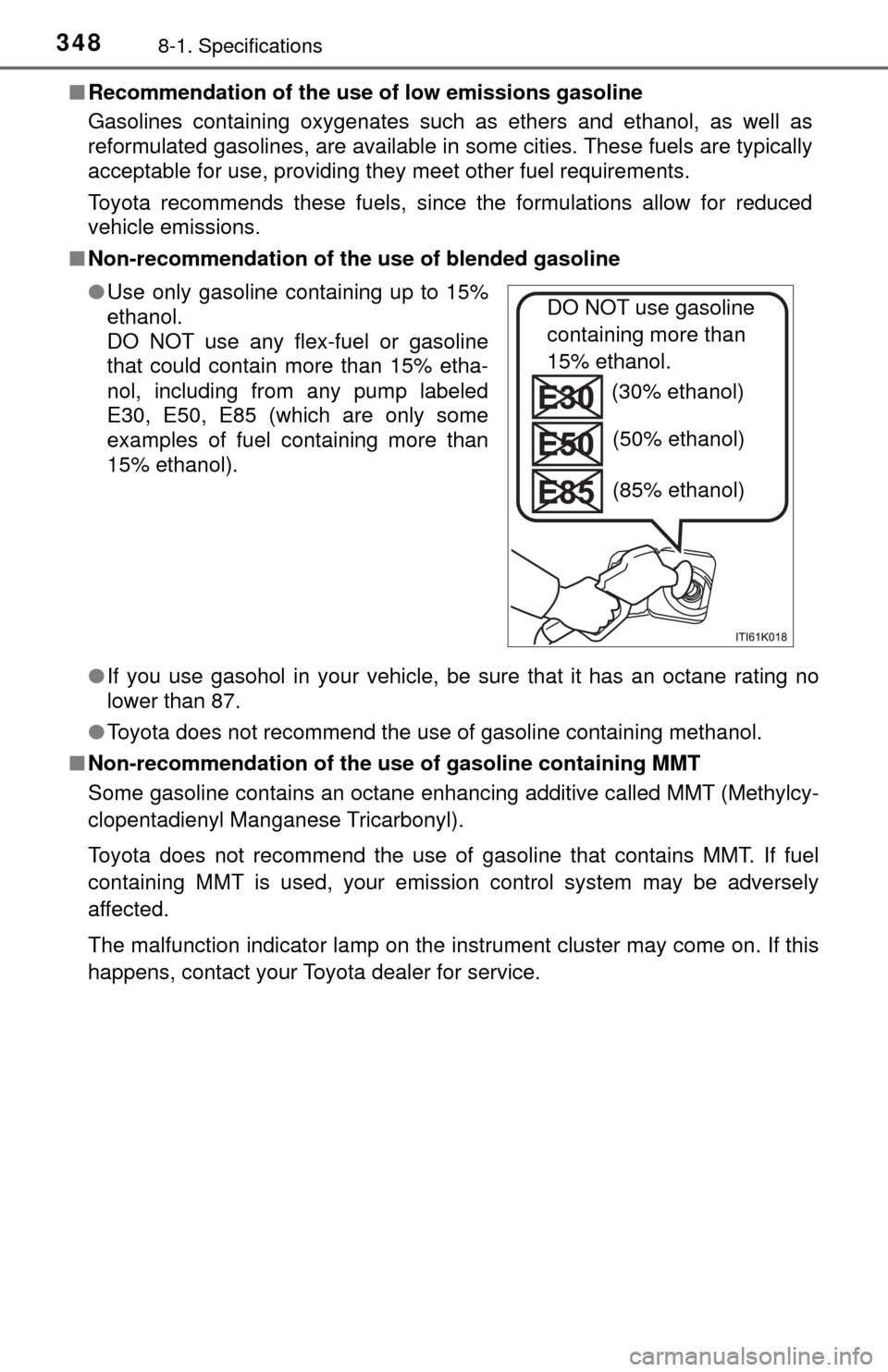
happens, contact your Toyota dealer for service. ● Use only gasoline containing up to 15%
ethanol.
DO NOT use any flex-fuel or gasoline
that could contain more than 15% etha-
nol, including from any pump labeled
E30, E50, E85 (which are only some
examples of fuel containing more than
15% ethanol).
DO NOT use gasoline
containing more than
15% ethanol.
(30% ethanol)
(50% ethanol)
(85% ethanol)
Page 349 of 396
3498-1. Specifications
8
Vehicle specifications
■If your engine knocks
●Consult your Toyota dealer.
● You may occasionally notice light knocking for a short time while accelerat-
ing or driving uphill. This is normal and there is no need for concern.
NOTICE
■Notice on fuel quality
● Do not use improper fuels. If improper fuels are used, the engine will be
damaged.
● Do not use leaded gasoline.
Leaded gasoline can cause damage to your vehicle’s three-way catalytic
converters causing the emission control system to malfunction.
● Do not use gasohol other than the type previously stated.
Other gasohol may cause fuel system damage or vehicle performance
problems.
● Using unleaded gasoline with an octane number or rating lower than the
level previously stated will cause persistent heavy knocking.
At worst, this will lead to engine damage.
■ Fuel-related poor driveability
If poor driveability (poor hot starting, vaporization, engine knocking, etc.) is
encountered after using a different type of fuel, discontinue the use of that
type of fuel.
■ When refueling with gasohol
Take care not to spill gasohol. It can damage your vehicle’s paint.