Sound TOYOTA YARIS 2017 3.G Owner's Manual
[x] Cancel search | Manufacturer: TOYOTA, Model Year: 2017, Model line: YARIS, Model: TOYOTA YARIS 2017 3.GPages: 396, PDF Size: 7.08 MB
Page 287 of 396
2876-3. Do-it-yourself maintenance
6
Maintenance and care
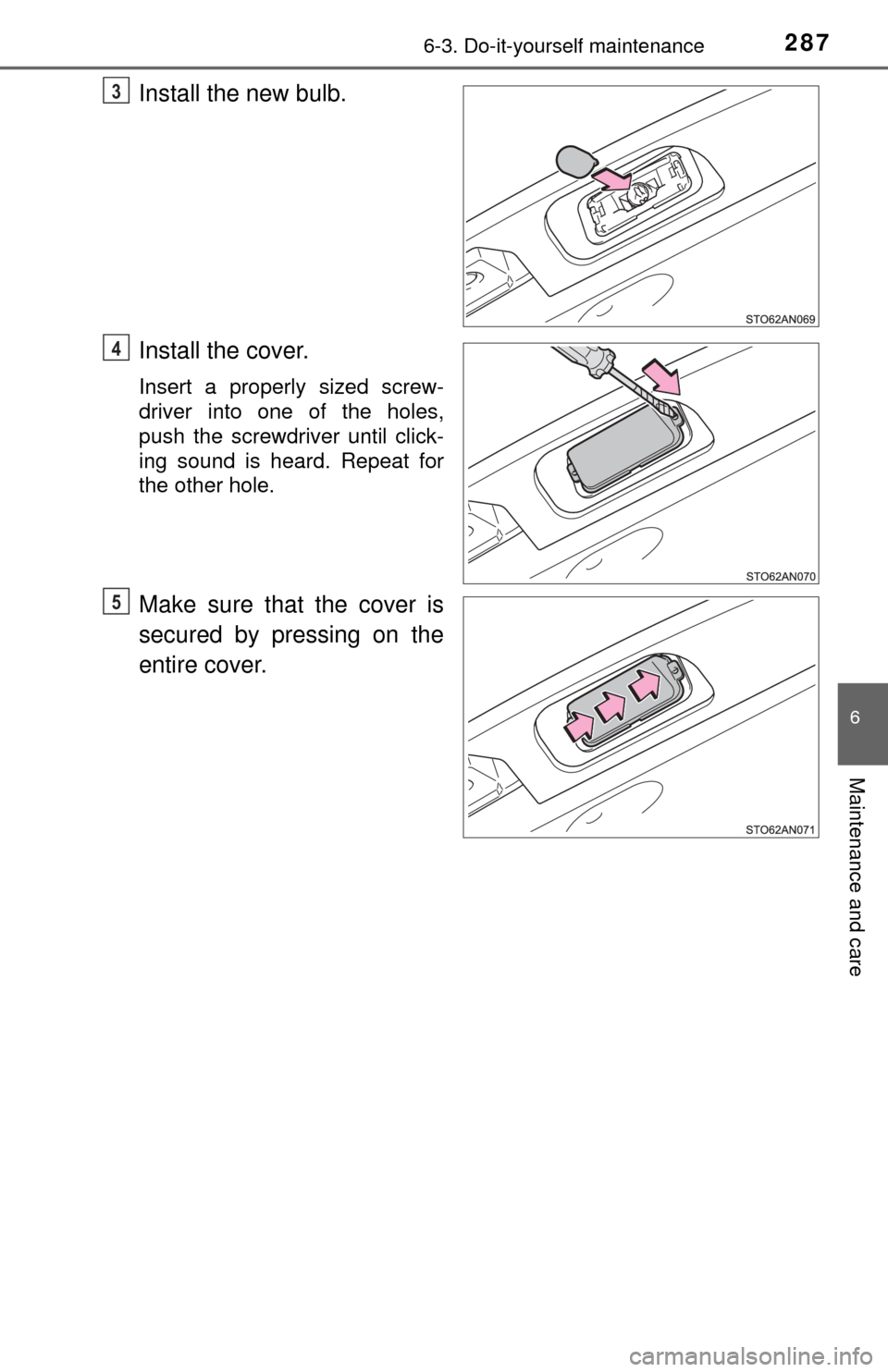
Install the new bulb.
Install the cover.
Insert a properly sized screw-
driver into one of the holes,
push the screwdriver until click-
ing sound is heard. Repeat for
the other hole.
Make sure that the cover is
secured by pressing on the
entire cover.
3
4
5
Page 291 of 396

291
7When trouble arises
7-1. Essential informationEmergency flashers .......... 292
If your vehicle has to be stopped in
an emergency ................. 293
7-2. Steps to take in an emergency
If your vehicle needs to be towed ......................... 295
If you think something is wrong .............................. 300
Fuel pump shut off system ............................ 301
If a warning light turns on or a warning buzzer
sounds ............................ 302
If you have a flat tire.......... 312
If the engine will not start .. 325
If the vehicle battery is discharged ...................... 327
If your vehicle overheats ... 330
If the vehicle becomes stuck ............................... 333
Page 295 of 396
295
7
When trouble arises
7-2. Steps to take in an emergency
If your vehicle needs to be towed
The following may indicate a problem with your transmission. Contact
your Toyota dealer or commercial towing service before towing.
● The engine is running but the vehicle does not move.
● The vehicle makes an abnormal sound.
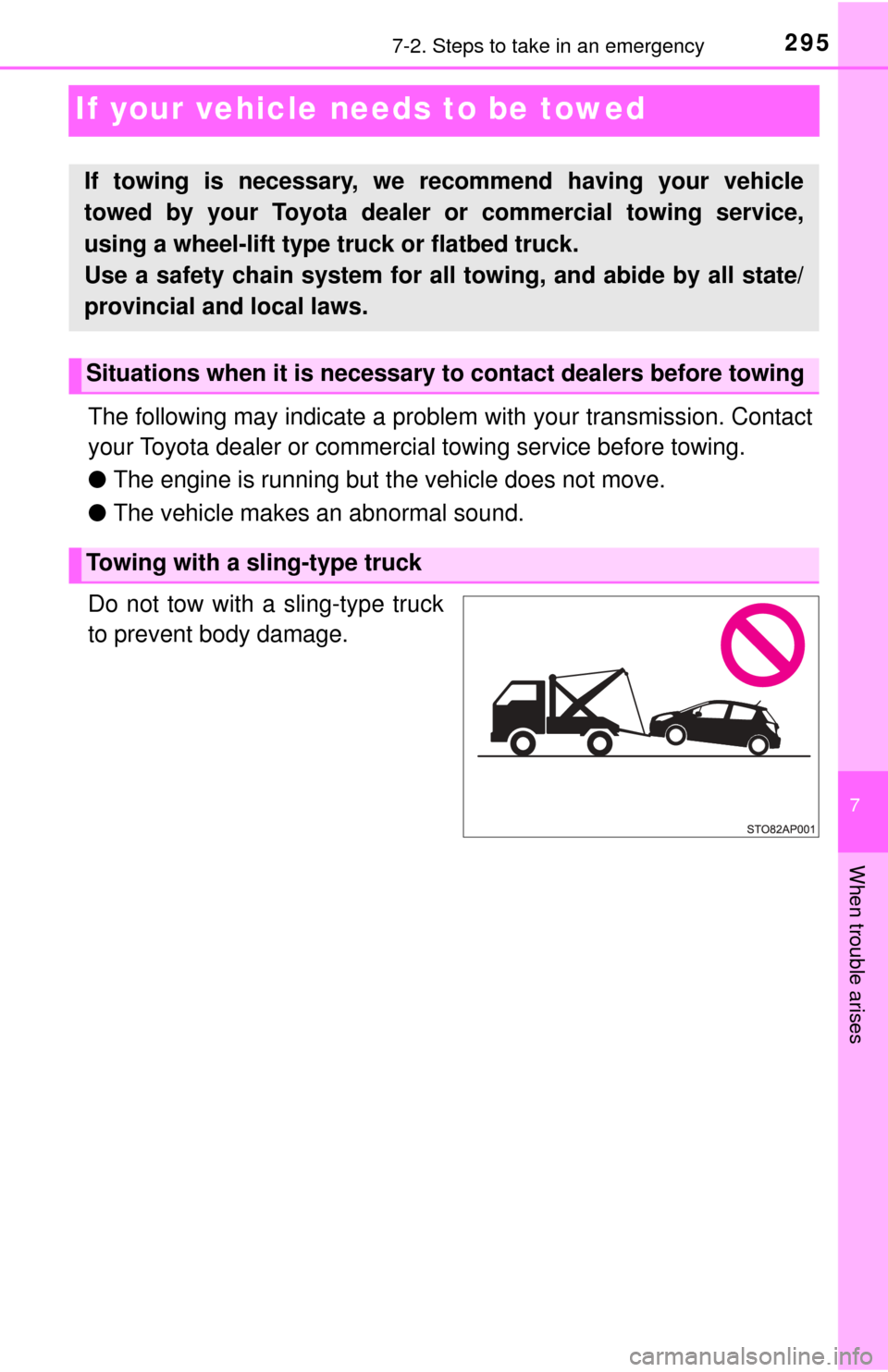
Do not tow with a sling-type truck
to prevent body damage.
If towing is necessary, we re commend having your vehicle
towed by your Toyota dealer or commercial towing service,
using a wheel-lift type truck or flatbed truck.
Use a safety chain system for all towing, and abide by all state/
provincial and local laws.
Situations when it is necessary to contact dealers before towing
Towing with a sling-type truck
Page 300 of 396
3007-2. Steps to take in an emergency
If you think something is wrong
●Fluid leaks under the vehicle
(Water dripping from the air conditioning after use is normal)
● Flat-looking tires or uneven tire wear
● High engine coolant temperature warning light flashes or comes on
● Low engine coolant temperature indicator comes on or does not
come on continuously
● Changes in exhaust sound
● Excessive tire squeal when cornering
● Strange noises related to the suspension system
● Pinging or other noises related to the engine
● Engine misfire, stumbling or running roughly
● Appreciable loss of power
● Vehicle pulls heavily to one side when braking
● Vehicle pulls heavily to one side when driving on a level road
● Loss of brake effectiveness, spon gy feeling, pedal almost touches
the floor
If you notice any of the follow ing symptoms, your vehicle proba-
bly needs adjustment or repair. Contact your Toyota dealer as
soon as possible.
Visible symptoms
Audible symptoms
Operational symptoms
Page 302 of 396
3027-2. Steps to take in an emergency
If a warning light turns on or a warning
buzzer sounds
Calmly perform the following actions if any of the warning lights
comes on or flashes. If a light comes on or flashes, but then
goes off, this does not necessarily indicate a malfunction in the
system. However, if this continues to occur, have the vehicle
inspected by your Toyota dealer.
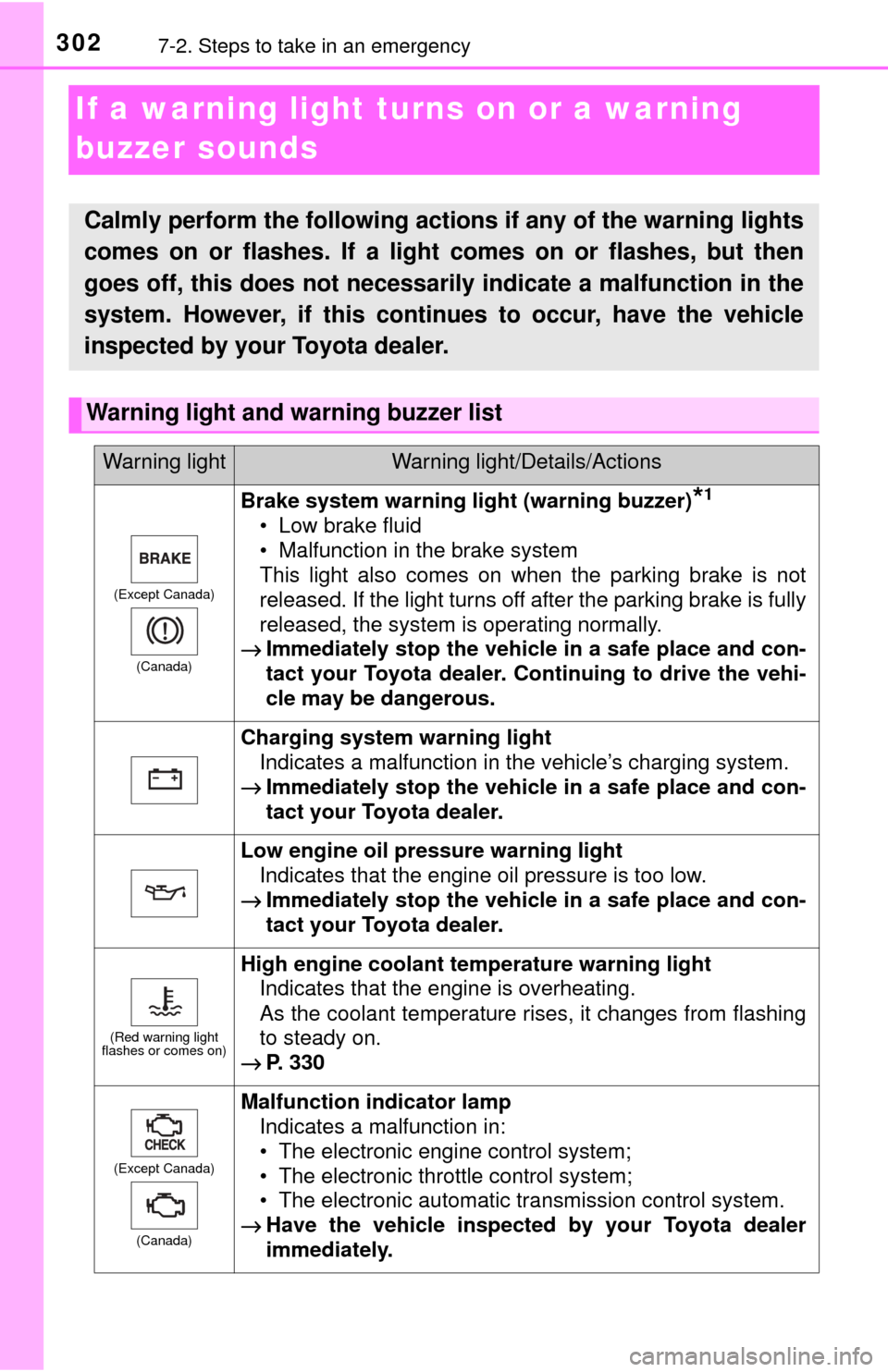
Warning light and warning buzzer list
Warning lightWarning light/Details/Actions
(Except Canada)
(Canada)
Brake system warning light (warning buzzer)*1
• Low brake fluid
• Malfunction in the brake system
This light also comes on when the parking brake is not
released. If the light turns off after the parking brake is fully
released, the system is operating normally.
→ Immediately stop the vehicle in a safe place and con-
tact your Toyota dealer. Continuing to drive the vehi-
cle may be dangerous.
Charging system warning light
Indicates a malfunction in the vehicle’s charging system.
→ Immediately stop the vehicle in a safe place and con-
tact your Toyota dealer.
Low engine oil pressure warning light
Indicates that the engine oil pressure is too low.
→ Immediately stop the vehicle in a safe place and con-
tact your Toyota dealer.
(Red warning light
flashes or comes on)
High engine coolant temperature warning light
Indicates that the engine is overheating.
As the coolant temperature rises, it changes from flashing
to steady on.
→ P. 330
(Except Canada)
(Canada)
Malfunction indicator lampIndicates a malfunction in:
• The electronic engine control system;
• The electronic throttle control system;
• The electronic automatic transmission control system.
→ Have the vehicle inspected by your Toyota dealer
immediately.
Page 303 of 396
3037-2. Steps to take in an emergency
7
When trouble arises
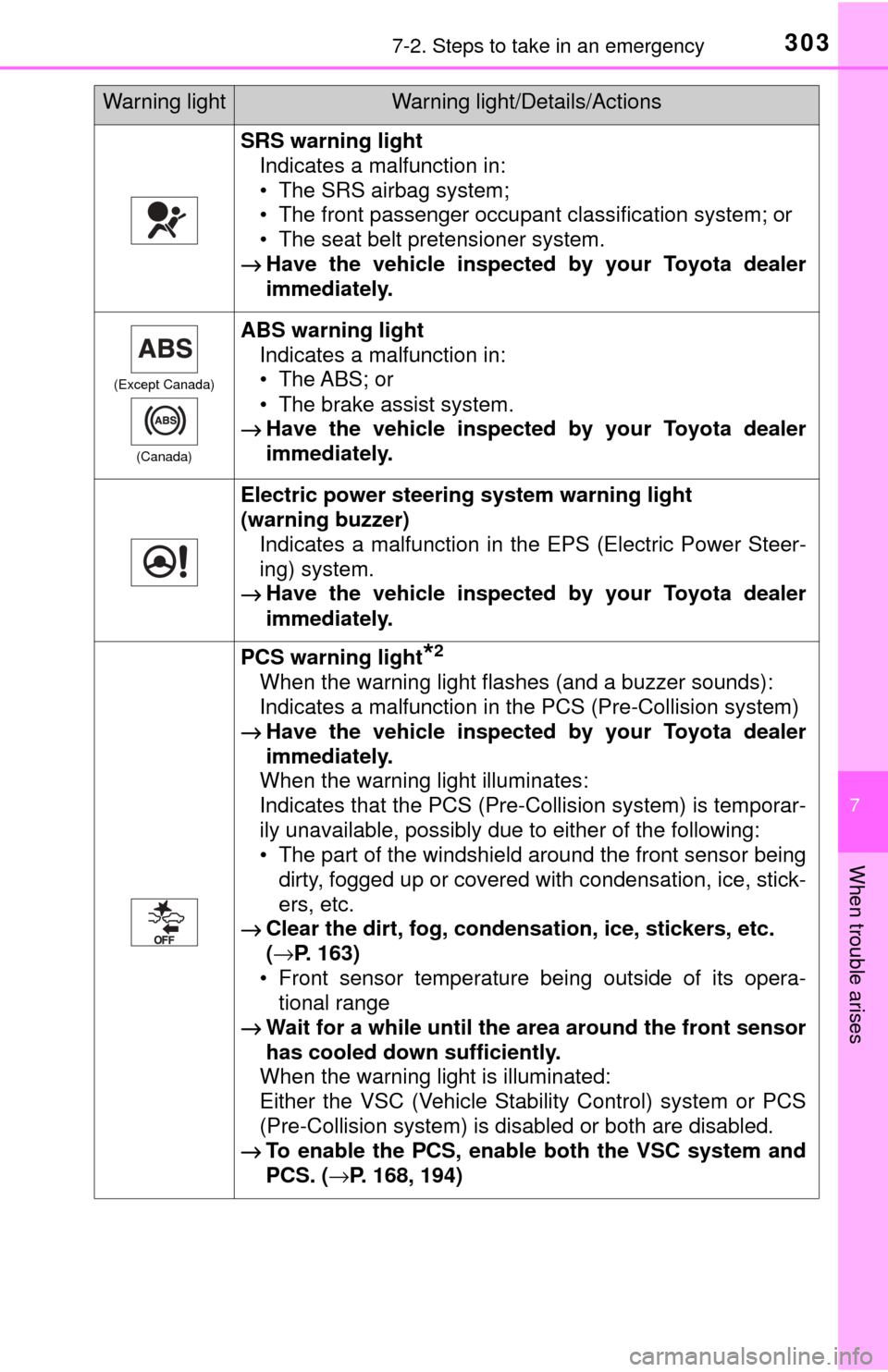
SRS warning lightIndicates a malfunction in:
• The SRS airbag system;
• The front passenger occupant classification system; or
• The seat belt pretensioner system.
→ Have the vehicle inspected by your Toyota dealer
immediately.
(Except Canada)
(Canada)
ABS warning lightIndicates a malfunction in:
• The ABS; or
• The brake assist system.
→ Have the vehicle inspected by your Toyota dealer
immediately.
Electric power steering system warning light
(warning buzzer)
Indicates a malfunction in the EPS (Electric Power Steer-
ing) system.
→ Have the vehicle inspected by your Toyota dealer
immediately.
PCS warning light*2
When the warning light flashes (and a buzzer sounds):
Indicates a malfunction in the PCS (Pre-Collision system)
→ Have the vehicle inspected by your Toyota dealer
immediately.
When the warning light illuminates:
Indicates that the PCS (Pre-Collision system) is temporar-
ily unavailable, possibly due to either of the following:
• The part of the windshield around the front sensor being dirty, fogged up or covered with condensation, ice, stick-
ers, etc.
→ Clear the dirt, fog, condensat ion, ice, stickers, etc.
( →P. 163)
• Front sensor temperature being outside of its opera- tional range
→ Wait for a while until the area around the front sensor
has cooled down sufficiently.
When the warning light is illuminated:
Either the VSC (Vehicle Stability Control) system or PCS
(Pre-Collision system) is disabled or both are disabled.
→ To enable the PCS, enable both the VSC system and
PCS. ( →P. 168, 194)
Warning lightWarning light/Details/Actions
Page 306 of 396
3067-2. Steps to take in an emergency
*1: Parking brake engaged warning buzzer: The buzzer sounds to indicate that the parking brake is still engaged (with
the vehicle having reached a speed of 3 mph [5 km/h]).
*2: If equipped
*3: Open door warning buzzer: A buzzer will sound if the vehicle reaches a speed of 3 mph (5 km/h) or
more with any door open.
*4: Driver’s and front passenger’s seat belt buzzer: The driver’s and passenger’s seat belt buzzer sounds to alert the driver
and front passenger that his or her seat belt is not fastened. Once the
engine switch is turned to the “ON” or “START” position, the buzzer sounds
for 6 seconds. The buzzer sounds once if the driver’s or front passenger’s
seat belt is unfastened when the vehicle reaches a speed of 12 mph
(20 km/h). Then, if the seat belt is still unfastened after 30 seconds elapse,
the buzzer will sound intermittently for approximately 10 seconds, followed
by a different tone for approximately 20 more seconds.
*5: Refer to the separate “Scheduled Maintenance Guide” or “Owner’s ManualSupplement” for the maintenance interval applicable to your vehicle.
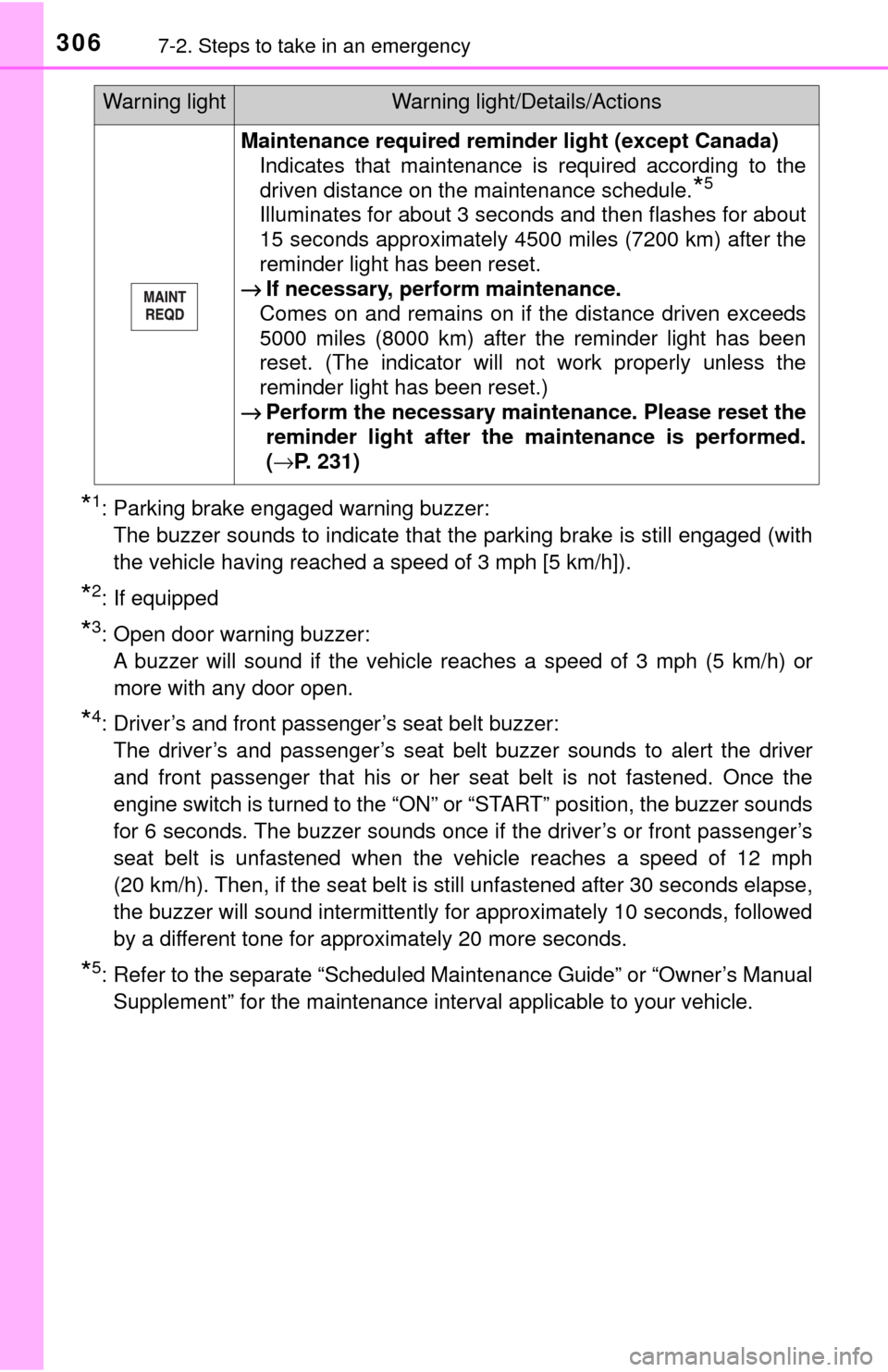
Maintenance required reminder light (except Canada) Indicates that maintenance is required according to the
driven distance on the maintenance schedule.
*5
Illuminates for about 3 seconds and then flashes for about
15 seconds approximately 4500 miles (7200 km) after the
reminder light has been reset.
→ If necessary, perform maintenance.
Comes on and remains on if the distance driven exceeds
5000 miles (8000 km) after the reminder light has been
reset. (The indicator will not work properly unless the
reminder light has been reset.)
→ Perform the necessary maintenance. Please reset the
reminder light after the maintenance is performed.
(→P. 231)
Warning lightWarning light/Details/Actions
Page 307 of 396
3077-2. Steps to take in an emergency
7
When trouble arises
■SRS warning light
This warning light system monitors the airbag sensor assembly, front impact
sensors, side impact sensors, driver’s seat belt buckle switch, front passen-
ger occupant classification system (ECU and sensors), “AIR BAG ON” indica-
tor, “AIR BAG OFF” indicator, front passenger’s seat belt buckle switch, seat
belt pretensioner assemblies, airbags, interconnecting wiring and power
sources. ( →P. 34)
■ Front passenger detection sensor, passenger seat belt reminder and
warning buzzer
● If luggage is placed on the front passenger seat, the front passenger de\
tec-
tion sensor may cause the warning light to flash and the warning buzzer to
sound even if a passenger is not sitting in the seat.
● If a cushion is placed on the seat, the sensor may not detect a passenger,
and the warning light may not operate properly.
■ Electric power steering system warning light (warning buzzer)
When the battery charge becomes insufficient or the voltage temporarily
drops, the electric power steering system warning light may come on and \
the
warning buzzer may sounds.
■ If the malfunction indicator la mp comes on while driving
First check the following:
● Is the fuel tank empty?
If it is, fill the fuel tank immediately.
● Is the fuel tank cap loose?
If it is, tighten it securely.
The malfunction indicator lamp will go off after several driving trips.
If the malfunction indicator lamp does not go off even after several trips, con-
tact your Toyota dealer as soon as possible.
■
When the tire pressure warning light comes on (vehicles with a tire
pressure warning system)
Check the tire inflation pressure and adjust to the appropriate level. Push-
ing the tire pressure warning reset switch will not turn off the tire pressure
warning light.
Page 325 of 396
325
7
When trouble arises
7-2. Steps to take in an emergency
If the engine will not start
One of the following may be the cause of the problem:
●There may not be sufficient fuel in the vehicle’s tank.
Refuel the vehicle.
● The engine may be flooded.
Try to restart the engine again following correct starting procedures.
(→ P. 136)
● Vehicles with engine immobilizer system: There may be a malfunc-
tion in the engine i mmobilizer system. (→ P. 6 7 )
One of the following may be the cause of the problem:
● The battery may be discharged. ( →P. 327)
● The battery terminal connections may be loose or corroded.
If the engine will not start eve n though correct starting proce-
dures are being followed ( →P. 136), consider each of the follow-
ing points:
The engine will not start even though the starter motor operates
normally.
The starter motor turns over slowly, the interior lights and head-
lights are dim, or the horn does not sound or sounds at a low
volume.
Page 326 of 396
3267-2. Steps to take in an emergency
One of the following may be the cause of the problem:
●One or both of the battery terminals may be disconnected.
● The battery may be discharged. ( →P. 327)
● There may be a malfunction in the steering lock system (vehicles
with a smart entry & start system).
Contact your Toyota dealer if the problem cannot be repaired, or if repair
procedures are unknown.
The starter motor does not turn over, the interior lights and head-
lights do not turn on, or the horn does not sound.