Buzzer TOYOTA YARIS 2017 3.G Owners Manual
[x] Cancel search | Manufacturer: TOYOTA, Model Year: 2017, Model line: YARIS, Model: TOYOTA YARIS 2017 3.GPages: 396, PDF Size: 7.08 MB
Page 4 of 396

TABLE OF CONTENTS4
6-1. Maintenance and careCleaning and protecting the vehicle exterior .......... 224
Cleaning and protecting the vehicle interior ........... 227
6-2. Maintenance Maintenance requirements ................... 230
General maintenance ........ 232
Emission inspection and maintenance (I/M)
programs ......................... 235
6-3. Do-it-yourself maintenance Do-it-yourself service precautions ..................... 236
Hood.................................. 239
Positioning a floor jack ...... 241
Engine compartment ......... 243
Tires .................................. 253
Tire inflation pressure........ 261
Wheels .............................. 265
Air conditioning filter .......... 268
Wireless remote control battery ............................. 270
Checking and replacing fuses ............................... 273
Light bulbs ......................... 278 7-1. Essential information
Emergency flashers ........... 292
If your vehicle has to be stopped in
an emergency.................. 293
7-2. Steps to take in an emergency
If your vehicle needs to be towed .......................... 295
If you think something is wrong............................... 300
Fuel pump shut off system ............................. 301
If a warning light turns on or a warning buzzer
sounds ............................. 302
If you have a flat tire .......... 312
If the engine will not start ... 325
If the vehicle battery is discharged ....................... 327
If your vehicle overheats.... 330
If the vehicle becomes stuck ................................ 333
6Maintenance and care7When trouble arises
Page 15 of 396
15Pictorial index
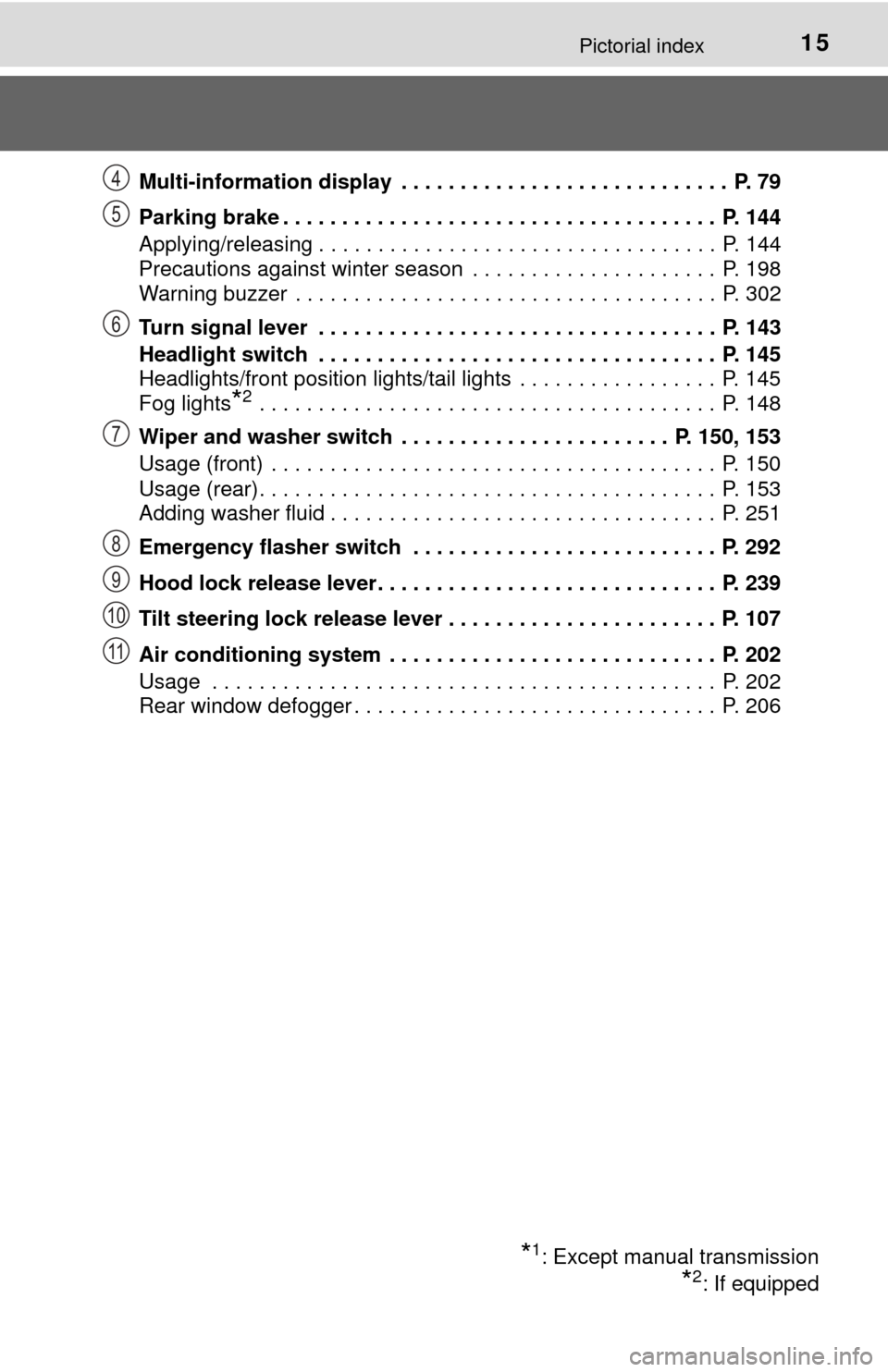
Multi-information display . . . . . . . . . . . . . . . . . . . . . . . . . . . . P. 79
Parking brake . . . . . . . . . . . . . . . . . . . . . . . . . . . . . . . . . . . . . P. 144
Applying/releasing . . . . . . . . . . . . . . . . . . . . . . . . . . . . . . . . . . P. 144
Precautions against winter season . . . . . . . . . . . . . . . . . . . . . P. 198
Warning buzzer . . . . . . . . . . . . . . . . . . . . . . . . . . . . . . . . . . . . P. 302
Turn signal lever . . . . . . . . . . . . . . . . . . . . . . . . . . . . . . . . . . P. 143
Headlight switch . . . . . . . . . . . . . . . . . . . . . . . . . . . . . . . . . . P. 145
Headlights/front position lights/tail lights . . . . . . . . . . . . . . . . . P. 145
Fog lights
*2 . . . . . . . . . . . . . . . . . . . . . . . . . . . . . . . . . . . . . . . P. 148
Wiper and washer switch . . . . . . . . . . . . . . . . . . . . . . . P. 150, 153
Usage (front) . . . . . . . . . . . . . . . . . . . . . . . . . . . . . . . . . . . . . . P. 150
Usage (rear) . . . . . . . . . . . . . . . . . . . . . . . . . . . . . . . . . . . . . . . P. 153
Adding washer fluid . . . . . . . . . . . . . . . . . . . . . . . . . . . . . . . . . P. 251
Emergency flasher switch . . . . . . . . . . . . . . . . . . . . . . . . . . P. 292
Hood lock release lever. . . . . . . . . . . . . . . . . . . . . . . . . . . . . P. 239
Tilt steering lock release lever . . . . . . . . . . . . . . . . . . . . . . . P. 107
Air conditioning system . . . . . . . . . . . . . . . . . . . . . . . . . . . . P. 202
Usage . . . . . . . . . . . . . . . . . . . . . . . . . . . . . . . . . . . . . . . . . . . P. 202
Rear window defogger . . . . . . . . . . . . . . . . . . . . . . . . . . . . . . . P. 206
*1: Except manual transmission
*2: If equipped
4
5
6
7
8
9
10
11
Page 137 of 396
1374-2. Driving procedures
4
Driving
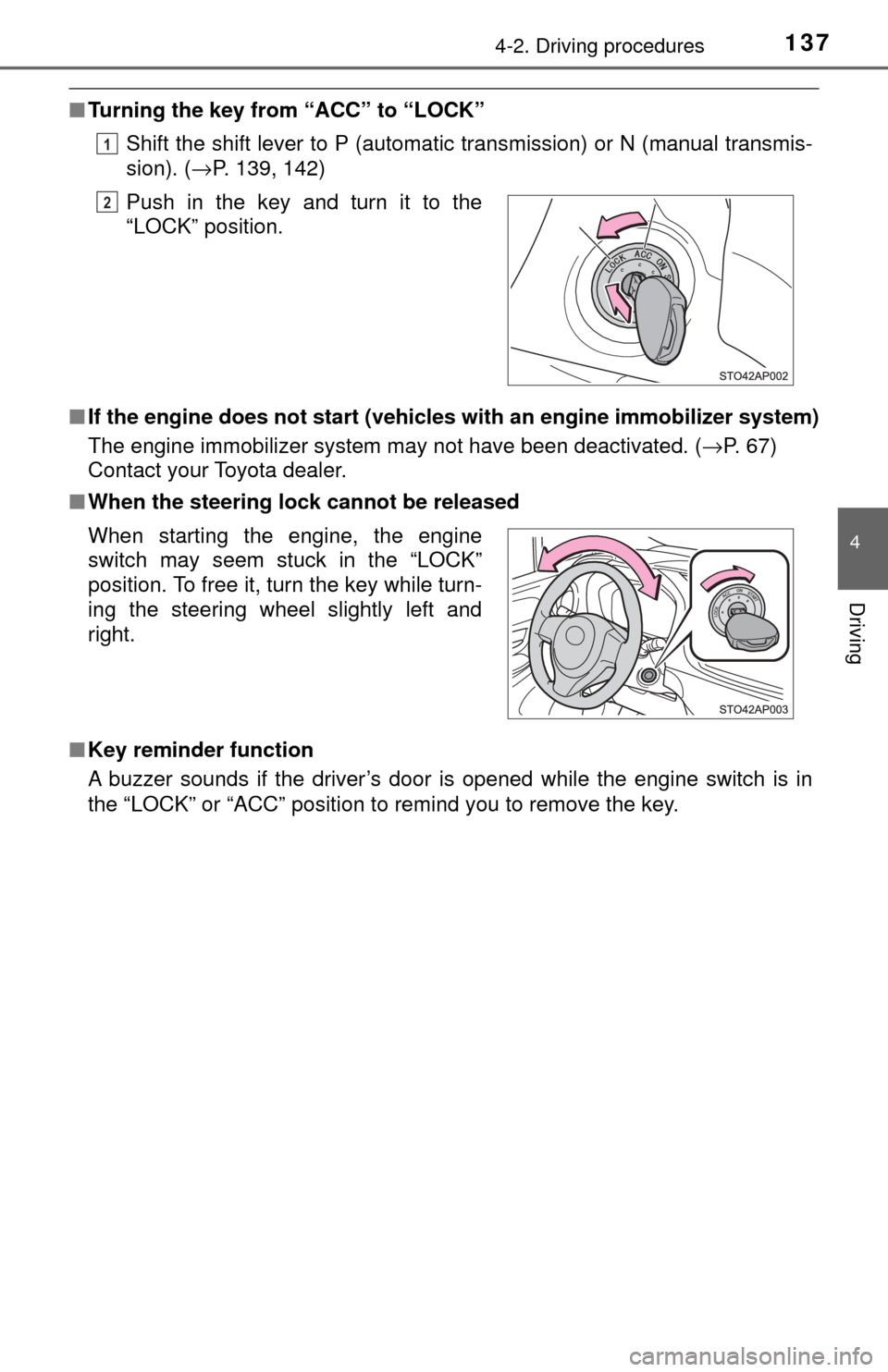
■Turning the key from “ACC” to “LOCK”
Shift the shift lever to P (automatic transmission) or N (manual transmis-
sion). ( →P. 139, 142)
■ If the engine does not start (vehicl es with an engine immobilizer system)
The engine immobilizer system may not have been deactivated. ( →P. 67)
Contact your Toyota dealer.
■ When the steering lock cannot be released
■ Key reminder function
A buzzer sounds if the driver’s door is opened while the engine switch is in
the “LOCK” or “ACC” position to remind you to remove the key. Push in the key and turn it to the
“LOCK” position.
When starting the engine, the engine
switch may seem stuck in the “LOCK”
position. To free it, turn the key while turn-
ing the steering wheel slightly left and
right.
1
2
Page 147 of 396
1474-3. Operating the lights and wipers
4
Driving
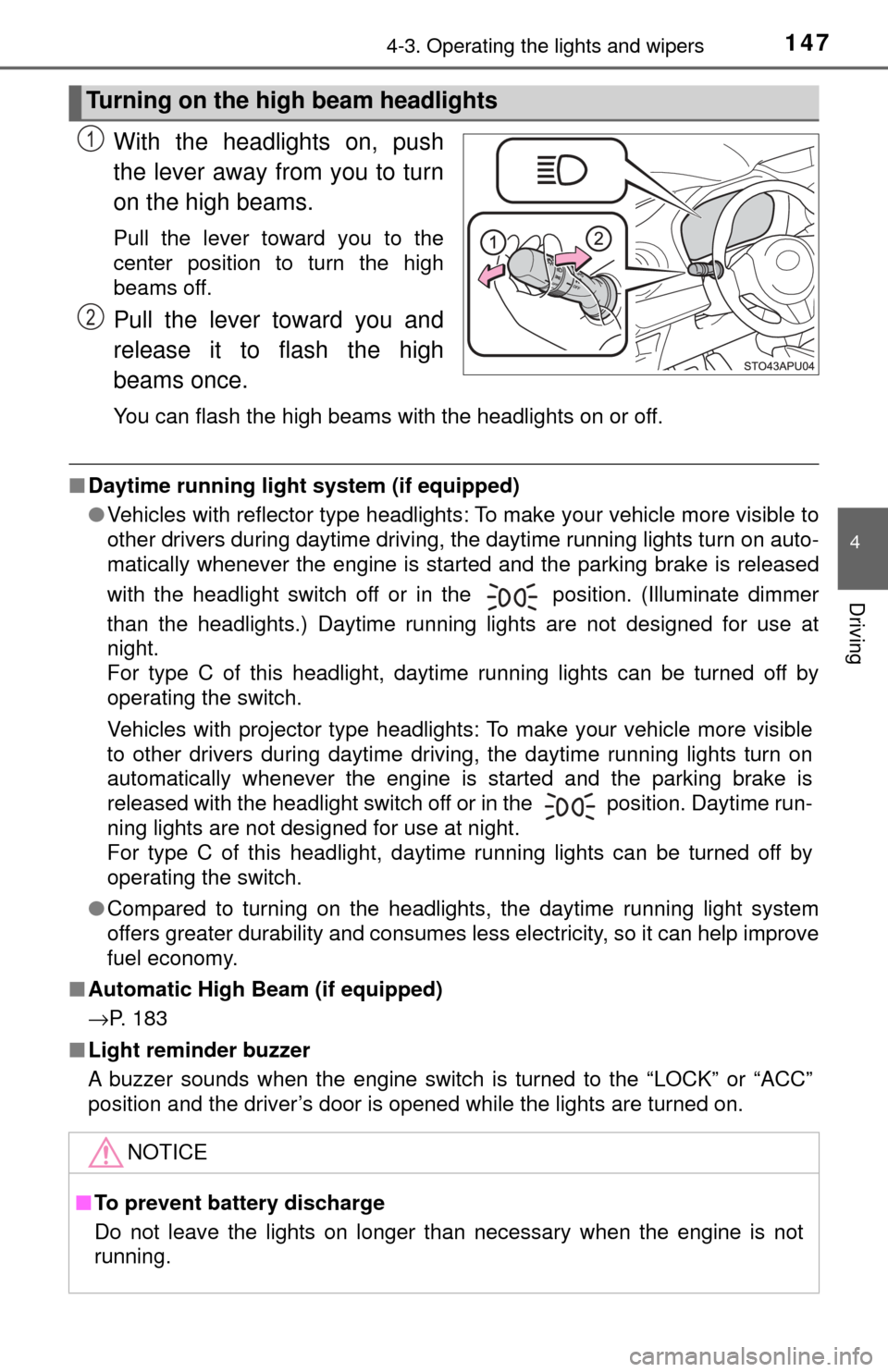
With the headlights on, push
the lever away from you to turn
on the high beams.
Pull the lever toward you to the
center position to turn the high
beams off.
Pull the lever toward you and
release it to flash the high
beams once.
You can flash the high beams with the headlights on or off.
■Daytime running light system (if equipped)
●Vehicles with reflector type headlights: To make your vehicle more visible to
other drivers during daytime driving, the daytime running lights turn on auto-
matically whenever the engine is started and the parking brake is released
with the headlight switch off or in the position. (Illuminate dimmer
than the headlights.) Daytime running lights are not designed for use at
night.
For type C of this headlight, daytime running lights can be turned off by
operating the switch.
Vehicles with projector type headlights: To make your vehicle more visible
to other drivers during daytime driving, the daytime running lights turn on
automatically whenever the engine is started and the parking brake is
released with the headlight switch off or in the position. Daytime run-
ning lights are not designed for use at night.
For type C of this headlight, daytime running lights can be turned off by
operating the switch.
● Compared to turning on the headlights, the daytime running light system
offers greater durability and consumes less electricity, so it can help improve
fuel economy.
■ Automatic High Beam (if equipped)
→P. 183
■ Light reminder buzzer
A buzzer sounds when the engine switch is turned to the “LOCK” or “ACC”
position and the driver’s door is opened while the lights are turned on.
Turning on the high beam headlights
1
2
NOTICE
■To prevent battery discharge
Do not leave the lights on longer than necessary when the engine is not
running.
Page 165 of 396
1654-5. Toyota Safety Sense C
4
Driving
PCS (Pre-Collision system)∗
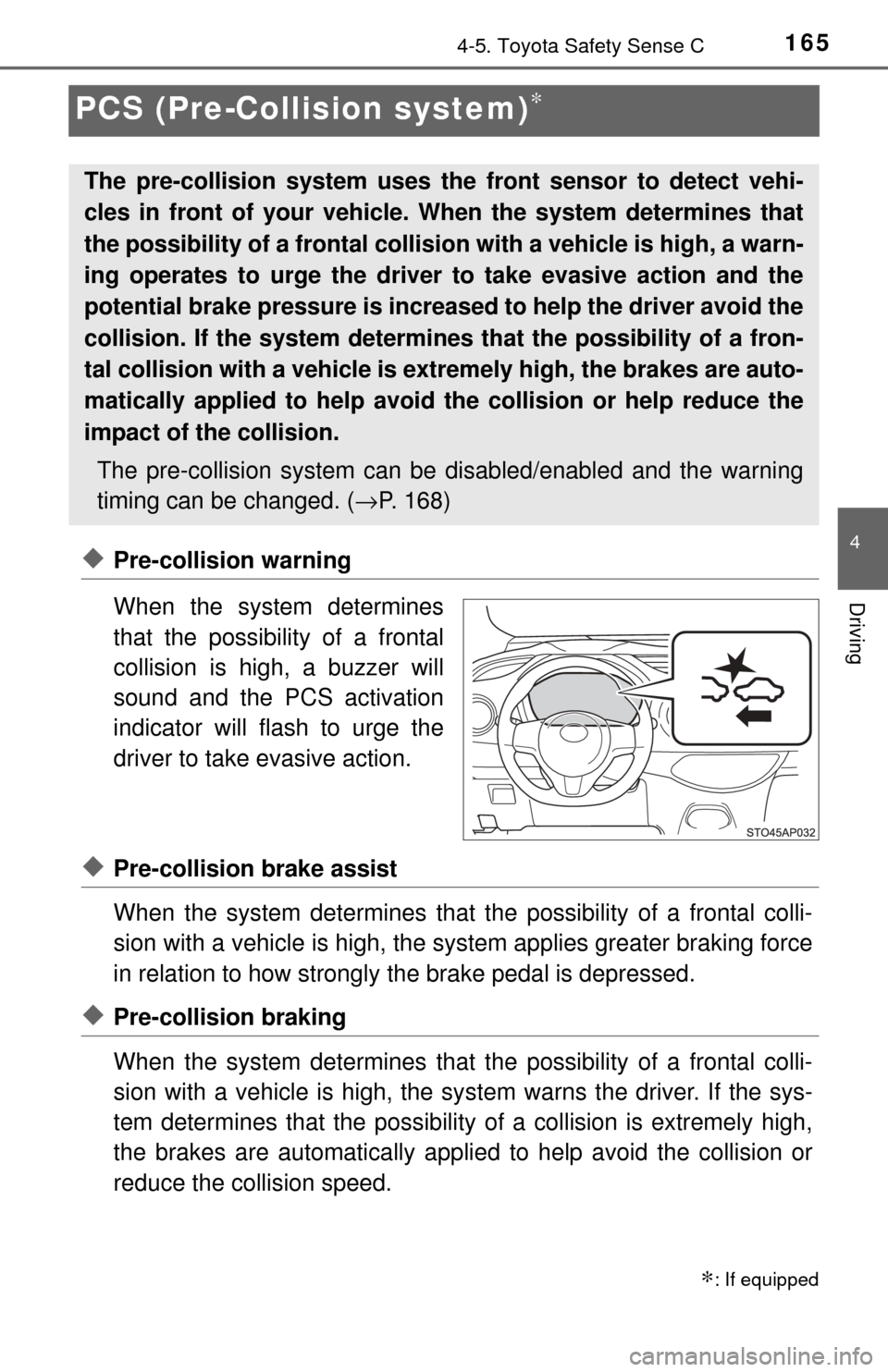
◆Pre-collision warning
When the system determines
that the possibility of a frontal
collision is high, a buzzer will
sound and the PCS activation
indicator will flash to urge the
driver to take evasive action.
◆Pre-collision brake assist
When the system determines that the possibility of a frontal colli-
sion with a vehicle is high, the system applies greater braking force
in relation to how strongly the brake pedal is depressed.
◆Pre-collision braking
When the system determines that the possibility of a frontal colli-
sion with a vehicle is high, the sy stem warns the driver. If the sys-
tem determines that the possibility of a collision is extremely high,
the brakes are automatically appli ed to help avoid the collision or
reduce the collision speed.
∗: If equipped
The pre-collision system uses the front sensor to detect vehi-
cles in front of your vehicle. When the system determines that
the possibility of a frontal collisi on with a vehicle is high, a warn-
ing operates to urge the driver to take evasive action and the
potential brake pressure is increased to help the driver avoid the
collision. If the system determin es that the possibility of a fron-
tal collision with a vehicle is extremely high, the brakes are auto-
matically applied to help avoid the collision or help reduce the
impact of the collision.
The pre-collision system can be disabled/enabled and the warning
timing can be changed. ( →P. 168)
Page 178 of 396
1784-5. Toyota Safety Sense C
LDA (Lane Departure Alert)∗
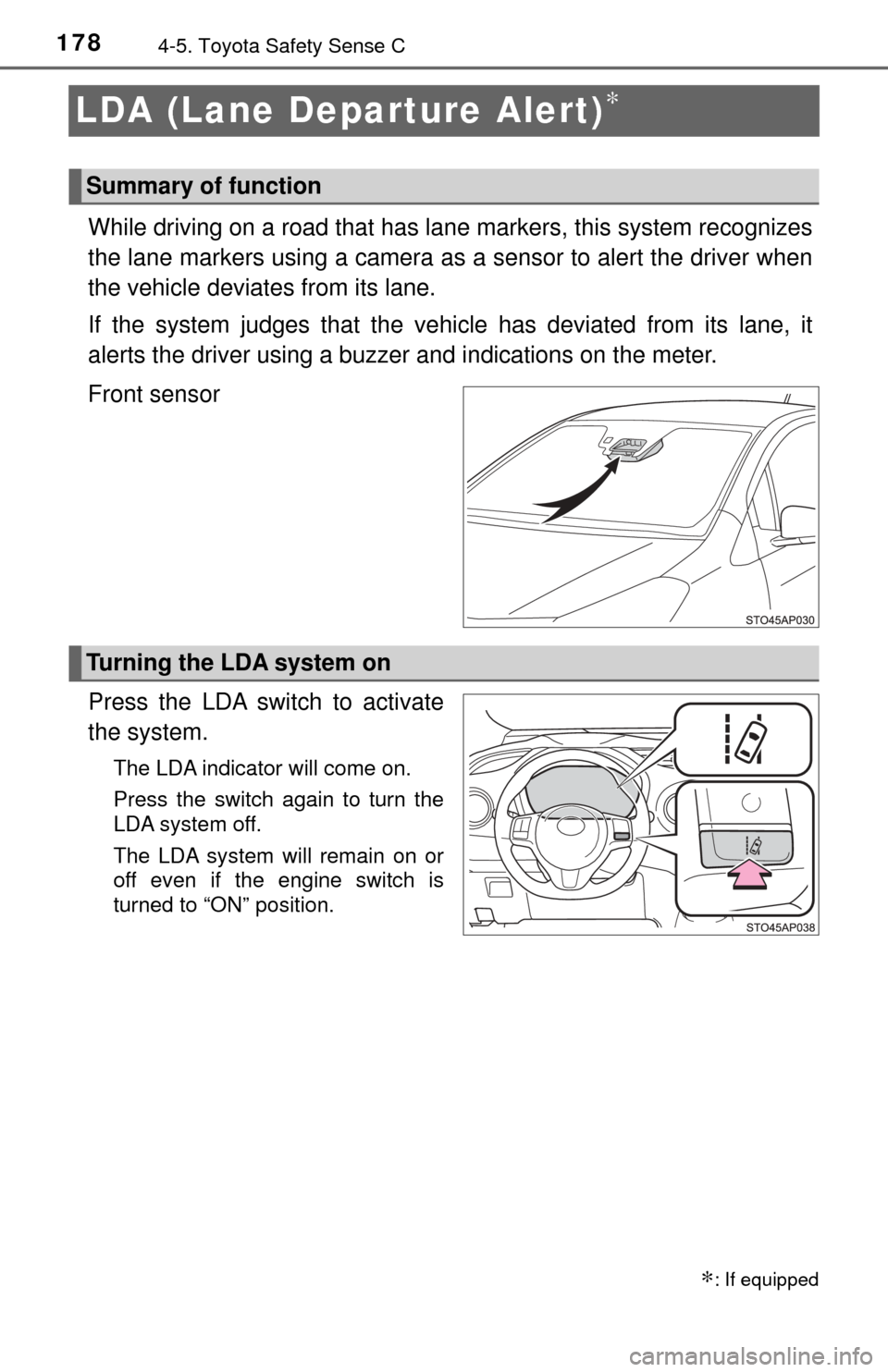
While driving on a road that has lane markers, this system recognizes
the lane markers using a camera as a sensor to alert the driver when
the vehicle deviat es from its lane.
If the system judges that the ve hicle has deviated from its lane, it
alerts the driver using a buzzer and indications on the meter.
Front sensor
Press the LDA switch to activate
the system.
The LDA indicator will come on.
Press the switch again to turn the
LDA system off.
The LDA system will remain on or
off even if the engine switch is
turned to “ON” position.
∗: If equipped
Summary of function
Turning the LDA system on
Page 233 of 396
2336-2. Maintenance
6
Maintenance and care
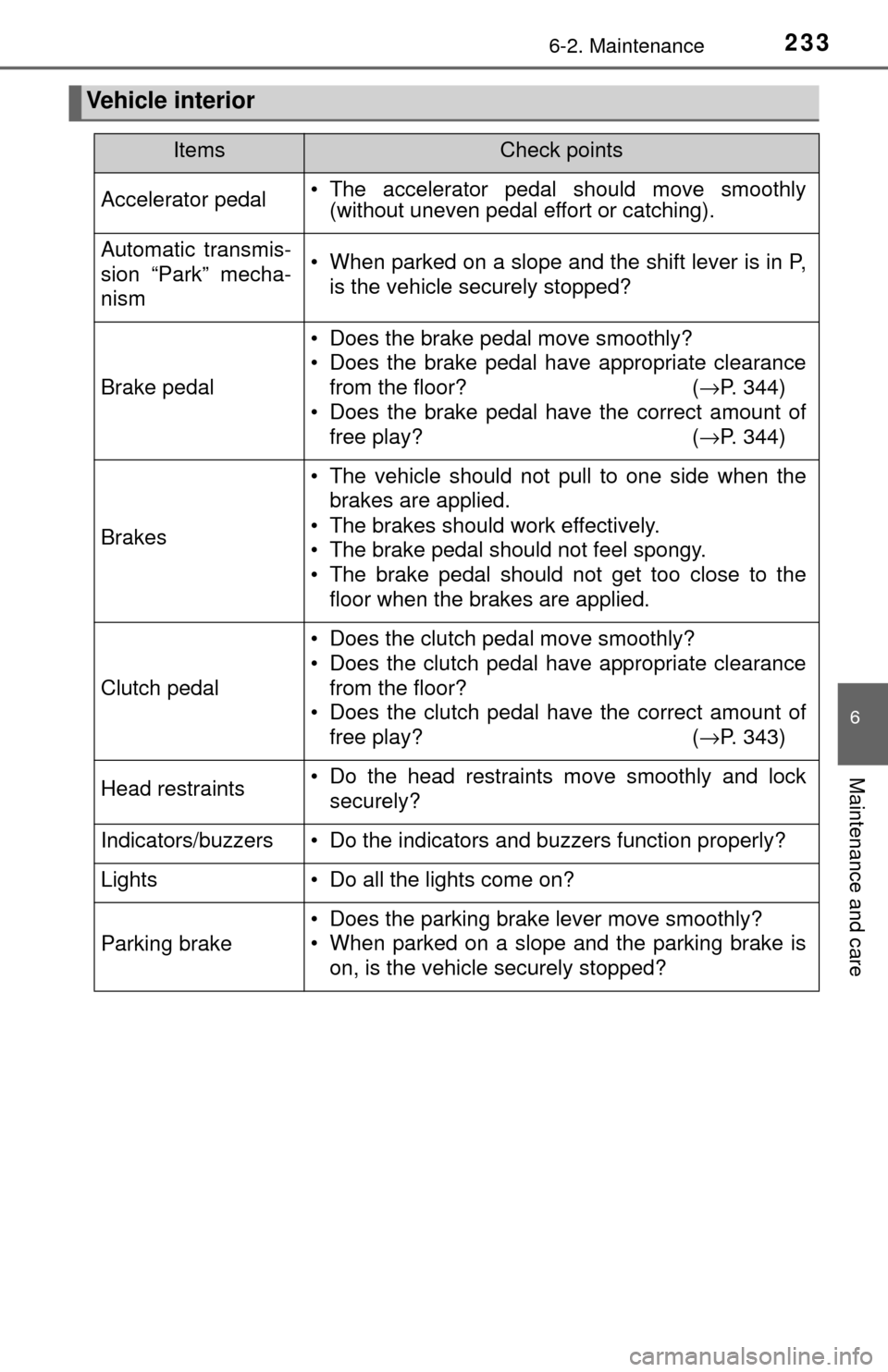
Vehicle interior
ItemsCheck points
Accelerator pedal• The accelerator pedal should move smoothly(without uneven pedal effort or catching).
Automatic transmis-
sion “Park” mecha-
nism• When parked on a slope and the shift lever is in P,
is the vehicle securely stopped?
Brake pedal
• Does the brake pedal move smoothly?
• Does the brake pedal have appropriate clearancefrom the floor? ( →P. 344)
• Does the brake pedal have the correct amount of free play? (→P. 344)
Brakes
• The vehicle should not pull to one side when the
brakes are applied.
• The brakes should work effectively.
• The brake pedal should not feel spongy.
• The brake pedal should not get too close to the floor when the brakes are applied.
Clutch pedal
• Does the clutch pedal move smoothly?
• Does the clutch pedal have appropriate clearancefrom the floor?
• Does the clutch pedal have the correct amount of
free play? ( →P. 343)
Head restraints• Do the head restraints move smoothly and lock
securely?
Indicators/buzzers• Do the indicators and buzzers function properly?
Lights• Do all the lights come on?
Parking brake
• Does the parking brake lever move smoothly?
• When parked on a slope and the parking brake ison, is the vehicle securely stopped?
Page 291 of 396

291
7When trouble arises
7-1. Essential informationEmergency flashers .......... 292
If your vehicle has to be stopped in
an emergency ................. 293
7-2. Steps to take in an emergency
If your vehicle needs to be towed ......................... 295
If you think something is wrong .............................. 300
Fuel pump shut off system ............................ 301
If a warning light turns on or a warning buzzer
sounds ............................ 302
If you have a flat tire.......... 312
If the engine will not start .. 325
If the vehicle battery is discharged ...................... 327
If your vehicle overheats ... 330
If the vehicle becomes stuck ............................... 333
Page 302 of 396
3027-2. Steps to take in an emergency
If a warning light turns on or a warning
buzzer sounds
Calmly perform the following actions if any of the warning lights
comes on or flashes. If a light comes on or flashes, but then
goes off, this does not necessarily indicate a malfunction in the
system. However, if this continues to occur, have the vehicle
inspected by your Toyota dealer.
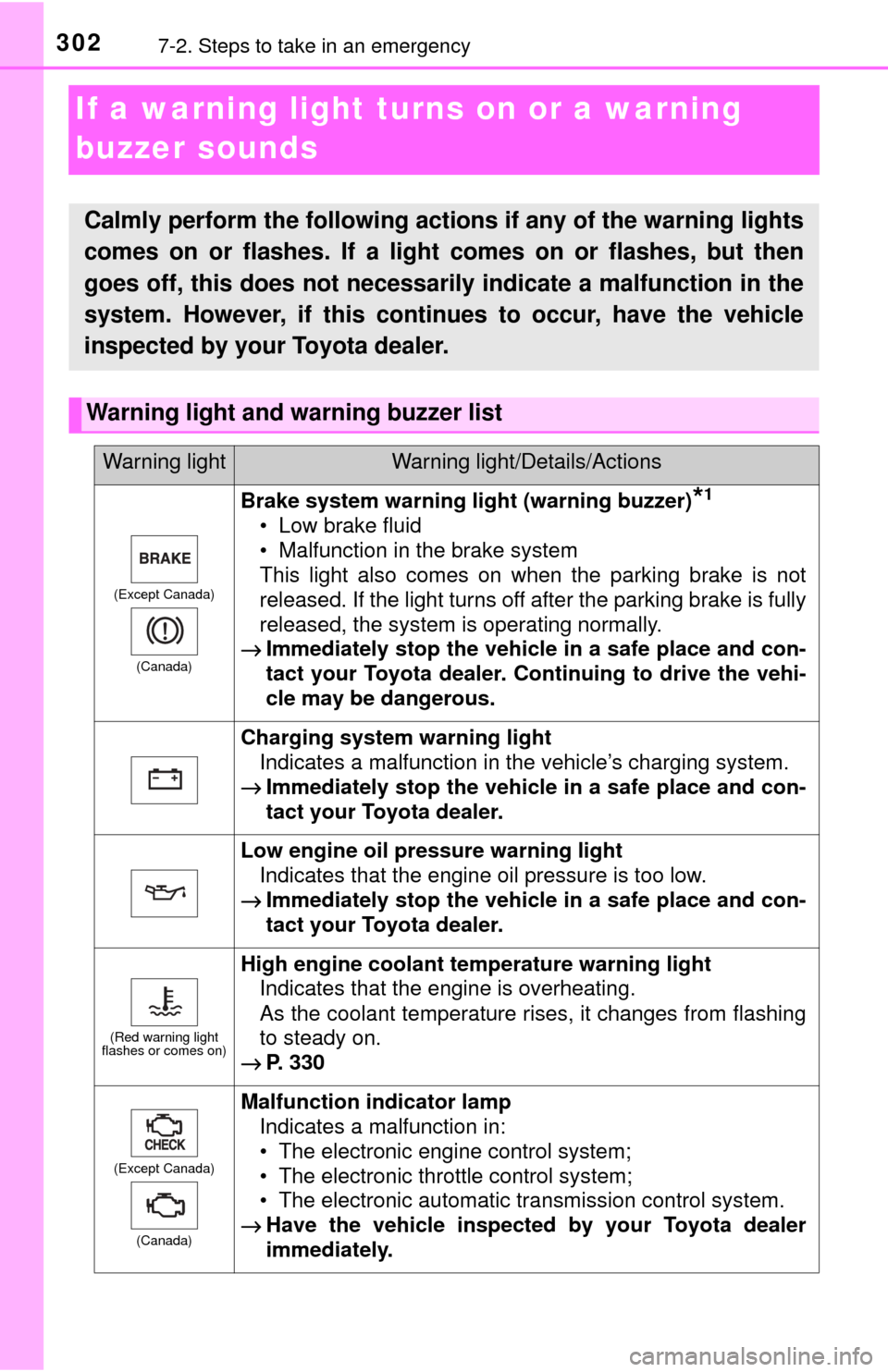
Warning light and warning buzzer list
Warning lightWarning light/Details/Actions
(Except Canada)
(Canada)
Brake system warning light (warning buzzer)*1
• Low brake fluid
• Malfunction in the brake system
This light also comes on when the parking brake is not
released. If the light turns off after the parking brake is fully
released, the system is operating normally.
→ Immediately stop the vehicle in a safe place and con-
tact your Toyota dealer. Continuing to drive the vehi-
cle may be dangerous.
Charging system warning light
Indicates a malfunction in the vehicle’s charging system.
→ Immediately stop the vehicle in a safe place and con-
tact your Toyota dealer.
Low engine oil pressure warning light
Indicates that the engine oil pressure is too low.
→ Immediately stop the vehicle in a safe place and con-
tact your Toyota dealer.
(Red warning light
flashes or comes on)
High engine coolant temperature warning light
Indicates that the engine is overheating.
As the coolant temperature rises, it changes from flashing
to steady on.
→ P. 330
(Except Canada)
(Canada)
Malfunction indicator lampIndicates a malfunction in:
• The electronic engine control system;
• The electronic throttle control system;
• The electronic automatic transmission control system.
→ Have the vehicle inspected by your Toyota dealer
immediately.
Page 303 of 396
3037-2. Steps to take in an emergency
7
When trouble arises
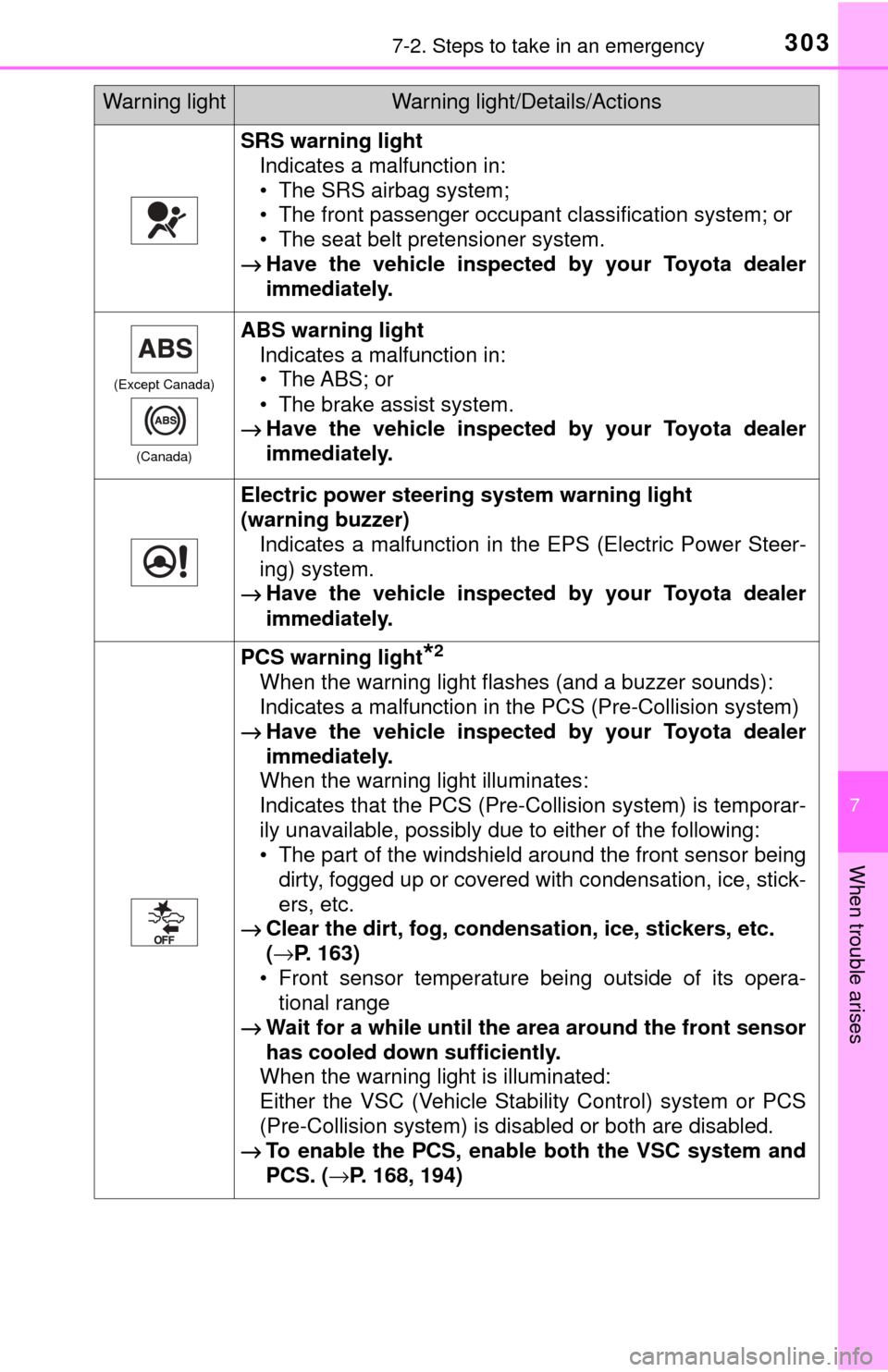
SRS warning lightIndicates a malfunction in:
• The SRS airbag system;
• The front passenger occupant classification system; or
• The seat belt pretensioner system.
→ Have the vehicle inspected by your Toyota dealer
immediately.
(Except Canada)
(Canada)
ABS warning lightIndicates a malfunction in:
• The ABS; or
• The brake assist system.
→ Have the vehicle inspected by your Toyota dealer
immediately.
Electric power steering system warning light
(warning buzzer)
Indicates a malfunction in the EPS (Electric Power Steer-
ing) system.
→ Have the vehicle inspected by your Toyota dealer
immediately.
PCS warning light*2
When the warning light flashes (and a buzzer sounds):
Indicates a malfunction in the PCS (Pre-Collision system)
→ Have the vehicle inspected by your Toyota dealer
immediately.
When the warning light illuminates:
Indicates that the PCS (Pre-Collision system) is temporar-
ily unavailable, possibly due to either of the following:
• The part of the windshield around the front sensor being dirty, fogged up or covered with condensation, ice, stick-
ers, etc.
→ Clear the dirt, fog, condensat ion, ice, stickers, etc.
( →P. 163)
• Front sensor temperature being outside of its opera- tional range
→ Wait for a while until the area around the front sensor
has cooled down sufficiently.
When the warning light is illuminated:
Either the VSC (Vehicle Stability Control) system or PCS
(Pre-Collision system) is disabled or both are disabled.
→ To enable the PCS, enable both the VSC system and
PCS. ( →P. 168, 194)
Warning lightWarning light/Details/Actions