engine TOYOTA YARIS 2017 Owners Manual
[x] Cancel search | Manufacturer: TOYOTA, Model Year: 2017, Model line: YARIS, Model: TOYOTA YARIS 2017Pages: 549, PDF Size: 33.09 MB
Page 466 of 549
4668-2. Steps to take in an emergency
YARIS_F_OM_Europe_OM52J20E
WARNING
■When using the compact spare tire
● Remember that the compact spare tire provided is specifically designed
for use with your vehicle. Do not use your compact spare tire on another
vehicle.
● Do not use more than one compact spare tire simultaneously.
● Replace the compact spare tire with a standard tire as soon as possible.
● Avoid sudden acceleration, abrupt steering, sudden braking and shifting
operations that cause sudden engine braking.
■ When storing the compact spare tire
Be careful not to catch fingers or other body parts between the compact
spare tire and the body of the vehicle.
■ After using the tools and jack
Before driving, make sure all the tools and jack are securely in place in their
storage location to reduce the possibility of personal injury during a collision
or sudden braking.
■ When the compact spare tire is attached
The vehicle speed may not be correctly detected, and the following systems
may not operate correctly:
● ABS
● Brake assist
● VSC (if equipped)
● TRC (if equipped)
● PCS (Pre-Crash Safety system) (if equipped)
● LDA (Lane Departure Alert) (if equipped)
● Automatic High Beam (if equipped)
● Cruise control (if equipped)
● Navigation system (if equipped)
● EPS (Electric Power Steering)
■ Speed limit when using the compact spare tire
Do not drive at speeds in excess of 80 km/h (50 mph) when a compact
spare tire is installed on the vehicle.
The compact spare tire is not designed for driving at high speeds. Failure to
observe this precaution may lead to an accident causing death or serious
injury.
Page 469 of 549
4698-2. Steps to take in an emergency
8
When trouble arises
YARIS_F_OM_Europe_OM52J20E
●Stop the vehicle in a safe place on a hard, flat surface.
● Set the parking brake.
● Shift the shift lever to P (Multidrive) or N (manual transmission).
● Stop the engine.
● Turn on the emergency flashers. (P. 428)
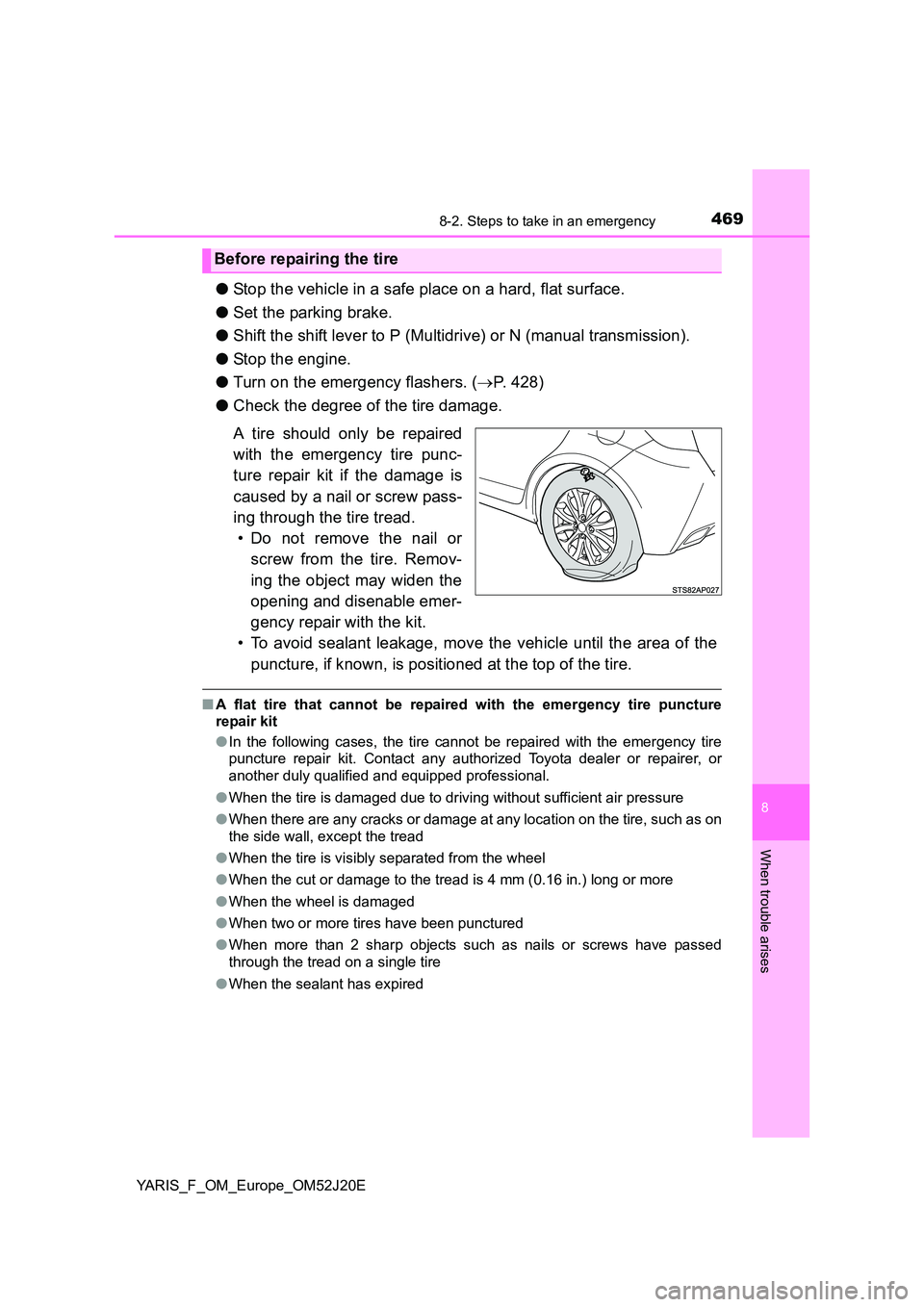
● Check the degree of the tire damage.
A tire should only be repaired
with the emergency tire punc-
ture repair kit if the damage is
caused by a nail or screw pass-
ing through the tire tread.
• Do not remove the nail or
screw from the tire. Remov-
ing the object may widen the
opening and disenable emer-
gency repair with the kit.
• To avoid sealant leakage, move the vehicle until the area of the
puncture, if known, is positioned at the top of the tire.
■ A flat tire that cannot be repaired with the emergency tire puncture
repair kit
● In the following cases, the tire cannot be repaired with the emergency tire
puncture repair kit. Contact any authorized Toyota dealer or repairer, or
another duly qualified and equipped professional.
● When the tire is damaged due to driving without sufficient air pressure
● When there are any cracks or damage at any location on the tire, such as on
the side wall, except the tread
● When the tire is visibly separated from the wheel
● When the cut or damage to the tread is 4 mm (0.16 in.) long or more
● When the wheel is damaged
● When two or more tires have been punctured
● When more than 2 sharp objects such as nails or screws have passed
through the tread on a single tire
● When the sealant has expired
Before repairing the tire
Page 475 of 549
4758-2. Steps to take in an emergency
8
When trouble arises
YARIS_F_OM_Europe_OM52J20E
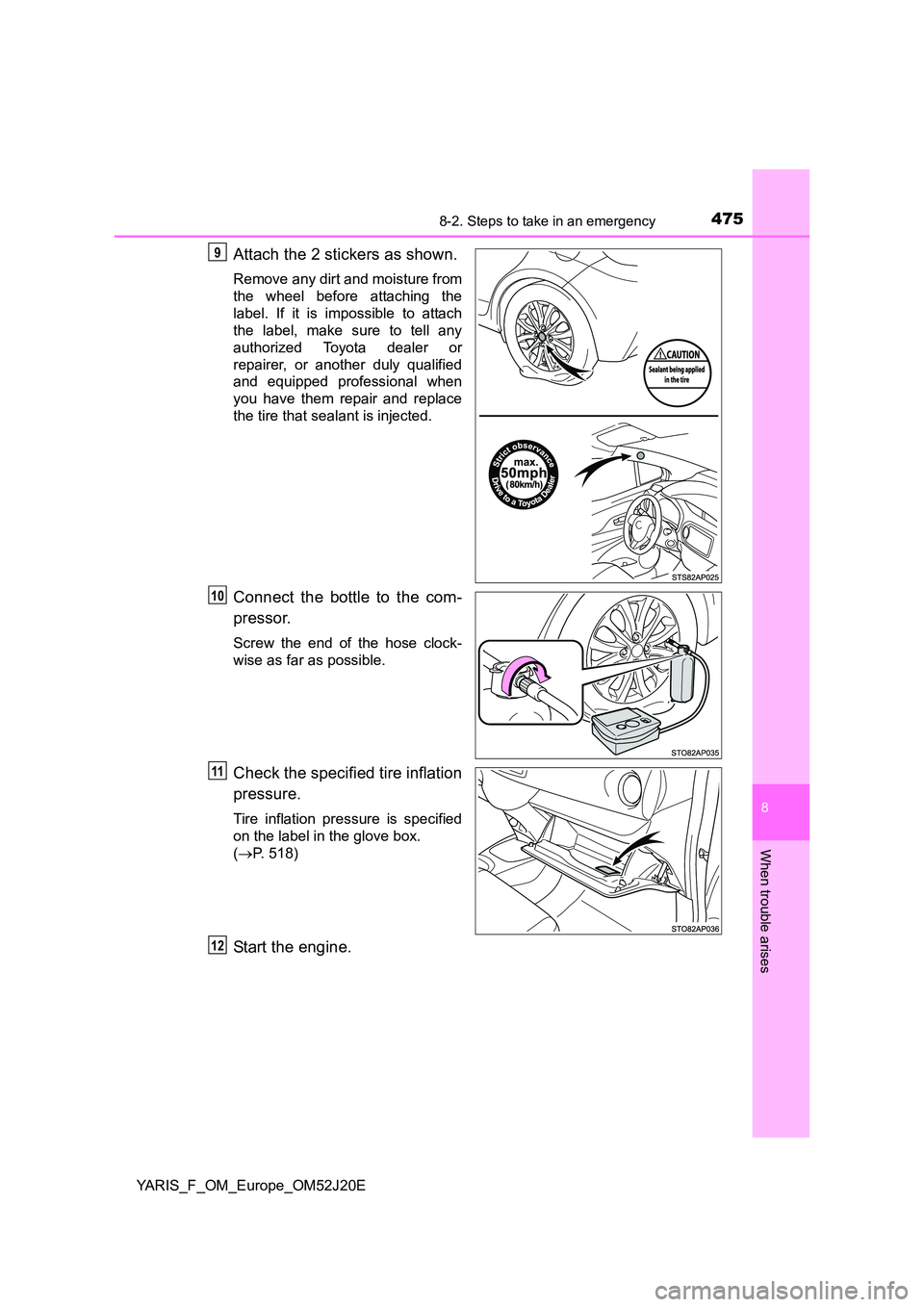
Attach the 2 stickers as shown.
Remove any dirt and moisture from
the wheel before attaching the
label. If it is impossible to attach
the label, make sure to tell any
authorized Toyota dealer or
repairer, or another duly qualified
and equipped professional when
you have them repair and replace
the tire that sealant is injected.
Connect the bottle to the com-
pressor.
Screw the end of the hose clock-
wise as far as possible.
Check the specified tire inflation
pressure.
Tire inflation pressure is specified
on the label in the glove box.
( P. 518)
Start the engine.
9
10
11
12
Page 484 of 549
4848-2. Steps to take in an emergency
YARIS_F_OM_Europe_OM52J20E
If the engine will not star t
One of the following may be the cause of the problem:
● There may not be sufficient fuel in the vehicle’s tank.
Gasoline engine: Refuel the vehicle.
Diesel engine: P. 4 9 7
● The engine may be flooded. (gasoline engine)
Try to restart the engine again following correct starting procedures.
( P. 182, 185)
● There may be a malfunction in the engine immobilizer system.
( P. 7 6 )
One of the following may be the cause of the problem:
● The battery may be discharged. (P. 488)
● The battery terminal connections may be loose or corroded.
The engine starting system may be malfunctioning due to an electrical
problem such as an open circuit or a blown fuse. However, an interim
measure is available to start the engine. ( P. 485)
If the engine will not start even though correct starting proce-
dures are being followed ( P. 182, 185), consider each of the fol-
lowing points:
The engine will not start even though the starter motor operates
normally.
The starter motor turns over slowly, the interior lights and head-
lights are dim, or the horn does not sound or sounds at a low
volume.
The starter motor does not turn over (vehicles with a smart entry
& start system).
Page 485 of 549
4858-2. Steps to take in an emergency
8
When trouble arises
YARIS_F_OM_Europe_OM52J20E
One of the following may be the cause of the problem:
● One or both of the battery terminals may be disconnected.
● The battery may be discharged. (P. 488)
● There may be a malfunction in the steering lock system (vehicles
with a smart entry & start system).
Contact any authorized Toyota dealer or repairer, or another duly qualified
and equipped professional, if the problem cannot be repaired, or if repair
procedures are unknown.
When the engine does not start, the following steps can be used as an
interim measure to start the engine if the engine switch is functioning
normally:
Set the parking brake.
Shift the shift lever to P (Multidrive) or N (manual transmission).
Turn the engine switch to ACCESSORY mode.
Press and hold the engine switch for about 15 seconds while
depressing the brake pedal (Multidrive) or brake pedal and clutch
pedal (manual transmission) firmly.
Even if the engine can be started using the above steps, the system
may be malfunctioning. Have the vehicle inspected by any authorized
Toyota dealer or repairer, or another duly qualified and equipped pro-
fessional.
The starter motor does not turn over, the interior lights and
headlights do not turn on, or the horn does not sound.
Emergency start function (vehicles with a smart entry & start
system)
1
2
3
4
Page 486 of 549
4868-2. Steps to take in an emergency
YARIS_F_OM_Europe_OM52J20E
If the electronic key does not operate properly
(vehicles with a smart entr y & start system)
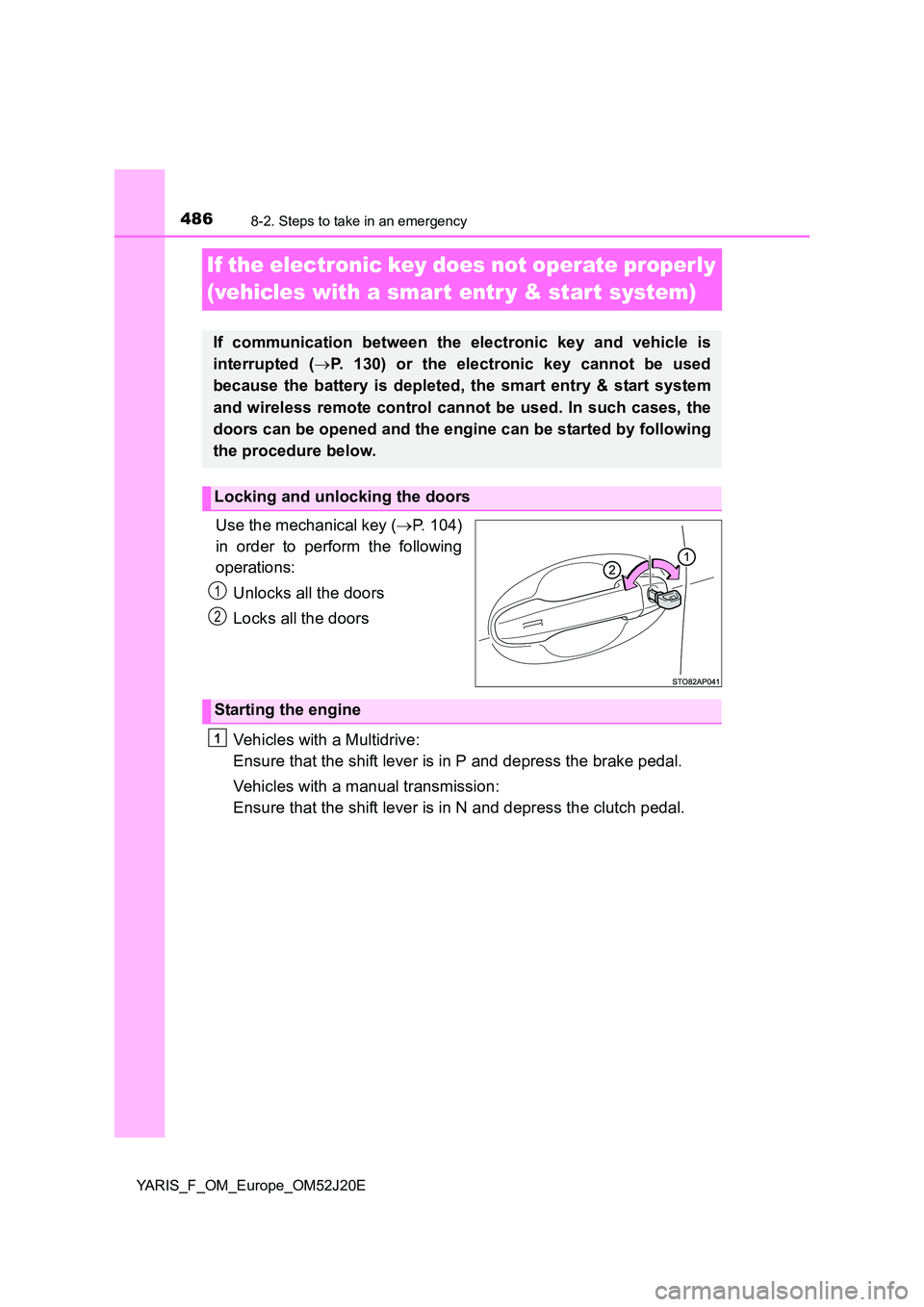
Use the mechanical key ( P. 104)
in order to perform the following
operations:
Unlocks all the doors
Locks all the doors
Vehicles with a Multidrive:
Ensure that the shift lever is in P and depress the brake pedal.
Vehicles with a manual transmission:
Ensure that the shift lever is in N and depress the clutch pedal.
If communication between the electronic key and vehicle is
interrupted ( P. 130) or the electronic key cannot be used
because the battery is depleted, the smart entry & start system
and wireless remote control cannot be used. In such cases, the
doors can be opened and the engine can be started by following
the procedure below.
Locking and unlocking the doors
1
2
Starting the engine
1
Page 487 of 549
4878-2. Steps to take in an emergency
8
When trouble arises
YARIS_F_OM_Europe_OM52J20E
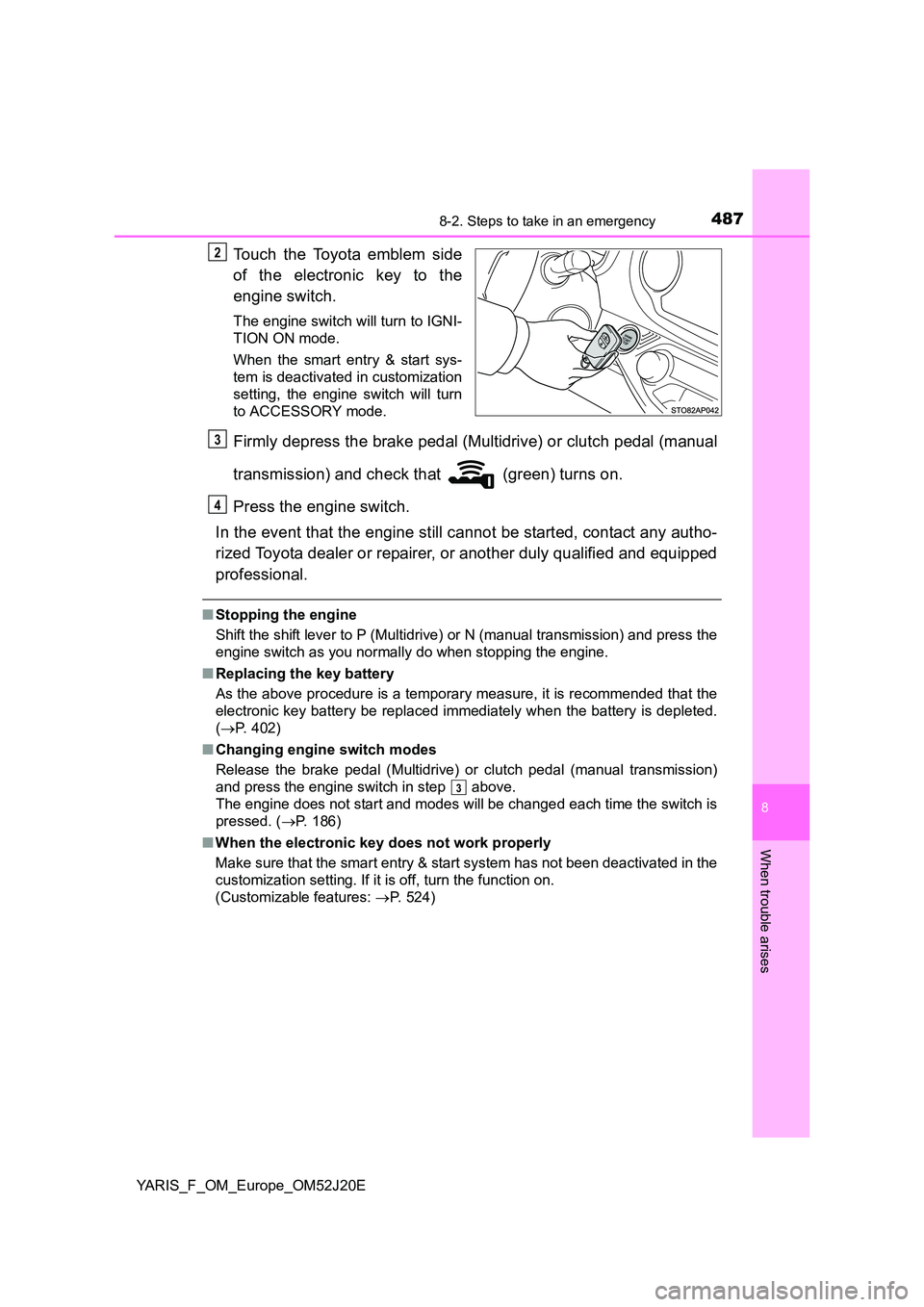
Touch the Toyota emblem side
of the electronic key to the
engine switch.
The engine switch will turn to IGNI-
TION ON mode.
When the smart entry & start sys-
tem is deactivated in customization
setting, the engine switch will turn
to ACCESSORY mode.
Firmly depress the brake pedal (Multidrive) or clutch pedal (manual
transmission) and check that (green) turns on.
Press the engine switch.
In the event that the engine still cannot be started, contact any autho-
rized Toyota dealer or repairer, or another duly qualified and equipped
professional.
■ Stopping the engine
Shift the shift lever to P (Multidrive) or N (manual transmission) and press the
engine switch as you normally do when stopping the engine.
■ Replacing the key battery
As the above procedure is a temporary measure, it is recommended that the
electronic key battery be replaced immediately when the battery is depleted.
( P. 402)
■ Changing engine switch modes
Release the brake pedal (Multidrive) or clutch pedal (manual transmission)
and press the engine switch in step above.
The engine does not start and modes will be changed each time the switch is
pressed. ( P. 186)
■ When the electronic key does not work properly
Make sure that the smart entry & start system has not been deactivated in the
customization setting. If it is off, turn the function on.
(Customizable features: P. 524)
2
3
4
3
Page 488 of 549
4888-2. Steps to take in an emergency
YARIS_F_OM_Europe_OM52J20E
If the vehicle batter y is discharged
If you have a set of jumper (or booster) cables and a second vehicle
with a 12-volt battery, you can jump start your vehicle by following the
steps below.
Open the hood. ( P. 362)
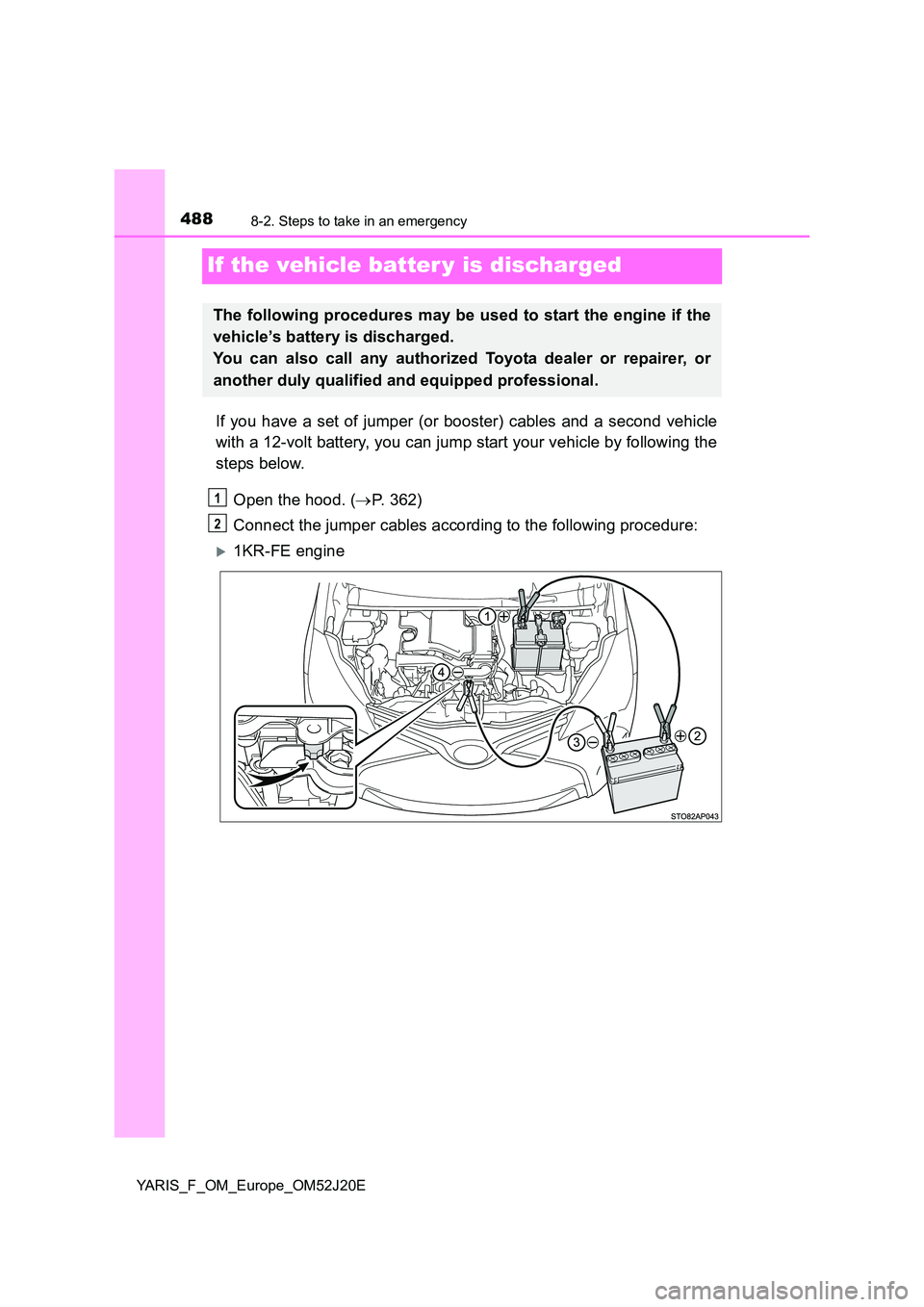
Connect the jumper cables according to the following procedure:
1KR-FE engine
The following procedures may be used to start the engine if the
vehicle’s battery is discharged.
You can also call any authorized Toyota dealer or repairer, or
another duly qualified and equipped professional.
1
2
Page 489 of 549
4898-2. Steps to take in an emergency
8
When trouble arises
YARIS_F_OM_Europe_OM52J20E
Connect a positive jumper cable clamp to the positive (+) battery
terminal on your vehicle.
Connect the clamp on the other end of the positive cable to the
positive (+) battery terminal on the second vehicle.
Connect a negative cable clamp to the negative (-) battery termi-
nal on the second vehicle.
Connect the clamp at the other end of the negative cable to a
solid, stationary, unpainted metallic point away from the battery
and any moving parts, as shown in the illustration.
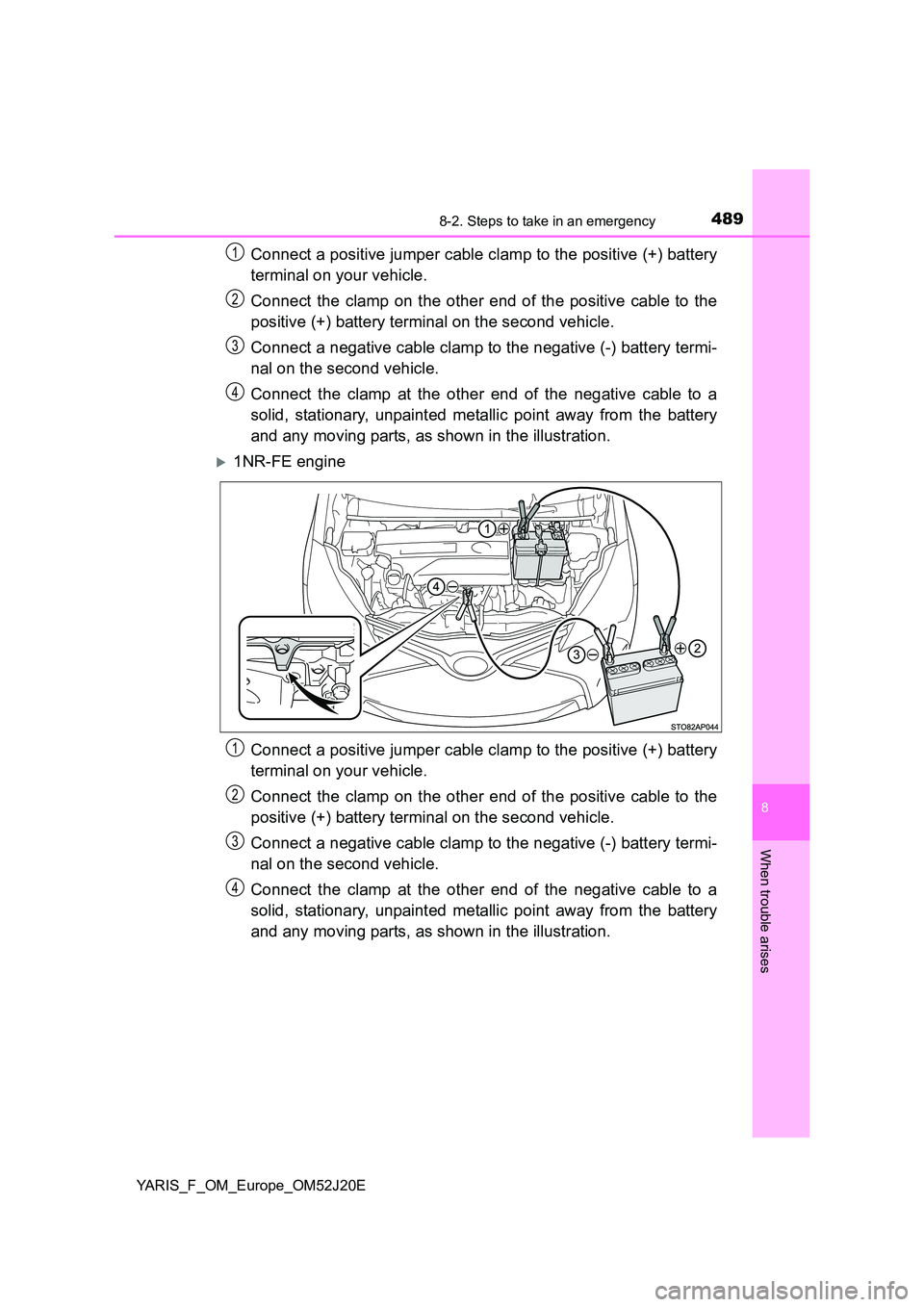
1NR-FE engine
Connect a positive jumper cable clamp to the positive (+) battery
terminal on your vehicle.
Connect the clamp on the other end of the positive cable to the
positive (+) battery terminal on the second vehicle.
Connect a negative cable clamp to the negative (-) battery termi-
nal on the second vehicle.
Connect the clamp at the other end of the negative cable to a
solid, stationary, unpainted metallic point away from the battery
and any moving parts, as shown in the illustration.
1
2
3
4
1
2
3
4
Page 490 of 549
4908-2. Steps to take in an emergency
YARIS_F_OM_Europe_OM52J20E
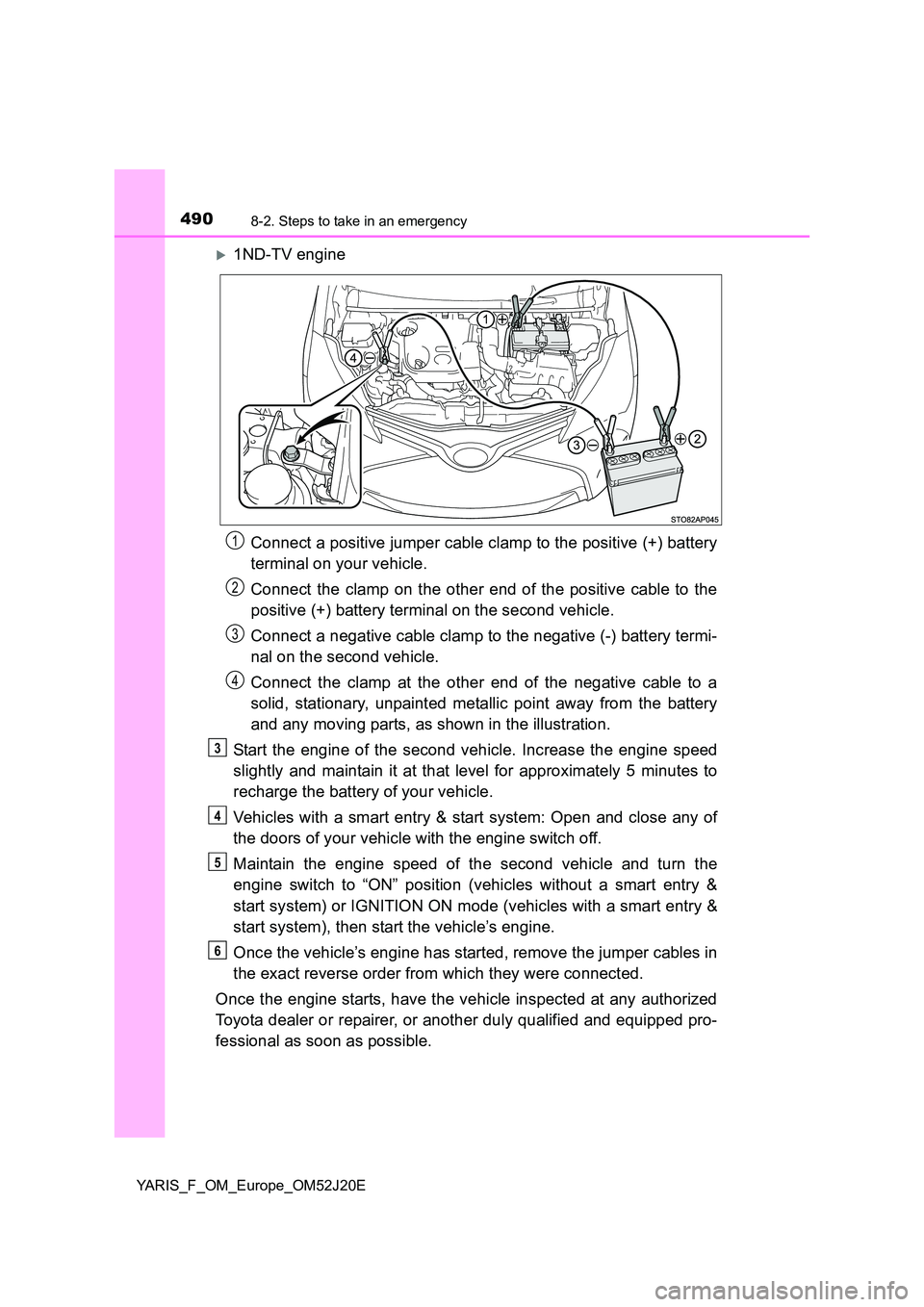
1ND-TV engine
Connect a positive jumper cable clamp to the positive (+) battery
terminal on your vehicle.
Connect the clamp on the other end of the positive cable to the
positive (+) battery terminal on the second vehicle.
Connect a negative cable clamp to the negative (-) battery termi-
nal on the second vehicle.
Connect the clamp at the other end of the negative cable to a
solid, stationary, unpainted metallic point away from the battery
and any moving parts, as shown in the illustration.
Start the engine of the second vehicle. Increase the engine speed
slightly and maintain it at that level for approximately 5 minutes to
recharge the battery of your vehicle.
Vehicles with a smart entry & start system: Open and close any of
the doors of your vehicle with the engine switch off.
Maintain the engine speed of the second vehicle and turn the
engine switch to “ON” position (vehicles without a smart entry &
start system) or IGNITION ON mode (vehicles with a smart entry &
start system), then start the vehicle’s engine.
Once the vehicle’s engine has started, remove the jumper cables in
the exact reverse order from which they were connected.
Once the engine starts, have the vehicle inspected at any authorized
Toyota dealer or repairer, or another duly qualified and equipped pro-
fessional as soon as possible.
1
2
3
4
3
4
5
6