warning light TOYOTA YARIS 2017 Owner's Guide
[x] Cancel search | Manufacturer: TOYOTA, Model Year: 2017, Model line: YARIS, Model: TOYOTA YARIS 2017Pages: 549, PDF Size: 33.09 MB
Page 219 of 549
2194-4. Refueling
4
Driving
YARIS_F_OM_Europe_OM52J20E
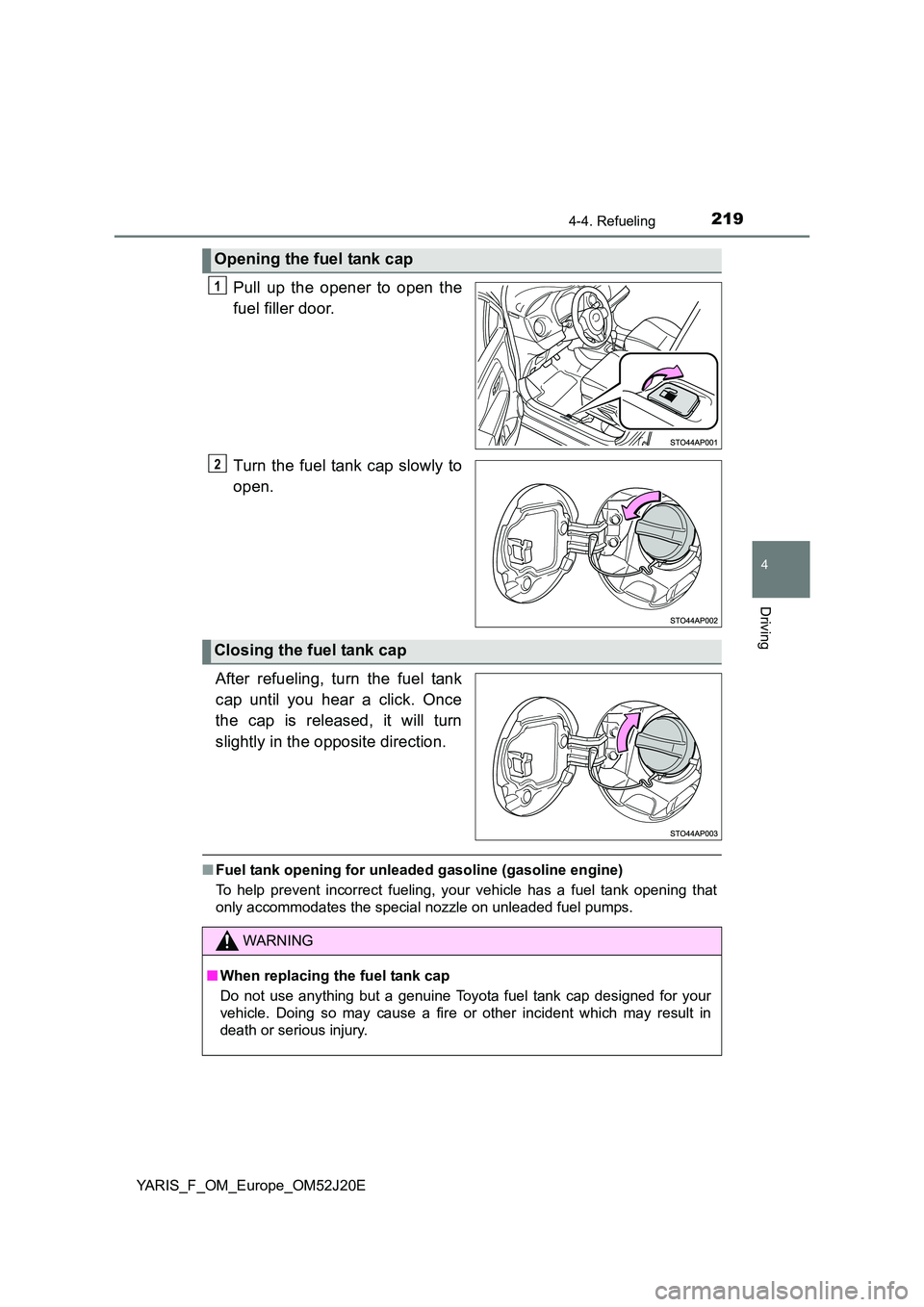
Pull up the opener to open the
fuel filler door.
Turn the fuel tank cap slowly to
open.
After refueling, turn the fuel tank
cap until you hear a click. Once
the cap is released, it will turn
slightly in the opposite direction.
■ Fuel tank opening for unleaded gasoline (gasoline engine)
To help prevent incorrect fueling, your vehicle has a fuel tank opening that
only accommodates the special nozzle on unleaded fuel pumps.
Opening the fuel tank cap
1
2
Closing the fuel tank cap
WARNING
■ When replacing the fuel tank cap
Do not use anything but a genuine Toyota fuel tank cap designed for your
vehicle. Doing so may cause a fire or other incident which may result in
death or serious injury.
Page 224 of 549
2244-5. Toyota Safety Sense
YARIS_F_OM_Europe_OM52J20E
WARNING
■To avoid malfunction of the front sensor Observe the following precautions.
Otherwise, the front sensor may not operate properly, possibly leading to an
accident resulting in death or serious injury.
● Keep the windshield clean at all times. If the windshield is dirty or covered
with an oily film, water droplets, snow, etc., clear the windshield. If the
inner side of the windshield in front of the front sensor is dirty, contact any
authorized Toyota dealer or repairer, or another duly qualified and
equipped professional.
● If there is a large difference in temperature between the inside and outside
of the vehicle, such as in winter, t he windshield is likely to fog up easily. If
the part of the windshield in front of the front sensor is fogged up or cov-
ered with condensation or ice, the PCS warning light may illuminate and
the system may be temporarily disabled. In this case, use the windshield
defogger to remove the fog, etc. ( P. 314, 324)
● If the area of the windshield in front of the front sensor is covered with
water droplets, use the windshield wipers to remove them.
If the water droplets are not sufficiently removed, the performance of the
front sensor may be reduced.
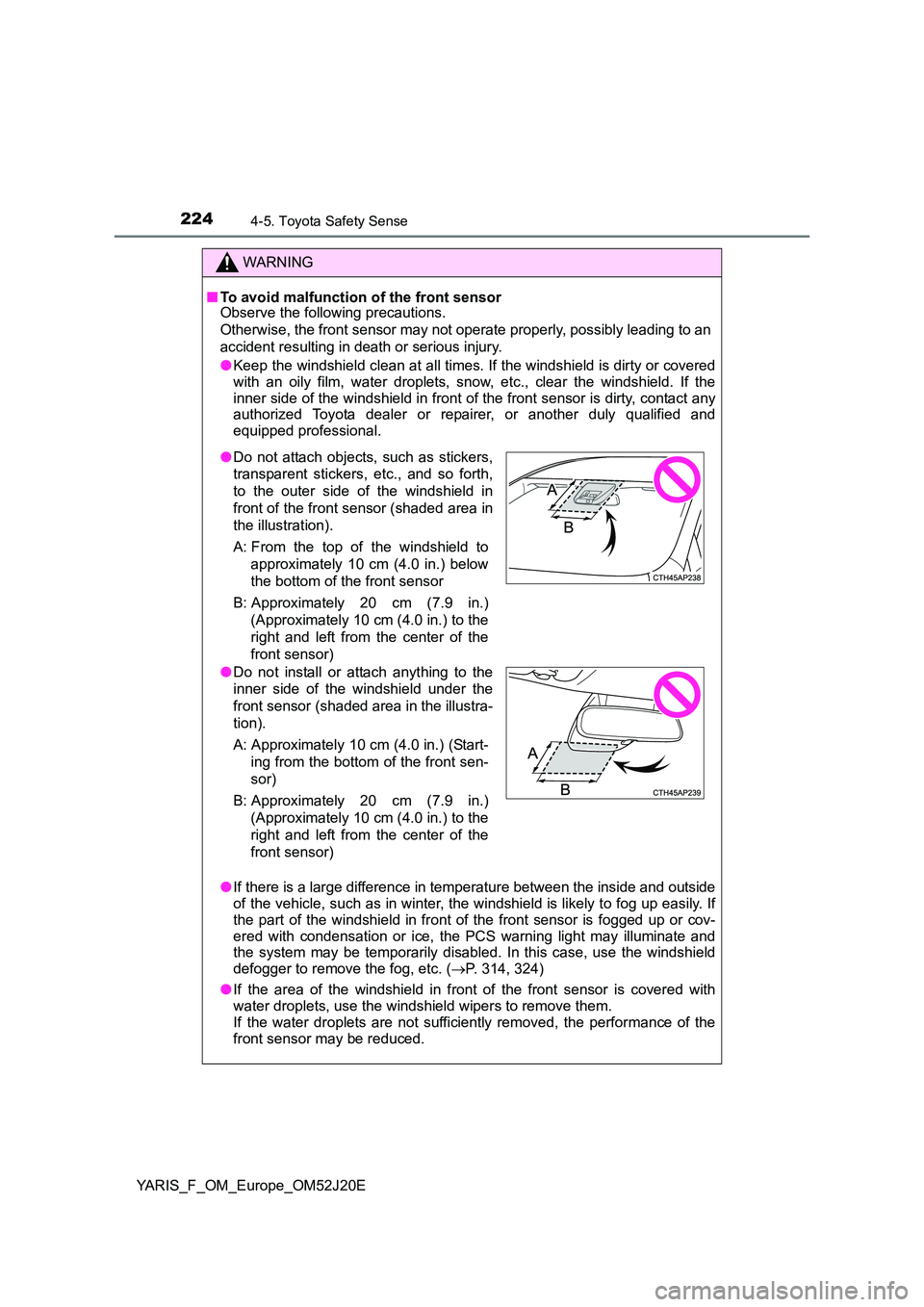
● Do not attach objects, such as stickers,
transparent stickers, etc., and so forth,
to the outer side of the windshield in
front of the front sensor (shaded area in
the illustration).
A: From the top of the windshield to
approximately 10 cm (4.0 in.) below
the bottom of the front sensor
B: Approximately 20 cm (7.9 in.)
(Approximately 10 cm (4.0 in.) to the
right and left from the center of the
front sensor)
● Do not install or attach anything to the
inner side of the windshield under the
front sensor (shaded area in the illustra-
tion).
A: Approximately 10 cm (4.0 in.) (Start-
ing from the bottom of the front sen-
sor)
B: Approximately 20 cm (7.9 in.)
(Approximately 10 cm (4.0 in.) to the
right and left from the center of the
front sensor)
Page 225 of 549
2254-5. Toyota Safety Sense
4
Driving
YARIS_F_OM_Europe_OM52J20E
WARNING
●If water droplets cannot be properly removed from the area of the wind-
shield in front of the front sensor by the windshield wipers, replace the
wiper insert or wiper blade.
If the wiper inserts or wiper blades need to be replaced, contact any autho-
rized Toyota dealer or repairer, or another duly qualified and equipped
professional.
● Do not attach window tinting to the windshield.
● Replace the windshield if it is damaged or cracked.
If the windshield needs to be replaced, contact any authorized Toyota
dealer or repairer, or another dul y qualified and equipped professional.
● Do not install an antenna in front of the sensor.
● Do not get the front sensor wet.
● Do not allow bright lights to shine into the front sensor.
● Do not dirty or damage the front sensor.
When cleaning the inside of the windshi eld, do not allow glass cleaner to
contact the lens. Also, do not touch the lens.
If the lens is dirty or damaged, contact any authorized Toyota dealer or
repairer, or another duly qualified and equipped professional.
● Do not subject the front sensor to a strong impact.
● Do not change the installation position or direction of the front sensor or
remove it.
● Do not disassemble the front sensor.
● Do not install an electronic device or device that emits strong electric
waves near the front sensor.
● Do not modify any components of the vehicle around the front sensor
(inside rear view mirror, sun visors, etc.) or ceiling.
● Do not attach any accessories that may obstruct the front sensor to the
hood, front grille or front bumper. C ontact any authorized Toyota dealer or
repairer, or another duly qualified and equipped professional for details.
● If a surfboard or other long object is to be mounted on the roof, make sure
that it will not obstruct the front sensor.
● Do not modify the headlights or other lights.
● Do not attach anything to or place anything on the dashboard.
■ Installation area of front sensor on windshield When the windshield is fogging up easily, the glass around the front sensor
may be hot due to the heater running. If the glass is touched, it may result in
burns.
Page 229 of 549
2294-5. Toyota Safety Sense
4
Driving
YARIS_F_OM_Europe_OM52J20E
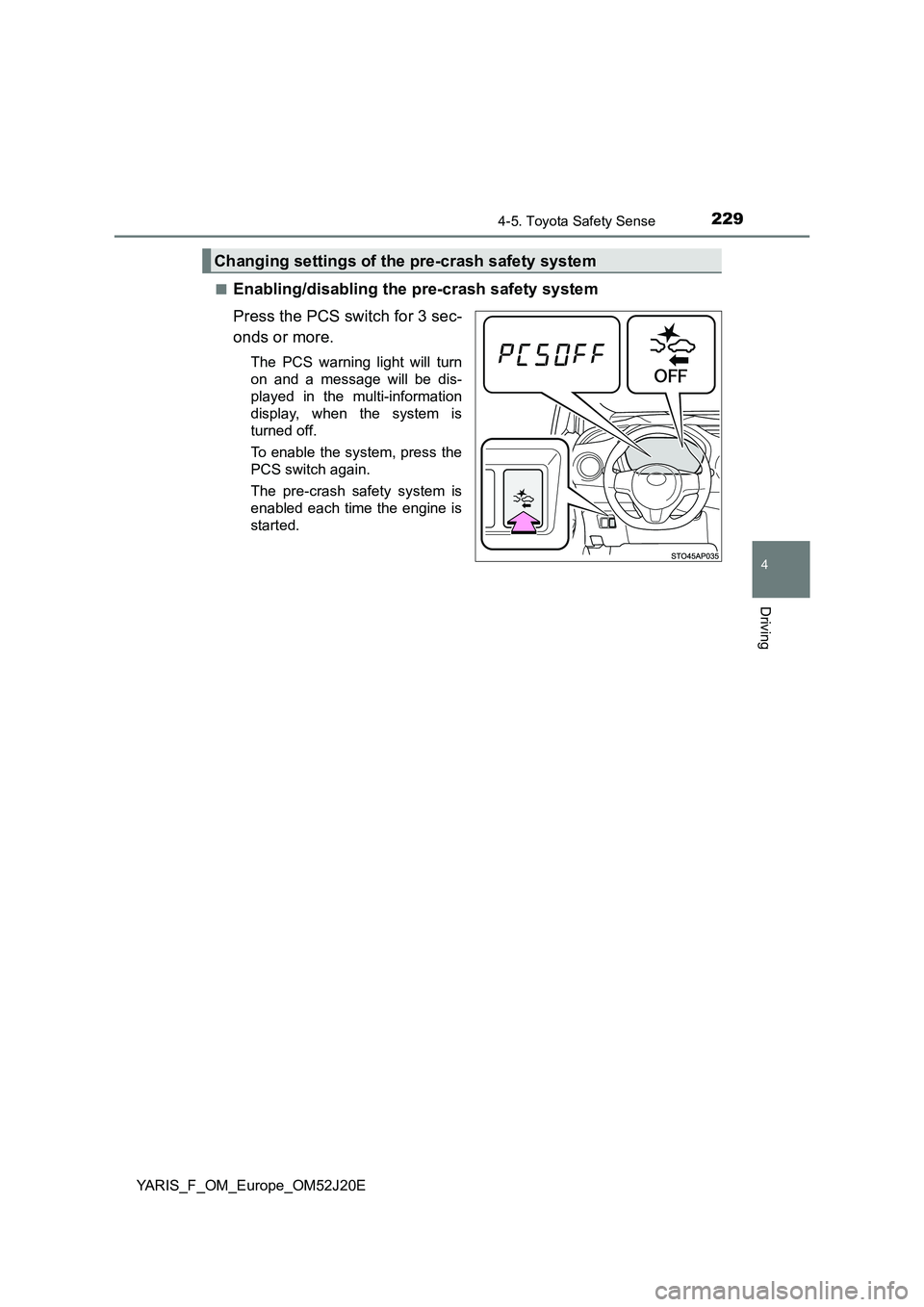
■Enabling/disabling the pre-crash safety system
Press the PCS switch for 3 sec-
onds or more.
The PCS warning light will turn
on and a message will be dis-
played in the multi-information
display, when the system is
turned off.
To enable the system, press the
PCS switch again.
The pre-crash safety system is
enabled each time the engine is
started.
Changing settings of the pre-crash safety system
Page 239 of 549
2394-5. Toyota Safety Sense
4
Driving
YARIS_F_OM_Europe_OM52J20E
■ If the PCS warning light flashes or illuminates
The pre-crash safety system may be temporarily unavailable or there may be
a malfunction in the system.
● In the following situations, the warning light will be cleared and the system
will become operational when normal operating conditions return:
• When the area around the front sensor is hot, such as after the vehicle
has been parked in the sun
• When the windshield is fogged up or covered with condensation or ice
( P. 314, 324)
• When the front sensor or the area around either sensor is cold, such as in
an extremely cold environment
• If the area in front of the front sens or is obstructed, such as when the
hood is open
● If the PCS warning light continues to flash or illuminate, the system may be
malfunctioning. Have the vehicle inspected by any authorized Toyota dealer
or repairer, or another duly qualifi ed and equipped professional immediately.
■ If VSC is disabled
● If TRC and VSC are disabled (P. 267), the pre-crash brake assist and pre-
crash braking functions are also disabled. However, the pre-crash warning
function will still operate.
● The PCS warning light illuminates.
Page 244 of 549
2444-5. Toyota Safety Sense
YARIS_F_OM_Europe_OM52J20E
WARNING
■Before using the LDA system
Do not rely solely on the LDA system. The LDA system does not drive the
vehicle automatically, nor does it reduce the amount of care you need to
take. As such, the driver must always assume full responsibility for under-
standing his/her surroundings, for operat ing the steering wheel to correct
the driving line, and for driving safely.
Inappropriate or negligent driving could lead to an accident.
■ To avoid operating the LDA by mistake
Switch the LDA system off using the LDA switch when not in use.
NOTICE
■ To prevent damage to or incorrect operation of the LDA system
● Do not modify the headlights or attach stickers to the surface of the lights.
● Do not modify the suspension. If your suspension needs repairs, contact
any authorized Toyota dealer or repairer, or another duly qualified and
equipped professional.
● Do not install or place anything on the hood or the grille. Also, do not install
a grille guard (bull bars, kangaroo bar etc.).
Page 248 of 549
2484-5. Toyota Safety Sense
YARIS_F_OM_Europe_OM52J20E
● High beam may be turned on or off when unexpected by the driver.
● In the situations below, the system may not be able to correctly detect the surrounding brightness levels, and may flash or expose nearby pedestrians to the high beam. Therefore, you shoul d consider turning the high beams on or off manually rather than relying on the Automatic High Beam system.
• In bad weather (rain, snow, fog, sandstorms, etc.) • The windshield is obscured by fog, mist, ice, dirt, etc.• The windshield is cracked or damaged.• The front sensor is deformed or dirty. • The front sensor temperature is extremely high. • Surrounding brightness levels are equal to those of headlights, tail lightsor fog lights.• Vehicles ahead have headlights or tail lights that are either switched off,dirty, are changing color, or are not aimed properly.• When driving through an area of intermittently changing brightness anddarkness. • When frequently and repeatedly driving ascending/descending roads, or roads with rough, bumpy or uneven surfaces (such as stone-pavedroads, gravel tracks, etc.).• When frequently and repeatedly taking curves or driving on a windingroad.• There is a highly reflective object ahead of the vehicle, such as a sign or a mirror. • The back of a vehicle ahead is highly reflective, such as a container on atruck.• The vehicle’s headlights are damaged or dirty.• The vehicle is listing or titling, due to a flat tire, a trailer being towed, etc.• The driver believes that the high beam may be causing problems or dis- tress to other drivers or pedestrians nearby.
■ If the Automatic High Beam indicator comes on in yellow
It may indicate a malfunction in the system. Contact any authorized Toyota dealer or repairer, or another duly qualified and equipped professional.
WARNING
■ Limitations of the Automatic High Beam
Do not rely on the Automatic High Beam. Always drive safely, taking care to
observe your surroundings and turning high beam on or off manually if nec-
essary.
NOTICE
■ Notes when using the Automatic High Beam system
Observe the following to ensure that the Automatic High Beam functions
correctly.
● Do not overload the vehicle.
● Do not modify the vehicle.
Page 262 of 549
2624-6. Using the driving support systems
YARIS_F_OM_Europe_OM52J20E
■ The Stop & Start system protection feature
Vehicles without a smart entry & start system
When an excessively loud sound is being projected by the audio system, the
audio system may be automatically cut off in order to maintain power for the
Stop & Start system function.
If this occurs, turning the engine switch to the “LOCK” position then to the
“ACC” or “ON” position re -enables the audio system.
Vehicles with a smart entry & start system
When an excessively loud sound is being projected by the audio system, the
audio system may be automatically cut off in order to maintain power for the
Stop & Start system function.
If this occurs, turning the engine switch off then to ACCESSORY mode or
IGNITION ON mode re-enables the audio system.
■ Hood
If the hood is opened while the engine is stopped by the Stop & Start system,
the engine cannot be restarted by the Stop & Start system or by the automatic
engine start function. Restart the engi ne with the engine switch operation.
( P. 182, 185)
Vehicles with a Multidrive: If the hood is opened while the engine is stopped
by the Stop & Start system and the shift lever is in N or P, the engine will
restart.
■ When to use the Stop & Start system
Use the Stop & Start system when stopping the vehicle temporarily at red
lights, intersections, etc. When stoppi ng the vehicle for a longer period of
time, turn off the engine completely.
■ Stop & Start system warning buzzer
If the engine is stopped by the Stop & Start system and either of the following
actions is performed, a buzzer will sound and the Stop & Start indicator will
flash (Multidrive), or a buzzer will sound (manual transmission). This indi-
cates that the engine is only stopped by the Stop & Start system, not that the
engine has been turned off completely.
Vehicles with a Multidrive
The driver’s door is opened when the shift lever is in D or M.
Vehicles with a manual transmission
The shift lever is shifted into a position other than N with the clutch pedal
released.
Page 264 of 549
2644-6. Using the driving support systems
YARIS_F_OM_Europe_OM52J20E
WARNING
■When the Stop & Start system is operating
● Keep the shift lever in N (manual transmission) and apply the brake pedal
or parking brake for safety while the engine is stopped due to the Stop &
Start system (while the Stop & Start indicator is on).
Unexpected accidents may occur due to the automatic engine start func-
tion.
● Do not leave the vehicle while the engine is stopped due to the Stop &
Start system (while the Stop & Start indicator is on).
Unexpected accidents may occur due to the automatic engine start func-
tion.
● Ensure that the engine is not stopped by the Stop & Start system while the
vehicle is in a poorly ventilated area. The engine may restart due to the
automatic engine start function, causing exhaust gases to collect and
enter the vehicle and resulting in death or a serious health hazard.
NOTICE
■ To ensure the system operates correctly
If any one of the following situations occurs, the Stop & Start system may
not operate correctly, thus, please have your vehicle checked by any autho-
rized Toyota dealer or repairer, or another duly qualified and equipped pro-
fessional.
● While the driver’s seat belt is fastened, the driver’s and front passenger’s
seat belt reminder light flashes.
● Even when the driver’s seat belt is not fastened, the driver’s and front pas-
senger’s seat belt reminder light remains off.
● Even when the driver’s door is closed, the open door warning light comes
on, or the interior light comes on when the interior light switch is in the door
position.
● Even when the driver’s door is opened, the open door warning light does
not come on, or the interior light does not come on when the interior light
switch is in the door position.
Page 267 of 549
2674-6. Using the driving support systems
4
Driving
YARIS_F_OM_Europe_OM52J20E
■Turning off both TRC and VSC systems
To turn TRC and VSC systems off, press and hold the VSC OFF switch for
more than 3 seconds while the vehicle is stopped.
The “TRC OFF” indicator and the VSC OFF indicator will come on.
Press the switch again to turn the systems back on.
On vehicles with pre-crash safety system, pre-crash brake assist and pre-
crash braking will also be disabled. The PCS warning light will come on.
( P. 239)
■ When the “TRC OFF” indicator comes on even if the VSC OFF switch
has not been pressed
TRC cannot be operated. Contact any authorized Toyota dealer or repairer, or
another duly qualified and equipped professional.
■ Sounds and vibrations caused by the ABS, brake assist, TRC and VSC
systems
● A sound may be heard from the engine compartment when the brake pedal
is depressed repeatedly, when the engine is started or just after the vehicle
begins to move. This sound does not indicate that a malfunction has
occurred in any of these systems.
● Any of the following conditions may occur when the above systems are
operating. None of these indicates that a malfunction has occurred.
• Vibrations may be felt through the vehicle body and steering.
• A motor sound may be heard after the vehicle comes to a stop.
• The brake pedal may pulsate slightly after the ABS is activated.
• The brake pedal may move down slightly after the ABS is activated.
■ EPS operation sound
When the steering wheel is operated, a motor sound (whirring sound) may be
heard. This does not indicate a malfunction.
■ Automatic reactivation of TRC and VSC systems
After turning the TRC and VSC systems off, the systems will be automatically
re-enabled in the following situations:
● When the engine switch is turned to the “LOCK” position
● If only the TRC system is turned off, the TRC will turn on when vehicle
speed increases
If both the TRC and VSC systems are turned off, automatic re-enabling will
not occur when vehicle speed increases.
■ Reduced effectiveness of the EPS system
The effectiveness of the EPS system is reduced to prevent the system from
overheating when there is frequent steering input over an extended period of
time. The steering wheel may feel heavy as a result.
Should this occur, refrain from excessive steering input or stop the vehicle
and turn the engine off. The EPS system should return to normal within 10
minutes.