wheel TOYOTA YARIS 2017 Manual Online
[x] Cancel search | Manufacturer: TOYOTA, Model Year: 2017, Model line: YARIS, Model: TOYOTA YARIS 2017Pages: 549, PDF Size: 33.09 MB
Page 481 of 549
4818-2. Steps to take in an emergency
8
When trouble arises
YARIS_F_OM_Europe_OM52J20E
WARNING
■Precautions for use of the sealant
● Ingesting the sealant is hazardous to your health. If you ingest sealant,
consume as much water as possible, and then immediately consult a doc-
tor.
● If sealant gets in eyes or adheres to skin, immediately wash it off with
water. If discomfort persists, consult a doctor.
■ When fixing the flat tire
● Stop your vehicle in a safe and flat area.
● Do not touch the wheels or the area around the brakes immediately after
the vehicle has been driven.
After the vehicle has been driven, the wheels and the area around the
brakes may be extremely hot. Touching these areas with hands, feet or
other body parts may result in burns.
● To avoid risk of burst or severe leakage, do not drop or damage the bottle.
Visually inspect the bottle before use. Do not use a bottle with shock,
crack, scratch, leakage or any other damage. In such case, immediately
replace.
● Connect the valve and hose securely with the tire installed on the vehicle.
If the hose is not properly connected to the valve, air leakage may occur
as sealant may be sprayed out.
● If the hose comes off the valve while inflating the tire, there is a risk that
the hose will move abruptly due to air pressure.
● After inflation of the tire has completed, the sealant may splatter when the
hose is disconnected or some air is let out of the tire.
● Follow the operation procedure to repair the tire. If the procedures not fol-
lowed, the sealant may spray out.
● Keep back from the tire while it is being repaired, as there is a chance of it
bursting while the repair operation is being performed. If you notice any
cracks or deformation of the tire, turn off the compressor switch and stop
the repair operation immediately.
● The repair kit may overheat if operated for a long period of time. Do not
operate the repair kit continuously for more than 40 minutes.
● Parts of the repair kit become hot during operation. Be careful when han-
dling the repair kit during and after operation. Do not touch the metal part
around the connecting area between the bottle and compressor. It will be
extremely hot.
● Do not attach the vehicle speed warning sticker to an area other than the
one indicated. If the sticker is attached to an area where an SRS airbag is
located, such as the pad of the steering wheel, it may prevent the SRS
airbag from operating properly.
Page 482 of 549
4828-2. Steps to take in an emergency
YARIS_F_OM_Europe_OM52J20E
WARNING
■Driving to spread the liquid sealant evenly
Observe the following precautions to reduce the risk of accidents.
Failing to do so may result in a loss of vehicle control and cause death or
serious injury.
● Drive the vehicle carefully at a low speed. Be especially careful when turn-
ing and cornering.
● If the vehicle does not drive straight or you feel a pull through the steering
wheel, stop the vehicle and check the following.
• Tire condition. The tire may have separated from the wheel.
• Tire inflation pressure. If the tire inflation pressure is 130 kPa (1.3 kgf/cm2
or bar, 19 psi) or less, the tire may be severely damaged.
Page 499 of 549
4998-2. Steps to take in an emergency
8
When trouble arises
YARIS_F_OM_Europe_OM52J20E
If the vehicle becomes stuck
Stop the engine. Set the parking brake and shift the shift lever to P
(Multidrive) or N (manual transmission).
Remove the mud, snow or sand from around the front wheels.
Place wood, stones or some other material under the front wheels
to help provide traction.
Restart the engine.
Shift the shift lever to D or R (Multidrive) or 1 or R (manual trans-
mission) and release the parking brake. Then, while exercising cau-
tion, depress the accelerator pedal.
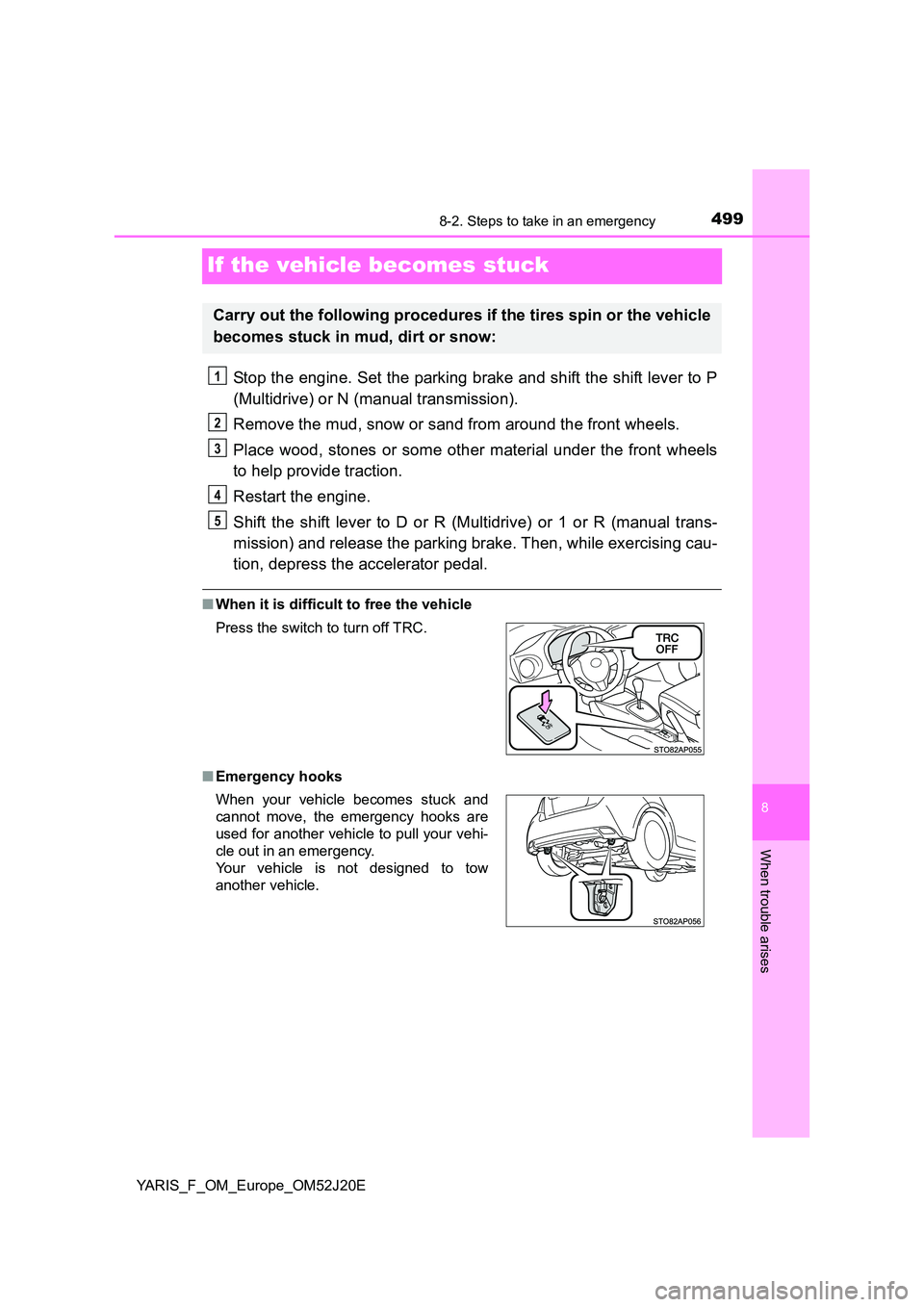
■ When it is difficult to free the vehicle
■ Emergency hooks
Carry out the following procedures if the tires spin or the vehicle
becomes stuck in mud, dirt or snow:
Press the switch to turn off TRC.
When your vehicle becomes stuck and
cannot move, the emergency hooks are
used for another vehicle to pull your vehi-
cle out in an emergency.
Your vehicle is not designed to tow
another vehicle.
1
2
3
4
5
Page 500 of 549
5008-2. Steps to take in an emergency
YARIS_F_OM_Europe_OM52J20E
WARNING
■When attempting to free a stuck vehicle
If you choose to push the vehicle back and forth to free it, make sure the
surrounding area is clear to avoid striking other vehicles, objects or people.
The vehicle may also lunge forward or lunge back suddenly as it becomes
free. Use extreme caution.
■ When shifting the shift lever
Be careful not to shift the shift lever with the accelerator pedal depressed.
This may lead to unexpected rapid acceleration of the vehicle that may
cause an accident resulting in death or serious injury.
NOTICE
■ To avoid damage to the transmission and other components
● Avoid spinning the front wheels and depressing the accelerator pedal
more than necessary.
● If the vehicle remains stuck even after these procedures are performed,
the vehicle may require towing to be freed.
Page 502 of 549
5029-1. Specifications
YARIS_F_OM_Europe_OM52J20E
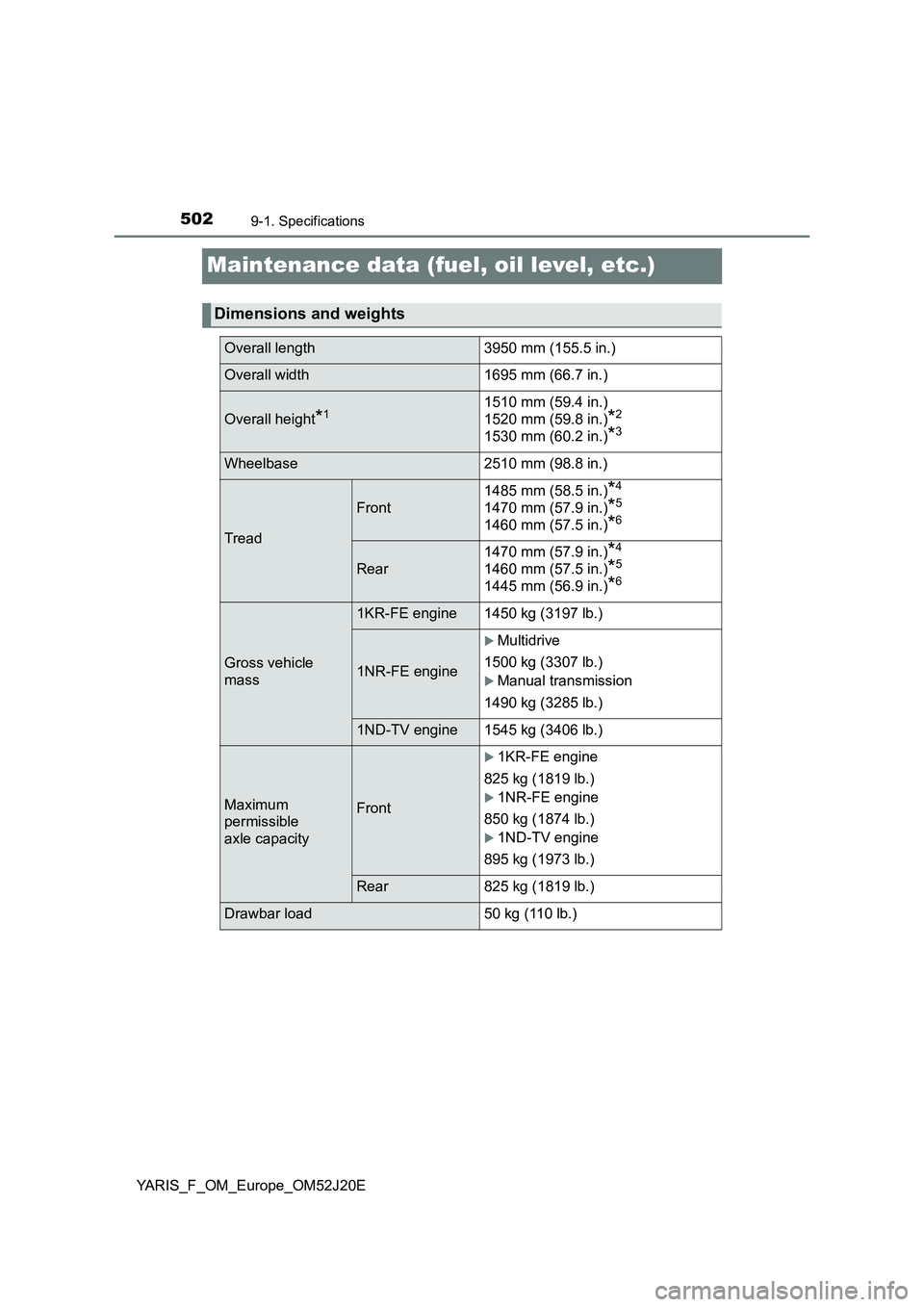
Maintenance data (fuel, oil level, etc.)
Dimensions and weights
Overall length 3950 mm (155.5 in.)
Overall width 1695 mm (66.7 in.)
Overall height*11510 mm (59.4 in.)
1520 mm (59.8 in.)*2
1530 mm (60.2 in.)*3
Wheelbase 2510 mm (98.8 in.)
Tread
Front
1485 mm (58.5 in.)*4
1470 mm (57.9 in.)*5
1460 mm (57.5 in.)*6
Rear
1470 mm (57.9 in.)*4
1460 mm (57.5 in.)*5
1445 mm (56.9 in.)*6
Gross vehicle
mass
1KR-FE engine 1450 kg (3197 lb.)
1NR-FE engine
Multidrive
1500 kg (3307 lb.)
Manual transmission
1490 kg (3285 lb.)
1ND-TV engine 1545 kg (3406 lb.)
Maximum
permissible
axle capacity
Front
1KR-FE engine
825 kg (1819 lb.)
1NR-FE engine
850 kg (1874 lb.)
1ND-TV engine
895 kg (1973 lb.)
Rear 825 kg (1819 lb.)
Drawbar load 50 kg (110 lb.)
Page 518 of 549
5189-1. Specifications
YARIS_F_OM_Europe_OM52J20E
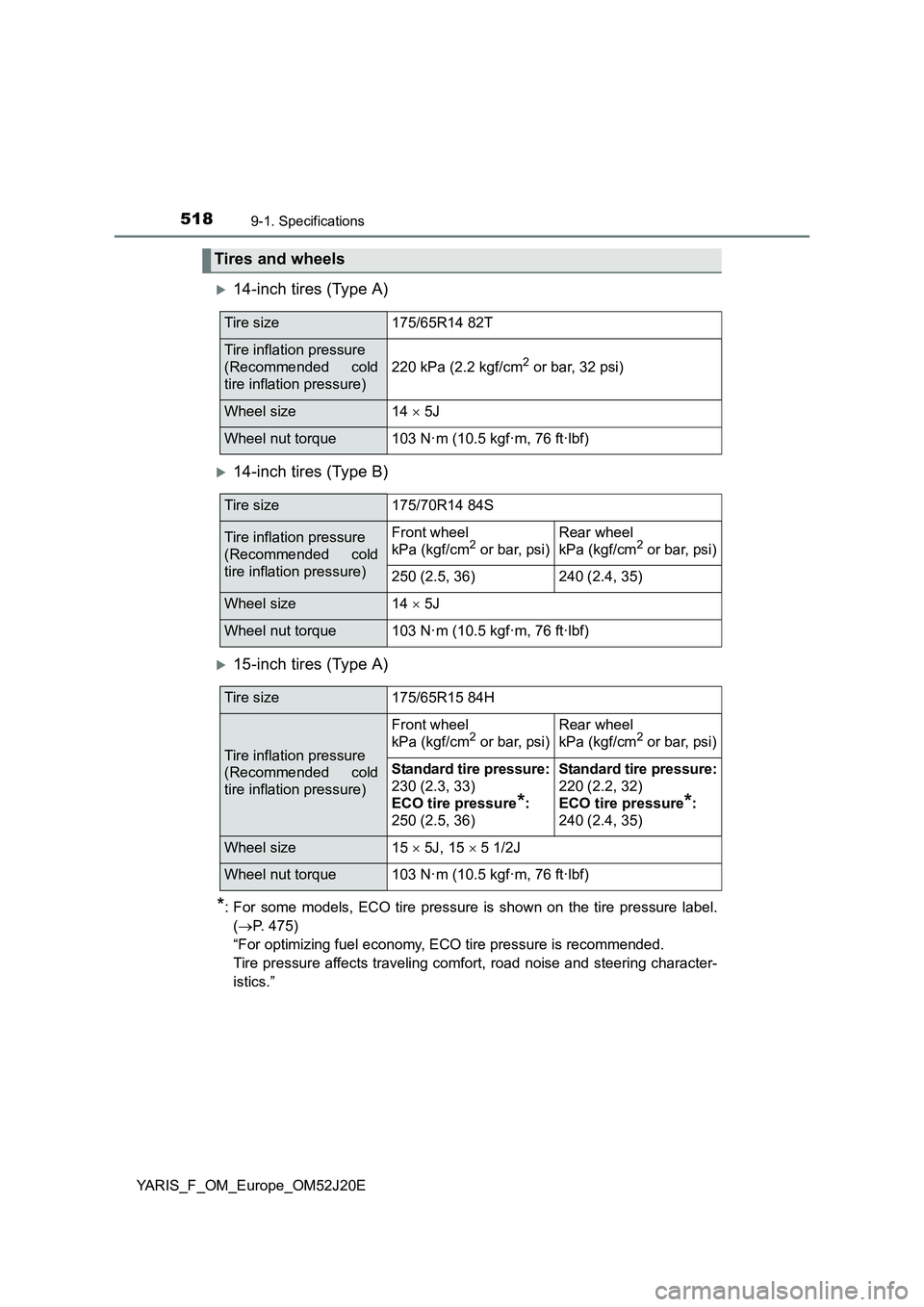
14-inch tires (Type A)
14-inch tires (Type B)
15-inch tires (Type A)
*: For some models, ECO tire pressure is shown on the tire pressure label.
( P. 475)
“For optimizing fuel economy, ECO tire pressure is recommended.
Tire pressure affects traveling comfort, road noise and steering character-
istics.”
Tires and wheels
Tire size175/65R14 82T
Tire inflation pressure
(Recommended cold
tire inflation pressure)
220 kPa (2.2 kgf/cm2 or bar, 32 psi)
Wheel size14 5J
Wheel nut torque103 N·m (10.5 kgf·m, 76 ft·lbf)
Tire size175/70R14 84S
Tire inflation pressure
(Recommended cold
tire inflation pressure)
Front wheel
kPa (kgf/cm2 or bar, psi)
Rear wheel
kPa (kgf/cm2 or bar, psi)
250 (2.5, 36)240 (2.4, 35)
Wheel size14 5J
Wheel nut torque103 N·m (10.5 kgf·m, 76 ft·lbf)
Tire size175/65R15 84H
Tire inflation pressure
(Recommended cold
tire inflation pressure)
Front wheel
kPa (kgf/cm2 or bar, psi)
Rear wheel
kPa (kgf/cm2 or bar, psi)
Standard tire pressure:
230 (2.3, 33)
ECO tire pressure*:
250 (2.5, 36)
Standard tire pressure:
220 (2.2, 32)
ECO tire pressure*:
240 (2.4, 35)
Wheel size15 5J, 15 5 1/2J
Wheel nut torque103 N·m (10.5 kgf·m, 76 ft·lbf)
Page 519 of 549
5199-1. Specifications
9
Vehicle specifications
YARIS_F_OM_Europe_OM52J20E
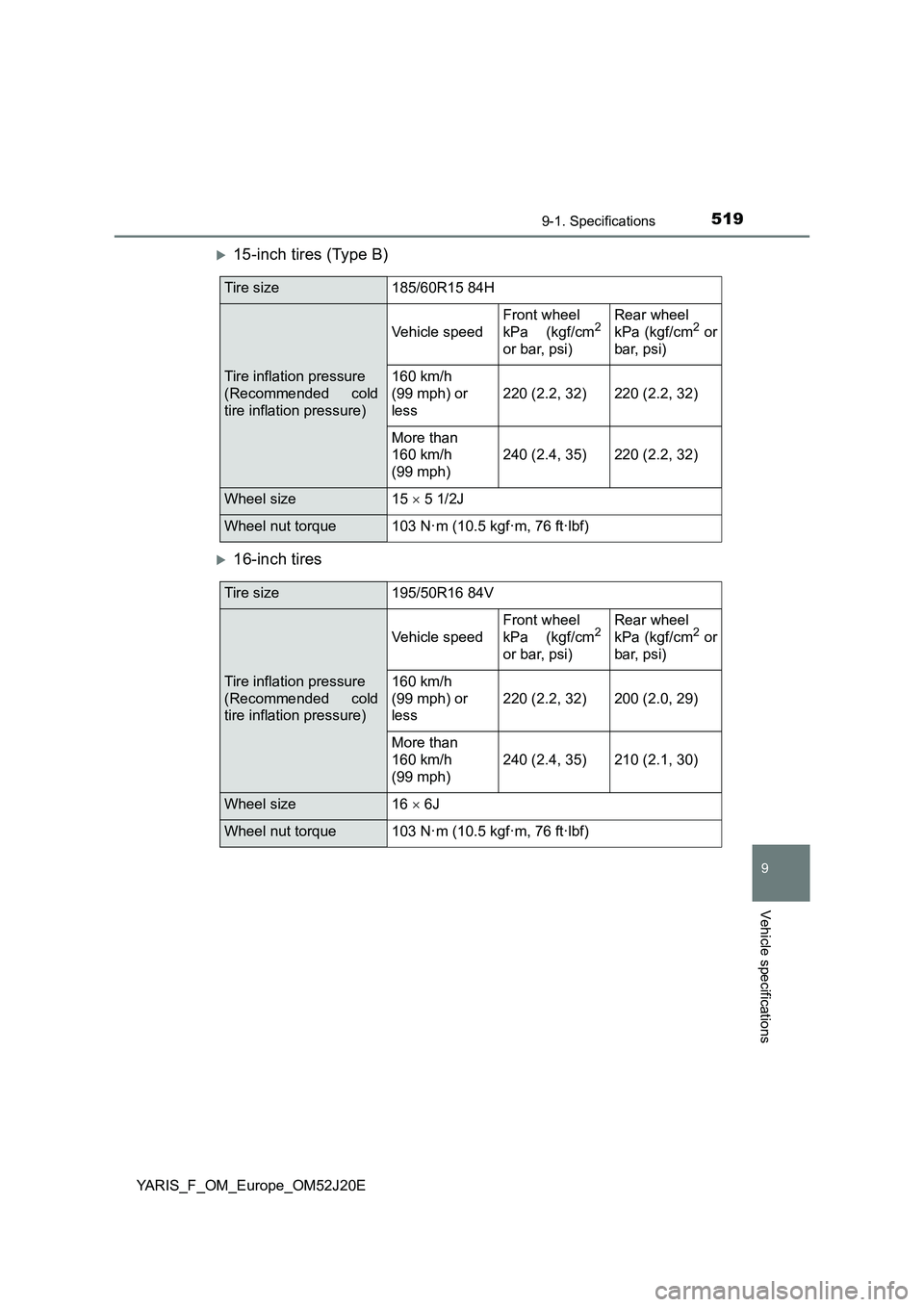
15-inch tires (Type B)
16-inch tires
Tire size185/60R15 84H
Tire inflation pressure
(Recommended cold
tire inflation pressure)
Vehicle speed
Front wheel
kPa (kgf/cm2
or bar, psi)
Rear wheel
kPa (kgf/cm2 or
bar, psi)
160 km/h
(99 mph) or
less
220 (2.2, 32)220 (2.2, 32)
More than
160 km/h
(99 mph)
240 (2.4, 35)220 (2.2, 32)
Wheel size15 5 1/2J
Wheel nut torque103 N·m (10.5 kgf·m, 76 ft·lbf)
Tire size195/50R16 84V
Tire inflation pressure
(Recommended cold
tire inflation pressure)
Vehicle speed
Front wheel
kPa (kgf/cm2
or bar, psi)
Rear wheel
kPa (kgf/cm2 or
bar, psi)
160 km/h
(99 mph) or
less
220 (2.2, 32)200 (2.0, 29)
More than
160 km/h
(99 mph)
240 (2.4, 35)210 (2.1, 30)
Wheel size16 6J
Wheel nut torque103 N·m (10.5 kgf·m, 76 ft·lbf)
Page 520 of 549
5209-1. Specifications
YARIS_F_OM_Europe_OM52J20E
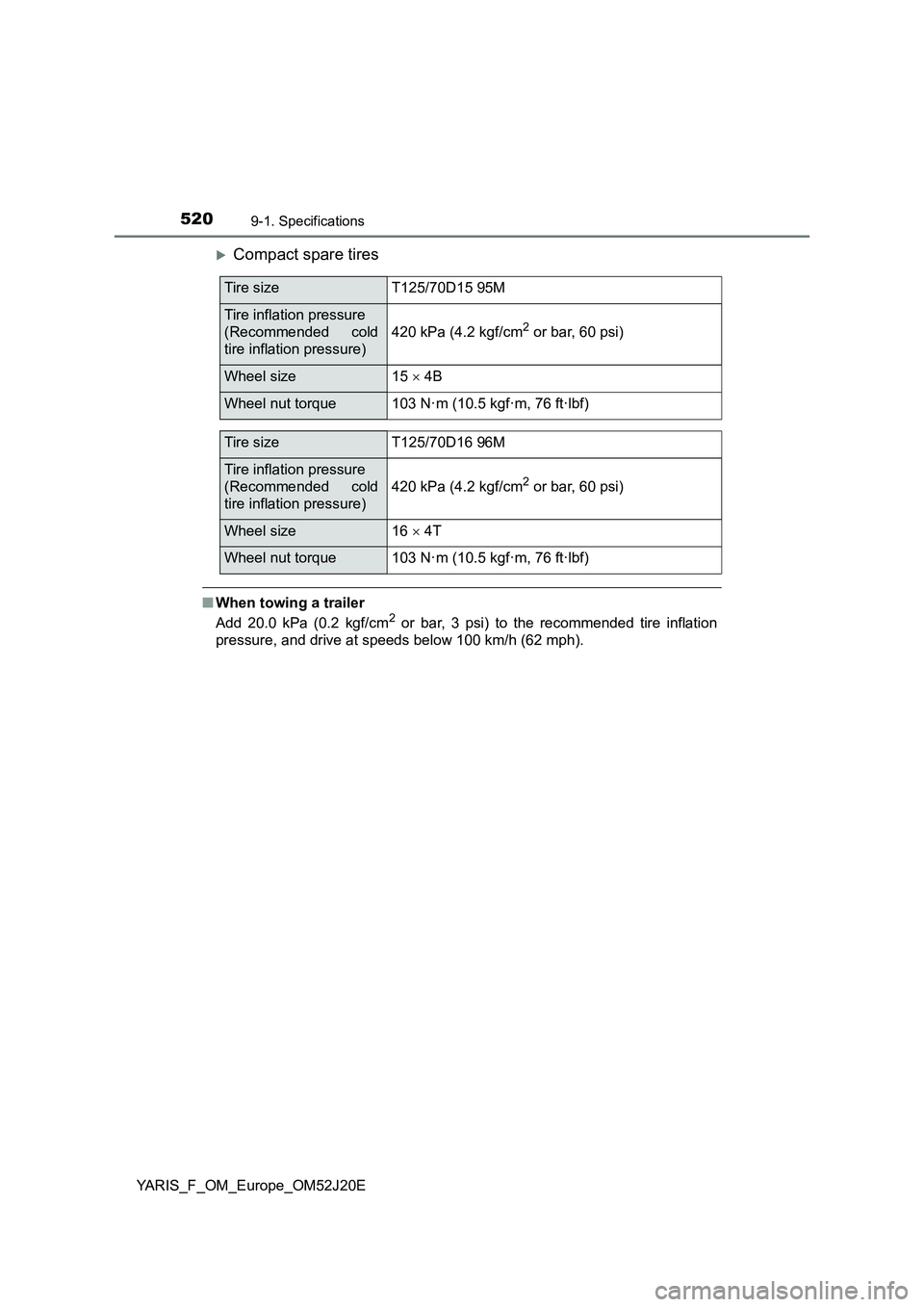
Compact spare tires
■When towing a trailer
Add 20.0 kPa (0.2 kgf/cm2 or bar, 3 psi) to the recommended tire inflation
pressure, and drive at speeds below 100 km/h (62 mph).
Tire sizeT125/70D15 95M
Tire inflation pressure
(Recommended cold
tire inflation pressure)
420 kPa (4.2 kgf/cm2 or bar, 60 psi)
Wheel size15 4B
Wheel nut torque103 N·m (10.5 kgf·m, 76 ft·lbf)
Tire sizeT125/70D16 96M
Tire inflation pressure
(Recommended cold
tire inflation pressure)
420 kPa (4.2 kgf/cm2 or bar, 60 psi)
Wheel size16 4T
Wheel nut torque103 N·m (10.5 kgf·m, 76 ft·lbf)
Page 531 of 549
531What to do if... (Troubleshooting)
YARIS_F_OM_Europe_OM52J20E
●Vehicles with a Multidrive:
Is the shift lever in P? ( P. 182)
●Vehicles with a manual transmission:
Did you turn the key while firmly depressing the clutch pedal? ( P. 182)
●Is the battery discharged? (P. 488)
●Vehicles with a Multidrive:
Did you press the engine switch while firmly depressing the brake pedal?
( P. 185)
●Vehicles with a manual transmission:
Did you press the engine switch while firmly depressing the clutch pedal?
( P. 185)
●Vehicles with a Multidrive:
Is the shift lever in P? ( P. 185)
●Is the electronic key anywhere detectable inside the vehicle? (P. 128)
●Is the steering wheel unlocked? (P. 188)
●Is the electronic key battery weak or depleted?
In this case, the engine can be started in a temporary way. ( P. 486)
●Is the battery discharged? (P. 488)
If you think something is wrong
The engine does not start
(vehicles without a smart entry & start system)
The engine does not start
(vehicles with a smart entry & start system)
Page 532 of 549
532What to do if... (Troubleshooting)
YARIS_F_OM_Europe_OM52J20E
●Vehicles without a smart entry & start system:
Is the engine switch in the “ON” position?
If you cannot release the shift lever by depressing the brake pedal with the
engine switch in the “ON” position. ( P. 195)
●Vehicles with a smart entry & start system:
Is the engine switch in IGNITION ON mode?
If you cannot release the shift lever by depressing the brake pedal with the
engine switch in IGNITION ON mode. ( P. 195)
●Vehicles without a smart entry & start system:
It is locked to prevent theft of the vehicle if the key is pulled from the engine
switch. ( P. 184)
●Vehicles with a smart entry & start system:
It is locked automatically to prevent theft of the vehicle. ( P. 188)
●Is the window lock switch pressed?
The power window except for the one at the driver’s seat cannot be oper-
ated if the window lock switch is pressed. ( P. 154)
●The auto power off function will be operated if the vehicle is left in ACCES-
SORY or IGNITION ON mode (the engine is not running) for a period of
time. ( P. 187)
The shift lever cannot be shifted from P even if you depress
the brake pedal (vehicles with a Multidrive)
The steering wheel cannot be turned after the engine is
stopped
The windows do not open or close by operating the power
window switches
The engine switch is turned off automatically
(vehicles with a smart entry & start system)