ECU TOYOTA YARIS 2018 Owner's Manual
[x] Cancel search | Manufacturer: TOYOTA, Model Year: 2018, Model line: YARIS, Model: TOYOTA YARIS 2018Pages: 632, PDF Size: 44.1 MB
Page 62 of 632
621-2. Child safety
YARIS_HV_OM_Europe_OM52J66E
WARNING
■Handling the child restraint system
If the child restraint system is not properly fixed in place, the child or other
passengers may be seriously injured or even killed in the event of sudden
braking, sudden swerving, or an accident.
● If the vehicle were to receive a strong impact from an accident, etc., it is
possible that the child restraint system has damage that is not readily visi-
ble. In such cases, do not reuse the restraint system.
● Depending on the child restraint system, installation may be difficult or
impossible. In those cases, check whether the child restraint system is
suitable for installment in the vehicle. ( P. 70, 77) Be sure to install and
observe the usage rules after carefully reading the child restraint system
fixing method in this manual, as well as the operation manual enclosed
with the child restraint system.
● Keep the child restraint system properly secured on the seat even if it is
not in use. Do not store the child restraint system unsecured in the pas-
senger compartment.
● If it is necessary to detach the child restraint system, remove it from the
vehicle or store it securely in the luggage compartment.
Page 63 of 632
631-2. Child safety
1
For safety and security
YARIS_HV_OM_Europe_OM52J66E
Install the available child restraint system in vehicle upon confirming
the following items.
■Standards for child restraint systems
Use a child restraint system that conforms to ECE R44*1 or ECE
R129*1, 2.
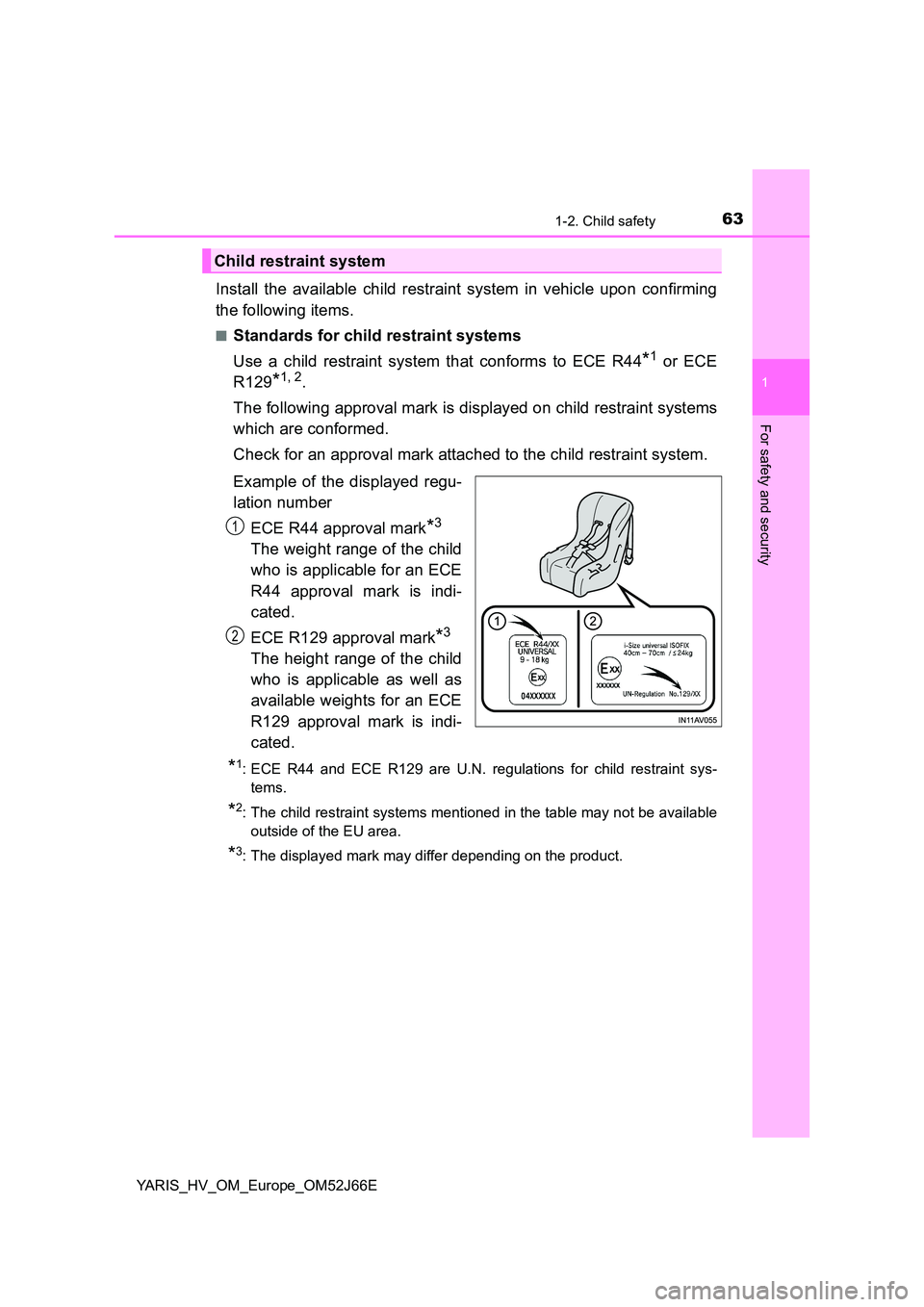
The following approval mark is displayed on child restraint systems
which are conformed.
Check for an approval mark attached to the child restraint system.
Example of the displayed regu-
lation number
ECE R44 approval mark*3
The weight range of the child
who is applicable for an ECE
R44 approval mark is indi-
cated.
ECE R129 approval mark*3
The height range of the child
who is applicable as well as
available weights for an ECE
R129 approval mark is indi-
cated.
*1: ECE R44 and ECE R129 are U.N. regulations for child restraint sys-
tems.
*2: The child restraint systems mentioned in the table may not be available
outside of the EU area.
*3: The displayed mark may differ depending on the product.
Child restraint system
1
2
Page 65 of 632
651-2. Child safety
1
For safety and security
YARIS_HV_OM_Europe_OM52J66E
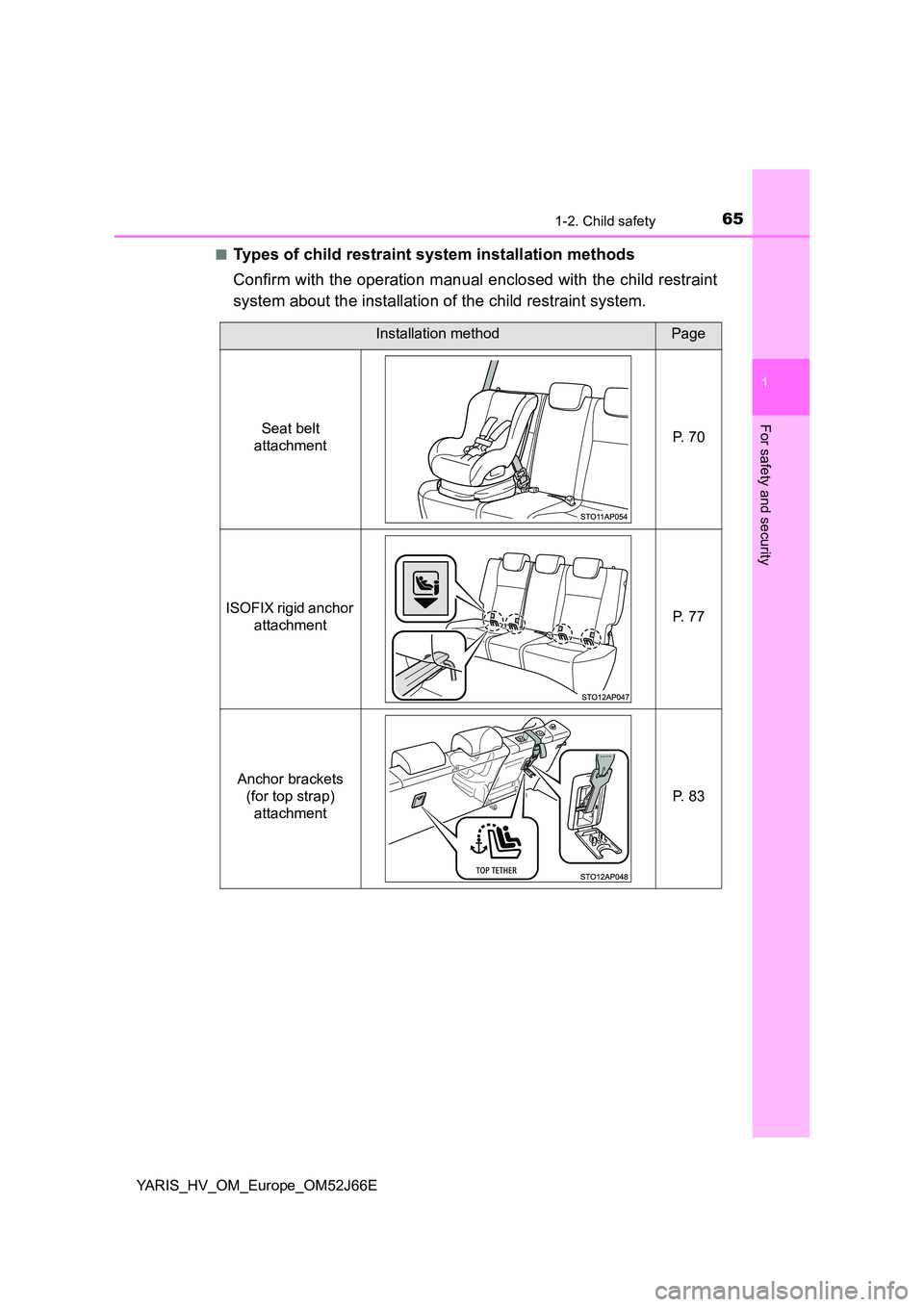
■Types of child restraint system installation methods
Confirm with the operation manual enclosed with the child restraint
system about the installation of the child restraint system.
Installation methodPage
Seat belt
attachment P. 7 0
ISOFIX rigid anchor
attachment P. 7 7
Anchor brackets
(for top strap)
attachment
P. 8 3
Page 67 of 632
671-2. Child safety
1
For safety and security
YARIS_HV_OM_Europe_OM52J66E
WARNING
■When using a child restraint system
Observe the following precautions.
Failure to do so may result in death or serious injury.
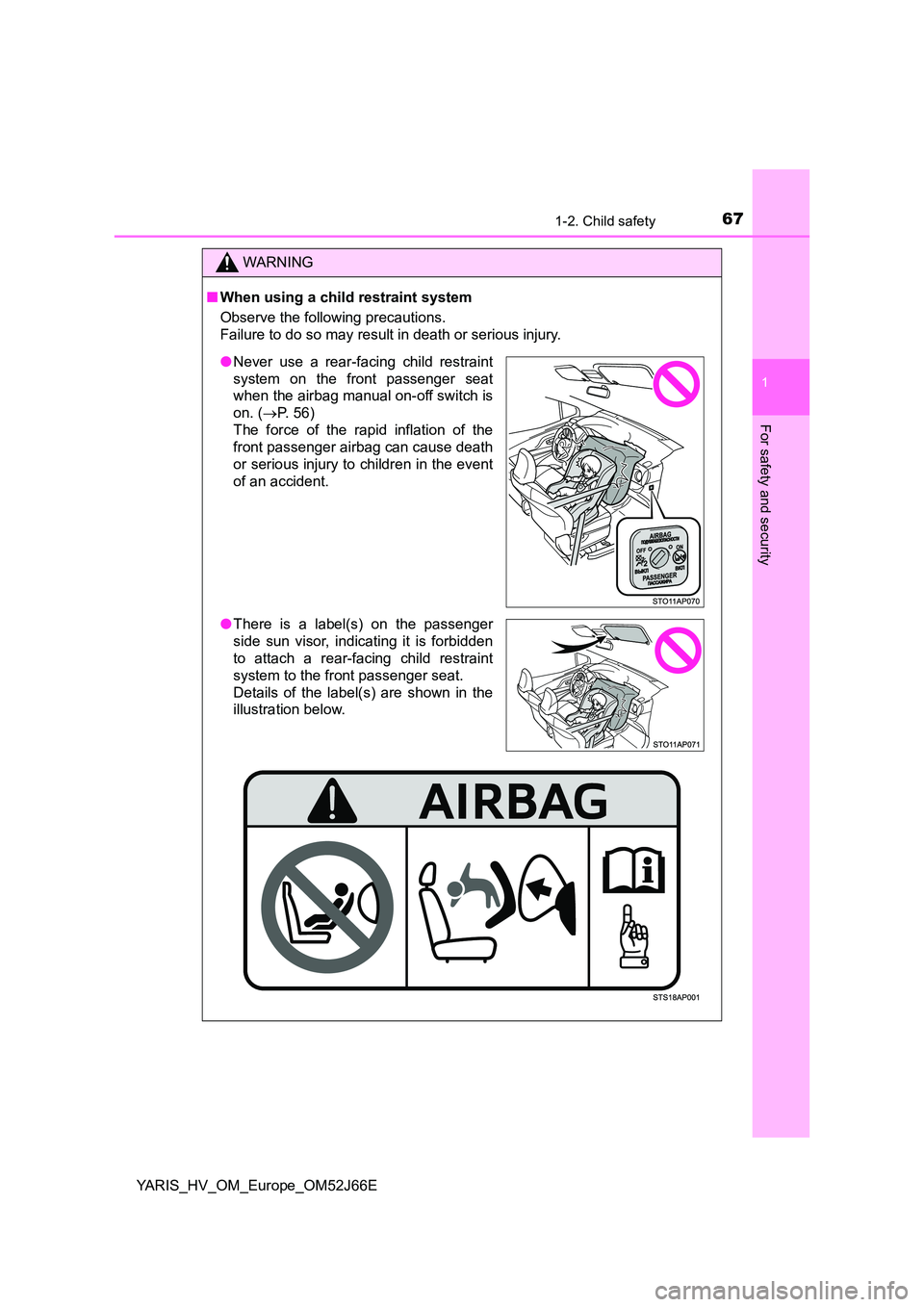
● Never use a rear-facing child restraint
system on the front passenger seat
when the airbag manual on-off switch is
on. ( P. 56)
The force of the rapid inflation of the
front passenger airbag can cause death
or serious injury to children in the event
of an accident.
● There is a label(s) on the passenger
side sun visor, indicating it is forbidden
to attach a rear-facing child restraint
system to the front passenger seat.
Details of the label(s) are shown in the
illustration below.
Page 69 of 632
691-2. Child safety
1
For safety and security
YARIS_HV_OM_Europe_OM52J66E
WARNING
■When using a child restraint system
● When a junior seat is installed, always ensure that the shoulder belt is
positioned across the center of the child’s shoulder. The belt should be
kept away from the child’s neck, but not so that it could fall off the child’s
shoulder.
● Use child restraint system suitable to the age and size of the child and
install it to the rear seat.
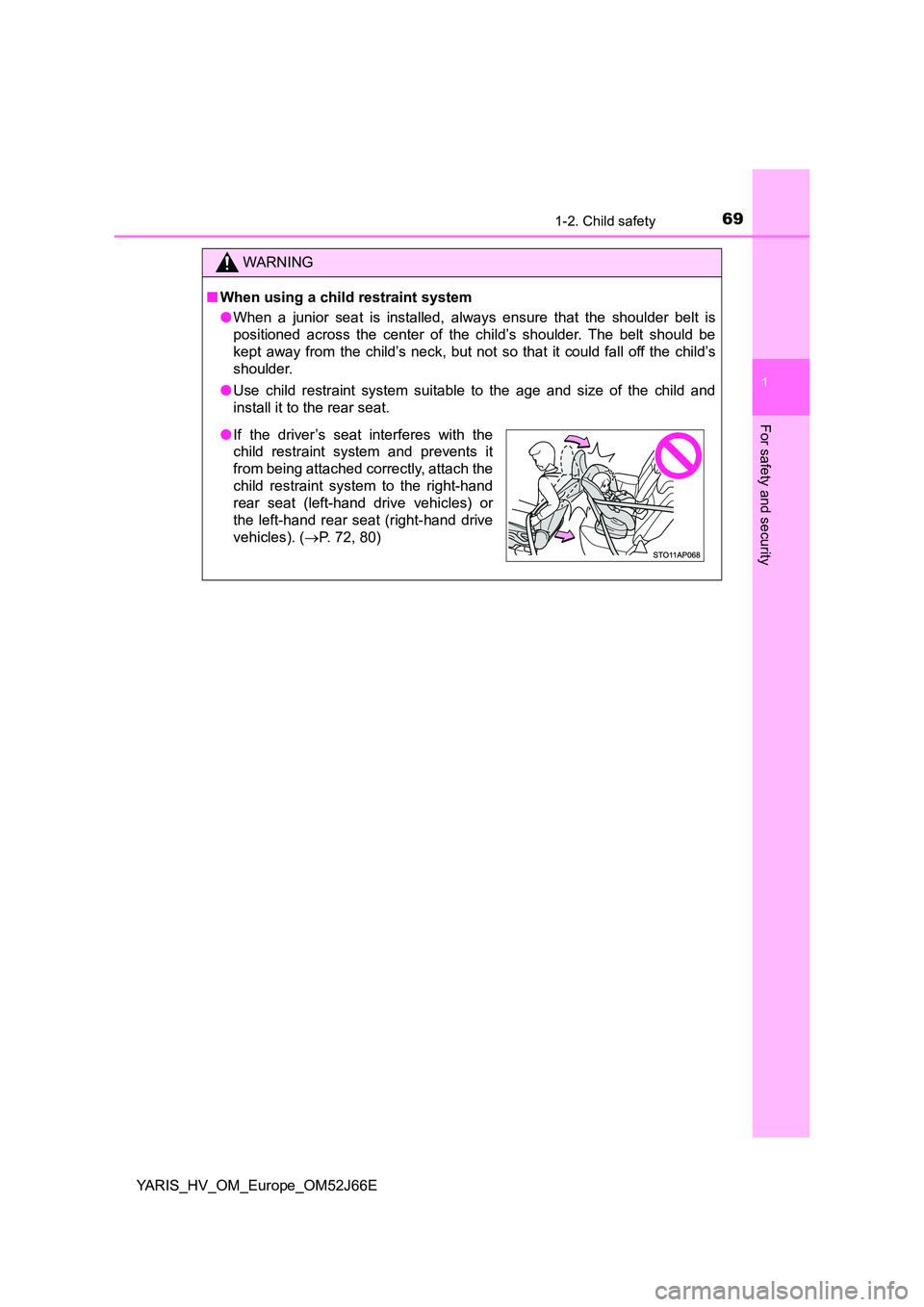
● If the driver’s seat interferes with the
child restraint system and prevents it
from being attached correctly, attach the
child restraint system to the right-hand
rear seat (left-hand drive vehicles) or
the left-hand rear seat (right-hand drive
vehicles). ( P. 72, 80)
Page 71 of 632
711-2. Child safety
1
For safety and security
YARIS_HV_OM_Europe_OM52J66E
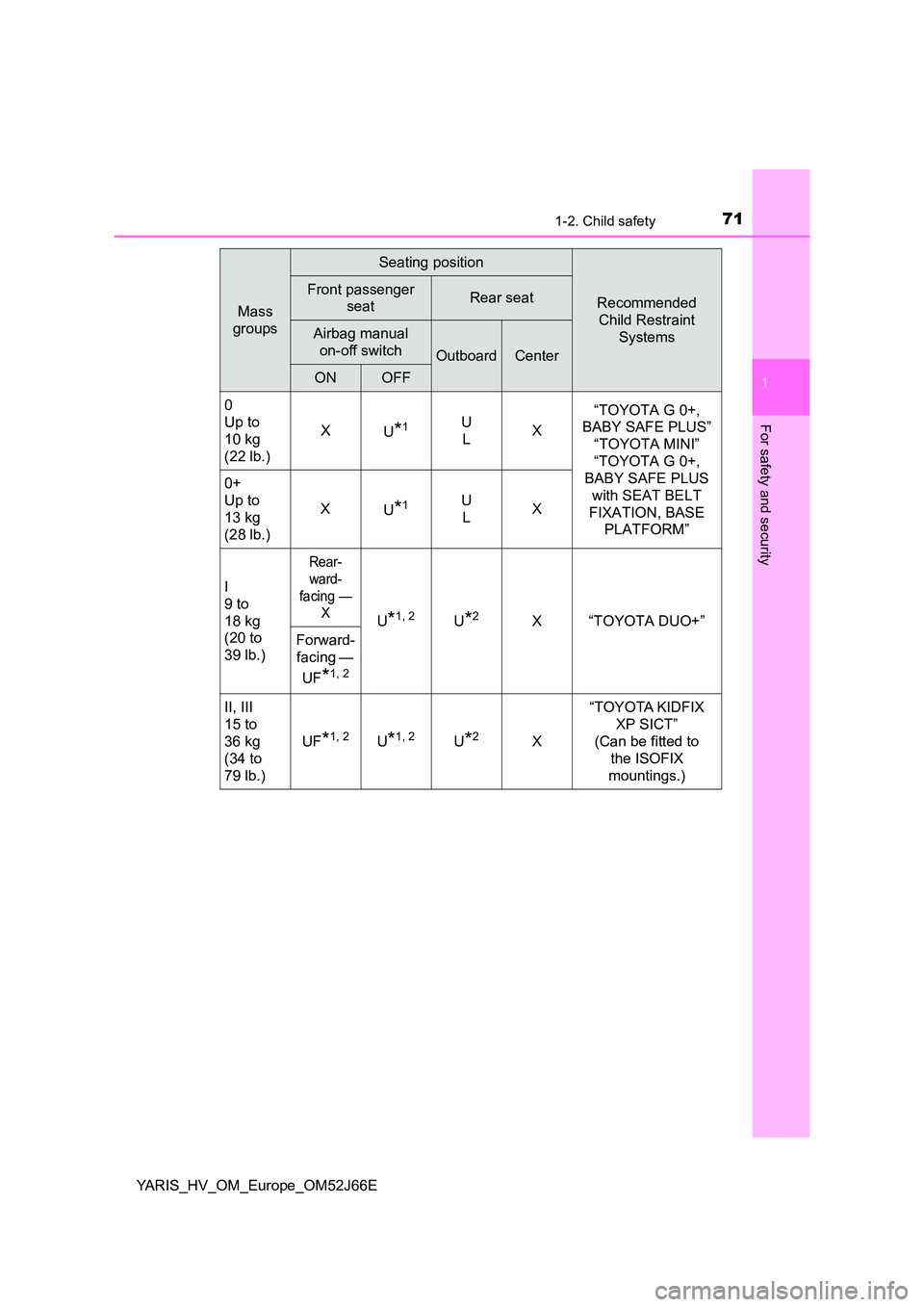
Mass
groups
Seating position
Recommended
Child Restraint
Systems
Front passenger
seatRear seat
Airbag manual
on-off switchOutboardCenter
ONOFF
0
Up to
10 kg
(22 lb.)
X U*1U
L X
“TOYOTA G 0+,
BABY SAFE PLUS”
“TOYOTA MINI”
“TOYOTA G 0+,
BABY SAFE PLUS
with SEAT BELT
FIXATION, BASE
PLATFORM”
0+
Up to
13 kg
(28 lb.)
X U*1U
L X
I
9 to
18 kg
(20 to
39 lb.)
Rear-
ward-
facing —
XU*1, 2U*2X “TOYOTA DUO+”
Forward-
facing —
UF*1, 2
II, III
15 to
36 kg
(34 to
79 lb.)
UF*1, 2U*1, 2U*2X
“TOYOTA KIDFIX
XP SICT”
(Can be fitted to
the ISOFIX
mountings.)
Page 72 of 632
721-2. Child safety
YARIS_HV_OM_Europe_OM52J66E
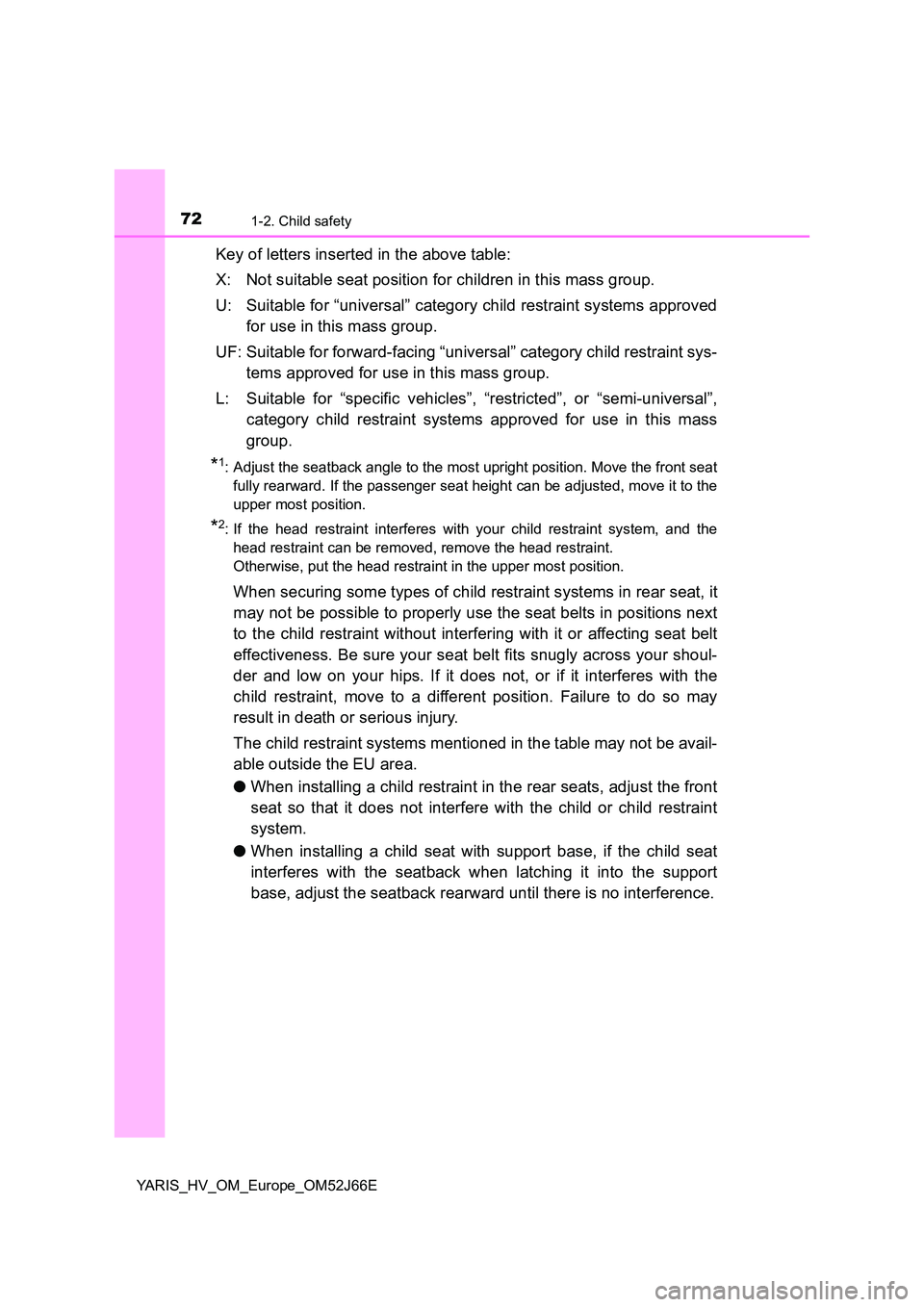
Key of letters inserted in the above table:
X: Not suitable seat position for children in this mass group.
U: Suitable for “universal” category child restraint systems approved
for use in this mass group.
UF: Suitable for forward-facing “universal” category child restraint sys-
tems approved for use in this mass group.
L: Suitable for “specific vehicles”, “restricted”, or “semi-universal”,
category child restraint systems approved for use in this mass
group.
*1: Adjust the seatback angle to the most upright position. Move the front seat
fully rearward. If the passenger seat height can be adjusted, move it to the
upper most position.
*2: If the head restraint interferes with your child restraint system, and the
head restraint can be removed, remove the head restraint.
Otherwise, put the head restraint in the upper most position.
When securing some types of child restraint systems in rear seat, it
may not be possible to properly use the seat belts in positions next
to the child restraint without interfering with it or affecting seat belt
effectiveness. Be sure your seat belt fits snugly across your shoul-
der and low on your hips. If it does not, or if it interferes with the
child restraint, move to a different position. Failure to do so may
result in death or serious injury.
The child restraint systems mentioned in the table may not be avail-
able outside the EU area.
● When installing a child restraint in the rear seats, adjust the front
seat so that it does not interfere with the child or child restraint
system.
● When installing a child seat with support base, if the child seat
interferes with the seatback when latching it into the support
base, adjust the seatback rearward until there is no interference.
Page 73 of 632
731-2. Child safety
1
For safety and security
YARIS_HV_OM_Europe_OM52J66E
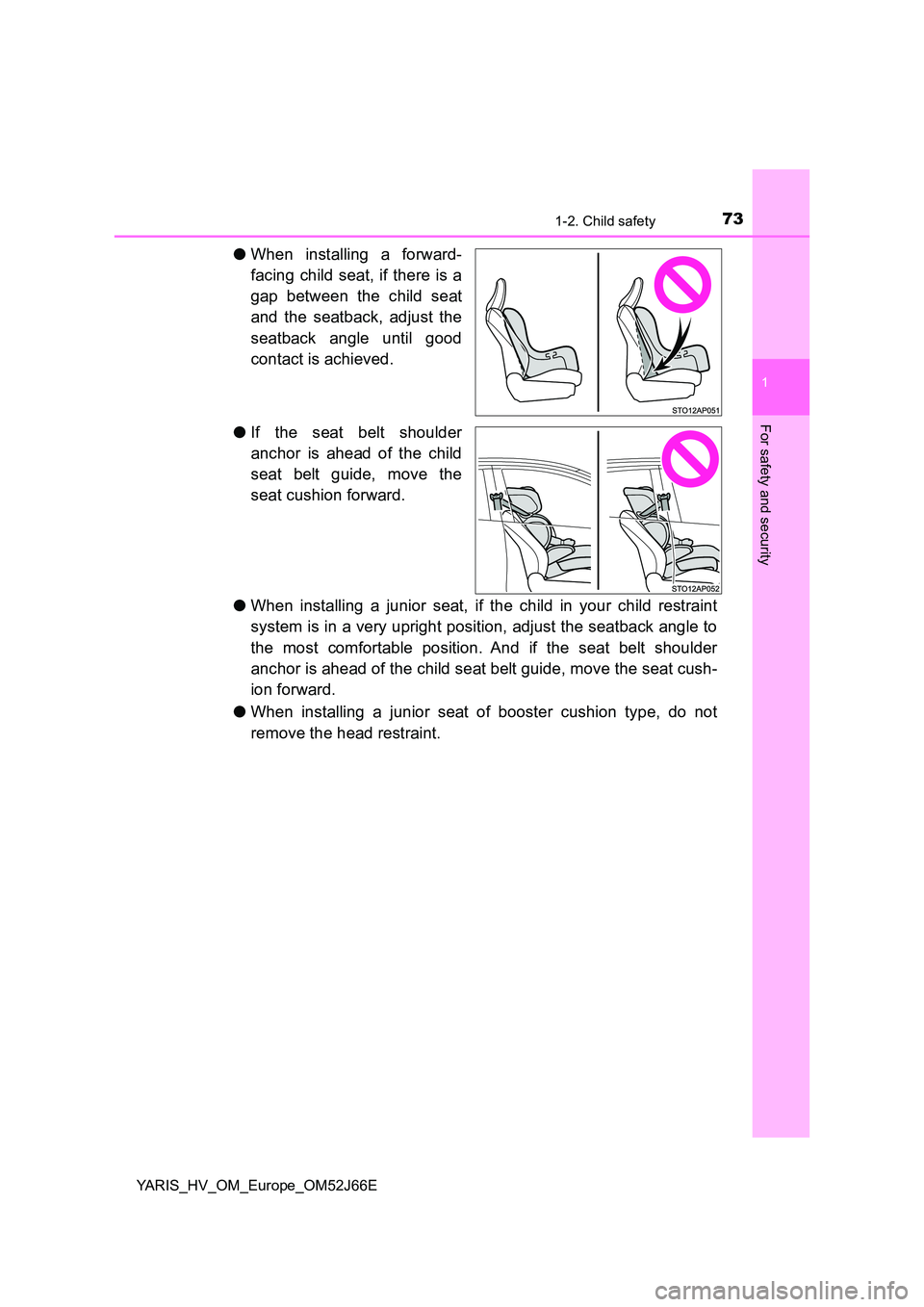
●When installing a forward-
facing child seat, if there is a
gap between the child seat
and the seatback, adjust the
seatback angle until good
contact is achieved.
● If the seat belt shoulder
anchor is ahead of the child
seat belt guide, move the
seat cushion forward.
● When installing a junior seat, if the child in your child restraint
system is in a very upright position, adjust the seatback angle to
the most comfortable position. And if the seat belt shoulder
anchor is ahead of the child seat belt guide, move the seat cush-
ion forward.
● When installing a junior seat of booster cushion type, do not
remove the head restraint.
Page 74 of 632
741-2. Child safety
YARIS_HV_OM_Europe_OM52J66E
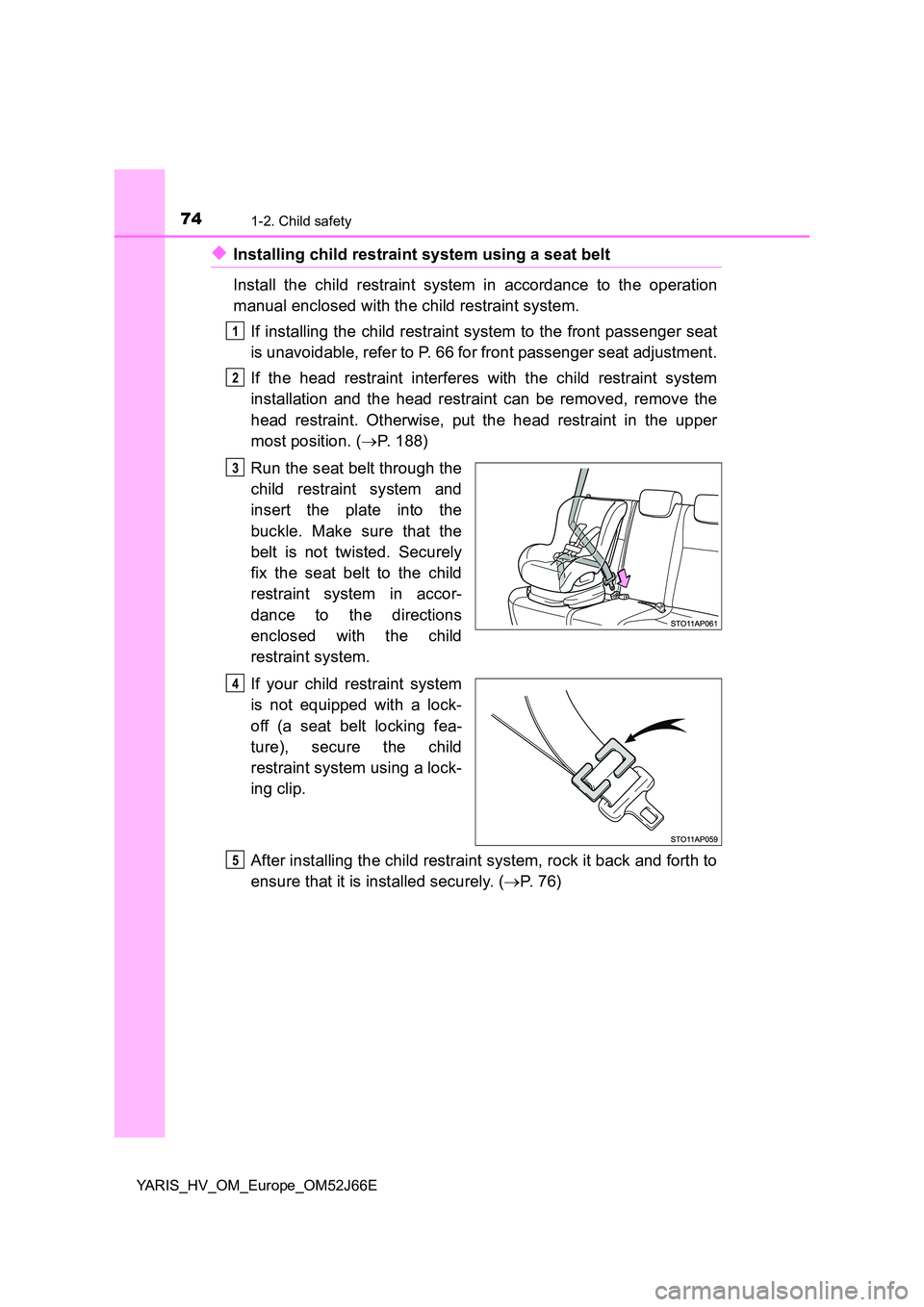
◆Installing child restraint system using a seat belt
Install the child restraint system in accordance to the operation
manual enclosed with the child restraint system.
If installing the child restraint system to the front passenger seat
is unavoidable, refer to P. 66 for front passenger seat adjustment.
If the head restraint interferes with the child restraint system
installation and the head restraint can be removed, remove the
head restraint. Otherwise, put the head restraint in the upper
most position. ( P. 188)
Run the seat belt through the
child restraint system and
insert the plate into the
buckle. Make sure that the
belt is not twisted. Securely
fix the seat belt to the child
restraint system in accor-
dance to the directions
enclosed with the child
restraint system.
If your child restraint system
is not equipped with a lock-
off (a seat belt locking fea-
ture), secure the child
restraint system using a lock-
ing clip.
After installing the child restraint system, rock it back and forth to
ensure that it is installed securely. ( P. 7 6 )
1
2
3
4
5
Page 75 of 632
751-2. Child safety
1
For safety and security
YARIS_HV_OM_Europe_OM52J66E
◆Removing a child restraint system installed with a seat belt
Press the buckle release button and fully retract the seat belt.
When releasing the buckle, the chil d restraint system may spring up due
to the rebound of the seat cushion. Release the buckle while holding
down the child restraint system.
Since the seat belt automatically reels itself, slowly return it to the stow-
ing position.
■ When installing a child restraint system
You may need a locking clip to install the child restraint system. Follow the
instructions provided by the manufacturer of the system. If your child restraint
system does not provide a locking clip, you can purchase the following item
from any authorized Toyota retailer or Toyota authorized repairer, or any reli-
able repairer: Locking clip for child restraint system
(Part No. 73119-22010)