pressure TOYOTA YARIS 2018 Workshop Manual
[x] Cancel search | Manufacturer: TOYOTA, Model Year: 2018, Model line: YARIS, Model: TOYOTA YARIS 2018Pages: 632, PDF Size: 44.1 MB
Page 553 of 632
5538-2. Steps to take in an emergency
8
When trouble arises
YARIS_HV_OM_Europe_OM52J66E
WARNING
■When fixing the flat tire
● Stop your vehicle in a safe and flat area.
● Do not touch the wheels or the area around the brakes immediately after
the vehicle has been driven.
After the vehicle has been driven, the wheels and the area around the
brakes may be extremely hot. Touching these areas with hands, feet or
other body parts may result in burns.
● To avoid risk of burst or severe leakage, do not drop or damage the bottle.
Visually inspect the bottle before use. Do not use a bottle with shock,
crack, scratch, leakage or any other damage. In such case, immediately
replace.
● Connect the valve and hose securely with the tire installed on the vehicle.
If the hose is not properly connected to the valve, air leakage may occur
as sealant may be sprayed out.
● If the hose comes off the valve while inflating the tire, there is a risk that
the hose will move abruptly due to air pressure.
● After inflation of the tire has completed, the sealant may splatter when the
hose is disconnected or some air is let out of the tire.
● Follow the operation procedure to repair the tire. If the procedures not fol-
lowed, the sealant may spray out.
● Keep back from the tire while it is being repaired, as there is a chance of it
bursting while the repair operation is being performed. If you notice any
cracks or deformation of the tire, turn off the compressor switch and stop
the repair operation immediately.
● The repair kit may overheat if operated for a long period of time. Do not
operate the repair kit continuously for more than 40 minutes.
● Parts of the repair kit become hot during operation. Be careful when han-
dling the repair kit during and after operation. Do not touch the metal part
around the connecting area between the bottle and compressor. It will be
extremely hot.
● Do not attach the vehicle speed warning sticker to an area other than the
one indicated. If the sticker is attached to an area where an SRS airbag is
located, such as the pad of the steering wheel, it may prevent the SRS air-
bag from operating properly.
Page 554 of 632
5548-2. Steps to take in an emergency
YARIS_HV_OM_Europe_OM52J66E
WARNING
■Driving to spread the liquid sealant evenly
Observe the following precautions to reduce the risk of accidents.
Failing to do so may result in a loss of vehicle control and cause death or
serious injury.
● Drive the vehicle carefully at a low speed. Be especially careful when turn-
ing and cornering.
● If the vehicle does not drive straight or you feel a pull through the steering
wheel, stop the vehicle and check the following.
• Tire condition. The tire may have separated from the wheel.
• Tire inflation pressure. If the tire inflation pressure is 130 kPa (1.3 kgf/cm2
or bar, 19 psi) or less, the tire may be severely damaged.
NOTICE
■ When performing an emergency repair
● A tire should only be repaired with the emergency tire puncture repair kit if
the damage is caused by a sharp object such as nail or screw passing
through the tire tread.
Do not remove the sharp object from the tire. Removing the object may
widen the opening and disenable emergenc y repair with the repair kit.
● The repair kit is not waterproof. Make sure that the repair kit is not
exposed to water, such as when it is being used in the rain.
● Do not put the repair kit directly onto dusty ground such as sand at the
side of the road. If the repair kit vacuums up dust etc., a malfunction may
occur.
● Do not turn the bottle upside down when using it, as doing so may cause
damage to the compressor.
Page 555 of 632
5558-2. Steps to take in an emergency
8
When trouble arises
YARIS_HV_OM_Europe_OM52J66E
NOTICE
■Precautions for the emergency tire puncture repair kit
● The repair kit power source should be 12 V DC suitable for vehicle use. Do
not connect the repair kit to any other source.
● If gasoline splatters on the repair kit, the repair kit may deteriorate. Take
care not to allow gasoline to contact it.
● Place the repair kit in a storage to prevent it from being exposed to dirt or
water.
● Store the repair kit in the luggage room out of reach of children.
● Do not disassemble or modify the repair kit. Do not subject parts such as
the air pressure indicator to impacts. This may cause a malfunction.
■ To avoid damage to the tire pressure warning valves and transmitters
(vehicles with a tire pressure warning system)
When a tire is repaired with liquid sealants, the tire pressure warning valve
and transmitter may not operate properly. If a liquid sealant is used, contact
any authorized Toyota retailer or Toyota authorized repairer, or any reliable
repairer or other qualified service shop as soon as possible. After use of liq-
uid sealant, make sure to replace the tire pressure warning valve and trans-
mitter when repairing or replacing the tire. ( P. 453)
Page 565 of 632
5658-2. Steps to take in an emergency
8
When trouble arises
YARIS_HV_OM_Europe_OM52J66E
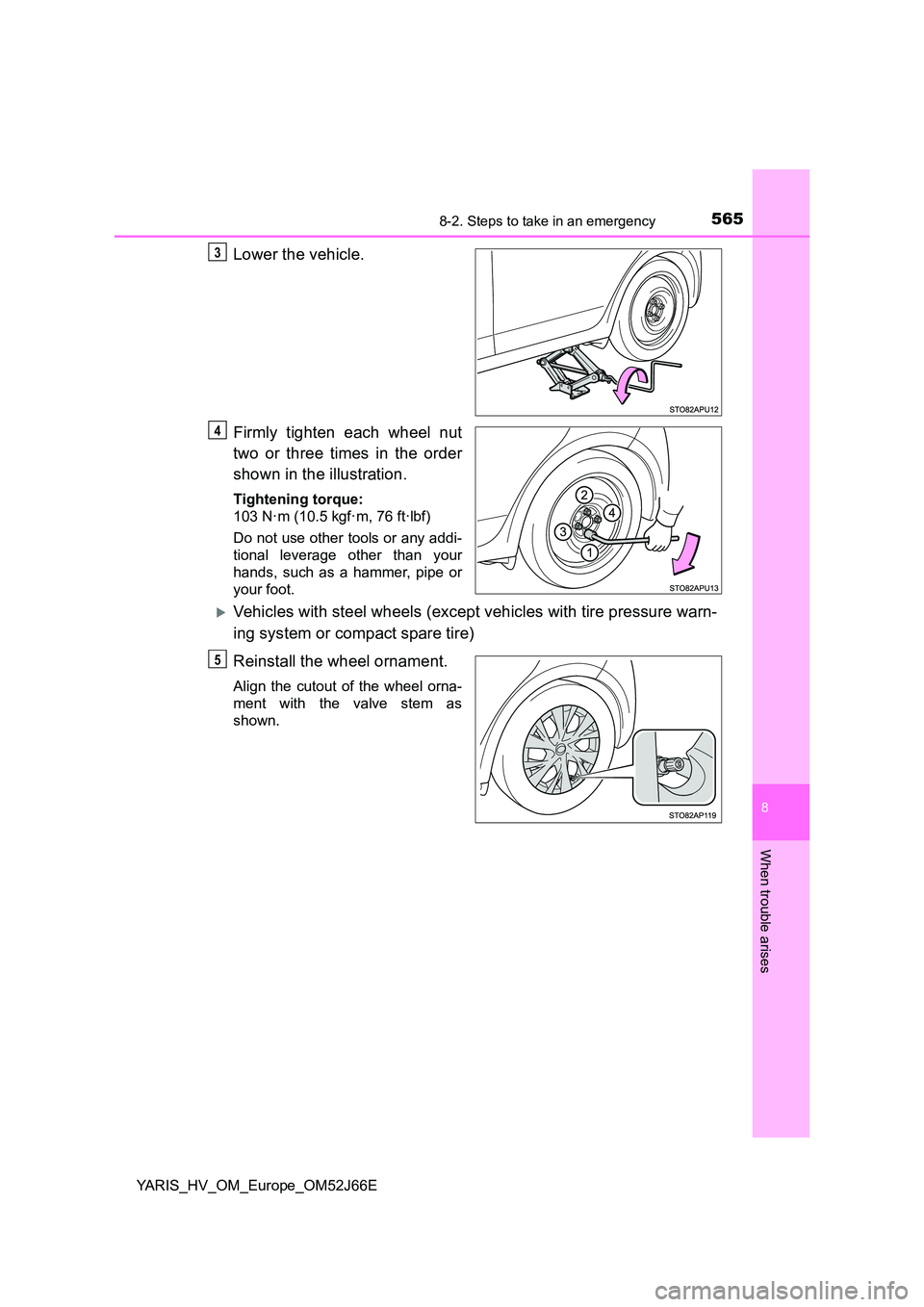
Lower the vehicle.
Firmly tighten each wheel nut
two or three times in the order
shown in the illustration.
Tightening torque:
103 N·m (10.5 kgf·m, 76 ft·lbf)
Do not use other tools or any addi-
tional leverage other than your
hands, such as a hammer, pipe or
your foot.
Vehicles with steel wheels (except vehicles with tire pressure warn-
ing system or compact spare tire)
Reinstall the wheel ornament.
Align the cutout of the wheel orna-
ment with the valve stem as
shown.
3
4
5
Page 566 of 632
5668-2. Steps to take in an emergency
YARIS_HV_OM_Europe_OM52J66E
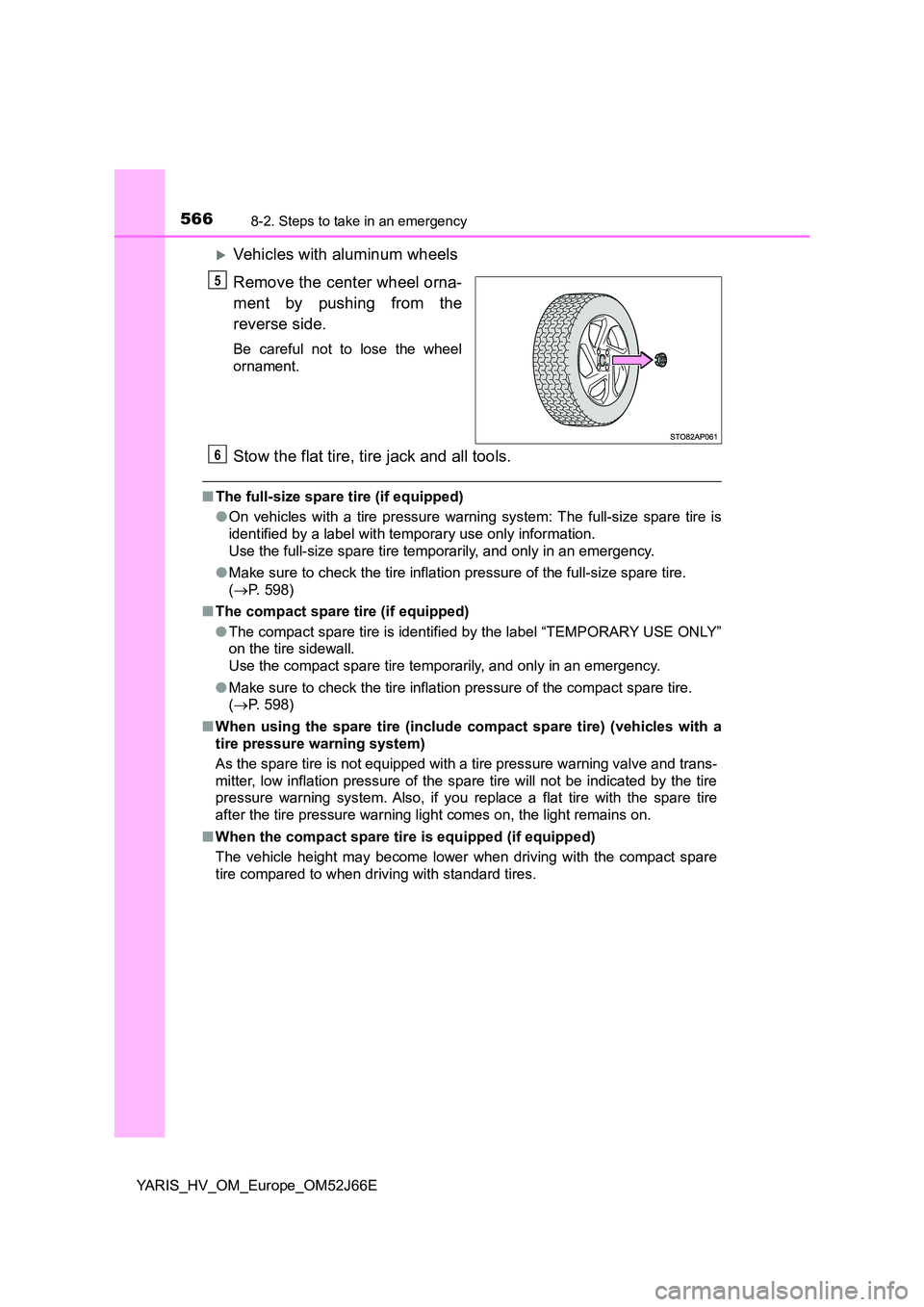
Vehicles with aluminum wheels
Remove the center wheel orna-
ment by pushing from the
reverse side.
Be careful not to lose the wheel
ornament.
Stow the flat tire, tire jack and all tools.
■ The full-size spare tire (if equipped)
● On vehicles with a tire pressure warning system: The full-size spare tire is
identified by a label with temporary use only information.
Use the full-size spare tire temporarily, and only in an emergency.
● Make sure to check the tire inflation pressure of the full-size spare tire.
( P. 598)
■ The compact spare tire (if equipped)
● The compact spare tire is identified by the label “TEMPORARY USE ONLY”
on the tire sidewall.
Use the compact spare tire temporarily, and only in an emergency.
● Make sure to check the tire inflation pressure of the compact spare tire.
( P. 598)
■ When using the spare tire (include compact spare tire) (vehicles with a
tire pressure warning system)
As the spare tire is not equipped with a tire pressure warning valve and trans-
mitter, low inflation pressure of the spare tire will not be indicated by the tire
pressure warning system. Also, if you replace a flat tire with the spare tire
after the tire pressure warning light comes on, the light remains on.
■ When the compact spare tire is equipped (if equipped)
The vehicle height may become lower when driving with the compact spare
tire compared to when driving with standard tires.
5
6
Page 569 of 632
5698-2. Steps to take in an emergency
8
When trouble arises
YARIS_HV_OM_Europe_OM52J66E
WARNING
■When using the full-size spare tire (if equipped)
● On vehicles with a tire pressure warning system: Replace the full-size
spare tire with a standard tire as soon as possible.
● Avoid sudden acceleration, abrupt steering, sudden braking and shifting
operations that cause sudden engine braking.
■ When using the compact spare tire (if equipped)
● Remember that the compact spare tire provided is specifically designed
for use with your vehicle. Do not use your compact spare tire on another
vehicle.
● Do not use more than one compact spare tire simultaneously.
● Replace the compact spare tire with a standard tire as soon as possible.
● Avoid sudden acceleration, abrupt steering, sudden braking and shifting
operations that cause sudden engine braking.
■ When storing the spare tire (if equipped)
Be careful not to catch fingers or other body parts between the spare tire
and the body of the vehicle.
■ After using the tools and jack
Before driving, make sure all the tools and jack are securely in place in their
storage location to reduce the possibility of personal injury during a collision
or sudden braking.
■ When the compact spare tire is attached (if equipped)
The vehicle speed may not be correctly detected, and the following systems
may not operate correctly:
■ Speed limit when using the compact spare tire (if equipped)
Do not drive at speeds in excess of 80 km/h (50 mph) when a compact
spare tire is installed on the vehicle.
The compact spare tire is not designed for driving at high speeds. Failure to
observe this precaution may lead to an accident causing death or serious
injury.
• ABS & Brake assist
• VSC
•TRC
• EPS
• Automatic High Beam*
*: If equipped
• PCS (Pre-Crash Safety system)*
• LDA (Lane Departure Alert)*
• Cruise control*
• Navigation system*
Page 570 of 632
5708-2. Steps to take in an emergency
YARIS_HV_OM_Europe_OM52J66E
NOTICE
■Do not drive the vehicle with a flat tire
Do not continue driving with a flat tire.
Driving even a short distance with a flat tire can damage the tire and the
wheel beyond repair.
■ Be careful when driving over bumps with the compact spare tire
installed on the vehicle (if equipped)
The vehicle becomes lower when driving with the compact spare tire com-
pared to when driving with standard tires. Be careful when driving over
uneven road surfaces.
■ Driving with tire chains and the compact spare tire (if equipped)
Do not fit tire chains to the compact spare tire.
Tire chains may damage the vehicle body and adversely affect driving per-
formance.
■ When replacing the tires (vehicles with a tire pressure warning system)
When removing or fitting the wheels, tire s or the tire pressure warning valve
and transmitter, contact any authorized Toyota retailer or Toyota authorized
repairer, or any reliable repairer as the tire pressure warning valve and
transmitter may be damaged if not handled correctly.
■ To avoid damage to the tire pressure warning valves and transmitters
(if equipped)
When a tire is repaired with liquid sealants, the tire pressure warning valve
and transmitter may not operate properly. If a liquid sealant is used, contact
any authorized Toyota retailer or Toyota authorized repairer, or any reliable
repairer or other qualified service shop as soon as possible.
Make sure to replace the tire pres sure warning valve and transmitter when
replacing the tire. ( P. 453)
Page 585 of 632
5858-2. Steps to take in an emergency
8
When trouble arises
YARIS_HV_OM_Europe_OM52J66E
Start the hybrid system and check for the hybrid system overheat
warning light (with monochrome display) or warning message
(with color display).
If the warning light (with monochrome display) or warning mes-
sage (with color display) does not go off:
Stop the hybrid system and contact any authorized Toyota
retailer or Toyota authorized repairer, or any reliable repairer.
If the warning light (with monochrome display) or warning mes-
sage (with color display) goes off:
Have the vehicle inspected at the nearest any authorized Toyota
retailer or Toyota authorized repairer, or any reliable repairer.
WARNING
■ To prevent an accident or injury when inspecting under the hood of
your vehicle
● If steam is seen coming from under the hood, do not open the hood until
the steam has subsided. The engine compartment may be very hot, caus-
ing serious injuries such as burns.
● After the hybrid system has been turned off, check that the indicator on the
power switch and the “READY” indicator are off.
When the hybrid system is operating, the gasoline engine may automati-
cally start, or the cooling fans may suddenly operate even if the gasoline
engine stops. Do not touch or approach rotating parts such as the fan,
which may lead to fingers or clothing (especially a tie, a scarf or a muffler)
getting caught, resulting in serious injury.
● Do not loosen the coolant reservoir cap while the hybrid system and radia-
tor are hot.
Serious injuries, such as burns, may result from hot coolant and steam
released under pressure.
6
Page 598 of 632
5989-1. Specifications
YARIS_HV_OM_Europe_OM52J66E
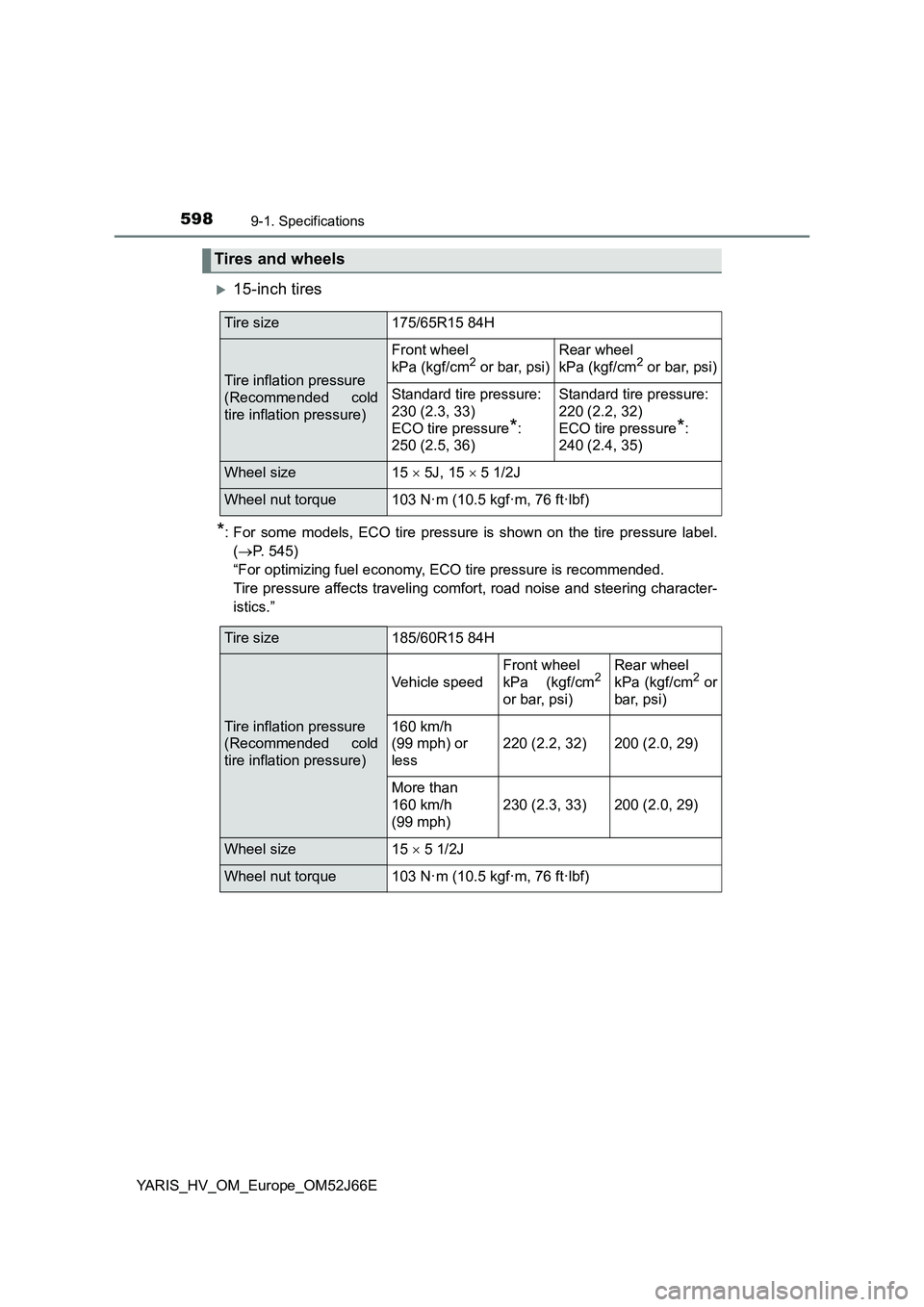
15-inch tires
*: For some models, ECO tire pressure is shown on the tire pressure label.
( P. 545)
“For optimizing fuel economy, ECO tire pressure is recommended.
Tire pressure affects traveling comfort, road noise and steering character-
istics.”
Tires and wheels
Tire size175/65R15 84H
Tire inflation pressure
(Recommended cold
tire inflation pressure)
Front wheel
kPa (kgf/cm2 or bar, psi)
Rear wheel
kPa (kgf/cm2 or bar, psi)
Standard tire pressure:
230 (2.3, 33)
ECO tire pressure*:
250 (2.5, 36)
Standard tire pressure:
220 (2.2, 32)
ECO tire pressure*:
240 (2.4, 35)
Wheel size15 5J, 15 5 1/2J
Wheel nut torque103 N·m (10.5 kgf·m, 76 ft·lbf)
Tire size185/60R15 84H
Tire inflation pressure
(Recommended cold
tire inflation pressure)
Vehicle speed
Front wheel
kPa (kgf/cm2
or bar, psi)
Rear wheel
kPa (kgf/cm2 or
bar, psi)
160 km/h
(99 mph) or
less
220 (2.2, 32)200 (2.0, 29)
More than
160 km/h
(99 mph)
230 (2.3, 33)200 (2.0, 29)
Wheel size15 5 1/2J
Wheel nut torque103 N·m (10.5 kgf·m, 76 ft·lbf)
Page 599 of 632
5999-1. Specifications
9
Vehicle specifications
YARIS_HV_OM_Europe_OM52J66E
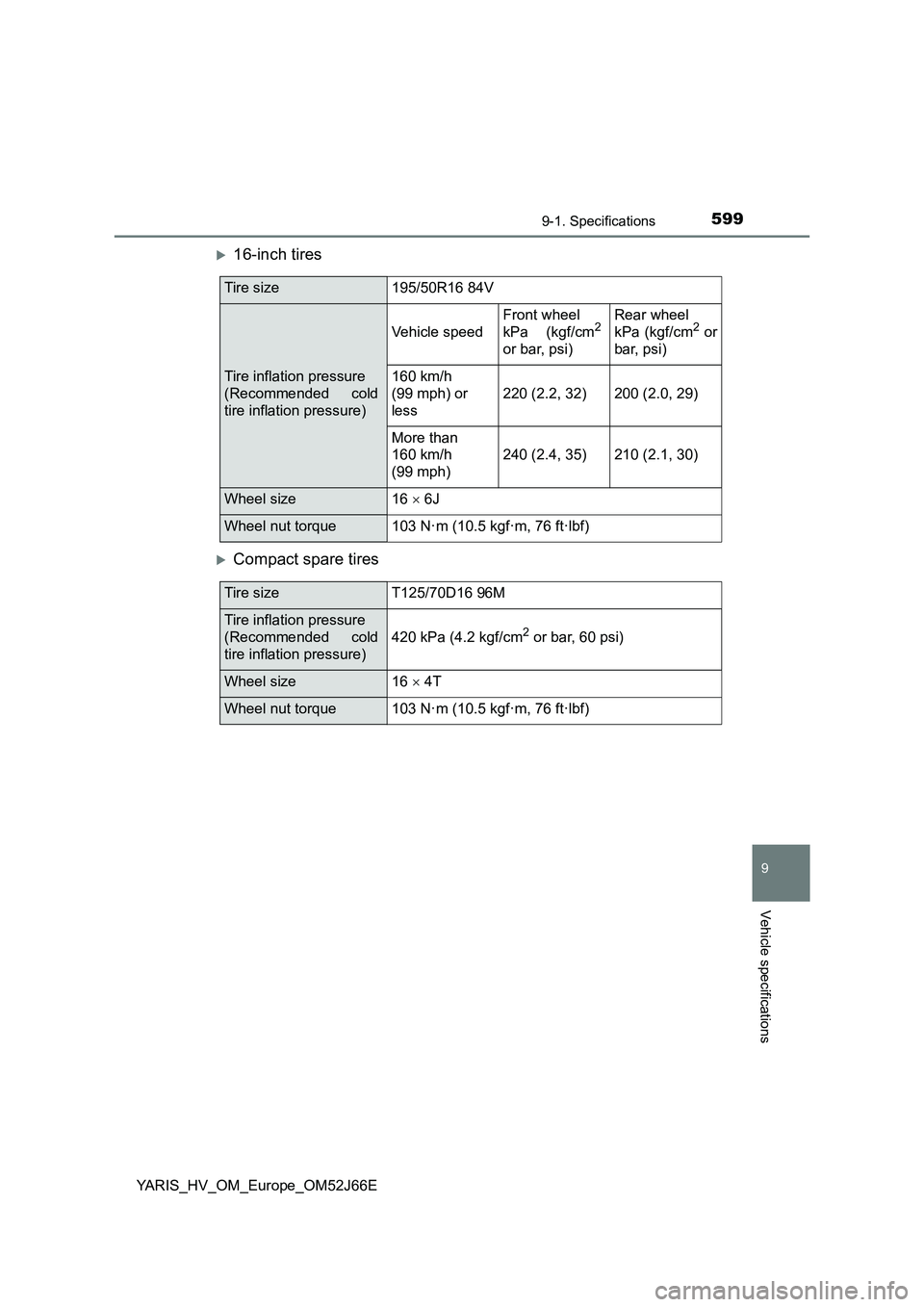
16-inch tires
Compact spare tires
Tire size195/50R16 84V
Tire inflation pressure
(Recommended cold
tire inflation pressure)
Vehicle speed
Front wheel
kPa (kgf/cm2
or bar, psi)
Rear wheel
kPa (kgf/cm2 or
bar, psi)
160 km/h
(99 mph) or
less
220 (2.2, 32)200 (2.0, 29)
More than
160 km/h
(99 mph)
240 (2.4, 35)210 (2.1, 30)
Wheel size16 6J
Wheel nut torque103 N·m (10.5 kgf·m, 76 ft·lbf)
Tire sizeT125/70D16 96M
Tire inflation pressure
(Recommended cold
tire inflation pressure)
420 kPa (4.2 kgf/cm2 or bar, 60 psi)
Wheel size16 4T
Wheel nut torque103 N·m (10.5 kgf·m, 76 ft·lbf)