child seat TOYOTA YARIS 2020 Owners Manual (in English)
[x] Cancel search | Manufacturer: TOYOTA, Model Year: 2020, Model line: YARIS, Model: TOYOTA YARIS 2020Pages: 572, PDF Size: 7.94 MB
Page 1 of 572
YARIS_YARIS HATCHBACK_OM_OM99V59z_(U)
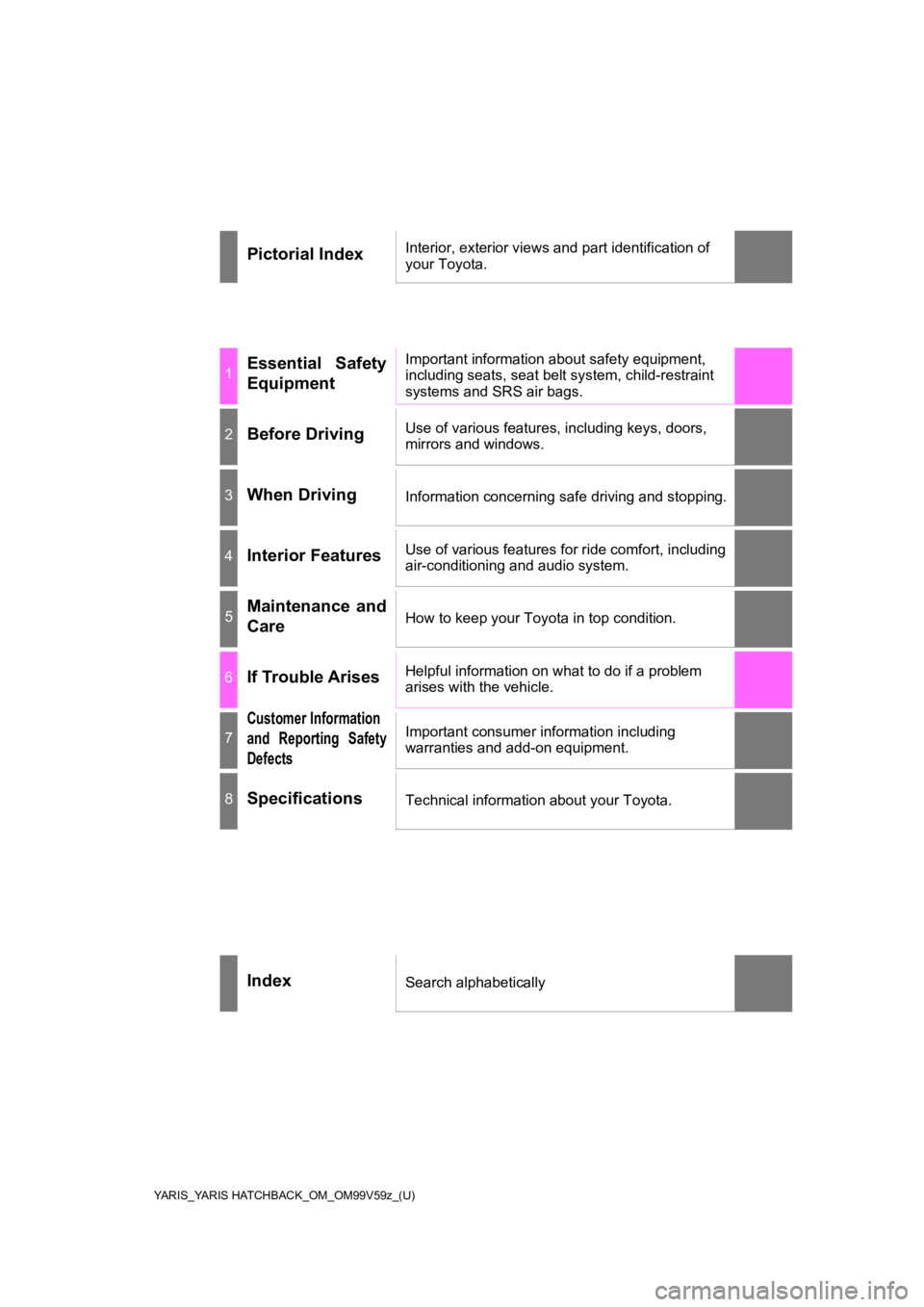
Pictorial IndexInterior, exterior views and part identification of
your Toyota.
1Essential Safety
EquipmentImportant information about safety equipment,
including seats, seat belt system, child-restraint
systems and SRS air bags.
2Before DrivingUse of various features, including keys, doors,
mirrors and windows.
3When DrivingInformation concerning safe driving and stopping.
4Interior FeaturesUse of various features for ride comfort, including
air-conditioning and audio system.
5Maintenance and
CareHow to keep your Toyota in top condition.
6If Trouble ArisesHelpful information on what to do if a problem
arises with the vehicle.
7
Customer Information
and Reporting Safety
DefectsImportant consumer information including
warranties and add-on equipment.
8SpecificationsTechnical information about your Toyota.
IndexSearch alphabetically
Page 2 of 572
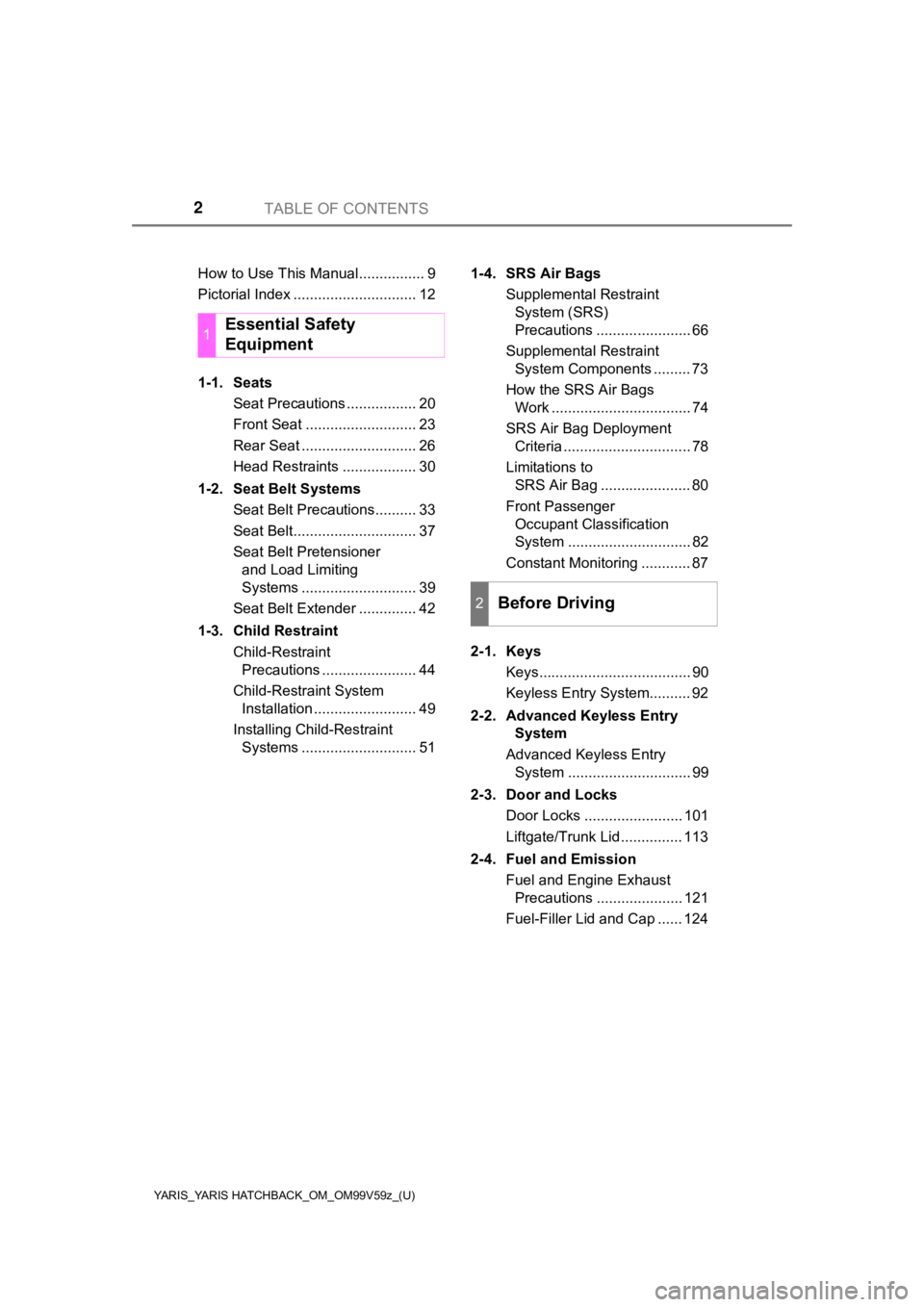
TABLE OF CONTENTS2
YARIS_YARIS HATCHBACK_OM_OM99V59z_(U)
How to Use This Manual................ 9
Pictorial Index .............................. 12
1-1. SeatsSeat Precautions ................. 20
Front Seat ........................... 23
Rear Seat ............................ 26
Head Restraints .................. 30
1-2. Seat Belt Systems Seat Belt Precautions.......... 33
Seat Belt.............................. 37
Seat Belt Pretensioner and Load Limiting
Systems ............................ 39
Seat Belt Extender .............. 42
1-3. Child Restraint Child-Restraint Precautions ....................... 44
Child-Restraint System Installation ......................... 49
Installing Child-Restraint Systems ............................ 51 1-4. SRS Air Bags
Supplemental Restraint System (SRS)
Precautions ....................... 66
Supplemental Restraint System Components ......... 73
How the SRS Air Bags Work .................................. 74
SRS Air Bag Deployment Criteria ............................... 78
Limitations to SRS Air Bag ...................... 80
Front Passenger Occupant Classification
System .............................. 82
Constant Monitoring ............ 87
2-1. Keys Keys..................................... 90
Keyless Entry System.......... 92
2-2. Advanced Keyless Entry System
Advanced Keyless Entry System .............................. 99
2-3. Door and Locks Door Locks ........................ 101
Liftgate/Trunk Lid ............... 113
2-4. Fuel and Emission Fuel and Engine Exhaust Precautions ..................... 121
Fuel-Filler Lid and Cap ...... 124
1Essential Safety
Equipment
2Before Driving
Page 19 of 572
19
YARIS_YARIS HATCHBACK_OM_OM99V59z_(U)
Essential SafetyEquipment1
1-1. Seats
Seat Precautions ................. 20
Front Seat ........................... 23
Rear Seat ............................ 26
Head Restraints .................. 30
1-2. Seat Belt Systems Seat Belt Precautions ......... 33
Seat Belt ............................. 37
Seat Belt Pretensioner and Load Limiting
Systems ............................ 39
Seat Belt Extender .............. 42 1-3. Child Restraint
Child-Restraint Precautions ....................... 44
Child-Restraint System Installation......................... 49
Installing Child-Restraint Systems ............................ 51
1-4. SRS Air Bags Supplemental Restraint System (SRS)
Precautions ....................... 66
Supplemental Restraint System Components ........ 73
How the SRS Air Bags Work ................................. 74
SRS Air Bag Deployment Criteria .............................. 78
Limitations to SRS Air Bag...................... 80
Front Passenger Occupant Classification
System .............................. 82
Constant Monitoring ............ 87
Page 20 of 572
20
YARIS_YARIS HATCHBACK_OM_OM99V59z_(U)
1-1. Seats
Seat Precautions
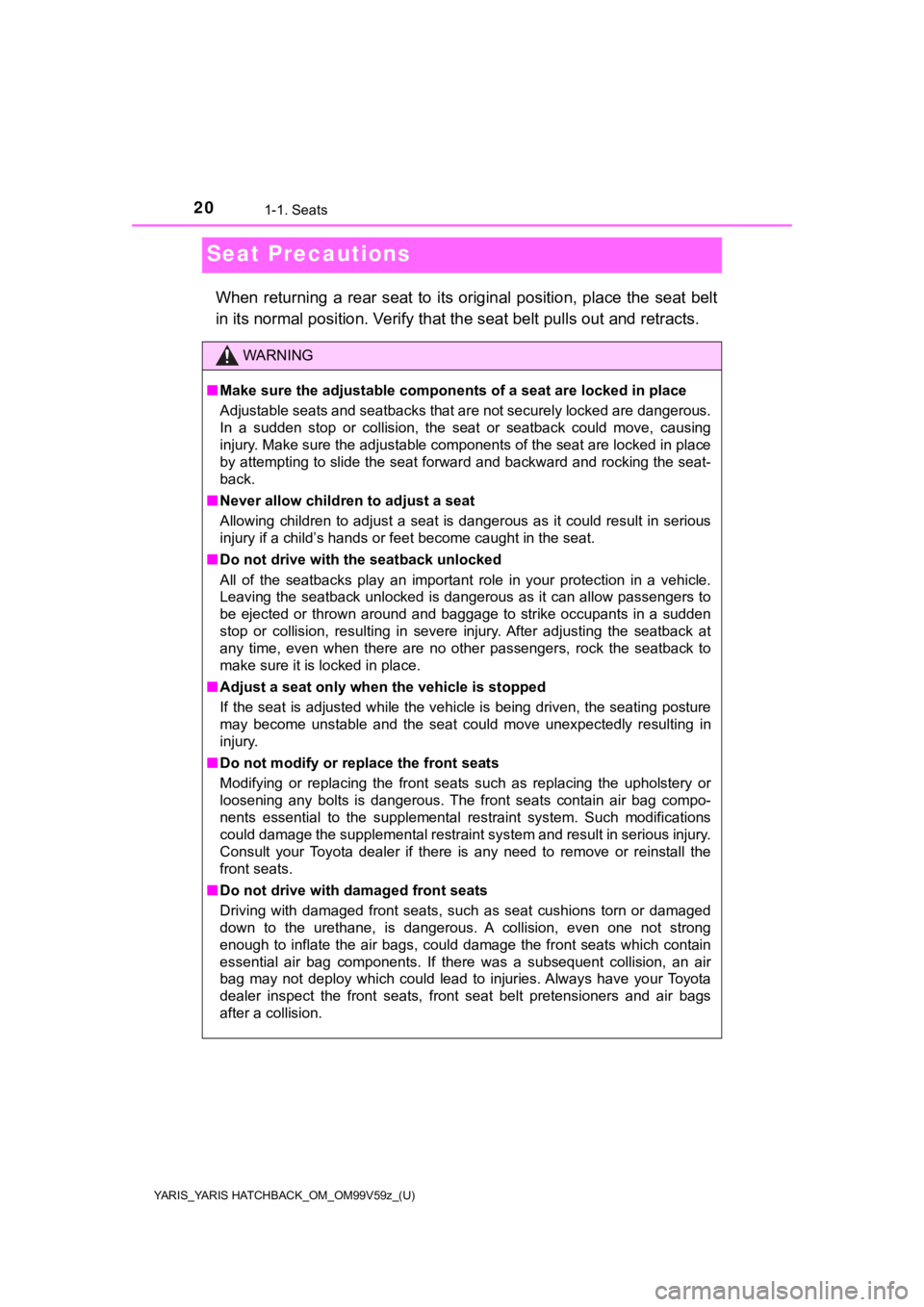
When returning a rear seat to its original position, place the seat belt
in its normal position. Verify t hat the seat belt pulls out and retracts.
WARNING
■Make sure the adjustable components of a seat are locked in place
Adjustable seats and seatbacks that are not securely locked are dangerous.
In a sudden stop or collision, the seat or seatback could move, causing
injury. Make sure the adjustable components of the seat are loc ked in place
by attempting to slide the seat forward and backward and rocking the seat-
back.
■ Never allow children to adjust a seat
Allowing children to adjust a seat is dangerous as it could res ult in serious
injury if a child’s hands or feet become caught in the seat.
■ Do not drive with t he seatback unlocked
All of the seatbacks play an important role in your protection in a vehicle.
Leaving the seatback unlocked is dangerous as it can allow passengers to
be ejected or thrown around and baggage to strike occupants in a sudden
stop or collision, resulting in severe injury. After adjusting the seatback at
any time, even when there are no other passengers, rock the seatback to
make sure it is locked in place.
■ Adjust a seat only when the vehicle is stopped
If the seat is adjusted while the vehicle is being driven, the seating posture
may become unstable and the seat could move unexpectedly result ing in
injury.
■ Do not modify or replace the front seats
Modifying or replacing the front seats such as replacing the up holstery or
loosening any bolts is dangerous. The front seats contain air b ag compo-
nents essential to the supplemental restraint system. Such modi fications
could damage the supplemental restraint system and result in serious injury.
Consult your Toyota dealer if there is any need to remove or re install the
front seats.
■ Do not drive with d amaged front seats
Driving with damaged front seats, such as seat cushions torn or damaged
down to the urethane, is dangerous. A collision, even one not strong
enough to inflate the air bags, could damage the front seats wh ich contain
essential air bag components. If there was a subsequent collision, an air
bag may not deploy which could lead to injuries. Always have yo ur Toyota
dealer inspect the front seats, front seat belt pretensioners a nd air bags
after a collision.
Page 21 of 572
YARIS_YARIS HATCHBACK_OM_OM99V59z_(U)
211-1. Seats
1
Essential Safety Equipment
WARNING
■Do not drive with either front seats reclined
Sitting in a reclined position while the vehicle is moving is d angerous
because you do not get the full protection from seat belts. During sudden
braking or a collision, you can slide under the lap belt and su ffer serious
injuries. For maximum protection, sit well back and upright.
■ Do not place an object such as a cushion between the seatback a nd
your back
Putting an object such as a cushion between the seatback and yo ur back is
dangerous because you will be unable to maintain a safe driving posture
and the seat belt cannot function at its full capacity in a collision, which
could result in a serious accident, injury or death.
■ Do not place objects under the seat
The object could get stuck and cause the seat to not be fixed s ecurely, and
result in an accident.
■ Do not stack cargo hig her than the seatbacks
Stacking luggage or other cargo higher than the seatbacks is da ngerous.
During sudden braking or a collision, objects can fly around an d become
projectiles that may hit and injure passengers.
■ Make sure luggage and cargo is secured before driving
Not securing cargo while driving is dangerous as it could move or be
crushed during sudden braking or a collision and cause injury.
■ Never allow a passenger to sit o r stand on the folded seatback while
the vehicle is moving
Driving with a passenger on the folded seatback is dangerous. A llowing a
child to sit up on the folded seatback while the vehicle is mov ing is particu-
larly dangerous. In a sudden stop or even a minor collision, a child not in a
proper seat or child-restraint system and seat belt could be th rown forward,
back or even out of the vehicle resulting in serious injuries o r death. The
child in the baggage area could be thrown into other occupants and cause
serious injury.
■ Never give the car keys to children and do not allow them to pl ay in the
vehicle
Playing with the folding rear seats is dangerous. Once the seat backs are
back up, a child in the trunk would not be able to get out the way they had
entered. If you have small children, keep the seatbacks locked.
Page 22 of 572
22
YARIS_YARIS HATCHBACK_OM_OM99V59z_(U)
1-1. Seats
WARNING
■Always leave your car locked and keep the car keys safely away from
children
Leaving your car unlocked or the keys in reach of children is d angerous.
Children who find their way into the trunk through an unlocked rear seat-
back or an open trunk can become accidentally locked in the tru nk. This
could result in death or brain damage from heat prostration, pa rticularly in
the summer. Always lock the doors and the trunk, and as an added mea-
sure, keep the rear seatbacks locked, whether you have children in your
home or not.
■ When operating a seat
● When operating a seat, be careful not to put your hands or fingers near the
moving parts of the seat or on the side trim to prevent injury.
● When moving the seats forward and rearward or returning a rear-reclined
seatback to its upright position, make sure you hold onto the seatback with
your hand while operating. If the seatback is not held, the sea t will move
suddenly and could cause injury.
● When inserting your hand under the seat to clean the cabin or p ick up
something you dropped under the seat, be careful not to hurt yo urself. If
you contact the moving parts of the seat rail or seat frame, it could result in
injury.
NOTICE
When moving the seats, make sure there is no cargo in the surrounding
area. If the cargo gets caught it could damage the cargo.
Page 26 of 572
26
YARIS_YARIS HATCHBACK_OM_OM99V59z_(U)
1-1. Seats
Rear Seat
By lowering the rear seatbacks the luggage compartment space can
be expanded.
Split Folding the Seatback
WARNING
■ Do not drive the vehicle with occupants on folded down seatbacks or
in the luggage compartment.
Putting occupants in the luggage compartment is dangerous because seat
belts cannot be fastened which could lead to serious injury or death during
sudden braking or a collision.
■ Do not allow children to play inside the vehicle with the seatb acks low-
ered.
Allowing children to play in the vehicle with the seatbacks folded down is
dangerous. If a child enters the luggage compartment and the se atbacks
were raised back up, the child may become trapped in the luggag e com-
partment which could lead to an accident.
■ Tightly secure cargo in the luggage compartment when it is tran s-
ported with the seatbacks folded down.
Driving without tightly securing cargo and luggage is dangerous as it could
move and become an obstruction to driving during emergency brak ing or a
collision resulting in an unexpected accident.
■ When transporting cargo, do not allow the cargo to exceed the height
of the seatbacks.
Transporting cargo stacked higher than the seatbacks is dangero us as visi-
bility to the rear and sides of the vehicle is reduced which could interfere
with driving operations and lead to an accident.
Page 33 of 572
33
YARIS_YARIS HATCHBACK_OM_OM99V59z_(U)
1-2. Seat Belt Systems
1
Essential Safety Equipment
Seat Belt Precautions
All of the seat belt retractors are designed to keep the lap/shoulder
belts out of the way when not in use.
The driver’s seat belt has no provisions for child-restraint sy stems and
has only an emergency locking mode . The driver may wear it comfort-
ably, and it will lock during a collision.
However, the front passenger’s seat and all rear lap/shoulder b elt
retractors operate in two modes: emergency locking mode, and fo r
child-restraint systems, automatic locking mode. While we recom -
mend you put all children in the rear seats, if you must use th e front
passenger seat for a child, slide the front passenger seat as f ar back
as possible and make sure any ch ild-restraint system is secured prop-
erly.
Seat belts help to decrease the possibility of severe injury
during accidents and sudden st ops. Toyota recommends that
the driver and all passengers always wear seat belts.
WARNING
■ Always wear your seat belt and ma ke sure all occupants are properly
restrained
Not wearing a seat belt is extremely dangerous. During a collis ion, occu-
pants not wearing seat belts could hit someone or things inside the vehicle
or even be thrown out of the vehicle. They could be seriously i njured or
even killed. In the same collision, occupants wearing seat belt s would be
much safer.
Page 36 of 572
36
YARIS_YARIS HATCHBACK_OM_OM99V59z_(U)
1-2. Seat Belt Systems
When the seat belt is fastened, it will always be in the emergency
locking mode.
In the emergency locking mode, the belt remains comfortable on the
occupant and the retractor will lock in position during a collision.
If the belt is locked and cannot be pulled out, retract the bel t once, and
then try pulling it out slowly. If this fails, pull the belt st rongly one time
and loosen, then pull it out again slowly.
Seat Belt with Autom atic Locking Mode:
When the seat belt is fastened, i t will always be in the emergency
locking mode until it is switched to automatic locking mode by pulling
it all the way out to its full length. If the belt feels tight and hinders
comfortable movement while the vehicle is stopped or in motion, it
may be in the automatic locking mode because the belt has been
pulled too far out. To return the belt to the more comfortable emer-
gency locking mode, wait until th e vehicle has stopped in a safe, level
area, retract the belt fully to c onvert it back to emergency lo cking
mode and then extend it around you again.
Always use the automatic locking mode to keep the child-restrai nt
system from shifting to an unsafe position in the event of an a ccident.
To enable seat belt automatic lo cking mode, pull it all the way out and
connect it as instructed on the child-restraint system. It will retract
down to the child-restraint system and stay locked on it. See t he sec-
tion on child restraint ( P. 44).
Emergency Locking Mode
Automatic Locking Mode (if equipped)
Page 43 of 572
YARIS_YARIS HATCHBACK_OM_OM99V59z_(U)
431-2. Seat Belt Systems
1
Essential Safety Equipment
WARNING
■Do not use an extende r that is too long
Using an extender that is too long is dangerous. The seat belt will not fit
properly. In an accident, the seat belt will not provide adequa te protection
and you could be seriously injured. Do not use the extender or choose one
shorter in length if the distance between the extender’s buckle and the cen-
ter of the user’s body is less than 6 in. (150 mm).
■ Do not leave a seat belt extende r connected to the buckle
Leaving a seat belt extender connected to the buckle without using the seat
belt is dangerous. When the seat belt extender is connected to the driver’s
seat belt buckle (or front passenger’s seat belt buckle), the S RS driver’s (or
front passenger’s) air bag system will determine that the drive r (or front pas-
senger) is wearing the seat belt even if the driver (or front p assenger) is not
wearing it. This condition could cause the driver’s (or front passenger’s) air
bag to not activate correctly and result in death or serious injury in the event
of collision. Always wear the seat belt with the seat belt exte nder.
■ Do not use the seat belt extender when installing a child-restr aint sys-
tem on the front or rear passenger seat
Using a seat belt extender to fasten a child-restraint system on any seat is
dangerous. Always follow the child-restraint system manufacture r’s installa-
tion instructions and never use a seat belt extender.