battery TOYOTA YARIS 2020 Workshop Manual
[x] Cancel search | Manufacturer: TOYOTA, Model Year: 2020, Model line: YARIS, Model: TOYOTA YARIS 2020Pages: 692, PDF Size: 68.71 MB
Page 587 of 692
5878-2. Steps to take in an emergency
8
When trouble arises
YARIS_F_OM_Europe_OM52A54E
■Passenger detection sensor and passenger seat belt reminder
● If luggage is placed on a passenger seat, the passenger detection sensor
may cause the warning light to flash even if a passenger is not sitting in the
seat.
● If a cushion is placed on the seat, the sensor may not detect a passenger,
and the warning light may not operate properly.
■ Warning light operations for unfastened rear passenger seat belts
● When opening and closing the rear door, the warning light comes on for
approximately 34 seconds.
● When any of the rear seat belts are unfastened, the warning light comes on.
When the rear doors are opened and closed while the warning light is on,
the warning light will turn off after approximately 34 seconds.
■ If the malfunction indicator lamp comes on while driving
For some models, the malfunction indicator lamp will come on if the fuel tank
becomes completely empty. If the fuel tank is empty, refuel the vehicle imme-
diately. The malfunction indicator lamp will go off after several trips.
If the malfunction indicator lamp does not go off, contact any authorized
Toyota retailer or Toyota authorized repai rer, or any reliable repairer as soon
as possible.
■ Warning buzzer
In some cases, the buzzer may not be heard because of noisy place or an
audio sound.
■ Electric power steering system warning light (warning buzzer)
When the battery charge becomes insufficient or the voltage temporarily
drops, the electric power steering system warning light may come on and the
warning buzzer may sounds.
Page 591 of 692
5918-2. Steps to take in an emergency
8
When trouble arises
YARIS_F_OM_Europe_OM52A54E
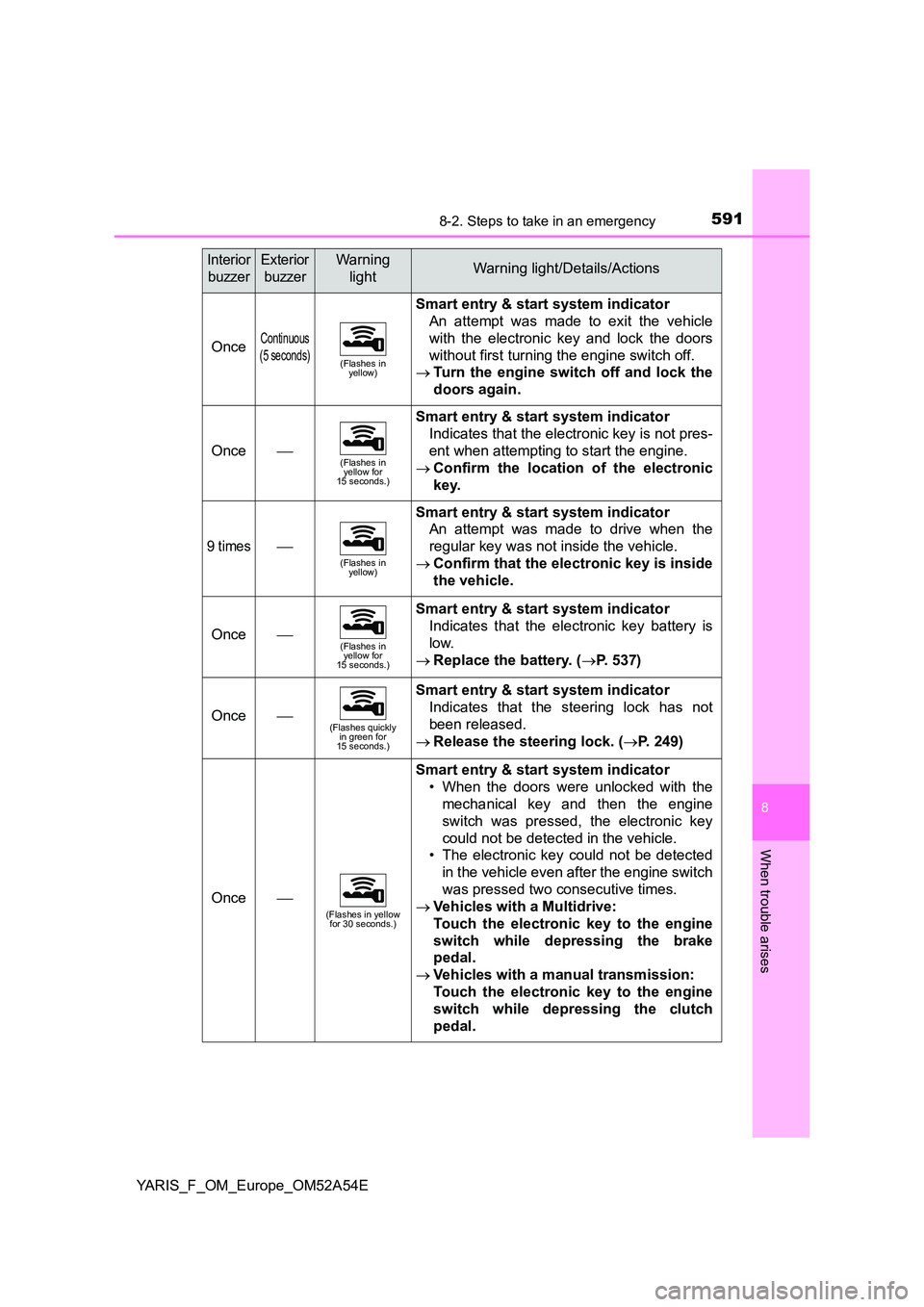
OnceContinuous
(5 seconds)(Flashes in yellow)
Smart entry & start system indicator
An attempt was made to exit the vehicle
with the electronic key and lock the doors
without first turning the engine switch off.
Turn the engine switch off and lock the
doors again.
Once(Flashes in yellow for 15 seconds.)
Smart entry & start system indicator
Indicates that the electronic key is not pres-
ent when attempting to start the engine.
Confirm the location of the electronic
key.
9 times(Flashes in yellow)
Smart entry & start system indicator
An attempt was made to drive when the
regular key was not inside the vehicle.
Confirm that the electronic key is inside
the vehicle.
Once(Flashes in yellow for 15 seconds.)
Smart entry & start system indicator
Indicates that the electronic key battery is
low.
Replace the battery. (P. 537)
Once(Flashes quickly in green for 15 seconds.)
Smart entry & start system indicator
Indicates that the steering lock has not
been released.
Release the steering lock. (P. 249)
Once(Flashes in yellow for 30 seconds.)
Smart entry & start system indicator
• When the doors were unlocked with the
mechanical key and then the engine
switch was pressed, the electronic key
could not be detected in the vehicle.
• The electronic key could not be detected
in the vehicle even after the engine switch
was pressed two consecutive times.
Vehicles with a Multidrive:
Touch the electronic key to the engine
switch while depressing the brake
pedal.
Vehicles with a manual transmission:
Touch the electronic key to the engine
switch while depressing the clutch
pedal.
Interior
buzzer
Exterior
buzzer
Warning
lightWarning light/Details/Actions
Page 629 of 692
6298-2. Steps to take in an emergency
8
When trouble arises
YARIS_F_OM_Europe_OM52A54E
If the engine will not start
One of the following may be the cause of the problem:
● There may not be sufficient fuel in the vehicle’s tank.
Refuel the vehicle.
● The engine may be flooded.
Try to restart the engine again following correct starting procedures.
( P. 241, 243)
● There may be a malfunction in the engine immobilizer system.
( P. 8 5 )
One of the following may be the cause of the problem:
● The battery may be discharged. (P. 634)
● The battery terminal connections may be loose or corroded.
The engine starting system may be malfunctioning due to an electrical
problem such as an open circuit or a blown fuse. However, an interim
measure is available to start the engine. ( P. 630)
If the engine will not start even though correct starting proce-
dures are being followed ( P. 241, 243), consider each of the fol-
lowing points:
The engine will not start even though the starter motor operates
normally.
The starter motor turns over slowly, the interior lights and head-
lights are dim, or the horn does not sound or sounds at a low
volume.
The starter motor does not turn over (vehicles with a smart entry
& start system).
Page 630 of 692
6308-2. Steps to take in an emergency
YARIS_F_OM_Europe_OM52A54E
One of the following may be the cause of the problem:
● One or both of the battery terminals may be disconnected.
● The battery may be discharged. (P. 634)
● There may be a malfunction in the steering lock system (vehicles
with a smart entry & start system).
Contact any authorized Toyota retailer or Toyota authorized repairer, or any
reliable repairer if the problem cannot be repaired, or if repair procedures
are unknown.
When the engine does not start, the following steps can be used as an
interim measure to start the engine if the engine switch is functioning
normally:
Set the parking brake.
Shift the shift lever to P (Multidrive) or N (manual transmission).
Turn the engine switch to ACCESSORY mode.
Press and hold the engine switch for about 15 seconds while
depressing the brake pedal (Multidrive) or brake pedal and clutch
pedal (manual transmission) firmly.
Even if the engine can be started using the above steps, the system
may be malfunctioning. Have the vehicle inspected by any authorized
Toyota retailer or Toyota authorized repairer, or any reliable repairer.
The starter motor does not turn over, the interior lights and head-
lights do not turn on, or the horn does not sound.
Emergency start function (vehicles with a smart entry & start
system)
1
2
3
4
Page 631 of 692
6318-2. Steps to take in an emergency
8
When trouble arises
YARIS_F_OM_Europe_OM52A54E
If the electronic key does not operate properly
(vehicles with a smart entry & start system)
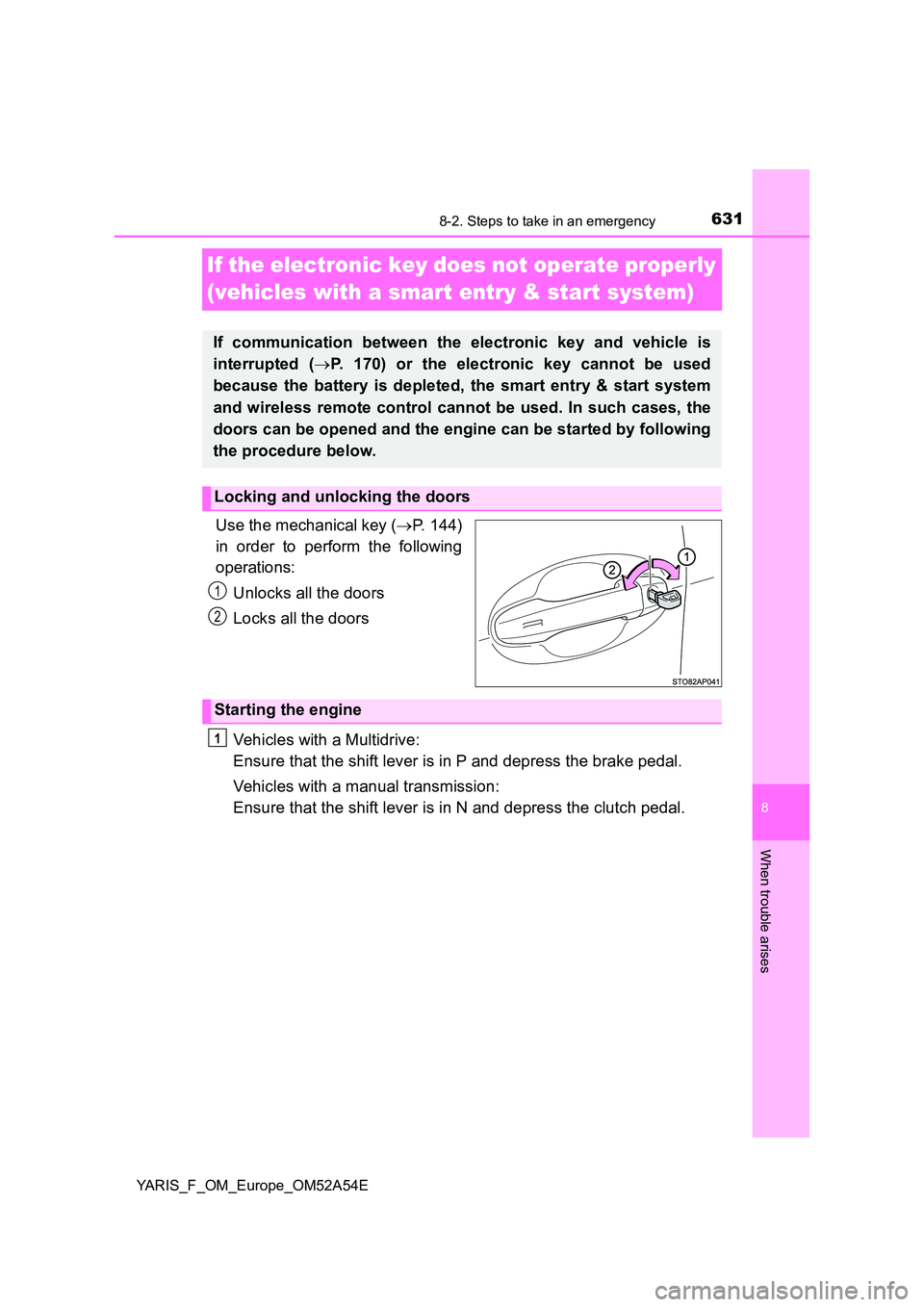
Use the mechanical key ( P. 144)
in order to perform the following
operations:
Unlocks all the doors
Locks all the doors
Vehicles with a Multidrive:
Ensure that the shift lever is in P and depress the brake pedal.
Vehicles with a manual transmission:
Ensure that the shift lever is in N and depress the clutch pedal.
If communication between the electronic key and vehicle is
interrupted ( P. 170) or the electronic key cannot be used
because the battery is depleted, the smart entry & start system
and wireless remote control cannot be used. In such cases, the
doors can be opened and the engine can be started by following
the procedure below.
Locking and unlocking the doors
1
2
Starting the engine
1
Page 633 of 692
6338-2. Steps to take in an emergency
8
When trouble arises
YARIS_F_OM_Europe_OM52A54E
■Stopping the engine
Shift the shift lever to P (Multidrive) or N (manual transmission) and press the
engine switch as you normally do when stopping the engine.
■ Replacing the key battery
As the above procedure is a temporary measure, it is recommended that the
electronic key battery be replaced immediately when the battery is depleted.
( P. 537)
■ Changing engine switch modes
Release the brake pedal (Multidrive) or clutch pedal (manual transmission)
and press the engine switch in step above.
The engine does not start and modes will be changed each time the switch is
pressed. ( P. 245)
■ When the electronic key does not work properly
● Make sure that the smart entry & start system has not been deactivated in
the customization setting. If it is off, turn the function on.
(Customizable features: P. 666)
● Check if battery-saving mode is set. If it is set, cancel the function.
( P. 170)
3
Page 634 of 692
6348-2. Steps to take in an emergency
YARIS_F_OM_Europe_OM52A54E
If the vehicle battery is discharged
If you have a set of jumper (or booster) cables and a second vehicle
with a 12-volt battery, you can jump start your vehicle by following the
steps below.
Open the hood. ( P. 491)
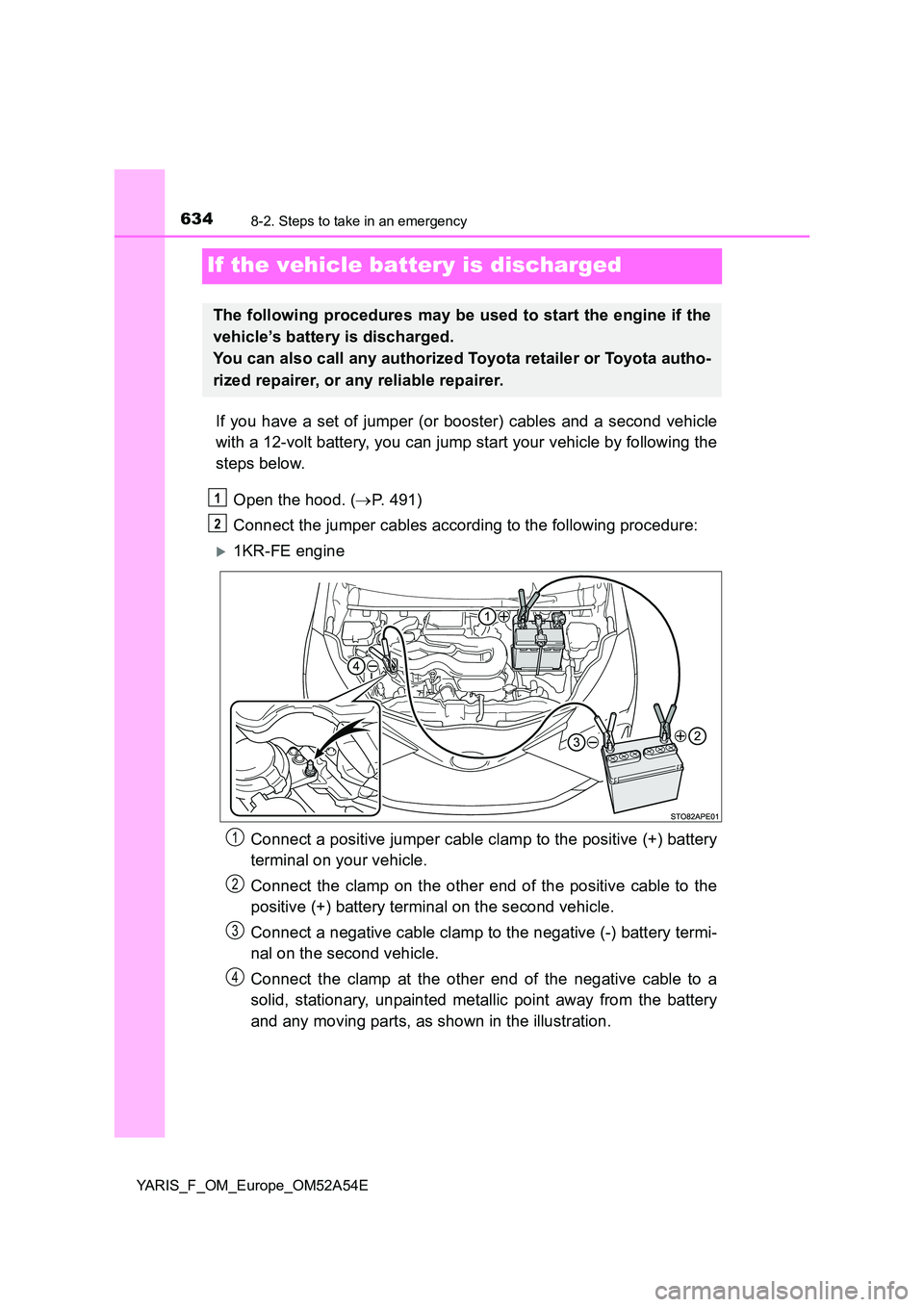
Connect the jumper cables according to the following procedure:
1KR-FE engine
Connect a positive jumper cable clamp to the positive (+) battery
terminal on your vehicle.
Connect the clamp on the other end of the positive cable to the
positive (+) battery terminal on the second vehicle.
Connect a negative cable clamp to the negative (-) battery termi-
nal on the second vehicle.
Connect the clamp at the other end of the negative cable to a
solid, stationary, unpainted metallic point away from the battery
and any moving parts, as shown in the illustration.
The following procedures may be used to start the engine if the
vehicle’s battery is discharged.
You can also call any authorized Toyota retailer or Toyota autho-
rized repairer, or any reliable repairer.
1
2
1
2
3
4
Page 635 of 692
6358-2. Steps to take in an emergency
8
When trouble arises
YARIS_F_OM_Europe_OM52A54E
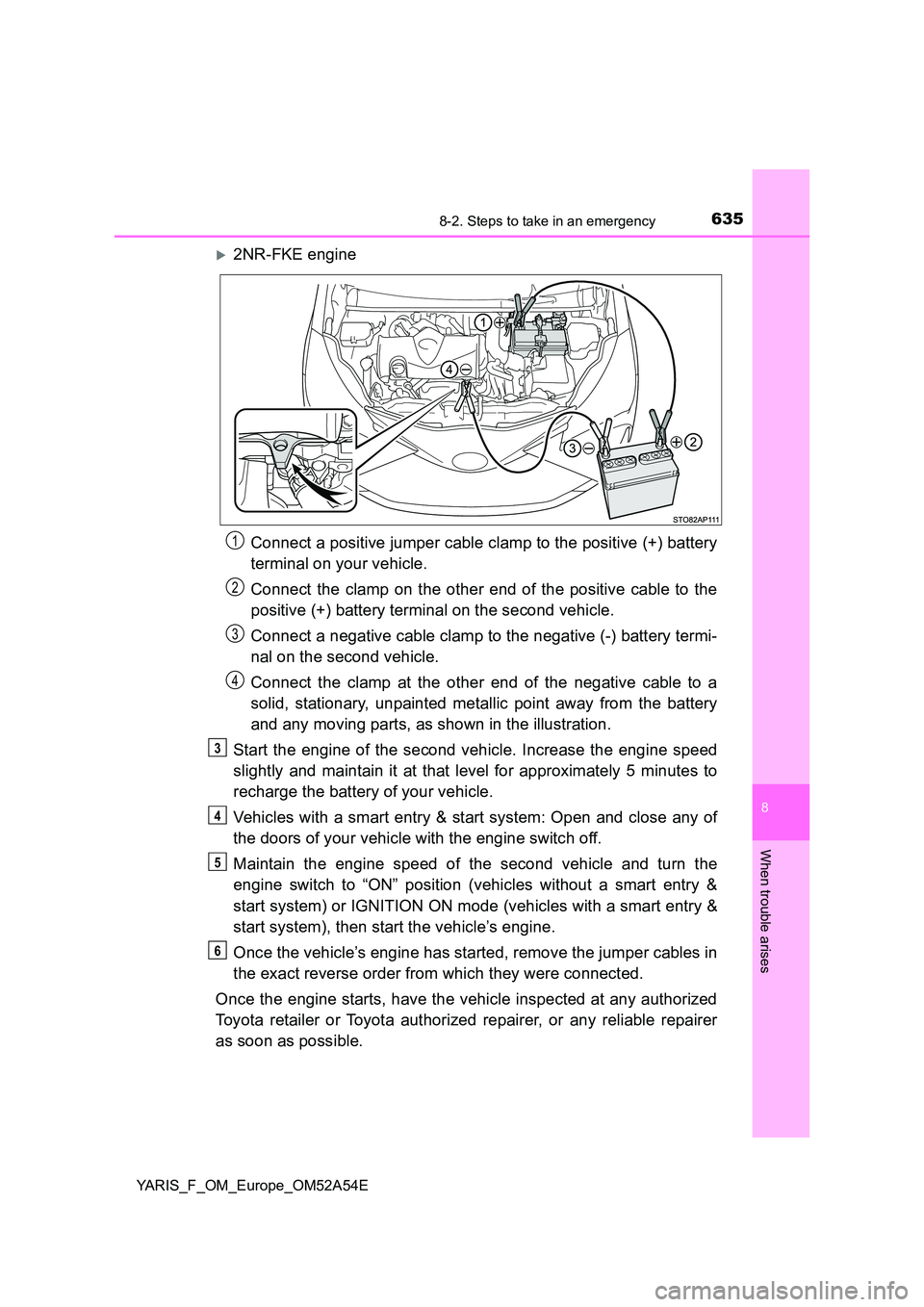
2NR-FKE engine
Connect a positive jumper cable clamp to the positive (+) battery
terminal on your vehicle.
Connect the clamp on the other end of the positive cable to the
positive (+) battery terminal on the second vehicle.
Connect a negative cable clamp to the negative (-) battery termi-
nal on the second vehicle.
Connect the clamp at the other end of the negative cable to a
solid, stationary, unpainted metallic point away from the battery
and any moving parts, as shown in the illustration.
Start the engine of the second vehicle. Increase the engine speed
slightly and maintain it at that level for approximately 5 minutes to
recharge the battery of your vehicle.
Vehicles with a smart entry & start system: Open and close any of
the doors of your vehicle with the engine switch off.
Maintain the engine speed of the second vehicle and turn the
engine switch to “ON” position (vehicles without a smart entry &
start system) or IGNITION ON mode (vehicles with a smart entry &
start system), then start the vehicle’s engine.
Once the vehicle’s engine has started, remove the jumper cables in
the exact reverse order from which they were connected.
Once the engine starts, have the vehicle inspected at any authorized
Toyota retailer or Toyota authorized repairer, or any reliable repairer
as soon as possible.
1
2
3
4
3
4
5
6
Page 636 of 692
6368-2. Steps to take in an emergency
YARIS_F_OM_Europe_OM52A54E
■Starting the engine when the battery is discharged (vehicles with a Multi-
drive)
The engine cannot be started by push-starting.
■ To prevent battery discharge
● Turn off the headlights and the audio system while the engine is stopped.
(Vehicles with a Stop & Start system: except when the engine is stopped by
the Stop & Start system.)
● Turn off any unnecessary electrical components when the vehicle is running
at a low speed for an extended period, such as in heavy traffic.
■ Charging the battery
The electricity stored in the battery will discharge gradually even when the
vehicle is not in use, due to natural discharge and the draining effects of cer-
tain electrical appliances. If the vehicle is left for a long time, the battery may
discharge, and the engine may be unable to start. (The battery recharges
automatically during driving.)
■ Precautions when the battery is discharged
● Vehicles with a smart entry & start system: In some cases, it may not be
possible to unlock the doors using the smart entry & start system when the
battery is discharged. Use the wireless remote control or the mechanical
key to lock or unlock the doors.
● Vehicles with a smart entry & start system: The engine may not start on the
first attempt after the battery has recharged but will start normally after the
second attempt. This is not a malfunction.
● Vehicles with a smart entry & start system: The engine switch mode is mem-
orized by the vehicle. When the battery is reconnected, the system will
return to the mode it was in before the battery was discharged. Before dis-
connecting the battery, turn the engine switch off.
If you are unsure what mode the engine switch was in before the battery dis-
charged, be especially careful when reconnecting the battery.
● Vehicles with Stop & Start system: For a while after the battery terminals
have been disconnected and reconnected, for a while after the battery has
been replaced, the Stop & Start system may not automatically stop the
engine for approximately 5 to 60 minutes.
Page 637 of 692
6378-2. Steps to take in an emergency
8
When trouble arises
YARIS_F_OM_Europe_OM52A54E
■ When exchanging the battery (vehicles with Stop & Start system)
Use a genuine battery specifically designed for use with the Stop & Start sys-
tem or a battery with equivalent specifications to a genuine battery. If an
unsupported battery is used, Stop & Start system functions may be restricted
to protect the battery. Also, battery performance may decrease and the
engine may not be able to restart. Contact any authorized Toyota retailers or
Toyota authorized repairers, or any reliable repairers for details.
■ When replacing the battery
● Use a battery that conforms to European regulations.
● Use a battery that the case size is same as the previous one, 20 hour rate
capacity (20HR) is equivalent or greater, and performance rating (CCA) is
equivalent or greater.
Check the label on top of the battery for the battery size and specifications
(ex. LN2, 60Ah, 520A).
• If the sizes differ, the battery cannot be properly secured.
• If the 20 hour rate capacity is low, even if the time period where the vehi-
cle is not used is a short time, the battery may discharge and the engine
may not be able to start.
● For details, consult any authorized Toyota retailers or Toyota authorized
repairers, or any reliable repairers.